



Abstract
BACKGROUND:
Lean philosophy is used by companies to increase productivity and reduce costs. Although uncontested benefits are created, it is necessary to highlight the problems related to employees’ health and welfare caused by implementing lean manufacturing projects.
OBJECTIVE:
The primary objective of this paper is to review the literature and identify the most relevant problems created by lean philosophy for employees.
METHODS:
Research about the theme was performed on many international databases over three months, and an initial sample of 77 papers was found. Twenty-seven sources were utilized.
RESULTS:
We identified 22 categories of problems related to health and welfare of employees.
CONCLUSIONS:
The most cited problem was work intensification, mentioned by thirteen papers. Increased stress and increased responsibilities, demands and, consequently, pressure on the workers are among the primary problems observed in the research.
Introduction
Productivity is the central point that determines the level of a company’s prosperity [1, 2]. Thus, the intense competition observed in the last few decades has made companies search for more efficient ways to operate [3, 4]. Productivity, quality and low costs of production have been highlighted as differentials and are now necessary requirements to remain competitive in the market [5, 6].
It is in this context of competition and necessity of cost reduction, increase of productivity and quality improvement that lean manufacturing stands out [7]. It first appeared in Toyota Production System in the 70’s, but became well known with the publication of the book “The machine that changed the world” [8–10]. The concepts of this philosophy, as stated by Ohno [11] and Womack et al. [12], are based on continuous improvement of a production’s flow, production controlled by client demand, flexibility, waste elimination, zero defects, visual management, a safe and orderly work environment and quality defined according to the client’s vision. There are five phases of academic studies about lean production.
The first phase, the discovery phase, between 1970 and 1990, was when the book “The machine that changed the world” was published. The phase of principle dissemination, from 1991 to 1996, was when the automotive industry implemented lean, and it gave more cases for literature to study the relations between workers and companies. The implementation phase, from 1997 to 2000, was when companies were trying to implement lean correctly, and, at the same time, the negative impacts of lean techniques on workers were shown in literature. The enterprise phase, between 2001 and 2005, was the stage during which companies were developing knowledge and implementing lean in other areas besides the shop floor. The performance phase, from 2006 onward, is the stage of performance analysis and improving the application of lean, which, due to Toyota’s success, became a relevant issue [13].
In all these phases, problems relating to the implementation of lean were reported, due to this, even though good correlation had been shown, many critical points related to this philosophy’s implementation need to be investigated, for example, problems relating to the health and well-being of employees linked to lean’s execution. Authors such as Leslie and Butz [14] and Genaidy and Karwowski [15] highlighted problems such as job intensification, little control from workers over the production process, increased work related injuries, responsibilities, demands and, consequently, pressure on workers. De Haan et al. [16], Moyano-Fuentes and Díaz [17] and Hasle et al. [18] highlighted the increase in employees’ stress and the deterioration of the workers’ quality of life. Which is considered an significant injury due to its adverse affects [19].
The current importance of lean philosophy is comparable to the importance of mass production in the twentieth century [20]. Lean raises an organization’s competitiveness and it has already been applied in many sectors [20, 21]. According to Pampanelli et al. [22], peoples involvement is essential to lean.
As Rodrígues et al. [23], Cullinane et al. [24] and Ramnath et al. [25] pointed out, there are previous studies that have indicated that lean has positive effects on employees. However, the negative effects are highlighted by many papers [24, 26–28]. As precariousness of labor conditions [24], increased worker fatigue [24, 28], lack of worker autonomy [28], increased worker stress [26] and repetitive work [26].
Gnanavel et al. [29], discussing Cellular Manufacturing Systems within lean production, point out that “some workstations within the cell demand more physical and cognitive load which are not ergonomically safe for the workers and there was a bias in the assignment of work to workers”.
This context justifies academic research related to employees’ health and welfare because a great imbalance between this topic and productivity should not be allowed. Every action must be developed considering the interests of all parts, business owners and employees. Therefore, the main objective of this paper is perform a wide literature review to identify the most important negative elements related to workers’ health and welfare caused by implementing lean manufacturing projects.
An important guide to this research was the International Ergonomics Association’s definition of ergonomics. According to International Ergonomics Association [30], there are three domains in ergonomics: physical, cognitive and organizational. The first one is related to the physical aspects, for example, work related musculoskeletal disorders, safety and health. Cognitive ergonomics, as the name suggests, is concerned about the mental aspects, such as the workers’ stress caused by their jobs. Organizational ergonomics is related to work design, teamwork and other aspects linked to the processes, structures and policies of the organization. Bearing this in mind, the present article focused on finding problems related to issues in occupational ergonomics that can affect their health and welfare.
Thereby, the question that drives the research can be formalized: What are the main problems related to the health and welfare of employees caused by implementing lean philosophy projects highlighted in specific literature? Three specific targets came out: Analyze the relevant literature, aiming at finding research about problems related to the health and welfare of employees caused by the implementation of lean philosophy. Organize a bibliometric analysis, creating strata and making evident the most relevant problems in each phase. Establish conclusions about the results according to the problem type, the number of citations and the publication year.
Literature review
Lean production principles
Lean production is composed of a series of principles developed over five decades by Toyota’s employees [8]. Following these principles is a necessary condition, but not sufficient, for successful application of the lean approach in a company [11, 12].
Waste elimination is the main goal of the lean philosophy according to Eroglu and Hofer [31] and Karim and Arif-Uz-Zaman [6] because it is an effective way to diminish costs and, consequently, increase productivity without layoffs. There are eight types of wastes listed by Liker [32], adapted and expanded from Ohno [11]: overproduction, waiting (time without working), defects, inventory, material handling, processing waste, motion waste and waste of employees’ creativity.
The five principles of lean, according to Womack and Jones [33], Lowry [34], Yang et al. [35] and Karim and Arif-Uz-Zaman [6], determine the production’s central points: a) value defined by the client and made by the company; b) value stream (itinerary followed by a product, from the conception to the final product); c) flow (a production with no buffer); d) demand pull production (this enables inventory reduction); e) performance and perfection (to work properly, the system needs an incessant concern with the correct way to use the techniques and with the work’s result, constantly searching for improvements).
For inventory reduction, the philosophy of just in time has to be emphasized, characterized by Ohno [11] as one of the pillars of lean. To be just in time the production should follow the specifications, that is, in the right moment, the right place and the right quantity, and one of the principal consequences is significant reduction of stocks [35, 36]. Regarding suppliers, Jayaram et al. [37] emphasize that deliveries have to be performed in a synchronized way with the real necessity of production and, for this, Kanban’s techniques can be used. Kanban puts just in time in action, that is, it is a service’s command that informs a specific part of the productive process what this part must do [3, 38].
Another pillar highlighted by Ohno [11] in lean’s philosophy is automation, giving human intelligence to machines. Through this principle, the employees of a production’s line or production’s cell can halt operations as soon as an anomaly is detected, thus preventing a problem from spreading [35]. Ohno [11] highlighted that each employee can be responsible for many machines at the same time.
Kaizen and Kaikaku are essential philosophies inside lean manufacturing projects, meaning continuous improvement and radical improvement, respectively [12]. As Forno et al. [20] argue, both are very important for uninterrupted improving. As Melton [39] summarizes, the first step for all improvements is the implementation of the 5Ss program (seiri, seiton, seiso, seiketsu and shitsuke), according to which any activity should be classified, organized, cleaned, standardized and continuously improved.
Fast changeovers have an essential role in lean’s philosophy because they reduce machine setups and allow different product models to be made within a cell or line of production [35, 40]. Shingo [41] denominated this tool as the Single Minute Exchange of Dies (SMED), believing that every company should search for setups of less than ten minutes; achieving this goal has many benefits, as explained by Fogliato and Fagundes [42] and Benjamin et al. [43].
The method of problem resolution developed by Toyota and used by lean’s philosophy at the present moment is characterized by asking “why?” five times, intending to find the real reason for a problem. If the true cause of the problem is not found, no solution will be effective [11, 44]. At present, the process of problem solving from automakers is the Toyota Business Practice (TBP), which reports the steps to be followed to solve a problem [44].
In lean’s philosophy, the rhythm of all production is determined by takt-time, allowing synchrony between production and demand, according to Ohno [11], Rother and Shook [45] and Liker and Ogden [44]. Transparency or visual control, in turn, has the goal of making visible to everybody the production situation, and for this, it uses the Andon technique as an indication sign [11, 44].
In relation to the efficiency results of applying lean manufacturing in companies, many researchers have noted a positive correlation between implementing lean and business performance, as is the case for the broad research performed by Losonci and Demeter [46]. In this research, significant impacts were observed arising from implementing lean manufacturing in inventory turnover, quality, production times, worker productivity, use of spaces, volume flexibility, mix and costs. The extended bibliography review published by Hofer et al. [47] and the proposals of Anvari et al. [48] highlight the positive impacts of lean on a company’s financial performance, especially on reducing operational costs. Additionally, Yang et al. [35] classified the results obtained from companies that use the system as “huge benefits.”
The relationship with suppliers in lean is different from that observed in Fordism because it is based on trust and commitment with the just in time philosophy. As Womack and Jones [33] and Myerson [49] argue, the priority is long-term relationships and there is a preoccupation with partner’s profitability. According to Dyer and Nobeoka [50], Womack et al. [12] and Liker and Ogden [44], the suppliers are encouraged to participate in all processes to quickly understand the aims of the main company.
At the same time that lean increases productivity due to multi-skilled workers and allowing the increased engagement of employees, this production philosophy promote job security as organizations are more inclined to keep their qualified personnel, compared to the less qualified ones [11, 12]. There is constant incentive for cooperation among workers and establish a trusting relationship between supervisors and subordinates.
However, an important point is multi-skilled workers. As Coriat [51] and Humphrey [52] argue, this has advantages and disadvantages. It can provide productivity gains for the company, but it can also create some problems related to worker health and welfare, for example, increased job intensity, reduced worker control over production and more pressure on employees. The detailed study of these problems approached by the literature is the primary aim of this paper and will be addressed with more detail in the results section.
Method
A literature review about the theme was performed on many international databases over three months, and an initial sample of 77 papers was found. Twenty-seven sources were utilized, among them, journals such as International Journal of Operations & Production Management, Studies in Political Economy, Politics & Society and the Journal of Development Studies stands out. The databases used have credibility in the academic environment and their articles are broadly referenced by others researchers.
The research’s aim was to find problems associated with the health and welfare of employees observed when implementing lean projects. The search terms used were “lean production problems,” “lean worker health,” “lean pressure,” “lean stress,” “lean labor,” and “lean labor problems”. All of the papers selected contained the term ‘lean’ or an equivalent term, such as Toyota Production System.
Among the 77 selected papers, 43 had as a primary subject problems related to employees’ health and welfare resulting from the implementation of lean philosophy by companies, and these were considered for the analyses. The 34 papers rejected did not fit with the research objectives.
A detailed analysis of each of the 43 articles was completed over two months, identifying problems in thirty different categories. To increase objectivity and accuracy, some related categories were combined, reducing the total to 22 strata. This reduction was made based on the similarities among the strata, for example, the strata “Dismissal of workers that does not fit into the needs” and “High turnover rates” were included in the category “Layoffs”. Deletions were made after consulting experts in lean processes and ergonomics, in order to not remove any significant stratum.
It is important to emphasize that these categories are not related to a perfect lean implementation. They are problems that have been observed in companies that are implementing lean and have been published specially in international journals. The implementation of lean production is not implied in these problems, but misinterpretations and failure implementations can lead to one or more of these problems.
Another relevant aspect to emphasize is that the categories developed in this study are not necessarily problems of health and safety, but they can turn into problems, hence, they are called problems associated with health and welfare. For example, work intensification is not a health problem, however, it is associated with health problems, because it can degrade workers’ health. To investigate the existence of a possible correlation between the publication years and the problems stated in the analyzed papers, a cross reference between the publication years and the indicated problems were made, as visualized in the Table 2. This was done to verify if there are any signs that indicates specific links between some lean phase and a problem or a group of problems.
Results
Results presentation
From the analysis of the first 77 articles selected, it was noted that 34 of them did not fit into the research objective. Many of them did not mention health problems with workers in a lean company. In some of them, the company did not use lean as the production philosophy or the article did not mention any problems related to workers health and welfare.
The forty-three selected papers, from scientific databases, were organized into 22 types of problems related to the health and welfare of employees. The first column of the following table named “Group” categorizes the problems into four different groups (A, B, C and D), that will be explained in the next section.
From the twenty-two categories problems studied, a quantitative evaluation was made, identifying the number of papers that mention each problem. Figure 1 shows the relationship between problems and the quantity of papers that mention them.
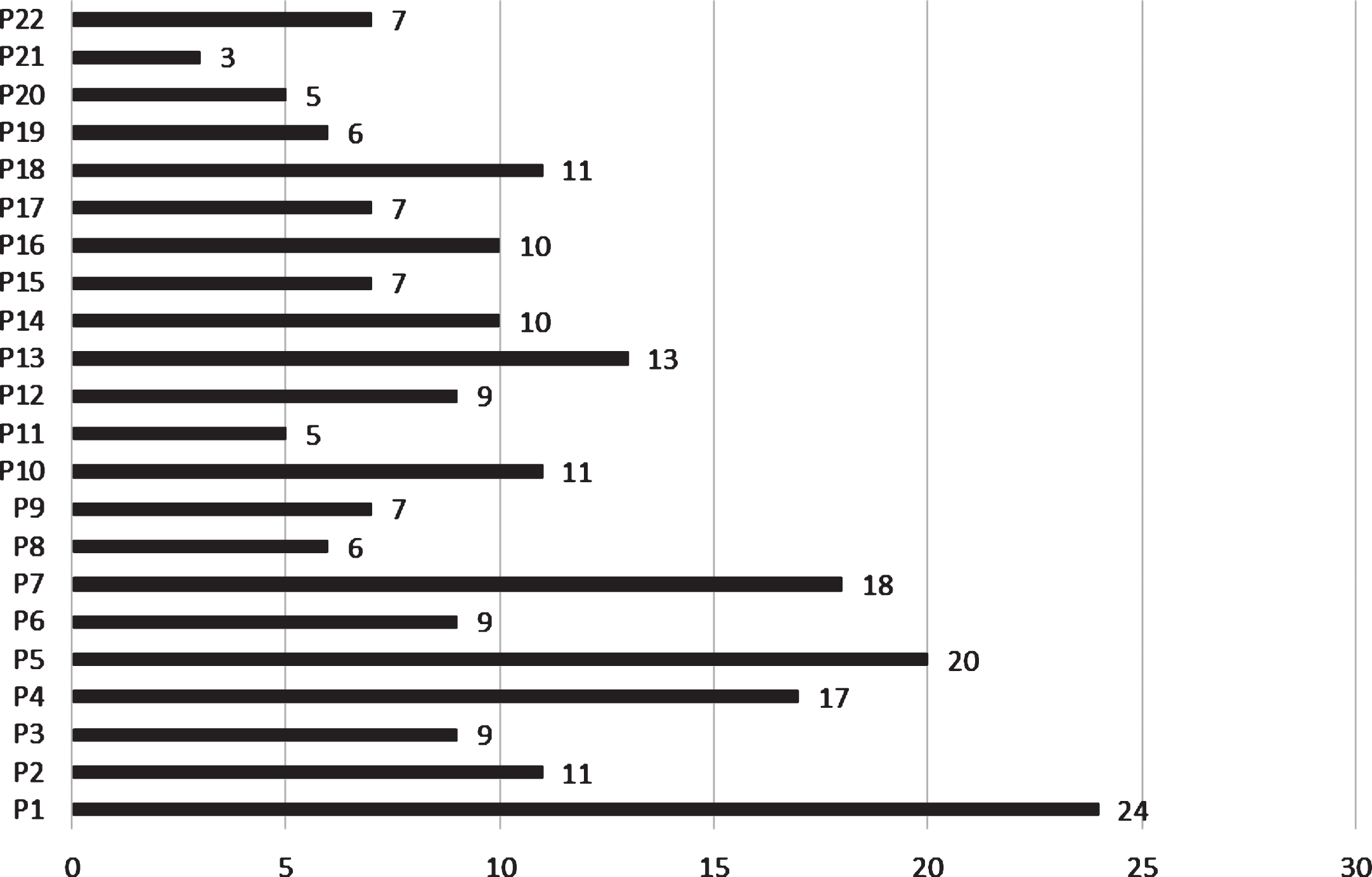
Quantity of paper that mention each problem, as shown in Table 2. Source: elaborated by the authors.
Another interesting analysis corresponds to the relationship between the total number of problems arising from implementing lean projects and the publication’s year to identify whether the problems have been decreasing over the decades. The total number of papers published each year were clustered at each stage of the philosophy’s studies developed by Stone [13], according to his five phases of lean production academic studies: the discovery phase (1970–1990); the phase of principle dissemination (1991–1996); the implementation phase (1997–2000); the enterprise phase (2001–2005); and the performance phase (2006 and onward). Table 2 classifies each paper according to the publication year and the phases above.
Main problems related to the health and welfare of employees
The 22 problems identified in the literature were divided into four categories: the first category (A) is composed of the negative impositions for workers. This category includes the problems: P1, P2, P6, P7, P12, P16, P17.
The problem addressed by the largest number of papers is the intensification of work (P1) [14–16, 53–68]. Additionally, the reduced worker control over production (P2) [14, 70] makes them more dependent and less motivated. Moreover, with little control over job rhythm, an intensified routine is expected. Heloani [71] denotes it as the transfer of “living labor” to “dead labor,” in which the productive system becomes increasingly independent of a worker’s decisions, inhibiting their creativity and their power of decision making and thus their motivation. Working with these issues in lean manufacturing projects became essential in the search for better results from implementing this philosophy.
Regarding the increased number of tasks (P6) [9, 14, 73], including inspection and maintenance, these papers indicate that these extra duties do not make a multi-skilled worker because they are simple variations of similar jobs, requiring little training. Rather than seek an “enrichment” of the work through extra activities that motivate and develop workers’ skills, what exists instead is the “enlargement” of activities through tasks that only consume more time and do not develop necessary abilities.
In relation to the lack of planning, the increased responsibilities and requirements without previous planning (P7) [14, 72] creates greater pressure on the workers because they have to be concerned about the quality of what is being produced and also with their colleagues’ performance without having the necessary maturity. If the increased responsibilities are accompanied by planning activities and a constant performance analysis of activities, this increase can be good for both the company and for the employees, but unfortunately this is observed in only a few lean manufacturing projects. Another important item is long working hours imposed on workers.
With employees’ framework smaller than firms that operate with another production system and without buffer stocks, lean companies use overtime as a way to adjust production to demand (P12) [26, 74]. The reported problems related to overtime are arbitrary schedules, excessive overtime, warnings given at short notice and coercion – through payment – to avoid denial. Among the negative consequences of long working hours are the health and family problems for workers [75]. Besides overtime, the precariousness of labor conditions is another problem faced by workers.
Temporary workers, part-time employees, outsourcing [66, 73], subcontracting, downsizing, and reduction of the internal labor market and employment growth mediated by the market [66] determine the precariousness of labor conditions (P16) [17, 77] (that is, the long-term is not a priority for the growth of an employee within the company; when a worker is needed, the organization resorts to the labor market). All of these create an uncomfortable and insecure environment for workers. For Parker and Slaughter (1988), the essence of multi-skilling is actually the absence of resistance, from a union or from individual workers, for labor changes for any reason [72]. However, this precariousness is not the only work degradation that threatens employees.
The repetitive jobs at a lean plant are also criticized (P17) [17, 77]. The continuous reduction of non–value added tasks and the cycle time reductions are among factors that increase repetitive work (P17).
The second category (B) is about the negative consequences on workers’ health. This group includes: P3, P4, P5, P14, P21.
Some problems may be considered as a consequence of increased intensity of work, which include increased stress (P5) [9, 72], increased fatigue (P3) [14, 64] and increased worker injuries, especially musculoskeletal disorder (MSD), (P4) [9, 14, 78]. MSD is due to working in strained and awkward positions for long periods [26].
And this condition contributes to a deterioration of the workers’ quality of life (P14) [15–18, 79], which is reported by many authors. The negative effects go beyond that of the already cited increased stress, fatigue and injuries. Depression (P21), for example, is highlighted in some papers [18, 62] as one of the consequences of this deterioration. Employees’ welfare is reduced in and out of work.
The increased number of tasks to be performed and the increased worker responsibilities also contribute to a more intense job. Therefore, in lean manufacturing projects it is necessary to quantify the maximum acceptable limit related to job rhythm to simultaneously obtain good productivity indexes and maintain workers’ health and welfare. Moreover, Dejours [80] highlights that an intensive job can contaminate a worker outside of his work environment.
“The intensive work also defiles the man out of the workplace because there is no form to separate the man in two parts titled work time and free time [..] in today’s terms, the employee takes to his home the hectic pace of production [... ] who have never seen the mad traffic after leaving a workday. Working time and free time continuum [become] hardly separable.”
The third group of problems (C) is associated with the negative consequences on workers behavior. The problems P8, P10, P18 and P19 are in this category.
Moreover, harsh criticisms are made by workers about the lack of autonomy at work (P10) [9, 65], because there is little freedom to make decisions, employees are less motivated to learn [65]. The growing fear of making complaints (P8) [14, 74] leads the worker not to oppose negative changes in their working conditions. The concern of becoming unemployed, especially during periods of low economic growth, leaves workers without alternatives. Complaints about injuries and pains are also avoided and lead to probable future losses of working days. Because the work takes place in teams, the absence of an employee overloads the activities of the others.
Lean teams share responsibilities among their members and, consequently, there are increased conflicts inside teams (P18) [18, 81]. Teamwork means that there is a greater intensification of work due to pressure from colleagues [62]. This pressure also maintains “work and attendance standards” [64]. In this context, it is increasingly difficult for workers to believe in the benefits of lean.
The resistance, disbelief and deception of workers about lean (P19) [53, 81–83] affect the performance of the system. There are three distinct situations: the first is related to experienced employees leaving their comfort zones to allow the implementation of a new system; the second situation is the lack of trust from workers that do not believe in the necessity of changes neither the durability of them (both are based on their past experiences); and the last one is the deception of those who believed in the announced improvements and realized that, for some reason(s), these advances have not occurred and will not happen (workers are encouraged to believe that, working in a lean company, they will satisfy their necessities of creation and control, but their expectations are not reached [82]).
The last group (D) is characterized by the structural problems, they are: P9, P11, P13, P15, P20, P22.
In lean companies, low salaries are received mainly by peripheral workers and paid by subcontractors (P11) [56, 77]. The jobs offered by large companies may have more stability and remuneration for their workers, but small enterprises pay low salaries, do not have stability for their employees and provide little or no social benefits [56]. It is argued that the salary should be higher because the intensity of the work increases [67]. However, improved salaries would require more powerful unions.
With weakened union power, workers have less chance to make claims (P15) [56, 72]. According to Humphrey [59], companies which use lean practices “have a strong interest in minimising or controlling the activities of unions in their plants”. The enterprise unionism is, according to some authors, a decisive tool for lean’s success because this organization is not independent, that is, the workers’ interests are replaced by the focus on cooperation with the company as the union’s priority [64]. In addition, unions are unable to regulate the internal labor market of companies. With this, the workers are dependent on the goodwill of the manager throughout their careers to decide on their progress. This individualized treatment creates strong competition among workers. With this, class solidarity is destroyed [56]. Another obstacle for both company and worker is the culture.
The difficulty of lean’s diffusion from Japan to other countries (P9) [15, 84] is given, first, to cultural differences. Toyota has developed this method of production in very specific conditions that were important to their success. An example of this is life-long employment, which allowed the cooperation of employees in a satisfactory manner. The difficulty for other companies, especially from other countries, to understand the lean approach undermines their success. The incorrect deployment of the Toyota Production System may create ergonomic injuries that could be avoided. An example of it is that, contrary to what is highlighted in literature, workers at a lean company stated that their health and safety had been prejudiced due to an intensification of work demand followed by a reduction of stimulation for good job performance [15]. Managers have part of the responsibility for it.
Main problems associated with employees’ health and welfare caused by implementing lean projects. (Sources: authors mentioned in the table itself)
Main problems associated with employees’ health and welfare caused by implementing lean projects. (Sources: authors mentioned in the table itself)
Classification according to the year of publication and the phases. (Source: elaborated by the authors based on Stone, 2012)
The inefficiency of managers to implement lean and manage an organization that uses it compromises the results (P13) [16, 81]. This inefficiency is especially related to the use of only a group of lean practices aiming to benefit the company at the expense of workers [67]. The impact of lean techniques on employees will depend a lot on managers’ choices [16, 70]. Especially choices related to the degree of lean implementation.
The limited application of lean’s techniques is not accepted well by employees. Trust and cooperation is important to reach success, especially with practices, such as kaizen and work teams, which require more autonomy and freedom for workers [57]. Jackson and Mullarkey [70], comparing lean production to traditional systems, conclude that equilibrium between the positive and negative effects of lean largely depends on the way that managers and supervisors interact with employees (cited on paper [16]). That is, lean production needs to be well implemented and managed to have a good balance between positive and negative effects.
Assembly line employees are significantly more affected by the negative effects of lean (P20) [24, 65]. The work on the assembly line is rigidly limited and inclined to raise the velocity and is the job archetype of low quality and high strain. People who are repeatedly confronted with stressful situations in which they have little control to solve problems are less motivated to learn and their skills can atrophy [65]. According to Parker’s [62] research, the work features have worsened for all groups of lean. The assembly line employees had the worst results, with the greatest reduction in labor autonomy, decreased use of skills, and decreased participation in decision making [62].
Besides that, with the increased productivity allowed by lean and the utilization of multi-skilled workers, the number of employees needed is reduced and layoffs are a perverse system consequence (P22) [14, 76]. The elimination of inspection and maintenance jobs is an example; these tasks are performed by the assembly line workers [56, 72]. Another group for layoffs is staff that does not suit the lean philosophy: this system requires young and healthy people, with an unlimited capacity to work. Those who do not fit this system are always subject to unemployment and injuries [14]. The use of kaizen as a synonym for job elimination by shop floor employees is a good illustration of the interpretation made by them about this tool [63]. The elimination of jobs through kaizen is also cited by article [64].
Based on the divisions proposed by Stone [76], the following problems were identified in the first phase: P1, P5, P6, P7, P8, P9, P11, P12, P15, P18 and P22. Just one publication [56] was found in this period and this paper started the debate about problems related to employee health and welfare associated with implementing lean philosophy.
The second phase has a larger number of papers. From the seven papers published in this period [53, 59, 84], the increased responsibilities, increased demands and, consequently, increased pressures on the workers (P7) are present in five of them. Moreover, problems P1, P2, P4, P15 also stood out here.
In the third phase, the problems P5 and P7 stand out, as each was cited by four articles [14, 72]. In the papers of this period, the frequency of the dysfunctions analyzed is lower than in the previous period.
The fourth phase also has a lowered frequency compared to the previous period. Most of the problems in this phase were cited by two articles ([15] and [62] cited P1, P2, P7 and P14, [62] and [28] cited P5 and P6, [15] and [28] cited P9). The other problems were cited just once.
In the fifth and last phase, the most cited problem was work intensification (P1). It was cited by fourteen articles [16, 68]; nine papers [16, 81] reported the inefficiency of managers (P13); and ten articles [9, 65] discuss increased worker stress (P5). Because of sample limitation and the different number of papers in each phase, statements with statistic rigor can not be made, but it is possible to deduce there are more problems in the second phase and the last phase.
Conclusions
Taking into account the current level of competitiveness among companies [4, 85] and considering that production systems used by organizations, as well as the impacts of these systems on workers, determines a company’s trajectory, this paper aimed at analyzing the problems associated with the health and welfare of employees caused by implementing lean philosophy.
Forty-three papers were analyzed, and the twenty-two most relevant problems were cataloged. From this catalog, a table was created to show the problems along with a brief description of each one. Besides that, the problems were divided into four different groups, according to their affinities.
Thus, the question proposed initially can be answered. With lean implementation, the main problems identified were related to intensification of work (P1) [14–16, 53–68], increased stress (P5) [9, 72], increased responsibilities and requirements without previous planning (P7) [14, 72], increased worker injuries (P4) [9, 78], and inefficient managers (P13) [16, 81]. These findings are important to show the relevance of taking attitudes to minimize the impacts created by these problems.
An important injury addressed in the literature is work-related musculoskeletal disorder (WMSD or just MSD) [68], which links P4 with P17, because P17 is about the cause of MSD and P4 is a consequence of it. Besides, injuries being a problem for companies, they are a significant expenditure source for governments too [86].
Analyzing the main problems identified in the literature, it can be seen that to be lean, a company must plan well, before implementing it. Firstly, preparing managers to make them able to deal with lean techniques and support workers. When a company implements lean, it must not only prepare its workers, but continuously improve the relationship between employees and their work.
It is essential to implement the whole concept of lean, and not just to take advantage of what is good for the company. For example, when lean is correctly implemented, a multi-skilled worker does job rotation among tasks that add value to the product [12, 87]. Although it can intensify the work, if it is well planned and the necessary support is given, problems such as stress and injuries can be minimized. Actually, proper job rotation can minimize the risk of an MSD, for example.
The importance of this paper is credited to the survey about pertinent issues strategically important for the success of organizations that have lean philosophy as their production system because, considering the key role of workers on production in general, the situations triggered by negative impacts highlighted in this paper might ruin the company’s results. Moreover, this paper characterizes an excellent initial information basis for future research to be developed by other researchers.
Because this paper focus only on bibliographic research, its results are limited to the references used within the text. Therefore, as a complementary research, it is recommended to perform an empirical research analyzing the impacts noted in this paper.
It is important to highlight that the conclusion of this article is based on analysis with the articles referenced on Table 1. This is not a general conclusion about the lean process.
Conflict of interest
None to report.