



Abstract
BACKGROUND:
High physical exertion during work is a risk factor for back pain and long-term sickness absence.
OBJECTIVE:
To investigate which factors are associated with physical exertion during manual lifting.
METHODS:
From 14 workplaces across Denmark, 200 blue-collar workers reported perceived physical exertion (Borg-CR10) during manual lifting from floor to table height of 5, 10, 20 and 30 kg at the beginning and end of the working day. The workers also responded to a questionnaire and went through testing of isometric back muscle strength. Associations were modelled using logistic regression analysis controlled for various confounders. The outcome was dichotomized into low (0–4) and high (5–10) physical exertion.
RESULTS:
Gender (OR 8.57 [95% CI 4.46–16.46] for women), load (OR 4.22 [95% CI 3.58–4.97] for each 5-kg increase), back muscle strength (OR 0.43 [95% CI 0.23–0.83] for high), and back pain intensity (OR 2.80 [95% CI 1.43–5.48] for high) were associated with high perceived physical exertion. Age, smoking, Body Mass Index (BMI), and time of the day were not associated with physical exertion.
CONCLUSIONS:
Gender, load, back muscle strength and back pain influence physical exertion during manual lifting in blue-collar workers. These factors should be considered when planning work with manual lifting for individual workers.
Keywords
Introduction
Chronic back pain and its consequences in terms of reduced work ability and sickness absence remain a problem for individuals, workplaces and societies across Europe and the United States [1–4]. The prevalence and consequences of back pain are most pronounced among workers with high physical work demands [5]. In particular, heavy and frequent occupational lifting, which is common among blue-collar workers, is a risk factor for back pain [6]. Based on laboratory studies, lifting below knee height is particularly stressful for the back muscles [7]. While exact quantification of physical workload can be difficult in real-life situations, Takala and coworkers identified 30 observational methods used in different countries to assess physical workload [8]. Of these, eight focused on manual material handling; altogether these methods address the same known biomechanical risk factors for back pain, namely, force, duration and frequency of the task combined with body postures [8]. While being highly relevant, many of these observational methods are time-consuming and require expertise. Alternatively, high perceived physical exertion during work may be an important indicator of excessive physical workload [9].
Perceived physical exertion during manual lifting tasks can be assessed by the Borg scale [10]. In prospective workplace studies, high perceived physical exertion during the working day has shown to be predictive of development of and recovery from musculoskeletal disorders as well as long-term sickness absence [11–13]. Perceived exertion of more than 4 on the Borg CR10 scale during a full working day indicates that relatively heavy occupational loads are lifted more frequently [9]. Thus, individual perceptions of high physical exertion can be a good indicator of excessive physical workload.
Several individual factors influence the perception of perceived physical exertion during work [10]. In laboratory studies, perceived physical exertion shows a strong positive correlation with work demands relative to the physical capacity of the individual [14–18]. Thus, individuals with a high physical capacity reports lower physical exertion at the same absolute workload. In relation to heavy lifting, muscle strength of the individual worker is especially relevant. In general, men have higher levels of muscle strength than women [19]. Accordingly, Snook and Ciriello showed in a small sample of 22 industrial workers, clear differences in self-chosen lifting load between men and women when working as hard as they could without straining themselves, which together with physiological measurements led to gender-stratified tables for maximum acceptable occupational lifting limits [20]. However, a range of other individual factors may also influence the perception of perceived exertion during manual lifting.
The present study investigates in a relative large sample of blue-collar workers factors associated with high perceived physical exertion during manual lifting, performed as box lifts of 5, 10, 20 and 30 kg from floor to table height.
Methods
Recruitment and participants
Altogether, 200 blue-collar workers from 14 different companies across Denmark participated. Using the same population, we have previously published data on perceived exertion during a full working day in relation to muscle activity and heart rate [9]. Inclusion criteria were employees from companies where manual material lifting (note: not person transfers), was part of the daily work. The recruited participants were slaughterhouse workers, construction workers, machine operators, postal workers, warehouse workers, brewery workers, mechanics, gardeners, shop clerks and firefighters. Exclusion criteria were disc prolapse, hypertension above 160/100 mmHg, or serious chronic disease. All participants were informed about the purpose and content of the study and gave written informed consent to participate in the study, which conformed to The Declaration of Helsinki, and was approved by the Local Ethical Committee (H-3-2010-062). Table 1 shows descriptive characteristics of the men and women participating in the study.
Demographics, lifestyle factors, work and pain
Demographics, lifestyle factors, work and pain
Testing was performed at the respective worksites in the morning and repeated at the end of the work day in the afternoon. Participants performed single manual lifting tasks of 5, 10, 20 and 30 kg with rest breaks of 2 minutes in between. The load was safely attached in a box of 0.54×0.34×0.20 m (width, depth and height, respectively) and was lifted from floor to table height (0.75 m). Participants were instructed to lift the box as illustrated in Fig. 1.
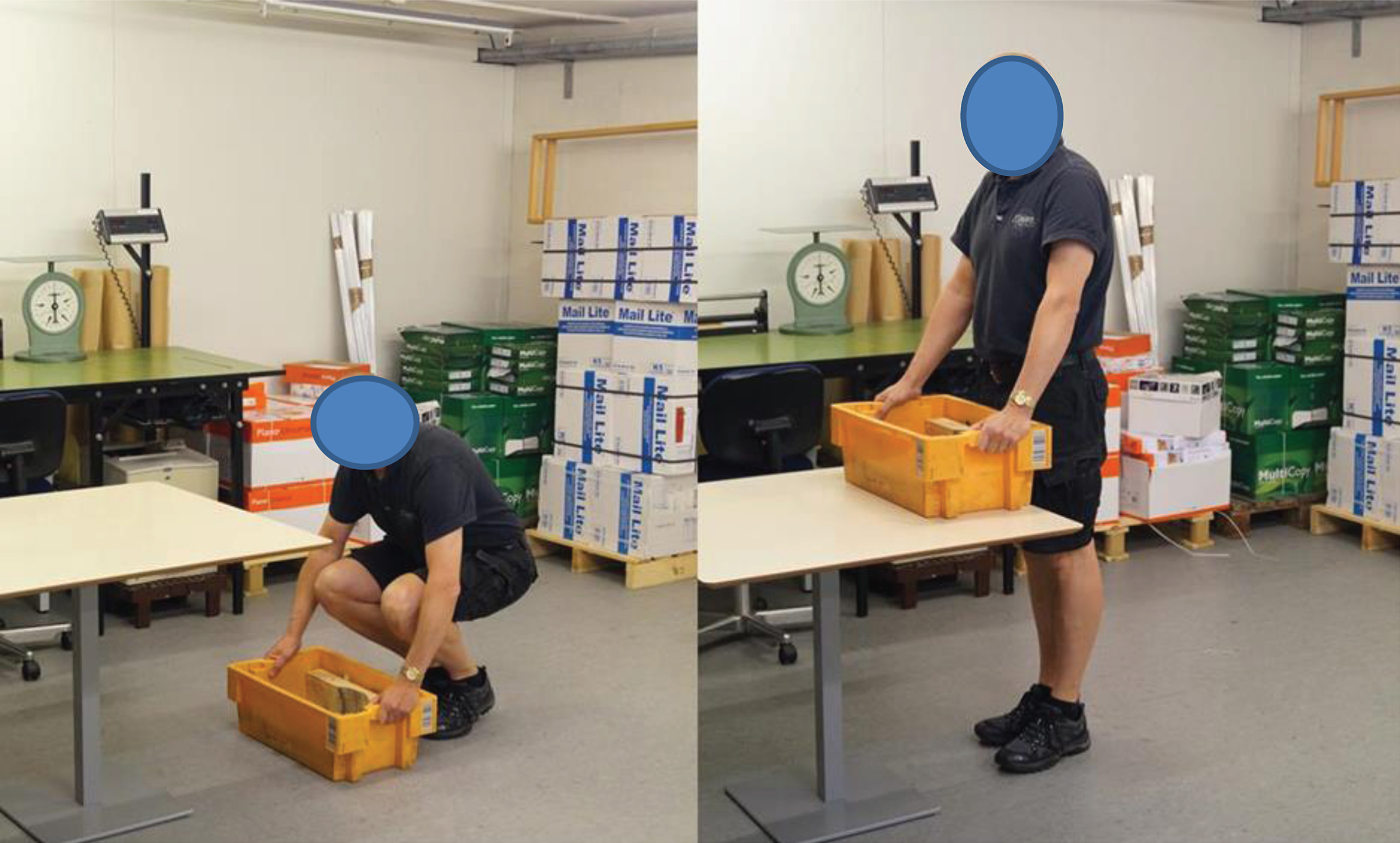
Illustration of the setup. Participants performed single manual lifting tasks of 5, 10, 20 and 30 kg with rest breaks of 2 min in between. The load was attached safely in a box of 0.54×0.34×0.20 m (width, depth and height, respectively) and was lifted from floor to table height (0.75 m).
Gender, age, load (5, 10, 20, 30 kg), time of measurements (beginning or end of work day), body mass index (BMI), smoking (yes/no), back muscle strength, proportion of workday spent lifting, and back pain (scale 0–10) were the explanatory variables.
Back muscle strength was assessed with the worker standing upright with a strap around the shoulders at the level of insertion of the deltoid muscle. The strap was horizontally connected to a strain gauge dynamometer. The worker was facing the dynamometer with the pelvis against a plate placed with the upper edge aligned with the subject’s iliac crest. The worker then maximally extended the back by performing isometric ramp contractions of 3 seconds according to standardized procedures [21]. The maximal force value was multiplied by the lever arm length to obtain torque (unit: Nm). For subsequent statistical analyses, back muscle strength was trichotomized (low, moderate, and high, based on the frequency distribution) for each gender separately.
Proportion of the workday spent lifting was assessed with the question “does your work cause you to lift or carry?” with the response options: 1) almost all the time, 2) approx. 3/4 of the time, 3) approx. 1/2 of the time, 4) approx. 1/4 of the time, 5) seldom/very little, and 6) never. For subsequent statistical analyses, proportion of the workday was trichotomized into 0–25%, 50–75% and 100% of the workday to obtain three groups of approximately equal size.
Participants rated their average low back pain during the previous month on a numerical rating scale from 0–10 with 11 points (i.e. 0, 1, ... 9, 10), where 0 is ‘no pain’ and 10 is ‘worst imaginable pain’. The rating scale was horizontally oriented to represent a modified visual-analogue scale [22]. A drawing from the Nordic Questionnaire defined the low back area [23]. Back pain intensity was subsequently trichotomized into low (0-1), moderate (2–4) and high pain (5–10).
Outcome variable
Workers rated perceived physical exertion immediately after each manual lift using the Borg CR10 scale [10], where 0 corresponds to no exertion and 10 corresponds to maximal exertion. The scale was carefully explained to the workers prior to the study. The question asked was, “please rate your physical exertion during the lift”. Participants responded to the question on a scale with 16 steps, ranging from 0 to 10, some of which were verbally anchored (0 = none, 0.5 = extremely weak, 1 = very weak, 2 = weak, 3 = moderate, 5 = strong, 7 = very strong, and 10 = extremely strong).
Statistics
Generalized estimation equations with repeated measurements were performed to determine the association between the explanatory variables and perceived physical exertion. For the analyses, perceived physical exertion of 0–4 was defined as ‘low physical exertion’ and 5 to 10 as ‘high physical exertion’, based on the wording of the scale where 5 is equal to ‘strong’ exertion. Model 1 included gender, age, load and time of measurement. Model 2 additionally included BMI, smoking status, and back muscle strength. Model 3 was the same as model 2, but additionally included proportion of the workday spent lifting. Finally, model 4 was the same as model 3, but additionally included back pain intensity. Results are reported as OR (95% CI).
Results
Out of the 41 women of this study 6 (∼15%) were not able to lift 30 kg. Their perceived exertion for lifting 30 kg was therefore estimated to be 10 (i.e. maximal) and used for the further analyses.
Table 2 shows the percentage of the men and women experiencing high physical exertion (5–10 Borg CR10) during manual lifting of 5, 10, 20 and 30 kg in the morning and afternoon of the work day. Approximately half and one tenth, respectively, of the women and men experienced high physical exertion lifting 20 kg.
Percentage of the women and men experiencing high physical exertion (5–10 on the Borg CR10 scale) during manual lifting of 5, 10, 20 and 30 kg, respectively
Percentage of the women and men experiencing high physical exertion (5–10 on the Borg CR10 scale) during manual lifting of 5, 10, 20 and 30 kg, respectively
Table 3 shows that the odds for experiencing high physical exertion were approximately 4-fold for each 5-kg increase in load during manual lifting. Women were 8-9 times more likely than men to experience high physical exertion during the standardized lifting task. Participants with high back muscle strength had decreased odds and participants who spent most of the working day lifting and those with high levels of back pain had increased odds for experiencing high physical exertion.
Odds ratios for experiencing high physical exertion (5–10 on the Borg CR10 scale) during manual lifting. Values marked in bold indicate a statistical significance level at P < 0.05
In addition to the main analyses of Table 3, we performed gender-stratified analyses using the factors included in model 4 (not shown in the tables). These analyses showed that the OR’s for experiencing high physical exertion for each 5 kg increase in load were 10.0 (95% CI 5.2 –19.0) for women and 3.8 (95% CI 3.2 –4.5) for men.
Figure 2 shows that perceived physical exertion increased with increasing load, and that women experienced higher perceived physical exertion at the same loads for all loads greater or equal than 10-kg. The average load for perceiving physical exertion of 5 was 20 and 30 kg in women and men, respectively.
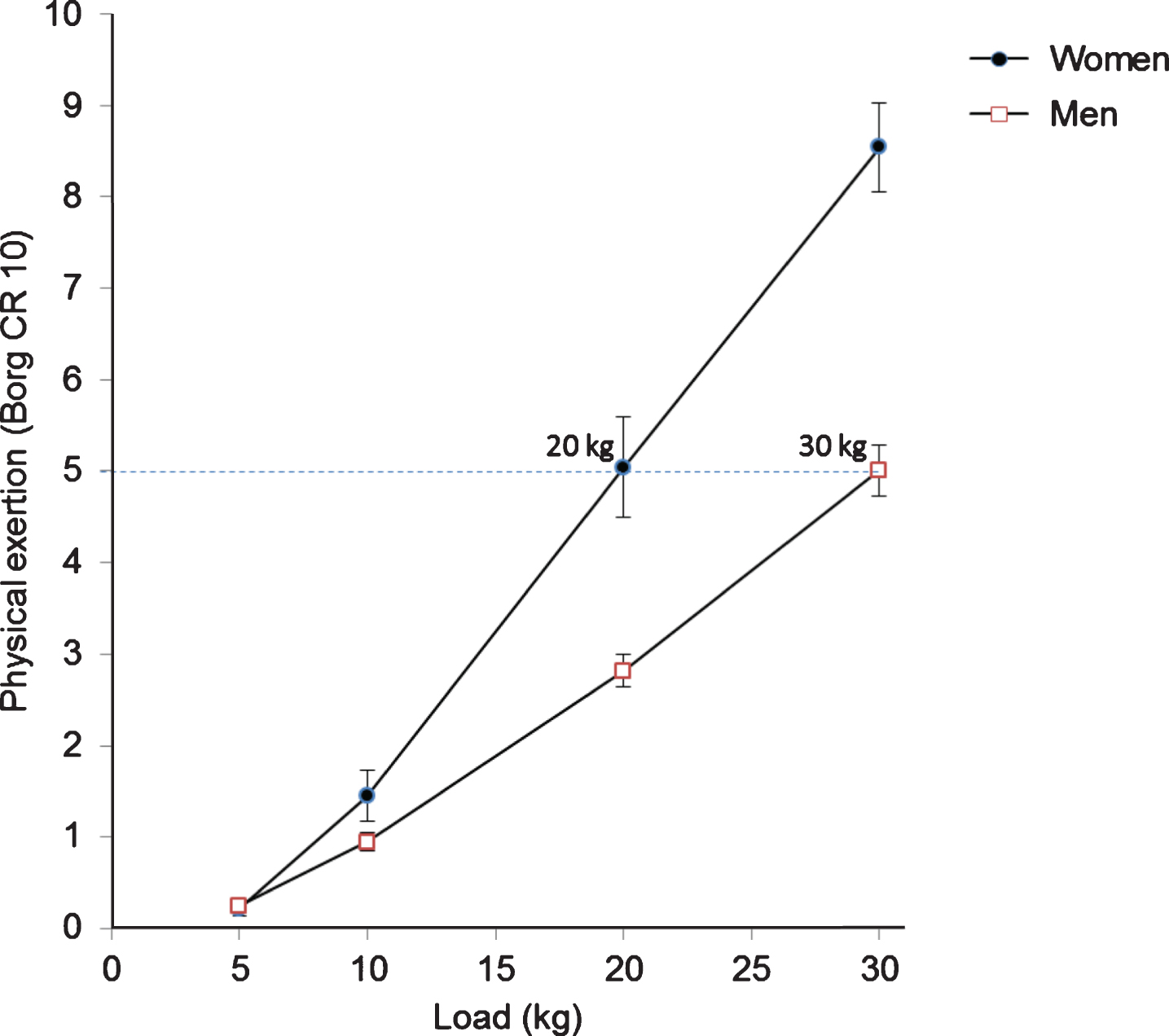
Perceived physical exertion during manual lifts of 5, 10, 20 and 30 kg in men and women. Values are mean and error lines, and indicate 95% confidence intervals (+/–1.96 * SE). The loads corresponding to 5 on the Borg CR 10 scale was 20 and 30 kg for women and men, respectively.
The present study shows that gender, load, back muscle strength and back pain influence perceived physical exertion during manual lifting. Because perceived physical exertion during work is predictive for development of and recovery from musculoskeletal disorders as well as long-term sickness absence [11–13], the present study underscores the importance of reducing heavy occupational lifting and considering individual differences when planning manual lifting tasks.
Load had a strong association with perceived physical exertion. In the fully adjusted model, the odds for experiencing high physical exertion were approximately 4-fold for each 5 kg increase in load during manual lifting. This is not surprising and validates that participants understood the meaning of the Borg scale. Several laboratory studies have shown positive associations between load and perceived physical exertion [14, 18]. Coenen and coworkers estimated that exposure to lifting loads heavier than 25-kg per day can potentially lead to an increased annual incidence of back pain by 4.3% [6], but did not take into account individual factors when establishing this threshold.
There are both pros and cons of using perceived physical exertion to assess work demands as opposed to a biomechanical analysis of the work situation. Perceived exertion during occupational lifting is easy to assess, i.e. asking the worker to rate exertion on the Borg-CR10 scale. Ergonomist can use the individual ratings as a practical tool to modify work tasks without having to rely on a number of expensive and time-consuming measurements that are unrealistic in an occupational setting. As opposed to perceived exertion of the individual worker, generalized knowledge about average biomechanical exposures of certain work tasks can be used for legislative purposes and policy decisions. From an ideological perspective, there can also be a concern that focusing on individual workers may lead to discrimination and unwarranted blame of the individual as opposed to a faulty system. These arguments are similar to those put forward by Gardell when discussing the working environment and industrial democracy in the Scandinavian countries, who argued against an individual focus [24]. However, leaving the individual worker out of the equation neglects important information and uses a unidimensional approach to a multidimensional problem. Indeed, human performance may be described as a compromise between the environment and the individual [25], dependent on the constant interplay between an individual’s capacity, willingness, motivation, and opportunity to perform [26]. Thus, from a scientific standpoint, the interest in protecting individual workers against physical overload may benefit from considering individual factors. However, individual factors such as muscle strength are not easy to assess at workplaces and can change over time.
Conversely, one easy accessible individual factor in relation to occupational heavy lifting is gender, with men being markedly stronger than women [19]. Faber and coworkers reported in a representative sample of 423 Danish employees 80–90% higher back muscle strength in men compared with women [27]. This corresponds with the present study among blue-collar workers, where men had on average 85% higher back muscle strength than women (Table 1). Likewise, Snook and Ciriello reported in a small sample of 22 industrial workers that women chose correspondingly lower loads than men when asked to work as hard as they could without straining themselves [20]. Later, Potvin developed and evaluated an equation to predict maximum acceptable effort during repetitive lifting and lowering tasks, and this equation was found to fit closely with the data from Snook and Ciriello [28]. Nordander and coworkers found approximately 50% higher activity in the trapezius and forearm muscles in women compared with men during identical repetitive industrial tasks [29], showing that women use a relatively higher percentage of muscle strength to perform a certain task. As shown in Fig. 2 the threshold of perceived physical exertion of 5 on the Borg scale was 20 and 30 kg in women and men, respectively. Although the frequency distribution (Table 2) confirms that there is also large variability within each gender, the marked difference between men and women is apparent. Such gender differences are in line with many previous studies. Silverstein and Messing have argued that gender-stratified analyses can provide additional useful information when assessing occupational risk factors [30–32]. Therefore, we additionally performed gender-stratified analyses. These analyses confirmed that load is a much stronger risk factor for experiencing high perceived exertion among women than men, with odds ratios of 10.0 (95% CI 5.2–19.0) for women and 3.8 (95% CI 3.2 – 4.5) for men for each 5-kg increase in load.
The present study also revealed other findings. Notably, those who lifted all the time as part of their work had approximately double the chance of experiencing high physical exertion during the manual lifting tasks (Model 3). Based on the findings, there is likely no positive physiological ‘training effect’ of occupational lifting. High levels of back pain were associated with higher odds of experiencing high physical exertion (model 4). However, introducing back pain in the multivariate model did not markedly change the estimates of gender or the other factors. Nevertheless, the significant association between back pain and perceived exertion may have relevance for secondary prevention and return to work in terms of modifying work duties for people with back pain. Interestingly, increased age was not associated with increased physical exertion, neither in the minimally nor fully adjusted models, which could indicate the presence of a ‘healthy worker effect’ in the present population. While Singh and co-workers reported that severe obesity compared with normal weight was associated with higher disc compression forces during manual lifting [33], we did not find an association between BMI and physical exertion in the present study, likely because the majority of the workers were normal weight or only slightly overweight. High back muscle strength was associated with lower odds of experiencing high perceived physical exertion during manual lifting, which is not surprising because higher muscle strength reduces the relative workload during identical tasks [29]. However, in contrast to gender, assessment of muscle strength of individual workers requires extensive resources and is therefore not feasible as a protective method to guide thresholds of acceptable maximal lifting limits at workplaces.
Strengths and limitations
A strength of the study is that levels of muscle strength in both the men and women were comparable to those obtained in a representative sample of Danish employees in a previous study [27]. Likewise, lifestyle factors and health are comparable to blue-collar workers in a large representative sample of more than 10,000 employees of the general Danish working population [34]. The 200 participants of the present study are likely representative of blue-collar workers in general, which increases the external validity of our findings. A limitation is that only 20% of the present population was women. However, this also reflects the gender distribution at blue-collar workplaces. Another limitation is that no 3D biomechanical analyses of the lifts were performed. Although the workers were instructed to lift as illustrated in Fig. 1, inherent differences in body mechanics (e.g. ‘good’ versus ‘poor’ posture) may influence the association between external load and exertion. Generalizability of the present results is limited to single heavy manual lifts and not repetitive work with low loads, where gender differences are likely less obvious [35].
Conclusion
In conclusion, gender, load, back muscle strength and back pain influence perceived physical exertion during manual lifting in blue-collar workers. The present study underscores the importance of reducing heavy occupational lifting and considering individual differences when planning manual lifting tasks.
Conflict of interest
None to report.
Author contributions
LLA designed and led the study. All co-authors provided critical feedback on the design. RP, MDJ, ESU, MBP and ELD collected and analyzed the data. LLA drafted the manuscript, and all authors provided critical feedback and approved the final version.
Footnotes
Acknowledgments
We would like to express our gratitude to Klaus Hansen, Jørgen Skotte, Stefan Jakobsen, Martin H. Lawaetz and Marianne Boysen for valuable help during the project. Thanks to Palle Ørbæk for valuable feedback on the original study design. The measurements for the present study were obtained in relation to another main project [ ], which was financed by an agreement between the Danish Working Environment Authority and the National Research Centre for the Working Environment. No external funding was obtained for this study.