



Abstract
BACKGROUND:
Hard hats are among the personal protective equipment (PPE) used in many industries to reduce the impact of any falling object on the skull and also to prevent head and brain injuries. However, the practice of wearing a safety helmet during working hours is still low. This is due to the physical discomfort perceived by safety helmet users.
OBJECTIVE:
Given the unpopularity of the current hard hat, the general perception of workers concerning its use and its measurements are the determining factors in the development of a new hard hat.
METHOD:
A cross-sectional study was conducted in which 132 male oil palm harvesters between 19 and 60 years of age were selected from among the employees of the same oil palm harvesting company. A set of questionnaires was developed to collect their socio-demographic information as well as their perceptions of comfort and the prevalence of head injury. In addition, a set of measuring instruments, including Martin’s anthropometry set, was used for head measurement and data collection in respect of the current hard hat. In this research, six respondents were randomly selected to attend an interview session for qualitative assessment.
RESULTS
Based on the questionnaires, the unpopularity in the use of the hard hat was largely influenced by factors related to poor design, in general, and, specifically, poor ventilation (64%), load (67% ), and physical discomfort (42% ). The measurements of the anthropometric parameters and the dimensions of the hard hat also showed a significant mismatch.
CONCLUSION:
The unpopularity of the current hard hat among oil palm harvesters stemmed from the discomfort from wearing, which showed that the development of a new hard hat could lead to better usage and the greater likelihood of wearing a hard hat throughout the working day.
Introduction
The agricultural sector in Malaysia is one of the primary sources of income encompassing the cultivation of commodity crops, such as oil palm and rubber, in addition to a range of smaller-scale crops by small-holder farmers. Based on the report by the Malaysian Palm Oil Board [1] (2016), it has been stated that 5.74 million hectares of land in Malaysia involve oil palm plantation. The oil palm industry is one of the leading economic forces within the agricultural sector in Malaysia and Indonesia, which is proven by the significant contribution of these two countries to the global production and consumption of oils and fats [2, 3].
Due to the increasing demand for agricultural products in the present market, there has been a concomitant increase in the labor force of the agricultural sector from 1.2 million to approximately 1.4 million workers [3], with 570,000 people employed in the Malaysian oil palm industry [4]. Most harvesters working in oil palm plantations are foreigners, as Malaysia is beset with a shortage of local labor, and, therefore, is extremely reliant on foreign labor, particularly from Indonesia [4]. As the number of workers increase, the risk of mishaps occurring in the agricultural sector also increases. According to the International Labour Organization [5, 6], the agricultural sector is one of the most hazardous types of work, which can lead to health issues worldwide. Consequently, to comply with Malaysia’s Occupational Safety and Health Act 1994 (section 15), to protect workers from any injury in the workplace, employers must ensure the safety, health, and welfare [7, 8] of all their employees [9]. One of OSHA’s (United States) federal registries specified that head protection must be worn by all employees while working, especially when ‘there is potential for head injury from falling or flying objects’ [10]. Safety helmets and hard hats are among the forms of head protection widely used by workers in various industries [11]. However, at present, there is no specific helmet design for agricultural workers. A helmet is designed with the intention of protecting the head from impact and falling objects; however, it may also cause thermal discomfort when being worn in the workplace, particularly in hot climatic conditions [11]. Therefore, this study was conducted to determine the factors related to the discomfort caused by wearing a hard hat, and, subsequently, to develop a new hard hat specifically designed for agricultural workers.
Method
The purpose of this cross-sectional study is to develop a new hard hat specifically designed for agricultural workers, notably oil palm harvesters. This study was conducted among oil palm harvesters from 15th of December 2014 until 23rd of December 2014. The sampling frame was made up from the list of harvesters obtained by the respective management offices. Purposive sampling was used to ensure that the respondents involved in this study were selected based on a set of inclusive criteria, including age ranging between 19 and 60 years old, ability to understand Malay/Indonesian language, and prior use of a hard hat while working.
A structured walk-through survey was used to gain real information about the tasks performed by oil palm harvesters. From the informal interviews using non-specific questions, information was obtained from managers and harvesters during the walk-through survey on the tasks performed. A set of questionnaires written in the Indonesian language was used to obtain background information about the respondents as well as the perceptions of workers concerning the use of the current hard hat and the prevalence of injuries among them. Observations during harvesting were recorded using a video camera, as were the interviews with the six selected harvesters concerning their perceptions regarding the current hard hat.
The anthropometric parameters of the head and hard hat dimensions were measured using Martin’s anthropometry set, which comprises Vernier calipers, measuring tape, and ruler. The respondents were asked to sit vertically during the measurement. Six parameters were recorded three times each. The measurements were then paired with the hard hat dimensions to determine any mismatch between the measurements.
Results and discussion
Sociodemographic information
A total of 132 subjects aged between 19 and 60 years were selected. The mean age was 33.3±27.8 years. The results indicated that 8% of the harvesters did not receive formal education, whereas 42% had received primary education. In addition, those who were educated up to the secondary level recorded 42% , and harvesters with tertiary education accounted for 7% of the total population.
Prevalence of injury among oil palm harvesters
Based on the results of the prevalence of injury among oil palm workers, among the symptoms experienced by harvesters due to wearing a hard hat while working were feeling dizzy (75%), headaches (64% ), nausea (25% ), vomiting (19% ) and fainting (17% ). The respondents were asked if they would see a doctor should they be involved in any work-related injury, to which 111 (84% ) answered yes, while the remaining 21 (16% ) said no. This indicated an alarming prevalence of negligence toward safety among oil palm workers through not reporting injuries that occurred in their workplace, which was further associated with factors related to safety awareness.
Evaluation of comfort in using the current hard hat
Figure 1 shows the type of current hard hat used by harvesters. Harvesters used the hard hat when harvesting from oil palm trees that were 3 to 5 meters (9.8 to 16.4 feet) in height. Most of them worked for 10 to 12 hours a day, and the mean use of a hard hat was 6.69±3.11 hours per day. From our observations, most of the oil palm harvesters did not wear their hard hats, as the hats made their heads feel hot and uncomfortable when they were working. This is supported in a previous study by Abeysekera [12] who found that only 5% to 10% of workers who participated in the field actually wore their helmets. The workers also said that the helmets were too hot and sometimes caused headaches and loss of hair.
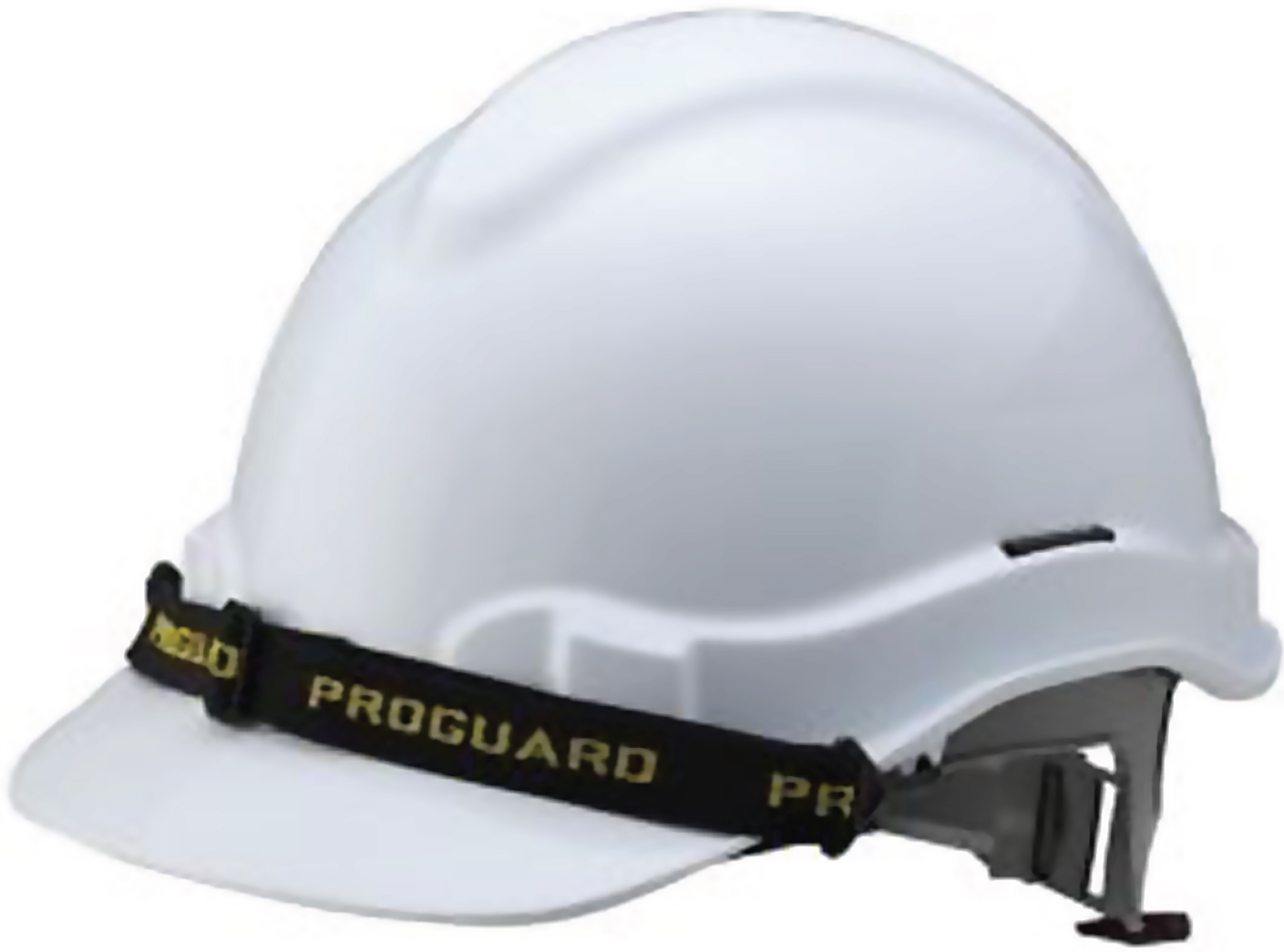
Current hard hat design.
Based on the questionnaire, the main causes of discomfort were the lack of ventilation and the weight of the hard hat; 64% of the harvesters complained about ventilation, while 67% were uncomfortable with the weight of the hard hat. The harvesters also claimed that the hard hats added strain to their necks, and caused them a great deal of discomfort. This was due to the nature of harvesting the oil palm, in which the harvesters needed to tilt their heads upward to locate the bunches of fresh fruit on the trees; the trees were approximately 3 meters in height, and between 5 and 10 years old. This is also supported by Ng et al. [13] who stated that at such age and height, the trees require harvesters to naturally tilt their heads upwards in order to locate the ripe fruits.
Based on the interview results, the weight of the current hard hat (83%) was the primary problem that led to discomfort, followed by ventilation (67% ), comfort (50% ) and design (50% ). Meanwhile, the perception of safety (33% ) proved to be the least concern of the harvesters (Fig. 2). Although some form of head protection must be worn in the workplace, workers are likely to remove their helmets during uncomfortably hot weather should they experience discomfort from heat-induced stress while wearing them [13, 14]. As reported by Davis et al. [14], workers’ perceptions showed that while weight and usability are important factors in helmet design, ventilation contributed to greater helmet comfort. Table 1 shows the questionnaire given to the harvesters regarding the contributing factors to discomfort from the use of the current hard hat.
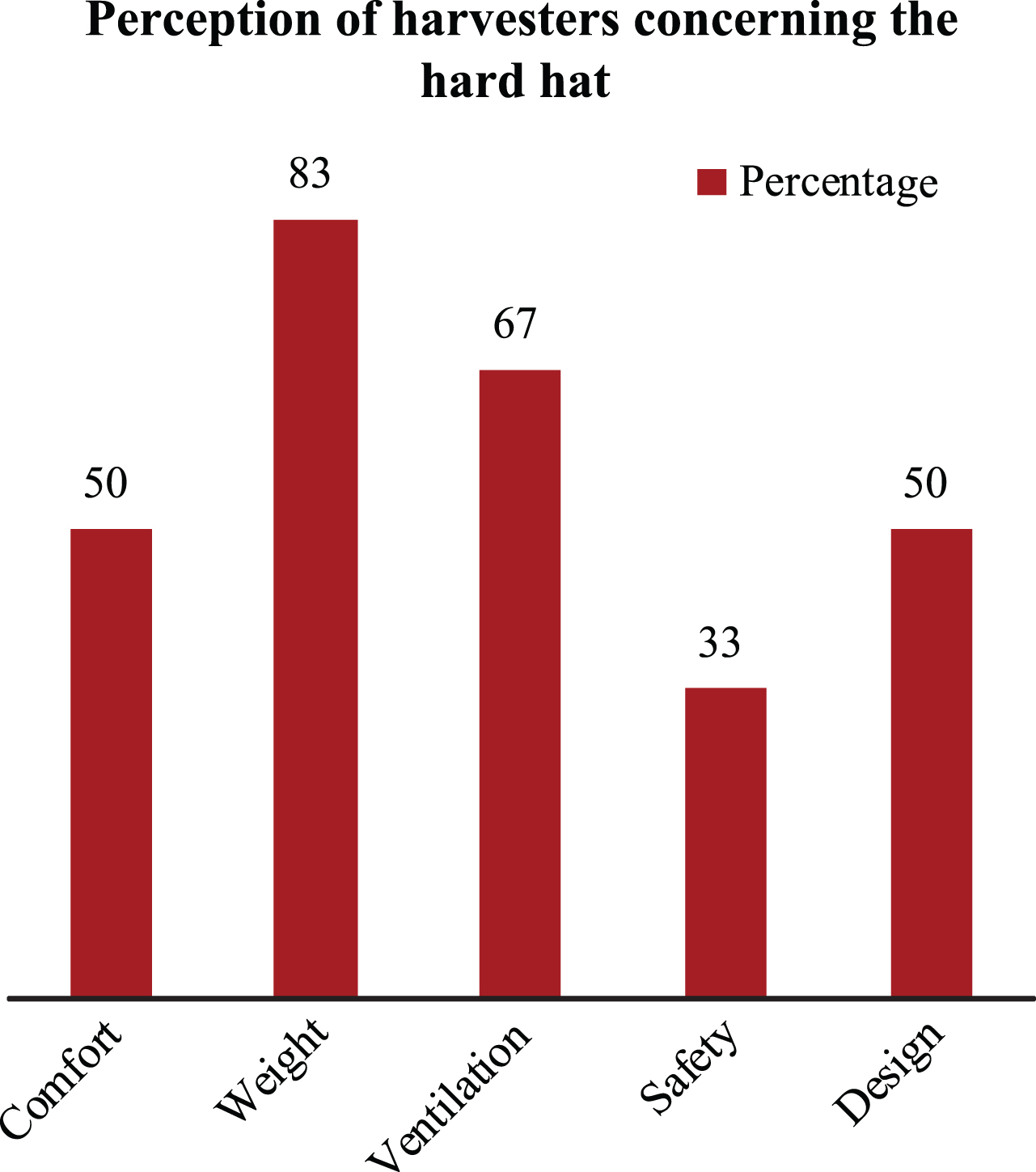
Workers’ perception concerning the current hard hat.
Information regarding the comfort elements of the current hard hat
N = 132 oil palm workers.
Comparison of the anthropometric parameters and hard hat dimensions
*significance at p < 0.00.
To determine the mismatch between the current hard hat dimensions and the anthropometric measurements, six parameters of the measurements were paired. The comparison of the mean between the head measurement and the current hard hat for five parameters – head circumference, anterior-posterior length, anterior-posterior arc, head width and ear-to-ear arc – showed a statistically significant difference with the hard hat for each variable measured (p < 0.001). The only anthropometric measurement that matched with the current hard hat in use was the head height measurement (p > 0.05) (Table 2). In addition, two percentiles were used in proposing a new hard hat dimension, namely, the 5th percentile and the 95th percentile. The use of percentiles in this study was to ensure that the proposed dimensions would match about 95% of the oil palm harvesters. For head circumference, the anterior-posterior length, anterior-posterior arc, head width, and ear-to-ear arc, 95th percentile data were used for the new dimensions of the proposed hard hat. The 5th percentile data were then used for the head height measurement. Based on Table 2, it can be concluded that there was a mismatch in the data between the hard hat dimensions and the anthropometric head measurements, albeit there was no difference in the head height and the hard hat height. Since only five parameters were mismatched, the 95th percentile of the five parameters for the head measurement was chosen to ensure that the proposed dimensions would match 95% of the oil palm harvesters (Table 3).
Proposed dimensions of new hard hat
Proposed dimensions of new hard hat
N = 132 oil palm workers.
The design of a new hard hat was developed by taking into consideration the opinions of the oil palm harvesters and members of the oil palm harvesting management, in addition to the opinions of experts and our observations in the oil palm harvesting fieldwork. The crucial problems of the present issue concerning the use of the current hard hat were determined; namely, ventilation, weight, and comfort of the hard hat. This is supported by Davis et al. [15] in their study in which the psychosocial results showed that greater helmet comfort, weight, and fit are important factors in helmet design.
According to the Chinese National Standard (CNS) [16], the ideal weight of a hard hat is 425 g. The weight of the current hard hat was recorded at 350 g. The current hard hat design did not have any ventilation holes on the top or side of the head, which caused the harvesters to feel hot during harvesting due to poor air circulation inside the hard hat. Based on a previous study conducted by Jung & Schenk [17], it was found that the temperature and humidity levels are higher inside the helmets than outside by 5C and 39% , respectively. In accordance with the Malaysian Standard (MS 183:1973) [18], to improve the ventilation of hard hats, six ventilation holes were added, with three holes on each side. The Malaysian Standard (MS 183:2001) [19] further added that the diameter of each ventilation hole should be no less than 150mm2 and not more than 450mm2. Ventilated helmets have been proven to impart less heat, and, consequently, cause less sweating compared to other tested helmet styles [13]. According to Reischl [20], helmets with ventilation holes on both sides are cooler compared to an identical, but unventilated helmet by increasing the partition between the helmet shell and the user’s head. A ventilated helmet also enhances the cooling action due to the improved air circulation.
The color of the helmet is also an important factor in reducing thermal discomfort, and, consequently increases the wearer’s comfort. This is supported by Hsu et al. [21], who found that during the testing of insulation to determine the most suitable color for helmets, the final average temperatures of red and yellow helmets under standard test conditions are 4-7C higher than that of a white helmet. In addition, reflective materials covering the outside of the shell are also effective in reducing thermal discomfort.
According to the Department of Engineering of the University of Cambridge [21], the selection of the materials used in manufacturing helmets should be highly resilient, sufficiently strong, inexpensive, and preferably lightweight. Therefore, polymers are the best material that meet all these criteria; however, most hard hats are made from polycarbonate or ABS (Acrylonitrile Butadiene Styrene). Moreover, helmets made from different plastic materials, such as polyethylene, ABS or polycarbonate do not produce significant differences in thermal properties [20]. Based on the interviews with the members of management of the oil palm harvesting, one of the improvements suggested was to insert leather into the headband of the hard hat. This would allow the sides of the headband to be designed to fit the users’ ears so that it would not cause any injury due to prolonged use of the hard hat.
Conclusion
This study demonstrates that, in general, the current hard hat used by oil palm workers is not ergonomically designed. The results of this study show that the five parameters for the head measurement are statistically significantly mismatched with the current hard hat dimensions. To solve the problem pertaining to the measurements of the hard hat dimensions, new dimensions for hard hats are proposed. The dimensions of the new hard hat must match and fit the workers. Thus, the newly proposed size is based on the 5th and 95th percentiles of the oil palm workers’ heads. In terms of workers’ perceptions concerning the design of the hard hat, it can be concluded that the main factors behind their refusal to wear a hard hat are thermal discomfort and the weight of the hard hat itself. Thus, a new hard hat designed to overcome these issues should be developed.
A limitation of this study is that the information about the prevalence of head injuries was only obtained from the respondents’ confessions in the questionnaire. There was no clinical examination or diagnosis to confirm their complaints. Their recall bias in terms of remembering the pain cannot be confirmed since no records were collected from hospitals or private clinics.
Moreover, further research is needed to improve the comfort and effectiveness in ventilating the hard hat without neglecting the safety of the wearer. In other words, a new safety helmet of acceptable weight that fits comfortably and has adequate ventilation while complying with the standard requirements of safety has yet to be developed.
Conflict of interest
The authors declare no potential conflicts of interests with respect to the research, authorship, and/or publication of this article.
Funding
There was no grant or funding for this research, which was carried out using the personal allocation of the researchers.
Ethical considerations
Ethical issues related to this study had been approved by the ethical committee, University of Putra Malaysia.
Footnotes
Acknowledgments
The author would like to express her deepest gratitude toward the oil palm harvesting management for providing full accommodation and facilities to conduct this research as well as the officer and the oil palm workers for their cooperation, encouragement, and support in successfully conducting this research.