



Abstract
BACKGROUND:
Office workers spend long hours in their workplace, and these environments impact their well-being and performance. This relationship can involve different mediation chains. The degree of complexity of this relationship can vary depending on different types of office work (work patterns) employees carry out.
OBJECTIVE:
To analyze the relationship between indoor environment and absenteeism, and the mediating role of job satisfaction, affective well-being, and health, in different work patterns.
METHOD:
1306 office workers from different European countries were classified into work patterns depending on: task complexity and interactivity.
RESULTS:
Job satisfaction, affective well-being, and health mediate the relationship between indoor environment and absenteeism. However, differences in the mediation paths were found for different work patterns. The paths through which indoor environment can affect absenteeism increased as the work patterns increased in complexity and interactivity.
CONCLUSION:
Work patterns play a role in the relationship between indoor environment, health, well-being, and absenteeism. This study highlights the mechanisms through which an improved indoor environment can protect employees’ well-being, and decrease absenteeism in different work patterns. It also points out workers especially at risk of a detrimental impact of poor indoor environment and it suggests ways to prevent them.
Introduction
In recent years, attention has been paid to defining work settings that can have a positive effect on employees’ well-being and productivity [1]. With this in mind, researchers have studied different aspects that may ensure high levels of well-being and work performance, manifested as a lower rate of employee absenteeism [2]. Results show that the work context has an impact on employees’ health [3], which is a relevant issue in public and occupational health [4]. Simultaneously, employees who are satisfied with the overall environmental quality of their workspace tend to be more productive [5]. Therefore, occupational health care has to prioritize its efforts towards enhancing the quality of working life as a possible way to prevent and decrease absenteeism [6, 7].
More than 50% of workers spend long hours in offices, and these environments have an important impact on their health and well-being [3]. Furthermore, work in offices can be characterized by the extent to which one works alone or with other people, and by the degree of complexity of the tasks, giving rise to different work patterns [8]. Researchers have shown that factors such as task complexity or interaction with other people can be potential boundary conditions for the effects of different work-related variables, influencing work outcomes [9]. However, the role of these work patterns in the relationship between indoor environment and well-being, health, and work performance has not been explicitly studied. Therefore, the purpose of the present study is to examine the relationship between indoor environment and absenteeism, and the mediating role of job satisfaction, affective well-being, and general health, in different work patterns. Expanding research on the role of work patterns in the relationship between indoor environment, well-being, health, and work performance is important because it would allow to contribute to an improved design of indoor environments adequate for different types of office work. The generated knowledge in this area would help to prevent work-related illness, and, as consequence, improve performance.
The indirect effect of poor indoor environment on sick-leave absenteeism: cognitive and affective paths
Employees’ rate of absenteeism is one of the main indicators of performance [2]. Different aspects of the indoor environment have been studied to estimate their impact on workers’ performance, showing that about 86% of productivity problems reside in the work environment of organizations [10]. First, performance decreases at excessively cool or warm environmental temperatures [11], for example the increase in air temperature has been associated with the reduction of physical and cognitive performance in humans [12]. Second, performance decrease when there is bad indoor air quality [13]. Third, employee productivity can be reduced by as much as 40% in noisy offices [14], being one of the most disturbing noise sources at shared workplaces background speech [15]. Fourth, exposure to organic vapors that can be produced by office equipment [16] and dust in office environments are main factors related to health symptoms [17] and occupational diseases [18]. In this sense, improper occupational conditions in the workplace may affect both workers well-being and productivity [19]. In fact, the indoor environment is an important risk factor for the onset of long-term sickness absence among employees [20, 21].
Absenteeism is an unavoidable phenomenon in the world of work; however, however, when its levels exceed a certain threshold, it can hinder public health [22] and organizational performance [23]. In addition, the causes of absenteeism may indicate certain problems workers have in terms of their health and well-being being threatened by their work [23]. In this regard, Allen’s [24] model suggests that the prevalence of adverse working conditions makes employees’ absence more likely. In fact, some evidence shows that the indoor environment has a strong association with sickness absence and is even an important risk factor for the onset of long-term sickness absence among employees [20]. Furthermore, studies indicate that improving the working conditions should be part of any scheme designed to decrease sickness absence [25] and thus, investment in interventions to prevent absenteeism should increase [21].
Additionally, Veitch, Charles, Kelly, Farley, & Newsham [26] suggest that satisfaction with the physical environment may indirectly contribute to broader organizational outcomes. Therefore, we expect that there will be mediators in the relationship between a poor indoor environment and absenteeism.
The first avenue through which indoor environment can affect the absenteeism rate involves job satisfaction. Job satisfaction can be defined as a “positive evaluative judgment one makes about one’s job or job situation” [27], emphasizing its cognitive nature. On the one hand, previous research has reported relationships between indoor environment and job satisfaction [28]. On the other hand, according to the happy-productive worker thesis, an increase in job satisfaction can lead to better job performance [29] and reduced absenteeism [30]. By contrast, lack of job satisfaction can be an important reason for some employees to look for ways to avoid working, such as faking illness [31].
A second possible path through which poor indoor environment can affect absenteeism involves affective well-being, which can be defined as the frequent experience of positive affect [1]. On the one hand, being forced to work in unpleasant conditions has negative consequences for affective well-being [32] (e.g., too warm or too cool temperatures may produce negative emotions, which can increase absenteeism [33]). On the other hand, work can provide opportunities for personal growth, purpose in life, and positive relationships with others. Therefore, people with higher affective well-being at work are often better workers and deliver important benefits to their organizations [32]. Taking into account results obtained in previous studies on how the indoor environment can affect sick-leave absenteeism through a ‘cognitive’ path and an ‘affective’ path, we formulate the following hypotheses:
Hypothesis 1a. Office workers’ job satisfaction will mediate the relationship between the perception of poor indoor environment and sick-leave absenteeism (cognitive path)
Hypothesis 1b. Office workers’ affective well-being will mediate the relationship between the perception of poor indoor environment and sick-leave absenteeism (affective path)
The indirect effect of poor indoor environment on sick-leave absenteeism: Cognitive-health and affective-health paths
Furthermore, different studies have established a relationship between cognitive and affective facets of well-being and health. On the one hand, job satisfaction has been shown to be related to improved employee health [34–36]. By contrast, people who are dissatisfied with their work have been shown to have worse health than satisfied people [37].
On the other hand, research has shown a relationship between higher affective well-being (i.e., absence of negative emotions and a high level of positive emotions) and better health [38]. The broaden-and-build theory of positive emotions [38] offers a theoretical explanation for the fact that people who are happier achieve better health [34] by linking the cumulative experience of momentary positive emotions to the development of lasting resources such as health. In turn, the main causes of absenteeism are health problems because employees with worse health often miss more work hours, ask for more sick-leave, and are less productive than healthy workers [23]. With this in mind, we formulate the following hypotheses:
Hypothesis 2a. There will be an indirect effect of the perception of a poor indoor environment on sick-leave absenteeism through office workers’ job satisfaction and general health, in that order (cognitive-health path).
Hypothesis 2b. There will be an indirect effect of the perception of a poor indoor environment on sick-leave absenteeism through office workers’ affective well-being and general health, in that order (affective-health path).
The indirect effect of poor indoor environment on sick-leave absenteeism: Cognitive-affective path and cognitive-affective-health paths
Simultaneously, human cognition and emotion systems interact in important ways [39], and cognition has been found to influence people’s affectivity [40, 41]. In this regard, the cognitive appraisal process, understood as the way one evaluates and interprets one’s situation, gives rise to a particular emotion with more or less intensity depending on how the situation is evaluated; thus, cognition processes are crucial to the emotional response [40]. Thus, dissatisfaction can produce negative emotions [42]. In fact, researchers have found a significant positive relationship between job satisfaction and affective well-being [43], which in turn improves health [35, 38]. At the same time, job satisfaction has a positive cross-lagged effect on work engagement, which is characterized by a positive emotional state that has positive cross-lagged effects on mental-health [35, 38]. With this in mind, we formulate the following hypotheses:
Hypothesis 3. There will be an indirect effect of the perception of poor indoor environment on sick-leave absenteeism through office workers’ job satisfaction and affective well-being, in that order (cognitive-affective path)
Hypothesis 4. There will be an indirect effect of the perception of poor indoor environment on sick-leave absenteeism through office workers’ job satisfaction, affective well-being and general health, in that order (cognitive-affective-health path)
The role of work patterns in the mediated relationship between perception of poor indoor environment on sick-leave absenteeism
Jobs consist of a set of work activities [44] designed to fulfill a number of functions that can form several configurations or patterns. A similar pattern of work activities is often found in a number of jobs. Work in offices can be characterized by four types of work activities occurring in multiple jobs: information input (e.g., observing), mental processes (e.g., analyzing data), work output (e.g., documenting information), and interaction with others (e.g., communicating with supervisors or subordinates) [45]. This classification suggests that there are two dimensions: task complexity (which refers to a psychological experience, an interaction between task and personal characteristics, and depends on objective task characteristics) [46] and interaction with other people. These two dimensions can yield four types of work patterns: 1) Non-interactive, high complexity, 2) Non-interactive, low complexity, 3) Interactive, high complexity, and 4) Interactive, low complexity [8].
The different ways an employee’s work is designed has captured the attention of many scientists, and it has been shown that work patterns can be relevant in different outcomes at work [9]. Activation theory [47] suggests that an individual’s activation level is directly related to the intensity, variation, uncertainty, and meaningfulness of the stimulus. Thus, performance has been found to vary from individual to individual depending on the complexity of the tasks performed. Along these lines, this theory proposes that there is an optimal activation level, and when this level is exceeded (e.g. task complexity and interaction with others), workers’ performance decreases. Although these results are not directly related to the ways work conditions can lead to absenteeism, in the present study we expect the relationships among indoor environment, job satisfaction, health, affective well-being, and absenteeism to vary depending on the types of activities carried out in the workplace. However, the role of these work patterns in the relationship between working conditions and well-being, health, and work performance has not been explicitly studied. Studies have shown that when jobs involve interaction with others, environmental characteristics such as noise can be appraised as greater stressors, due to the difficulty of talking by phone or maintaining oral communication [48]. Moreover, workers who perform simple tasks are less affected by temperature differences than workers who simultaneously perform two tasks [49]. Based on these ideas, researchers have argued that there is increased sickness absence among employees who perform cognitively demanding tasks under ambient noise conditions due to the significant interaction between noise in the workplace and task complexity [50]. As in the case of interaction with other people, task complexity has not been studied to find out whether the rate of absenteeism of people who perform complex tasks is affected in more ways by a poor indoor environment than the absenteeism rate of workers who perform simple tasks. In order to explore the roles of job tasks involving interaction with others and task complexity in the associations mentioned above, we formulate the following exploratory hypothesis:
Hypothesis 5. There will be greater indirect effects of a poor indoor environment on sick-leave absenteeism through office workers’ job satisfaction, affective well-being, and general health, as work patterns increase in complexity and interactivity.
The European HOPE study [51] highlighted that it is necessary to detect and control occupational environmental risks in order to improve workers’ work capacity and well-being. More recently, Bluyssen and colleagues [52] carried out the OFFICAIR project, in which they showed the need for an integrated approach to understanding the relationship between the indoor environment and workers’ well-being, in order to provide a healthy workspace. The identification of work patterns is especially useful for designing work environments and ensuring optimal conditions that contribute to performance and create opportunities to promote workers’ health and well-being.
Therefore, the main objective of this study is to analyze the paths through which the indoor environment influences sick-leave absenteeism, taking into account the mediating role of job satisfaction, affective well-being, and general health, in different work patterns. Figure 1 graphically represents the model to be tested in the study.
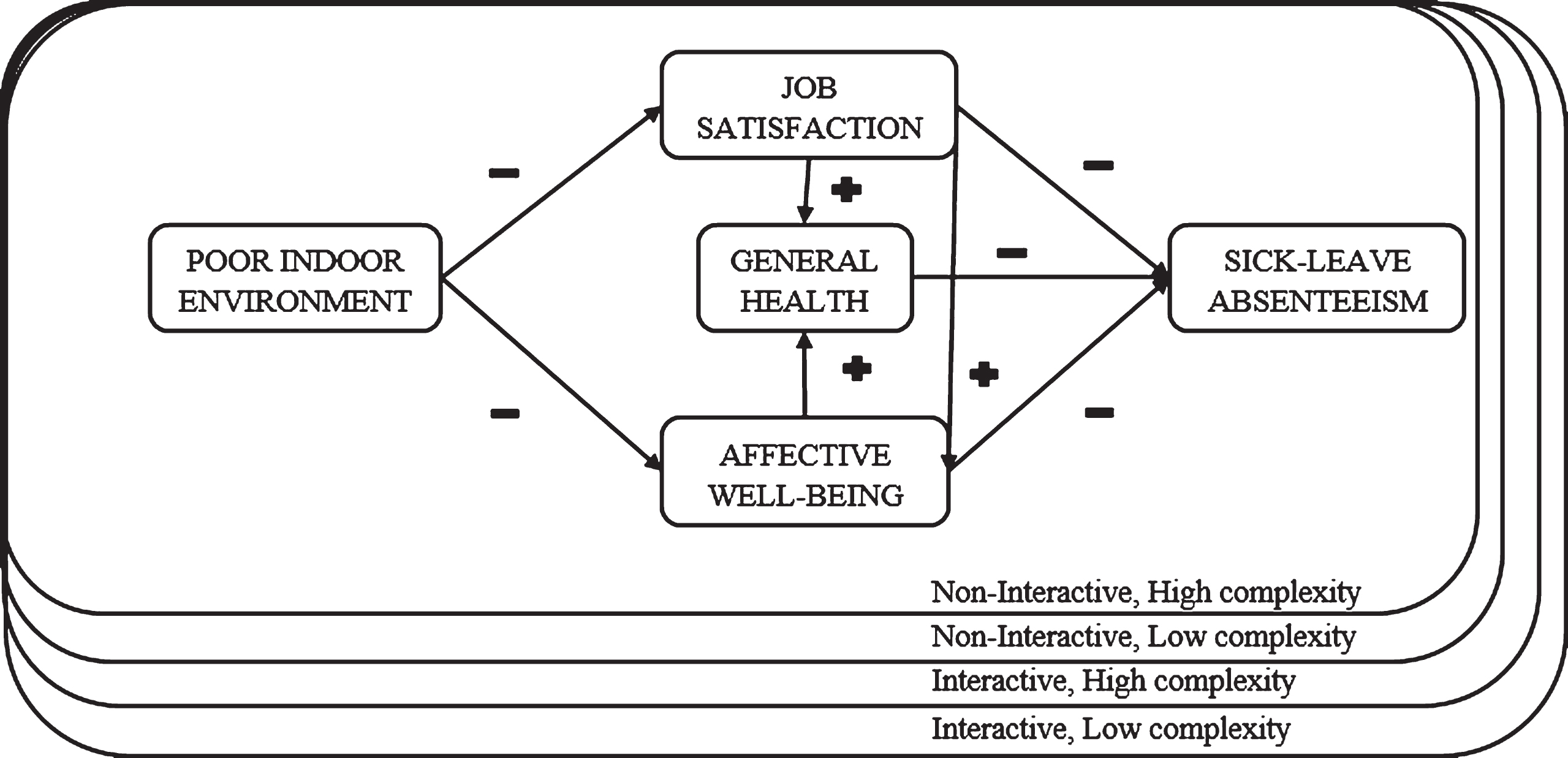
The proposed research model in this study.
Sample
In the present study, we used data from the fifth European Survey on Working Conditions (EWCS) by the European Foundation on Working Conditions (Eurofound). The basic multi-stage, stratified, random sample of the fifth European Working Conditions Survey was composed of 43,816 workers from 34 European countries. 1However, given that the European Working Conditions Study does not focus specifically on office workers, we have filtered the data from the participants just to select the sub-sample of office workers, following a multiple step procedure based on the individuals’ responses to a number of questions included in the survey. First, we selected the workers who, in response to the question: “Where is your main place of work?”, responded “My employers’/my own business’ premises (office, factory, shop, school, etc.)”. Second, out of this group, we selected workers pertaining to the category ‘office clerks’. Third, because our study involves groups of office workers who work alone as well as those who work in interaction with other people, we further narrowed the sample to include those office workers who, in response to a question about whether they work with other colleagues and/or with clients, indicated that they work both with other colleagues and with clients. In addition, we also included those who indicated that they do not work with colleagues or with clients. Finally, in our study we were interested in employees who carry out simple or complex tasks. Then, in the last step, we excluded anyone who did not provide an affirmative or negative response to the question “Generally, does your main paid job involve complex tasks?” This process yielded a final sample of 1306 office employees.
Procedure
The fifth European Working Conditions Survey was developed by Eurofound, and data collection was carried out by a network of national institutes, coordinated by Gallup Europe. The methods met the required quality standards for the test development and implementation process, which includes a pre-test, a review of trend elements, a 5-phase translation process and validation of new questionnaire elements, an additional layer of questionnaire translation validation by experts, and a pilot stage [53]. Data collection took place in 2010.2
Variables
Perceived poor indoor environment was measured with a 6-item scale (e.g., ‘Are you exposed at work to high temperatures that make you perspire even when not working?’) to assess temperature, air quality, noise, and the existence of chemical substances in the work environment. These items were taken from the fifth European Working Conditions Survey. The questionnaire was developed by Eurofound, considering a wide range of workers (including office workers). Despite its generic character, the majority of the items are relevant to office workers. Three items on the scale were omitted based on the opinion of three independent competent experts because they considered them unsuitable for office workers (i.e., Vibrations from hand tools, machinery, etc.; Tobacco smoke from other people; and handling or being in direct contact with materials that can be infectious, such as waste, bodily fluids, laboratory materials, etc.). The six items included in the present study were kept for theoretical and psychometric reasons. On the one hand, the items referred to characteristics identified in the literature as important environmental stressors present in offices, such as: exposure to excessively high or low temperatures in offices [11], exposure to organic vapors that can be produced by office equipment [16], exposure to dust, which is one of the main office factors related to health symptoms [17], or uncomfortable noise in offices where people naturally would raise their voice levels when the ambient noise exceeds 45 dB [54]. These items are relevant for the majority of offices. However, if an item was not considered relevant by the respondents, they could use the response option “don’t know” or “no answer”, and these responses were not taken into account in the analyses in our study. On the other hand, the Cronbach’s a for the six-item perceived poor indoor environment scale was satisfactory, and the Confirmatory Factor Analysis showed a good fit (RMSEA = 0.087; CFI = 0.96; TLI = 0.94). Regarding the convergent validity of the attributes reflected in the items, results indicated that the items converged well enough because the standardized factor loadings for the one-factor structure proposed were statistically significant (p < 0.01) and above 0.80 and, thus, above the standard requirement of 0.60 [55]. The distribution of perceived poor indoor environment was truncated (high levels of kurtosis and skewness). This problem was tackled by applying the ln (punctuation+1) transformation. Once it had been computed, the kurtosis and skewness (1.9 and 1.5, respectively) values were acceptable [56].
General health was measured with a single item (“How is your health in general?”). This item was taken from the fifth European Working Conditions Survey. The significant correlation of this measure with the total score on the 20-item Short-form General Health Survey (Cronbach’s alpha ranged from 0.87 to 0.95) suggests that a simple measure like this one is an acceptable way of assessing health [57].
Job satisfaction was measured with an 8-item scale (e.g., “In general, do your working hours fit your family or social commitments outside work?”) (Cronbach’s a = 0.70). These items were taken from the fifth European Working Conditions Survey.
Affective well-being was measured with a 5-item scale (e.g., “how have you been feeling in the past two weeks? – I have felt cheerful and in good spirits”) (Cronbach’s a = 0.86). These items were taken from the fifth European Working Conditions Survey.
Self-reported sick-leave absenteeism was measured with a single item (“over the past 12 months, how many days in all were you absent from work due to health problems?”). This item was taken from the fifth European Working Conditions Survey. Because the distribution of the absenteeism measures was also truncated, we applied the same transformation as in the case of perceived poor indoor environment. Once this transformation had been implemented, the levels of kurtosis and skewness (0.1 and 0.9, respectively) were acceptable [56]. A strong congruence was found between company record-based absenteeism reports and worker self-reports [58]. Moreover, absenteeism results were similar when comparing single-item measures and large-scale studies [59].
Work patterns were identified on the basis of the configuration of the participants’ responses to the questions on the fifth European Working Conditions Survey about: a) interactions with others at work; b) the complexity of the task they performed; and c) education, 5 - Post-secondary, including pre-vocational or vocational education, but not tertiary, 6 - Tertiary education – first level, and 7 - Tertiary education – advanced level).
Analysis
Given that behavioral research may suffer from common method bias [60], prior to carrying out the analyses to test the hypotheses in the current study, we conducted preliminary analyses to ensure that common method bias was not an issue in our data. To this end, we carried out a CFA, which has been indicated as a relevant way to rule out the problem of common method bias [61–63] using MPLUS [64]. Statistical analyses were carried out using SPSS v.22. Hierarchical regression analyses of direct and indirect effects and bootstrapped bias-corrected 95% confidence intervals of the indirect effect were computed using the PROCESS macro in SPSS (Model 6). Model 6 in the PROCESS macro specifies a serial multiple mediator model, and the sequence of variables in the list (job satisfaction, affective well-being, and general health) specifies the causal ordering of the mediators. The PROCESS command generates the model for the total effect, as well as bootstrap confidence intervals for the indirect effects based on 5,000 resamples [65]. PROCESS already employs measures to reduce Type I errors because it constructs bias-corrected and percentile-based bootstrap confidence intervals for conditional and unconditional indirect effects in mediation models [65]. Confidence intervals that do not contain zero indicate a significant indirect effect (mediation). In addition, country, gender, and educational level were controlled in these mediations. Differences between countries have been found in all the variables considered in this study. Regarding gender, differences between males and females on job satisfaction and poor indoor environment were significant (women showed higher satisfaction and lower perception of poor indoor environment). Regarding education, health and poor indoor environment varied in the different educational-level groups (higher educational levels meant better health and perception of poorer indoor environment).
Results
Preliminary results show that common method bias is not an issue in our data because a single-factor CFA taking into account all the study variables (RMSEA = 0.138; CFI = 0.513; TLI = 0.452; SRMR = 0.130) obtained a significantly worse fit (Δchi2(3) = 3122.771(3), p < 0.001, ΔCFI = 0.402, ΔTLI = 0.451, ΔSRMR = –0.087) [66–68] than a multi-factor CFA with the same number of factors as scales in the present study (RMSEA = 0.058; CFI = 0.915; TLI = 0.903; SRMR = 0.043) [60–63]. The descriptive characteristics of the sample for each work pattern are shown in Table 1.
Work patterns: sample characteristics
Work patterns: sample characteristics
Note. aMeans and standard deviations. bThe number in parentheses represents the percentage of the total in each work pattern. NI/HC (Non-interactive, high complexity), NI/LC (Non-interactive, low complexity), I/HC (Interactive, high complexity) and I/LC (Interactive, low complexity).
Means, standard deviations, analyses of variance (ANOVA), and correlations (Pearson) are presented in Table 2. Workers from different work patterns present similar average levels of general health, job satisfaction, and affective well-being. Regarding the indoor environment, interactive workers perceive worse physical conditions than non-interactive workers who perform complex tasks (p < 0.001). In addition, interactive workers who perform complex tasks perceive worse physical conditions than non-interactive workers who perform simple tasks (p < 0.05). Furthermore, taking into account the rate of absenteeism, there are no significant differences between the groups, except for the work patterns “Non-interactive, low complexity” and “Interactive, high complexity”, as the latter presents higher absenteeism levels than the former (0.83 and 1.16, respectively, p < 0.05).
Means, standard deviations, variance analyses (ANOVA) and correlations (Pearson)
Note: Significant at: *p < 0.05 and **p < 0.01; the correlations are aggregated data of the different work pattern samples; separate correlations for the four samples might be facilitated after contacting the authors. NI/HC (Non-interactive, high complexity), NI/LC (Non-interactive, low complexity), I/HC (Interactive, high complexity) and I/LC (Interactive, low complexity).
Results are presented in Table 3 and 4, and Fig. 2. Taking into account the whole sample, in contrast to hypotheses 1.A and 1.B, there are no simple mediations between indoor environment and absenteeism. Nevertheless, a double mediation between perception of poor indoor environment and office workers’ sick-leave absenteeism was found through office workers’ job satisfaction and health (B = 0.044; IC 95% = [0.03, 0.07]) and through office workers’ job satisfaction and affective well-being (B = 0.02; IC 95% = [0.01, 0.05]), (hypotheses 2.A and 3). No support was found for hypothesis 2.B, as the double mediation between the independent variable and the dependent variable through affective well-being and health was non-significant. Finally, a triple mediation effect was found between perception of poor indoor environment and workers’ sick-leave absenteeism through employees’ job satisfaction, affective well-being, and health (hypothesis 4) (B = 0.01; IC 95% = [0.01, 0.03]).
Parallel multiple mediation analyses: general model
Notes: Results are based on 5000 bias-corrected bootstrap samples. *p < 0.05. α(Unstandardized parameter estimate).
Parallel multiple mediation analyses: work patterns
Notes: Results are based on 5000 bias-corrected bootstrap samples. *p < 0.05. α (Unstandardized parameter estimate).

Parallel multiple mediation analyses: different work patterns.
The subgroup analysis using work patterns as moderator showed differences in the number of paths in the indirect effects between work patterns. The interactive, low complexity (I/ LC) pattern presents a triple mediation between perception of poor indoor environment and employees’ sick-leave absenteeism through office workers’ job satisfaction, affective well-being and health (B = 0.04; IC 95% = [0.01, 0.09]). The non-interactive, low complexity (NI/LC) pattern shows a double mediation between indoor environment and absenteeism through office workers’ job satisfaction and health (B = 0.07; IC 95% = [0.02, 0.19]) and a triple mediation through employees’ job satisfaction, affective well-being, and health (B = 0.02; IC 95% = [0.01, 0.07]). The non-interactive, high complexity (NI/HC) pattern presents a significant double mediation through office workers’ job satisfaction and health (B = 0.19 IC 95% = [0.08, 0.38]), and another one through employees’ affective well-being and health (B = 0.04; IC 95% = [0.01, 0.13]). The results also show a triple mediation path through employees’ job satisfaction, affective well-being, and health (B = 0.06; IC 95% = [0.01, 0.15]). Finally, for the interactive, high complexity (I/HC) pattern, a mediation was found through office workers’ job satisfaction (B = 0.05; IC 95% = [0.01, 0.11]), and there were two double mediation paths: one through office workers’ job satisfaction and health (B = 0.02; IC 95% = [0.01, 0.05]), and another one through employees’ job satisfaction and affective well-being (B = 0.03; IC 95% = [0.01, 0.06]). Finally, a triple mediation path was identified through office workers’ job satisfaction, affective well-being, and health (B = 0.01; IC 95% = [0.01, 0.02]).
The results obtained generally provide support for the hypotheses. They show that office workers who interact with other people at work and perform complex tasks, are affected by the indoor environment through a larger number of indirect paths (hypothesis 5). In fact, although hypothesis 4 (“cognitive- affective- health” path) is supported for all of the work patterns, those involving complex tasks are characterized by a greater influence of affective well-being. On the one hand, in the non-interactive, high complexity pattern, the indoor environment directly affects affective well-being, regardless of job satisfaction. On the other hand, in the interactive, high complexity pattern, the indoor environment affects sick-leave absenteeism through job satisfaction and affective well-being, regardless of health. In addition, in this latter work pattern, job satisfaction mediates the relationship between indoor environment and sick-leave absenteeism, regardless of health and affective well-being.
The aim of this study is to analyze whether (and how) work patterns moderate the mediating role of office workers’ job satisfaction, affective well-being, and general health in the relationship between poor indoor environment and sick-leave absenteeism.
The results for the whole sample show that different indirect paths were significant. First, the “job satisfaction-affective well-being” path was significant, and this result is in line with the one obtained by Grieshaber, Parker and Deering [42], who found that emotional problems are the result of high dissatisfaction. Second, the “job satisfaction-health” path was also significant, which is consistent with Diener and Chan [35]. Finally, the results obtained in the present study and those reported by other researchers [35, 69] support the idea that the “job satisfaction-affective wellbeing-health” path mediates the relationship between indoor environment and sick-leave absenteeism. These results can be explained by considering the conclusions of the authors of the European HOPE project [70] and the OFFICAIR study [52]. In the European HOPE project, Bluyssen, Aries and van Dommelen [70] highlight that building and personal factors can influence one’s perceived health, whereas the OFFICAIR study [52] concludes that affectivity plays a part in the relationship between indoor environment and workers’ health and comfort.
Regarding the effect of the control variables (country, gender, and educational level), results showed a significant effect of the ‘country’ variable. These results could be explained by taking into account the cross-cultural approach to stress literature, which has shown that there might be country differences in the perception of stressors [71], the consequences of stress, and the strength of the relationships between the reported stressors and their outcomes [72, 73]. Future studies should consider the effect of country on the perception and consequences of environmental stressors.
The results for the different work-pattern groups separately show that there is a relationship between the perception of the indoor environment and sick-leave absenteeism through the three proposed mediators in each pattern. However, most of the indirect paths were significant in the work patterns consisting of complex tasks. We can argue that workers who perform complex tasks are more bothered by aspects of the indoor environment, such as temperature [49] or noise [50], as they have a more negative influence on attitudes, affect, and health.
Furthermore, our results indicate that there are more indirect paths in work patterns consisting of complex tasks than in those consisting of interactions with others. However, interactions with other people at work, as previous research indicates, also play an important role in the studied relationships [48], as the work pattern with more significant paths between the perception of the indoor environment and sick-leave absenteeism through the mediators is the one referring to working with people and performing complex tasks. According to activation theory [47], when there is too much activation (e.g., poor indoor environment, complex tasks, and interaction with other people at work), the performance level decreases, probably due to the effect of these conditions on employees’ health and well-being.
Despite its contributions, the present study has some limitations. First, although the indoor environment scale developed by EUROFOUND and Gallup Europe measures different relevant aspects of the indoor environment, such as noise, indoor temperature, or dust in different types of jobs, a limitation of this scale is that it was not possible to include some aspects of the indoor office environment in the scale used in the present study (i.e., stuffy air, unpleasant odor, lighting, and reflections). Second, due to the cross-sectional nature of the study design, causal inferences cannot be made. Third, our results are based on responses obtained from some single-item scales which may provide limited information. Nevertheless, a number of studies suggest that this simple measure is an acceptable method [57–59], although it would be informative to expand the current methodology using multiple-item scales. Fourth, although in the present study we use self-report measures for several variables, research shows a strong congruence between company records and workers’ self-reports [58]. Future studies should complement the research using self-reports with other more objective measures. Finally, we are aware that survey data might be subject to common method bias [60]. However, we believe that this issue may not have affected the results in this study. In fact, Eurofound and Gallup Europe, who developed the questionnaire, were aware of the issue of common method bias and took measures to reduce it. They followed Podsakoff and colleagues’ [60] suggestions by: a) instructing respondents that the aim was to explore how they felt about their work and how their work affects their life, b) ensuring anonymity, and c) using different scale formats for different scales on the questionnaire [53]. Additionally, some behavioral research may suffer from common method bias [60]. However, as suggested by literature [61–63], we were able to test whether common method bias might affect our results using CFA. It indicated that a single factor did not emerge from the factor analysis, nor did one general factor account for the majority of the covariance among the measures, providing support for the assumption that a substantial amount of common method variance is not an issue in our study [60].
The results of the present study suggest that future research should investigate these relationships in different occupational samples and distinguish between interactions with colleagues and interactions with clients in these work patterns. In addition, future studies should explore other relevant issues related to the broaden-and-build theory [38] and study the moderating effect of positive emotions on the proposed relationships.
Our findings have important implications. First, regarding theoretical issues, in this study we conceptualize office workers’ well-being by taking into consideration both cognitive and affective well-being. We also take into account different constructs that play a mediating role in the relationship between indoor environment and sick-leave absenteeism, studying aspects related to work life (job satisfaction) and aspects related to life in general (general health and affective well-being). We introduce the concept and operationalization of work patterns, which, until now, have hardly been considered. This concept has been fruitful and useful, with both theoretical and practical significance.
This study also has important practical implications. Its results contribute to existing knowledge about the need of occupational health to increase its efforts towards improving the design of indoor environments [7]. Additionally, our study provide evidence for the importance of considering different types and situations of office workers, which can be useful to prevent work-related illness, and thus improving workers’ performance. The results indicate that workers who perform complex and interactive tasks are especially affected by indoor environment through different mediation chains, which in turn have a more negative influence on their health. This suggest that workers who perform complex and interactive tasks could need special support from the organization that could include special attention paid to ensuring optimal indoor environment to prevent health problems and absenteeism. Moreover, this results provide important information about the proper design of a workplace that fosters performance and ensures well-being at work, as it shows that an inadequate indoor environment affect employees well-being and performance (absenteeism). Thus, managers should pay attention to offices indoor environment (temperature, noise, etc.) to prevent workers health problems and increase their well-being and performance. Due to the long hours office workers spend in their workplace, and the impact that these environments have on their health [3], it is necessary to recognize the relevance and particular characteristics of employees’ health and well-being in different types of office work, in order to understand how we should approach this topic and improve workers’ health while ensuring their productivity.
Conclusion
This study highlights the important role of work patterns when studying the mediation paths through which the indoor environment influences absenteeism in office workers. This approach to the study of the relationships between different work-related antecedents and outcomes and their boundary conditions according to different work patterns is novel and reveals important distinct characteristics and implications.
Conflict of interest
All authors contributed equally in the preparation of this manuscript. The Authors declare that there are no conflicts of interest.
Footnotes

Acknowledgments
The preparation of the manuscript was supported by the EMPQUAL Project PSI2015-64862-R (MINECO/FEDER), and by the PROMETEO 2016/138 Project granted by the Valencian Regional Ministry. The first author had a research grant “Atracción del Talento” from the University of Valencia.