



Abstract
BACKGROUND:
Flexed head and neck postures are associated with the development of neck pain in the office environment. There is little evidence regarding whether a wearable posture sensor would improve the head and neck postures of office workers.
OBJECTIVE:
The aim of this study was to evaluate the effect of the wearable posture sensor on the posture and physical demands on the head and neck during office work.
METHODS:
Nineteen participants performed a typing task with and without the wearable sensor in the sitting and standing positions. They were allowed to adjust their workstation during the experiment based on a psychophysical method. The flexion angles of the head and neck, the gravitational moment on the neck, and the positions of the workstation components were measured.
RESULTS:
On average, participants with the wearable sensor had 8% lower neck flexion angles and 14% lower gravitational moments on the neck than those of participants without the wearable sensor. The effect of the wearable sensor on reducing postural stress of the neck was more significant when using the standing workstation compared to the sitting workstation.
CONCLUSIONS:
The wearable posture sensor could be an effective tool to alleviate the postural stress of the neck in the office setting.
Introduction
Office workers typically sit for six hours per day during work [1]. Prolonged sedentary work has been associated with adverse health effects, including musculoskeletal disorders [2–4], cardiovascular disorders [5, 6], and type II diabetes [7]. The lack of motion in the sitting environment is known to affect low circulatory demands [8] and muscle activations [9].
Flexed head and neck postures have been found to be risk factors for neck pain in the office environment [10–14]. For instance, a recent study showed that tablet computer usage increases the physical demand of the neck 3 to 5 times compared to the neutral posture in sitting [10]. In terms of biomechanics, an increased neck flexion angle is related to an increase of the gravitational moment on the neck [12, 16]. Compared to neutral posture, the higher demand of the gravitational moment in the flexed posture requires greater activation of neck muscles [17], which leads to muscle fatigue and increases risk of neck pain [18].
To alleviate the adverse effects of substantial head and neck flexion in the office environment, several administrative and engineering controls have been suggested. For instance, previous studies found that an accessory stand for the tablet or laptop can reduce flexion angles of the head and neck and decrease muscle activities of the neck [10, 19]. Despite the positive results of the accessory stand on reducing postural stress of the neck, the long-term effects of ergonomic training on musculoskeletal disorders of office workers are still controversial [20, 21]. Proper ergonomic training and sustained usage of ergonomic interventions are still challenging issues in the office environment [22, 23].
Wearable posture correction sensors might be a useful tool to help office workers maintain good, upright postures in the office environment. A previous study showed that a wearable sensor that tracks the user’s postures and gives light vibration feedback in real-time is effective at improving posture over 25 days [24]. Despite this promising result, there is little evidence that wearable posture sensors reduce the flexion angles and physical demands of the head and neck when using sitting and standing workstations.
The objective of this study was to investigate whether a wearable posture sensor reduces the postural stress of the head and neck in sitting and standing workstations. Our first hypothesis was that the wearable sensor feedback would help participants reduce flexion angles of the head and neck, thereby decreasing the gravitational moment on the neck relative to that of participants without the wearable sensor. Our second hypothesis was that the wearable sensor would assist participants in finding better workstation configurations that alleviate physical demand, including the heights of the chair and desk and tilt angle of the laptop, compared to participants without the aid of the wearable sensor.
Methods
Participants
A total of 19 participants (10 females and 9 males) were recruited for the study. All participants provided informed consent per Institutional Review Board requirements prior to participation in the study. The inclusion criteria were that the participant should have a typing speed of at least 30 words per minute (WPM) and should not have had any pain in the upper extremities or lower back region within the past 7 days. The means (standard deviation) of age, height, body mass, and head circumference of the participants were 24.47 (5.32) years, 167.98 (12.25) cm, 66.79 (9.30) kg, and 54.53 (2.84) cm, respectively. The detailed anthropometric information is summarized in Table 1.
Mean and standard deviation of participant anthropometry
Mean and standard deviation of participant anthropometry
Kinematics data of the head, neck, and positions of the workstation components (desk, chair, and laptop) were continuously collected during the task using an optical motion capture system with six Flex 13 infrared cameras (Natural Point, Corvallis, OR, USA) at a sampling rate of 100 Hz. A customized Matlab program (R2015a, MathWorks, Natick, MA, USA) was utilized to compute joint angles and joint moments of the head and neck. The posture correction wearable sensor (Alex, NAMU Inc., Seoul, South Korea) was positioned on the posterior side of the participant’s neck. This device consisted of a 3-axis accelerometer to measure posture and movement of the neck in real time, and it sends this information to the companion smartphone app through Bluetooth for the posture management. This device measures the gravitational force on the sensor in a static posture then computes the neck flexion angle [25]. When a participant maintained a poor neck posture (a neck flexion angle greater than 15° relative to the neutral posture) for more than 30 seconds, the wearable sensor gently vibrated in real-time to remind the participant to correct their posture. We determined the 15° flexion as a threshold since previous study found 15° forward bending had 2–3 times greater stress on the neck compared to the neutral posture [26].
Testing procedure
Anthropometric measures including the height, body mass, and head circumference of each participant were collected at the beginning of the study. Seven reflective markers were placed on the participant’s left and right canthus, left and right tragus, C7 spinous process, sternal notch, and the vertex of the head to calculate joint angles and gravitational moment of the head and neck. Eight reflective markers were placed on the ground, chair, edge of the desk, and laptop to compute the height of the desk and chair, as well as the laptop tilt angle.
The participants were asked to type continuously using typing software (Typing Master 10) with and without the wearable sensor in the sitting and standing workstations. A total of four conditions were randomized, and each condition consisted of a 30-minute typing task. The contents of the typing tasks were varied between conditions of each participant to minimize the learning effect. Five-minute breaks were provided to the participants between conditions to minimize carryover fatigue. The experimental setup is shown in (Fig. 1).
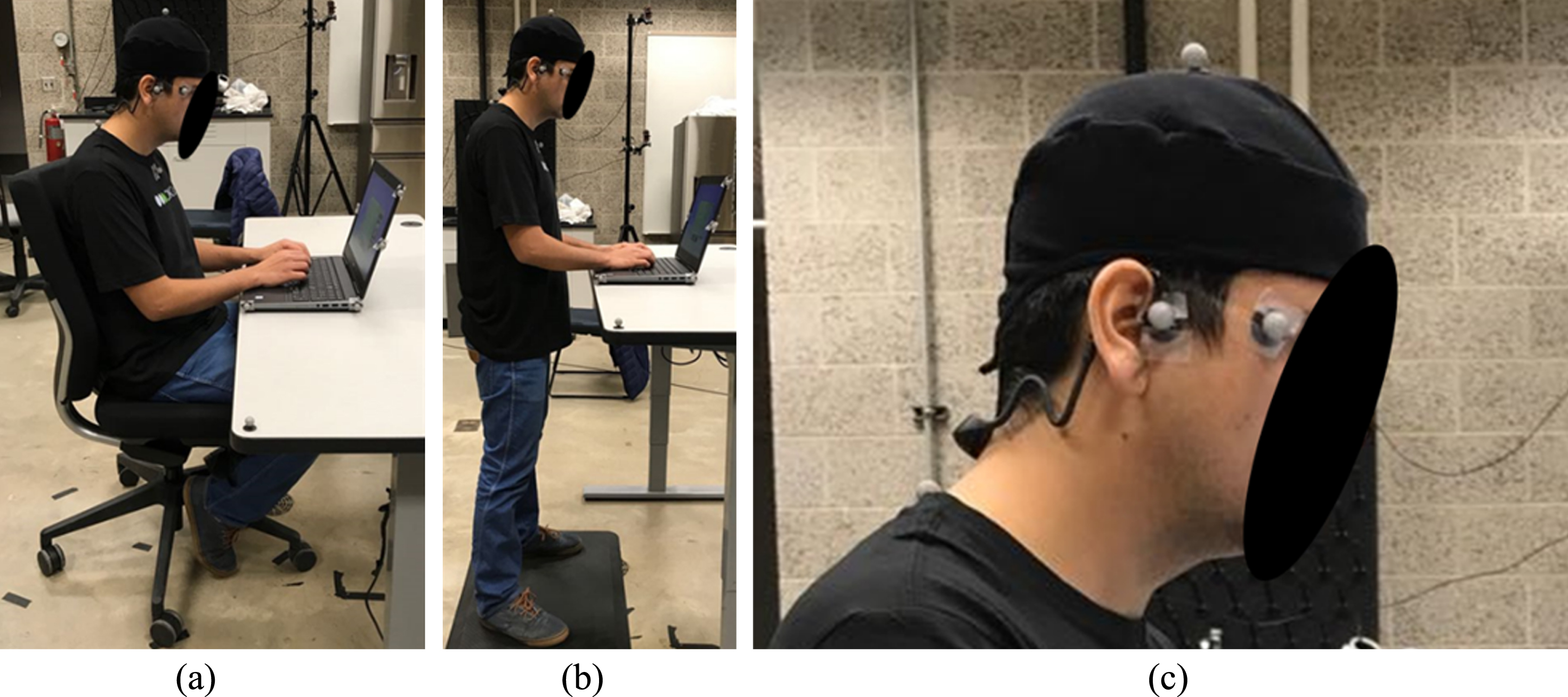
Experimental setup. (a): with wearable sensor while sitting, (b): with wearable sensor while standing, and (c): the wearable sensor positioned on the neck.
At the beginning of each task, the laptop was located at the left edge of the desk, and the height of the desk and the chair were set to the lowest level in the sitting workstation, or the desk was set to the highest level in the standing workstation. Each participant initially adjusted their workstation components. Based on the psychophysical method [27], participants were instructed to adjust the tilt angle of the laptop screen and the height of the desk and chair to their preference. They could also adjust them in the middle of the task if they wanted. They were instructed to keep adjusting their workstation as if they were comfortably working a full 8-hour day. This method was found to be a robust and effective method to determine a participant’s preferred setup of the sitting and standing workstations [28].
Independent variables included the presence of the wearable sensor (with or without). Dependent variables included the neck flexion angle, head flexion angle, cranio-cervical angle, gaze angle, gaze distance, C7-T1 gravitational moment, C7-T1 moment-arm, laptop tilt angle, chair height, desk height, typing speed, and typing accuracy. Figure 2 illustrates the dependent variables. The neck flexion angle was defined as the angle between the vertical line at the C7 spinous process and the vector pointing from the C7 spinous process to the mid-tragus (midpoint between left and right tragus). The head flexion angle was defined as the angle between the vertical line at the mid-tragus and the vector pointing from the mid-tragus to the mid-canthus (midpoint between left and right canthus). The cranio-cervical angle was defined as the angle between the vector pointing from the mid-tragus to the C7 spinous process and the vector pointing from the mid-tragus to the mid-canthus. The gaze angle was defined as the angle between a horizontal line at the mid-canthus and the vector pointing from the mid-canthus to the center of the laptop screen. Gaze distance was computed from the mid-canthus to the center of the laptop screen.
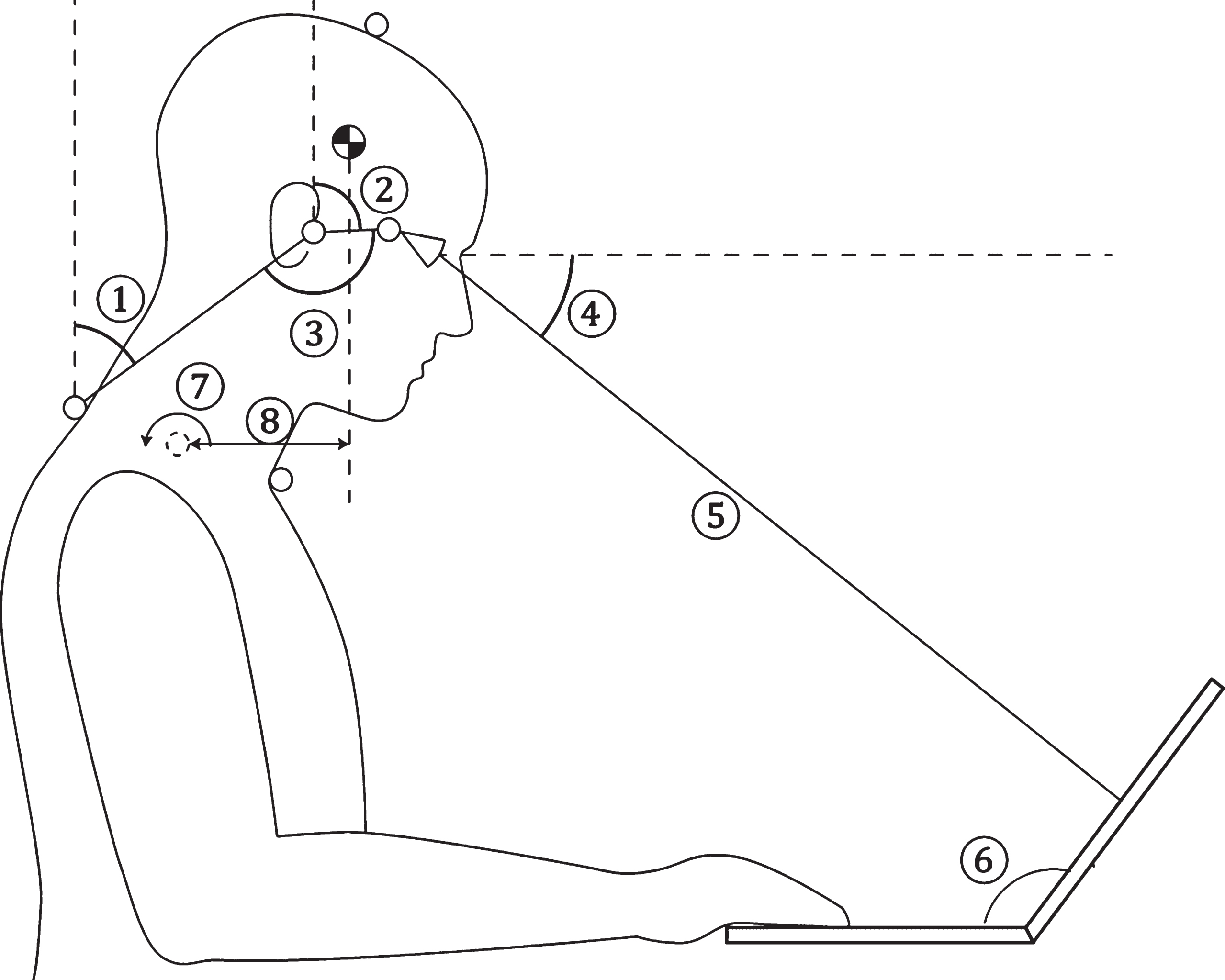
Illustration of dependent variables. ①: neck flexion angle, ②: head flexion angle, ③: cranio-cervical angle, ④: gaze angle, ⑤: gaze distance, ⑥: laptop tilt angle, ⑦: gravitational moment on the neck, and ⑧: gravitational moment-arm of the neck. Solid circle: reflective markers, and dotted circle: virtual marker.
The gravitational moment was calculated from the product of the head mass and the perpendicular distance between the vertical axis at the center of gravity (COG) of the head and C7-T1. The COG was estimated as 17% of the distance from the mid-tragus to the vertex of the head [29]. The head mass was estimated using a regression equation based on the head circumference and the body mass [30]. The C7-T1 position was estimated from the midpoint between the sternal notch marker and the C7 spinous process marker [31].
The average values of the joint angle, gravitational moment of the head and neck, and workstation positions were calculated during the last 6 minutes (minute 24 to 30) of each condition to represent the participant’s final preferred workstation configuration and associated posture [28]. A previous study showed that the participant gradually settled into a preferred workstation configuration within 11.25 minutes while sitting or standing [28]. Thus, we assumed that the 30-minute task period would be a reasonable duration to find convergence of the workstation and associated posture.
For normally distributed data, a paired t-test was conducted using SPSS 24 software at a significance level of 0.05. If the data were not normally distributed, a Wilcoxon signed-rank test was conducted. The mean and standard error of each dependent variable was summarized.
Results
Head and neck postures
The number of vibrations that occurred from the wearable sensor decreased over time in the sitting and standing workstations (Fig. 3). The average number of vibrations was less than one during the last interval (24 to 30 minutes). In addition, the average differences between the desk and chair heights between the fourth interval (18 to 24 minutes) and the last interval (24 minute to 30 minute) were less than 0.3 cm (Fig. 3). This was indicative of the convergence of the workstation configuration at the end of each condition for the participants. Thus, only the final preferred configuration and associated posture in the last interval were considered in the following analysis.
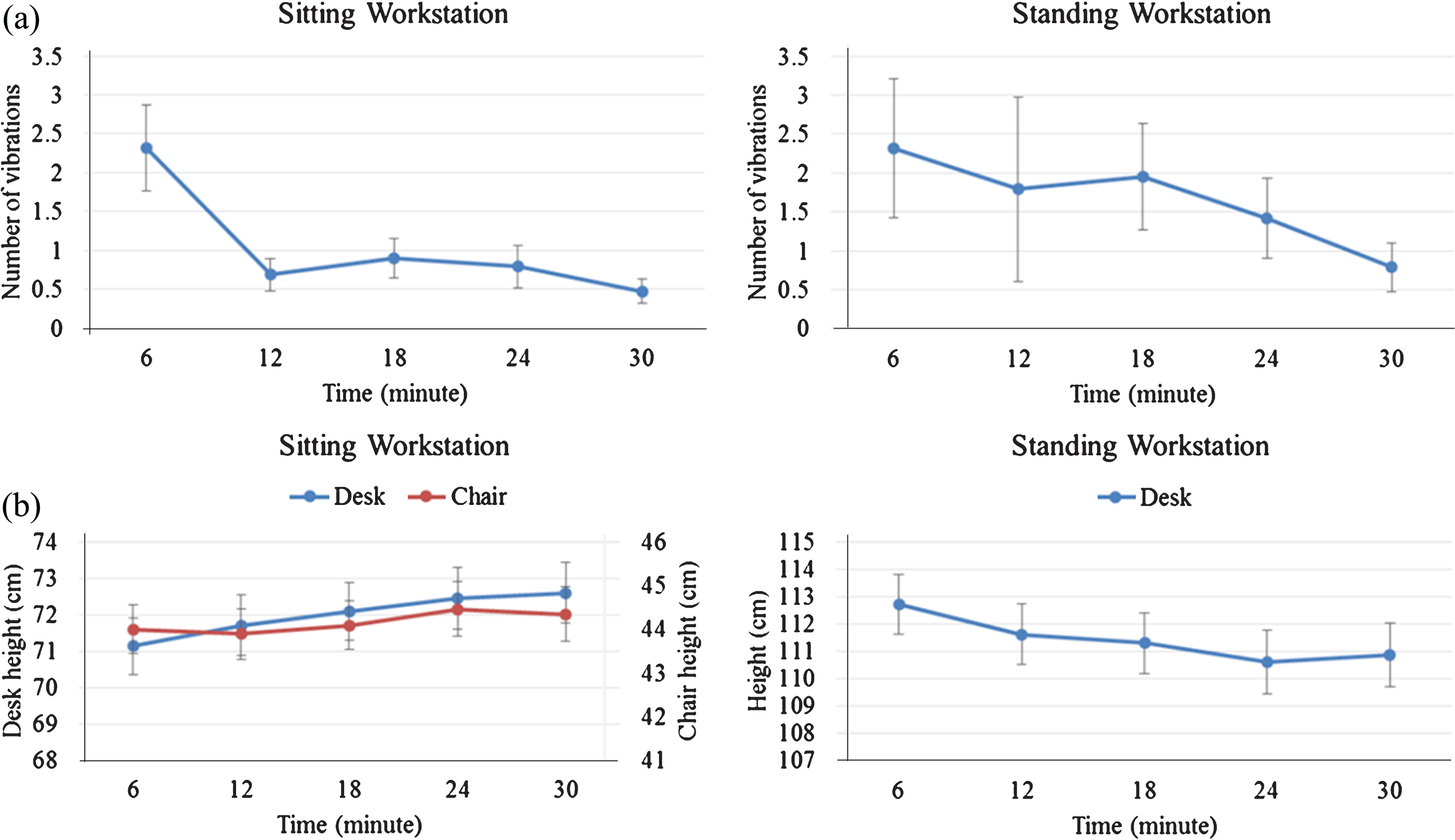
Mean and standard error of (a) the number of vibrations occurred from the wearable sensor, and (b) height of the desk and chair over time while sitting and standing. Each data point represented the average values of the preceding 6-minute interval.
Table 2 shows the mean and standard error of each dependent variable, with p-values, while sitting. With the aid of the wearable sensor, participants showed significantly lower neck flexion angles (p = 0.002) and cranio-cervical angles (p = 0.001) compared to those of participants without the wearable sensor. The neck flexion and cranio-cervical angles were decreased by 6 and 4 degrees when participants wore the sensor.
Mean and standard error of final preferred workstation configuration and associated head and neck postures in the sitting workstation
Note: Mean and standard error of each variable was summarized. *p-values < 0.05. The Wilcoxon signed ranks test was conducted for typing accuracy and speed.
Table 3 shows the mean and standard error of each dependent variable, with p-values, while standing. With the wearable sensor, participants showed significantly lower neck flexion angles (p < 0.0001) and head flexion angles (p = 0.038) compared to those of participants without the wearable sensor. The neck flexion and head flexion angles were reduced by 5 and 3 degrees while wearing the sensor. With the wearable sensor, participants had significantly longer gaze distance (p = 0.018) than did participants without the wearable sensor. The gaze distance was increased by 2 cm when wearing the sensor.
Mean and standard error of final preferred workstation configuration and associated head and neck postures in the standing workstation
Note: Mean and standard error of each variable was summarized. *p-values < 0.05. The Wilcoxon signed ranks test was conducted for typing accuracy and speed.
There was a significant effect of the wearable sensor on the gravitational moment and moment-arms at C7-T1 while sitting and standing (Tables 2 and 3). With the wearable sensor, participants showed lower gravitational moments and moment-arms compared to without the wearable sensor. The statistical significance was greater in the standing workstation (p < 0.0001) than the sitting workstation (p = 0.028). When participant wore the sensor, the gravitational moment and moment-arm were decreased by 0.4 Nm and 1 cm in the sitting workstation, and reduced by 0.5 Nm and 1 cm in the standing workstation.
Typing accuracy and speed
Typing accuracy and speed were not significantly different with and without the wearable sensor for either the sitting or standing workstations (Tables 2 and 3). Average typing accuracy ranged from 92.53% to 93.68%, and average typing speed ranged from 38.63 to 39.63 WPM.
Discussion
The objective of this study was to investigate the effect of the wearable posture correction sensor on the preferred workstation setup and associated postures of the head and neck while sitting and standing. The results showed that the wearable sensor assisted participants in achieving more upright postures of the head and neck (reduced flexion angles and gravitational moments) compared to without wearable sensor. This result supported the first hypothesis that the wearable posture sensor would reduce the flexed head and neck postures of participants and alleviate the gravitational moment on the neck.
Regardless of the wearable sensor, participants had similar preferred workstation setups, including the desk height, chair height, and laptop tilt angle for sitting and standing at the last interval (24 to 30 minutes) of the study. This result did not support our second hypothesis that the wearable sensor would assist participants in having a more upright posture than without the wearable sensor. In addition, there was no significant difference in typing performance with and without the wearable sensor.
The neck flexion angle was significantly different with and without the wearable sensor for the sitting (p = 0.002) and standing (p < 0.0001) workstations. The effect of the wearable sensor on the neck flexion angle was more significant in the standing workstation in comparison with the sitting workstation. Participants with the wearable sensor in the sitting position showed the lowest neck flexion angle (57.52°), while participants without the wearable sensor in the standing position showed the highest neck flexion angle (63.21°). The range of values in the present study was comparable to a previous study (55.0° to 60.2°) in which participants typed with a tablet computer in different positions [10]. For example, the neck flexion angle with the wearable sensor in the sitting condition (57.52°) was comparable to the more upright posture condition (desk high while reading, 56.8°), with the exception of neutral posture, reported in the previous study [10].
The head flexion angle was significantly different (p = 0.038) with and without the wearable sensor in the standing workstation. Standing participants with the wearable sensor showed a less flexed posture (81.32°) than those without the wearable sensor (84.35°). This finding was comparable to the range of values (85° to 107.3°) from previous studies that investigated the interaction of individuals with tablet devices and their positions [10, 11]. For example, the head flexion angle with the wearable sensor while sitting (80.22°) was comparable to the lowest demand condition (movie watching with the tablet, 85°) reported in the previous study [11].
The cranio-cervical angle was significantly different (p = 0.001) with and without the wearable sensor while sitting. While sitting, the wearable sensor resulted in a smaller angle (157.15°) than that without the wearable sensor (160.90°). The cranio-cervical angle is the combination of the neck and head flexion angles. The head flexion angle did not significantly vary (p = 0.156) with and without wearable sensor while sitting. Therefore, the cranio-cervical angle was mainly influenced by the neck flexion angle with (57.52°) and without (63.16°) the wearable sensor.
The average gravitational moment on the neck, which ranged from 2.60 Nm (with the wearable sensor in sitting) to 3.18 Nm (without the wearable sensor in standing), was significantly different with and without the wearable sensor for sitting (p = 0.028) and standing (p < 0.0001). The effect of the wearable sensor on the gravitational moment was more significant in the standing workstation. Our finding was comparable to the range (3 to 3.8 Nm) of the previous study that included typing with the tablet device [10]. Participants without the wearable sensor in the standing workstation showed a 1.2 times greater gravitational moment than participants with the wearable sensor in the sitting workstation. Previous studies showed that a 1.47 to 1.5 times greater gravitational demand occurs at the desk flat position compared to the desk high position [10, 12]. The gravitational moment with the wearable sensor in sitting (2.60 Nm) was comparable to the desk high reading position (approximately 3 Nm), the lowest demand condition with the tablet in the previous study [10].
Participants with the wearable sensor had a significantly (p = 0.018) longer gaze distance (55.76 cm) than without the wearable sensor (53.55 cm) while standing, and the range of gaze distances was similar to the range of the previous study [11]. A greater gaze distance was associated with a reduced neck flexion angle with the wearable sensor (58.49°) compared to without the wearable sensor (63.21°). The previous study reported that a gaze angle below –45° is associated with significantly higher strain on the neck extensors [12]. In the present study, the gaze angle ranged from –35.67° (without the wearable sensor, standing) to –30.51° (with the wearable sensor, sitting), above the threshold (–45°) reported in the previous study [12].
There were no significant differences of the workstation configuration setups, including the chair height, desk height, and laptop tilt angle, with and without the wearable sensor. Based on the psychophysical methods implemented in this study, we found that participants settled on a similar preferred setup, regardless of the wearable sensor. This indicates that the significant differences of the neck and head flexion angles and gravitational moment with and without the wearable sensor were mainly influenced by posture. In other words, given similar configurations of the workstations while sitting and standing, participants tended to approach upright postures more with the aid of the wearable sensor compared to without the wearable sensor.
For the sitting workstation, the participants preferred chair and desk heights were approximately 44 and 73 cm, respectively. A previous study found that the user’s preferred desk height in sitting is 74 cm, close to our finding [28]. For the standing workstation, the preferred desk height of participants was approximately 111 cm, higher than the preferred desk height (98 cm) reported in the previous study [28]. The difference might be due to the different tasks conducted by the participants and the different devices used in the two studies. The present study involved typing with a laptop, while the previous study involved one third keyboard work and two thirds mouse work with the desktop setting [28].
There were several limitations in this study. Only healthy young participants were recruited. Elderly participants, who have different cognitive and motor functions, might behave differently given the same psychophysical experiment setup. This was a laboratory study to investigate the effect of the wearable sensor on head and neck postures in simulated office work. Even though we found some potential benefits of the wearable posture sensor on reducing physical demands on the neck, the long-term effect of the wearable sensor on the physical stress of the neck in daily life is still unknown. Neck muscle fatigue was not addressed in this study. Each condition consisted of a 30-minute task, and the muscle activity was not monitored in this study. Future studies might address the effect of the wearable sensor on neck muscle fatigue in the longer duration task. The commercial wearable sensor used in this study was not directly validated or calibrated in our laboratory. This sensor might result in lower sensitivity to estimate neck angles in walking due to the external accelerations of the movement [25]. Since participants had static postures (Fig. 3: number of vibration was less than 1 in last period), we expect that the measurement error of the sensor would be minimal.
Conclusions
The potential benefit of the wearable posture correction sensor was investigated to find whether participants could improve their head and neck postures in office work. With the assistance of the wearable sensor, participants had 8% lower neck flexion postures and 14% lower gravitational moments on the neck, compared to without the wearable sensor for the sitting and standing workstations. The effect of the wearable sensor on the physical demands on the neck was more significant in the standing workstation compared to the sitting workstation. The present study showed that the wearable sensor could be an effective tool to alleviate postural stress of the head and neck in sedentary work. Our findings will be helpful to improve the design of the wearable sensor and to develop ergonomic guidelines for using the wearable sensor during office work.
Conflict of interest
None to report.