



Abstract
BACKGROUND:
In modern society, there is an increase both in the demand and the duration of computer work. Failure to correct body posture while using the computer has become a serious health hazard.
OBJECTIVE:
To identify global trends in research related to body posture and visual display terminals (VDTs) using a bibliometric approach.
METHODS:
In the search process, the keywords (posture *) AND (computer* OR “visual display terminal”) were used in the study title section, in the Wos, Scopus and Medline databases.
RESULTS:
149 references published between 1970 and 2016 were analyzed. The studied variables were the years of publication, authorship and collaboration index, publication type, titles of journals, most used languages, impact of the publications, as well as content of the articles.
CONCLUSIONS:
In recent years, the studies on body posture in relation to VDT have been increased both in quantity and quality of publications. The analysis and/or design of the workplace, as well as the elements that make up the computer (keyboard and mouse) are the most researched topics in the area.
Introduction
The use of computers has increased dramatically over the past decade in various offices, making staff spend a lot of time sitting in front of the computer [1].
The analysis of scientific publications is an essential tool to assess the quality and impact of knowledge. In this context, the bibliometric analysis as a subdiscipline of scientometry allows us to gain access to certain indicators of the research process and to assess scientific activity.
Lack of attention to correct body posture while using the computer has become a serious health hazard, currently costing billions of dollars each year [2]. Thus, many people are diagnosed with musculoskeletal repetitive strain [3] injuries each year [4–7]. What once was considered an adult problem, now also occurs in childhood and adolescence. Today, students begin to use computers in the preschool stage. Studies conducted on school-age children show that they experience musculoskeletal discomfort similar to that of adults during computer use [8].
Despite the amount of literature that has been published related to body posture while sitting at a computer, there is a lack of systematic and chronological studies which analyze the evolution of this research from a global perspective. This work is aimed at analyzing the scientific production in this area: its structure, development and evolution.
The bibliometric studies involve the use of mathematical and statistical methods in a specific collection of articles, to evaluate and quantify the increase or decrease of literature on a particular subject, and to manage information and scientific knowledge in a field of research [9–11]. It is an effective method for revealing the historical development and quantitative trends of publications on a particular topic [12]. As measurement of the quality of scientific publication, bibliometrics, expressed through various indicators, has become very important for researchers and organizations. For researchers, bibliometric indicators are important because they allow objective measurements of the diffusion and the impact of the articles published by a particular journal [13].
The measurement using bibliometric indicators may be controversial [14, 15], because references are searched in indexed journals, leaving certain journals out of these analyses. However, they are useful for describing and analyzing the scientific literature on a specific topic of research and for determining its importance to the scientific community.
Therefore, the present study is aimed at determining the state of research on body posture and visual display terminals, using a bibliometric and network analysis, based on a quantitative analysis of peer-reviewed articles.
Methods
Search strategy
The following keywords were used in the search process: (posture *) AND (computer* OR “visual display terminal”) in the title section of the study, since this concept was intended to be the central topic of our research. A search of articles published between 1970 and 2016 in the following international databases was performed: Web of Science (WoS), Scopus and Medline. WoS and Scopus are multidisciplinary, whereas Medline is a medical database. The information had to be electronic. Access to the full document was not required.
The first two were selected because they are multidisciplinary databases, and they are commonly used in any research project. WoS is characterized by being very selective, in the most prestigious and high impact journals. However, it includes few sources of information in languages other than English. This lack is compensated for by Scopus, who covers a wider range of journals. Slightly more than 50% of the indexed titles are unique, that is, they do not appear in WoS [16]. Compared to the Anglo-Saxon bias of WoS, Scopus has a broader linguistic and geographical coverage with a significant presence of literature from Europe, Latin America, and Asia and the Pacific [17].
On the other hand, Medline is a database specialized in Health Sciences. It covers, among others, the areas of medicine, biomedicine, nursing and public health, it has therefore been selected as a specialized database for our research.
The two authors individually extracted information from each article. Any detected discrepancies were resolved by consensus.
Data collection
Out of the selected documents and journals, the following information was collected: Years of publication, to determine the rate of growth of publications. Authorship and collaboration index, in order to identify the authors who published and the type of publication they chose, whether they did it on their own or in collaboration, with the aim of discovering leading authors, and possible working groups or networks. Types of publication, of the following categories were established according to the definitions of the Web of Science. Article: Reports of research on original works. Includes research papers, features, brief communications, case reports, technical notes, chronology, and full papers that were published in a journal and/or presented at a symposium or conference. Meeting Abstract: A general summation of completed papers that were or will be presented at a symposium or conference. Proceedings Paper: Published literature of conferences, symposia, seminars, colloquia, workshops, and conventions in a wide range of disciplines. Generally published in a book of conference proceedings. News Item: News, current events, and recent developments. Review: A renewed study of material previously studied. Includes review articles and surveys of previously published literature. Usually will not present any new information on a subject. Journal titles. The periodical publications most used in the dissemination of articles, in order to find the titles of the most specific or productive journals published on this topic. Languages used in publications. References and citations, impact studies. Network analysis.
Statistical analysis
Descriptive statistics and frequency distributions were used to analyze bibliometric indicators. The data were entered into the statistical package Excel 2010 (Microsoft Corporation, EEUU) for analysis.
The representation and visualization of the relationships established between the indexing terms were carried out by means of VOSviewer_1.6.5. The most common keywords were calculated, and a co-occurrence network was developed with combinations of word pairs. Point density was calculated using the number of neighboring items and their weight [18].
Results
An analysis of the results found in each of the above-mentioned databases was performed. A total of 229 references were identified (WoS: 135 results, Scopus: 6 results, and Medline: 88 results). After removing duplicates (n = 80), there were 149 references included in the analysis, published from 1970 to 2016.
Year of publication
There was a large difference in the number of publications during the time frame studied, indicating that this field has gained interest in recent years (Fig. 1). In the early 1990s the number of recorded publications increased significantly. Since 2007, there has been a strong increase, with a peak of 12 publications in 2008 and 11 publications in 2013.

Number of publications by year.
Out of the 149 articles included in this analysis, only 13.42% were published by a single author. The collaborations between two or three authors were 46.31%, representing 22.15%, and 24.16% respectively (Fig. 2).
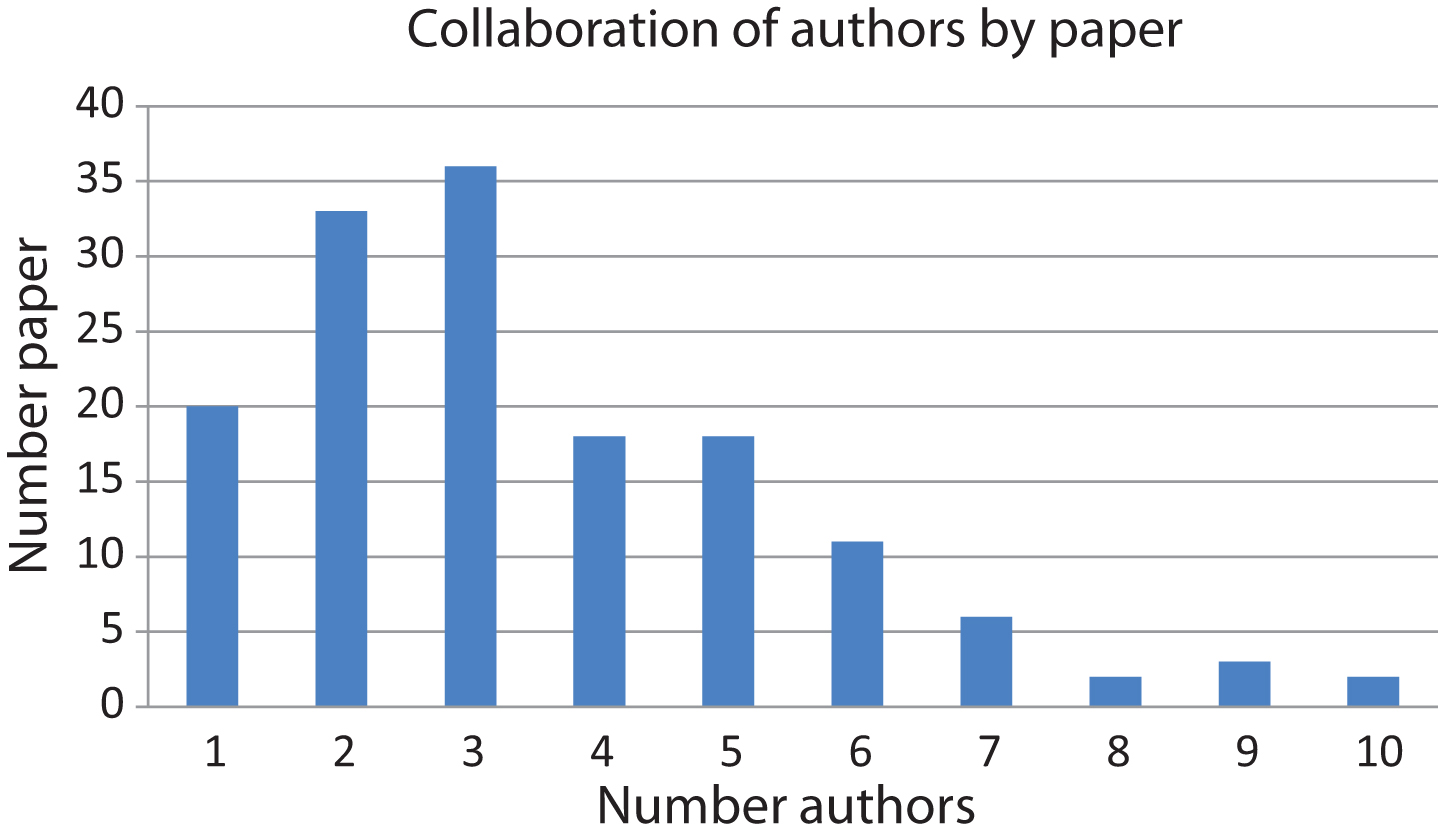
Collaboration of authors by paper.
The most productive authors can be observed in Table 1, which considered researchers with five or more publications.
More productive authors
Figure 3 shows the relationships established between authors.

Co-author network.
The majority of publications (73.15%) refer to journal articles, although a high proportion (19.46%) refers to communications and presentations at peer-review international conferences (Fig. 4).

Distribution by the type of publication.
The journals of Ergonomics (ISSN: 0014-0139), Work: A Journal of Prevention, Assessment & Rehabilitation (ISSN: 1051-9815), and Applied Ergonomics (ISSN: 0003-6870) published the most on the subject, with 12 publications per journal, 24.2% of publications. In general, there was great dispersion of the publications (Fig. 5).
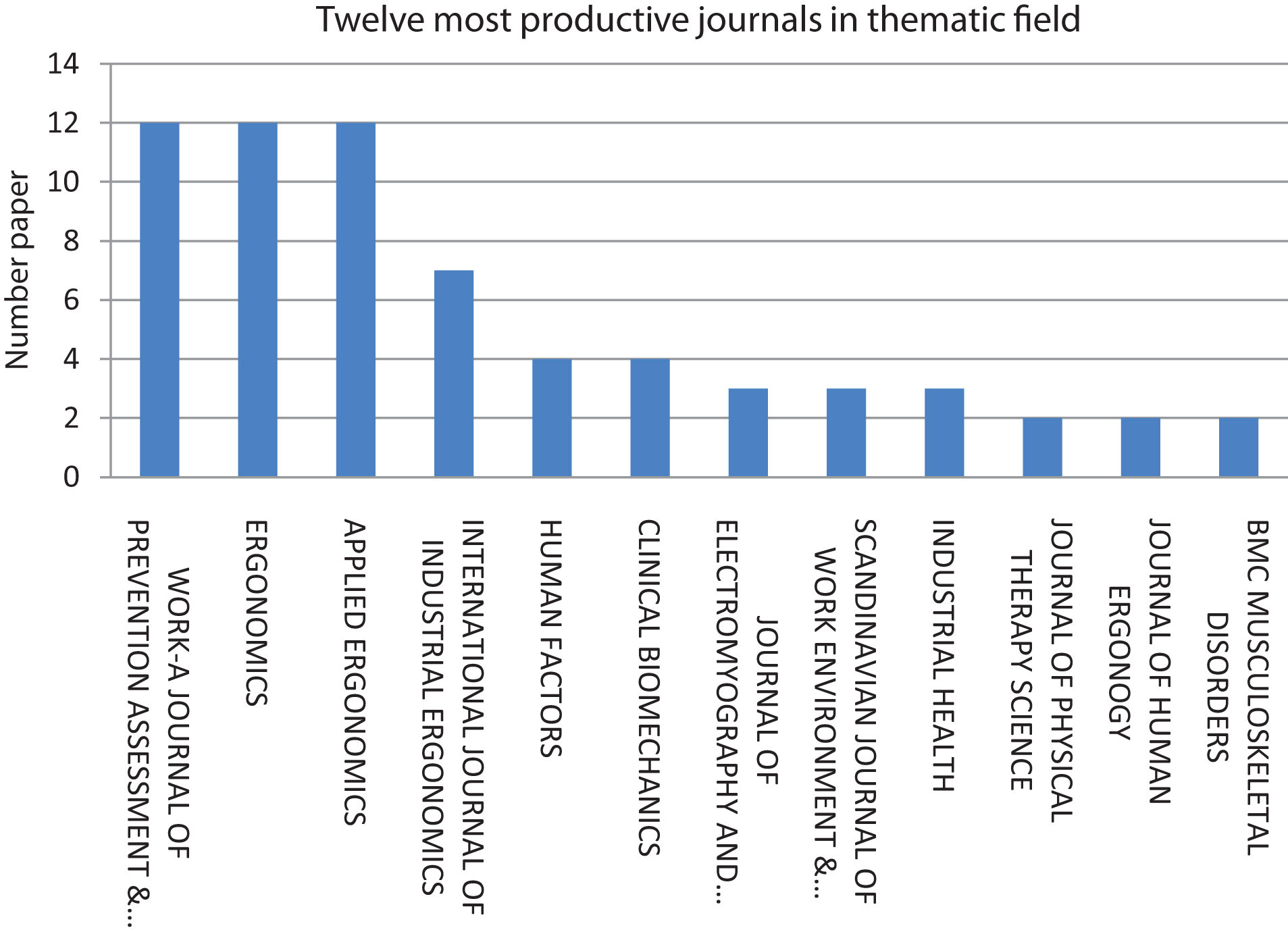
Twelve most productive journals in thematic field.
The most frequently used language was English in 92.6% of the cases (138 publications), followed by Portuguese, German, Russian and Japanese, with two publications in each. Finally, three other publications were identified: one in Slovak, one in Italian and one in French. In terms of geographical distribution, the United States had more publications than any other country (29.1%), followed by Australia (9.15%), the Netherlands (8.45%), Japan (8.45%), Canada (6.34%) and South Korea (5.63%).
References and impact factor
A study of the impact factor of journals with the highest number of publications on the topic (Table 2) was carried out, also including the most cited articles on the subject under study (Table 3). It should be noted that the most referenced journals are indexed both in the Scimago Journal & Country Rank (SJR) and the Journal Citation Reports (JCR). The most cited articles are those with the highest impact factor and they are usually journals.
Impact factor on the three most productive journals
Impact factor on the three most productive journals
The journals with the most publications obtained the following impact factor in the Journal Citation Reports 2015: Work: a journal of prevention assessment & rehabilitation (0,715); Ergonomics (1,449); Applied Ergonomics (1,713); Human Factors (1,370); Clinical Biomechanics (1,636); Journal of Electromyography and Kinesiology (1.530); Scandinavian Journal of Work Environment & Health (3.793); Industrial Health (1,057).
Table 3 includes Google Scholar, aimed at verifying the citation and assessing the scientific disclosure of these articles. However, it was not used in the search (Table 2) because the objective was to find peer-reviewed scientific publications.
“Top ten” articles
The five research areas with the highest number of publications are as follows: engineering (n = 67); psychology (n = 34); public, environment and occupational health (n = 25); computer science (n = 18) and rehabilitation (n = 11). It should be noted that some research studies are listed in more than one areas within the databases.
The most common keywords were calculated, and a co-occurrence network was developed with combinations of word pairs. Point density was calculated using the number of neighboring items and their weight. The items are indicated by a label and, by default, also by a circle. The more important an item, the larger its label and its circle. If colors have been assigned to items, each item’s circle is displayed in the color of the item. By default, to avoid overlapping labels, only a subset of all labels is displayed [18].
Figure 6 shows the relationships of the keywords with each other, the co-occurrence and the frequency of occurrence by the size of the node. Based on a clustering technique, the journals in the data set were divided into seven clusters. These keywords show the main topics of the articles. The terms posture, computer and visual display terminal are not reflected in the keyword network, because they are search terms.
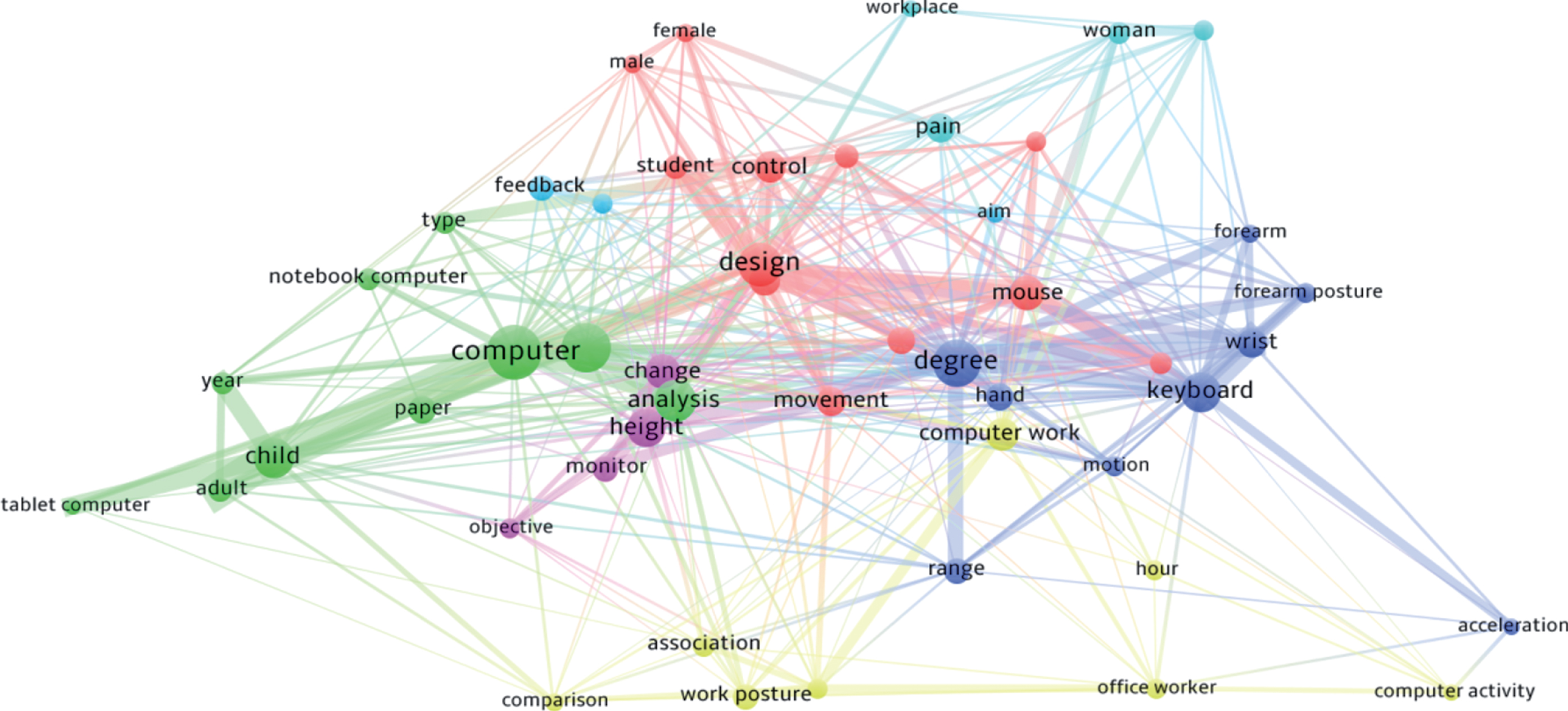
Keyword Network.
The most frequently used terms, excluding the search terms are: design, degree, analysis.
Other common terms in studies on body posture and visual display terminals are: terms referring to the type of sample (woman, man, child, adult or office worker), body areas (upper limb posture, wrist posture, forearm or hand), the devices to analyze (laptop, keyboard paper, mouse, tablet or work equipment), the type of design and methodology applied in the study (control, association or comparison) or the variables analyzed in the research (questionnaireon posture, pain, electromyography, hours, time, movement).
In view of the results obtained, this work presented a summary of the research on body posture and its relationship with VDTs.
Although the measurement through bibliometric indicators may be controversial [14, 15], it is useful for describing and analyzing the scientific literature on a specific topic of research and for determining its publication frequency and the consumption of information. to the scientific community.
Its great strength lies in the fact that its calculation is very simple, easy to interpret and allows comparison of journals or articles published, institutions, research teams and individual researchers worldwide according to their “productivity”. However, the calculation of this indicator also suffers from several important limitations [14], among which there is the fact that references are searched only among indexed journals ... and also that quality is not a criteria for inclusion in the analysis.
It should be taken into account that the scientometric indicators are different depending on the field of study, and this hinders the comparative analysis [19]. In terms of variables selected to classify documentary information on body posture and visual display terminals and the chosen bibliometric indicators, it should be pointed out that there are few publications on the topic from the 1970’s, due to the scarcity of computers at that time. However, there has been a growing interest in this topic in recent years. This fact may be due to computer use at increasingly earlier ages. The relatively recent expansion of computer use among these younger populations could be a factor that to some extent may account for the increasing number of publications in recent times.
There is a clear tendency to publish as a single author or in small groups of two to three researchers, therefore it can be pointed out that research groups are rather small. This is linked to funding, since the number of co-authored articles increases when it comes to works receiving financial aid.
However, it should be noted that a significant proportion of these research studies are co-authored by seven authors, making up the largest working group and with the highest number of publications (Dennerlein, Garza, Huymans, Eijckelfof, Johnson, Van de Beek, Van de Dien) [20–25]. The importance of the author J. Dennerlein can also be observed, since he is the author with the highest number of publications, and the one who carried out the highest number of studies in collaboration with other authors. The number of publications may be due to their consolidation as a research group. The topic selected by these researchers refers to the muscular activity and posture of VDT users.
The study conducted by Gerr et al. [26], should also be noted, as it has the highest number of citations on this topic: 97 in WoS, 125 in Scopus and 206 in Google Scholar. The high number of citations may be due to the fact that they perform a review examining the epidemiological evidence of associations between the results of musculoskeletal disorders and the computer user’s posture, as well as intensity of keyboard use. This is followed by the work carried out by Van der Beek et al. [27] and Fransson-Hallet al. [28] with 67 and 61 citations in WoS respectively. In both, portable ergonomic observation methods are employed to monitor the sitting posture in the workplace. This is a factor that provides greater reliability of assessment of musculoskeletal disorders among workers associated with the job.
Regarding journals that publish on the topic, a great variety is observed and most contain only one article, leading to a great dispersion of publications. The journals with the highest number of publications on the topic are: Work: A Journal of Prevention, Assessment & Rehabilitation, Applied Ergonomics and Ergonomics. It should be observed how these journals have been gaining impact factor over the years. The three journals are included in the Journal Citation Report, with an impact factor in 2015 of 0.715, 1.713 and 1.149 respectively.
Regarding the content analysis, it was found that the main areas of study were engineering, psychology and public health, environment and occupational health. Among the most studied topics, the analysis and/or design of the workplace should be pointed out. In our opinion, this occurs because musculoskeletal disorders are one of the reasons that have a high cost for the healthcare system [2], as well as an increase of sick leave days.
The output devices of the computer, such as the keyboard and mouse should also be considered, which could be due to their increasing use [1].
From the results of this study, it could be claimed that there is a evolution to publish in journals with a higher impact factor and to increase international collaboration, these factors indicating a positive advance of the international research in this area. The availability of databases of indexed journals increased the use of bibliometric analyses to a great extent [29], thus, this analysis allowed us to obtain in a fast and effective manner the global trends in the research on body posture and visual display terminals.
Practically, these indicators can help researchers in selecting the journals to which to submit their manuscripts. For organizations, bibliometric indicators are important because they allow objective measurements of the quality of particular research, individual researchers, or a researcher group. These indicators can help organizations to make decisions regarding appointments, promotions, and funding [13].
Study limitations
The main limitation of this research is that the methodological aspects mentioned in the studies could not be addressed in detail, due to the large sample size, i.e. limited content analysis. However, the set of collected and presented data broadly characterizes the productivity of the research and the impact of the topic under study.
Another significant limitation is that only electronic versions of material were included in the study.
The main strength of this study is that it adds a clear pattern of how research in this area is. Obtaining a better understanding of academic, institutional and geographic academic networks, which become apparent through specialized journals.
Conflict of interest
The authors have no conflict of interest to report.
Funding
The research study that gave rise to the present work was supported by a grant-in-aid to the first author (PRE/2013/405) for her Predoctoral stage, provided by the Department of Culture, Education and University Organization (Xunta de Galicia).