



Abstract
BACKGROUND:
The quality of the places where workers take their breaks may affect the completeness of recovery in the time available. Little is known about how characteristics of a company canteen buffer the relationship between job demands and fatigue.
OBJECTIVE:
We addressed the possibility that the company canteen buffers the relationship between job demands and fatigue to the extent that workers perceive it to hold restorative quality. Further, we considered how the restorative quality of the canteen signals the provision of organizational support, another job resource thought to buffer the demands-fatigue relationship.
ETHODS:
A questionnaire was completed by 141 male blue collars workers during their lunch break in the factory canteen of an Italian industrial organization.
RESULTS:
Canteen restorative quality correlated positively with organizational support. In multivariate regression analyses, the demands-fatigue association was weaker among workers who saw greater restorative quality in the canteen. This buffering effect was accounted for by a buffering effect of organizational support.
CONCLUSIONS:
When settings for rest in the workplace have higher restorative quality, they may better function as job resources in two respects: serving the immediate needs of workers for recovery from job demands, and signaling the interest of the organization in their well-being.
Keywords
Introduction
A person’s desire for temporary relief from stressors and replenishment of resources (i.e., perceived need for recovery) is a strong predictor of well-being in the context of work [1, 2]. Employees who experience a high need for recovery are characterized by feelings of overload, lack of energy and reduced performance [3]. Lack of recovery from efforts to meet job demands increases the likelihood of strain reactions and health problems [4–7]. It is therefore important for employees to regularly replenish the resources they deplete in their work. Legislation and organizational policies commonly support this objective in various ways, including provisions for times and places for coffee and lunch breaks at the workplace during working hours.
The quality of the places where workers take their breaks may affect the completeness of recovery in the time available. It is therefore relevant to consider which physical and social features of those places are potentially important to replenish worker’s resources. Research published in this journal has to date considered a variety of aspects of recovery from job demands inside as well as outside of the workplace [8, 9], but the physical and social features of break settings that support recovery have yet to receive attention in WORK. This state of affairs is characteristic of the field of work and organizational psychology generally. Observing that there is little research on this topic, de Bloom, Kinnunen and Korpela [10] recently described environmental and psychosocial factors potentially involved in recovery by knowledge workers during a lunch break. Those factors included where they spend their breaks and whether they have the company of others. More recently, Nejati, Shepley, Rodiek, Lee and Varni [11] investigated staff break areas in healthcare facilities and concluded that improvements in their restorative quality (e.g., having access to private outdoor spaces such as balconies or porches) could improve nurse’s satisfaction and stress reduction.
We add to this small body of literature by investigating how characteristics of a company canteen buffer the relationship between work overload and fatigue among blue collars workers in heavy industry. Specifically, we examine the possible buffering effect of restorative quality perceived in the canteen environment, of itself and as a manifestation of organizational support perceived by workers. We thus consider the novel possibility that a buffering effect of the restorative quality of the canteen environment is a component of and so accounted for by the buffering effect of organizational support. As the basis for this proposition, we integrate theoretical frameworks from environmental and work psychology. Specifically, attention restoration theory (ART) [12, 13] describes how transactions between a person and the sociophysical environment may promote recovery from cognitive job demands, whereas the job demands-resources model (JD-R) [14, 15] describes how job resources (e.g., perceived organizational support) can buffer the adverse effect of job demands and reduce their negative consequences at work (i.e., fatigue at work).
In the following, we first explain the construct of restorative quality in environments. In the subsequent sections we then elaborate on the JD-R model [14, 15]; the construct of perceived organizational support (POS), and how the restorativeness of break environments and POS may work to buffer the overload-fatigue relationship. We conclude our introduction by presenting the hypotheses that guided the present research.
The restorative quality of break environments
Aspects of the physical design of the work environment (e.g., lighting quality, temperature, spatial layout) can harm or improve performance of work tasks either directly, by affecting the work activity itself (e.g., poor illumination making it difficult to see) [16], or indirectly, by affecting the physical and psychological resources a worker needs to continue working. In looking at aspects of the work environment that have an indirect effect, much attention has been given to those that deplete resources and so engender stress, such as acoustic properties of the environment [17], as they ultimately can have negative effects on productivity and workers’ health [18]. Relatively little attention has been given to the characteristics of work environments that help people continue working by enabling faster and more complete restoration of those resources that would inevitably be depleted even when the environmental conditions for work performance are good.
Research within environmental psychology has however led to the formulation of theory concerned with how the sociophysical environment can support psychological restoration. Attention restoration theory (ART) [12, 13] is primarily concerned with mental fatigue, which involves an inability to willfully direct attention in work tasks and otherwise exercise executive control. ART offers an explanation for how the capacity to direct attention can be restored. Four properties of person-environment transactions are seen supporting a process of attention restoration [12, 13]. First, and of focal concern, fascination is described as an effortless form of attention which when employed allows rest of the inhibitory mechanism on which directed attention depends. Second, restoration is additionally enabled and sustained by a sense of being away, that is, having the sense that one is in a different place and/or engaged with different mental contents [13]. This may be facilitated by a physical separation from work tasks, but the emphasis in ART is on being psychologically removed or distant from demands and routine contents. Third, extent refers to the scope and coherence of the environment as it extends in time, space and even conceptually; that is, the extent to which it is perceived to be possible to enter and spend time in it, to perceive it as a larger whole. Finally, compatibility refers to a fit between environmental supports (or demands), the person’s inclinations or purposes, and the actions required of the person by the environment [19].
Research with ART has generally focused on how the natural environment in particular offers experience characterized to a relatively high degree by these four components (i.e., its perceived restorativeness) [20]. Some of this research has also considered opportunities for micro-restorative experiences available at one’s desk in an office workplace [17, 21] and in cafés [22]. To date, little work has been done on break rooms (for an exception regarding art museum visitors, see [23]). With a view to the work setting more generally, Bellini, Fornara, and Bonaiuto [24] considered the relationship between perceived restorative quality in offices and positive work outcomes (e.g., work engagement, job satisfaction) in a sample of industrial workers. They found the restorativeness of the work setting positively associated with job satisfaction and work engagement. Moreover, their results suggest that restorativeness can influence intrinsic job satisfaction indirectly via work engagement, and extrinsic job satisfaction both directly and indirectly via work engagement.
The constructs in ART are used to explain a process through which a cognitive resource becomes restored; however, this process may also generate other outcomes, such as improved affect, and it can proceed together with the reduction of psychophysiological activation characteristic of acute stress recovery [25]. Further, the constructs in ART resemble those in other theorizing concerned with restoration in the context of work. Notably, psychological detachment resembles being away and is described in the effort-recovery (E-R) model [7], while ideas about mastery and control are congruent with the construct of compatibility and appear in the conservation of resources (COR) theory [26]. According to the E-R model, effort at work leads to strain reactions (e.g., fatigue), and when individuals no longer face job demands, recovery can occur. According to the COR theory, stress occurs when an individual’s valued resources (e.g., energy) are threatened or lost or when no resources are gained after resource investment. Therefore, to recover from stress an individual has to gain new resources or restore threatened or lost resources. In this process mastery and control may be helpful [26].
The job demands-resources model (JD-R)
The significance of the restorativeness of break settings in workplaces can be further understood with regard to the broader dynamics of resource depletion and restoration in the workplace as described by the job demands - resources model (JD-R) [14]. The JD-R model organizes social and psychological work characteristics into two categories: job demands and job resources [14, 27]. Job demands are “all physical, psychological or social aspects of the job that require sustained physical or mental effort and that are therefore associated with psychological costs, such as emotional exhaustion” [15, p. 501]. Job resources are “those aspects of the job that are functional in achieving work goals, in stimulating personal growth and development, and in reducing job demands and the associated psychological costs” [15, p. 501]. Because restorative environments help people to gain psychological distance from depleting circumstances and replenish psychological resources, they can be considered job resources.
Job demands are assumed to deplete energy and other resources [14]. Research has found consistently positive associations between workload, emotional demands, and cognitive demands on the one hand and emotional exhaustion on the other hand [27–30]. Job resources in general protect workers against the adverse effects of job demands, and a lack of resources is considered to have health-impairing consequences [27, 29]. More specifically, job resources are expected to foster workers’ growth, learning and development [27], and to reduce their work stress [14]. Different studies affirm that job resources buffer the negative impact of job demands on individuals’ psychological outcomes [31, 32].
Based on the theoretical grounds and empirical work we have cited, we expect that job demands are positively linked to fatigue at work; and that the restorativeness of settings available for work breaks (considered here as a job resource) moderates the relationship between job demands and fatigue. We focus here on job demands framed in terms of work overload and cognitive demands because work with the JD-R model indicates that both of them have negative effects on work outcomes [14].
Social support in the work context
In general, social support encompasses the emotional, mental and material support a person can obtain from a social network, helping the person to feel that he or she is cared for, loved, esteemed, and valued [33]. Social support is positively related to psychological and physical health [34]. An important dimension of social support in the work context is perceived organizational support, or employees’ “beliefs concerning the extent to which the organization values their contribution and cares about their well-being” [35, p. 501]. According to a social exchange view, an organization’s provision of support will induce reciprocity on the part of employees [36–38]. A meta-analysis [38] confirmed that POS has a strong, positive association with job satisfaction and organizational commitment; a moderate, positive association with employee performance; and a strong, negative association with intention to leave.
The JD-R model [14] considers social support as a job resource which can reduce the psychological impact of job demands, which is functional in achieving work goals and which encourages personal growth, development, and learning [27]. The JD-R model thus assumes that social support (and by extension perceived organizational support) should play a moderating or buffering role in the relationship between job demands and the potential negative consequences of exposure to them [31, 32]. Moreover, like other indications that the organization cares for the well-being of employees, the restorative quality of the company canteen can be framed as an expression of perceived organizational support.
Study aim and hypotheses
The present study aimed to investigate how perceived organizational support and the perceived restorative quality of a company canteen buffer the relationship between job demands and fatigue. The following hypotheses are proposed:
Hypothesis 1a: Job demands (framed in terms of work overload) will be positively associated with fatigue.
Hypothesis 1b: Job demands (framed in terms of cognitive demands) will be positively associated with fatigue.
Hypothesis 2a: The restorativeness of the lunch setting will moderate the relationship between work overload and fatigue, such that the relationship will be weaker when restorativeness is higher.
Hypothesis 2b: The restorativeness of the lunch setting will moderate the relationship between cognitive demands and fatigue, such that the relationship will be weaker when restorativeness is higher.
Hypothesis 3a: Perceived organizational support will moderate the relationship between work overload and fatigue, such that the relationship will be weaker when support is higher.
Hypothesis 3b: Perceived organizational support will moderate the relationship between cognitive demands and fatigue, such that the relationship will be weaker when support is higher.
An open question for the present research concerns the co-action of the two job resources: To what extent do restorativeness and perceived organizational support independently moderate the relationship between job demands and fatigue? Conceivably, the design and maintenance of work environments that confer restorative quality, and the social activities that occur within them, also reflect on the concern of the organization for its employees and the sense that one has support from coworkers.
Methods
Participants and procedure
The study was conducted in April 2014 during workday lunch breaks in a company canteen of a South Italian petrochemical organization. Workers were invited by a researcher to participate on a voluntary basis and they were informed about the aim of the study. They completed the questionnaire in the canteen during the break. A total of 400 questionnaires were randomly distributed during one week, and 170 workers returned their questionnaires to the researcher when they left the canteen. Twenty nine of these were incomplete. All participants who provided complete data (N = 141) were blue collars workers. All participants were men, and most (77.3%) were in the age range 20 to 49 years. The majority of the workers had a permanent position (80.9%), and had long-term experience within the organization (18.8% of the sample had over 16 years of experience, 39.1% participants from 12 to 16 years, 15.9% from 6 to 11 years, and the remaining 26.1% had 5 years or less of company experience). The majority of participants (83%) worked from 7 to 9 hours per day, and they spent about 30 minutes per day in the canteen (91.5%).
Company canteen
The company canteen has a rectangular shape and is about 50 m×30 m in area, with a ceiling height of about 4 m. It can be used by about 250 workers at the same time, with seating at tables (ca. 1.5 m square) arranged in rows.
Every day, during the peak-hours (12–3 pm), about 700 workers visit the canteen in successive shifts of 45 minutes. During their lunch break, workers can freely choose locations that offer two quite different views out from the canteen’s windows. Some can see urban elements (e.g., cars, factory), while others can view natural elements of different kinds (e.g., the sea, some trees, green areas). Previous research has found natural elements to elicit higher ratings of restorative quality framed in terms of ART [12, 13].
The company canteen was crowded and during data collection the workers often complained to the canteen’s staff about such matters as the quality of food, time spent waiting for it, and lack of courtesy by the staff. Thus, the canteen and the routines enacted there could involve demands of their own.
Measures
Participants filled in a questionnaire that included self-report measures of work overload, cognitive demands, perceived restorativeness, perceived organizational support, and fatigue. All measures are previously tested Italian translations of the original versions published in English. The measures are widely used and have previously been shown to have good validity and reliability properties, as described in the respective references given below. For each measure, the score used in the analyses was the mean of the item responses.
Work overload was measured with the Job Content Questionnaire (JCQ), an instrument validated in previous studies [31, 32]. It includes four items referring to quantitative, demanding aspects of a job in which workers have too much to do (e.g., time pressure, working hard). A sample item is “My job requires working very hard”. Items were scored on a 5-point scale, from never (=1) to always (=5). For the present sample, Cronbach’s alpha = .85.
Cognitive demands were also measured with the Job Content Questionnaire (JCQ), which includes four items that refer to demands that involve cognitive processes, such as directed attention. A sample item is “My job requires a lot of concentration”. Items were scored on a 5-point scale, from never (=1) to always (=5). For the present sample, Cronbach’s alpha = 0.87.
Perceived restorativeness was measured with 16 items from an Italian version [39] of the Perceived Restorativeness Scale (PRS) [20] a scale intended to represent the constructs described in ART. Instructions for the scale directed respondents to focus on the canteen when making their ratings. Each item was rated on a 7-point scale, from strongly disagree (=0) to strongly agree (=6). Examples of items regarding the canteen are: “It is an escape experience” (being away); “The setting has fascinating qualities” (fascination); “Being here suits my personality” (compatibility); and “There is too much going on” (coherence as an aspect of extent; negatively formulated). Cronbach’s alpha was.85 for fascination,.88 for compatibility,.36 for coherence and.47 for being away. The low internal consistencies for coherence and being away appear to stem from a lack of variability, with the majority of responses at the low end of the scale. Analyses of PRS data have often used the total item score because of strong correlations among factors. This was the case in the present study as well (e.g., rbeingaway - fascination = 0.56; rfascination - compatibility = 0.86), and the analyses here therefore focus on restorativeness in general rather than the individual components of restorative experience. In the present sample, Cronbach’s alpha for the total scale was .93.
Perceived organizational support was measured with the 8-item Italian version [40] of the Survey of Perceived Organizational Support (SPOS) [35]. Respondents rate their level of agreement with the survey statements on a 5-point scale with options ranging from not at all (=1) to completely (=5). Two examples of items are: “Help is available from the organization when I have a problem” and “The organization cares about my opinions”. In the present sample, Cronbach’s alpha = .89.
Fatigue was measured with five items for thetiredness dimension of the Four Dimension Mood Scale (the revised factorial structure of PANAS) developed by Huelsman, Nemanick, and Munz [41]. The instructions for the scale asked the respondents to report on how they felt at the moment. Each adjective is rated on a 5-point scale, from not at all (=1) to completely (=5). Examples of the adjectives used are “fatigued”, “tired”, and “exhausted”. In the present sample, Cronbach’s alpha = 0.88.
Socio-demographic and occupational variables
The questionnaire also included questions about socio-demographic characteristics and job-related variables. Those used in the present analyses were age (six categories, from 19 years to over 60 years); kind of contract (permanent contract = 1, temporary contract = 2, other forms of contract = 3; recoded into permanent contract vs temporary contract, because workers had only those two kinds of contract); and duration of employment (six categories, from one year = 1 to over sixteen years = 6). Gender was not included because all members of the population were male.
The questionnaire also invited the respondent to describe what he saw outside from the canteen windows. Responses were used to create a variable that reflected on the amount of natural and built elements, from a view with only natural elements (=1) to a view with only urban/built elements (=6). During their lunch 34.1% of the workers reported seeing mostly natural elements (ratings of 1 or 2), while 26.8% employees saw mostly urban or built elements (ratings of 5 or 6) and 39.1% workers did not indicate a predominance of urban/built or natural elements (a rating of 3 or 4).
Data analysis
Confirmatory factor analyses affirmed that each of the five construct measures could be treated as unidimensional, with fit indices satisfying standard criteria [e.g., Comparative Fit Index >0.90 [42], Root Mean Square Error of Approximation <0.08 [43]; additional details available from the first author on request].
Our hypothesis tests, and our tests of the extent to which restorativeness and perceived organizational support independently moderate the effects of job demands on fatigue, were performed within a multiple linear regression framework using SPSS version 20 and the PROCESS macro developed by Hayes [44]. Given a strong bivariate correlation between the two job demand variables and to simplify the examination of their respective interactions with the job resource variables (restorativeness and POS), separate analyses were run with either work overload or cognitive demands as a predictor. We tested four separate models with each of these job demand variables. In Model 1, we regressed fatigue on the given job demand variable together with restorativeness and POS. In Model 2 we added one interaction term, the given job demand variable × restorativeness. Model 3 also had only one interaction term, but for the given job demand variable × POS. Model 4 included both of the interaction terms.
Common method bias (CMB) was examined using methods proposed by Podsakoff, MacKenzie, Lee, and Podsakoff [45]. All construct variables were loaded into an exploratory factor analysis to determine the number of factors necessary to account for the variance in the variables. Bias is indicated when either a single factor or one “general” factor explains a majority of the total variance. Further, taking direction from Mossholder, Bennett, Kemery, and Wesolowski [46], all variables were loaded on one factor to examine the fit of a confirmatory factor analysis model tested using the AMOS statistical package in SPSS. If common method variance is largely responsible for the associations among the variables, the one-factor CFA model (the simplest model) should fit the data well [45, 46].
Results
Descriptive statistics
Means (SDs) and bivariate correlations among the measured variables are presented in Table 1. Work overload was significantly positively associated with fatigue. As noted above, cognitive demands correlated strongly and positively with work overload; however, it did not correlate significantly with fatigue. Age, kind of contract and experience in the organization had only weak correlations with the other predictors and the fatigue outcome (all r < 0.10).
Study Variables: Descriptive Statistics and Bivariate Correlations (N = 141)
Study Variables: Descriptive Statistics and Bivariate Correlations (N = 141)
Note: For age (six categories, from 19 years to over 60 years old), kind of contract (permanent contract = 1 vs temporary contract = 2), and duration of employment (six categories, from one year = 1 to over sixteen years = 6), means and standard deviations are not reported because these variables were categorical in the questionnaire. POS = Perceived Organizational Support. Restorativeness was measured on a 7-point scale, with higher values indicating greater perceived restorativeness. Work overload, cognitive demands and fatigue were all measured on 5-point scales, with higher values indicating higher levels of the construct. *p < 0.05; **p < 0.01.
One correlation of interest here is not presented in Table 1, and that is the correlation between the amount of natural content in view from the canteen and perceived restorativeness. The correlation is weak (r = –0.07) and not significant. On average, the restorativeness of the canteen was rated quite low.
As foreshadowed by their weak bivariate correlations with fatigue, we found that age, kind of contract and experience in the organization did not contribute significantly to explanation of fatigue in the multivariate regression analyses. We therefore pared them from the analyses for which we report the results here.
Hypothesis 1a: Job demands (framed in terms of work overload) will be positively associated with fatigue.
Results of the regression analysis confirmed a positive association between work overload and fatigue (p < 0. 001), as reported for Models 1–4 in Table 2.
Hierarchical Regression Analyses of the Independent and Interactive Associations of Work Overload (WO), Perceived Restorativeness (PR) and Perceived Organizational Support (POS) with Perceived Fatigue (N = 141)
Hierarchical Regression Analyses of the Independent and Interactive Associations of Work Overload (WO), Perceived Restorativeness (PR) and Perceived Organizational Support (POS) with Perceived Fatigue (N = 141)
POS, work overload, cognitive demands and fatigued were all measured on 5-point scales, with higher values indicating higher levels of the constructs. *p < 0.05; **p < 0.01; ***p < 0.005.
Hypothesis 1b: Job demands (framed in terms of cognitive demands) will be positively associated with fatigue.
Results of the regression analysis did not confirm that greater cognitive demands were associated with more fatigue (p > .05) for any of the models reported in Table 3.
Hierarchical Regression Analyses of the Independent and Interactive Associations of Cognitive Demands (CD), Perceived Restorativeness (PR) and Perceived Organizational Support (POS) with Fatigue (N = 141)
*p < 0.05; **p < 0.01.
Hypothesis 2a: The restorativeness of the lunch setting will moderate the relationship between work overload and fatigue, such that the relationship will be weaker when restorativeness is higher.
The interaction between restorativeness and work overload was negative and significant (p < 0.05), as reported for Model 2 in Table 2. The interaction is depicted in Fig. 1. Among workers who gave the canteen relatively low restorativeness ratings, there was a significant positive association between work overload and fatigue. The respective tests of the simple slopes relating fatigue to work overload at the low end and mean of restorativeness yielded b = 0.68, 95% CI = 0.41 to 0.95, t = 4.99, p < .001; and b = 0.41, 95% CI = 0.18 to 0.64, t = 3.59, p < 0.05. Conversely, for those who rated restorativeness relatively high, there was a non-significant association between workoverload and fatigue, b = 0.14, 95% CI = –0.19 to 0.47, t = 0.82, p = .412.
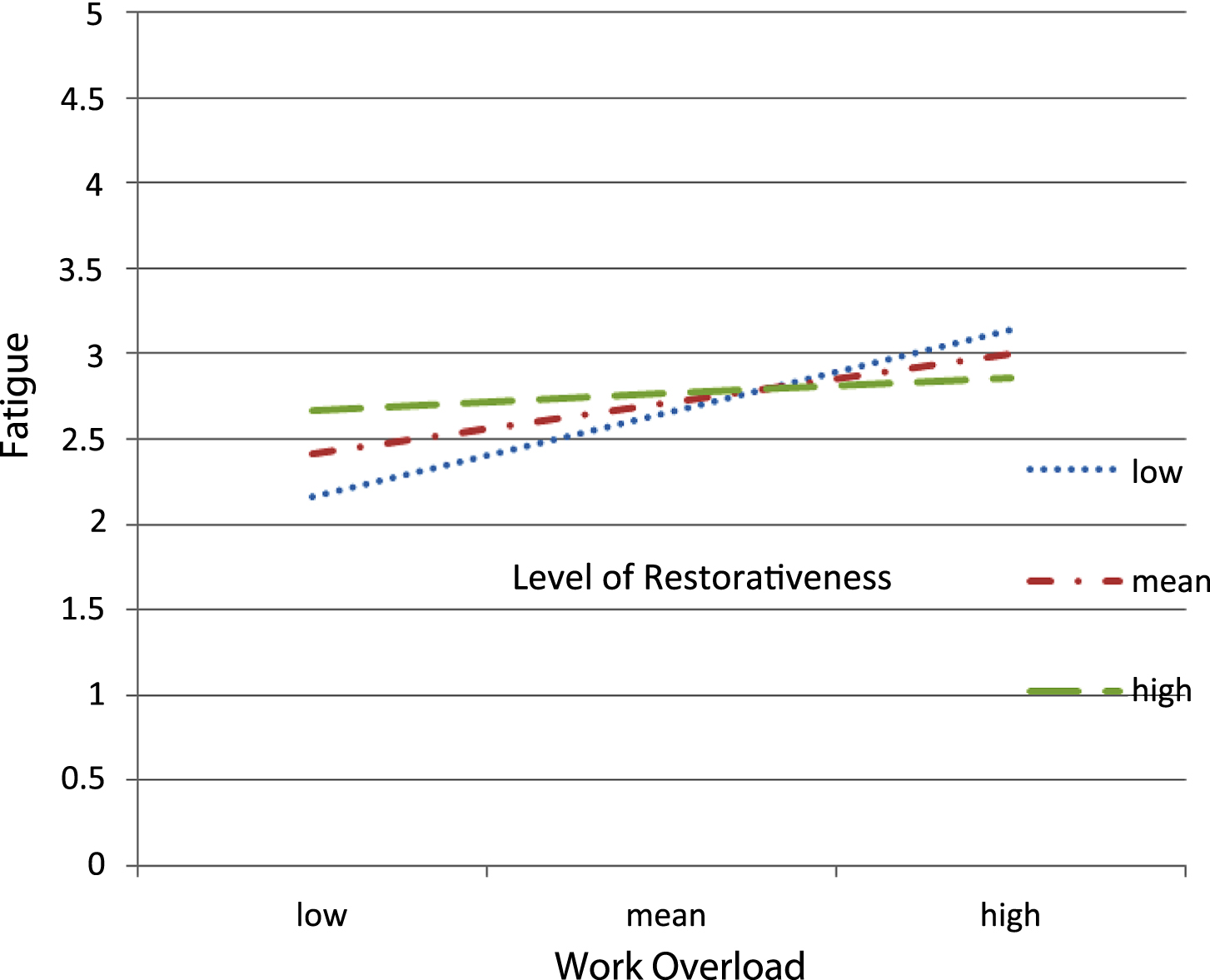
Interaction Between Work Overload and Perceived Restorativeness of the Canteen in the Explanation of Variation in Fatigue.
Hypothesis 2b: Restorativeness will moderate the relationship between cognitive demands and fatigue, such that the relationship will be weaker when restorativeness is higher.
In contrast to the test of the main effect of cognitive demands, the test of the interaction between cognitive demands and the restorativeness of the canteen was significant (p < .05), as reported for Model 2 in Table 3. When restorativeness was low, greater cognitive demands were attended by greater fatigue: for the test of simple slope, b = 0.37, 95% CI = 0.43 to 0.70, t = 2.23, p < .05. Conversely, when restorativeness was at the mean or relatively high, the association between cognitive demands and fatigue was not significant; for the respective tests of simple slope, b = 0.12, 95% CI = –0.96 to 0.35, t = 1.12, p > .05 and b = –0.13, 95% CI = –0.41 to 0.16, t = 0.86, p > .05 (see Fig. 2).
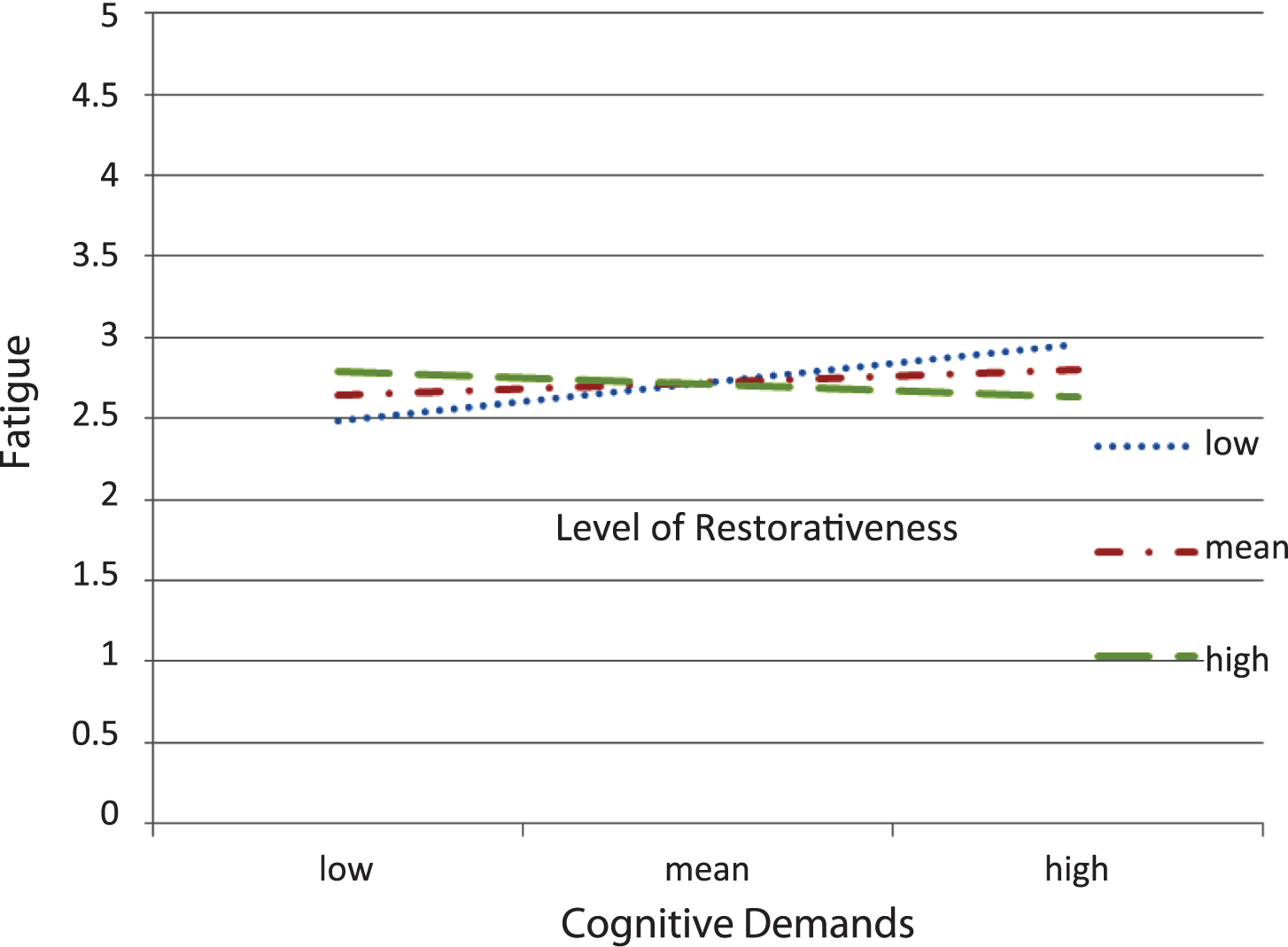
Interaction Between Cognitive Demands and Perceived Restorativeness of the Canteen in the Explanation of Variation in Fatigue.
Hypothesis 3a: Perceived organizational support will moderate the relationship between work overload and fatigue, such that the relationship will be weaker when support is higher.
Work overload interacted with POS in explaining fatigue (p < .05) as reported for Model 3 in Table 2. For relatively low and moderate levels of POS, the greater work overload was attended by greater fatigue; for the respective tests of simple slope, b = 0.58, 95% CI = 0.29 to 0.87, t = 4.04, p < .001; and b = 0.32, 95% CI = 0.12 to 0.52, t = 3.11, p < .05 (see Fig. 3). For relatively high levels of POS, work overload was not significantly related to fatigue: b = 0.06, 95% CI = –0.25 to 0.37, t = 3.93, p = .694.
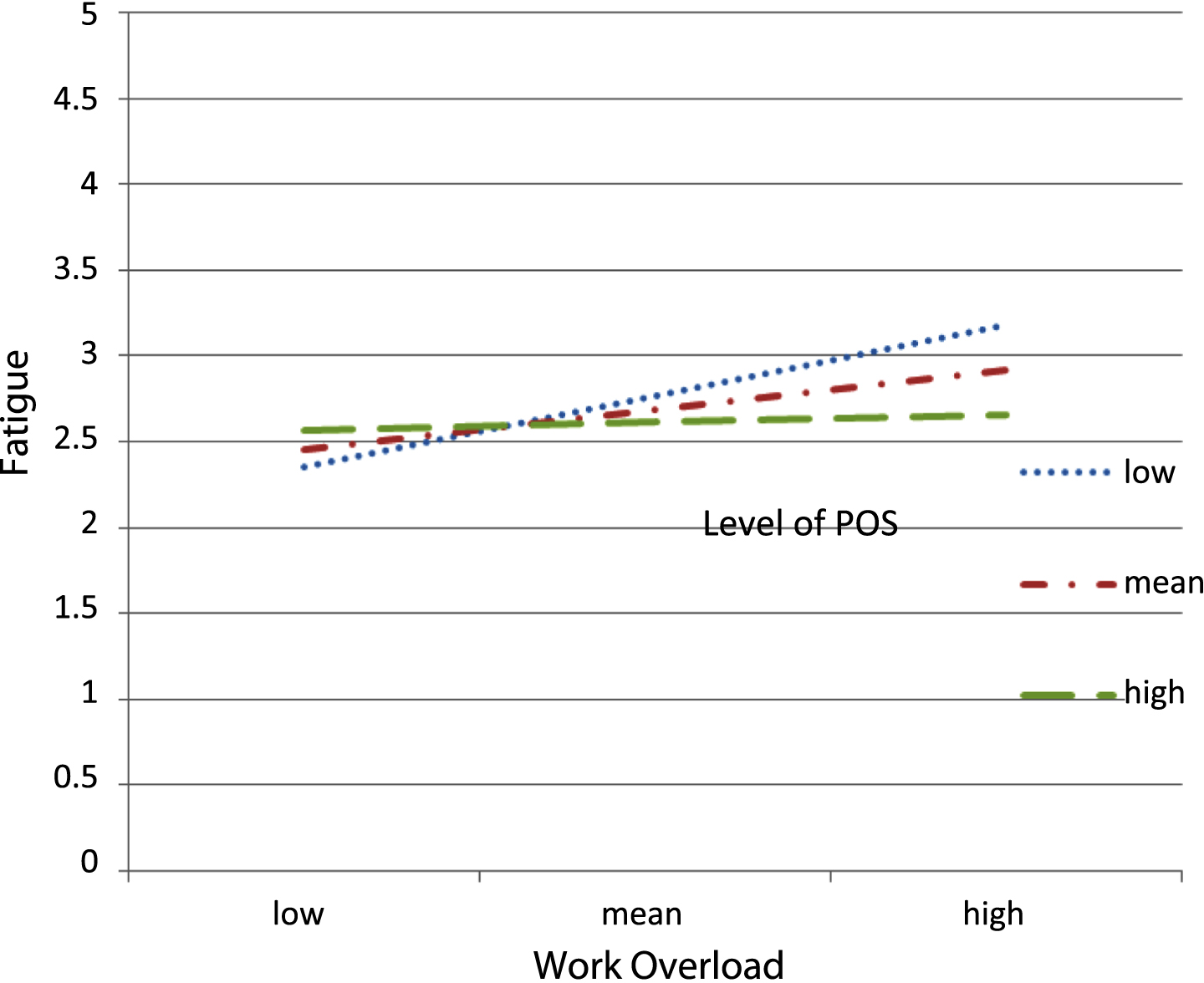
Interaction Between Work Overload and Perceived Organizational Support (POS) in the Canteen in the Explanation of Variation in Fatigue.
Hypothesis 3b: Perceived organizational support will moderate the relationship between cognitive demands and fatigue, such that the relationship will be weaker when support is higher.
The interaction between cognitive demands and POS was negative and significant (p < .05) as reported for Model 3 in Table 3. When POS was low, greater cognitive demands were attended by greater fatigue; for the test of simple slope: b = 0.36, 95% CI = 0.004 to 0.712, t = 1.98, p < .05. Conversely, when POS was moderate and/or relatively high, the association between cognitive demands and fatigue was not significant: for the respective tests of simple slope, b = 0.01, 95% CI = –0.22 to 0.25, t = 0.13, and b = –0.33, 95% CI = –0.69 to 0.44, t = 1.74, p = .412 (see Fig. 4).

Interaction Between Cognitive Demands and Perceived Organizational Support (POS) in the Canteen in the Explanation of Variation in Fatigue.
In addition to our hypotheses, we used a multivariate regression analysis to address an open question concerning the co-action of the two job resources: To what extent do restorativeness and perceived organizational support independently moderate the effects of job demands on fatigue? When we included both of the job demand x work resource interaction terms in the model, both were reduced to statistical non-significance (p > 0.05), although their inclusion contributed significantly to explained variance (in Tables 2 and 3, compare Model 4 to Models 2 and 3). The two interaction terms thus overlapped to a considerable degree.
Assessment of common method bias
Exploratory factor analyses carried out with different methods (un-rotated principal component analysis, principal component analysis with varimax rotation, and principal axis analysis with varimax rotation) revealed the presence of four factors rather than one (common method) factor. Those four psychological constructs together accounted for 69.6% of the total variance. No dominant factor accounted for the majority of the variance; the largest accounted for 28.4% of the total variance. Going further, a confirmatory factor analysis considering the four constructs used in this study (job demands, perceived restorativeness, perceived organizational support, fatigue) found that the single-factor (common method) model did not fit the data well (χ2 = 1616.373, df = 300, p = .001, χ2/df = 5.388, CFI = 0.358, TLI = 0.304, SRMR = 0.2076, RMSEA = 0.177). This result indicates that the associations uncovered in our regression analyses can be interpreted with regard to relationships among empirically distinct constructs.
Discussion
The present study aimed to investigate the roles of two job resources - perceived environmental restorativeness and perceived organizational support (POS) - in reducing fatigue from job demands during lunch breaks in a company canteen. We also considered whether a possible buffering effect of restorative quality perceived in the canteen environment could be understood at least in part as a manifestation of organizational support for workers.
In keeping with previous studies indicating negative outcomes of work overload [14, 15], we found a positive association between work overload and fatigue at work (H1a). Counter to expectations, we did not find such an association between cognitive demands and fatigue (H1b). That cognitive demands did figure in fatigue was however indicated in one of the tests of interaction in focus here; restorativeness weakened the association between cognitive demands and fatigue (in line with H2b), just as it had moderated the association between work overload and fatigue (in line with H2a). Further, POS moderated the association between cognitive demands and fatigue (in line with H3b) and the association between work overload and fatigue (in line with H3a). Specifically, with high levels of one or both of these two job resources, the negative associations between work overload/cognitive demands and fatigue were diminished. Conceptually, these results align with findings from previous research on the positive effect of a break environment on stress reduction [11] and on work stress recovery and restorative experiences [10]. More generally, these results align with the JD-R model [14, 15] and underline the capacity of job resources like perceived organizational support to reduce the negative effects of job demands on work-related fatigue and strain in the long run. Such outcomes are important for the well-being of workers who need to replenish personal resources depleted by job demands [14].
In this study, it is important to stress that, of the two job resource variables, only POS had an independent negative association with fatigue prior to the tests of interaction (Model 1). The restorativeness of the company canteen did not have such a main effect. In fact, POS showed a relatively high level in this study (M = 3.99 on a scale from 1 to 5), while restorativeness was generally low (M = 2.05 on a scale from 0 to 6). In contrast to the main effects, both POS and restorativeness moderated the association between both job demand variables and fatigue when treated separately (Models 2 and 3). So, while restorative quality was low on average, it varied enough to play a role as a buffering resource, at least with regard to worker perceptions during a lunch break. Just how it played a role is however an interesting issue here, as the buffering effect of organizational support on the demands-fatigue relationship rendered non-significant the seeming buffering effect of the restorative quality of the canteen when both interaction terms were included in the analysis (Model 4).
Presumably, the ratings of restorative quality in the canteen reflect to some extent on the organization’s concern for its employees and perhaps other factors potentially bound up with POS, such as the quality of social relations among coworkers. This said, for neither work overload nor cognitive demands did the interaction with POS reduce the coefficient for the Demands x Restorativeness interaction to zero. A residual buffering influence might be due to physical characteristics of the canteen. The correlation between restorativeness and the natural content of views from the canteen was quite weak, so the residual buffering effect presumably rests on other characteristics (e.g., perceived sound levels or their acoustic characteristics [17]).
The results did not confirm a positive direct association between cognitive demands and fatigue (H1b); however, we found that POS moderated that association, such that for low and moderate levels of POS more cognitive demands did entail more fatigue (in line with H3b). Only for higher levels of POS did we find that cognitive demands did not mean significantly greater fatigue.
In various ways, then, this study illustrates empirically how the physical and psychosocial environments together can play a role in buffering the negative effect of job demands on fatigue. The results also suggest that organizational support, and perhaps other forms of social support that align with it, may be particularly important when the physical work environment offers relatively poor opportunities for restorative breaks from work. In other words, organizational support may help employees to feel less tired in their work even in circumstances when the physical work environment offers little to support restorative experience. The relative importance of POS and the broader social context compared to restorative physical features of the environment, such as natural elements, is a question that merits deeper empirical inquiry. Such an endeavor can attend to the ways in which physical and social aspects of the work situation come together to produce experiences with qualities like those described in ART. For example, even with a relatively impoverished physical setting, perhaps the presence of friendly coworkers helps a worker to gain some psychological distance from the work (i.e., a sense of being away) and to engage effortless attention in some pleasant and interesting activity (i.e., fascination while participating in a fun conversation) [22, 48].
Strengths and limitations of the research
This contribution has several strengths, including the use of standard measures, the use of different response scales and anchors to counter response set, and assessment of common method bias. In addition to statistical controls for confounding, homogeneity in some characteristics of the sample would rule out alternative explanations due to gender, tenure of employment, occupation, type of work contract, organization, and the duration and location of the work break during which data were collected. Specifically, the sample consisted only of men who had worked at least several years in similar jobs on permanent contracts within the same large industrial organization, and they had lunch breaks of roughly 30 minutes within the company canteen. This homogeneity does also imply that the findings may have limited generalizability; however, as always, the issue of generalizability is a matter for further research.
The study also has several limitations. First, the cross-sectional correlational design does not allow strong causal inferences. Second, our sample is small; some of the non-significant associations reported here may be uncovered with greater statistical power. Third, the reliance on self-report instruments can lead to common method bias [45]; however, we did find that common method bias was not strong enough to disallow distinction between the constructs measured [49]. Finally, further research can address what people are actually doing and attending to when in the break room, and so better get at the relative contributions of different social and physical environmental components to restorativeness.
Conclusions
Our findings suggest that both perceived organizational support and perceived restorative quality in the canteen setting play a role in ameliorating the negative effects of work overload and cognitive demands on fatigue. This result holds promise for future research and good practices in the organization. For instance, it gives organizations and managers some useful elements toward which to target interventions to reduce negative consequences of job demands for individual employees’ health and well-being [5, 6]. More generally, the results demonstrate the value of bridging between industrial/organizational and environmental psychology to enhance understanding of links that sociophysical and psychosocial aspects of work environments have with important work-related outcomes.
Conflict of interest
None to declare.
Footnotes
Acknowledgments
We thank the two anonymous reviewers for their constructive feedback on the initial version of this paper. Some work on this paper was done while the first author visited the Institute for Housing and Urban Research at Uppsala University, and he is grateful for the support provided there.