



Abstract
BACKGROUND:
Return-to-work (RTW)/back-to-work (BTW) interventions that are designed to rehabilitate individuals impaired from fulfilling employment roles are facing challenges. Ethics discourses, including ethics theories, principles and concepts, are meant to give guidance on what one ought to do or not to do and RTW professionals could use them to respond to their challenges.
OBJECTIVE:
A scoping review was performed to investigate to what extent 33 ethics concepts, theories, and principles are employed in RTW/BTW academic literature, and to what extent RTW/BTW is engaged with in ethics linked academic journals.
METHODS:
Three academic databases were searched, and 147 article results were extracted from our literature review to be thematically analyzed.
RESULTS:
Searches with n = 11 ethics concepts and n = 4 ethics theories generated results. The content of 20 RTW/BTW article results demonstrated conceptual engagement between RTW and ethics discourses. Only one article in ethics-related journals conceptually engaged with RTW/BTW.
CONCLUSION:
Ethics theories and principles were not used extensively in RTW/BTW academic literature and RTW/BTW is a topic under-engaged within ethics-related journals. Our findings indicate opportunities for further research, like conducting interviews, to better understand our findings and how to respond to them.
Introduction
Return-to-work (RTW) or back-to-work (BTW)1 processes, describes a period of recovery and integration back to work after individuals acquire injuries that prevent them from fulfilling employment roles [1–7]. Both injured employees and employers desire successful RTW program outcomes since it indicates not only positive physical functioning after an impairment, but also meaningful social integration [7–12]. RTW processes are highly specific to the individual and are deeply rooted in the unique interactions between each party that is involved [1, 14]. Coordination across parties is vital in this multidimensional field, since all parties explore accommodating procedures such as reduced work hours or workstation modifications [13–17]. RTW coordinators have an extensive role in mediating these collaborative efforts and in determining what constitutes reasonable accommodations and demands [14, 15]. The success rates of RTW programs have been frequently deemed to be low [18]. RTW programs often focus extensively on the economic benefits clients gain, but not on the other reasons that may motivate them to go back to work [18]. Furthermore, new challenges in RTW processes have arisen due to the emergence of automation, for example, which has reduced the amount of open employment positions in many industries [19] and RTW professionals face current and future challenges in implementing their interventions [20–24].
Ethics theories, concepts and principles are employed to give guidance on what one ought to do or not to do [25, 26]. Employing ethics theories, concepts and principles in one’s reasoning, in addition to adhering to relevant professional codes of ethics, can assist RTW professionals in responding to such challenges.
However, the ethics field itself is concerned with the utility of its field and with others embracing the guidance they provide. Sherwin, a leading ethicist, concluded that “we lack the appropriate intellectual tools for promoting deep moral change in our society” [26, p.80]. In other words, the ethics field is currently facing a dilemma of being irrelevant if the tools, including ethics theories, concepts and principles, and the guidance ethics discourses provide are not applied by practical fields like the RTW/BTW discourse. Therefore, as a first step, we investigated the use of ethical reasoning and the employment of various ethics theories, concepts and principles in RTW-focused academic literature. We also probed the engagement between ethics-focused academic literature and RTW; this was done so we could understand whether ethicists have made specific recommendations in relation to the RTW discourse.
RTW and its challenges
Return-to-work (RTW) or back-to-work (BTW) processes are concerned with the reintegration of individuals into employment after they have acquired injuries that prevent them from fulfilling employment roles [1–7]. Many challenges faced by RTW processes have been identified in the academic literature. One challenge for RTW actions is linked to “identity work” [18, p.81]. When individuals modify their occupational and personal identities in order to adapt to changes in their abilities; they must also feel aligned with their social and work environments, so they can exercise a sense of self [18]. The need to coordinate the interests of different parties, including employers, the employee, their co-workers, RTW coordinators, and the insurance sector, however, can negatively impact identity work [1, 9].
A further challenge is that individuals also participate in “invisible work” [3, p.111], occupations often excluded from official RTW policy considerations because they are not a part of traditional employment arrangements [3, 27]. This work includes caregiver roles [3, 29], for example. Women especially display an emphasis on caring needs to justify not returning to formal employment [5, 28]. Individuals may be worried that returning to work will diminish the time available for what is viewed as an irreplaceable care role, compared to when new hires can replace their duties in formal employment [28]. “Invisible work” can also include purposeful volunteer work or job searching from home, which taken together still does not conform to the social perception of formal employment [3, 27].
Another challenge is linked to advancements in automation and robotics. Robotics and automation can introduce challenges to the concept and availability of work for people not seen as disabled, as many paid jobs in various industries are projected to be eliminated due to these technologies in the near future [19, 31]. Automation and robotics will impact in a negative way especially people with disabilities as many of the jobs foreseen to be replaced are occupied by people with disabilities; people with disabilities now have to compete with the non-disabled unemployed people for the remaining jobs [19]. However, the negative impact of automation and robotics on people with disabilities is rarely discussed [19]. The ill-preparedness of governments towards the negative impacts of automation and robotics on workplace participation of people with disabilities [19] might also negatively impact the RTW process since it introduces new barriers on whether these individuals can be re-employed. Automation and robotics raise RTW issues such as whether alternative occupations are available to fill the gap of employment, and whether individuals can be retrained for alternative positions.
Universal basic income (UBI) is a concept that was created in response to the decreased availability of employment positions [32–34] and also poses a challenge for RTW processes. An UBI is a benefit payment “transferred from public to private accounts throughout an entire lifetime, from birth to death, without any application or preconditions to be fulfilled by the beneficiary” [33, p.74]. Having been considered in countries such as Finland, Switzerland, and India [33], UBI policies can present an alternative income source if individuals cannot return to work. These policies would also eliminate many societies’ dependence on the labour market to provide employees with economic and social fulfillment [33]. If an UBI policy is implemented, the personal financial benefit it generates can influence whether people with impairments choose to return to work. This could also be the case with individuals wanting to pursue “invisible work” [18, p.81], where UBI payments would ensure that they are financially compensated. In other words, the concept of UBI can indirectly challenge the need for RTW programs and might change the role of RTW professionals. RTW professionals may need to consider whether their emphasis on paid employment is justified or beneficial to clients, since individuals may see less of a financial incentive to seek work and may also therefore engage less with their prescribed interventions.
Saunders, MacEachen and Nedelec see it as a challenge for RTW [3] that RTW professionals may embrace moral hazard theory [35] and believe that individuals undergoing RTW interventions will act dishonestly, which can lead them to unjustified and unethical biases when interacting with clients [3, 35]. This economic theory describes situations “where one party has an incentive to behave badly and in doing so creates higher than anticipated costs for another party” [36, p.41]. Ethicists have studied this topic in economics [37], education [38], and politics [39]. Moral hazard theory can be employed by RTW stakeholders, who may believe their clients will behave dishonestly if they do not return to work under a certain time frame [3, 35]. Members of the insurance sector, for example, may embrace the belief that individuals are likely to be less motivated in returning to work if compensation is too generous [3]. Similarly, there is a concern that individuals out of work may over-inflate the extent of their injuries to extend their compensation claim period. In addition to their use of moral hazard theory, professionals evaluating out-of-work compensation applications may also embrace the belief that participants of RTW processes are likely to abuse RTW benefits for easy material gain [3]. Saunders, MacEachen and Nedelec [3] see the discourse of abuse as a challenge to the RTW field since it may prevent professionals from demonstrating understanding toward a client’s difficult circumstances.
Ethics concepts, principles and theories
Ethics concepts, principles and theories are used to argue for what one ought to do or not to do [22, 23]. Stakeholders can use ethics-related decision-making that encourages consideration of diverse perspectives various parties in RTW processes may display, especially with regards to what is considered morally correct [23].
Many ethics concepts exist, including the notion of autonomy, dignity, and justice. For example, the concept of human dignity entails that there is inherent value in every human, “simply by the virtue of being human” [40, p.366]. Ethics theories provide multiple lenses from which to analyze and frame a situation, with differing perspectives fostering dialogue between the various different stakeholders involved [23, 24]. Consequentialism, like its naming implies, is a theory that postulates how morally correct an act is based on what consequences it brings [41]. On the other hand, deontology puts forward the right action as an obligation or duty, rather than one that must be perceived as acceptable or beneficial by the parties that it affects [42, 43].
In medical ethics discourses, the four ethics principles of autonomy, beneficence, justice, and non-maleficence [44, 45] often guide decision-making. Beneficence describes both a goal and a requirement to take the right actions to benefit others [40, 47], while the motto “to do no harm,” [48, p.29] is captured in non-maleficence [49]. Many dilemmas occur when ethics theories are applied in reality [23]. For example, the question of whether patients are required to be fully informed of intervention repercussions or only to a certain extent complicates the degree of patient autonomy professionals can offer [44]. One significant application of the four principles arises in healthcare. Health-related interventions must respect patient dignity, and health professionals must also make judgements that consider both beneficence and maleficence [40, 49]. Using deontology, professionals must balance client autonomy with actions that save lives, but also, they need to inspect the effects of continued intervention using a consequentialist lens.
Applied and practical ethics
Practical ethics is the application of ethics concepts and theories into contextual settings [50]. One example of a practical ethics application is bioethics. Bioethics is defined as ethics applied in the medical professions [51]. Public health ethics uses a different approach from bioethics by aiming to address the systematic injustice found in group and societal health policies and at the same time promote health-giving social structures [25, 52]. Ethical reasoning is applied in emerging social topics such as the morality of abortion, for example [53]. Yet, different practical ethics traditions have emerged with diverse approaches. Given the many challenges the RTW field faces, it would be useful to investigate which practical ethics fields can help the RTW field solve its own ethical and social dilemmas.
Ethics discussion of RTW challenges
Many issues and challenges that the RTW field does and will face in the future are discussed in ethics-focused literature, although outside of an RTW context. Notably, roboethics is a term used for a discourse that covers various ethical issues raised by robotics [54–58]. Automation is discussed in relation to work ethics [59], counselling [60], and general impact on work [61]. Given that robots are capable of delivering psychotherapy, for example [62], or that they can enhance human physical abilities beyond what is currently imagined [63], there is increasing attention devoted to whether the introduction of automated technology is ethical overall.
In terms of RTW processes themselves, the South Korean government has drafted an ethical guideline on how to maintain human-robot coexistence in the economy [61]. Yet, it has also been argued that “it is not clear that the [South] Korean government has been so proactive in preparing for future employment consequences (i.e., technological unemployment) resulting from automation” [61, p.29]. Displaced employees are more likely to contribute to mass immigration and discontentment towards governments [61]. Furthermore, social welfare programs themselves can become unsustainable as a result of automation; governments have traditionally sustained them by collecting income tax from those who work [33]. At least in current times, however, robots do not have to pay taxes, so the decrease in a human labour force is likely to result in a decrease in government income [33]. The idea of a “robot tax” has been proposed, but it has been argued that it would not be feasible [33]. Ethical guidance is required to reduce the negative repercussions of mass unemployment, such as increased crime rates and social welfare program costs [33, 61].
Researchers have also explored whether the egalitarian distribution of wealth proposed by a universal basic income (UBI) is ethical [32]. In a capitalist society, an UBI could be argued to be a “moral obligation” [64, p.133] because it enables all citizens to have the same access to social resources [64]. Firstly, it would ensure that all citizens have a stable financial base, allowing them more freedom to exchange and pursue knowledge amongst each other [64]. In turn, an UBI would “facilitate the development of a proper environment for the training of a superior intellectual and ethical human being” [64, p.132+]. This suggests UBIs can reduce the time individuals spend on securing financial sustenance and citizens could reallocate their time toward learning about and reflecting on ethical thinking. UBI policies employ the ethics theory of egalitarianism, which argues that the distribution of wealth is a matter of luck rather than a matter of merit [32]. Therefore, individuals who do not have that choice suffer from bad luck and implementing a UBI would be an ethical solution to compensate for that [32]. UBI policies are seen to reinforce the belief that individuals should have both the means and the right to choose what type of life they want to live [32, 65].
Methods
Study design
We conducted a scoping review to examine the borrowing of concepts [66–70] between the RTW and ethics academic discourses. We examined whether n = 33 ethics-related terms derived from Beauchamp and Childress [71], Lisitza and Wolbring [72], and Sirianni and Wolbring [21] were conceptually engaged with in RTW literature, that is whether specific ethics-related terms are explored in detail in terms of their utility to the RTW discourse. Specifically, we investigated the extent with which RTW-related literature engaged with the n = 33 ethics-related terms. We separated the ethics-related terms into two categories. The ethics concepts category covered n = 13 terms (see Table 1, column 1, “ethics concepts” section). The remaining n = 20 terms formed the ethics theories category (see Table 1, column, 1, “ethics theories”section).
Article counts with n = 33 ethics terms in article abstracts and full text
Article counts with n = 33 ethics terms in article abstracts and full text
We furthermore investigated how the RTW and BTW terms were engaged with in ethics-focused academic literature. We searched for the presence of the two terms (return to work and back to work) in articles from journals with “ethic*” in the title.
From the 14 literature review types outlined by Grant and Booth [73], we used a scoping review method. We chose this method because it provides an exploratory and rapid way of assessing the current state of the academic literature that fit our two research questions [73–76]. With Sherwin’s concerns that others are not utilizing ethics guidance [26], a scoping review is a useful approach to ascertain whether the gap of uptake of ethical guidance and tools is reflected in RTW literature [75]. We adapted the steps presented in Levac, Colquhoun, and O’Brien [74] into our method, which included identifying the research question, including databases to search, generating inclusion/exclusion criteria, recording quantitative results, selecting relevant studies to be reviewed, charting the data, and summarizing and reporting the results. We also generated article count results for the searches conducted to provide a concise summary of the extent of the conceptual engagement between RTW and ethics academic discourses [73, 74].
Eligible papers were identified using explicit search strategies across a range of data sources [77]. Searches were conducted on July 4th, 2017 using three academic databases, including EBSCO-HOST, which is an aggregate database featuring over 70 other databases, Scopus, which includes the entire Medline collection, and Web of Science. The three databases were chosen for the diverse and extensive journal collections they encompass. We searched for either “return to work” or “back to work” in article abstracts in searches involving EBSCO-HOST and Scopus, or in the topic field, which include article title, abstract, author keyword, and keywords Plus®, in Web of Science searches. Each of the three databases have different article types one can select. As a result, we restricted our search to scholarly, peer reviewed content in EBSCO-HOST, while article searches in Scopus were restricted to conference papers, editorials, peer reviewed articles, and reviews. Web of Science search results only returned peer reviewed articles, editorial material, reviews, and proceeding papers. The obtained English language articles were searched for the presence of the n = 33 ethics-related terms derived from Beauchamp and Childress [71], Lisitza and Wolbring [72], and Sirianni and Wolbring [21], within the article abstracts or full text, with no publishing date or geographical restriction (Table 1).
Secondly, the terms “return to work” and “back to work” were searched for in article abstracts from journals with titles including the keyword “ethic*” using Scopus (Table 2).
Article counts in journals with “ethic*” in title
Article counts in journals with “ethic*” in title
Of the obtained results, we did not download articles for searches returns of n = 100 or more article counts since we assumed there was reasonably detailed conceptual engagement with RTW/BTW and the ethics term found in those search combinations. For the remaining searches, we transferred each article’s RIS format citation files into EndNote X8® referencing software, where duplicate articles found between the three databases were eliminated and total article results were tabulated. We then downloaded a total of n = 147 results consisting of conference papers, editorial papers, peer-reviewed papers, and reviews from searches that generated less than n = 100 article counts.
For analysis, we first uploaded the 147 article results into the qualitative analysis software ATLAS.Ti 8trademark. We then used the auto-coding function of ATLAS.Ti 8trademark software to search the full text of each of the 147 results for content related to the n = 33 ethics-related terms and to RTW-related terms. Then, we read the content surrounding each auto-code mention to verify conceptual engagement between the two disciplines. Specifically, we examined whether associated terms were explicitly defined and explained in their connection with one another [72]. Authors of some articles conceptually engaged with both RTW and multiple ethics terms (see Table 1, row 8). These articles were analyzed multiple times for the presence of each ethic term. Our content analysis was deductive in the sense that we were analysing content related to set keyword search terms [78, 79] but also inductive in the sense that we did not hypothesize the extent or content of conceptual engagement we found between the two discourses.
Trustworthiness measures
Trustworthiness measures include confirmability, credibility, dependability, and transferability [80–83]. The two authors debriefed on the findings to ensure they were credible and dependable. We reconciled differing opinions between the authors through mutual feedback and revised our findings to reflect the consensus we reached. To maintain the confirmability of our findings, ATLAS.Ti® 8 and EndNote® X8 coding and reference organization files were kept to provide an audit trail, which is a detailed history of which articles were found in which search. Regarding transferability [80–82], our article provides all the necessary information for others to apply our search methods on other sources, such as grey literature [84], or perform research that extend on our findings.
Limitations
Our article analyses were applied to English-language articles only. We also limited ourselves to searching academic literature. In order to maintain reasonably specific inclusion/exclusion criterion for our scoping review [75], we did not use grey literature [84] as sources. Ethics language, however, could also present in the many non-academic sources that deal with RTW. In order to keep the scope of the research manageable, we also made use of a search strategy using explicit keywords such as “return to work”, “back to work” in conjunction with n = 33 ethics terms to determine whether the RTW and ethics academic literature are engaging with each other. We did not look for articles that implicitly covered RTW using other terms such as “finding work” or referenced the ethics discourses using terms outside of the n = 33 we selected. Therefore, our searches did not include a complete set of terms that can be used to describe the ethics and RTW fields. Within our limitation of only reading English language content, only n = 2 articles that discussed South African and Ugandan contexts were not focused on RTW processes within countries of Western backgrounds. Therefore, we gained little understanding of RTW processes from other locales in our study. Others can use our transferable search methods, however, to investigate whether conceptual engagement between RTW and ethics discourses exist in grey literature [84], inliterature with alternative terms that reference RTW/BTW, in countries not covered by our English language articles, or in non-English literature.
Results
First, we generated article counts for all searches conducted with ethics-related concepts. The flow chart in Fig. 1 describes how we selected articles to be qualitatively analyzed, while Tables 1 and 2 display article-count results.
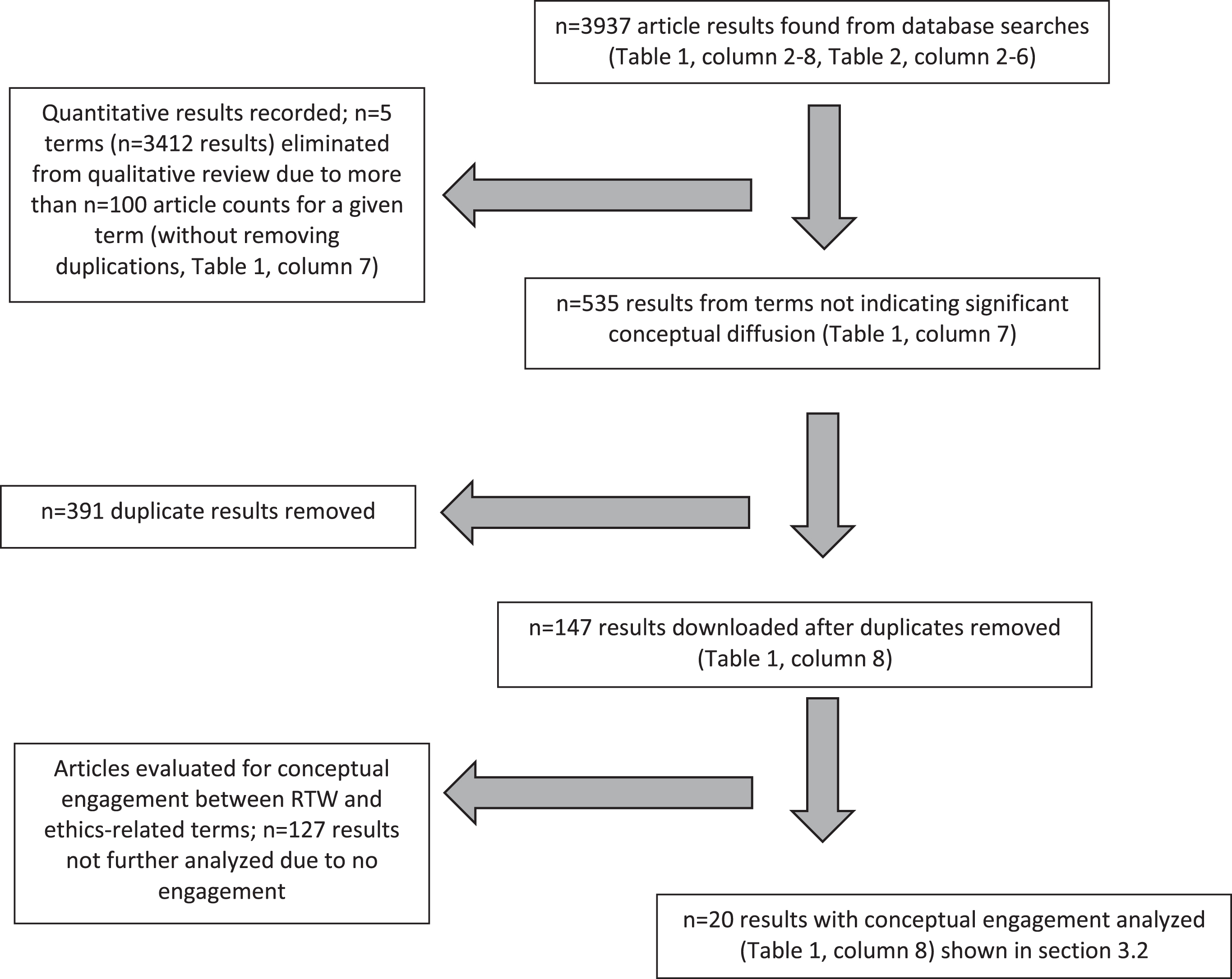
Flow chart of the selection of article for qualitative analysis.
We first generated quantitative results which are shown in Tables 1 and 2.
Qualitative results
Within the n = 147 article results downloaded, n = 20 demonstrated conceptual engagement between the RTW and ethics discourses.
The most studied country or author nationality amongst the n = 20 article results was Sweden with n = 7 (35%) results, followed by the United Kingdom and the United States at n = 3 (15%) results each. Canada was covered in n = 2 (10%) results. Australia, France, South Africa, and Uganda were each covered in one article (5%). One remaining article described RTW systems in both the Netherlands and New Zealand.
As to the time published, n = 1 (5%) result was published in the 1990’s, n = 7 (35%) results were published in the 2000’s and n = 12 (60%) results were published in the 2010’s.
Three results (15%) originated from Disability and Rehabilitation and Journal of Business Ethics respectively, while n = 2 results originated from the journal Environmental Planning. The remaining results were all from separate journals reflecting a variety of disciplines, including Journal of Occupational Rehabilitation, Journal of Sex and Martial Survey, and Journal of Workplace Rights. In terms of the study methods, n = 11 results (55%) were not of an experimental nature. Authors of n = 7 (35%) article results conducted interviews for their studies. Authors in n = 1 (5%) study utilized a survey method while the remaining n = 1 (5%) study described clinical diagnoses of participants.
The relevant article content is summarized below RTW and “ethic*”
Out of the n = 147 articles downloaded, n = 126 articles were found for searches using the keywords “return to work” or “back to work” and the keyword “ethic*”, as shown in Table 1, row 7. Out of the n = 126 articles, a total of 32 articles only mentioned ethics in terms of research ethics committee approval for their study design, such as with Dwyer et al. and Stirling et al. [85, 86]. Another 61 articles did not actually mention ethics within the text body or did not utilize a definition of returning to work that included the acquisition of a disability [87–93]. Authors in a total of 10 articles discussed clients’ work ethics [94–103], but not the ethics field itself. 19 of the 126 articles utilized terms such as “the ethics of policy and practice,” [104, p.280] or “ethical considerations,” [105, p.958] but did not define them, which does not represent conceptual engagement between the two discourses.
3.2.1.1 RTW and professional ethical conduct. Out of the n = 126 articles found, n = 14 articles displayed conceptual engagement between search combinations of RTW/BTW and “ethic*”, 8 of them primarily discussed the importance of ethical codes of conduct for professionals involved in RTW processes [106–114]. For example, RTW professionals in South Africa who both assess and treat clients’ impairments may face a conflict of interest between the two roles [112]. Professionals may be influenced by other stakeholders, like insurance sector representatives, to accelerate the pace they treat clients beyond what their assessments allow for [112]. Swedish RTW professionals may also face an ethical dilemma when they are not allowed to administer helpful experimental treatments to clients who do not meet the legal criteria of being likely to return to work [110]. Most drastically, one article showed more than half of the studied American pain specialists were not aware their discipline supplied detailed ethical standards at all [106].
On the other hand, RTW professionals may face the same pressure from clients who do not wish to return to work at all, refusing treatment and demanding physicians sign paperwork that exaggerates their impairment severity [109]. Even when clients do not take up what is best for their health, professionals must continue to uphold their duty to care until all options for treatment are exhausted. At this point, professionals must refer clients to another professional rather than comply with a client’s requests[109, 114].
The “duty of care” [113, p.1] that especially physicians must uphold may also be violated by RTW professionals themselves as they refuse to engage in a RTW claim process. Some Australian professionals were found to be unwilling to verify patient accounts and complete compensation-related paperwork since this work strains their mental health and takes significant time [113]. Individuals with impairments can be refused medical care by multiple professionals, reducing how efficient and effective their RTW interventions may be [113].
A final critical theme relates to the disclosure of sensitive information; insurance companies may deny clients access to their RTW likelihood assessments, which violates freedom of information rights [111]. Under client confidentiality rules, RTW professionals are not allowed to disclose how their clients require modified arrangements to other members of the workplace [107]. Due to this requirement, some British RTW professionals have found it difficult to reduce the discontent clients’ co-workers have with why the clients themselves receive less job tasks compared to the rest of the employees [107].
3.2.1.2 RTW and Employment of ethics discourses Out of the n = 14 articles found in searches between RTW/BTW and “ethic*”, n = 6 articles discussed RTW and ethical thinking beyond applications of professional codes of ethics [115–120]. The heterogeneous stakeholder approach of RTW intervention, a model applicable to a variety of nations, was addressed in two articles. The heterogeneous model states that an equal and legitimate RTW process must consider and respect the perspectives of all parties involved; this approach is defined as instrumentally-oriented, which means that individuals and groups are considered stakeholders if they have an economic relationship with an RTW client [116, 120]. Such parties include insurance companies, social welfare agencies, the employer, the government, and the individuals’ family, who are all affected economically and financially if a client is unable to earn employment income [116, 120]. Each stakeholder is driven by their priorities and values, influencing the ethical choices they make and the ethical concepts and theories they are influenced by [120]. Ultimately, the dominant stakeholders determine RTW intervention outcomes; employers who refuse to admit employees back to their workplace, for example, can effectively stop an entire RTW process [120].
At the same time, current RTW program models can also “be myopic in identifying the key individuals and groups involved in the process,” which impairs intervention plans from acknowledging and addressing barriers to return to work [116, p.77]. For example, they may disregard the negative reactions of other employees within the organization towards RTW programs, leading the client in question to feel unsupported [116]. In other words, RTW programs in Canada and beyond must account for more stakeholders than it currently appears toinclude [116].
Under the three-domain model of corporate social responsibility, employers often have economic and legal reasons for their actions in addition to their ethical justifications [118, 120]. Employers generally supported RTW efforts for the sake of legal or economic compliance more than to demonstrate good ethical judgement [118, 120]. Managers often supported RTW interventions for particular employees because of the value they brought to a workplace rather than became they felt morally obligated to do so [118].
Finally, the way an employee with impairments is treated by different stakeholders depends on what ethics beliefs they employ [120]. For example, healthcare providers use biomedical ethical beliefs such as justice to prioritize their clients’ medical needs while at the same time ensuring they obtain informed consent [120]. On the other hand, employers are influenced by the ethics principle of corporate social responsibility [120]. The public sector employs citizen theory, which suggests governments are obligated to uphold citizen dignity and rights, and social equity, which emphasize how government services must be equally available to individuals disadvantaged in social status [120]. Furthermore, the government must account for the needs of diverse sectors of society; legislators need to ensure employers are economically incentivized to create and follow RTW policies while at the same time enable clients to access necessary support [120]. The three ethics traditions are not mutually exclusive, however. As one example, business ethics is also utilized in healthcare sectors [120].
In Canada, the United States, or in Scandinavian countries such as Sweden, RTW policies are drafted by governmental bodies but are executed by employers, so their implementation is influenced more by business rather than public administration ethics [120].
RTW and beneficence
n = 2 articles were found in search combinations involving RTW/BTW and the keyword “beneficence”. One of them displayed no conceptual engagement between the two terms [121]. The second article, which was mentioned previously, defined beneficence as a key bioethics tradition [120]. Professionals’ wish to uphold beneficence can conflict with their clients’ right to autonomy, however, since clients have the freedom to refuse and select treatments that are deemed very beneficial [120].
RTW and bioethics
n = 3 articles were found in search combinations involving RTW/BTW and the keyword “bioethics”. Two articles did not conceptually engage with bioethics at all as the term was not mentioned explicitly in the article [109, 122]. The third article described the bioethics principles of autonomy and beneficence and how they might be relevant to RTW [120].
RTW and dignity
n = 6 articles were found in search combinations involving RTW/BTW and the keyword “dignity”. Three articles did not extensively engage with the notion of dignified treatment [123–125] and one article did not engage with the RTW field [126].
One article identified dignity as a fundamental principle that RTW compensation systems must be based on given findings across RTW systems in both the Netherlands and New Zealand [128]. Dignified treatment must place the employees’ interests first; employers must reduce the stigma and prejudice even neutrally-worded policies can deliver [128]. All stakeholders can potentially treat clients in prejudiced ways, but physicians and lawyers representing employers are most likely to do so [128]. In some cases, compensation boards and employers have allegedly hired private investigators to record clients making physical movements that are thought to not be medically possible [128]. Coupled with that is the strained relationship between employees and employers, characterized by a sense of distrust since employees’ claims can be perceived as illegitimate [128].
Furthermore, RTW clients can also feel they are not being treated with dignity due to structural barriers [128]. For example, medical professionals may believe that clients who spend time applying for RTW compensation, especially those who have employed lawyers to represent them, will take longer to recover from a state of disability than if they had returned to work immediately [128]. The remaining article spoke of how coworkers and RTW professionals can create activities such as goodbye lunches to provide a dignified closure to RTW clients who must leave their previous employment positions[127].
RTW and egalitarianism
n = 7 articles were found in when searching for conceptual engagement between the RTW and egalitarianism concepts. Four articles did not mention the concept within the article [129–132], and one did not engage with RTW processes [133]. An additional article did not display conceptual engagement with our definition of return to work, instead defining it as after women had completed advanced education[134].
The remaining article discussed how Swedish legislators and professionals have limited the amount of time RTW clients should spend out of work [119]. From an egalitarian view, these standardized time limits are meant to establish justice and equality, ensuring that governments can distribute resources equally [119]. This belief did not manifest in reality, however, because standardized programs appear bureaucratic and unsupportive instead [119]. Professionals working in the insurance industry found it difficult to account for each client’s unique circumstances under these standardized time limits, while physicians on the other hand found issues with the limits because they assume when clients will find work based on hypothetical, rather than realistic, job market conditions [119]. Furthermore, this attempt at egalitarian policy could be argued as unjust for both clients and professionals; the need to care for clients and to provide just distribution of services are not necessary opposed to one another and should not be thought as such in policy[119].
RTW and feminist ethics
n = 1 article mentioned conceptual linkage between RTW and feminist ethics. A feminist ethics of care approach to British RTW policy, for example, would challenge a justice-based definition of work [115, p.805]. Citizenship has traditionally been associated with formal paid employment, since employees viewed as “worker citizens” [115, p.805] are superior to predominantly women participating in unpaid family occupations. Traditional visions of RTW processes and formal employment can ignore the tendency for individuals to care for their families, that the tendency “was not only an activity but also an orientation or disposition, underpinned by values that are different to those associated with paid work...” [115, p.806].
Unlike in liberal, justice-based thinking, feminist ethics views dependency and autonomy as coexisting and interdependent, rather than as opposing values [115]. Feminists do not agree that the worker role should be seen as superior to the mother role [115]. RTW policies in the United States, for example, often limit the time claimants are exempt from work before they must once again attempt to seek work [115]. This requirement may pressure mothers to sacrifice time on maternal care and return to employment early [115]. Current constructions of society imply that it is more productive for women to work, even if their job is to care for other children, than to stay at home to care for their own family members [115]. Yet, with the increasing attention on early-childhood education and on family life, a feminist ethics of care suggests the dominant value of work in social service policies should be questioned [115].
RTW and “Ethic*” in journal title
In this search combination, n = 4 articles were downloaded. Three of the such articles, however, indicated no conceptual engagement between the two discourses [93, 136]. The remaining article was already found and discussed in previous searches [120]. Therefore, this search resulted in no new articles with conceptual engagement between the ethics and RTW academic discourses.
Discussion
Ethics academic discourses, which utilize ethics concepts, principles, and theories, could offer a systematic and organized way to examine the interests of multiple parties involved in RTW processes [120]. Our findings suggest that there seems to be low conceptual engagement with ethics concepts, principles and theories within RTW academic literature, similar to what was found in cognitive enhancement [20], in occupational therapy [21], and in organ transplant technologies [137]. There also appears to be a low level of engagement with RTW within ethics-focused academic journals. Our study provides empirical evidence that ethical tools commonly used by ethicists are not taken up within RTW focused academic literature, suggesting that Sherwin might be arguably correct when stating that “we [ethicists] lack the appropriate intellectual tools for promoting deep moral change in our society” [26, p.80] as the current tools of ethics terminology are not extensively used in the RTW focused academic literature.
Lack of use of specific ethics concepts, principles, and theories in RTW literature
Lack of use of ethics theories
Searches involving n = 16 ethics theories, including consequentialism and virtue ethics, did not generate any articles. Only searches with n = 3 ethics theories generated results, but none of the corresponding articles displayed any conceptual engagement between the two discourses. Conceptual engagement with these terms could enrich the RTW academic field, however. For example, a linkage between consequentialism and RTW would allow us to conclude whether the consequences RTW processes have on employers, such as increased accommodation costs and bureaucracy [120], is justified in removing the positive consequence of employee identity development [18]. Virtue ethics places the responsibility for ethical decision making on specific individuals who have pledged to always maintain such responsibility; this obligation is evident in medicine, for example, where the Hippocratic Oath places such integrity on doctors [44]. It would be useful to consider what guidelines or privileges may provoke RTW professionals to acquire this virtuous role. For this reason, as well as to explore whether the assurance of returning to work should be a moral responsibility as much as it is an economic and legal one [118, 138], it would be beneficial to mention virtue ethics in RTW literature.
The RTW academic discourse could also benefit from a meta-analysis of how different ethics theories impact RTW in different ways. This analysis would allow us to determine which ethics theories would be most relevant for each of the differing dilemmas faced by RTW professionals. If we analyzed the ethics theories employed by specific stakeholders, our findings could enable us to examine how conflicts between each stakeholder’s ethics-related beliefs can cause disagreements that hamper RTW processes [120]. One such conflict is between the often-opposing theories of consequentialism and deontology. Consequentialism requires individuals to evaluate whether to act based on potential consequences, while deontology highlights that one should act regardless of them [41, 42]. If this conflict is reflected in RTW decision making, we can encourage stakeholders to engage in a dialogue to understand each other’s moral and philosophical motivations behind adapting such theories. When stakeholders collaborate, they can together ensure that RTW clients attain all intervention outcomes without being denied necessary employment or financial compensation.
Ability privileges are used to describe the advantages in social status that individuals enjoy as a result of their perceived superior physical abilities [139]. Ethics theories imply what abilities should be considered superior, and therefore which abilities one should expect others to display [140]. For example, egalitarianism theory suggests that benefits and wealth should be distributed across people with varying abilities [140]. On the other hand, utilitarianism theory implies that we should have the ability to determine if the benefits of a decision outweigh its drawbacks [140]. This means that by determining which theories RTW professionals find the most useful, we can examine which ability expectations are exercised in RTW programs. In other words, we can determine what roles and tasks RTW professionals believe their clients and they themselves should be capable of achieving. We can also begin to look at what ability privileges RTW programs and professionals uphold through the theories that they find the most relevant [139].
Lack of use of applied ethics concepts
The term bioethics was conceptually engaged with in the context of RTW processes in n = 1 article. This article described the various bioethics branches, such as clinical ethics and biomedical ethics, and the four principles approach outlined earlier [120]. RTW professionals can engage with bioethicists to help determine whether they provide adequately ethical treatment towards their clients [51]. Given that RTW professionals have employed moral hazard theory in past to limit financial compensation that clients can receive, their assumptions that clients are likely to be dishonest do not always reflect the beneficence and justice principles of bioethics [3].
According to our background search, which suggests that “invisible work” [3, p.111] in the form of domestic occupations are ignored when accounting for how to return to work [3], there is also a need for RTW intervention programs to incorporate feminist ethics and care ethics-based view of occupations [115, 141]. The idea that an ethic of care is an orientation, rather than a temporary endeavour, confirms the view that RTW academic discourses must account for additional occupational choices that do not involve paid employment [28, 115]. Further investigation into the role of both feminist ethics and care ethics, we propose, would provide crucial insight on how to direct RTW interventions to also support clients who choose not to return to formal employment.
Connections to the public health ethicists, on the other hand, would allow professionals to discuss how RTW processes are characterized by systematic barriers to care and what might be a set of reasonable approaches to address them [25, 50]. Indeed, the field itself aims to address the systematic injustice found in group and societal health policies and at the same time promote health-giving social structures [50, 52].
Lack of use of ethics principles
The four principles of bioethics include autonomy, beneficence, justice, and non-maleficence [44, 120]. On the one hand, searches involving “autonomy” and “justice” resulted in over n = 100 article counts each, and we conducted no qualitative article analysis since we could assume RTW academic literature conceptually engages with these concepts to a reasonably high extent. However, “beneficence” was only engaged with conceptually in one article [120]. No articles engaged with the term “maleficence”. Beneficence imply professions should work to benefit clients, while non-maleficence advocates for a reduction of harm [44]. These results suggest that despite RTW processes being focused on upholding client dignity [128], the relevant academic literature has not fully addressed the RTW professionals’ responsibility to ensure that their clients are not harmed. However, it can be argued that clients can feel stigmatized, and can therefore be harmed, by the very stakeholders that make up RTW processes [3, 128]. RTW processes could be deemed iatrogenic, meaning that clients could acquire further impairments as a result of treatment and intervention, rather than the original medical cause [142]. Therefore, RTW processes could be harmful rather than helpful. Given that clients are often perceived to be abusive in moral hazard theory [3], RTW processes could be preventing individuals from returning to a state where they feel occupationally engaged [3]. Thus, the lack of conceptual engagement with beneficence and maleficence is also concerning since it implies that professionals may not be aware of potentially iatrogenic practices.
Lack of engagement with RTW in ethics focused journals
We analyzed n = 1 article [120] that utilized RTW and BTW terms in ethics-related academic literature, although it also appeared as a result in our initial search of RTW-related literature. We posit that there are many RTW challenges that could benefit from ethics guidance. Despite that, it appears that ethicists have not examined this lack of engagement in RTW academic literature to determine why ethics guidance is currently not employed in many fields. Sherwin has strongly advocated for ethicists to account for social, rather than medical, factors of health. Furthermore, RTW processes also incorporate these social factors by considering and fostering “identity work” [7, 118–120]. Therefore, ethicists can apply relevant tools, such as ethics concepts, principles, and theories to further recognize the social aspects of health, in line with Sherwin [26].
Reflecting back on Sherwin’s remarks that “we [ethicists] lack the appropriate intellectual tools for promoting deep moral change in our society” [26, p.80], the lack of conceptual engagement shown here could be an opportunity for ethicists to then determine what tools might be useful for RTW professionals. In turn, ethicists should engage with RTW academic discourses, so they can respond to dilemmas regarding employment and work, including roboethics.
Challenges with employing ethics theories in the RTW field
Engagement between RTW and ethics academic discourses provides a powerful mechanism from which stakeholder interests can be reconciled and realigned. However, the uptake of ethical reasoning is influenced by other priorities and values as well. With the three-domain model of corporate social responsibility [118], it was demonstrated that ethical actions are likely to be supplemented by legal or economic motives; employers were not readily willing to allow individuals to return to work if the economic and social value in their presence is not apparent [118].
Yet, RTW professionals must exercise caution if they would like to apply ethics-related theories as appropriately as Sherwin deemed [26]. In the case of egalitarianism, attempts to ensure justice have resulted in unrealistic projections in RTW-related financial compensations. For example, hypothetical economic conditions, rather than individual circumstances, were used to determine the time limits that clients were permitted to be out of work [119, 120]. This standardization had the opposite effect, however, in addition to client dissatisfaction, doctors and insurance officials reported feeling distressed from decision-making they perceived to be unethical [119]. In addition to this, the standard ethical requirement of client confidentiality has at times rendered it difficult for employees to obtain the full support they need from employers [107]. In both scenarios, the need to make ethical decisions conflicts with the need to honour client outcomes. This suggests that different interpretations of ethics-related theories, and the application of these theories, can lead to contradictory results. From findings, future education and research should be conducted regarding which of the diverse ethics theories are to be employed in RTW practice, and how to navigate the resulting ethical dilemmas that can arise. The lack of conceptual engagement with RTW and BTW academic discourses within the ethics literature suggests that these suggestions are not yet underway.
Conclusions
Return-to-work (RTW) or back-to-work (BTW) processes are concerned with a period of recovery after individuals acquire injuries that prevent them from fulfilling employee roles [1–7]. Ethics academic discourses aim to provide guidance regarding what one ought to do or not to do, employing different theories, concepts and principles [22, 143]. Sherwin argues however that “[ethicists] lack the appropriate intellectual tools for promoting deep moral change in our society” [26, p.80]. The results of our scoping review show that there is low engagement, with ethics theories, concepts and principles, most of which is not conceptual, in academic literature on RTW. In addition, there is a lack of engagement with RTW as an applied topic within the academic literature focusing on ethics issues. As such, our findings seem to support Sherwin’s claims [26, p.80]. We propose that both academic discourses could benefit from further engagement with each other. In terms of the work context, RTW professionals can make use of ethics concepts and theories to support their ethical reasoning beyond merely complying with a given professional code of ethics. Engaging with ethics terms will offer RTW professionals a better understanding of how to respond to various challenges they face including automation and robotics [19], as well as “invisible work” [3, p.111] and other challenges.
Given our findings, future research could explore the presence of ethics related terminology
within RTW grey literature [84], non-English literature, and literature that uses alternative terms to refer to RTW/BTW. This would expand on our investigation of whether the RTW field as a whole utilizes ethics-related concepts, principles, and theories.
Furthermore, interviews could be conducted with RTW professionals to better understand our findings. Questions one could ask include: In general, do RTW professionals find ethics theories useful? Do RTW professionals consider it their role to employ ethics theories to reason why certain actions should be taken? Do they see it as useful to engage with ethicists on topics such as the future impacts of robotics and automation on work? Do RTW professionals see it as their role to proactively respond to new and emerging societal developments linked to the advancement of science and technologies that impact RTW processes?
Further research could also engage with faculty members in post-secondary degree programs that educate current and future RTW professionals on their views on whether and how their programs should teach concepts, principles, and theories related ethical reasoning beyond how to apply existing professional codes of ethics.
Conflict of interest
The authors have no conflicts of interest to declare.
Footnotes
Acknowledgments
The authors would like to sincerely thank fellow members of our WolbPack collaborative interdisciplinary research team for their consistent and everlasting professional and emotional support.
After this point, we will use RTW to refer to both RTW and BTW.