



Abstract
BACKGROUND:
Workers engaged in dairy farming are exposed to awkward and poor postures that may result in work-related musculoskeletal disorders (WMSDs).
OBJECTIVE:
This study carried out ergonomic interventions in order to eliminate and reduce awkward postures in dairy farming.
METHODS:
This quasi-experimental study applied rapid entire body assessments (REBA) to evaluate the risks associated with each posture while performing the assigned tasks on a dairy farm in Iran to identify high and very high-risk tasks. A participatory ergonomics model was used that incorporated suggestions by dairy workers to design the used interventions.
RESULTS:
In the first intervention, by using an automatic transmission system for pouring milk, one high and one very high-risk task— pouring milk into a bucket and pouring milk from a bucket into a tank, respectively— were eliminated. In the second intervention, two high-risk tasks— filling corn containers and pouring corn into the milling machine— were eliminated by using a material conveying vacuum pump to transfer corn from the ground to the opening of the milling machine. In the third intervention, a simple and cheap holding device for the bag was designed to reduce the posture risk score from very high to medium. The fourth intervention involved the use of a shovel with a handle appropriate to the anthropometric characteristics of the workers that reduced the posture risk from very high to medium.
CONCLUSIONS:
The results indicated that applying participatory ergonomic principles along with low cost and simple designs with high performance resulted in significant reductions in postural risks pertaining to of musculoskeletal disorders on Iran dairy farms.
Introduction
Workers are exposed with different harmful occupational factors, which may cause different occupational diseases, reduce working ability, and reduce quality of life [1–3]. The diseases may impose high direct and indirect costs for the workers and have adverse impact on efficiency of organizations as well as social and economic development in communities. Work-related musculoskeletal disorders (WMSDs) are prevalent diseases in many different jobs and have the highest percentage of costs, compensation, and lost workdays [4–6]. WMSDs affect the muscles, joints, tendons, ligaments, cord disks, blood vessels, and neurons and can cause pain and disability in different parts of body [5, 7].
International Labor Organization (ILO) reports indicate that there are more than 160 million occupational diseases; the highest prevalence due to WMSDs [8]. The prevalence of WMSDs in different jobs in Iran, as in other developing countries, is high. Results of Ebrahimi et al. [9] showed that prevalence of musculoskeletal disorders among the study population was 88%. Results of a comprehensive study by Choobineh et al. indicated that 81% of Iranian workforce had experienced sort of musculoskeletal disorder in at least one body region [10].
Different physical and psycho-social risk factors can effect WMSDs. Results of a systematic review by da Costa and Vieira [7] suggested that heavy physical load and high demand of psycho-social are counted as “risk factors with at least reasonable evidence of a causal relationship for the development of WMSDs”. They reported that more longitudinal studies emphasized biomechanical risk factors, especially heavy load transportation, awkward postures, and repetitive work [7]. Agriculture is one industry in which the workers are exposed to such risk factors. Agricultural workers carry heavy physical loads, do repetitive work, using poor and awkward postures (such as bending forward, crawling, kneeling, bending to one side and twisting) [11]. Results of different studies indicated that prevalence rates of WMSDs among farmers were higher compared to the other industries [12–14].
Dairy farming is an important agricultural sector with high prevalence of WMSDs due to high physical demands and force while working in high risk postures. However, very limited work has been done to eliminate or reduce the risk of WMSDs in dairy farming tasks [15]. Dairy farming is one of the main occupations in Iran. The data from the Iranian Statistic Center [16], in 2013, indicated that there were 16 259 dairy farms in Iran, employing more than 63 700 workers. Due to the poor economic situation of dairy farms in Iran, most dairy farm owners do not use modern technology. As a result, their workers perform their tasks manually using unsuitable postures [11].
The results of our previous study using Rapid Entire Body Assessment (REBA) indicated that the risk factors for developing WMSDs in most of the dairy farming tasks were unacceptably high [11]. The results showed that unacceptable levels of risk for WMSDs in the following tasks: pouring milk into a bucket; pouring milk from a bucket into a tank; pouring corn into a milling machine; filling feed bags; and removal of manure. Implementation ergonomic interventions for eliminating or reducing risk levels of these tasks should be considered [11]. The study was first in Iran to describe risk factors for developing WMSDs in different tasks of dairy farming due to unsuitable postures [11]. Therefore, the current study, in line with the previous study, was conducted to evaluate effect of ergonomic design interventions on postural risk on selected high and very high tasks on a dairy farm in Yasuj city, southwestern Iran.
Methods
Study design and workplace
This quasi-experimental study is the second phase of an investigational study which was conducted on a dairy farm in Yasuj, southwestern Iran. All dairy farm workers (8 men with the mean age of 32.3±3.5 years old) participated in the study. Most of dairy farmers in this city are semi-industrial and almost all tasks are done manually. One dairy farm with a manager willing to participate using the ergonomic design interventions, was enrolled. The Ethics Committee of Yasuj University of Medical Sciences reviewed and approved the ethical standards of this study.
Postural load risk assessment of different of dairy farming tasks [11]
Postural load risk assessment of different of dairy farming tasks [11]
At the first phase of this study, after describing the goal of study to the workers and obtaining the informed consent, with their guidance and assistance, their main tasks were identified. Then work posture risk level for each work task was assessed using the REBA method (Table 1). In the present study, as a second phase, the five tasks of pouring milk into a bucket, pouring milk from a bucket into a tank, pouring corn into the milling machine, filling food bag and removal of manure, were selected for performing interventions to eliminate or reduce their awkward postures. Complete information about the work method and results of the first phase of study has been presented in a separate study [11].
At first, in order to the attract worker participation and to build their confidence for presenting ergonomic design propositions, necessary trainings about anatomy of the musculoskeletal system, WMSDs and their risk factors, principles of ergonomics in the design of work stations, tools and equipment were provided during six two-hour sessions. These trainings motivated the workers to take part in the ergonomic design interventions in order to modify their work duties and to have active and purposeful participation.
After the training, a working group consisting of two ergonomics consultants, the manager of the dairy farm, and the workers, was formed. Each of the five tasks was evaluated by the risk scores related to each organ. According to these risk scores, suggested ergonomic design interventions given by the workers were discussed in the working group and some were selected and implemented. It should be mentioned that according to financial limitations, the suggestions were selected which could be implemented at low cost using available resources on the dairy farm as far as possible. To evaluate of the efficiency interventions, the risk score of tasks were assessed. For this aim, as in the first phase of the study, working postures of the tasks were photographed and photos illustrating the most frequent and worst working postures were selected. Their risk scores were assessed using the REBA method.
It is worth mention that the studied dairy farm was new and interviews with the workers before implementing the intervention showed that they did not have any WMSDs. Therefore, the prevalence rate of musculoskeletal disorders was not estimated before and after implementing the interventions.
Results
The first intervention in this study was for the milking tasks. In order to eliminate risk of musculoskeletal disorders related to pouring milk into a bucket (with risk score 11) and the pouring milk from a bucket into a tank (with risk score 9), an automatic transmission system for milk was designed which transferred milk from the milking machine directly into the milk tank. By using this design, two the high-risk tasks were eliminated (Fig. 1).
The second intervention was for the feeding tasks. The REBA analysis showed that the risk score for filling corn containers and pouring corn into a milling machine was 9 (high risk level). By using a material conveying vacuum pump to transfer corn from the ground to the opening of the milling machine, the risks associated with the two tasks were eliminated (Fig. 2).
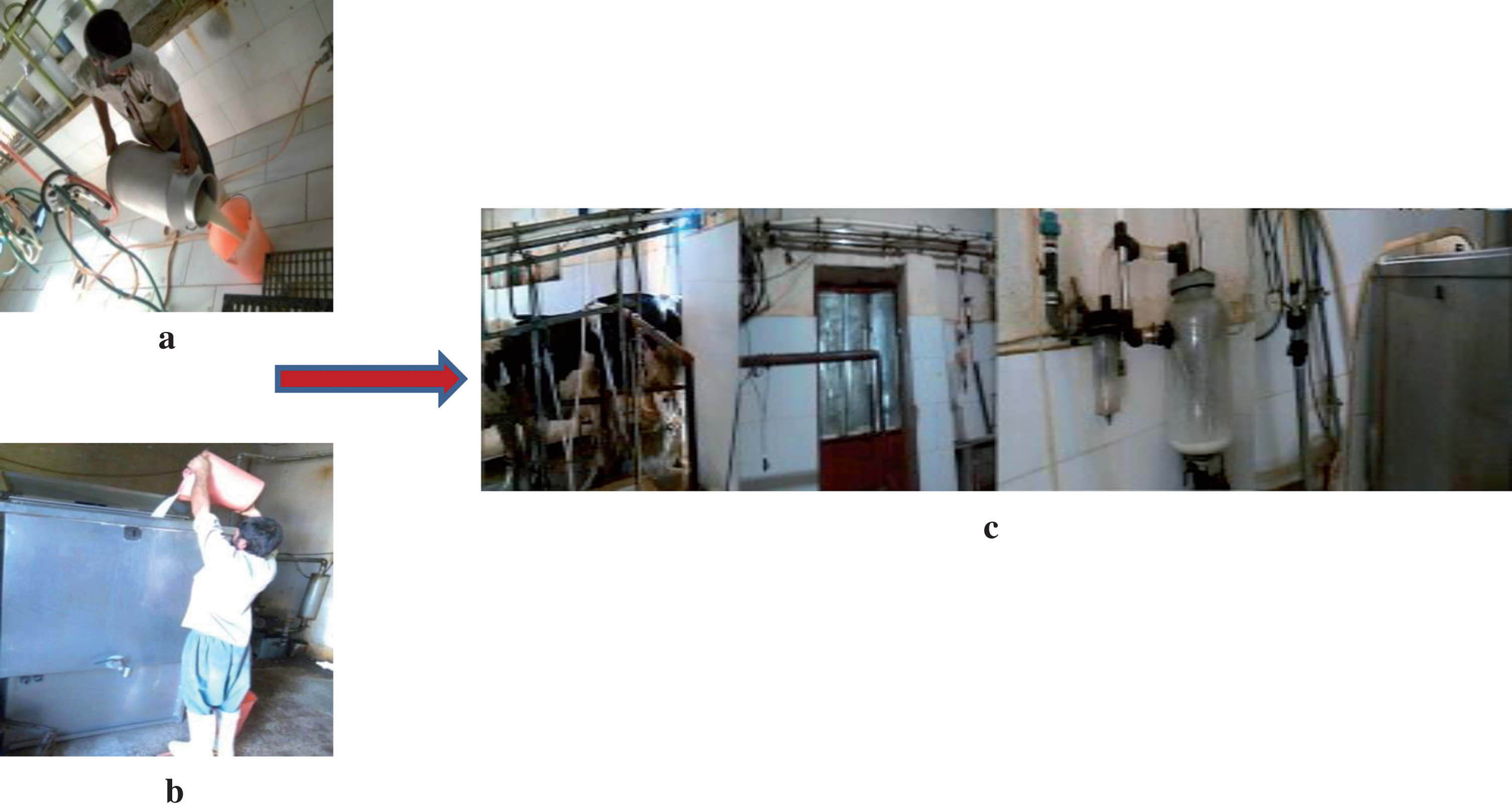
a, Pouring milk into a bucket; and b, Pouring milk from a bucket into a tank (before intervention); c, an automatic transmission system to transfer milk from milking machine into a tank (after intervention).
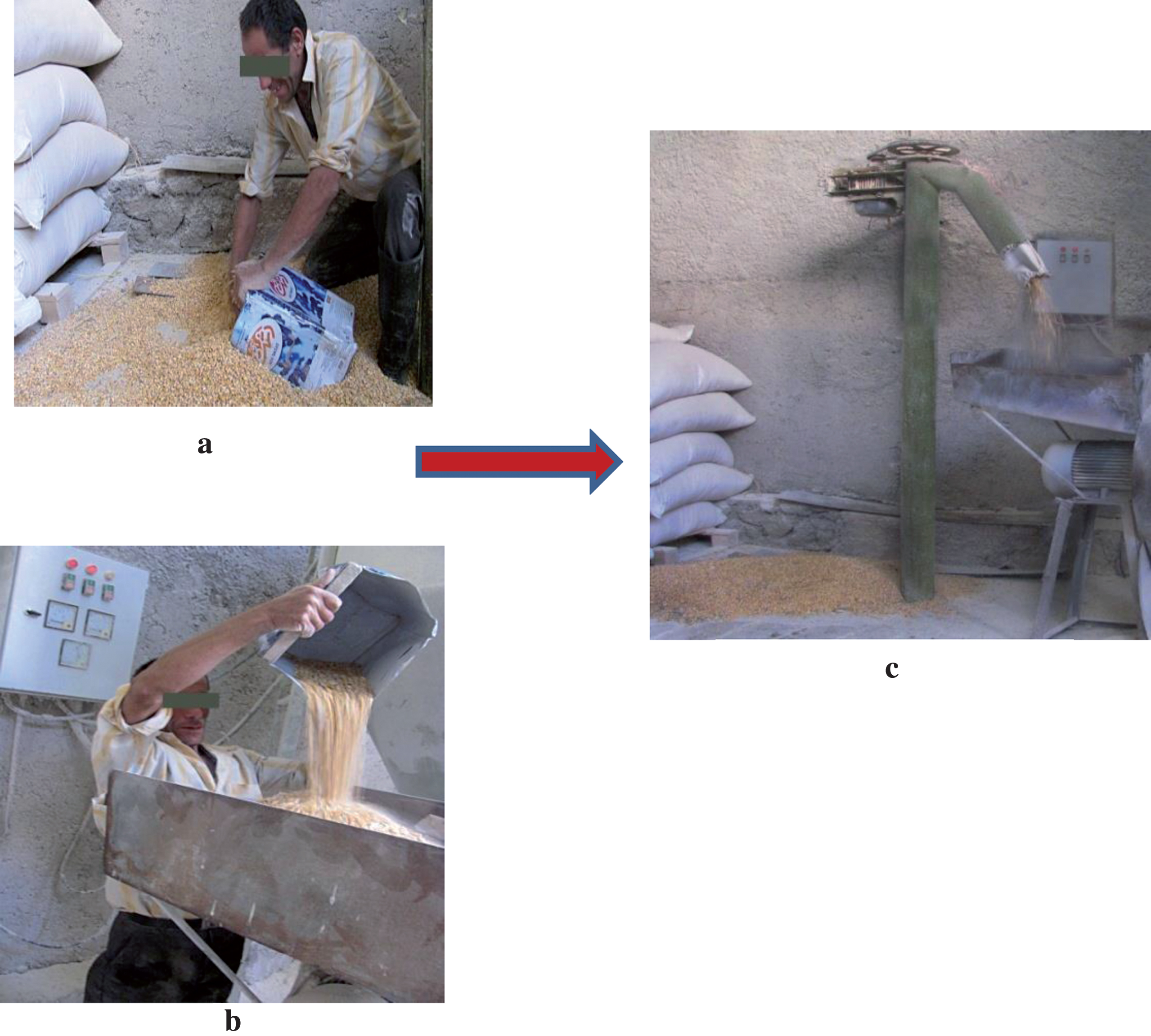
a, Filling corn containers; and b, Pouring corn into the milling machine(before intervention); c, an automatic transmission system to transfer corn into a milling machine (after intervention).
The third intervention was for reducing the posture risk score of filling feed bags. Evaluation results of risk by using REBA method show that highest risk in this task was related to the back and feet (with score of 4). By designing a simple and cheap holding device for the bag, the posture risk score was reduced; worker could fill the bags by using a shovel and in a relatively good posture. This ergonomic design intervention reduced the risk score related to back from 4 to 2 and risk score related to feet was reduce from 4 to 1. The total risk score was reduced from 11 to 4 (Fig. 3).
The fourth intervention was for reducing the posture risk score associated with manure disposal. REBA evaluation indicated that in this task, the highest risk score was related to the back and the feet. According to these results and by considering available resources, a shovel with a handle appropriate to the anthropometric characteristics workers, was designed. This ergonomic design intervention reduced the risk score related to the back from 4 to 2 and the risk score related to feet from 3 to 1. Also, the total risk score of task was reduced from 11 to 5 (Fig. 4).
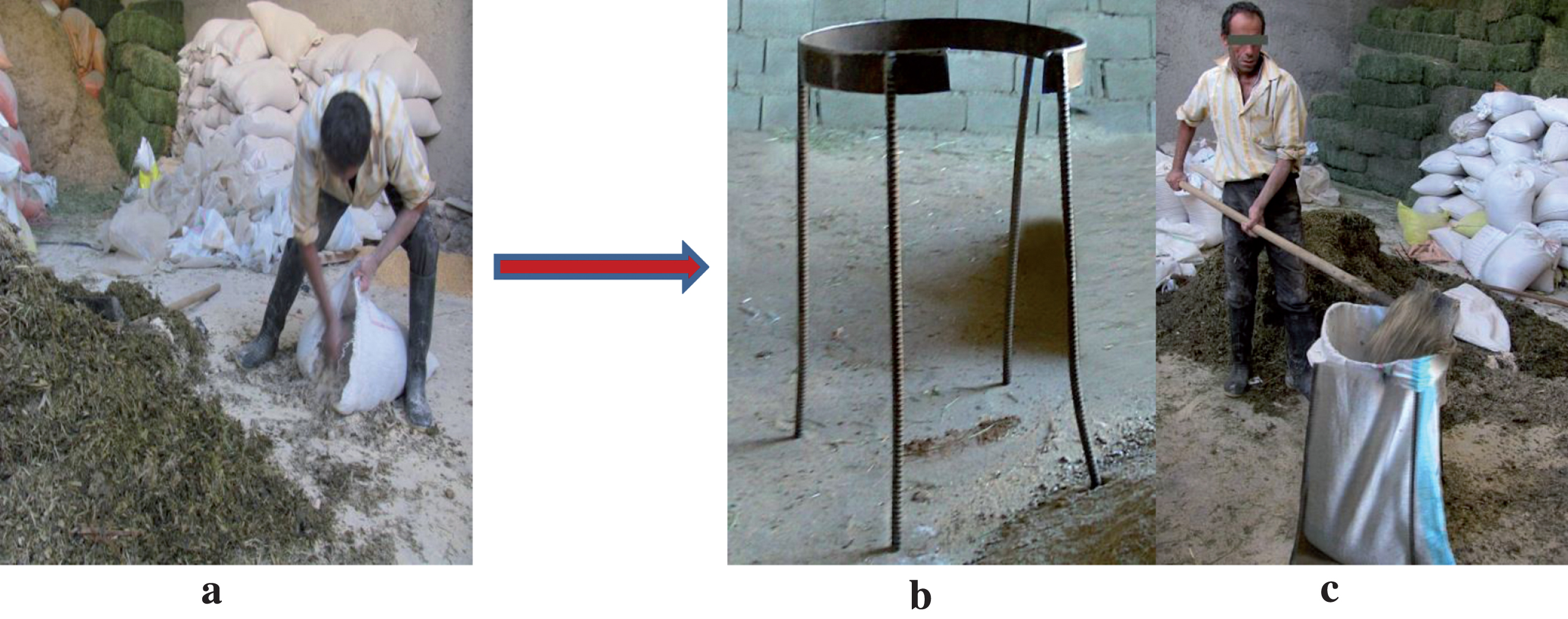
a, Workers manually filling the feed bags (before intervention); b, Bag holder (a metal frame) and c, (after intervention).
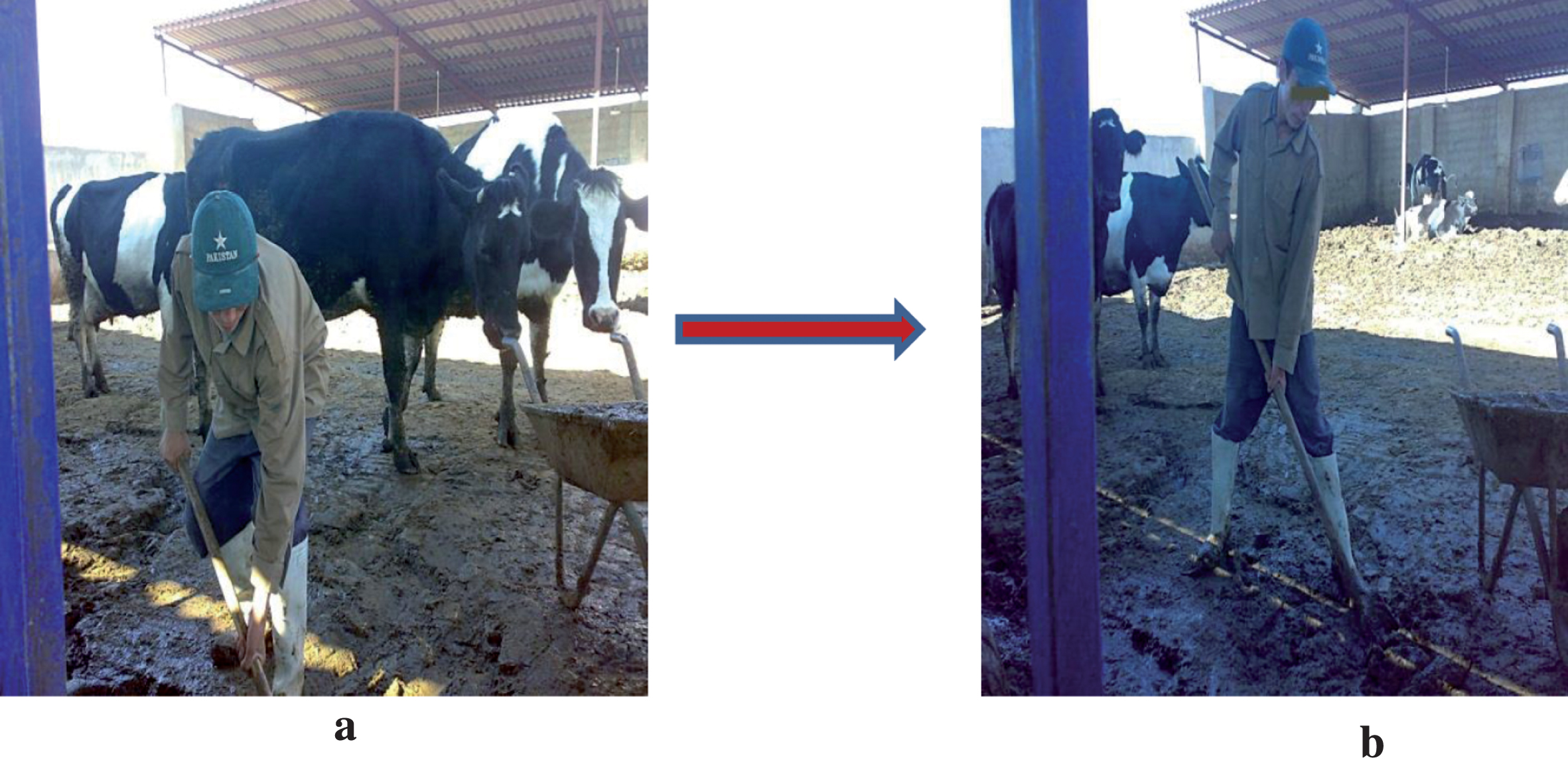
a, Collecting and removal of manure using a shovel of inappropriate size (before intervention); b, Collecting and removal of manure using a shovel of appropriate size (after intervention).
This study evaluated ergonomic design interventions for eliminating or reducing unsuitable postures during dairy farming tasks. Interventions designed with active participation of the workers led to improving unsuitable postures from pouring milk in a bucket, pouring milk from a bucket into a tank, filling corn containers and pouring corn into the milling machine and reducing score risk of unsuitable postures from filling the feed bags and manure disposal.
In this study, for the first time, ergonomic design interventions were conducted for different tasks of dairy farming. Engineering control methods the most efficient methods for controlling and reducing risk factors for musculoskeletal disorders [17]. In the designed engineering interventions conducted in this study, available sources on the dairy farm using low cost methods were used. According to the poor economic situation of dairy farms in Iran, using these simple low cost interventions effective interventions, can be considered important for preventing WMSDs. Many middle and small private industries are marginal operations due to economic conditions of Iran [1]. In addition, in some deprived provinces such as Kohgilouyeh & BoyerAhmad safety and hygiene standards are relatively low [3]. Therefore, developing low cost engineering design interventions can be efficient and suitable for removing or reducing safety risks, improving ergonomics and reducing health problems in these industries [18].
One of the advantages of this study was the use of the participatory ergonomics approach to involve training workers and using workers to help design ergonomic interventions. The effectiveness of this approach in reducing prevalence of musculoskeletal disorders has been reported among Iranian workers [19, 20]. According to Wilson and Haines [21], in order to perform an effective and successful participatory ergonomics process, three interdependent requirements of creating knowledge, confidence and motivation in personnel should be considered. In the present study, training ergonomics principles to the workers led to increase of their knowledge and empowerment and their self-confidence. This motivated the workers to be engaged in the current study and in presenting efficient and low cost suggestions for eliminating or reducing ergonomic risk factors related to their tasks. In fact, in participatory ergonomics, workers learn principals of ergonomics knowledge and may apply it for the improvement of other aspects of their work conditions [22, 23]. Moreover, one of the necessities of participatory ergonomics approach is top management organizational support for implementing workers’ proposed changes [19, 24]. Performing effective interventional designs in the current study was possible with the support and complete involvement of the manager of the dairy farm.
The results of previous studies indicated that ergonomic risk factors are very high in milking and prevalence of musculoskeletal disorders in different body parts is very high among milkers [15, 26]. In milking, personnel perform repeated and full-pressure work by high speed and unsuitable posture of hands, wrist, forearm, and shoulders [27]. The result of this study, in line with these studies, showed that risk levels of pouring milk into a bucket and pouring milk form a bucket into a tank were at unacceptable levels and ergonomic intervention for eliminating or reducing was necessary. In this regard, an automatic transmission system of milk was designed. By using this system, the two mentioned tasks were eliminated and as a result of it, unsuitable risk postures and carrying heavy and repeated physical load were also eliminated. By using an automatic transmission system for corn, risks of filling corn containers and of pouring corn into the milling machine were eliminated. In fact, by using two automatic transmission systems in milking and feeding tasks, in addition to preventing exposure of the workers to risk of musculoskeletal disorders, the time required to do these tasks was reduced.
Ergonomic interventions in the current study reduced posture risk associated with filling feed bags and manure disposal. The risks were at unacceptable levels and ergonomic interventions were necessary. Due to poor economic conditions on the farm, it was not possible to use automatic devices for eliminating risk. Therefore, in order to reduce risk, using the workers suggestions, simple and low cost ergonomic interventions were used. Designing a holding device for the food bags and a shovel with a handle appropriate to the anthropometric characteristics of workers reduced the risk related to the both tasks considerably.
One of the limitations of the present study was that only the REBA observational method was used, and other methods of risk evaluation such as electromyography were not. The present study was conducted on only one dairy farm. However, the field observations of the research team showed that tasks performed on other dairy farms in Yasuj city were performed in the same manner. The other main limitations of this study were financial and economic limitations which prevented testing some design interventions proposed by the workers, especially for eliminating risks of filling feed bags and manure disposal. In spite of these limitations, by performing done interventions, risk level of these two tasks were reduced considerably.
Together, results of this study indicated that using a participatory ergonomics approach was effective for eliminating or reducing ergonomic risks in semi-industrial dairy farming tasks in Iran. In the first and second design interventions, by designing two automatic systems, two tasks of milking and two tasks of feeding were eliminated. In the third and fourth design interventions, unsuitable postures filling feed bags and manure disposal were considerably reduced. The results of this research indicated that by using participating ergonomic principals and by low cost and simple designs, postural risks for WMSDs on Iran dairy farms and other dairy farms could be prevented.
Conflict of interest
None to report.