



Abstract
BACKGROUND:
The use of school furniture with a height that is anthropometrically mismatched can lead children into taking awkward postures while sitting. In Korea, desks and chairs for primary schools have seven different height levels, and these levels are regulated by the national standard KSG-2010. These levels serve to accommodate children of all heights, but the choice problem remains because of the many alternatives.
OBJECTIVE:
This study evaluates the anthropometric feasibility of the currently used guidelines for the selection of height level for Korean primary school furniture. In addition, we examine children’s ability to select anthropometrically recommendable desk and seat heights.
METHODS:
In study 1, anthropometric data from 2005 Korean children were acquired and a mismatch analysis was performed under the assumption that children were paired with the height level recommended by the guidelines. In study 2, we conducted a desk and seat height selection experiment that included 36 children.
RESULTS:
The results of study 1 revealed that about three quarters of children could be matched by following the guidelines. The results of study 2 showed that a quarter of children selected matchable desk and seat heights by themselves. We developed new guidelines using classification algorithms based on the employed data in study 1, and it was confirmed that the new guidelines could significantly increase the degree of match.
CONCLUSION:
This study confirmed that the currently used guidelines need to be revised and that children had difficulty in selecting the appropriate height of school furniture by themselves. The new guidelines suggested in this study are expected to contribute to the correct usage by Korean primary school children.
Keywords
Introduction
Today, sedentary activities are very common in children and long-term sitting of children can be observed frequently. Incorrect long-term sitting may lead to the occurrence of musculoskeletal disorders such as spinal diseases [1, 2]. Childhood is an especially important period for the formation of postural habits and the habits formed are difficult to correct in adulthood [3]. Moreover, spinal diseases in childhood could negatively affect physical development [4]. Therefore, it is very important to encourage children to sit appropriately.
Most children spend a significant time in school where many sedentary activities are held [5, 6] so the establishment of sitting postural habits can be strongly affected by their school life. Additionally, participating in a lesson with an inappropriate posture can negatively affect learning performance [7]. Consequently, schools have a tremendous responsibility in ensuring that children sit properly. In this context, schools have to offer an appropriate educational environment. More specifically, schools must offer anthropometrically designed school furniture to children. Use of school furniture that is not matched with the anthropometric characteristics of the user can lead to awkward posture [8–16]. Desk and seat heights are known as especially critical dimensions [17, 18]. Agha [19] found that children who use too high of a chair assumed awkward postures such as excessively leaning forward or positioning their feet between their hips and the seat. In addition, Panagiotopoulou and colleagues [20] observed that children who use too high of a desk assumed poor postures such as sitting on the front edge of seat and shrugging their shoulders. Therefore, the height of school furniture for each child must be carefully determined by considering each child’s anthropometric characteristics.
In Korea, all schools have to use desks and chairs that are certificated by the Korean Standards Association (KSA). KSG-2010 is a standard for chairs and tables for educational institutions such as kindergartens, elementary schools, junior high schools, and high schools [21]. The corresponding international standard conforming to this standard is ISO 5970 [22]. This standard regulates the size of school furniture to follow the given size system comprising seven levels. More specifically, furniture dimensions of each level must be in a given range or just meet a given fixed value. Something to note is that desk height and seat height are the only dimensions that have to be a fixed value by level. Most Korean primary schools have these seven types of desks and chairs to accommodate as many children as possible. Recently, in accordance with the suggestions from many researchers [13, 23], adjustable desks and chairs in which the height can be incrementally adjusted to one of seven levels have also been widely used.
However, the spread of desks and chairs of various sizes still leaves the problem of whether children can choose a desk and chair of the right size for themselves. This problem is unavoidable because there are no one-size-fits-all solutions for school furniture design [24, 25]. To solve this problem, some guidelines to select the appropriate desk and seat heights should be given to children. If such guidelines are not given, children have to select by themselves. However, most children do not know their anthropometric measures, making it difficult for them to select the desk and chair of appropriate heights. KSG-2010 recommends that children select the levels of desk and seat heights based on their height. In other words, it suggests comparing their stature to the reference stature of each level and choosing the level of reference height nearest to their stature. However, the feasibility of this guideline is doubtful. First, the reference stature at each level is composed of equal intervals. This is in contrast with the ISO 5970 standard and the suggested guidelines in previous studies that were developed to decrease the degree of mismatch for children from other countries [26, 27]. In addition, although desk height and seat height are related to independent anthropometric measures [11, 28], the reference stature for each level of desk height and seat height is the same. Yanto and colleagues [25] found that the use of a set with the same levels of desk and chair lead to a mismatch problem.
This study aims to evaluate the feasibility of currently used guidelines for selecting desk and seat heights of Korean primary school children and the ability of children to select the appropriate desk and seat heights without guidelines. In study 1, the degree of mismatch caused by following the guidelines was analyzed based on anthropometric data from Korean children. In study 2, a desk and seat height selection experiment was conducted and a mismatch analysis was performed. Finally, new guidelines were developed using classification algorithms to decrease the degree of mismatch.
Methods
Study 1: Evaluation of currently used guidelines for the selection of desk and seat heights
Currently used height systems and guidelines for school furniture
As mentioned above, both desks height (DH) and seat height (SH) can be adjusted over seven levels (Fig. 1). In particular, all desks have a drawer that is attached underneath the desktop. Subsequently, the underneath desk height (UDH) at each level depends on the board (desktop) thickness (BT) and the drawer height (DRH). In this study, it was assumed that BT is 20 mm and DRH is 70 mm, which are average values of desks used in Korean primary schools. To help children use anthropometrically appropriate school furniture, KSG 2010 proposed guidelines to select the level of DH and SH by referring to the child’s stature (Table 1).
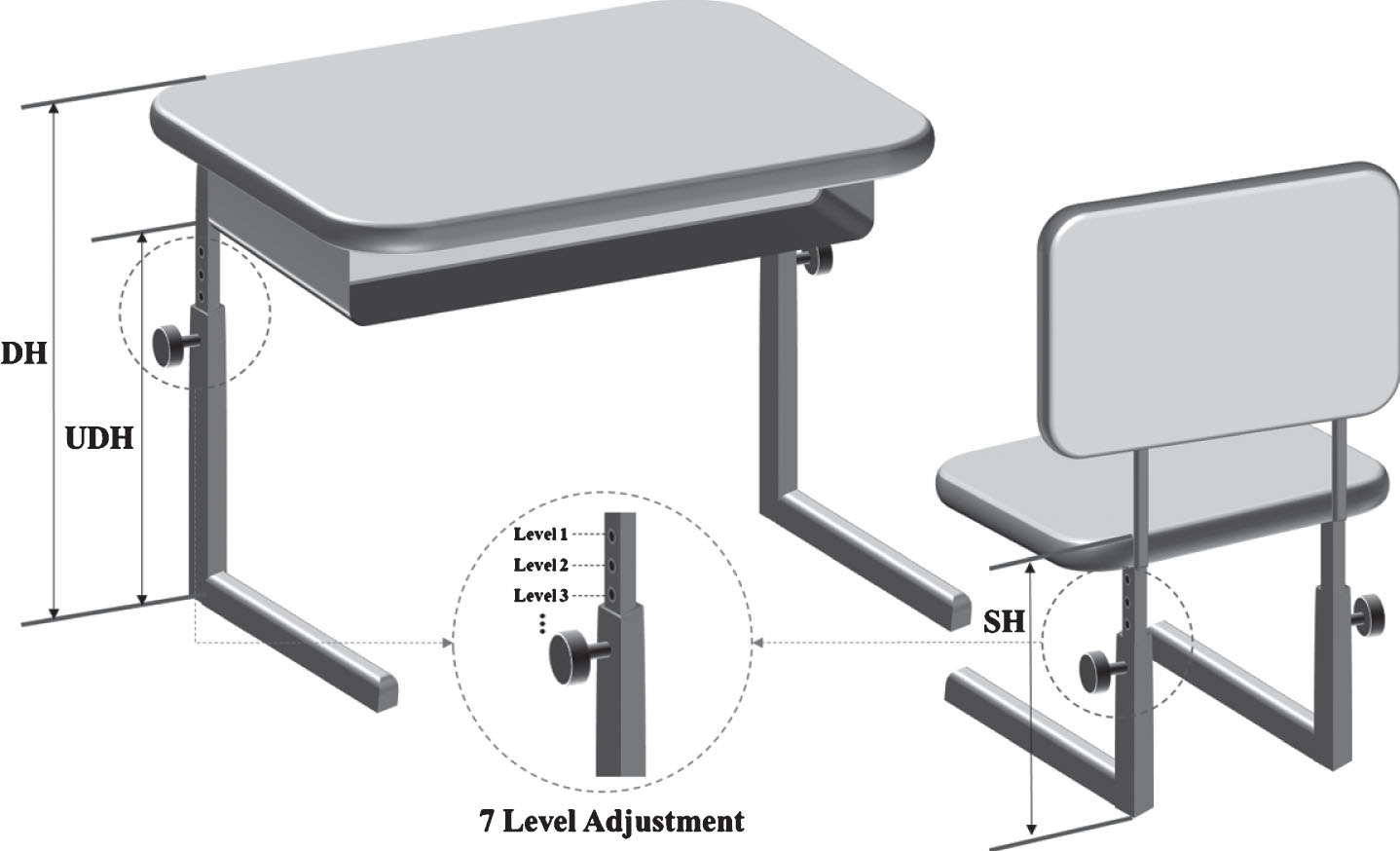
Illustration of Korean school furniture designed according to KSG 2010.
Height systems for school furniture in Korea
*Underneath desk height of each level was defined under the assumption of board thickness and drawer height.
This study employed anthropometric data measured by the national anthropometric survey (6th Size Korea, KATS) in 2010. In this study, five anthropometric measures for children aged from 7 to 12 (n = 2005) were selected: popliteal height, sitting (PH); knee height, sitting (KH); shoulder height, sitting (ShH); elbow height, sitting (EH); and stature (S) (Fig. 2). The descriptive statistics of the five anthropometric measures of the children are presented in Table 2.

Selected anthropometric measures in study 1.
Descriptive statistics of acquired anthropometric data in study 1
For every child, the lower and upper limits for SH, DH, and UDH can be calculated based on anthropometric measures [9, 29–31]. For SH, both lower and upper limits were defined by PH:
This equation means that the knee joints must be in an appropriate range (5° to 30° flexion) while the child is sitting on a chair. Note that 20 mm was added to PH to correct for the thickness of shoe sole in Equation (1). The appropriate range of knee joints was suggested by Molenbroek and colleagues [23].
For DH, both lower and upper limits were defined by three anthropometric measures, EH, PH, and ShH:
This equation means that the shoulder joints must be in an appropriate range (0° to 25° flexion and 0° to 20° abduction) when the child is resting his or her elbows on the desk while sitting on a chair with appropriate SH. The appropriate range of shoulder joints was suggested by Chaffin and Anderson [32]. For UDH, the lower limit was defined by KH and the upper limit was expressed by EH, PH, and ShH:
This equation means that sufficient clearance (20 mm) between the child’s legs and the bottom of the desk must be given while the child is sitting on a chair. Note that 20 mm was added to KH for the same reason as for the mismatch equation for SH. The upper limit of UDH was defined based on the upper limit of DH and the assumed height of the drawer and thickness of the desktop.
Finally, by considering the relationship between DH and UDH,
To evaluate the feasibility of the currently used guidelines, the degree of mismatch caused by following the guidelines was calculated. Every child was allocated to one of seven levels of SH and DH based on the guidelines (Table 1). In other words, each child was paired with levels of SH and DH for which the standard stature is closest to his or her stature. Next, whether or not the child and SH and DH are anthropometrically matched was determined based on Equations (1 and 4), respectively. If they were mismatched, it was verified whether the cause of the mismatch was exceeding the upper limit or falling short of the lower limit. Based on this mismatch analysis, degrees of mismatch for all children and by age group were calculated.
Participants
In study 2, 36 healthy 7- to 12-year-old children (18 boys and 18 girls) were recruited. Their average age was 9.53 (standard deviation (SD) = 2.00). A body discomfort chart and a visual analog scale were used to screen the unhealthy participants, and all of participants passed. Before data collection, the participants were informed by their caregivers of the purpose of the study and procedure, and they were given consent to participate. All participants received monetary compensation. The anthropometric information of the participants is given in Table 3.
Anthropometric measures of children participating in study 2
Anthropometric measures of children participating in study 2
For the experiment, a desk used in one Korean preliminary school and a chair with a footrest were prepared (Fig. 3). For the chair, the height of the footrest and the seat were independently and continuously adjustable so that the effective seat height (the height of seat minus the height of the footrest) was freely adjustable. Also, the backrest was fully adjustable, allowing for effective seat depth (distance from the back to the front of the sitting surface) to be freely adjustable. The seat width of the chair was 470 mm, which was a factor of >1.1 greater than the maximum value of the buttock–popliteal length among the recruited children, so all participants were able to sit stably [21, 27]. For the desk, seven levels of adjustment were allowed but the desk height was fixed to level 7 (760 mm). Participants were free to adjust the effective desk height (height of the desk minus the height of the footrest) regardless of the fixed desk height because the heights of the footrest and the seat could be independently and continuously adjusted.

Illustration of equipment and measured dimensions in study 2.
Prior to the experiment, seven body dimensions in relation to the dimensions of desk and seat for each participant along with their stature and weight were measured. Based on the measured dimensions, the back rest was adjusted and securely fixed so that the effective seat depth could fall within a recommendable range of 80% to 95% of buttock–popliteal length [9, 33–35]. First, in the experiment, the footrest height was adjusted to determine the effective seat height suitable for each participant. Second, the participants were seated in front of the desk and asked to determine the appropriate seat height for themselves for the given desk height. At the same time, the initial footrest and seat heights were set either very high or very low, preventing participants from selecting the initial seat height. Once the participants confirmed the final heights, the effective desk and seat heights were measured. There was no time limit set for participants to select their own settings and they were allowed to override their previous decision until they made a final decision.
Mismatch analysis
As in study 1, the frequencies of match, mismatch from an excess of the upper limit, and mismatch from a shortfall of the lower limit were calculated based on the effective desk and seat heights chosen by participants.
Results
Degree of mismatch caused by following the currently used guidelines
Based on the mismatch analysis, all children were able to match with one of five DH levels (levels 2, 3, 4, 5, and 6). However, mismatching cases did occur when following the guidelines. When participants followed currently used guidelines, the degree of DH mismatch is shown in Fig. 4. A total of 76.62% of children from 7 to 12 years in age matched well; however, 23.03% mismatched because the paired level was too high for them while 0.35% paired to too low a level. In terms of age groups, the 12-year-old group was the most mismatched group. For 7-year-old children, 88.89% matched well, while 11.11% paired at too high a level for them. For 8-year-old children, 76.53% were paired with well-matched levels but 23.00% and 0.47% were paired with too high a level and too low a level, respectively. For 9-year-old children, 81.60% matched well while 18.00% and 0.40% could not be matched because too high and too low levels were paired. For 10-year-old children, 82.87% matched well, while 16.57% of them paired with too high a level and 0.56% paired with too low a level. For 11-year-old children, 76.63% of them matched and 23.37% of them could not be matched because too high a level was paired. Finally, for 12-year-old children, 66.36% paired with well-matched levels while 33.09% mismatched by too high a level and 0.55% mismatched by too low a level.

Results of mismatch analysis for desk height in study 1.
For SH, mismatching cases also did occur when the children followed the guidelines, although Based all children were able to match with one of five SH levels (levels 2, 3, 4, 5, and 6). The results of the SH mismatch analysis is shown in Fig. 5. A total of 74.38% of children from 7 to 12 years in age matched well. However, 23.68% mismatched because the paired level was too high for them while 0.35% paired with too low a level. In terms of age groups, the 12-year-old group was the most mismatched group, as was the case for DH. For 7-year-old children, 81.29% matched well while 12.87% paired with too high a level and 5.85% paired with too low a level. For 8-year-old children, 74.18% were paired with well-matched levels but 22.54% and 3.29% were paired with too high a level and too low a level, respectively. For 9-year-old children, 80.00% matched well while 18.40% and 1.60% were paired with too high a level and too low a level, respectively. For 10-year-old children, 78.37% matched well while 18.82% of them paired with too high a level and 2.81% paired with too low a level. For 11-year-old children, 74.95% of them matched well while 24.21% of them could not be matched because too high a level was paired and 0.84% mismatched because too low a level was paired. Finally, 66.54% of 12-year-old children paired with well-matched levels while 32.72% mismatched by too high a level and 0.74% mismatched by too low a level.
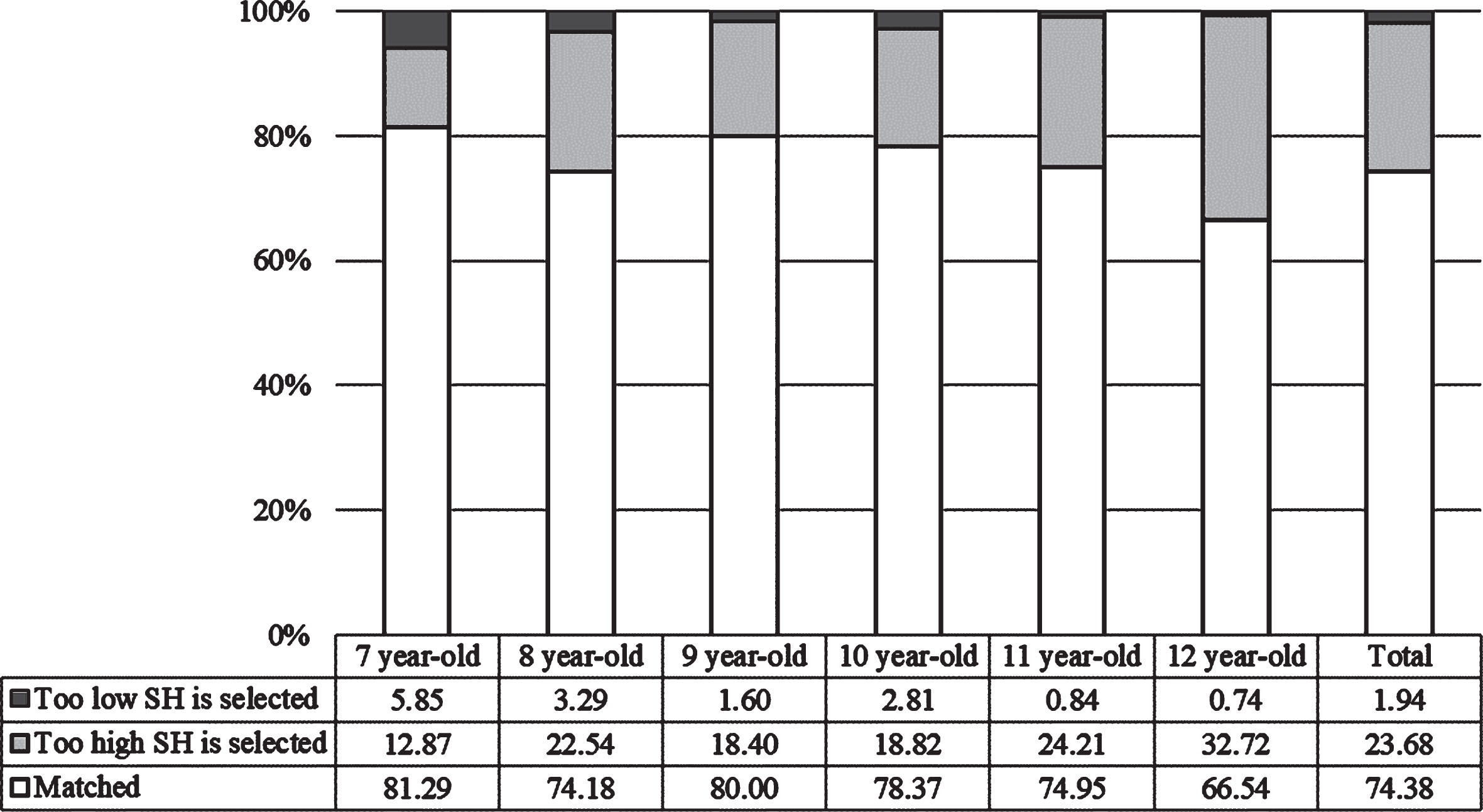
Results of mismatch analysis for seat height in study 1.
The degrees of mismatch of both desk and seat heights were 71.43% and 76.19%, respectively (Fig. 6). For desks, 61.90% of children selected a DH value exceeding the upper limit, while 9.52% selected a DH value falling short of their lower limit. For chairs, 57.14% selected heights exceeding their upper limit and 19.05% selected heights falling short of their lower limit.
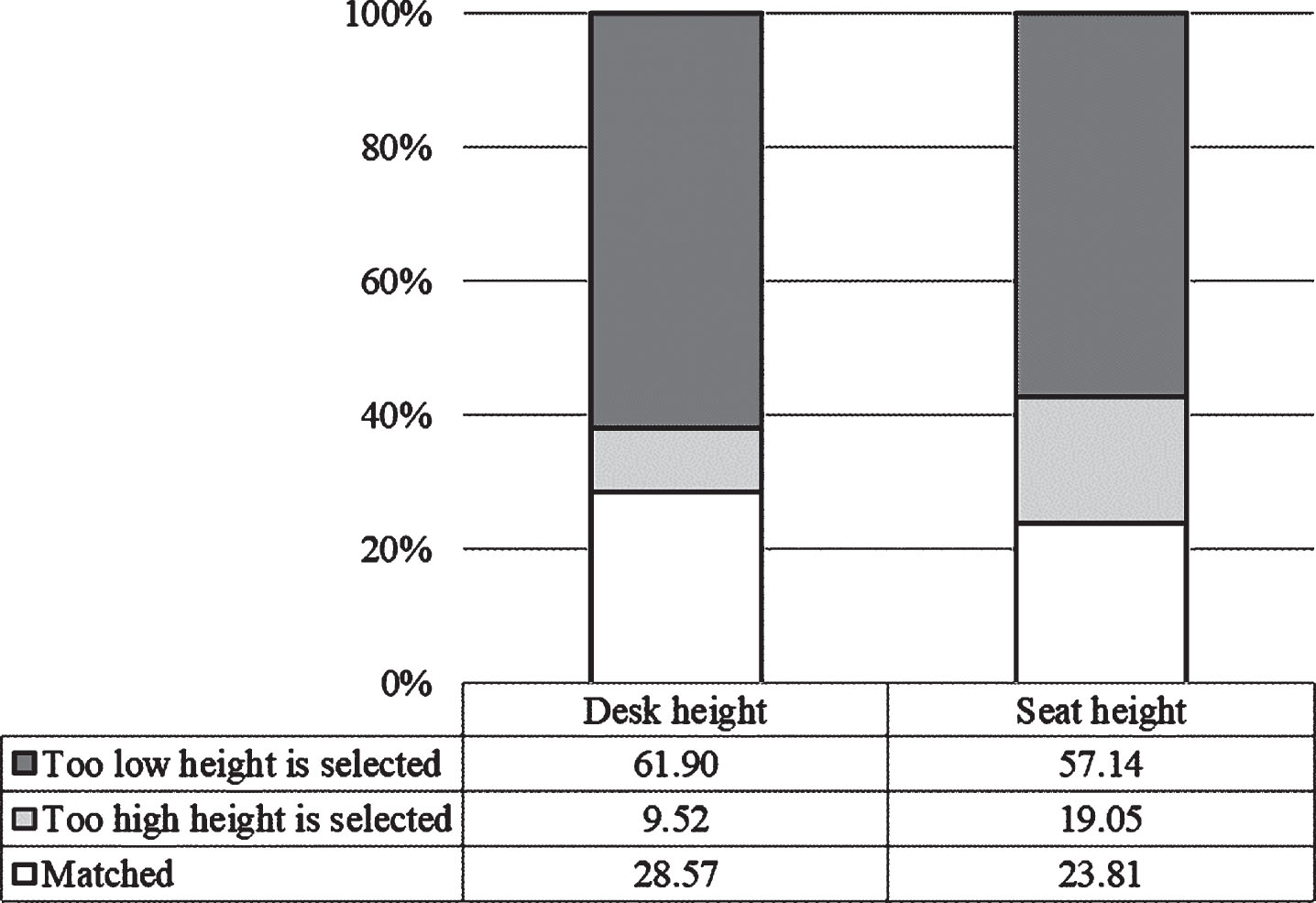
Results of mismatch analysis for desk and seat heights in study 2.
Mismatch problem in Korean primary schools
The results of these two studies revealed that the current guidelines were designed improperly, and, moreover, children lacked the ability to select the appropriate furniture height. Previously, Lim and colleagues [17] investigated the usage behavior of school furniture in one Korean school and found that 64% of students did not use the school furniture recommended by the guidelines. They also confirmed that 74% did not know the guidelines. Taken together, these results indicate that usage behavior of school furniture in Korean primary schools may be problematic.
According to the result of study 1, about three quarters of children were able to select appropriate DH and SH by following the currently used guidelines. Such results could be explained by a change in the anthropometric characteristics of Korean children. It has been over 17 years since the last revision of KSG-2010 on furniture dimensions. Moreover, this revision was based on anthropometric data acquired in 1998. The secular trend of anthropometric characteristics of children has been observed in other countries [36–38]. Castellucci and colleagues [38] argued that the secular trend can lead to a temporal change of accommodation level for long-lifetime products. In mismatched cases for both DH and SH, most of them were caused by pairing with too high a level. Based on these results, it can be inferred that the standard stature for each level needs to be increased.
In study 2, <30% of participants selected the appropriate desk and seat heights for themselves. Also, most students selected desk and seat heights that exceeded the upper limit. The first possible cause of such results may be the difference in the possible range to adjust in a natural situation. The desk height cannot be set significantly lower than the lower limit because there are limitations to setting the desk height lower than a certain height to position one’s legs under the desk. However, it can be set significantly higher than the upper limit owing to fewer limitations but broader adjustable ranges, leading to a higher probability of mismatch exceeding the upper limit. For chair height, the range from the upper limit to the physically adjustable upper limit is broader than the range from the lower limit to the physically adjustable lower limit as well. Second, these results could be affected by the preference of children. Tuttle and colleagues [18] found that students preferred higher seat height when they used desks with a high desk height. They also confirmed that preferred seat height is negatively correlated with stature. These results indicate that children who selected excessively high DH as the recommendable DH were likely to select too high an SH value for themselves and children who are generally shorter than middle and high school students may prefer high SH. Lastly, children lack experience with desks and chairs designed specifically for their anthropometric dimensions. Except for school furniture, most furniture/products are designed to fit the dimensions of adults. Children who lack knowledge of appropriate posture and furniture selection criteria or children who lack experience with musculoskeletal disease or back pain may have been used to using inappropriately designed furniture or may not even realize that they are feeling discomfort. Such behaviors have been reported by Panagiotopoulou and colleagues [20]. They revealed that most children from three primary schools in Greece were using mismatched desk and chair heights, all of which were too high. In addition, it was investigated that such an issue leads to awkward postures such as sitting on the edge of a seat or lifting arms and hunching shoulders. However, according to the survey of subjective perception, only a relatively small percentage of students felt uncomfortable with their desk height and seat height. Also, such a tendency occurs more frequently with children of younger age. These findings indicate that following the wrong guidelines may affect voluntary selection of the wrong furniture dimension.
Development of new guidelines to select recommended desk and seat heights
As shown in the results of studies 1 and 2, even if there is a desk and a chair that can be adjusted to suitable heights for each person, this is meaningless if wrong guidelines are given or each person has the ability to choose them. The recommended level of SH can be decided by a single anthropometric measure (PH). However, four anthropometric measures (ShH, EH, KH, and PH) have to be measured to select the recommended level of desk height. Most people do not know these values; moreover, they are difficult to measure in school [39]. Therefore, a practical and easy method to select the appropriate desk height is needed. In this section, new guidelines are derived by using multinomial logistic regression (MNL) and decision tree (DT) analysis using stature as an input variable, because stature is referred to as critical dimension for anthropometric school furniture design [40]. Although there have been some studies indicating that PH is the most relevant anthropometric measure [26, 41], stature was selected as an input variable because it is the most familiar and easily measurable anthropometric measure for children. Given that children could be matched to multiple levels, the true recommended levels of DH and SH for each child were assigned as follows: The level closest to the median of the lower and upper limits was assigned as the true recommended level. A randomly selected sample of 80% of the data was used as a training set and the remaining data were used as a test set. The results are listed in Tables 4 and 5. The recommended range of stature for levels 1 and 7 could not be derived because there was no child whose true recommended level was level 1 or 7. For DH, the classification accuracy of MNL was 0.905. A total of 92.62% of the children were able to choose the recommended levels, given that the predicted recommended level was not a true recommended level but still anthropometrically acceptable. The classification accuracy of DT was 0.91, and 92.42% of the children were able to choose an acceptable level. For SH, the classification accuracy of both MNL and DT was 0.827. A total of 90.03% of the children were able to choose the acceptable levels by using the new guidelines based on the results of MNL, while the matching rate for the new guidelines based on the DT results was 90.33%. The results revealed that the matching rate could be increased by suing the new guidelines. The accuracies and matching rates of the two new guidelines had no significant difference, so it was difficult to distinguish superiority between the new guidelines. However, given that the matching rate of the entire population might be slightly different from the results in this study, the new guidelines based on DT that showed better classification performance can be recommended.
Comparison of currently used and new guidelines for DH
Comparison of currently used and new guidelines for DH
Comparison of currently used and new guidelines for SH
In this study, we evaluated the feasibility of currently used guidelines for the selection of desk and chair height levels. Anthropometric data from 2005 Korean children were acquired and a mismatch analysis was conducted. The results reveal that a quarter of children were mismatched when they were paired with the height level recommended by the guidelines. In most mismatched cases, children were paired with too high a height level, even though they could be matched with one of the lower height levels. It was also found through the experiment that most children by themselves select desk and seat heights that are too high. To decrease the degree of mismatch, new guidelines were suggested by using classification algorithms. Evaluation the results on using the new guidelines revealed that they could increase the degree of match significantly.
Although the new guidelines were effective, they must be accompanied by action if they are to be meaningful. Therefore, first, it is important to encourage children to follow the guidelines through training and to familiarize them with anthropometrically recommendable school furniture. Secondly, a wider spread of adjustable school furniture is needed to mitigate the mismatch problem. Furthermore, they should be adjustable more easily than they are at present. A type of most of currently used height adjustable school furniture is a set-up type. More specifically, height adjustable desks and chairs for Korean primary schools have telescopic legs. They have seven holes in the legs so the height could be fixed to one of seven levels using Allen screw. This type of adjustable school furniture has economical advantage but it needs considerable disruption to adjust once it assembled. Thus, it is recommended to offer children more easily adjustable school furniture such as pneumatic or electric adjustable desks and chairs. At last, considering that primary school children experience relatively rapid physical development, stature needs to be measured at least once a year and it needs to be checked regularly whether their school furniture heights are appropriate or not.
The results of this study may change if more anthropometric data are acquired in study 1 or if experimental data from more children are gathered in study 2. However, they are still meaningful for identifying the mismatch problem caused by giving children multiple choices. Furthermore, a significant improvement in the degree of matching could be expected if the new guidelines are offered to children. The aim of this study was to evaluate and improve the guidelines for the selection of school furniture height, but it was not focused on devising guidelines for the design of school furniture. Further research needs to be conducted to evaluate the validity of the height system suggested by KSG-2010.
Conflict of interest
None to report.
Footnotes
Acknowledgments
This study was supported by the Korea Evaluation Institute of Industrial Technology (KEIT) funded by the Korean government (Ministry of Trade, Industry, and Energy) under Grant No. 1415152418. This study was also supported by the BK21 Plus Program (Centre for Sustainable and Innovative Industrial Systems) funded by the Korean government (Ministry of Education) under Grant No. 21A20130012638. We especially thank the Institute for Industrial Systems Innovation of Seoul National University for administrative support.