



Abstract
BACKGROUND:
In a real working environment, workers’ performance depends on the level of competence, psychological and health condition, motivation, and perceived stress. These are the attributes of actual availability. It is crucial to identify the most influential attributes to develop an adequate level of worker’s performance.
OBJECTIVE:
The purpose of this paper is to upgrade the Availability-Humanization-Model (AH-Model) with an implementation of the artificial intelligence classification tree to identify influencing factors of the well-being attributes on human performance, where the identified influencing factors are gripping points for maintaining sustainable performance in real-life conditions of different professions.
METHODS:
Well-being attributes are collected with the Questionnaire Actual Availability (QAA) from AH-Model and then analysed by implementation of the decision trees classification algorithms. An embedded clustering analysis of QAA ensures an efficient feature construction and selection. It negates the need of applying tree pruning or any other noise reduction algorithms.
RESULTS:
An implementation of the machine learning algorithms reflects the real conditions of working environments: (a) real performance of workers depends on the perception of well-being and availability and (b) the most influencing factors explicitly reflect the content of work in a specific domain (Fintech, health, forestry, traffic) with a high level of stress.
CONCLUSIONS:
The presented approach offers a possibility to identify the most important well-being attributes to determine an adequate efficiency and to improve the performance level in the real working conditions.
Keywords
Introduction
Well-being at workplace is a crucial element of the human performance. Maintaining an adequate level of well-being is one of the most important activities of the occupational health psychology [1, 2]. An external manifestation of well-being is a human behaviour reflected in the human performance. Well-being is characterized by the perceived actual availability. To describe the connection between work and a worker in the occupational health activities and in the area of work humanization, the Availability-Humanization-Model (AH-Model) has been developed [3].
Figure 1 is the AH-Model which is a graph with vertices O, T, E, M, W, A, H, P, and C:
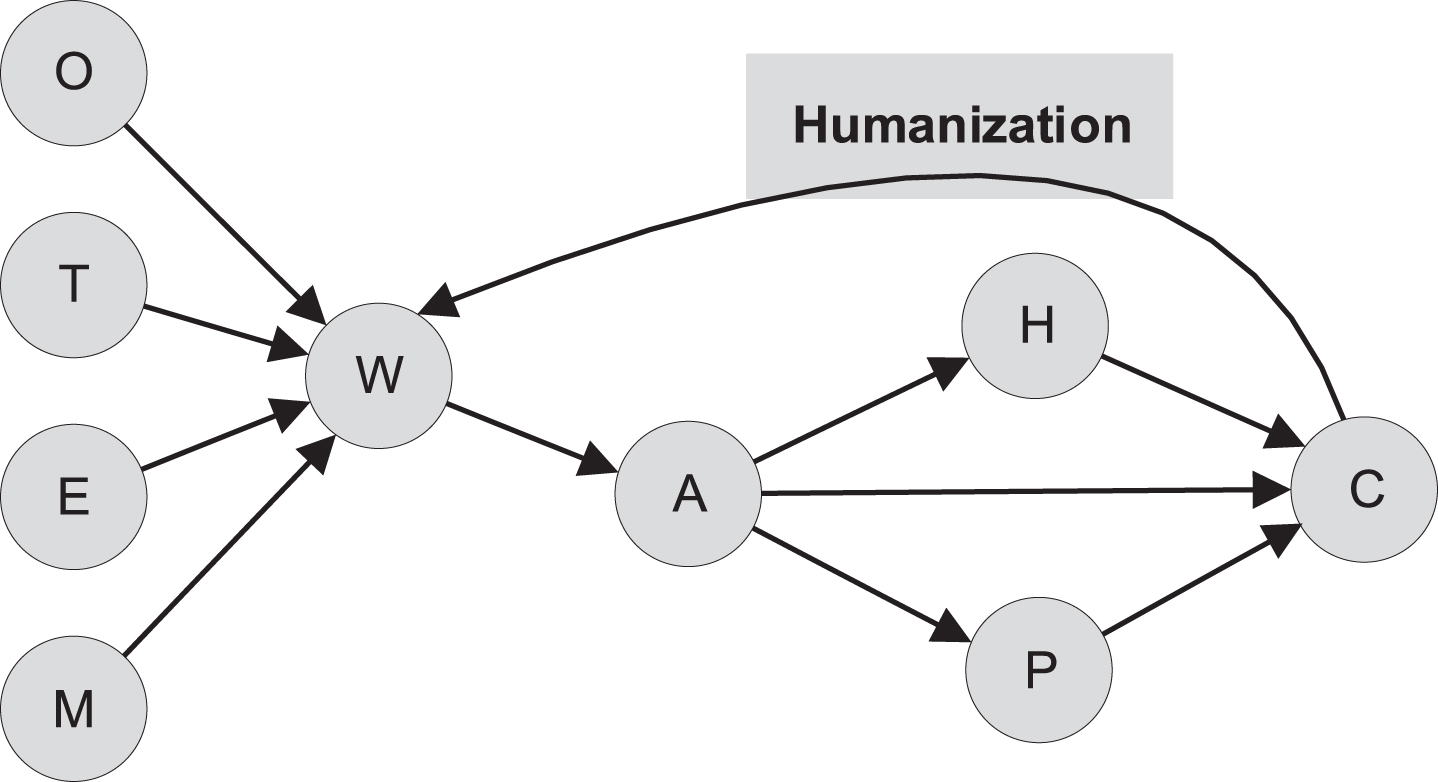
The graph of AH-Model.
Workload (W) is a combination of the environmental conditions at workplace (E), implemented technology (T), organizational conditions (O), and available human resources (M).
Availability (A) is a worker’s estimation of well-being at workplace. Manifested performance (P) is an output of the worker’s activity at workplace.
Health (H) is a manifestation of the psychological and health condition. The decrease in health and worker’s performance determines costs (C) and a considerable decrease in work.
Humanization is an edge from vertex C to vertex W and it is an intervention in the workplace components (E, T, O and M) to reduce workload.
The costs of interventions in the humanization are compared to the costs of health and performance decrease. The AH-Model covers work and worker in a real-life condition [4].
Data of actual availability is collected with the Questionnaire of Actual Availability (QAA). QAA has been developed to determine the perceived well-being in real conditions. The Questionnaire is composed of 47 items of the well-being attributes with a five-point scale of semantic difference for each item. The well-being attributes have been combined in seven scales of well-being with clustering analysis. The composite attributes of QAA are the following: (1) Perception of physical fatigue, (2) Perception of psychological fatigue, (3) Perception of general fatigue (Vigilance), (4) Decrease of motivation (Unmotivation), (5) Perception of exhaustion, (6) Depressed mood, and (7) Perception of stress. The QAA has been implemented in different applicative researches in the health sector [5], the financial [6] and other sectors [7].
Different humanization interventions focused on an individual or on a workplace have been implemented as a result of these studies. The focus of all these interventions has been keeping an adequate actual availability of an individual worker or a group of workers to achieve a stable and adequate performance [8].
Implementation of AH-Model with QAA on the sample of 15,000 workers assures a basis for further focused interventions. A focused intervention requires an improved analysis of the obtained data. Further deeper interventions as well as upgrades of the AH-Model, also require methodological improvements. For this purpose, the artificial intelligence - AI (machine learning - ML) technologies are applied.
ML, as a sub-area of AI, uses statistical techniques to give computers an ability to learn with data without being explicitly programmed [9]. Decision tree learning as a prediction model is used to improve the existing scientific tool to maintain a sustainable human performance. A generated classification tree transforms the collected QAA results to a new knowledge represented as findings about the human performance.
The main goal of this research work is to upgrade the AH-Model with the implementation of the AI classification tree to identify impact of the particular well-being attributes on human performance. The identified influencing factors should be gripping points for maintaining a sustainable human performance in a real-life condition.
A sub-goal of this work is to identify the influencing factors that determine human performance in different professions.
Procedure
The workers estimated their well-being with QAA in an average working day. They estimated their perception of well-being on a five-point scale of semantic difference where one means excellent well-being and five means extremely poor fit.
For each worker, the performance was collected from the performance evaluation data. Performance – efficiency (E) – is classified in five categories where E1 means excellent performance, E2 means very good, E3 means good, E4 means poor, and E5 means no performance.
Using the clustering analysis [10] of QAA, the forty-seven items from QAA were combined in seven clusters presented as composite attributes of QAA: (1) Physical, (2) Psychological, (3) Vigilance, (4) Unmotivation, (5) Exhaustion, (6) Depressed mood, and (7) Stress. These attributes are the input data for the decision tree classification. The decision tree divides population according to different levels of the most influencing factors of well-being.
The identified influencing factors (age, the content of work) offer the possibility to determine humanization interventions to keep the adequately stable worker’s performance. The most important attributes of well-being, which affect human performance, were defined with the implementation of the ML algorithms. The attributes of well-being are defined as a manifestation of actual availability.
Sample and data collection
The sample consists of data collected from 2,942 workers representing five different professions. The data was collected for a modal working day in the following organizations: (1) Financial sector – three most important Slovenian banks, (2) First responders – ten Slovenian fire brigades, (3) Natural environment – three forest companies, (4) Health sector – the biggest university hospital in Slovenia, and (5) Traffic – five fast traffic services. Structure of the sample is presented in Table 1.
Structure of the sample
Structure of the sample
Each worker is described by the profession identification (one from five), well-being related data collected with QAA, and data related to the performance efficiency (from E1 – excellent performance to E5 – poor performance).
Input data on workers’ well-being/availability for our ML algorithms are labelled and tagged with workers’ actual availability. Such data format and content are suitable for a supervised ML.
A decision tree (classification tree), as the most convenient supervised ML method, is used to visually represent decisions related to workers performance. The decision in this classification tree starts with an observation of the well-being attributes presented in the internal nodes and finishes with conclusions about performance classes (E1, E2, ... , E5) presented in the tree leaves. The level of nodes and leaves in a tree is a tree depth where a tree root is level 1. The goal of this classification tree is to predict worker’s performance classes by well-being attributes. Each internal node in this classification tree is labelled with a well-being attribute decision as a condition for the attribute value. Each leaf and each internal node is labelled with a class and a probability for this class of performance. This data is computed to predict workers’ performance.
The classification tree for worker’s performance modelling is computed with the recursive partitioning (
The problem of learning an optimal decision tree is an NP-complete problem [13]. To solve this problem, the practical decision-tree learning algorithms are based on heuristics where locally optimal decisions are made at each node (greedy algorithms).
Other methods for decision trees that better explain (fit) the train data become extremely complex and have high variance. The
Topologically, according to the left and the right side of the tree, the rpart method generates the decision tree so that branches with the largest average class are on the right side. Each node in a classification tree has also a percentage value – a probability for this class of performance. It is a natural number of a total population presented with this node.
The
Classification tree
The results of the
A number in the third line of a node is the percentage presented with a natural number of the total population in this node. The root node of a tree always has 100 %. Note that there is a possibility that the sum of percentage is not 100 because of real numbers rounding upward to natural numbers. Note that the numbers in the second line are truncated (rounded) to 2 digits and it is possible that the sum of these numbers is not 1. This happens for the root node for workers in banks - Fintech. In the decision tree for the Fintech workers, the vigilance is below 1% of instances of E5 and it is presented as 0.00 in the root node. In the tree leaf E4 on the right side, there is 1% of Fintech workers classified as E4 and within them, 7% are classified as E5; it means 7% of 1%, which is 0.07%, and 0.0007 is the number that should be written in the second line of the root node.
Variable importance
An importance of the well-being attributes is different in a decision tree. See the short names of these well-being attributes in the introduction section. In Table 2, the variable importance numbers are scaled to sum to 100. Attributes of QAA in this Table are sorted according to the variable importance (sum of all values for each row). The highest values for each composite attribute of QAA are the most important ones and they are in bold. Surrogate variables are presented with the blue colour.
Importance of QAA attributes
Importance of QAA attributes
Psychological well-being is obviously the most important attribute – it is the most important attribute for 3 professions and the second most important for 2 of them. The second most important attribute is physical well-being. It is the most important for foresters and drivers. Depressed mood, stress, exhaustion, and unmotivation are also very important and these attributes have an impact for humanization interventions described in the following chapters.
In Fintech (Fig. 2), the modal efficiency is E2 – very good with probability 51%. The most important influencing factor is the perception of psychological well-being. According to the obtained results, among workers with psychological fatigue bellow 1.4, there are 36% of all Fintech workers classified as high level of efficiency (leaf node classified as E1), wherein 68% have an extremely high level of efficiency (E1) and 30% have a very good efficiency (E2). If psychological fatigue is at least 1.4 and bellow 2.4, the efficiency classification is E2 and in this class, the efficiency will be very good (E2) with a probability of 73% and excellent (E1) with a probability of 17%. In case of psychological fatigue at least 2.4, unmotivation bellow 3.9 and depressed mood at least 1.9, the efficiency classification will be good (E3) and among them, the efficiency will be good (E3) with a probability of 64%. When psychological fatigue is at least 2.4 and unmotivation at least 3.9, the classification efficiency will be poor (E4) and among them, the efficiency will be poor (E4) with a probability of 80%.
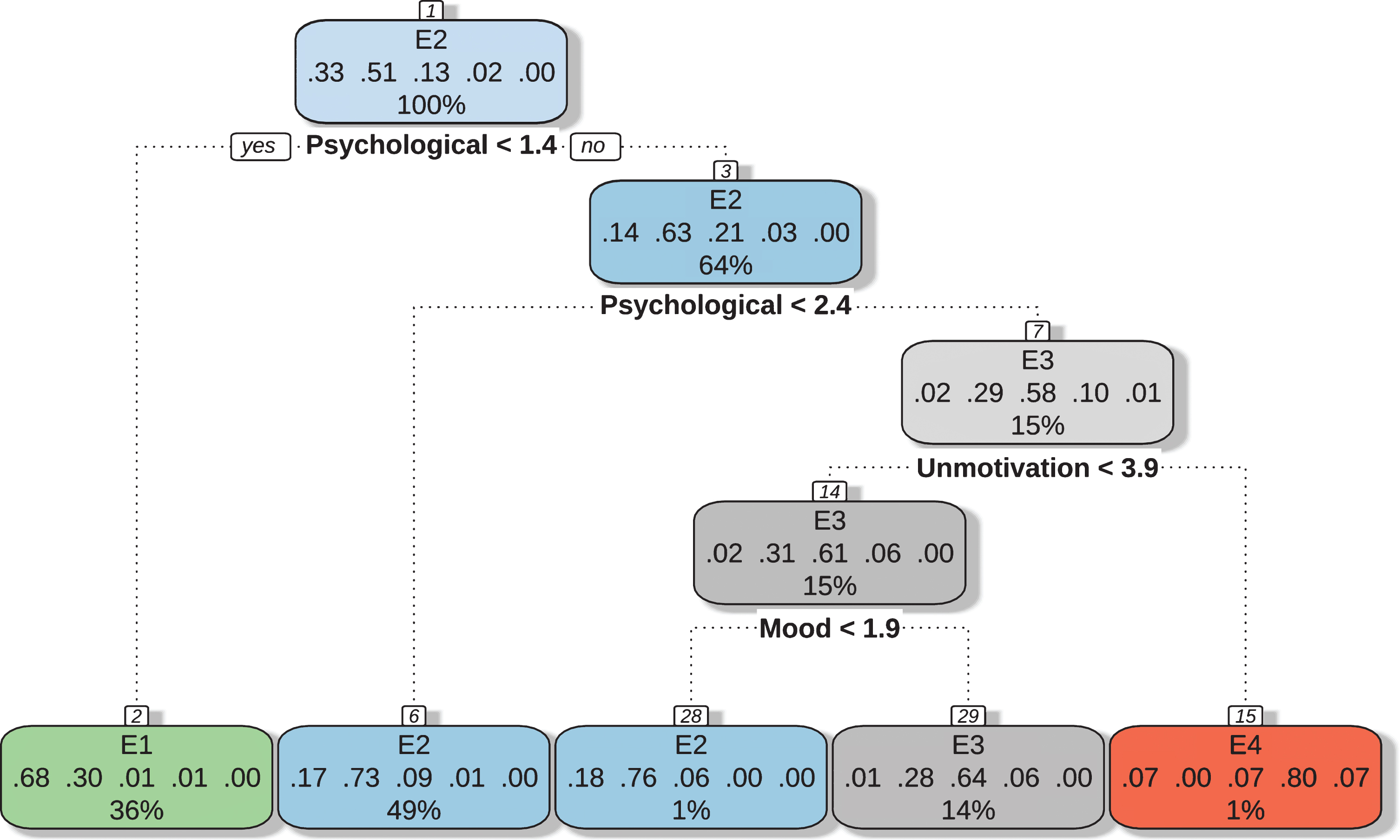
Decision tree for Fintech workers.
Efficiency in Fintech is mostly determined by the perception of psychological fatigue. The high importance of psychological fatigue is the consequence of the work contents influence. In Fintech, there are psychological demands, making decisions, work with customers and finances; there are no other workloads.
Investments in competences improvements and support in making decisions are the most important gripping points of humanization interventions.
With a probability of 56%, the modal efficiency of firefighters (Fig. 3) is very good (E2). The most important influencing factor is psychological well-being and the second important attribute is unmotivation. If psychological fatigue is below 1.4 and unmotivation is below 1.1, the efficiency classification will be excellent (E1) and in this class, the efficiency will be excellent (E1) with a probability of 93%. In case of psychological fatigue below 1.4, unmotivation at least 1.1, and physical fatigue below 1.4, the efficiency classification will be also excellent (E1) and within this class, the efficiency is excellent (E1) with a probability of 82%. If psychological fatigue is at least 1.4 and below 2.4 and depressed mood is below 2.9, the efficiency classification will be very good (E2) and within this class, the efficiency is very good (E2) with a probability of 78%. When psychological fatigue is at least 1.4, depressed mood is at least 2.9, and perception of stress is below 3.1, the efficiency classification will be good (E3) and within it, the efficiency will be good (E3) with a probability of 70%. If psychological fatigue is at least 1.4, depressed mood is at least 2.9, and perception of stress is at least 3.1, the efficiency classification will be E4 with the poor (E4) efficiency with a probability of 40%.
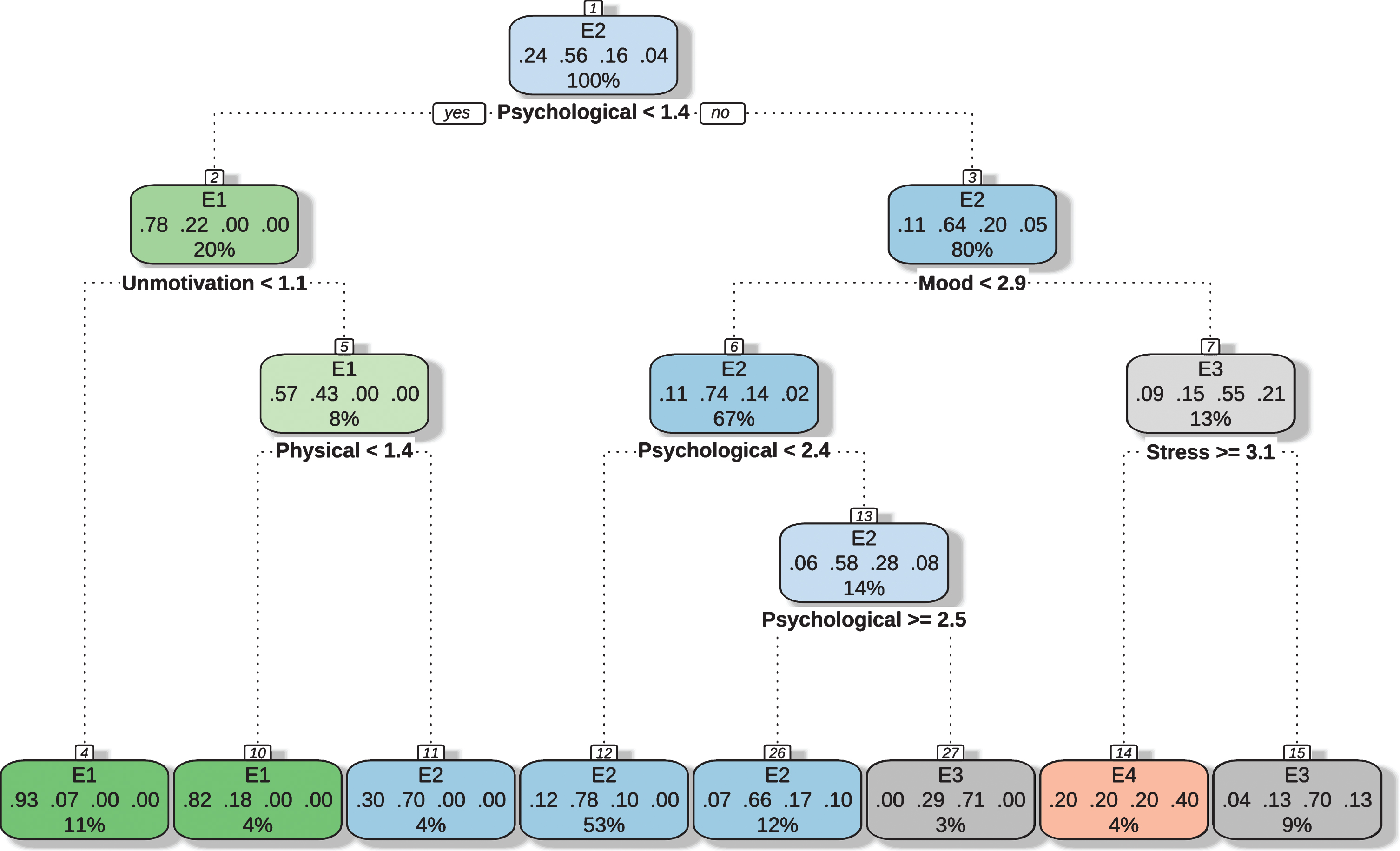
Decision tree for firefighters.
Firefighters have different tasks, they are under pressure of rescue activities, sometimes they have heavy long-lasting tasks and consequently, they are exhausted (psychologically and physically).
The decision for being a firefighter is determined with a higher level of motivation. Many firefighters are originally volunteers. For a firefighter, psychological and physical conditions are important. Gripping points for humanization interventions are investments in psychophysical conditions and in stress management techniques in the emergency situations.
The sample of foresters is small due to a small number of professional foresters. They estimated their level of well-being in normal circumstances without any extreme impacts (Fig. 4).
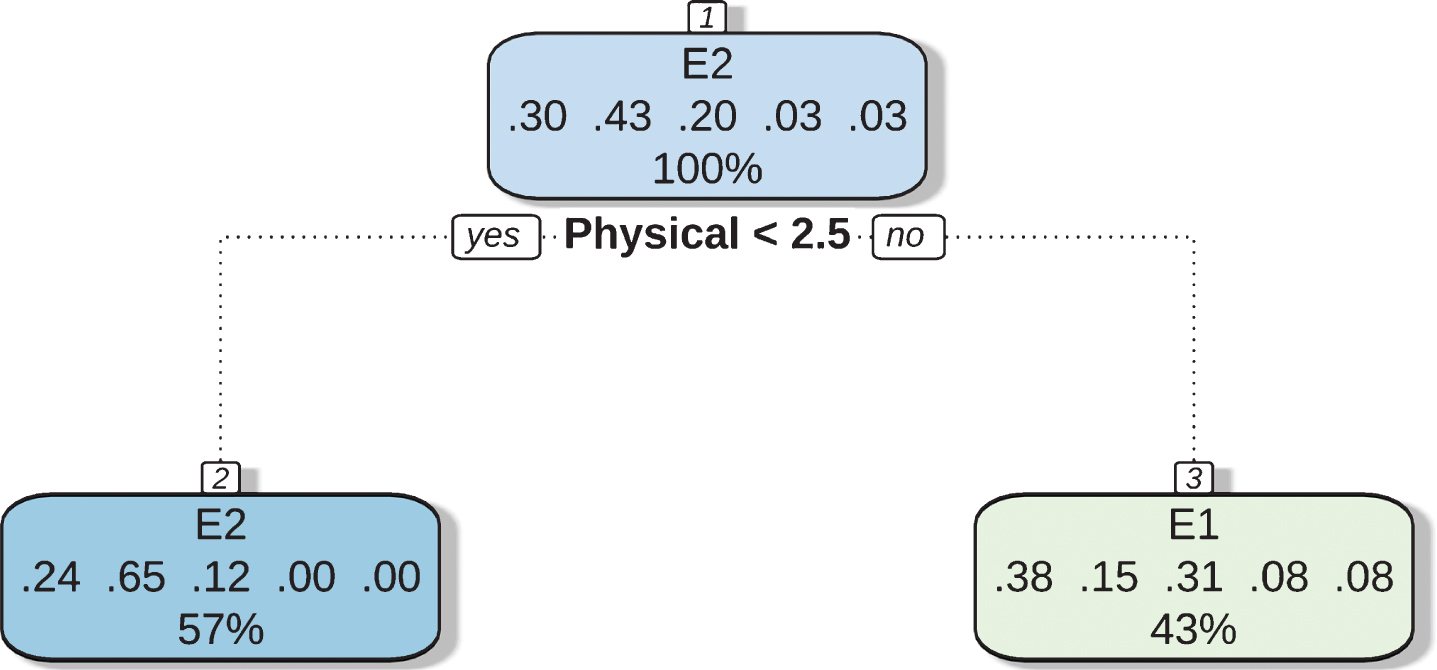
Decision tree for foresters.
The most important influencing factor is physical fatigue, which divides the sample into two groups. If physical fatigue is below 2.5, the efficiency classification will be very good (E2) and in this class, the efficiency will be very good (E2) with a probability of 65%. If the physical fatigue is at least 2.5, the efficiency classification will be excellent (E1) with excellent (E1) efficiency with a probability of 38%. The sample is too small to get results with an adequate validity.
It seems that an important influencing factor is a physical engagement in working situations. Workers with a higher level of physical engagement are consequently those with a higher level of physical fatigue and a higher level of effectiveness. Investments in a higher level of professionalism should be gripping points of humanization interventions in the work of foresters.
The modal efficiency is very good (E2). The most important influencing factor is psychological fatigue (Fig. 5). If psychological fatigue is less than 1.3, the efficiency classification will be E1 with an excellent (E1) efficiency with a probability of 69% and a very good (E2) efficiency with a probability of 20%. In case of psychological fatigue at least 1.3, depressed mood below 1.3, and vigilance below 1.5, the efficiency classification will be E1 and within this class, an excellent efficiency (E1) with a probability of 63%. If psychological fatigue is at least 2.5, the efficiency classification will be good (E3) and within this class, a good efficiency (E3) with a probability of 68%. If psychological fatigue is at least 1.3 and below 2.5, depressed mood at least 1.3, the efficiency classification will be E2 and within this class, a very good efficiency (E2) with a probability of 69%.
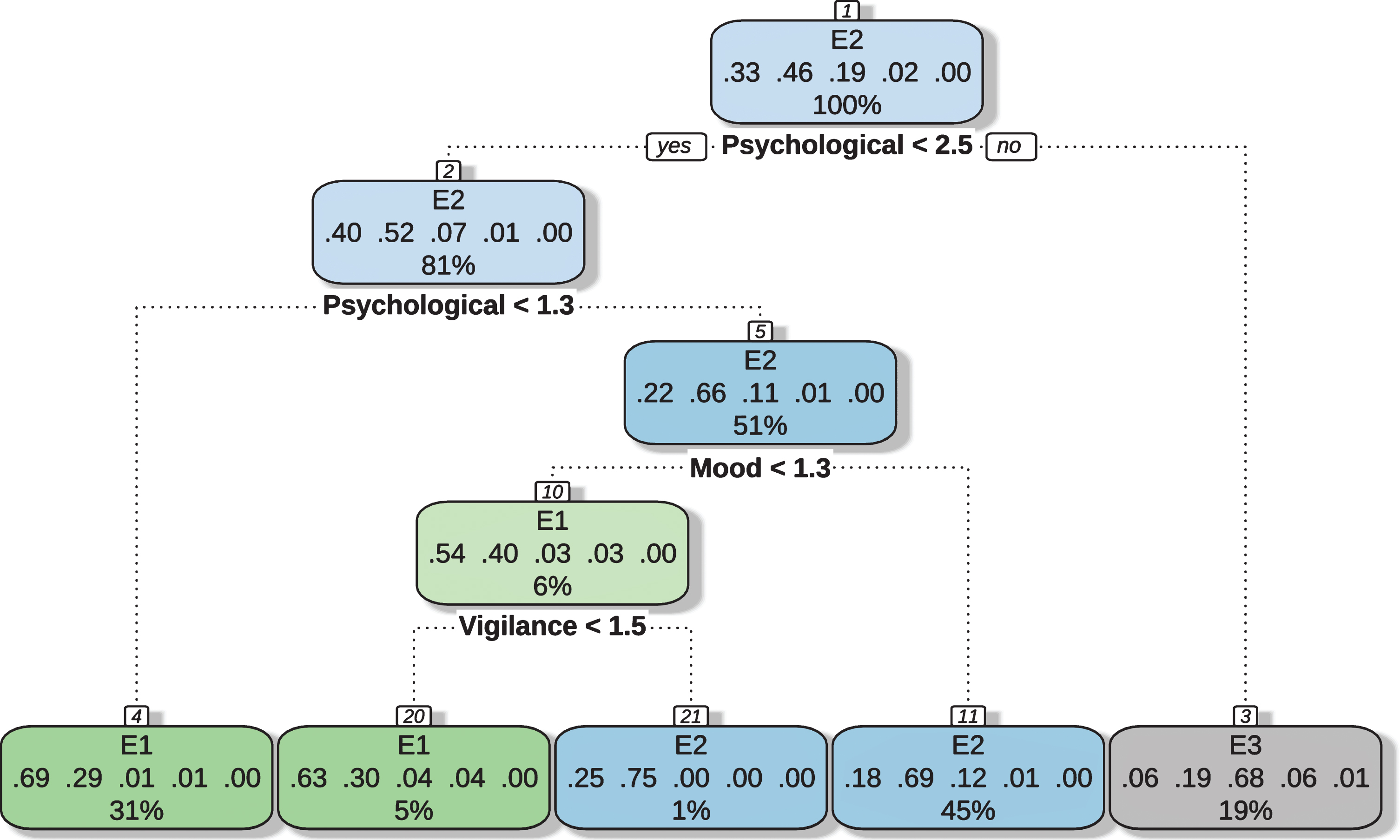
Decision tree for the health sector.
According to the results of the analysis, there is a high influence of psychological well-being, exhaustion and depressed mood. Some working positions in the health sector are determined by a high level of responsibility and consequently with a high level of psychological fatigue. There are also impacts of shift works on exhaustion and depressed mood.
Investments in a high level of competences should decrease the level of psychological fatigue. Another important gripping point is an organization of shift work. Adequate shift rotation should influence the level of vigilance.
In the groups of drivers, the important influencing factor is exhaustion (Fig. 6).
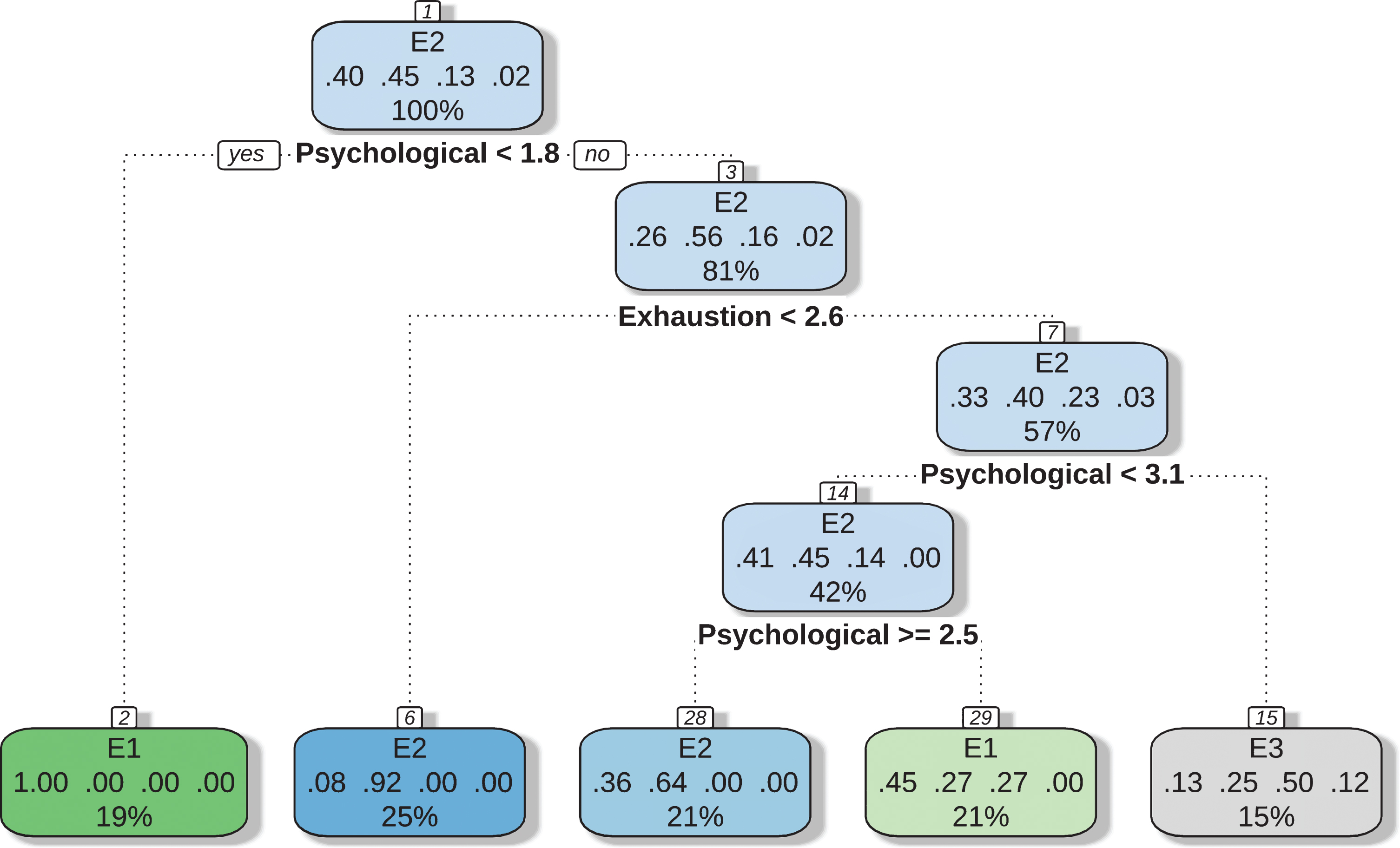
Decision tree for drivers.
If the level of psychological fatigue is less than 1.8, the efficiency classification will be excellent (E1) with a probability of 40%, and efficiency classification will be excellent (E1) for sure – a probability prediction is 100%. If psychological fatigue is at least 1.8, and exhaustion is less than 2.6, the efficiency classification will be very good (E2) and within this class, the efficiency classification will be very good (E2) with a probability of 92%. If exhaustion is at least 2.6, and psychological fatigue is at least 3.1, the efficiency classification will be good (E3) with a probability of 15%.
Professional drivers have to drive long distances and this task is exhausting. There are also psychologically demanding situations.
A gripping point for humanization interventions is a reduction of driving time. Consequently, the level of exhaustion and the level of psychological fatigue should be lower.
The goal of all humanization interventions is keeping the sustainable performance level in the interval between excellent performance (E1) and good performance (E3). The identified attribute psychological fatigue in Fintech, as the most influential one, shapes humanization interventions to the psychosocial interventions, upgrade of competences, and recruitment of workers with adequate abilities. In Health, interventions have to be focused on the implementation of adequate shift schedules and upgrading the competences. For the first responders – firefighters – investments in keeping the adequate level of the psychophysical condition is crucial. The other important preventive measure is stress management in emergency and stressful situations. For foresters, the most important is an adequate level of a physical condition and investments in professionalism that should reduce physical demands of work. For drivers, the most important intervention is a reduction of driving time and consequently, the perception of well-being should be more adequate.
The presented decision trees with maximum depth 5 describe possibilities for identification of humanization gripping points in different professions. Different attributes determine the level of efficiency according to the different content of work.
In general, the differences between modal levels of perceived well-being are small, but combinations of impacts between particular attributes offer possibilities for interventions. The final goal of keeping efficiency between excellent (E1) and good (E3) demands investment in particular attributes for each profession.
The main limitations of this research are problems in data collection. The data was collected in companies that were willing to participate. To get more reliable results, broader number of companies in different domains have to be included. Due to a limited number of workers, a limited number of the ML methods is applicable. With a larger number of workers, some more efficient ML methods, such as deep learning, could be implemented.
Conclusion
The AH-Model in this basic version could only provide the description of a connection between work and a worker. Upgrading the AH-Model with an implementation of the AI offers an identification of particular differences that affect the well-being attributes on the real human performance. The proposed approach is an additional tool that should be integrated with the domain knowledge and expertise.
Further upgrading the developed approach with an implementation of the decision tree classification offers a tool for implementation of sensitive humanization measure. The approach should be used in the evaluation of the introduced humanization interventions in the real conditions of the different working environments.
The most important outcome of the developed tool is its ability to distinguish between different professions and the identification of the crucial influencing factors. The identified influencing factors are gripping points for humanization interventions in a particular working environment. The AH-Model with the implementation of the ML algorithms describes real conditions of the actual working environments: The real performance of workers depends on their perception of well-being and availability. The most important influencing factors are directly affected by the content of work in the specific domains (fintech, health, forest, traffic) or in stressful situations.
Conflict of interest
None to report.