



Abstract
BACKGROUND:
Knowledge management is a central resource in achieving the goals of occupational safety efforts.
OBJECTIVE:
The main objective of this study was to investigate the relationships between the implicit (tacit) and explicit (formal) safety knowledge of employees and their effects on employee propensity to follow safe practices at work.
METHODS:
A survey with seven safety constructs: 1) tacit safety knowledge, 2) explicit safety knowledge, 3) attitudes toward safety: psychological aspects, 4) attitudes toward safety: emotional aspects, 5) safety culture: behavioral aspects, 6) safety culture: psychological aspects, and 7) propensity to follow safety regulations and safe work practices (safety at work), was designed and used for data collection. A total of 468 production workers from three manufacturing companies located in southeastern Poland provided valid responses to the self-administered survey. Structural equation modeling was used to analyze the collected data.
RESULTS:
The results support the hypothesized relationships among tacit and explicit knowledge of safety requirements, procedures, and practices, and the propensity of employees to follow work practices at work through the mediating variables of safety culture (with behavioral and psychological factors) and attitudes toward safety (with psychological, emotional, and behavioral factors).
CONCLUSIONS:
While both tacit and explicit safety knowledge affect safe practices, tacit knowledge has an important influence on the use of explicit safety knowledge at work.
Introduction
Knowledge management is a central resource in achieving the goals of occupational safety and health efforts [1–8]. A strong safety culture that focuses on an organization’s commitment to and knowledge of safety is important for increasing organizational readiness to manage accident and injury risk in the workplace as well as safety performance [7, 9–14]. In general, knowledge can be used to increase an organization’s capability for effective management [15]. Occupational safety management focuses on the identification and control of hazards to attain an acceptable level of risk [16]. Therefore, safety knowledge can be used to increase an organization’s capability to effectively manage hazards at work and control the level of risk. In this context, safety knowledge flows through management systems and organizational processes [7, 17].
Safety knowledge has been linked to organizational performance and safety culture [5, 20]. For example, Griffin and Neal [1] showed that safety climate is related to safety performance, knowledge, and motivation, while Jiang et al. [21] connected safety knowledge and behavior to safety performance. According to Davenport and Prusak [22], knowledge management helps to manage the organization’s knowledge through a systematically specified process for acquiring, developing, applying, organizing, sharing and creating both the tacit and explicit knowledge of employees to enhance organizational performance and create values. While explicit knowledge includes facts, rules, relationships, and policies that can be broadly shared with employees [23], tacit knowledge is based on the experience of individuals [24, 25]. Tacit and explicit safety knowledge are crucial for identifying work-related hazards and risks in the industry at large [4, 26–28].
Background
A critical challenge for occupational safety is the management of employees’ individual (hidden) knowledge about safety, as well as the explicit (structural) safety knowledge (EK) codified into formal safety documents, such as safety standards [29] regulations, rules, instructions, procedures or policies, including e-learning techniques [4, 30]. The importance of tacit knowledge for the development of safety culture and the complementarity of tacit and explicit safety knowledge have also been discussed [30–32].
As noted by Nonaka and Takeuchi [33], while explicit knowledge is a form of codified knowledge that is formal, objective, and easy to transmit, process and share, tacit knowledge is personal and context-specific and is therefore very difficult to communicate or formalize. It should be noted that new knowledge is also created during interactions between individuals who understand different content and possess different types of explicit and tacit knowledge [34]. Furthermore, effective organizational knowledge creation involves continuous and dynamic processes of conversion from tacit knowledge to explicit knowledge [35]. Today, many organizations focus their training efforts exclusively on the transfer of formal or explicit knowledge, including governmental regulations and corporate policies [36, 37]. However, such an approach does not account for the substantial variability and dynamic nature of the hazards and unsafe conditions at work. Therefore, comprehensive safety management systems should utilize both explicit and tacit (hidden) safety knowledge. Tacit employee knowledge is strongly tied to work context, and although it is difficult to formalize and verbalize, it can be acted upon and utilized during work processes [35]. Unfortunately, as noted by Thomas et al., [36], organizations tend to focus their training efforts mainly on explicit safety knowledge.
In their empirical study of work groups’ propensity to comply with safety rules, Simard and Marchand [38] concluded that in addition to top management commitment to occupational safety, micro-organizational factors such as work processes and hazards, workgroup cohesiveness and cooperation, and supervisor experience are the primary determinants of safety compliance behavior. Furthermore, because a good safety culture motivates workers to conform to safety rules by encouraging them to participate in the safety regulation process, workers’ compliance to safety rules should be considered as part of a larger cultural set of safety practices [1–3, 5–8]. In this context, there is also a pressing need to determine the extent to which a set of safety practices is linked to active employee use of knowledge about safety and safe practices at work.
According to Nonaka et al. [33–35], individual knowledge, also known as tacit knowledge, is personal, context-specific, and difficult to communicate, formalize and codify. Explicit knowledge is a form of codified knowledge that is formal, objective, and easy to transmit and process and share. Nonaka et al. [34, 35] also suggested that new knowledge is created during interactions between individuals who understand different content and possess different types of explicit and tacit knowledge. Furthermore, effective organizational knowledge creation involves continuous and dynamic processes of converting tacit knowledge to explicit knowledge.
The traditional approach to safety management in Poland has primarily focused on the application of explicit safety knowledge consisting of governmental and corporate regulations, norms, and policies. Furthermore, few studies have investigated safety and employee engagement from the perspective of safety knowledge management and safe practices in Polish industries. Thus, there is an important research gap concerning the relationship between safety knowledge and safety at work. The main objective of this study was to investigate the relationships between implicit (tacit) and explicit (formal) safety knowledge of employees and the effects of such knowledge on employee propensity to follow safety regulations and safe practices at work in selected Polish industrial enterprises.
Methods and procedures
Study variables
The main constructs of the model variables applied in this study were designed on the basis of previous safety culture literature [13, 38–45]. Several organizational “indicators” have been used to quantify the safety culture in an organization. For example, Weigmann et al. [46] identified a set of organizational safety culture indicators, including engagement, managerial commitment, employee empowerment, awards, and reporting systems. Furthermore, Guldenmund [10] stated that worker attitudes and perceptions are also important aspects of corporate safety culture. An influential framework by Cooper [41, 47] was also used in this study to describe three interrelated aspects of safety culture: the psychological, behavioral and situational. The psychological aspect refers to “what people feel” about safety and its management at all levels of the organization. The behavioral aspect describes the behaviors of employees, activities, and actions related to safety within the organization. This aspect describes what “people do” in an organization regarding safety (and is also known as an organizational factor). The situational (or corporate) aspect refers to a company’s policy, instructions, procedures, management system, and communication flow and explains “what an organization obtains” [48].
Given the above-stated study objectives, an initial set of variables used to develop the model were defined as follows: Use of tacit safety knowledge (TK) – eight items. Use of explicit safety knowledge (EK) – eight items. Attitudes toward safety: psychological aspects (ASPA) – six items Attitudes toward safety: emotional aspects (ASEA) – six items Safety culture: behavioral aspects (SCBA) – eight items Safety culture: psychological aspects (SCPA) – six items Propensity to follow safe work practices: i.e. safety at work (SW) – six items.
The original survey statements for each of the selected variables developed for this study are shown in Table 1.
Study variables and original questionnaire items
Study variables and original questionnaire items
The proposed study hypotheses are depicted in Table 2. In total, 13 hypotheses were developed to examine the plausible relationships between the main study variables and the propensity to follow safety regulations and safe work practices, termed “safety at work” and denoted as SW.
Proposed study hypotheses
Proposed study hypotheses
All questionnaire statements were measured on a five-point response Likert scale: (1) strongly disagree; (2) disagree; (3) neither agree nor disagree; (4) agree; (5) strongly agree. The order of all statements in the questionnaire was randomized.
Participants
The research was carried out in three large industrial enterprises in southeastern Poland. The survey questionnaire and the experimental protocol for this study were approved by the Institutional Review Board (# FWA00000351, IRB00001138) at the University of Central Florida, Orlando, Florida, USA. All of the participating companies in Poland provided the required approval for conducting the study at their sites, and the participation of employees in Poland was voluntary and conducted using the survey questionnaire and experimental protocol approved by the University of Central Florida.
A paper-and-pencil self-administered questionnaire was used. A total of 468 respondents (78.8% male workers and 21.2% female workers) provided valid survey responses (response rate of 56%). The study participants performed a wide variety of manufacturing and fabrication jobs with a mix of physical (62%) and cognitive (38%) task components.
Model development and analysis
Initial study model
The proposed initial study model is shown in Fig. 1 below. As the first step in model verification, a test for multicollinearity was performed to examine the extent of correlations between the independent variables. Multicollinearity for each latent factor was evaluated using Spearman’s correlation matrix due to the ordinal experimental nature of the collected data [49, 60]. Next, the reliability of each model construct was examined by calculating Cronbach’s alpha value. A cutoff point of 0.7 was used to accept the study variables in the subsequent confirmatory factor analysis (CFA) and structural equation modeling (SEM).
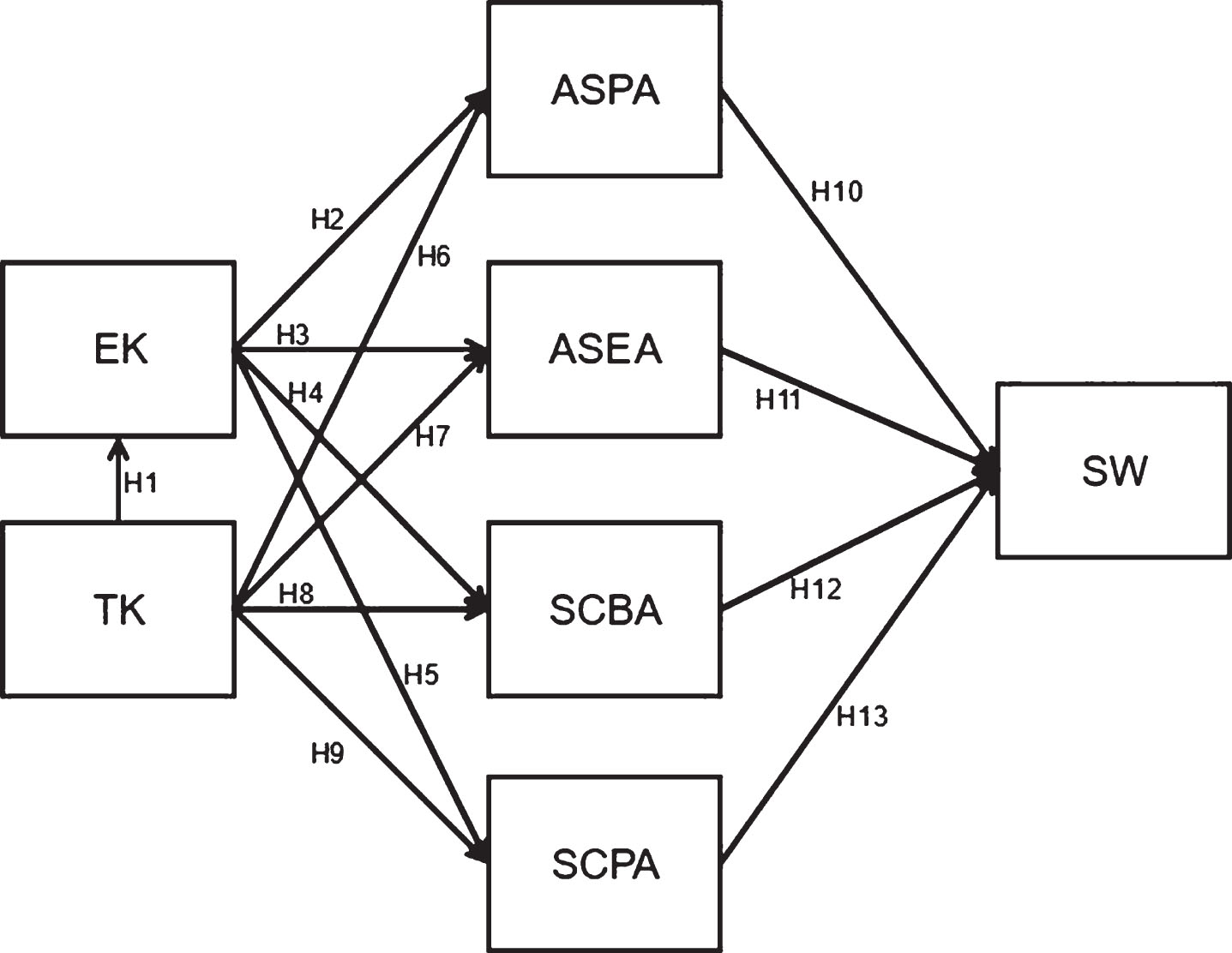
The hypothesized study model.
All statistical analyses were performed using AMOS 23 software [50, 51]. The analyses consisted of descriptive statistics, inter-correlational analysis, unidimensionality analysis, reliability analysis, and structural equation modeling (SEM) to analyze the relationships among model factors.
Inter-correlation matrices
As a starting point, we estimated the means and standard deviations for all study variables. Correlation analysis was also conducted to assess the relationship between any two variables used in the model construction (Table 3). All model variables had significant positive relationships at the p≤0.001 level. The inter-correlation matrix was used to check for potential data multicollinearity. None of the correlation values exceeded the threshold value of 0.9, thus confirming that multicollinearity was not present in the model data.
Means, standard deviations and the inter-correlation matrix for the model data
Means, standard deviations and the inter-correlation matrix for the model data
Notes: Correlations of 0.09 or higher were significant at the p≤0.05 level; Correlations of 0.12 or higher were significant at the p≤0.01 level; Correlations of 0.16 or higher were significant at the p≤0.001 level; Abbreviations: Age (years); number of years of job experience (EXP); tacit knowledge (TK); explicit knowledge (EK); attitudes toward safety: psychological aspects (ASPA); attitudes toward safety: emotional aspects (ASEA); safety culture: behavioral aspects (SCBA); safety culture: psychological aspects (SCPA); safety at work (SW).
A comparative fit index (CFI) of 0.9 or higher for the model implies strong evidence of unidimensionality [52, 53]. To test for the unidimensionality of the instrument used in the current study, CFI was conducted on measurements for each of the seven items. In this study, the CFI values were found to be above the 0.9 level (Table 4), indicating strong evidence of unidimensionality for all the scales.
Results of confirmatory factor analysis: unidimensionality and reliability coefficients
Results of confirmatory factor analysis: unidimensionality and reliability coefficients
Reliability indicates the internal consistency of the applied measurement scales. The reliability values of all the considered factors were above the cut-off criterion of 0.7 recommended by Cortina [61]. In this study, the estimated Cronbach’s α coefficient [55] ranged from 0.71 to 0.82 (see Table 4). Thus, the results indicated that the applied scales were reliable.
Structural equation modeling
The structural equation modeling (SEM) approach was used to determine the degree to which the hypothesized model in this research study was maintained and supported by the empirical data. SEM as a statistical method determines the relationships and directional influence, either direct or indirect, between the model’s latent variables, each of which has a set of observed variables in the conceptualized study model [50]. SEM is commonly and successfully employed in most survey research in the behavioral and social sciences because of its ability to improve and validate the latent constructs or unobserved variables in measurement models [59, 62]. The SEM methodology mainly consists of two parts: the measurement model and the structural model [59]. The structural model associates latent variables to measure the relationships between them, such as the direct and indirect effects, as well as the explained and unexplained variances accounted for in each latent variable [58].
Model fit indices
The goodness of fit for each measurement was assessed using five indices: relative chi-square ratio over the degrees of freedom (DF), CFI, Tucker-Lewis index (TLI), Goodness-of-Fit statistic (GFI), and root mean square error of approximation (RMSEA) index. A lower chi-squared index value is preferable because it indicates better model fitness for the data. A ratio of five or less is an acceptable fit between a hypothetical model and the sample data. The CFI and TLI indices, also called relative or comparative fit indices, express the relative improvement in fit of the hypothetical model compared with the sample data. The GFI statistic indicates the proportion of variance accounted for by the predicted population covariance [54]. CFI, GFI, and TLI values above 0.90 are generally considered acceptable model fits. Finally, the RMSEA gives a model’s residual and is considered one of the most informative criteria in covariance structure modeling. RMSEA values range from 0 to 1. A smaller RMSEA value, particularly one less than 0.06, is an indication of a good fit [57].
Results and discussion
Development of the final structural equation model
Structural equation modeling (SEM) was used to extract the structured model and to test the relationships among study variables. Path analysis was employed, using each latent indicator to test the connections between each latent variable as well as the postulated hypotheses of the study. Each latent variable was imputed by using its observed variables to form a composite variable delivering a measuring score for each item in the model. Comparison of fit indices for the initial and final model parameters are shown in Table 5 below. For the initial model, none of the fit indices met the acceptability criteria, with GFI = 0.804, CFI = 0.804, TLI = 0.411, RMSEA = 0.342, and χ2/df = 55.55. After eliminating the insignificant regression paths, the final structural model satisfied all fit criteria with the following values: GFI = 0.993, CFI = 0.995, TLI = 0.968, RMSEA = 0.079, and χ2/df = 3.935.
Summary of fit indices: comparison of the initial and final structural model
Summary of fit indices: comparison of the initial and final structural model
All relationships in the structural model shown in Fig. 2 were significant at the p = 0.05 level, except for those between (1) explicit knowledge (EK) and safety culture: psychological aspects (SCPA); and (2) EK and safety culture: behavioral aspects (SCBA). Figure 2 also illustrates that the variables of safety culture: psychological aspects (SCPA), attitudes toward safety: psychological aspects (ASPA), attitudes toward safety: emotional aspects (ASEA), and safety culture: behavioral aspects (SCBA) have a direct and significant effect on safety at work (SW).

A final model for the relationships between tacit and explicit safety knowledge and safe practices at work.
In addition, employees’ tacit knowledge and explicit safety knowledge have indirect (mediating) effects on safety at work through attitudes toward safety: emotional aspects and attitudes toward safety: psychological aspects, respectively. Moreover, TK and EK have direct effects on attitudes toward safety: psychological aspects (ASPA). It should be noted that tacit knowledge (TK) has a substantial direct influence on explicit knowledge (EK) with a factor loading of 0.56. Finally, tacit knowledge (TK) has a direct effect on attitudes toward safety: emotional aspects (ASEA) and safety culture: behavioral aspects (SCBA). The significance of all direct effects shown in the model was confirmed at p < 0.05 through bootstrapping analysis.
The hypothesis testing results are shown in Table 6 below. Eleven of the 13 hypotheses were supported by the survey results. Worker tacit safety knowledge had a significant influence on their explicit safety knowledge (H1). Both explicit knowledge (H2) and tacit knowledge (H6) had a significant effect on workers’ attitudes toward safety from a psychological point of view. Tacit knowledge also significantly affected the emotional aspects of workers’ attitudes toward safety (H7), their behavioral aspects (H8), and the psychological aspect of safety culture (H9). The psychological dimension of workers’ attitudes toward safety (H10) and the behavioral aspects of safety culture (H12) significantly influenced safety at work (H10). SW, defined in this study as the propensity to follow safety regulations and safe work practices, was also affected by the emotional aspects of workers’ attitudes toward safety (H11) and the psychological aspects of safety culture (H13). The survey results also indicated no significant effects of explicit safety knowledge on the behavioral (H4) aspects of workers’ attitudes toward safety, as well as on the psychological (H5) dimensions of safety culture.
Results of the final structural model relationships
Results of the final structural model relationships
*Note: p-value was considered significant at the = 0.05 level.
Based on the results illustrated in Table 6, the following conclusions can be drawn. For tacit safety knowledge, the p values for all relationships are less than 0.05, thus supporting hypotheses H1, H6, H7, H8, and H9. These data indicate that tacit safety knowledge significantly influences explicit safety knowledge, attitudes toward safety: psychological aspects, attitudes toward safety: emotional aspects, safety culture: behavioral aspects, and safety culture: psychological aspects. Explicit safety knowledge significantly influences attitudes toward safety: psychological aspects and attitudes toward safety: emotional aspects. Explicit safety knowledge does not affect SCBA and SCPA, as the p values for the relationships of EK with SCBA and SCPA were not significant (0.064 and 0.29, respectively). Therefore, hypotheses H2 and H3 are supported, whereas hypotheses H4 and H5 are not supported. In addition, attitudes toward safety: psychological aspects (ASPA), emotional aspects (ASEA), and safety culture: behavioral aspects (SCBA) and psychological aspects (SCPA) significantly affect the propensity of employees to follow safety regulations and safe work practices (SW), thus supporting hypotheses H10–H13.
One critical challenge for occupational safety is the management of employees’ individual (hidden) knowledge about safety, as well as the explicit safety knowledge codified into formal safety documents, such as safety standards regulations, rules, instructions, procedures or company policies [1–5]. This is because both tacit and explicit safety knowledge are important for identifying work-and preventing hazards at work [26, 27]. While the effective knowledge management is one of the most important aspects of safety culture in complex organizations [6–8], the relationships between employee tacit and explicit safety knowledge and the safe practices at work have not been extensively explored in previous studies.
The results of the current study conducted in Poland show that, in general, safe practices at work is conditioned by the application of employee tacit and explicit safety knowledge. The propensity to follow safe work practices is directly affected by the emotional and psychological dimensions of workers’ attitudes toward job safety, as well as by the psychological and behavioral dimension of safety culture. Both tacit and explicit safety knowledge have an indirect (mediating) effect on perceived safety at work through the psychological dimension of workers attitudes toward safety. Moreover, tacit safety knowledge directly affects the emotional and psychological dimensions of workers’ attitudes toward job safety, as well as the psychological and behavioral dimension of safety culture.
The results also indicate the importance of workers’ tacit safety knowledge, which was found to have a substantial and direct influence on the use of explicit safety knowledge. These results may be used in the future for effective safety knowledge management that maximizes the use of employee safety knowledge to improve overall safety performance. Finally, it should be noted that the results of this study are limited to workers employed by Polish industrial enterprises. Since the study used self-report manner of data collection through survey distribution, it is important to mention that the research participants might be influenced to report the general accepted safety procedure or conducts rather than stating their actual beliefs regarding each questions in the survey.
Further studies are needed to understand the nature of safety knowledge applications by employees of different industrial and service sectors who reside in other countries, with differing education level and relevant job experience.
Conflict of interest
None to report.
Footnotes
Acknowledgments
This research was supported by the Central Institute for Labour Protection- National Research Institute (CIOP-PIB), Warsaw Poland [grant number: IV.P.09].