




Abstract
BACKGROUND:
Working adults in the United States often do not engage in enough exercise to experience health benefits. With workplaces becoming increasingly sedentary, more emphasis is placed on providing exercise opportunities at work. Evidence suggests participating in exercise during the workday and socially connecting with others while exercising, can lead to positive health outcomes.
OBJECTIVE:
The purpose of this study is to examine whether mental and social health factors were related to increased exercise among employees participating in a worksite group exercise program.
METHODS:
An egocentric network analysis was conducted on a sample of university employees (n = 57).
RESULTS:
Regression analyses (Adjusted R2 = 0.501, F = 4.686, p = 0.001) suggest that depression (β= –0.548, p = 0.041), stress (β= 0.530, p = 0.016), nominating alters who exercise similarly (β= 0.326, t = 2.111, p = 0.045), average exercise scores across egonetworks (β= –0.330, t = –2.135, p = 0.043), and nominating other group exercise members (β= 0.579, t = 3.721, p = 0.001) were related to physical activity scores.
CONCLUSION:
These findings provide empirical support for using group exercise environments as a mechanism for increasing exercise among employees. Specifically, fostering social connections between employees involved in the program can lead to greater physical activity scores. Future research should confirm these results in larger samples, along with determining more causal relationships with longitudinal and experimental designs.
Introduction
The benefits of physical activity are well known and well documented. Positive outcomes of regular physical activity include weight management, reduced risk of cardiovascular disease, increased self-esteem, improved mental health and mood, and increased longevity [1–3]. Alternatively, low levels of physical activity and sedentary behaviors can increase the risk of chronic lifestyle diseases, including type II diabetes, obesity, loss of function, and all-cause mortality [4]. With the average American adult working approximately seven hours per day [5] and sitting 65% of the time [6], worksite wellness programs have emerged as powerful platforms for increasing employee physical activity and wellbeing [7].
Despite the dangers of sedentary behavior at the workplace, evidence suggests that physical activity during workdays is feasible and has overwhelmingly positive results. On a national level, the Centers for Disease Control and Prevention [8] is urging employers to provide a “culture of good health” throughout the workplace. Studies show that employees who engage in physical activity on workdays show a decrease in depression and job burnout [9] and an increase in productivity, time-management, and more positive attitudes toward colleagues [10]. In addition, employees that experience worksite health support, including the opportunity to exercise during the day, report sustained or improved productivity levels, and improved health and mood [10–12].
Group fitness settings are common in the workplace and provide the same positive health outcomes as independent activity [13]. Walking, team sports, stretching, and resistance training programs have been effective in reducing neck and shoulder pain, while improving cardiovascular fitness, strength and endurance among employees [14–17]. Evaluations of exercise in group and social settings indicate positive relationships between group exercise participation and improvements in physical performance, mental health, social interaction, and exercise motivation [18–21]. Exercising in a social environment, like the workplace, increases life satisfaction and a sense of belonging, reduces stress, lowers levels of depression and anxiety, and promotes overall wellbeing [22, 23].
Studies continually show social connection (feelings of belonging to another person or group) is related to increases in happiness [24, 25], physical functioning [26, 27], mental health [28], and emotional well-being [26, 29]. Social network analysis (SNA) is an effective way to study and measure how social connection influences behavior. The fundamental premise of SNA is that examining relationships, rather than individual level factors (i.e., drives, attitudes), is the best way to predict health outcomes and health behaviors. In other words, people’s social networks largely drive their behaviors, choices, and outcomes [30–32].
One approach to SNA is called egocentric network analysis, which is the study of individual people’s personal networks. Egocentric network analysis provides insight into the social context of personal behavior. This approach investigates an ego’s social relationships by asking each participant to nominate people in their lives that make up their personal network, collecting information on those nominees, and examining the ties among nominees [32, 33]. Egocentric network analysis can assess: network composition (attributes of nominees, such as gender or political affiliation, and how they relate to the ego); types of interactions and support available through these relationships; and structural measures (i.e., density, centralization) of how the network is organized [34–36].
Overall, employee’s mental, physical, social, and professional wellbeing is greatly improved with physical activity opportunities, especially in the workplace [37]. With regular physical activity, employees have better concentration and memory, faster learning, increased mental stamina and creativity, and far less stress [38, 39], suggesting the need for employees to be regularly active. Evidence suggests that exercise during regular work hours boosts performance and more importantly, leads to happier and healthier employees [9, 41], and exercising in group settings improves mental health and impacts of exercise [23]. Thus, the purpose of this study was to examine physical activity outcomes and mental health outcomes among employees participating in a worksite group exercise program by analyzing how social interactions influence behavior.
Methods
Participants and procedure
University faculty and staff (n = 57) were recruited from an on-campus group exercise program at a private university in the southern US. The on-campus group exercise program is available to university employees and offers more than 50 group exercise classes each week (e.g., cycling, yoga, functional fitness, dance). Eligibility requirements for participants included being 18 or older, a current group exercise member, and a current employee of the university.
An email describing the study purpose was sent to all members of the employee fitness program prior to data collection. A Qualtrics software survey link was included in the email. Upon accessing the Qualtrics link, employees reviewed details concerning the study purpose, risks, benefits, and that participation was voluntary. The survey could not be opened until a participant gave informed consent with an electronic signature. The Institutional Review Board approved this study before data collection.
Measures
By completing an online survey, faculty and staff indicated birth date, race and/or ethnicity, and whether they felt supported in their health and wellness at their institution. Depression, anxiety, stress, physical activity, overall well-being, and personal networks were also assessed for each participant. Egocentric network data were obtained through name generator and name interpreter questions [31]. Participants nominated up to five people they felt closest to on campus (name generator) and answered questions about each nominee (name interpreter) [30].
Physical activity
We applied the Godin-Shepard Leisure Time Exercise Questionnaire (Godin LTEQ) to obtain physical activity data. The Godin LTEQ is a 4-item scale in which intensity and duration of exercise are assessed throughout a typical 7-day period [42]. University employees indicated how many times they participated in mild, moderate, and strenuous levels of physical activity longer than 15 minutes in a given week. They also reported on exercising often, sometimes, or rarely. We multiplied strenuous activity by 9, moderate activity by 5, and mild activity by 3, and added the totals for a sum score per Godin and Shephard’s (1985) guidelines. Reliability coefficients reported in other studies using the Godin LTEQ range from 0.74 to 0.80 [43, 44].
Mental health
Depression, anxiety, and stress data were collected from the 21-item variation of the Depression Anxiety Stress Scale (DASS) [45]. The DASS applies a 4-point Likert scale (0 = did not apply to me at all, 3 = applied to me very much, or most of the time) and contains three subscales: (1) depression; (2) anxiety; and (3) stress. Depression, anxiety, and stress scores were totaled by summing the appropriate items (as indicated by the authors) and multiplying by two. Scores were separated into normal, mild, moderate, severe, and extremely severe categories [45]. With a Cronbach’s α score range from 0.84 to 0.95, internal consistency of the DASS is generally high [46, 47]. Our sample data yielded a Cronbach’s α of 0.84.
Overall well-being
We applied the 8-item Flourishing Scale (FS) to collect data on overall wellbeing [48]. The Flourishing Scale serves as a concise analysis of perceived sense of purpose, outlook on life, success in relationships, and self-esteem. A 7-point Likert scale (1 = strongly disagree, 7 = strongly agree) is used to measure each item, and all items were totaled for a sum score. A more positive overall well-being is represented by a higher score. Diener et al. (2009) reports a test-retest reliability of 0.71 and a Cronbach’s α of 0.87. For our sample, we reported a Cronbach’s α of 0.92.
Egocentric network data
University employees provided initials of up to five people they felt closest to among their institution to obtain egocentric network data. Participants were asked to list details about each person nominated, including: relationship (e.g., coworker, friend, spouse, other); gender; communication frequency; relationship length; exercise frequency of nominee (often, sometimes, or rarely); status of group exercise membership; and perceived support of participant’s wellness goals (5-point Likert scale, 0 = Strongly Disagree, 5 = Strongly Agree). Egocentric network data was used to create network variables, including network averages of physical activity (the average physical activity score across the entire egonetwork), homophily (connecting to others who are similar in some way), and composition (the “makeup” of a network based on a certain attribute; i.e., the percentage of a network that is male or female).
Analysis
We created compositional egocentric network variables using name generator and name interpreter data with the statistical program E-Net [49]. Subsequently, we used SPSS™ version 24 to conduct descriptive statistics and hierarchical linear regression analyses for demographic, attribute, and egocentric network data. Three regression models were tested predicting physical activity in our sample. The first contained just age and gender. The second added anxiety, depression, stress, and flourishing scores to the model. And finally, the third model included network variables.
Results
In our sample of employees, 17.5% (n = 10) were male, 77.2% (n = 44) were female, and three people did not identify gender. The average age of our sample was 41.75 years (SD = 12.54), with ages ranging from 24 to 69 years old. More than three-quarters (77.2%, n = 44) were White non-Hispanic, 7% (n = 4) Black non-Hispanic, 7% (n = 4) Hispanic or Latino, 7% (n = 4) Asian, and one person preferred not to answer.
Our sample engaged in strenuous exercise an average of 2.29 (SD = 1.96) times per week, and registered a mean Godin LTEQ score of 38.77 (SD = 23.99). About 10% (10.9%, n = 5) reported exercising rarely, 32.6% claimed exercising sometimes, and 56.5% reported they exercised often. The mean depression score for this sample was 3.48 (SD = 4.91), with scores ranging from 0 to 30 (out of a possible score of 40). Nearly the entire sample scored somewhere in the normal range for depression (mean scores between 0 and 9), with the exception of two people that scored in the moderate (14–20) or severe (23–30) range. Our sample scored an average anxiety score of 3.57 (SD = 3.70), with 82.6% scoring in the normal range (scores between 0 and 7), 8.7% in the mild range (8-9), and 8.7% in the moderate (10–14) range. Our sample had mostly normal stress scores (95.7% scored in the normal range, with scores between 0 and 14), with one person scoring in the mild range (15–18) and four people scoring in the moderate range. The average stress score for our sample was 1.20 (SD = 0.58). The mean flourishing score was 50.00 (SD = 5.56), with scores ranging from 29 to 56. See Table 1 for all descriptive statistics.
Descriptive statistics for a sample of university employees involved in a group exercise program
Descriptive statistics for a sample of university employees involved in a group exercise program
Note. n = sample size; % = percentage; M = mean; SD = standard deviation.
We accumulated data on 230 alters (nominees). When asked to nominate people participants felt close to within their institution of employment, 72% reported a friend, 56% reported a coworker, 30% reported a spouse, 15% reported a significant other, and 11% reported a parent. Of the 230 alters nominated, 22.15% exercised rarely, 38.46% exercised sometimes, and 37.41% exercised often. The majority of egos (71.7%, n = 33) nominated at least one person who exercises the same amount they do. For instance, egos who reported exercising “often” were very likely to nominate at least one person in their personal network who also exercises often. See Fig. 1 for examples of egos in this study.
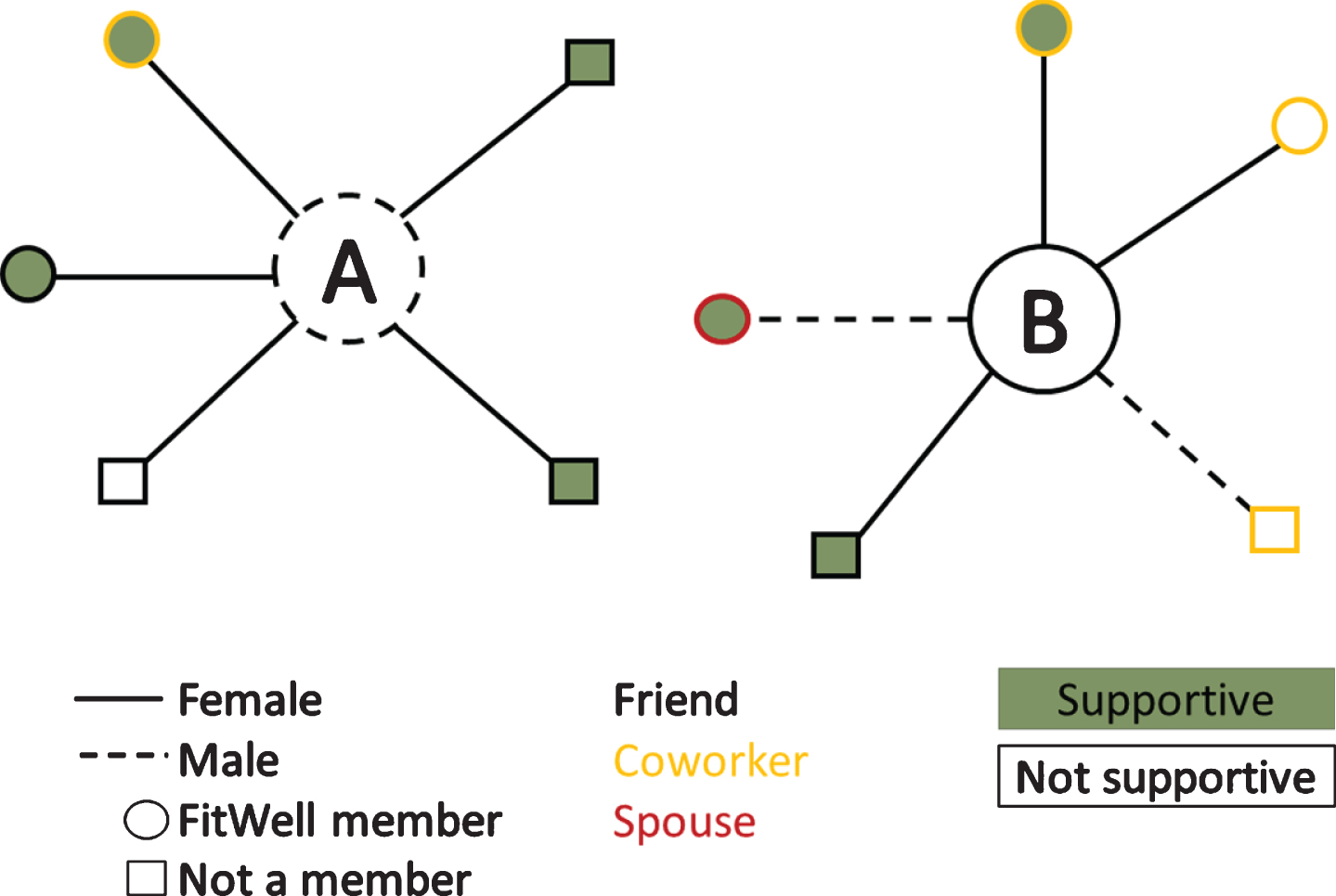
Examples of Two Egocentric Network Graphs.
A hierarchical linear regression analysis was conducted to test which variables accounted for variance in participants’ physical activity scores. We regressed demographic variables, mental health scores, flourishing scores, and network variables on participants’ Godin LTEQ scores.
The first (demographic factors only) and second (demographic factors + mental health and flourishing scores) models did not yield a statistically significant model. However, adding network variables to the model yielded statistically significant results (R2 = 0.637, adjusted R2 = 0.501, F = 4.686, df = 33, p = 0.001), demonstrating demographic, health, and network variables together explained 50.1% of variance in physical activity scores. Depression (β= –0.548, t = 2.161, p = 0.041), stress (β= 0.530, t = 2.587, p = 0.016), nominating alters who exercise similarly to the ego (β= 0.326, t = 2.111, p = 0.045), average exercise scores across egonetworks (β= –0.330, t = –2.135, p = 0.043), and nominating other group exercise members (β= 0.579, t = 3.721, p = 0.001) were significant predictor variables in the final model. See Table 2 for the all regression models.
Three regression models predicting physical activity among a sample of employees involved in a worksite wellness program
Three regression models predicting physical activity among a sample of employees involved in a worksite wellness program
Note. β= standardized beta.
Several reports show Americans spend over one-third of their day working full-time jobs [8]. With the increasing number of sedentary jobs, it is no surprise that the activity level of individuals in the workforce is decreasing [50, 51]. The dangers of sedentary behaviors on health [4] has led to the workplace emerging as an important setting for health promotion programs. This study evaluated the impacts of a worksite wellness program, specifically by investigating whether mental health, overall wellbeing, and social networks were related to higher levels of physical activity in a sample of participants in a worksite fitness program. We found stress, depression, and social network variables were all significant in explaining variance in physical activity among our sample.
Around 10% of employees at this university (n≈200/2000) were enrolled and participated in the worksite wellness program [52], indicating a 25% participation rate in our study. Members enrolled in the program regularly met the aerobic and muscle strengthening guidelines set by the US Department of Health and Human Services (2008), with approximately half exceeding those guidelines. The results show that overall, this is a more active group than the general population. Additionally, 100% of the sample reported feeling community support through the program. As mentioned previously, the CDC encourages workplaces to provide a “culture of good health” to their employees [8].
Mental health
Studies continually support a relationship between exercise and mental health [53]. Thus, we were not surprised to see individual stress and depression scores were related to physical activity in our sample. Most of the literature supports a negative relationship between mental health (i.e., stress, depression) and physical activity [54, 55]. However, results of this study showed stress was positively related to physical activity in this sample. There are a few possible reasons for this. First, if patrons were using exercise as a mechanism for stress management (the more stressed someone feels, the more they exercise), we would see a positive relationship between stress and activity. Previous literature does suggest higher stress as a motivation for more exercise in some cases [56], which supports how exercise can reduce the negative impacts of stress, even after someone experiences stress [57, 58]. Thus, exercise may not prevent stress, but it could alleviate symptoms associated with stress. It would be interesting to observe this relationship over time to observe whether the positive relationship between stress and physical activity persists. Other plausible explanations for a negative relationship between stress and physical activity could be that excessive exercise, which is often regimented or rigid [59, 60], and social expectations to exercise can induce stress [61]. If someone feels obligated to exercise, whether that obligation is due to personal guilt/inflexibility, or to uphold a social expectation, exercise can actually become a stressful experience [62, 63].
While stress was related to higher physical activity in our sample, consistent with the literature, members who were more physically active reported lower depression scores [54, 65]. Based on the short and long-term impacts exercise can have on improving mood and alleviating feelings of depression [54, 66], we were not surprised to see that the more active someone was, the less depression they reported. Therefore, this result suggests that taking part in a group exercise program in the workplace might decrease feelings of depression, which can ultimately lead to better work outcomes, including productivity [9, 67].
Social networks
Network variables were especially important in the explanation of physical activity in this study. Homophily, network composition, and network average were the most contributive variables when explaining variance in physical activity scores in our sample. In fact, only the final regression model that incorporated network variables in addition to demographic and health variables significantly explained activity scores in our sample. These overarching findings are supported by network theory, which postulates who someone is connected to impacts how they behave [30, 69].
In this study, egos who exercised similarly to the alters nominated in their networks were more likely to report higher personal physical activity scores. This similarity across egos and alters is known as homophily. Homophily is a measure of similarity between egos and alters [70], and is a common network variable related to health behaviors. In their review, Patterson and Goodson [71] found homophily and network composition were the most common egocentric network variables to influence health, including smoking [72], drinking [73, 74], drug use [75, 76] and physical activity [77] and all have been explained through homophily in egocentric network analyses. This result indicates that healthy behaviors are reinforced through personal networks and justifies connecting individuals to others who practice health behaviors the same way they do. In this case, connecting employees with colleagues who are active at the same levels through a worksite group exercise program could result in higher levels of physical activity among individuals.
One unanticipated finding was the average exercise across the entire network was negatively associated with increased physical activity. If behaviors are transferrable [78], then it would be assumed that those connected to a high-exercising network would result in higher personal exercise scores. A possible explanation for this might be that exercise is not a behavior passed through networks. In other words, exercise might not have the same “contagion” effect as other health behaviors, such as smoking or alcohol consumption [78, 79]. Or, the contagious nature of exercise might be dependent on how heavy exercisers are exercising. For example, if alters are exercising in an unhealthy way (i.e., compulsively), others may be deterred from exercising more often. Compulsive exercise is normally related to higher levels of exercise, and can oftentimes be socially isolating [59, 81], inhibiting the likelihood for that behavior to be passed on to alters. Also, compulsive exercise is associated with extreme feelings of guilt and anxiety [82, 83], which would not be attractive to the ego.
Although highly active networks were associated with decreased physical activity, having a higher composition of group exercise members in someone’s personal network was positively related to individual physical activity. This result supports the idea that exercising similarly to those an ego is connected with can induce more physical activity [70, 84]. Additionally, this result may suggest an interaction between exercise and social support. In this study, if a person was connected to someone who exercised “often,” but that person was not enrolled in the group exercise program, then that ego was less likely to report higher levels of physical activity compared to someone who was connected to a fellow group exercise member. Therefore, this result suggests that exercising in a social setting could actually increase someone’s personal activity levels –that the social aspect of a group exercise program is an important factor in increasing physical activity. Literature suggests a socially supportive environment (like a worksite fitness program) and belongingness is related to increased participation in healthy behaviors [85, 86]. It is possible that more group exercise members in personal networks create a supportive social environment in the context of exercise, resulting in more exercise for the ego.
Implications of study findings
This study supports using a social network approach when investigating exercise behavior. Specifically, findings suggest the importance of networks on exercise behavior above and beyond individual-level factors. Social network analysis stems from systems science, which allows researchers to think beyond traditional, individual level factors, and begin to understand the environment (e.g., built, social, political) that humans are functioning within. Several disciplines have begun using systems science to better understand complex behavior (such as physical activity), and many are urging researchers to adopt a systems perspective when studying behavior [87–90]. By using a systems science approach (via social network analysis), this study pushes the field forward, while offering unique insight into how the connections between people can largely influence individual behavior.
Future research
This study serves as a strong foundation for future research. Other fitness programs, worksite and otherwise, should consider using social network analysis to measure physical activity among their participants. Replication of this study would indicate whether results were more specific to this sample, or generalizable to other programs. Additionally, a longitudinal design would help to discern whether employee’s connections led to higher exercise, or if higher exercise led to more connections.
Future practice
This study provides important insight for institutions and organizations implementing worksite wellness programs. The smaller sample size and cross-sectional design limits generalizations beyond this specific program. Our results emphasize the importance of the social side of worksite wellness. In this study, having a network composed of more group exercise members was related to higher physical activity, being connected to people who exercised similarly to the ego was related to higher physical activity, but higher overall exercise scores across the network were inversely related to physical activity. This suggests that the social dynamic of group exercise programs, compared to independent exercise opportunities, might be the most meaningful opportunity an organization can provide its employees. Thus, employers should consider offering employees on-site exercise programs, which is likely much more cost-effective than paying for individual gym memberships or incentivizing independent exercise. Overall, connecting employees through a group fitness program could result in higher physical activity levels, which are known to improve employee productivity, morale, and health, with lower depression, and increased social support. At the very least, worksite exercise programs should evaluate factors related to higher physical activity in participants, with a specific interest in social support.
Limitations
Several limitations should be noted in this study that impact conclusions drawn from the results. First, the sample was small and largely homogenous based on sex and race. While the sample was fairly representative of the institution’s employees, and especially of the group fitness program, results should not be generalized beyond the sample, but rather serve as rationale for investigating these relationships in other samples. To account for the smaller sample size, the authors were sure to use adjusted R2 values to better reflect true relationships within the data.
Additionally, egos were limited to only nominating five alters in their personal networks. Larger numbers of ties can be extremely time consuming and complicate data collection [91]. Limiting the number of nominations can still be effective to remove weak ties from the network [35]. Close social relationships are often the impetus for how individuals develop habits and behaviors [31, 92]. There is a “strength in weak ties” because new concepts are often introduced into social networks through weaker, more peripheral connections [93, 94]. Thus, limiting alter nominations may remove opportunity to include important relationships present within the network [71].
Another way the study could have been strengthened is if egos were asked “interrelator questions”, which describe ties between nominated alters. In this study, we asked egos to nominate five alters, but we did not ask the ego to indicate whether those nominated were connected to one another. Alter-alter ties, or examining the possible connections between nominees, would allow the researcher to measure network structure more fully, and relate network structure to the ego’s behavior [71].
Finally, physical activity was reported as a weekly, summative measure. Details about when and where egos exercised remain unknown, meaning we are unable to confirm that the reported physical activity was occurring within the worksite wellness program. Future research should consider collecting data on how much of a person’s exercise is accounted for by participating in the program.
Conclusion
This analysis revealed individual and social-level factors related to physical activity levels in a sample of employees involved in a worksite fitness program, and supports the use of social network analysis in physical activity research. Specifically, our results indicate that in this sample network composition (having people in egocentric networks involved in the worksite wellness program), network average (overall exercise scores across the network), and homophily (being connected to people who exercise similarly to the ego) are important to the understanding of physical activity. Findings provide rationale for further study of the impact of social networks on activity among employees, especially those in a worksite wellness program. Also our research gives practitioners support for implementing on-site group fitness programs for employees.
Conflict of interest
All authors report no conflict of interest.