




Abstract
BACKGROUND:
Health literacy consists of an individual’s ability to make informed decisions in various sectors, including school. Most of the health problems and risky behaviours associated with the environment and lifestyle can be minimised or even prevented by increasing health literacy.
OBJECTIVES:
This study aimed to evaluate the effectiveness of a school physiotherapy programme in improving literacy regarding postures adopted at home and in school in adolescents living in the south of Portugal.
METHODS:
The sample was comprised of 84 students in the 5th grade, 42 (50%) were boys, aged to 10 and 13 years old (10.35±0.61). The measurement instruments included a theoretical and practical test applied one week before and one week after the school physiotherapy programme.
RESULTS:
The values obtained on the theoretical test before and after the intervention ranged from 1–13 (7.70±2.47) and 5–13 (10.83±2.27), respectively (p≤0.001) and, on the practical test, before and after ranged from 0–10 (4.14±2.21) and 6–15 (11.8±2.28), respectively (p≤0.001).
CONCLUSION:
This study found significant improvements in both theoretical and practical knowledge acquisition after participants attended a school physiotherapy programme. Thus, a school physiotherapy programme could be a useful tool to prevent and/or minimise musculoskeletal disorders in adolescents.
Introduction
Health literacy consists of an individual’s ability to make informed decisions in various sectors, including home, work, community, and health services. A strategy based on increasing health literacy seeks to empower individuals in terms of their quality of life, that is, by developing their own ability to seek information about, and assume responsibility for, their well-being [1, 2]. It is believed that most health problems and risky behaviours associated with the environment and lifestyle can be minimised or even prevented by increasing health literacy (i.e., through a proactive strategy based on health promotion) [3].
The adoption of inappropriate and maintained postures for a long time, as well as the transportation of possessions in a backpack, in excess of suggested weight, may promote the development of or aggravate musculoskeletal disorders (low back pain and postural changes) [4–10]. Low back pain has become a growing and serious public health problem particularly in adolescents; in fact, it is currently the most common cause of disability in young adults [11–15].
Cardon et al. [16] confirmed that the motivation of a teacher to teach students how to take care of their back, after having received orientation/training by a physiotherapist, has improved the effectiveness of educating students about this care. Geldhof et al. [17] investigated the effects of a postural education programme on students aged 13–14 years and found an increase in knowledge of optimal spinal posture among those who participated.
The role of health literacy is essential in the planning of interventions aimed at improving postures in adolescents, as a part of promoting self-efficacy and fostering behavioural change. There are some studies that have verified the effectiveness of a posture education programme [16–22], however the number of sessions in these programmes is high, and it is not possible to replicate this procedure in Portuguese schools due to the syllabus to be completed within the school calendar. Thus, this study aimed to evaluate the effectiveness of the school physiotherapy programme on the improvement of literacy about postures adopted at home and in school in adolescents of the south of Portugal.
Material and methods
The design of this study was quasi-experimental and longitudinal. Experimental investigations are characterized by the study of causal relationships. An intervention X, which is presumed to produce an effect Y, is introduced into a situation and controlled by the investigator. The quasi-experimental designs do not have equivalent groups created by random allocation or do not have control groups to compare changes due to treatment [23]. Longitudinal studies (follow-up) are studies where there is a known time sequence between exposure, absence of it or therapeutic intervention, and are intended to study a process over time to investigate changes [24].
The study was approved by the Piaget Institute’s Research Unit RECI - Research in Education and Community Intervention and by School Direction. Written informed consent was obtained from all parents or guardians of the students.
Population
The population included students from the 5th grade of the public school E.B. 2,3 Dr. Garcia Domingues, in Silves, southern Portugal. Inclusion criteria involved students of both sexes, of any age, whose sponsor of education authorised study participation, who were present on the days of the evaluations and who had attended both sessions of the school physiotherapy program.
Measurement instrument
The measurement instruments included a theoretical and a practical test and a scale. All instruments used were applied one week before the intervention and one week after the school physiotherapy program.
Theoretical test
A theoretical test was applied to students to assess the level of theoretical knowledge about correct posture (both dynamic and static) and the distribution of school material (the backpack transport method and the amount of weight the student carries in the backpack were evaluated).
A theoretical test was composed of 13 multiple-choice questions; the answer options were in the form of pictures or instead of written answers (to facilitate the perception of the requested activity).
This assessment was adapted from several studies (that included questions about spine anatomy and the best way to perform different tasks) [18, 19]. Differences between the test used in previous studies and this study were that the theoretical test used in this study included questions about the adopted sleeping posture and the use of mobile devices, and the questions about spine anatomy used in the previous studies were excluded.
The theoretical test used in this study involved the best way to: 1) lift a heavy box off the floor; 2) carry your shopping bags; 3) carry your backpack; 4) carry a heavy box; 5) move a heavy box; and 6) put your school supplies in your backpack; the best position: 7) in which to sleep; 8) for your back when sitting; 9) for your feet when sitting; 10) for your back for watching TV and/or playing games; 11) the best standing posture; 12) the best posture to use your mobile phone; and 13) the maximum weight you should carry in your school bag.
Each correct question had a value of 1; each wrong question was assigned a score of –1. In this way, the maximum score of the test was 13 and the minimum was –13.
Practical test
The evaluator requested that each task be performed with no demonstration provided. Each student performed the test individually.
The practical test used was adapted from other studies [17–20] and was composed of 5 tasks, with 15 items to be evaluated. For each task, a standard posture was defined that was considered to be correct. For each correctly executed item, a score of 1 value was given; the test thus had a maximum total of 15.
In the first task (Seated posture), the student was asked to sit in a chair and write some data (Fig. 1). This first task evaluated the seated posture during a writing task. For the second task (Heavy load lifting), the student was asked to remove from the ground a package simulating 6 liters of milk (made of wood) weighing 6.5 kg. The package was to be moved a distance of 5 meters and then placed on another table (Fig. 2). The third task (Light loading), the student picked up a pen (light object) from the floor and placed it on a table. On the fourth task (Heavy object shift), the student was asked to move the box to an adjacent table (Fig. 3). In the final task (Transportation, storage and weighing of the school backpack) the student was asked about which was the most frequent way of transporting his/her backpack. Then the adjustment of the backpack to the body of the student and how the material was distributed were verified. After that, the backpack and student were weighed using a SECA 780 digital scale with a capacity of 150 kg and a precision of 100 g. A backpack was classified as having excessive weight if it was more than 10% of the individual’s body weight [14].
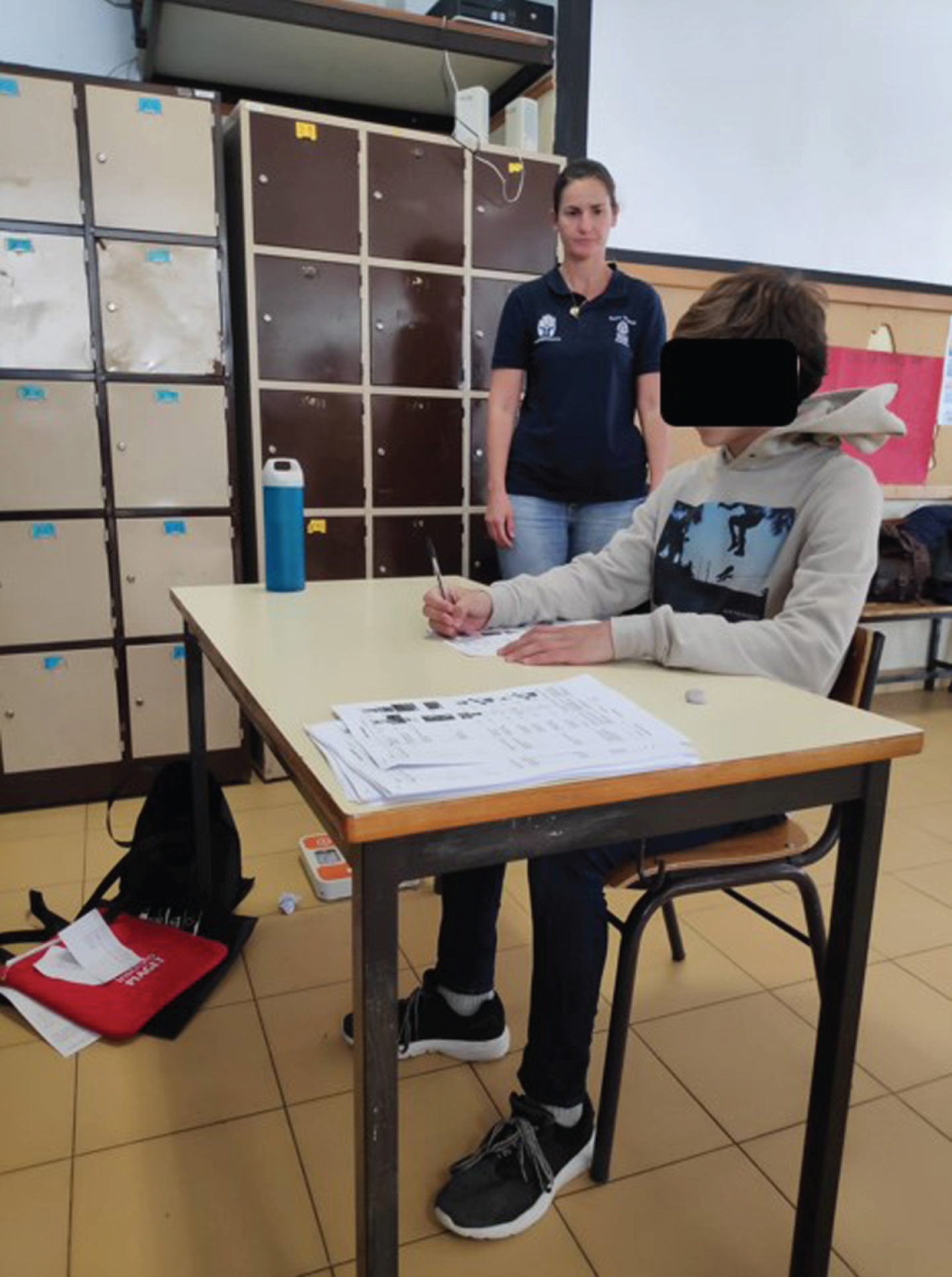
Task 1: Seated posture.

Task 2: Heavy load lifting.
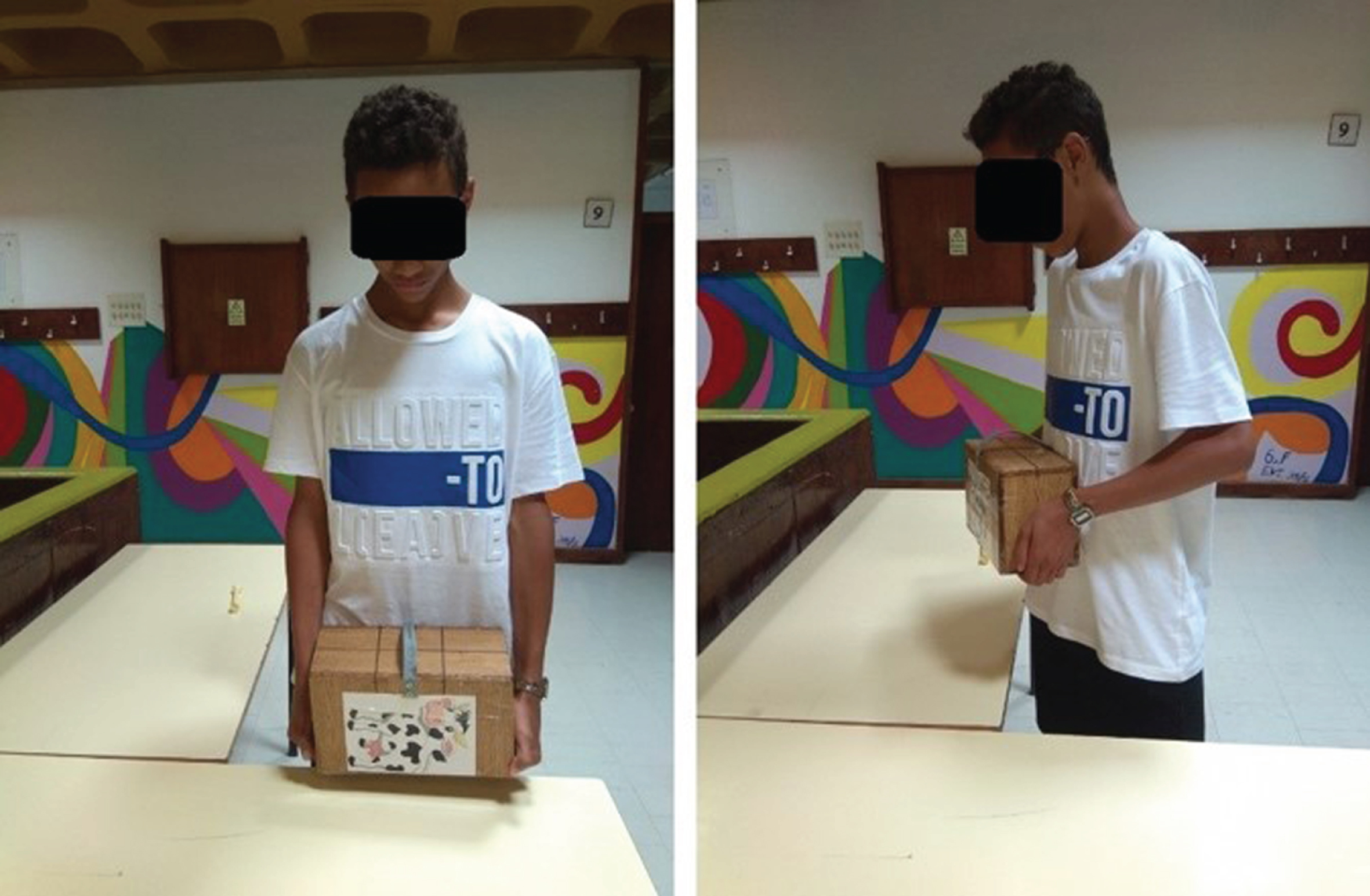
Task 4: Heavy object shift.
The aim of the intervention was to improve the students’ body mechanics and their posture (both static and dynamic) during daily tasks at school and at home. For each class, 2 sessions were taught by a physiotherapist, using both theoretical and practical approach. Each session lasted 45 minutes; one session per week. The sessions included the following topics: spinal anatomy; spinal joint physiology (spinal movements and intervertebral disc mechanics); postural changes and spinal pathologies; ergonomic analysis of sitting posture (during writing and watching a class); sleeping; getting out of bed; standing; lifting and transporting objects; transporting the backpack; the distribution of material in the backpack; consequences of adopting an incorrect and/or prolonged posture; the importance of intervals after maintaining the static posture; and exercises to be included in these intervals.
Data analysis
First, descriptive statistical data were obtained regarding all the variables in the study through measures of central tendency and dispersion. Subsequently, the Kolmogorov-Smirnov test was used to test the data normality. Normality tests are used to verify whether the probability distribution associated with a data set can be approximated by the normal distribution.
The result obtained in the Kolmogorov-Smirnov normality test (p≤0.05) confirmed the hypothesis that the data did not come from a population with a normal distribution, thus rejecting the null hypothesis and always using a non-parametric test.
The Wilcoxon non-parametric test was applied to compare medians of paired samples. In all inferential analyses, statistical significance was set at 0.05.
Statistical analysis was performed with Statistical Package for Social Sciences (SPSS), version 24.0.
Results
The sample constituted by 84 students, including 42 (50%) boys and 42 (50%) girls, aged between 10 to 13 years old (10.35±0.61 years old).
Table 1 shows the frequency and percentage of items of each task performed on practical test before and after the school physiotherapy programme.
Tasks performed during the practical test before and after the school physiotherapy program
Tasks performed during the practical test before and after the school physiotherapy program
Backpack weight before the intervention was between 1.9 kg and 7.5 kg (4.78±1.27 kg) and after the intervention was between 1.10 kg and 7.5 kg (4.6±1.28 kg), no statistical significance was obtained (p = 0.285).
The values obtained in the theoretical and practical tests are showed in Table 2. There were statistically significant differences between the values of both theoretical and practical tests applied before and after the intervention. The effect size were considered strong for the two comparisons between the tests.
Values obtained in theoretical and practical tests
This study found significant improvements in both theoretical and practical knowledge acquisition after the sessions of a school physiotherapy programme. Several studies showed that classes on back care education were effective in improving literacy on postural habits and represented an impact on students sitting and lifting behaviours [15–21]. However, there was no guideline defined on the number of suitable sessions and on the frequency of sessions. Robertson and Lee [21] performed three classes for students aged 10 to 12 years and the period between sessions ranged from 3 to 5 weeks. Dolphens et al. [22] performed a 6-week school-based back education programme, for students 9- to 11-year-old, at 1-week intervals. In this study, there were only 2 sessions in which significant effects can be observed. The Portuguese education reality does not allow the provision of classes of curricular subjects for these sessions, once the teachers must comply with the established curriculum plan. Providing classes to carry out the school physiotherapy programme becomes even more difficult in years of higher schooling. Therefore, given the benefits of these types of programs, the government should be included in the school curriculum plan, as well as other sessions for health.
Relative to the seated posture, many students flexed the trunk in an exaggerated way to be able to write, bringing the trunk too close to the table to use the paper and the pen; did not use the backrest of the chair, did not keep their feet on the floor and, consequently, did not keep the thigh and leg at a 90 angle. One observation to be pointed out is that school furniture is not adequate to the anthropometric dimensions of the students. Many 5th grade students could not touch their feet to the ground if they touched their gluteus region to the seat bottom to support their back because the chair is not suitable for their height. It was not the objective of this study to analyse the school furniture but, in order to try to minimise the problem, wooden boxes were made so that 5th grade students could place their feet on the floor.
What could be observed in practice is that many students had no knowledge of correct posture and what incorrect posture could entail. In addition, it could be observed that, after the sessions –although many had acquired knowledge regarding correct posture –students still had no corporeal awareness about the learned posture. That is, they thought they were seated correctly but were not. They could only correct the posture (because they had already acquired the theoretical knowledge) after seeing a photograph of themselves seated. Because of that, it is necessary to include in a training programme activities that involve corporeal expressions (particularly given the current generation’s habitual use of electronic devices and thus sedentary activities).
As for picking up an object from the ground correctly, it was observed that some students could not perform it because of lack of flexibility in the lower limbs and extensor musculature and, as well, lack of strength in the musculature of the hip joint and knee. Such persons could not flex the lower limbs, keeping the spine in neutral position and had no strength to lift from the crouching position. This served as another indication of the lack of movement activities in these young people.
Most students adopted the correct posture when picking up a light object from the ground (compared to picking up the heavy object). However, students must to have more attention to better position themselves to pick up a heavy object, because to do this implies a greater load on the musculoskeletal structures necessitated better overall positioning (compared to the light object).
The task that was most successfully learned was the transfer of a heavy object from one place to another without performing the rotation of the spine and shifting the feet in order to position the body and thereby transfer the object. Learning about the importance of moving the object close to the body (and thus avoiding greater body leverage) was also successful.
During the session, the distribution of school material in backpacks was discussed. Students were taught to place the heaviest items (e.g. books and notebooks) closer to the back and the lighter material (e.g. snack, pencil case) further away. Students were also taught to use small lump dossiers and to replace notebook binders with paper sheets, thereby reducing the weight in their backpacks. The adjustment of the backpack still presented some errors, since the size of some bags was not suitable for the individual student. In those instances, the straps of the backpacks were already at the limit of adjustment.
There was an improvement in the weight of school backpacks, but this did not reach the desired values. Statistical significance was not obtained in the variable weight of the backpack before and after the intervention. It is therefore of crucial importance to adopt government measures that use strategies to minimise the burden of school backpacks (through the use of tri-partitioned books, since in Portugal 3 school periods are stipulated, or by using books with detachable sheets so that they can be transported in a binder or, alternatively, using digital books).
This study presented some limitations that included the lack of observation of the postural habits during a lesson through filming. These limitations were due to the restrictions of the school and of the students' sponsors. That is, the posture that was assessed during the assessment may not be the one most frequently adopted by students in their day to day. Making it clear here that there is no absolute truth with regard to scientific evidence that there is an ideal standard for posture, nor an ideal posture for everyone. The aim of this intervention was to try to teach a posture pattern more appropriate to our upright posture (since students increasingly use the curved posture on the table, in the case of the sitting position), emphasizing postural changes throughout the classes and avoiding a static posture for a long period. Another limitation of this study is the fact that the school backpack was weighed in just one day, and may not represent the average weight of the week.
Conclusions
The school physiotherapy programme was effective in improving health literacy, specifically on theoretical and practical knowledge about postures adopted at school and at home in the students evaluated.
Through conducting this study, it was possible to confirm how the adolescents tended to assume incorrect postural positions. The posture that has to be given more attention is the seated posture, because it is static posture and is maintained for long periods without interval, across many years. Throughout a class day, students remain in the sitting posture for at least 5 hours, with intervals ranging from 45 to 90 minutes, depending on the sequence of classes. This position, assumed for a long time period, is acquired from the first year of school. Most students finish their studies in the 12th year; many will go on to practice professional activities in which this position is maintained. This prolonged sitting posture can have consequences in terms of musculoskeletal disorders that can extend throughout one’s adult life.
It is necessary, in future studies, to evaluate the effectiveness of different types of school physiotherapy programmes in order to implement a program that is feasible in schools, since they have to comply with the curricular program, making it difficult to include one more complement to the school schedule. Despite this, this program has shown some effectiveness compared to much longer programs, being more accepted for implementation in schools.
The improvement of postural habits can prevent and/or minimize musculoskeletal disorders in individuals who are in the stage of bone growth, minimizing expenses in the health system and promoting an improvement in the quality of life of students.
Conflict of interest
None to report
Funding
This study is financed by national funds through FCT - Foundation for Science and Technology, I.P., in the scope of the project UID/Multi/04587/2019; Research in Education and Community Intervention (RECI).