



Abstract
BACKGROUND:
The philosophy of universal design contributes to providing age-friendly products and environments in the ageing society.
OBJECTIVE:
The purpose of this study is to establish the philosophy of universal safety and design to ensure the safety and health of product users and production workers.
METHODS:
The concept and principles of universal safety and design are developed based on the limitations of universal design and the necessity of a new philosophy.
RESULTS:
Requirements of physical support, flexibility, accessibility, ensuring safety and health, diversity and inclusion, and sustainability are proposed for implementing the universal safety and design philosophy. Also, the guidelines for applying the universal safety and design philosophy are presented.
CONCLUSIONS:
The principles presented in this study can be applied to reduce incidents and ensure productivity in customers and production workers by helping them to work efficiently, comfortably, and safely.
Introduction
Universal design means the design of products, environments, and services to be usable by all people, to the greatest extent possible, without the need for adaptation or specialized design [1–3]. Universal design was used and promoted in the United States by Mace [1], and the seven principles of universal design by the Center for Universal Design [1]. However, the concept of universal design can differ in meaning and terminology, depending on the researcher or the field. The terms barrier-free design, inclusive design, accessible design, design-for-all, sustainable design, and universal design hold somewhat divergent historical and cultural meanings [1–5].
The initial term was barrier-free design, and was related to efforts that began to remove barriers for disabled people. In the United States, this concept was needed to return many wounded people from the Vietnam War back to society [1, 3]. In Europe, universal design philosophy was required to enable the elderly to live their own lives without the help of others [2]. Therefore, the concept of barrier-free design has become the primary focus of universal design [4].
Universal design is based on being barrier-free, but approaches and applications vary. The barrier-free approach is partial and passive as it is mainly applicable in the use of public buildings and facilities for the elderly and disabled population. In contrast, universal design or design-for-all is a more comprehensive and aggressive approach to enabling everyone to use living facilities [3–5]. It is an effort to provide public buildings and facilities that are easy to use for everyone regardless of age, gender, nationality, or disability, as well as their physical obstacles [6].
The concept of universal design has been applied in fields such as product design, architecture, and environmental design [3, 8]. Preiser and Smith [4] provided guidelines for public spaces, products, and technologies with examples, and Martin and Hanington [8] suggested a hundred innovative ideas and practical solutions for universal design. In recent years, it has been witnessed in the design of work or workplaces [9–13]. Back et al. [9] presented a method to apply the universal design concept to the manufacturing lines of electronics. The proposed guidelines for horizontal and vertical working area design reflected Koreans’ anthropometric measurements in the assembly, inspection, and logistics processes in the electronics industry.
Due to the increase in average life expectancy with the decrease in fertility, the proportion of seniors aged 65 or older among the total population is growing every year. In South Korea, they represented 14.3% of the population as of 2018 [14]. Furthermore, as society continues to age, workers will remain employed for longer. As the proportion of older workers in the workplace increases, the need to accommodate the diversity of the workforce will increase [15].
Universal design is also a concept that involves human rights or dignity. In South Korea, the characteristics of consumers and production workers are becoming diversified due to the increase of elderly, women, and foreigners. For the older workers who have been hired, their workplaces should follow and implement universal design principals. Working methods and environments should take the foreigner’s physical and cognitive features into account and provide a more natural and fault-proof task [3]. Sustainable design is required to benefit everyone by protecting people and the environment. Therefore, the need for the expansion of the universal design concept for everyone to safely and comfortably handle products has risen.
This study identifies the limitations of the existing universal design concept and the necessity of a new philosophy. Moreover, this study suggests the design principles of universal safety and design. Thereby, the purpose of this study is to establish the philosophy of universal safety and design.
Methods
Derivation of the necessity of universal safety and design
Kim and Jeong [15] proposed the establishment of a universal safety and design as a design philosophy to extend the universal design. This philosophy pursues a certain level of health and safety, not only for users or customers but also for production workers or service providers. Kim and Jeong also pointed out that universal safety ensures a certain level of health and safety for all workers regardless of their employment contract statuses. This study investigates the limitations of universal design and the necessity of a new philosophy.
Development of principles of universal safety and design
The universal safety and design philosophy aims to reduce workplace incidents and ensure productivity in production workers by helping them work efficiently, comfortably, and safely. The concept of universal safety and design is developed based on the limitations of universal design and the necessity of a new philosophy. Also, we develop the design principles for implementing universal safety and design.
Results
The need for universal safety and design philosophy
Figure 1 summarizes the need for universal safety design. Universal safety and design considers the followings: 1) taking into account the needs of different tiers, 2) targeting intangible services as well as tangible products, 3) satisfying consumers as well as production workers, 4) ensuring safety and health through design and policy.
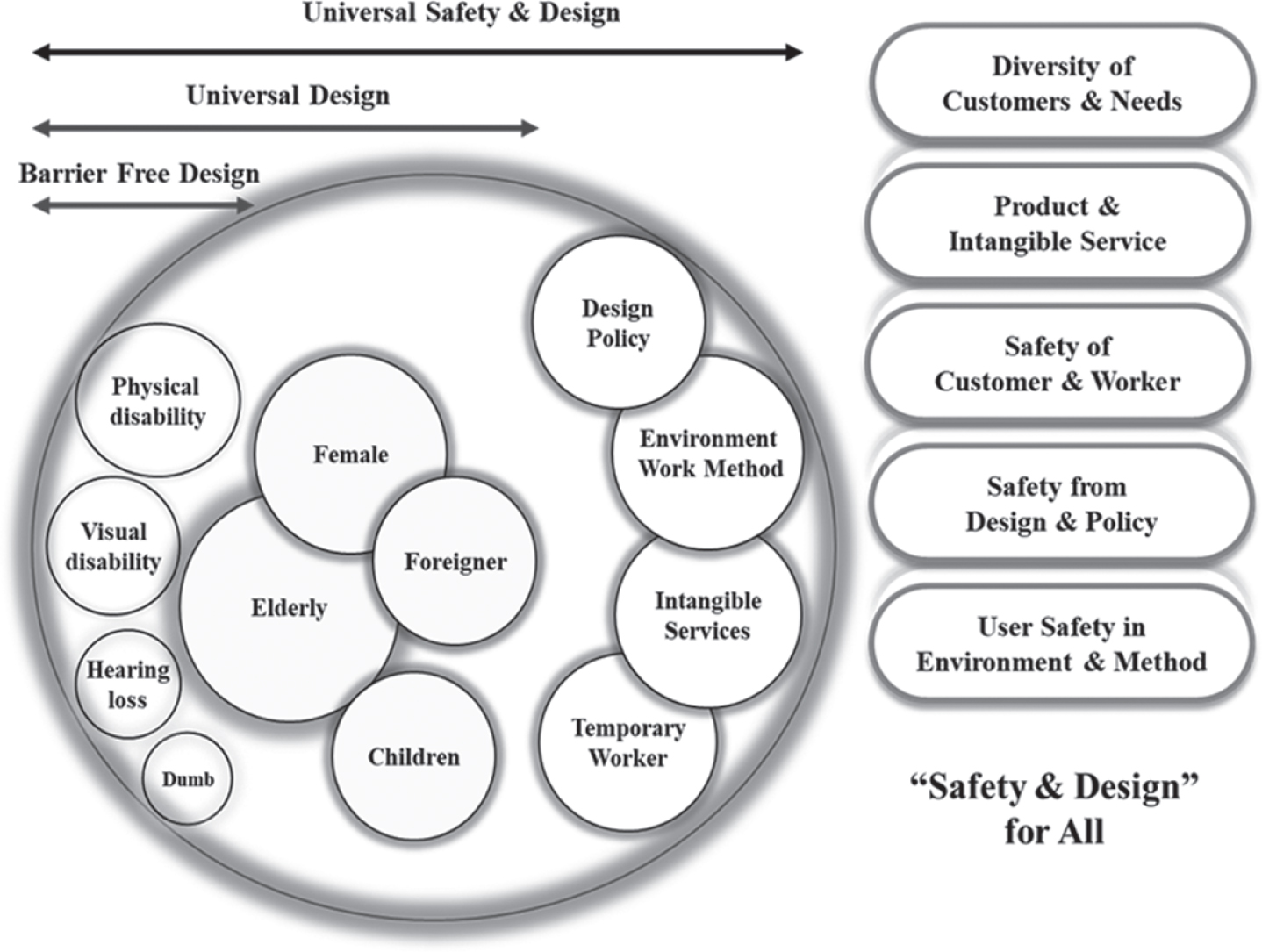
The need for universal safety and design philosophy.
Consumer and worker strata are becoming diverse. The elderly population is rapidly increasing, and the number of foreign workers of various nationalities is increasing year by year. As the aging accelerates, the economic activities of the elderly are continuously rising in society. Also, the participation of female workers in economic activities is increasing.
In 2017, the number of workers aged 60 and over was 4,090,000, accounting for 15.3% of all workers, with 2,349,000 men and 1,741,000 women [16]. As the number of elderly workers aged 60 or older continues to increase, there is a growing interest in the elderly, and there are various policies for the welfare of older people [3].
Meanwhile, non-regular workers, including temporary workers and part-time workers, accounted for 33.0% of the total workers, and the number of foreign workers had increased to 4.14% in 2017 [17].
As the employment of the elderly increases, the physical and cognitive characteristics of workers and users have become increasingly diversified. Also, as the number of foreigners increases, culture has become an issue. As a result, requirements are becoming more diverse in the design of products and work methods for the users and workers. The philosophy of universal design is an aggressive design strategy for satisfying customers. However, there is still limited acceptance of various needs in the area of designing and improving the workplace environment or facilities.
Ensuring the safety of both tangible products and intangible services
There are cases where the body part is damaged to a state in which the user cannot be aware of the hazards of products or intangible service. However, appropriate regulations and guidance are not made. Also, ensuring safety in continuous use of products or tools can be a problem.
For example, hearing loss was traditionally seen in workers at industrial sites with high noise levels. However, in recent years, it has frequently been seen in those who are exposed to loud music through earphones [18]. Since the manufacturer provides only a user guide, most users do not know how long, in what sound intensity it would damage their hearing. Likewise, user guidance is required for possible injuries or accidents that may occur during the repetitive exposure of both tangible products and intangible services.
Need for ease and safety of the customers and production workers
The number of people that experienced accidents from daily life activities was 0.1% of the total population [19], while the number of occupational injuries and illnesses was about 0.5% of the total workers in 2016 [20]. Thus ensuring the convenience and safety of both production workers and service providers is as necessary as protecting the customers in their use of products or services.
Many companies are working on developing the better user experience and implementing usability evaluation to impress customers. Such efforts directed at customers go hand in hand with aggressive marketing toward customers as it is in the best interest of the company to increase sales profit. Meanwhile, the costs of industrial accidents are now expanding to the level that threatens the profit of the company. However, corporate efforts to prevent disasters remain at the level of implementing minimum regulations. Therefore, it is necessary to register such efforts as minimizing costs to stay competitive in the industry [21].
Minimizing accident costs is now becoming a viable strategy for maximizing sales revenue. As a result, efforts should be made for the safety and health of workers who produce products or provide services.
Ensure safety from design and policy
The concept of decent work was taken up in 2007 by the United Nations [11]. With increased worker flexibility and participation of older workers, there has been an increased number of temporary and part-time workers. These workers are mainly engaged in high-risk tasks due to the risk of outsourcing, exposing them to more risks than regular workers. Therefore, policies and designs that can identify their characteristics and requirements are needed to eliminate discrimination and ensure safety.
From product design, work methods, and work environment, it is necessary to have a safety assurance policy that considers the social weak. Social weak is defined as a minority group that is separated from many groups by race, age, gender, and disability and is likely to be discriminated or marginalized [22]. The term social weak is a relative concept, and the category of the group may vary depending on the criteria and circumstances. For example, a social weak in the physical space of a city can refer to older people, disabled people, children, and pregnant women. From the workers’ point of view, the social weak can be interpreted as a group vulnerable to industrial accidents; non-regular workers, female workers, older workers, foreign workers, and disabled workers.
As the Act on the Employment of Foreign Workers was enacted, foreign workers were legally employed in workplaces under the Employment Permit System [23]. However, the majority of these foreign workers are working in jobs with low wages and a high risk of accidents. Because they use different languages and have different cultures, it is difficult for them to communicate in the workplace, leading to a poor understanding of the work. Therefore, a comprehensive approach is prompted to protect foreign workers who work in relatively dangerous occupations and have cognitive difficulties due to language and cultural differences [24]. Therefore, such circumstances should be considered in designing their product usage and working methods. Also, a design philosophy that can secure safety without alienation from the policy is needed.
Ensure safety regarding usage environment and method
Products or equipment should be manufactured using appropriate materials or parts for the user, taking into consideration the possibility of repeated use over a long period, and maintaining safety. In particular, attention should be given to long-term users so that consumables can be replaced easily and safely.
In 2016, the number of occupational illnesses was 7,876, which is 8.7% of total occupational injuries and illnesses [25]. The risks of exposure to hazardous materials should be reviewed in advance. Also, the possibility of musculoskeletal disorders due to manual materials handling or repeated works should be provided according to the repetition frequency per unit time [21].
Principles of universal safety and design
Figure 2 shows the design principles for implementing universal safety and design. Six principles, which are physical support, flexibility, accessibility, ensuring safety and health, diversity and inclusion, and sustainability, are presented in the context of universal safety and design.

Principles of universal safety and design.
Products should be designed to ensure comfort and safety, not solely for people with physical disabilities, but also for those who are small, tall, or fat. If the physical load is high, performance time and errors increase, and the probability of accomplishing the goal decreases [1]. Also, appropriate size and space should be provided for the approach, reach, manipulation, and use regardless of the user’s body size, posture, or mobility [1].
There are two characteristics of physical support designs: requiring low physical effort and appropriate size and space [1]: low physical effort and appropriate size and space.
Low physical effort: The design should be guaranteed for efficient and comfortable use causing minimum fatigue. Also, designs should minimize strain and overexertion [1]. Basic guidelines for reducing physical load are: allow the user to maintain a neutral body position; use reasonable operating forces even for people with weak strength; reduce the number of steps required to complete tasks; and minimize the range of motion and travel distances [26].
Appropriate size and space: Designs should accommodate variety in people’s body sizes and ranges of motion [1]. Basic guidelines for appropriate size and space are: provide a clear line of sight to important elements for any seated or standing user; make reach to all components comfortable for any seated or standing user; accommodate variations in hand and grip size; provide adequate space for the use of devices or personal assistance [1].
Flexibility
Users who want to use the product or facility should be free to use it freely regardless of the user’s characteristics or usage environment. The product or environment must meet the needs of various people [3]. Also, flexible working is needed to maximize the diverse workforce. It includes working practices such as part-time working, compressed hours, flexitime, and job-sharing [27].
There are two characteristics of flexibility: flexible designs and flexible working.
Flexible design: The design accommodates a wide range of individual preferences and abilities [1]. Designs should provide for multiple ways of doing things. Basic guidelines for improving flexibility are: provide choices in methods of use; accommodate right- or left-handed access and use; facilitate the user’s accuracy and precision; provide adaptability to the user’s pace [1].
Flexible working: Flexible working is a type of working arrangement that gives the workers some flexibility to their working conditions [27]. Basic guidelines for improving flexible working: apply flexible working concepts to accommodate diverse workforce; adopt strategies and policies focusing on implementing flexible working; take into account the different needs of different worker groups and improve work-life balance [28].
Accessibility
Accessibility means that obstacles in manipulation or action have been removed by altering the obstructive or threatening physical circumstances so that everyone can have access to procedures equally and conveniently. Also, regardless of the user’s experience, knowledge, and language ability, anyone should be able to recognize and utilize appropriate usage methods in an easy-to-understand manner.
There are two characteristics of accessible designs: simplicity and perceptibility.
Simplicity: Everyone can easily understand, regardless of the user’s experience, literacy, or concentration level [26]. Basic guidelines for improving simplicity are: eliminate unnecessary complexity; be consistent with user expectations and intuition; accommodate a wide range of literacy and language skills; arrange information consistent with its importance; make observations of the relevant parts of the system possible; and provide effective prompting and feedback during and after task completion [1, 26].
Perceptibility: Everyone can perceive the necessary information effectively, regardless of ambient conditions or the user’s sensory abilities [26]. Basic guidelines for improving perceptibility are: use different modes for redundant presentation of essential information; provide adequate contrast between essential information and its surroundings; give each action an immediate and obvious effect; and provide affordance and compatibility with a variety of techniques [1, 29].
Ensuring safety and health
Safety and health should be ensured so that the user is not exposed to danger or accidents while using the product. Designs should enable users to respond promptly in the event of a mistake or error and ensure safety even in the case of an accident or emergency. Also, products or equipment used by customers or production workers should be manufactured using materials or parts suitable for the user, taking into consideration the possibility of repeated use over a long time. Especially for repeated use, products should be easy to operate, and consumables should be comfortable and safe to go.
There are two characteristics for ensuring safety and health: error-proof design and safe and health assurance policy.
Error-proof design: The design minimizes hazards and the adverse consequences of accidental or unintended actions [29]. Basic guidelines for error-proof design are: arrange elements to minimize hazards and errors; provide fool-proof or fail-safe features; provide warnings of hazards and errors; discourage unconscious action in tasks that require vigilance [1]; and include reversible actions and safety nets to minimize the consequence of errors [26].
Safety and health assurance policy: The design policy ensures a certain level of health and safety for all workers regardless of their employment contract statuses [15]. Basic guidelines for safety and health assurance policy are: consider a safety and health assurance policy including the social weak; predict and prevent occupational accidents and illnesses; consider mental stress for emotional workers or service providers [28].
Diversity and inclusion
Efforts should be made to accommodate the diversity of consumers and production workers from early stages in design and production. Consideration should be given to the diversity of physical abilities, and the ethnic and cultural aspects of consumers and workers. In the production phase, the company considers product design, but in some cases, it is ambiguous whether a better design will lead to better sales. However, strategies to accommodate more various tiers can be a strategy to secure more special sales by expanding the target user population. Also, workers who produce products or provide services should be considered. As the worker population grows in diversity, inclusiveness should be emphasized. Efforts should be made to accommodate diversity without distinction in design or policy for older women workers, irregular workers, or foreign workers.
Diversity includes everyone: it is not something that is defined by disability, age, or gender. It extends to consumer and producer background, management and non-management, and tenure with the organization [30–32]. Although diversity and inclusion are sometimes used interchangeably, they are separate and distinct constructs. Diversity refers to differences among members, including both observable demographic diversity and nonobservable cognitive diversity [30, 31]. In contrast, feelings of inclusion are thought to be driven by perceptions of fairness and belonging. Thus, inclusion should be focused on employee involvement and ways to increase the equality and participation of all employees [32].
There are two characteristics of inclusive designs: equitable use and fairness of design policy.
Equitable use: The design is useful and marketable to people with diverse abilities. Basic guidelines for improving equality are: provide the same means of use for all users; avoid segregating or stigmatizing any users; make provisions for privacy, security, and safety equally available to all users; and make the design appealing to all users [1].
Fairness of design policy: The design policy should be planned to ensure fairness and equality, regardless of their physical abilities, employment status, nationality, and for consumer or producer [1]. Basic guidelines for fairness of design policy are: accommodate all production workers and consumers from the point of design policy; ensure non-discrimination in terms of cultural and institutional aspects; ensure equal policies for foreigners and temporary workers in terms of comfort and safety.
Sustainability
The term sustainability has multidisciplinary use and meaning. Sustainability, encompassing the environmental, social, and economic subsystems, is the ability to maintain or support an activity or process over the long term [33, 34].
Products should be environmentally friendly and should also be manufactured in concern for the persistence of resource recycling, such as environmental contamination due to repeated use or recycling of waste products. Consumers and production workers should take into account not only the visible hazards but also the risks of continuous exposure or repetitive use and assess future safety from the design stage. In particular, facilities and environments should be designed and evaluated to prevent future risks. Also, the design process should be maintained in reference to the users through the process of building consensus and making improvements in accordance with the consumer’s requirements and changes in social values [33].
There are two characteristics of sustainability: socio-ethical sustainability and work sustainability.
Socio-ethical sustainability: The design should ensure the process of building consensus and making improvements with changes in social values. Basic guidelines for socio-ethical sustainability are: encourage and support decision-making and planning processes relevant to long-term implications; provide the shareability and socializing abilities for continuous improvement through user feedback; consider the long term productive capability, quality and capacity of natural ecosystems [34].
Work sustainability: The design should ensure comfort and safety for long term work or use of products and services. Basic guidelines for work sustainability are: take into account not only the visible hazards but also the risks of continuous exposure or repetitive use; anticipate and prevent the cumulative risks and health impacts following long-term use or work; consider the mental workloads and stress in the new forms of creative or service works.
Discussion and conclusion
The universal safety and design philosophy proposed in this study is expected to serve the following roles; First, successfully offer a united philosophy of design covering safety issues of both consumers and manufacturers. Second, predict and prevent future risk factors associated with repetitive long-term use as well as currently defined risk factors. Third, it can serve as an opportunity to improve the working environment of the socially vulnerable population, including the elderly through policy and design considerations for the socially weak, and promote their economic participation in society. Finally, it can be used as a methodology to improve the human rights of the underprivileged substantively, while the emphasis on acceptance and accessibility of diversity can contribute to the creation of employment opportunities. Overall, this will lead to their more active participation in society.
The universal safety and design philosophy proposed in this study is presented as an effort to bring to light the limitations and need for a broader concept of universal design. However, this study has the limitation of suggesting a design philosophy based on an empirical and theoretical approach. Universal safety and design is constructed and driven from concepts that are not new in ergonomics or design, and even sums up various themes. Therefore, it is crucial to carefully review and verify the current forms of universal safety and design philosophy and principles. Further research will be needed for the expansion of ideas and practice in various fields. In particular, further development and verification of this concept through the application of the principles in designing projects related to public facilities and environment, production and service industry, traffic guidance system, safe town development, and information service system is warranted.
The design philosophy presented in this study is humanistic, environmentally friendly, and inclusive. Inclusive work climates have been linked to employee outcomes of well-being, high-quality work relations, job satisfaction, intention to stay, job performance, creativity and enhanced career opportunities, and organizational commitment [35, 36]. It can pave the way for the creation of an environment in which everyone, including the disabled, the elderly, and foreign men and women, can live in that is convenient to their various lifestyles. Furthermore, universal safety and design can be applied to reduce incidents and ensure productivity in product users and production workers by helping them to use efficiently, comfortably, and safely.
Conflicts of interest
None to report.
Footnotes
Acknowledgments
This research was financially supported by Hansung University.