



Abstract
BACKGROUND:
Smartphones (SPs) are widely used by people of all age groups and genders. Users spend many hours per day on the SPs for different purposes, which imposes significant stress on their musculoskeletal system.
OBJECTIVES:
This study explored head forward flexion, lateral bending angle, and viewing distance while working with a SP in sitting/standing postures and one-handed/two-handed grips. The users’ performance as well as pain development were also investigated.
METHODS:
Participants answered a questionnaire on pain experience before and after SP usage. Neck kinematics of 20 SP users were monitored by a motion analysis system while doing three tasks (typing, video watching, and reading) in sitting and standing postures. Performance was evaluated by number of typed words, amount of errors in typing, and total read words.
RESULTS:
The results indicated a significant increase in pain complaints in neck and upper limbs after test completion. Working with SPs in sitting and standing postures were, respectively, associated with greater head forward flexion for watching and viewing distance for two-handed typing tasks. Higher left lateral bending values were measured for one-handed watching and reading tasks in standing posture. The performance measures were superior for two-handed grips in all conditions.
CONCLUSIONS:
Overall, using SPs in sitting posture creates greater head forward flexion and lower lateral bending angles in all tasks and grip types. The findings of this study can be used to provide recommendations for SP users.
Keywords
Introduction
In the past decades, using smaprtphones (SPs) become more prevalent and popular all over the world. It has been predicted that the number of users will increase up to 5 billion users by the end of 2019 [1]. Smartphones as multi-functional devices rapidly become the most favorite and common version of mobile phones among users [2]. For instance, in 2016, about 97% of Sweden’s population (in all age groups) used mobile phones, and 80% of them owned SPs [3]. It is also reported that eighty-nine percent of the population in Australia had SPs in 2014 [4].
The rising popularity of SPs among users has increased concerns about the chance of experiencing musculoskeletal disorders (MSDs), pain and discomfort [5]. Musculoskeletal disorders are known as an enormous concern not only in people daily lives but also in their work lives [6]. The study by Korpinen et al. among 6000 SP users demonstrated that about 15.1% of the participants experienced pain and numbness in the neck; and 44.8% had pain symptoms and discomfort in shoulders [7]. In a systematic review, Xie et al. reported that the prevalence of musculoskeletal complaints among mobile device users ranges from 1.0–67.8% [8].
Static postures and prolonged gripping, as well as repetitive tasks and motions, have been recognized as potential risk factors in causing disorders in neck and upper extremities while using SPs [9, 10]. Moreover, factors including poor knowledge towards correct postures, holding an SP lower than the eye-height level, and lack of daily exercise are also known as essential risk factors for pain and discomfort symptoms among users of laptop, PC, and smartphone [11–15]. Forward head, slouched posture, and even rounded shoulders have been reported among VDTs users specifically in SP users due to the popularization of this new technology [16–18]. Holding smartphone below the eye-height level for a long time can cause permanent changes such as turtle neck. This forward head posture means decreased lordosis in lower part of cervical vertebrae and increase posterior curve in upper part of thoracic vertebrae [16, 19].
Text-neck syndrome is another health problem reported by users of handheld devices, described as neck pain due to looking down for checking their devices in a static and prolonged posture [20]. Kyphosis in the spine, spinal degeneration, and muscle/nerve damage are some other recognized symptoms caused by using an SP with head forward flexion [20–23].
Neutral head position creates 10–12 lbs. force to the cervical spine and as the neck tilted forward up to 50°, the force increased to 60 lbs. Therefore, the placement of an SP can be considered as an important factor in head flexion angle and subsequent imposed biomechanical load. What is more, placing an SP on the lap causes higher head flexion than placing it on table-height level [15, 24–26]. Head forward flexion has been studied among users of technologies like Pc, laptop and tablet [26–28]. Evaluating different tasks, various postures and grips among users can draw useful information about the relationship of these factors with neck kinematics and the occurrence of musculoskeletal symptoms.
Thus, considering the high prevalence of SP usage and the above-mentioned risk factors, the main aim of this study was to explored head forward flexion, lateral bending angle, and viewing distance while working with SPs in sitting/standing postures and performing three common tasks with only one hand (one-handed grip) and using both hands (two-handed grip). Additionally, the users’ performance while working with an SP and its effect on pain development were assessed.
Methods
Subjects
In this study, 20 young adult females were recruited from a university population. All participants were right-handed. The inclusion criteria were: (1) using their current smartphone for a year or more (touchscreen size between 4” and 5.5”), (2) daily continuous texting for at least 10 minutes, and (3) spending at least two hours per day on an SP. Participants with previous experience of pain, traumatic injuries, surgery, dislocation or fracture in upper extremities and those with a history of chronic musculoskeletal disorders (e.g. carpal tunnel syndrome, thoracic outlet syndrome, or trigger finger) were excluded from the study. Tehran University of Medical Sciences Research Ethics Committee approved the protocol of this study and all participants provided written informed consent.
Questionnaires
Subjects who met the required criteria were asked to fill in three questionnaires: Demographics information questionnaire including age, educational level, and brand and model of the SP. Smartphone self-administrated questionnaire validated (CVI: 0.97 and CVR: 0.98) in this study containing information about daily hours on an SP, years of owing an SP, usual positions while using an SP (sitting, standing, prone and supine positions, one-handed or two-handed grip), and Yes/No questions about using an SP for net browsing, reading (books or news), watching (short movies or series), and gaming. Body-map diagram [30] asking subjects about pain level in various body parts: neck, upper back, shoulders, elbow/forearm, tip and middle of thumb, base of thumb, thenar, fingers, and hypothenar. Subjects indicated their pain level on a Likert from 0 (no pain) to 100 (the most severe pain). This pain diagram was rated by the subjects before and after the completion of the test.
Tasks
Three different tasks were provided to the participants in this study:
Experimental protocol
Subjects were divided into two groups by random selection: the sitting group (n = 10) and the standing group (n = 10). Reflective markers (0.5 inch) were attached to top head, forehead, rear head, left and right temple, C7, left and right acromion, and the smartphone (Fig. 1). During the tests, markers were tracked by 6 raptors (E model, Motion Analysis, California, USA) at the sampling rate of 200 Hz. Participants in the sitting group were asked to sit on a chair with no back and armrest, while the height of the chair was adjustable according to ANSI/HFES standards (2007) [31]. The chair was located in the center of capture volume where markers could be recognized by six cameras. Subjects of both groups were asked to work with their own SP in their preferred posture. The study variables including body posture (sitting or standing), the required tasks (typing, watching and reading) and one-handed or two-handed grips were assigned between subjects in a randomized order. Each task completion took 10 min with 5 min interval between conditions for rest. An audible alarm was presented at the end of 10 min test to announce subjects to stop the task.
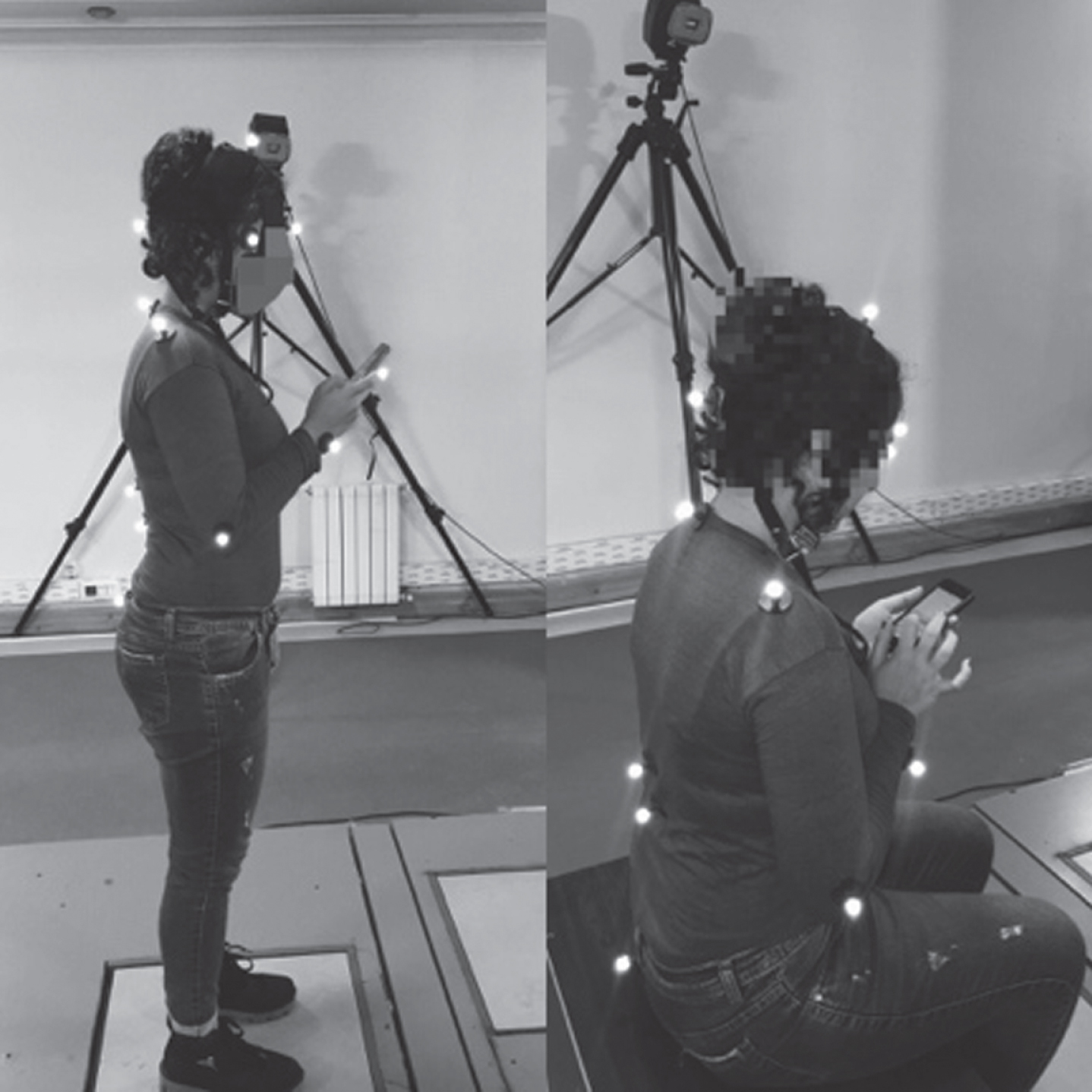
Using an SP in sitting and standing postures (all markers were attached to the skin. This picture was not taken during the actual test).
In this study, performance of subjects in reading and typing tasks was also evaluated. Performance in reading tasks was defined as the number of the read words in one- and two-handed grips. By the end of the time in reading task, subjects expressed the last read word aloud, thus, the number of read words could be calculated. Typing performance was defined as the number of errors in typing task in each kind of gripping. In order to calculate the number of misprinted words, the amount of incorrectly written words to totally written words was calculated.
Data analysis
The angles of head forward flexion, lateral bending, and viewing distance were calculated as subjects kinematics data using MATLAB software (version 24). The head forward flexion angle was measured based on the angle between the line passing through C7 and top head and the vertical plane. Angle of lateral bending on each side was calculated by the angle between temple-C7- acromion of the same side. Finally, viewing distance was defined as the distance between the forehead and smartphone markers (Fig. 2).

Head forward flexion (α), viewing distance (d), and lateral bending in right and left side (θ and θ’).
The differences of pain complaints before and after SP usage was determined by paired samples t-test. Before analyzing kinematics data, Kolmogorov–Smirnov test was performed to determine data distribution. The results showed normal distribution of the kinematics recordings. Therefore, independent samples t-test was used to compare forward head flexion, lateral bending, and viewing distance between sitting and standing groups, separately for different tasks. The effect of handgrip type (one-handed or two-handed) on forward head flexion, lateral bending, viewing distance, and participants’ performance in each posture group was assessed by paired sample t-test. One-way ANOVA was also conducted to make comparisons for kinematic variables under different tasks in sitting and standing groups. All statistical analyses were conducted using SPSS software version 24.0 (IBM, Armonk, NY, USA) and the level of significance was set at P < 0.05.
Subject characteristics
The mean (SD) age of the participants was 25.90 (1.80) years. The mean (SD) BMI was 21.36 (2.66) kg/m2. The average (SD) size and weight of SPs touchscreen were 5.1 (0.48) inches and 165 (23.11) g, respectively. The participants owned SPs for 5.5 (±0.94) years, on average. Subjects stated that they usually spend 6.2 (±3.76) hours per day on their SP. Table 1 shows the personal pattern of using smartphones in daily lives. Supine posture and sitting on a chair were the most popular postures among subjects. Additionally, two-handed and one-handed grips had approximately equal prevalence rates.
Personal pattern while working with a smartphone in daily life (n = 20)
Personal pattern while working with a smartphone in daily life (n = 20)
Table 2 describes the results of a self-reported diagram related to pain in the upper extremities before and after the tasks. The mean of pain complaints after test ranges from 18.75 to 63, with the highest value belonged to neck. A statistically significant increase in pain symptoms in neck, upper back, shoulders, tip and middle of thumb, base of thumb, and thenar was reported by participants at the end of test.
Musculoskeletal pain before and after the tests (n= 20)
Musculoskeletal pain before and after the tests (n= 20)
The descriptive results of kinematic findings are presented in Table 3. Regarding forward flexion angle, the smallest angle was belonged to standing posture and having one-handed grip while performing watching task. Meanwhile, the biggest angle was related to sitting posture, typing task, and two-handed grip. Typing task, holding an SP with two hands in a sitting posture, created the smallest angle of lateral bending on the left side; while the highest value of this variable was for reading in the standing posture with one-handed grip type. Video watching and holding the SP with one hand in sitting posture created the minimum bending angle on the right side and reading with two hands in a standing posture created the biggest angle in this side. The minimum distance between the eyes and the SP was observed in the reading task while having one-handed grip in standing posture and the maximum distance was accounted for reading task while having one-handed grip in a sitting posture (Table 3).
Descriptive data of kinematic variables according to task type, grip type, and sitting/standing status
Descriptive data of kinematic variables according to task type, grip type, and sitting/standing status
Independent samples t-tests showed a significant difference between sitting and standing groups in tasks done by one-handed grip type. In this sense, greater left lateral bending values were observed for watching and reading tasks in standing posture group (P-values = 0.01 and 0.047 respectively). In the two-handed grip type, sitting group reported a higher forward flexion angle for watching task; while distance in typing task was significantly higher in standing group (P-value = 0.03) (Table 3 and Table 4).
P-values of independent samples t-test to compare kinematics between sitting and standing groups, separately for different tasks
Comparing groups of different grip types, paired sample t-tests showed higher forward flexion, left and right lateral bending angles for two-handed watching task in sitting group. While one-handed group had higher left lateral bending while sitting in typing and reading tasks (P-value = 0.02 and 0.04, respectively). In the standing group, participants had higher forward flexion and left lateral bending angles while reading task with one-handed grip type.
No significant difference was found between the distance between subjects’ eyes and SPs in groups of one- and two-handed grip type in any of the task types (Table 3 and Table 5).
P-values of comparison between participants’ kinematics and performance in one- and two-handed grip groups
The effect of task type on kinematic variables were also investigated using ANOVA test. According to Table 6, there were no significant difference between various kinematic variables based on the performed tasks.
P-values of ANOVA to investigate the effect of task type on kinematics
Table 7 presents participants performance in reading and typing tasks. According to the results, the number of typed words and total read words were higher in two-handed grip condition than in one-handed one. Meanwhile, the average rate of typing errors in one-handed grip was higher than two-handed grip. A significant difference was found between the mentioned performance indices in the two grip groups (P < 0.05).
Performance in typing and reading tasks with one- and two-handed grip
Performance in typing and reading tasks with one- and two-handed grip
The current study aimed to compare sitting and standing postures in three main aspects of head kinematics while performing typing, video watching, and reading tasks and having two kinds of hand gripping. The results demonstrated that working with an SP significantly contributes to the development of pain symptoms in the neck, upper back, shoulders, elbow, tip and middle of thumb, base of thumb, and thenar. Previous findings reported that SP usage increases pain in the neck, shoulder, and base of the thumb [30] and also, upper back and thenar [32]. Kim et al. argued that by increasing the time of SP use from 10 min to 30 min, the chance of experiencing musculoskeletal disorders and discomforts, especially in shoulder region, would increase [33]. Pain complaints in the neck and upper back after 16 min of smartphone gaming was also reported by Park et al. [34].
Findings of the present study also showed that working with an SP in the sitting posture is associated with higher angle of head forward flexion in the three task types, and the two surveyed handgrips, which is in accordance to previous studies [25, 35]. However, these differences were statistically significant only for watching task while using an SP with two hands. As mentioned in Method section, participants in this study did not use back and armrest. Gustafssone et al. showed that subjects using an SP without armrest have a higher muscular activity and experience more load on muscles [36]. In this regard, it is assumed this is the reason that subjects in a sitting posture place their SP on their lap to reduce muscular tension on arms and shoulders, subsequently, causing an increase in head forward flexion angle [37].
The mean head flexion angle in this study ranged between 34.17–59.25 degrees for various tasks and grip type. In this regard, Tegtmeier, in her review study, showed that in 20 out of 26 of studies neck flexion was higher than 20° [38]. Andersen et al. (2003) revealed that having prolonged head forward flexion more than 20 degrees can increase the possibility of developing musculoskeletal disorders among SP users [39].
Furthermore, in this study, a higher tendency of lateral bending to the right and left sides was observed among subjects of standing group for all task types, regardless of handgrip type. However, for watching and reading while holding an SP with one hand the difference in left lateral bending was statistically significant. Xie et al. in a similar study found that users have a high degree of lateral bending in the thoracic spine while working on their SP [40].
Regarding distance between the eyes and the SP, sitting and standing groups had a significant difference only for two-handed grip typing task, with higher value belonged to standing group. With respect to this variable, the maximum value was accounted for one-handed reading task in a sitting posture. The measured distance between the eyes and the SP in typing (288.05 mm) was lower than in reading (332.82) and watching (326.91 mm) for sitting group (for both one- and two-handed groups together). However, in the standing group the lowest distance was for the reading task. It can be concluded that typing and reading tasks required more concentration, leading to reduced viewing distance. The results of the previous study conducted by Bababekova et al. showed that typing tasks created shorter viewing distance than reading and net browsing [41]. Also, Yoshimura et al. in their study reported 203 mm for the mean distance between the eyes and the SP in sitting posture was obtained, which was lower than that of the present study [42]. The main reason for this difference between studies is not clear; the brightness of the display, font size, spaces between letters are some important variables which is necessary to be considered. Jin et al. in a study revealed that the size of the screen is an important factor in viewing distance. According to their study, smartwatches with a smaller touch screen creates larger head flexion and lower viewing distance in comparison with smartphones with a larger touch screen [43].
Concerning the nature of tasks, the present study showed no significant effect of various performed tasks on kinematic variables separately for sitting/standing conditions, which may be attributed to short duration of tasks to create remarkable differences.
Handgrip had a significant impact on kinematic variables, except for distance, in both sitting and standing groups. Specifically, forward flexion angle was significantly higher in watching task while having two-handed grip in sitting group, while for standing group it was higher for one-handed reading. In both standing and sitting groups, higher left lateral bending in all tasks was reported in one-handed grip type, while for two-handed grip group, the values were relatively similar in right and left lateral bending angles. All the invited subjects were right-handed and it may be interpreted that this was a compensatory behavior to bend their neck toward the non-dominate hand. A study conducted by Ko et al. showed that head flexion was similar in one- and two-handed grips [44]. However, they just focused on typing task. Previous studies showed the there is a need for considering one-handed grip in designing a smartphone [45, 46]. In this regard, a study conducted by Kwon et al. found that combination of curvature and depth of smartphone has an important role in physical comfort of hands and fingers and muscular activity [47]. The effect of smartphone designs on handgrip type is suggested to be investigated in future studies.
The rate of errors in one-handed typing was observed to be higher than two-handed grip. Comparison of number of typed words showed that the pace of tapping on touch screen with one thumb is lower than two thumbs. Previous studies demonstrated that in one-handed grip, right thumb needed to reach all the touchscreen, and access to further keys from base of thumb cause more pauses and as a result, number of typed words was lower [44, 48]. Meanwhile, the result of the present study was in line with that of other studies which showed that holding an SP with the right hand and pressing buttons on the left side of the touchscreen was one of the main reasons for having misspellings [45, 49]. In another study, right hand holding/typing was not favored, due to increased muscle activities and slower typing speed [44, 50]. Having fully extension and flexion in thumb during one-handed grip is stated as another reason for a higher amount of errors in this task. Motor performance of thumb is low when the thumb has fully flexion and extension [45]. In the experiment by Trudeau et al., it was assumed that this posture could increase the effort of thumb joints and may have resulted in tapping on the wrong key [45]. What is more, the results of the study by Trudeau et al. revealed that two-handed grip provided a better stability in the smartphone than one-handed grip and suggested to use this posture for tasks requiring concentration like mailing and gaming [51].
There are a few possible limitations with the present study that should be considered. First, although each subject had at least a 20 min period to get used to markers and study procedure, attaching a large number of markers to the subjects and the presence in the laboratory environment may affect the natural postures while using smartphones. Second, we tried to set a higher task duration, in comparison to previous studies, in order to make duration of SP usage close to daily life. However, daily SP usage of subjects in present study was almost 6.5 hours. Meanwhile, the present study in total took about two hours which is about three times lower than their daily use. Third, subjects were asked to use their own SPs to decrease the possible effect of unfamiliarity on their performance, errors or posture; so the type of SP system operation and their design features was not considered in this study.
Conclusion
Results observed in this study suggest the relationship between use of SPs and pain symptoms in upper extremities. Spending about a quarter of a day on an SP, as reported by participants, together with static postures can increase the chance of experiencing musculoskeletal disorders. Furthermore, our findings provide evidence that using an SP in sitting or standing as well as with only one hand or with both hands can cause changes in head forward flexion angle, lateral bending angle, viewing distance and typing and reading performance. Using an SP in a sitting posture created greater head forward flexion and lower lateral bending in all tasks and grip types, compared to standing posture. However, its magnitude is task-dependent. Accordingly, specific recommendations can be provided for smartphone users based on the findings of this study.
Conflict of interest
The authors report no conflicts of interest related to this work.
Footnotes
Acknowledgments
This article prepared from a joint project No. 35970 between Tehran University of Medical Sciences (TUMS) and Sport Science Research Institute. Authors are thankful to the Sports Science Research Institute and all participants for their kind cooperation.