



Abstract
BACKGROUND:
The changing of work, driven by digitization, leads to the demand of large, open spaces in which the employees can work alone or in teams, can hold meetings or even find corners to relax.
OBJECTIVE:
This study empirically analyzed job demands and resources that can be found in innovative office concepts, like so called “activity-based working concepts”.
METHODS:
16 semi-structured face-to-face interviews were performed with employees working in activity-based offices. Content of the interviews included questions on their working conditions and health-related outcomes.
RESULTS:
The results show that work autonomy, the flexibility to decide where and when to work, and an improved communication and collaboration between different departments had a perceived positive effect on well-being, performance and motivation. Job demands, like missing territoriality on individual and team level, limited privacy and distractions in form of noise and interruptions describe consequences in form of perceived strain.
CONCLUSION:
The study results contribute to the expansion of knowledge in the subject area of flexible work arrangements in open work spaces. They can serve to design future working environments and thus increase the well-being and job performance of employees. It needs additional research to investigate the effects of office designs on the health of employees in the long term.
Introduction
In addition to the increasing dynamic of the markets and changing values and requirements concerning work and private life of the employees, the megatrends digitization and globalization are the main factors influencing work in companies. The digital revolution is paving the way into “Work 4.0”. However, not only the work is changing, also the places, where the work is done is in transition; all ahead of the current office environment [1–4]. As a result of the great dynamism of the markets and the network-like structures, project-related work is increasing and teamwork, cooperation, and communication, also in virtual and fluid teams, play an increasingly relevant role [3–6]. Corporate structures and working models are designed to become more innovative and flexible to be able to react more quickly to new conditions of competition because of the globalization [7, 8]. Traditional hierarchical leadership—based on the control-demand principle—is increasingly being replaced by new management concepts (i.e. result-orientated with target agreements) and thus create new requirements for employees in the form of self-organization and delimitation problems, but also scope for the reconciling of work and private life [1, 7].
The changes in the organizations are closely linked to new requirements for architecture and the spatial design in office buildings, which must be adapted to the more complex and flexible tasks and working methods. An increasing number of companies are replacing traditional office designs with innovative office concepts, whose features are summarized under the term “New Ways of Working” (NWW). A clear definition of the relatively new phenomenon “New Ways of Working” cannot be found in the literature so far. NWW—built on the experiences of tele-working—represents the redesign of offices with activity-based workplaces with opportunities for concentrated work and meeting rooms, and a result-oriented working approach where freedom and trust play an important role [9]. De Leede and Heuver [10] combine methods under the NWW concept, where employees have the opportunity to work independently of time, place and organization and are supported by a flexible work environment made possible by the use of information and communication technologies. One of the most advanced concepts of the NWW is the activity-based working (ABW).
Activity-based working
The main area in an ABW office is the workspace in an open work area, which is complemented by open, semi-open and closed activity-based workstations. The employees have no assigned workstation, which separates the connection between the workstations and the employees, and the total number of workstations is lower than the total number of the employees. The workspaces are generally booked or used on a daily or temporary basis. The aim is to optimize the utilization time of the workstations in this ways [11, 12]. Employees are encouraged to leave the desk clean and empty when they leave the workplace for more than a few hours. The choice of workstation is based on preferences and the daily activities of the employees. Lockers and trolleys are provided and in order to support the flexible use of the workspaces, these offices are mostly paperless. ABW is often implemented in combination with the possibility of home office [13–15].
The main reasons for a company to implement ABW concepts are the promotion and strengthening of communication and cooperation. The office layout generally provides more room for interaction and collaboration between the employees. This allows for a fast information flow and supports spontaneous team interaction and contributes to cross-departmental collaboration as employees are no longer restricted to a particular workplace and have more opportunities to meet with colleagues to interact [11]. Another important reason is savings regarding the office accommodation costs [16].
It is discussed that the possibility to choose a workstation freely is creating a sense of autonomy and control over the work environment and thus lead to a greater work satisfaction [11, 17]. In summary, the aim is to increase the well-being, productivity, effectiveness, performance, work satisfaction of the employees and to encourage innovation [18–20].
Theoretical background
The Job Demands-Resources model by Demerouti et al. [21] and the conceptual model by De Croon et al. [22] build the theoretical framework for this study. They illustrate the relationship between the office concept and employee’s health and well-being.
The Job Demands-Resources model
The key assumption of the Job Demands-Resour-ces (JD-R) model is that all risk factors, which are associated with job stress, can be classified into two main categories: job demands and resources. Therefore, the model can be applied to different occupational settings with their various specific demands and resources [23].
In this model, job demands are defined as physical, social, or organizational aspects of the job that require cognitive and/or emotional effort and subsequently are associated with physiological and psychological costs that lead to strain, draining an employees’ energy and result in health impairment [21, 23].
Job resources describe the aspects that lead to a motivational process, which in turn leads to increasing performance and job engagement. The job resources support the employee in achieving his or her work goals, helping to reduce demands of the job and the according costs, and stimulate the employees personal development, growth and learning [23].
Besides the direct effect of job demands and resources on the employees’ health and performance, Bakker and Demerouti [23] point out, that there is also an interaction effect. According to this interaction, the resources will be a buffer for the potential impact of the job demands. Based on the framework of this conceptual model, the first research question of this study is:
Q1: Which working conditions can be found in a flex-office, where ABW is implemented?
In order to answer the research question (Q1) of this study, on the one hand the focus is on the assumption, that a possibly unfavorable physical environment is created through the implementation of ABW and with it specific additional demands for the employees and on the other hand the possible emerging resources of the ABW environment are of interest.
Conceptual model: The effect of office concepts on worker health and performance
In order to the previously described JD-R model—which also takes into account the specific office environment setting of this study—the second model by De Croon et al. [22] is used as additional theoretical background. The conceptual model builds on the before mentioned JD-R model and describes the relationship between the office concept and the health and performance of the employees in a broader and wider context (see Fig. 1).
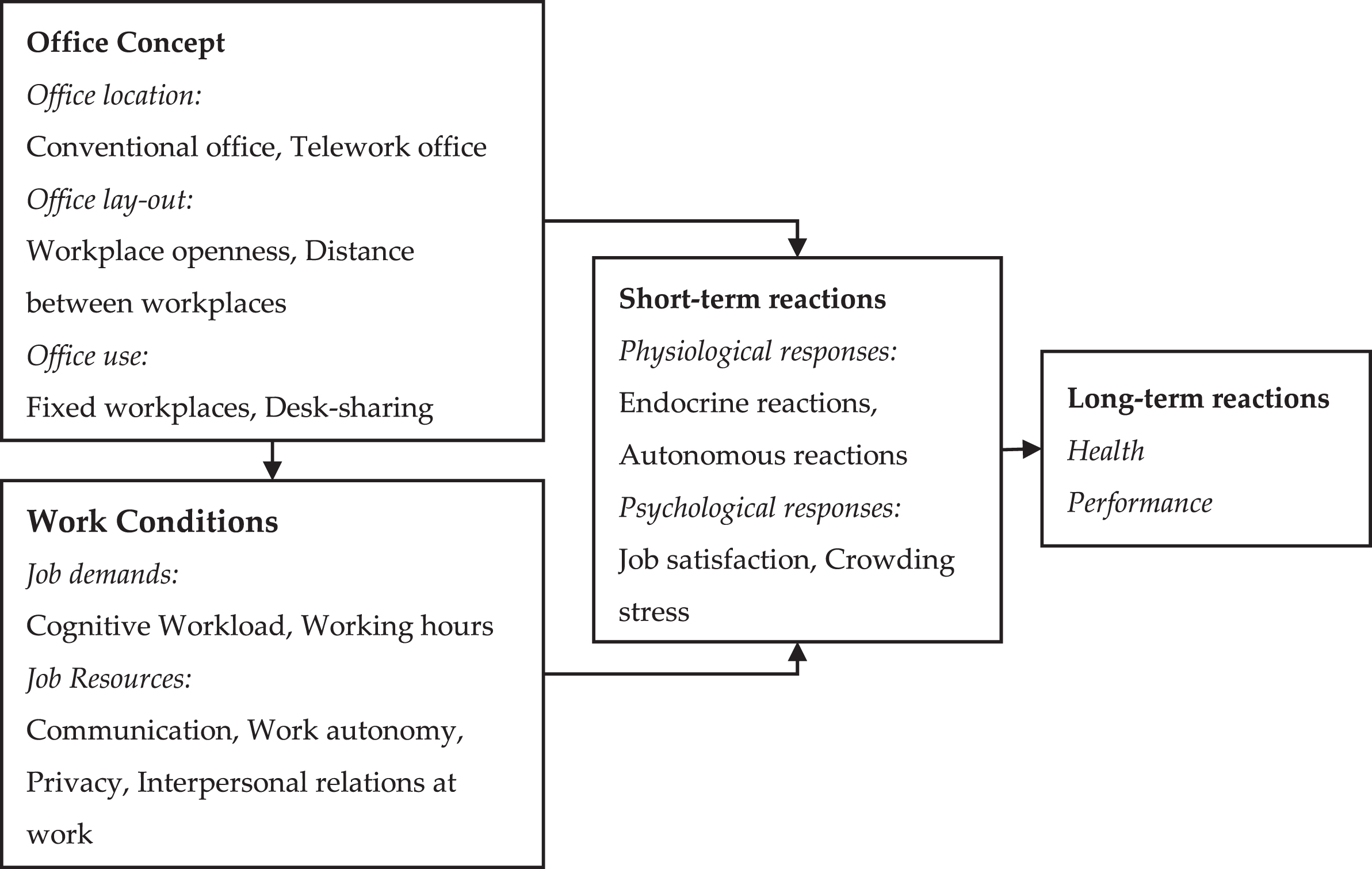
Conceptual model “The effect of office concepts on worker health and performance”.
The office concept is described in three dimensions: location, lay-out and use. Whereas the office location refers to the place where the employee works, the office lay-out describes the arrangements of the workspaces and the office use refers to the way the single workspaces are assigned to the employees. The office concept then may impact on the work conditions and therefore several different job demands and resources. The model describes that the combination of office concept and work conditions (job demands and resources) lead to short-term reactions, which are also of interest in this study. The model proposed further that the short-term reaction will lead to long-term reactions, which include the health and performance of the employees. With this conceptual model the second research question arises:
Q2: What are the perceived health-related outcomes resulting from the working conditions in an ABW environment?
In order to answer the research question (Q2) especially the psychological responses are focused on, to investigate what the subjectively perceived health-related outcomes are resulting from the working conditions. If ABW environments provided resources to the employees, positive outcomes would be expected. If there are also demands in the work environment, and these counter or outweigh the resources, negative outcomes will also be possible.
Although there are concerns and open questions about the impact of innovative office concepts on employees, there is little knowledge of the possible consequences of office types on health and well-being [22, 24]. Currently, there are not enough representative studies on the influence of ABW on health, satisfaction, motivation and productivity of employees and the results of the few available empirical studies are partly contradictory [15, 25].
A study by Appel-Meulenbroek and Janssen [14] reported poor values for productivity, health and satisfaction in an organization, which had implemented ABW structures. The study showed that the office concept was often not used as intended, resulting in productivity losses, illness and dissatisfaction.
Bodin Danielsson and Bodin [26] showed that the employees in small and medium-sized open-plan offices reported about the most diseases, followed by employees working in shared space offices and large open-plan offices. In this study, employees in flex and cellular offices reported the best health and well-being status.
On the basis of a representative sample of a Swe-dish population, Bodin Danielsson et al. [27] conducted a study in which they could demonstrate a higher rate of short-term sickness rate among women, but not in men, in open-plan offices of any size. For men, there is an increased risk for short-term sickness in flex-offices, which contradicts the previous results of Bodin Danielsson and Bodin [26], which showed a positive effect of the flex-offices.
Furthermore, Bodin Danielsson [28] explored the role of office design for the development of well-being in three studies. The question was raised, whether different office concepts affect the state of health, the assessment of leadership and job satisfaction. The results for the sick leave rate showed that men, who work in flex-offices, had a significantly higher risk for short-term illness-related absence as well as a higher total number of days absent. In addition, employees in flex-offices were less satisfied with their direct supervisors. The results for job satisfaction showed that desk-sharing leads to lower overall satisfaction. In sum, negative effects predominated in desk-sharing offices, especially in terms of psychological factors and job demands.
In contrast, the study by Meijer, Frings-Dresen and Sluiter [25] provides contradictory data of an evaluation of the implementation of an innovative office concept with regard to employee health and productivity. The study found that ABW has no or limited short-term effects on fatique and productivity, but had some positive effects on the overall health of employees after a longer period of time.
The focus of the review by De Croon et al. [22] was on which influence the office location (teleworking vs. conventional office), the office layout (open-plan office vs. cellular office) and the office use (fixed workstations vs. desk-sharing) have on the job demands and job resources and which short- and long-term reactions can be found in the employees. The results provided strong evidence that working at open workstations reduces privacy and satisfaction. In addition, the study showed with limited evidence that the cognitive workload was intensified and interpersonal relationships were worsened by open work stations. The study results also illustrated that proximity between workplaces leads to increased cognitive workload and reduced privacy. Desk-sharing, on the other hand, improved the communication among employees.
Kim and de Dear [29] presented the results of their cross-sectional study, showing that employees in cellular offices were more satisfied with acoustic and visual privacy. In addition, it was shown that employees in cellular offices reported the highest level of satisfaction with interaction, temperature and air and light quality. A more recent study by the authors [11] examined data from an Australian employee survey to determine whether desk arrangements (desk-sharing or fixed workspace) affect employee satisfaction, subjective productivity, and health at the workplace. The results suggested a decrease in self-assessed productivity when spatial factors, such as the ability to interact with colleagues through the office layout, the ability to customize and personalize their own workspace, and the available storage space, are not meeting the expectation of the employees. The analysis of the results further showed that the association with spatial factors with the self-assessed productivity was more pronounced for non-territorial workplaces than for workplaces with assigned workstations. In terms of self-assessed health, comfort through the furnishing was the strongest predictor for employees who used desk-sharing.
A further study suggested that working in an open office environment with additional quieter workspaces—referred to as a combi-office in this specific study—or in flex-offices leads to low satisfaction with productivity, privacy, and concentration compared to cellular offices and shared offices [13]. The authors also found in their study that employees in cellular and shared community offices were less satisfied with the architecture and the office layout compared to employees from the combi- and flex offices. In addition, the possibilities for communication were evaluated more positively in the open work environment, which is in contrast to the above-mentioned results of Kim et al. [11]. A study by Hoendervanger et al. showed how psychological needs, job characteristics, and demographic variables effects satisfaction with the ABW environment [30]. The results indicated that among others the satisfaction with the ABW environment is connected to the need for relatedness, need for privacy, job autonomy, social interaction and internal mobility. Wohlers and Hertel analyzed the long-term effects of ABW on teamwork [31]. They found out that ABW has a positive effect on collaboration across teams but inhibits teamwork.
In summary, the results of the existing studies are extremely diverse and in parts contradictory. Until today there are no consistent findings available about the job demands and resources and the health-related outcomes of the employees.
Aim of study
To better understand the relationship between demands, resources and health-related outcomes in ABW environments, this study aimed to investigate the relationship between the work environment and the demands and resources and the perceived health-related outcomes of the employees.
These aims lead to the following research questions of this study:
Q1: Which working conditions can be found in a flex-office, where ABW is implemented?
Q2: What are the perceived health-related outcomes resulting from the working conditions in ABW environments?
Materials and methods
Study design
In this study, an explorative qualitative study was performed in an office of a medium-sized enterprise. The company was renovated: traditional cellular workplaces and open-plan areas being replaced by the ABW environment with focus rooms, touchdown workstations, breakout areas, meeting rooms, coffee corners and an open-plan area in order to enable a lively and cooperative communication and to create a stimulating network in the organization. A qualitative interview method was chosen to better understand the reasons behind employee satisfaction with the ABW environment and their perception of performance in the ABW office, their state of subjective health and therefore perceived demands and resources. Data was collected through semi-structured face-to-face interviews using an interview guideline. The study’s methodological orientation and theory was based on the qualitative content analysis according to Mayring [32] with the use of the summarizing content analysis, where inductive categories are created.
Participants and recruitment
The participants of this study were exclusively employees of the previously mentioned company. To answer the research question, 20 employee interviews were planned to be conducted. In the preparation of the recruitment process, inclusion and exclusion criteria were defined to create a pool of employees for participating in this study (Table 1).
Inclusion and exclusion criteria
Inclusion and exclusion criteria
In the further proceeding of the recruitment process, the human resource department of the company prepared an employee database on the basis of the inclusion and exclusion criteria in order to select the 20 participants. The aim was to randomly choose the interview participants, in order to achieve unbiased insights from different perspectives of the employees and therefore avoid a bias through voluntary participation and unilateral perspective. An employee data pool including ID numbers for all employees working in the company was sued. The employees were selected by the researcher through a random software-based choice of numbers. The human resource department provided the contact information (email address) of overall 40 selected employees in order to be able to have enough backup contacts for the recruitment, since the participation in the study is voluntary.
After two cycles of contacting via email, 16 participants agreed to take part in an interview, so individual interview appointments were scheduled, either via email or telephone.
The interviews were conducted as a face-to-face interview. This interview room was not located in the same building as the ABW office. The setting was chosen to offer an environment for the interviews, which provides enough privacy to talk about the ABW environment and even more sensitive topics. During the interview only the researcher and the interviewee were in the room.
Interview guideline
The interview guideline is divided into five main sections, which reflect the central areas of interest. In Table 2 the main topics are summarized.
Main topics and questions of the interview guideline
Main topics and questions of the interview guideline
The conducted interviews lasted between 20 and 45 minutes each and were audio recorded. In the beginning of the interview process, the participants were informed again about the framework of the research project and the aim of the study, about the data protection guideline, that the research project is completely anonymous and that the recording of the audio tape will be deleted after the transcription and analysis of the interviews. The participants had to sign a declaration of consent in order to document their consent of the recording of the interview and the use of the data. In order to get an overview over the participants’ characteristics in the sample, a short questionnaire concerning demographic parameters was handed to the participants. The completion of this questionnaire was voluntary. One employee refused the participation, so 15 participants answered the questionnaire.
Data analysis
The first step of the data analysis included the transcription of the audio recorded data. Therefore transcription rules were defined, derived from Kuckarzt et al. [33]. The transcription rule system provided a clear traceability in the written data material. In order to prepare the analysis process, a specific query plan according to the process model for inductive creation of categories by Mayring [32] was developed. The last step was to carry out the analysis according to the content analysis under the terms of Mayring [32], using the software for mixed methods and qualitative content analysis MAXQDA.
Ethical considerations
Prior to the interview, all participants signed a declaration of informed consent regarding the performance and recording of the interview. The Medical Ethics Committee of the Hamburg Medical Association provided professional legal and ethical advice for the study (PV5652).
Results
Demographics
The gender distribution was slightly uneven in the sample with the favor for women (62.5 percent). With 80 percent most of the participants had a general qualification for university entrance, 80 percent of the sample either had a university degree or a degree of a university of applied sciences. Over 50 percent of the sample is employed in the company for more than 10 years. The frequency table will provide a description of the demographic variables, education and duration of employment (see Table 3).
Gender distribution of the study sample (n = 16)
Gender distribution of the study sample (n = 16)
Desk-sharing
In the ABW environment the principle of desk-sharing was implemented, so the employees do not have an assigned workstation anymore. They can choose their workspace freely but do not sit next to another colleague every day, even though the work environment is divided into so-called neighborhoods, which should ensure that colleagues from the same department still have proximity to one another.
As a positive aspect the employees mentioned the possibility and the freedom to choose their own workplace and thus a possible entrenched routine in the work routine is broken. Also as positive mentioned is that the contact to and the exchange with colleagues of other departments is increasing.
“[...] ... we sit in different areas and that‘s good, in this way the divers departments come closer together. I would consider this point as positive. This contact to the colleagues to whom you usually don’t have any contact, for me that’s very comfortable.”
On top of that, the feeling of team membership—in most cases it refers exclusively to one’s own team—changed to a sense of belonging to the company as a whole.
In contrast, some employees no longer feel properly integrated and feel interchangeable, because of the fact that they no longer have a personal workstation. Other employees often cannot sit together planned even when a direct exchange with other employees is absolutely necessary, e.g. between trainers and trainees. Besides the missing certainty in planning the seating situation, the employees have emphasized that they perceive it as unpleasant that they no longer know exactly, where colleagues and other employees sit and that they have to spend more time finding colleagues in the building.
Search for workspaces
The most frequently mentioned aspect concerning the daily search for a workspace was the fact that finding a place to work is unproblematic, as long as the employees come to the office really early.
“You get to work earlier to save a workplace in the mutational neighborhood, and yes, you stay longer in the evening, because then you’ve finally got the silence to do your work.”
The employees, who come to work early, use the free selection of the workplaces and therefore tend to always choose the same, usual workstation. If an employee does not find any place in his neighborhood, they will have to search on other floors or switch to the breakout areas. The employees emphasized that the search for a workstation takes a lot of time.
Clean desk policy
Desk-sharing was combined with a “Clean Desk Policy”, which included that no personal items are allowed to be left at the workspace. Employees emphasized, that the workplaces are perceived as impersonal and sterile. In order to find a solution for the missing personal working tools, some employees work with portable boxes—containing text markers, scissors, punches etc.—which can be quickly transported from one place to another.
Other employees stated that it is not as important to decorate their workstation according to their preferences as it is, for example, to have a workstation, where they can work concentrated. Employees mentioned positively that they are “forced” by the policy to keep the desk cleaner and that the utilization of digital storage systems is pushed forward. In addition, the reduction on the necessary items on the desks is perceived as liberating.
However, some employees stated, that many employees do not follow the rules of the policy and reserve working spaces even they do not use it.
“Well, the truth is, that a lot of people are in meetings and their working places would be there for others but the reality looks different ... my feeling is that when you walk through the department looking for a working place then you see a lot of reserved desks which are taken but nobody is sitting there. This represents the typical German habit of using beach towels to reserve spaces on the beach. [ ... ] They don’t stick to the two-hour-rule.”
Cleanliness and hygiene
The cleanliness and hygiene of the desks was on the one hand criticized by the employees after the use of another colleague, especially in the flu season, on the other hand the offices are mostly carpeted and the walls are partly covered with fabric. So even though the floor is being vacuum-cleaned regularly, the fabric covered walls are not being cleaned, which is especially for allergy sufferer a problem.
Light
Employees criticized that they do not have any influence on the control of the light any more at their individual workstations and that the preferences concerning the lighting vary per employee. Knowledge about the possible lighting control by the employees seems to be partly missing and the request for more concrete instructions was expressed. Also the different color shades of the light, which is controlled centrally by the company, are described as not ideal and responsible for discomfort.
“On the other hand it’s the artificial light we use in general which is suboptimal concerning die color shades of the light. It changes from yellow shades, blue shades and that’s annoying or rather it was annoying. [ ... ] Because there a people, who are very sensitive, who react photosensitive and to whom blue shades of light for example leads to headache. And that‘s unbearable.”
Employees criticized that the light in the focus rooms is related to motion detectors and the light would go out, if they were not moving enough in the room.
Air quality
Most of the employees’ statements were related to stale air and the fact that, despite open windows and the ventilation system, the air often does not have a good quality. In focus rooms, employees even reported very bad air after a short time period, which leads to the fact that they do not want to stay in them for a long time. Concentrated work, as intended by the room concept, is not possible.
Sound insulation
The measures for sound insulation, like the carpeted walls, are partly perceived positively and as an improvement. Other ABW rooms—like meeting rooms, telephone boxes and focus rooms—are criticized because of not being soundproof. Conversations of conferences and telephone calls in telephone boxes or focus rooms can be overheard. Employees reported that these acoustic disturbances affect their ability to work concentrated.
Working@Home
With the possibility to work two days a week from home—called “Working@Home”—they are trying to make a better work-life balance possible for their employees. Almost all interviewed employees stated that the possibility to use Working@Home is of great importance to them, that they make or want to make use of Working@Home regularly and that an elimination of this possibility would seriously worsen the situation of satisfaction. In fact, some employees emphasized that if the possibility of Working@Home was not available, they would take actions, like reducing their working hours, because of perceived stress in the ABW environment.
“If you take something like this away, like Working@Home. The very chance to work at home on several days is a big factor for the satisfaction with the general situation.”
On the one hand the employees use Working@Home for the compatibility aspect between private life and business, on the other hand they make use of it to be able to work concentrated. Many employees have indicated that they can concentrate better in their home office than in the office building and feel able to work more efficiently there. A controversial effect of Working@Home is the point that employees use it to keep working, when they actual feel ill, instead of calling in sick.
“[...] ... no, in general, she doesn’t like that. I think she prefers having us under control or perhaps she has no trust in us.”
Nevertheless, the majority of the employees stated that their supervisors do not support the utilization of Working@Home. It seems to the employees that the supervisors want to keep the employees in the company on-site in order to be able to keep control more easily. As a possible cause a lack of trust in the employees is mentioned.
Working conditions
Privacy and visual exposure
Some employees perceived the open structure as a strain, taking also into account that the situation is further reinforced by the previously described lack of space:
“However, I do know from other colleagues, that it’s stressing and they also take it home. It really seems to be a heavy pressure for them to sit in such a small room with this amount of people.”
Some interviews showed that the improved possibilities for communication are perceived positively, but a problem is that the employees are permanent accessed by colleagues and so they are constantly torn out of their workflow. It is difficult to achieve uninterrupted concentration, which is perceived as stressful. The architectural freely structured office lowers the threshold to address a colleague.
In relation to the perceived stressors in form of missing privacy and visual exposure, the employees expressed the wish for better zoning of the open-plan area, which means more walls or a better partition to create a calmer work environment with more privacy. An additional suggestion was to increase the amount of places of retreat.
Noise and trough traffic
The open-plan area was described as stressful because of the continuous through traffic and the resulting noise and disturbances. Employees stated, that they do not use the focus rooms in situations like this, because they need a possibility to focus and be able to work concentrated for longer than two hours. Other employees apply other coping strategies, e.g. using earplugs or listening to music over headphones. It is emphasized that for some employees working concentrated, even for a short period of time, is not possible at some workplaces, like the touch down places.
Several participants of the interviews made clear that the noise level—especially in form of hearable conversations—is a severe stress factor for the employees. In order to avoid making noise, social communication, like small talk, is decreasing. It is stated that networking became more difficult in the company.
Territoriality
Expressions towards territoriality included feelings of ownership towards social or physical objects. On the individual level, employees show feelings of ownership in an office by establishing physical and social boundaries by the personalization of their direct office environment. On the team level, territoriality is critical for group identification, intra-group information sharing and group cohesion. Regarding the territoriality on individual level, employees tend to be satisfied when working at the same workstation—their favorite place—if space permits it.
“So, when I’m the first in the morning, why should I look for a different place? In my view that’s awkward. [ ... ] Everybody has got his favorite place, and if anybody isn’t sitting there yet you can take the seat [...] I think that’s pretty practical because if someone out of a different area is looking for me then they know where I normally sit.”
Some employees reported that the lack of their own workstation and the lack of the opportunity to personalize them makes them feel uncomfortable, interchangeable and gives them a feeling of not being integrated in the company.
As mentioned above, territoriality on the team level is important for the development of group identification. Several times the employees addressed, that they feel a decrease in team spirit and team cohesion due to the spatial separation of the team members in the office building.
“The team spirit gets lost. We don’t even have a lot of [ ... ] such aspects that are nice along our work. To chat about the weekend. Things like that just get lost.”
Aspects that define a team—such as conviviality—would no longer be possible in the new office environment, which has a significant impact on their well-being at work.
Employees also complained about the fact that withdrawing into the focus rooms is only possible with simultaneous splitting off from their team and the feeling of isolation. Coordination and information transfer in the team are more difficult, employees stated. More organized meetings are necessary and more emails are written to ensure the flow of information. This costs more time than the fast and uncomplicated exchange of information between team members. Due to the lack of space, employees stressed that the spontaneity, promptness and flexibility of communication is partly lost.
However, in other neighborhoods without a lack of space, the employees reported that for them communication with colleagues is now much more dynamic and quality of work has improved. Related departments are arranged in a common area to facilitate collaboration, which has a positive effect on the quality of working together. Because of facilitated communication and spatial proximity, cross-departmental cooperation is being strengthened and interfaces between different departments can be partially overcome. Professional exchange and learning of one another is possible, so that work can become more efficient in some aspects.
Health-related outcomes
Subjective perception of well-being and mental workload
Some employees reported about frustration because in their work routine is a complex tension: On the one hand, the demands placed on them are continually increasing, and on the other hand the right conditions are lacking for them to meet these requirements and to be able to work concentrated.
“And I feel it already. I’ve got very bad headaches lately and I feel, actually I don’t really feel that well.”
They feel drained, exhausted and tired when they come home in the evening. Aspects such as an increased number of days with headache are mentioned several times by different interviewees. The stressors of noise and the missing opportunities to work concentrated causes inner restlessness in several employees, which is associated with a feeling of nervousness and a higher level of discomfort.
“ ... it’s really only the aspect of the tranquility. Right, you’re really beat-up when you get home.”
In contrast, other employees showed that the atmosphere of informality helps them to go to work more stress-free and the open design of the rooms brings serenity.
Concentration and performance
Many employees reported that the concentration ability is affected by the noise and the through traffic with the consequence to cannot focus on their tasks and work on a qualitative high level. Conversations with co-workers, telephone calls, conferences or video conferences taking place in the open space area are perceived as a considerable distraction by many employees. Some employees reported that the quantity of the work done has mainly stayed the same, but they perceive a decrease in the quality because of the stressors noise, through traffic and in some cases the lighting situation. In particular, the touchdown places offer no possibility to work concentrated, the employees stated. The possibility to work from home is appreciated especially because this option gives them the chance to work concentrated and to be productive.
“Constantly, it’s like that and it really would be nicer if you manage to complete your work because the surroundings would give you the tranquility and the chance to concentrate. Without having to isolate from the others. Focus rooms are equal to isolation. [ ... ] but I need to isolate myself to be able to work concentrates and for me that’s not attractive.”
They also use the focus rooms, which are designed for the purpose of concentrated work. The possibilities these rooms provide to work concentrated are mainly rated positively in this context. Although, two disadvantages of the focus rooms are mentioned: the bad air conditions in the focus rooms and that the withdrawal into the focus rooms in is always coupled with isolation from the team. Some employees have reported that they do not use the focus rooms, even in case of disturbances in the open space area, because the change of the working location is perceived as being too much effort. Working concentrated is difficult, when colleagues or co-workers address each other more often and without “permission”.
“Yes, it’s really exhausting trying to get into the work again and again. That’s the thing where I would say that this is more stress than in the past.”
While some employees perceived a decrease in the quality of the work done, other interviewees reported about an increase in quality because of the possibilities to exchange information in a fast and informal way with colleagues and co-workers in the same neighborhood area. The improved inter-divisional cooperation made it possible to work more dynamically. Employees mentioned the spatial proximity of different departments and the resulting improved inter-divisional communication as one reason for a more effective way of working. Also positively rated is the fact that in the new office environment more rooms are available for e.g. meetings with the consequence that spontaneous meetings can take place and that the time spent searching respective rooms is omitted. Through the idea to design task-based rooms, some employees feel supported in their work activities by the office environment and emphasized that ABW has a positive impact in their work.
Discussion
Major findings
The aim of this study was to examine, which job demands and resources result from the working conditions in ABW concepts and how they are related to health-outcomes. Qualitative semi-structured interviews with employees working in an ABW environment build the basis to take a closer explorative look into a new and under researched topic. The opinions and perspectives differed strongly and showed very diverse study findings.
Ambivalent expressions of being satisfied with the ABW concept have been investigated. As previous studies showed there is evidence that occupants are more satisfied with the physical ABW environments on most aspects, e.g. employees in ABW are satisfied with the functionality of the workspaces [13, 34]. Further studies [34, 35] demonstrated high levels of satisfaction with physical spaces intended for break and collaboration, while one study reported the opposite [14].
The results of this study suggest that the “Desk-sharing Principle” on the one hand gives the em-ployees more autonomy and thus more dynamics at work. This corresponds to Hoendervanger et al. [30], who described that job autonomy and the need for autonomy affect the employees’ satisfaction with the ABW environment. On the other hand desk-sharing limits immediate communication and collaboration of team members in work teams, which is equal to the outcomes in the literature [22, 27]. The communication and information transfer has become more difficult, which requires an intra-team organization of new ways of information sharing. In addition, the decoupling effect in teams has a critical influence of the perceived well-being of the employees. Concerning the inter-team processes—the processes between team members of different teams—the cross-departmental communication is perceived as improved and with it the quality of the work. The inter-team processes have a positive effect on well-being and performance in form of improved possibilities to exchange information faster and more effectively. In addition, findings by Millward, Haslam and Postmes [36] suggest that this kind of change in the inter-team collaboration can strengthen the sense of organizational identity, which could be confirmed in this study. In this regard, desk-sharing and the “Clean Desk Policy” have a direct influence on the feeling of territoriality on the individual and on the team level. It can either make employees feel more integrated in the company and the different teams or make them feel interchangeable, as the present study found out. Also the missing possibility to personalize the own desks was either perceived as a strain or as an improvement, because of its positive effect on their ability to concentrate. The behavior to choose the same workstation every day for a subjective higher level of satisfaction, makes them feel less interchangeable and more being integrated in the company, compared to daily changing workstations. The aspect of time consumption due to the search for workspaces as a strain can also be found in the findings of Kim et al. [11], who also report about the problem of a too small number of available desks as a reason for the same “blocking behavior”.
Even though precise data of the ratio of people to workstations for the sample company building in this research project is missing, the results made clear that the determination of the needed number of workstations per employee is a critical factor for the success of the implementation and to ensure the proper functioning of the idea of ABW. Anticipating the demand of needed workstations can be very difficult but as seen in this research project, a higher demand in excess of available workstations can result in low satisfaction and a decrease in performance. In contrast, areas with a sufficient number of workstations available, show that a more dynamic team communication is possible even with a perceived higher quality of work.
In the literature findings suggest that territorial feelings and behaviors have been found to have a positive effect on the well-being of employees [37, 38] by satisfying relevant human needs, like having a personal place and the need to establish, maintain and communicate self-identity [37, 39]. Therefore, the missing possibility to have a personal workstation can be understood for some employees as a possible job demand in the ABW environment. Effecting the territoriality on team level, there are difficulties in finding colleagues in the building and co-locating with team members, like also the results by Kim et al. [11] describe. As a consequence of the spatial separation of the team members, the perception of a decrease in team spirit and team cohesion occurred, which in turn affect the well-being and motivation. These findings support results in the literature, which underline that territoriality on the team level is important for group identification, group cohesion, and intra-group information sharing [40]. In addition, Kane, Argote and Levine [41] stressed that group identification is associated with job satisfaction, job motivation, and behaviors, which are important for team effectiveness, for example group cohesion, communication, cooperation, and social support.
Regarding the “architectural privacy” and “psychological privacy”, the ABW office concept has a low level of architectural privacy on the open plan area because walls and doors have almost completely disappeared [15]. Architectural privacy can be interpreted as a perceived additional job demand in general. The reduced architectural privacy leads to a perceived lower psychological privacy—a regulatory process by which employees experience having control over work-relevant aspects [42]. Mark et al. [43] reported that interruption is often compensated with a faster and more stressful working style, associated with high mental stress leading to frustration, cognitive workload, pressure and own effort. The findings of the present study show that the employees are permanent accessible to others with the consequence of person-related work interruptions, missing control about accessibility, acoustic disturbances and in this way a decrease in concentration and performance. Furthermore, De Croon et al. [22] found a strong negative evidence between the architectural privacy and job satisfaction. In addition to these findings, the present study also gathered positive effects like increased communication [44] and dynamics at work.
As expected, the study results show that the indoor environmental quality (IEQ) conditions—the general cleanliness and hygiene, light installation, the quality of the ventilation system and the sound insulation—were related to health, performance and well-being of the occupants working in the office environment. Previous research findings demonstrated high levels of satisfaction with the light and ventilation in ABW office concepts [11], but also reported increased noise distractions from co-workers [14, 34], from photocopiers, doors and air-conditioning [14], and poor temperature control [18]. Concerning the subjective perception of health-related outcomes, employees complained about headache and fatigue. This result is on the one hand similar to the findings of Bodin Danielsson and Bodin [26] but on the other hand in contrast to the results of De Leeede and Heuver [10].
The concentration and performance is strongly linked to the office concept, like IEQ and desk-sharing. Previous studies showed ambivalent results: positive effects on concentration have been found by Blok [45] or a reduction in distractions in an ABW environment, while several studies reported ABW to influence concentration negatively [13, 35, 46].
Limitations
In this study the method of qualitative semi-structured interviews was chosen in order to get explorative insights into the relatively new research area of ABW.
However, various limitations should be considered. It is possible for distortion to arise as a result of self-selection, e.g., workers signing up for the interviews specifically because they experience especially high demands or strains [47]. This research study is also based on the subjective perspectives of the employees, which makes it possible that they may have responded to questions in a “socially acceptable” manner. Transferability of the results to other is limited due to the study design. On the other hand, it may also provide a unique insight into the working conditions related to ABW.
No objective measurements of outcome variables of all employees in the company could be taken. The intercoder reliability, which verifies the accordance of different evaluators cannot be determined as the analysis was done from just one person. Therefore statements about the reliability of interpretations on applied procedures cannot be made [48].
In order to be able to make reliable statements on the relationship of working conditions in ABW offices and their relations on well-being, performance and motivation of employees, further research is needed.
Further research
Additional research is needed to investigate the effects of office designs like ABW on the health of employees in the long term. In addition, investigations, which take into account a pre- and post-evaluation, are needed to be able to compare the effects of the change from a traditional office to an ABW office.
Further research is also needed to investigate the effect of low privacy and interruptions on the well-being and performance of employees.
The aspects of territoriality on the individual level needs further research in order to answer the question how the issue of missing possibilities to personalize the workstation can be balanced in ABW office designs.
Due to the quality and quantity of work related to the amount of available activity-based office workstations, more research is needed in order to determine the necessary personnel-workstation-relation for a company in general in order to be able to fully understand the effect of ABW environments with desk-sharing on the territoriality on team level and their intra-team processes. A special focus in this area should also be placed on how such office concepts can be flexibly adapted to volatile numbers of employees and general fluctuation.
To reconsider the regulations of ABW concepts, for example to not have the boundary to only work for maximum two hours on some working stations, further research is needed to find out which conditions are better fitting to the employees to increase performance and concentration.
More research is necessary to investigate how the design and organization of ABW offices have to be done in order to minimize the effects of interruptions and noise on the main open work environment and to make concentrated work possible taking into account also the before mentioned aspects of light and air in focus rooms. Furthermore, deliberations are necessary how the architectural features in the open-plan area can be applied in order to achieve a maximum of additionally privacy and how, for example, additional premises for tranquility and concentrated work can be integrated in ABW office concepts.
Practical implications
Taking into account the complex nature of the relationship of working conditions and health-related outcomes, mediators, which have the possibility to influence the outcome in employees, should be respected in further investigations. Moderators can be task-related (e.g. task variety, task interdependence), person-related (e.g. personality, age, gender, need for routine seeking) and organizational-related (e g. organizational culture, leadership style, special office design features) [15].
In order to find solutions for the related difficulties regarding the effectiveness of teams and their collaboration because of the spatial separation—in some cases caused by lack of space—the space allocation and the spatial design of ABW office environments need to be carefully planned to take into account the wide variety of organizational work processes. In addition, technologies—for example tracking systems for employees to be able to locate employees in a large office building—may be interesting to consider, even though this idea would conflict with privacy aspects.
Improving the quality of air and light can be a solution to enhance the indoor environmental quality and therefore also influence the ability to concentrate and an increased feeling of well-being.
Providing chairs that are easy to adjust and a strict cleaning protocol can further improve the perception of well-being and decrease complaints in these areas.
The conversion to an ABW concept can only be achieved, if the working behavior of the employees also changes in the sense of the concept. Task facilitating offices require a different approach of working behavior with the need for the employees to choose the most appropriate workstation according to their current task. Therefore, a carefully planned accompanying process in form of an ongoing chance process in the beginning phase of the office concept chance can provide a more successful transformation, both in working behavior as well as in leadership style.
Conclusions
Although the trend of redesigning offices and implementing ABW is ongoing—to increase communication and corporation—the present study cannot argue in favour or against this new office concept. Therefore, the results are not indicatory enough. This study described, that the office concept as well as the working conditions can either strengthen health-related outcomes such as subjective perception of well-being and cognitive workload, and concentration and performance, or impairs these factors. The described often negatively associated outcomes on performance and well-being do not necessarily apply for ABW offices in general because they were often moderated by the lack of space and have to be verified in further research.
Together, the empirical evidence presented in this study suggests that ABW office design may have an influence on health-related outcomes of employees in various kinds of ways. However, more high-quality studies are recommended to strengthen the evidence.
Author contributions
Conceptualization, I.F. and S.M.; methodology, I.F.; data analysis, I.F.; writing—original draft preparation, I.F.; writing—review and editing, S.M., A.M., V.H.; visualization, I.F.; A.M.; S.M. supervision, V.H. and S.M.; project administration, I.F.; S.M.
Conflict of interest
The authors declare no conflict of interest.
Funding
This research received no external funding.
Footnotes
Acknowledgments
We thank all employees for their participation in this study.