



Abstract
BACKGROUND:
To promote the successful and sustainable inclusion of people with disabilities in different activities such as work, more precise job matching efforts may be of value, especially because people with disabilities are employed at a lower rate than people without disabilities. Requirement profiles as well as profile comparisons have not yet been recorded for horticultural work processes.
OBJECTIVE:
The aim of this study was to document precisely the work process of the cuttings production of the flower tradescantia and to compare the capabilities of people with disabilities with the requirements for this work process for the purpose of verifying that the tool employed was usable.
METHODS:
A skilled worker performed the cuttings production of tradescantias according to good horticultural practice. Additionally, five people with disabilities participated in this study. On the one hand, a structured questionnaire was used to collect the data. On the other hand, the work processes were documented with video recordings and described related to REFA (Association for Work Design, Business Organization and Corporate Development) and evaluated according to IMBA (Integration of People with Disabilities into the Working Environment).
RESULTS:
Apart from the too long working hours, the work in the cuttings production was feasible for the five subjects who had different types of disabilities. There were situations of underchallenges of different degrees, but no overchallenges. It was necessary to assess each subject individually for the risk of accident.
CONCLUSIONS:
IMBA proved to be an effective tool to evaluate and analyse work activities for the purpose of including people with disabilities into horticultural work processes. Thus, it has the potential to facilitate a socially sustainable and skill-oriented work participation for persons with disabilities.
Background
People with disabilities in Austria have difficulties in finding work and in staying employed especially on the regular or first job market as well as in social enterprises on the secondary labour market. In 2016, there were 101,318 people with disabilities in Austria with a degree of disability of more than 50%, as described in the People with Disabilities Employment Act [1]. In 2001, the unemployment rate for people with disabilities in Austria was 9.6% (6,314 people). In addition, 36,439 people with health-related placement restrictions were registered as persons seeking employment with the Labour Market Service in the same year [2]. According to the United Nations Committee on the Rights of Persons with Disabilities, 19,000 persons with disabilities in Austria. are at present being looked after in institutions that offer occupational therapy [1]. According to expert estimates, around 20% of them could possibly be included in the general labour market [3]. For the realisation of inclusion in Austria in 2012, the Austrian Federal Government adopted an Action Plan for the implementation of an inclusive society. Overall, “the visionary goal for 2020 is an inclusive society that is in line with the United Nations Convention on the Rights of Persons with Disabilities” [4]. An inclusive society enables every person to participate in all activities of society – including the public work life. Inclusion does not mean that persons with disabilities should be “integrated” or that they should adapt as far as possible to the requirements of people without disabilities so that they are not excluded from social activities. Education, work and participation are central in achieving an inclusive society, where all people are able to pursue self-chosen aims in their lives [5].
In this study, the following types of disability are taken into account: intellectual disabilities, learning disabilities, physical disabilities and mental health conditions. This choice is based on the classification according to REHADAT [6].
Persons with disabilities who are not employed in the labour market are cared for in sheltered workshops and integrative enterprises. Occupational the-rapy is thus central to this study. In particular, people with intellectual disabilities are employed in workshops where they receive occupational therapy [7]. In Austria, 64.1% of the people receiving occupational therapy in workshops have intellectual disabilities, whereas 16.4% of them have learning disabilities. People with mental health conditions and those with physical disabilities are represented at 14.5% [8]. For the most part, creative and manual activities are offered. In less than 10% of these workshops sales activities (9.7%), commercial activities (8.9%), office activities (6.9%) and agricultural activities (4.6%) can be practiced [8]. As this employment status is not subject to social insurance contribution, the clients with disabilities participating in these types of workshops receive no wage [9]. Instead, they receive a small amount of pocket money [10]. However, some institutions also offer job training and support in the search for employment in the first labour market [11]. Nonetheless, occupational therapy is often protective and preserving [12] and not always promoting inclusion through adequate systems of transition from workshops to paid jobs, as the number of transfers to employment subject to social security contributions in the general labour market is minimal [12]. The inclusion of people with disabilities in the different activities of society should be as socially sustainable as possible. In order to be able to substantiate this comprehensibly by comparing work requirements with a person’s abilities, the use of an adequate method is recommended [13].
An extensive classification method is the World Health Organization’s (WHO) International Classification of Functioning, Disabi-lity and Health (ICF). ICF is a classification of functional health and its impairments and complements in particular the International Classification of Diseases (ICD) [14]. The ICF model takes into account four dimensions (Body Functions and Body Structures, Activities and Participation, Environmental Factors and Personal Factors) and extends the biomedical model (ICD) to the bio-psycho-social one [15]. The ICF has been used in several studies for the inclusion of people with disabilities into the workplace [16–18]. Bruyère [18] described the ICF as a useful tool in vocational rehabilitation research. Conclave et al. [16], however, concluded that not all categories are relevant to their study and that the ICF with its 1495 categories is therefore too comprehensive. As a methodological weakness, Homa [17] also mentioned that some categories overlap and are difficult to distinguish. Kant and Amelsvoort [19] argued that the ICF is not that useful for research in the field of occupation and health. Therefore, the authors of this study decided to employ less complex methods that are primarily used in rehabilitation.
MELBA (Merkmalprofile für die Eingliederung Leistungsgewandelter und Behinderter in Arbeit) is a profile comparison and documentation tool for the determination and presentation of ability and requirement profiles and is used in vocational rehabilitation [6]. Achterberg et al. [20] noted a good interrater-reliability in the various elements of MELBA and therefore recommended MELBA for measuring the abilities of young people with disabilities. However, according to the authors, those elements with poor reliability should be used with caution [20]. MELBA proved to be unsuitable for this study as well, as it is not as comprehensive as the profile comparison system IMBA which focuses on intellectual, social and psychomotor aspects as well as on communication.
IMBA was developed and tested in an interdisciplinary team of occupational scientists, physicians and psychologists as part of a research project [21]. With IMBA workplace requirements and human abilities can be described by uniform, defined characteristics that can be directly compared. For horticultural work processes, requirement and ability profiles as well as profile comparisons have not yet been surveyed. Activities in horticulture are characterised by much manual labour and are very likely to be well suited for many people with disabilities, as research over the last decade has shown. The work processes in horticulture can be beneficial for body and mind. They alleviate stress, anxiety and depression, and have the potential to enhance the physical as well as cognitive condition, lead to feelings of calm and relaxation, wellbeing, quality of life and quality of work due to the contact with nature [22–27]. Horticultural activities in groups have also been shown to increase self-esteem, improve health and support the enhancement of social relations or a sense of community [24].
Objective
The aim of this case study is to facilitate the in-clusion of people with disabilities in occupational therapy and in horticultural activities and to find an adequate method for this purpose.
To meet this goal, the work process of producing cuttings of the flower tradescantia was documented. The profile comparisons were carried out with the ability profiles of people with disabilities in occupational therapy, related to activities and sub activities. The generated research results should enable a socially sustainable participation of people with disabilities in Austria who presently are in occupational therapy.
Material and methods
In this part of the study, site demographics of the horticultural farm and the work process of the cuttings production are presented. The characteristics of the skilled worker who performed the process during the survey, as well as the five subjects who could possibly perform this work process, are described. In addition, the methods used in the data collection and analysis are outlined.
Material
The pilot operation was an educational operation, which means that work and location were used to train workers in the skill of cutting flowers. Thus, it was representative of good technical practice. The production area was six hectares and the company had 36 employees and eight apprentices. Around 0.9 of the six hectares were indoors, 5.1 hectares outdoors. There was a total of five foil tunnels. Almost all the activities in the company could be done in teamwork, as it is appropriate for a training farm.
A skilled worker of the pilot plant carried out the cuttings production of the flower according to good technical practice. The characteristics of the five subjects who were cared for in occupational therapy are described below. The rights of the participating subjects were protected by anonymised data collection.
The five people were aged 24 to 50 years; the mean value (±SD) was 36 (±13). Two subjects were males and three females. The types and degrees of their disabilities varied greatly, but all (100%, 5/5) of them had an intellectual and a learning disability. About 60% (3/5) of the subjects had a mild intellectual disability and 40% (2/5) a moderate intellectual disability. Only 40% (2/5) had also a physical disability. One-fifth (20%, 1/5) had gross motor problems, while another 20% (1/5) had fine motor problems. One fifth (20%, 1/5) of the subjects also had a visual impairment. Only one (20%, 1/5) of the subjects had a moderate mental health condition or a pronounced mental health condition. The participants were selected from a farm with occupational therapy according to convenience sampling. This sampling strategy was chosen because it is less expensive and time-consuming compared to other sampling strategies [28].
The master gardener worked with tools and production materials that were already prepared: a table, several pots (10 cm), reproductive material, several boxes, a hose with a tap, several head cuttings, a finishing knife and a stick.
The cuttings production was done at a table. The work elements of this work process are mentioned in 3.2 Methods.
For one production unit, six pots of reproductive material and several head cuttings were put into a box. These were watered and placed on a table with floor heating. For that, it was necessary to walk into another room. Most of the time the work was performed in a standing position at the table, with the arms kept in forced posture. This means that it was not possible to put the arms on the table for balance.
Methods
A structured, written questionnaire that had been developed by the research team was used to obtain information about the horticultural farm. This type of questionnaire is based on closed questions which produce data that can be analysed quantitatively. A manager of the farm filled in the questionnaire. Ad-vantages of such a questionnaire are the significantly lower costs for collecting the data and the lower staffing requirements compared with an interview or an on-site inspection [29, 30]. The questionnaire included questions about farm type, farm size, cultivated crops and work sub-operations or work elements that allowed teamwork to identify work processes that could be suitable for occupational therapy. In order to collect the data, the various work elements were filmed and evaluated according to IMBA. The abilities of the five subjects were recorded in the spreadsheet program Excel (2016) according to IMBA. Profile comparisons were made using the software MARIE (Matching Abilities and Requirements to Increase Evidence). Data collection, analysis and results presentation were performed by a scientist. This procedure was also the evaluation tool for an implementation of work-related inclusive cooperation.
The recordings were made with audio-visual technology through videos at the farm under investigation. A Panasonic HC-X810 and a matching tripod were used. The recordings were made not only in order to collect data, but they also provided the necessary technology for measuring and recording the planned project IRMA (Socially Sustainable Inclusion of People with Disabilities into Horticultural Work Processes).
The different elements of the work process for the production of cuttings of the three-master flower (tradescantia) were determined for the creation of requirement profiles on the basis of the film scenes. They were documented in the spreadsheet program Excel, categorised and analysed. The REFA method according to Auernhammer [31] was chosen for the structuring process, especially the division of activities into work elements.
Based on the time structuring method REFA [32], the work process was divided into successive work sub-operations and work elements. Related to the work element method, the work processes of the cuttings production were sub-divided into twenty work elements in order to be subsequently evaluated by IMBA for persons with disabilities. The work elements were filling the pots with earth, pressing the earth in the pots, carrying the pots to the casting site, turning on the tap, watering the filled pots, turning off the tap, carrying the pots back to the table, cutting the plants under the nodium, pressing a hole in the earth, putting two cuttings into the hole (See Fig. 1: The Cuttings Production), pressing the earth in the pots, carrying the pots with the cuttings to the casting site, turning on the tap, carrying the tube, watering, carrying away the tube, turning off the tap, carrying away the pots and placing the pots on a table with heating.
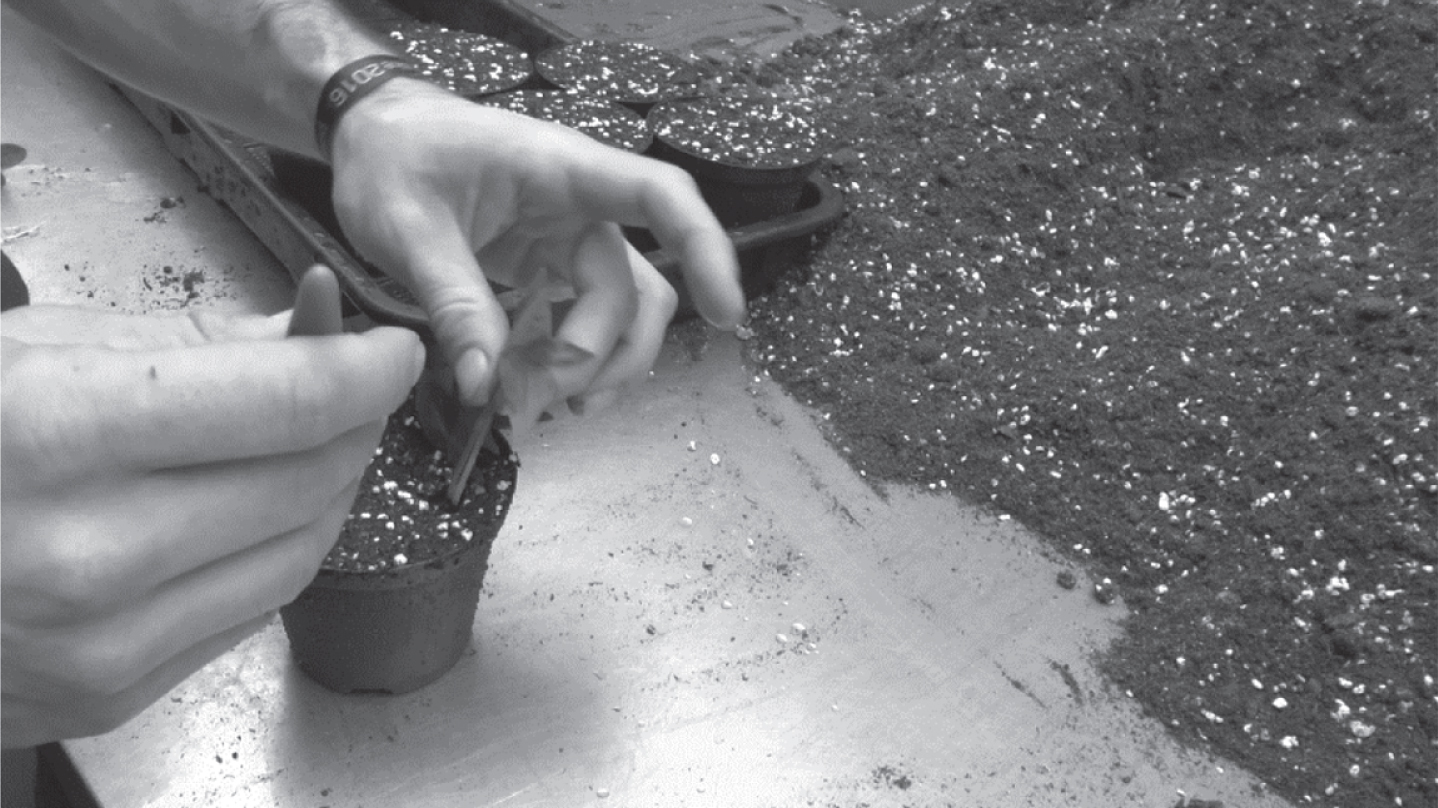
The cuttings production.
The evaluation according to IMBA was carried out with regard to the workplace and activity. After the data collection, the profiles were created and the profile comparisons were evaluated in an Excel file according to IMBA. IMBA has already been successfully employed in other sectors [21] and was employed in the field of horticulture in this case study.
IMBA is a profile comparison and documentation method for the prevention and rehabilitation of injuries in business operations and includes nine units of analysis or key features (See Table 1: The Nine Key Features of IMBA).
The nine key features of IMBA
Each profile unit of analysis was sub-divided again. In total, 70 features were evaluated. The profile unit information, for example, was sub-divided into the following features: seeing, hearing, speaking, feeling, feeling of movements, facial expressions, smelling, reading, calculating and writing. The requirements and abilities that were identified by these key features and ranked on a scale finally resulted in one requirement profile and five ability profiles, which provided information about the requirements of this work process and the existing abilities of the five subjects. In this study, all 70 characteristics were evaluated. For the rating, the profile values 0 to 5 were assigned according to IMBA. The profile comparisons had values between -5 and 5 as their results. -5 meant that a severe overchallenge existed whereas 5 stood for a severe underchallenge.
The software MARIE was used in parallel with the spreadsheet program Excel for creating the requirement profiles to evaluate the usability of this software for horticultural work processes. The recorded data was evaluated descriptively in Excel and analytically in the SAS Enterprise Guide 7.1 (64-bit). The significance level used was p≤0.05. Pearson Correlation Coefficient was selected to estimate linear dependencies. Analysis of Variance was done by using the SAS procedure General Linear Model.
In this section, the profile comparison of the work process of the cuttings production of the flower tradescantia is described. For all five subjects (100%, 5/5), the profile comparison score for the main feature “posture” was between 1 and 2. The mean score for all five subjects was 1.7. This means that on average the subjects were slightly underchallenged; the mean value (±SD) was 1.7 (±0.2). The underchallenges in the main feature “posture” correlated significantly positive with mental health conditions (CORR 0.77930, p = 0.0017) (see Table 2). The physical disability influenced the severity as an under-challenge of the main feature “posture” in a highly significant way (p < 0.0001). In the main features “body locomotion” (MW 1.6, SD 0.7) and “movement of body parts” (MW 1.7, SD 0.3), the subjects were slightly underchallenged. Only, intellectual disabilities had a significant impact on the main feature “body locomotion” (p = 0.0246). Intellectual disabilities (p < 0.0001), age (p = 0.0026) and gender (p = 0.0374) had a significant influence on the main feature “movements of body parts” in situations of underchallenge.
Generalised Linear Model Results Underloads/Overloads and personal characteristics (age, gender and different disabilities), correlation coefficients and level of significance
Generalised Linear Model Results Underloads/Overloads and personal characteristics (age, gender and different disabilities), correlation coefficients and level of significance
In the main feature “body locomotion”, 80% (4/5) felt slightly underchallenged and 20% (1/5) moderately underchallenged. In the main feature “movement of body parts”, 100% (5/5) of the five subjects were slightly underchallenged.
In the main feature “information”, the five subjects were moderately underchallenged, since the average over all five subjects was 2.5 (SD 0.6). About 20% (1/5) were strongly underchallenged, 40% (2/5) moderately underchallenged and another 40% (2/5) slightly underchallenged. Age (p < 0.0001), gender (p = 0.0022), intellectual disability (p < 0.0001) and physical disability (p = 0.0004) had a significant influence on the main feature “information” in situations of underchallenge.
In the “complex features” (MW 1.7, SD 0.9), the subjects were slightly underchallenged. One fifth each (20%, 1/5) were very slightly underchallenged or slightly underchallenged, and 60% (3/5) were moderately underchallenged. The main feature “complex features” correlated positively with intellectual disabilities (CORR 0.71911, p = 0.0056) and negatively with physical disabilities (CORR –0.88150, p < 0.0001) and mental health conditions (CORR –0.76166; p = 0.0025) (see Table 2). Age (<0.0001), gender (<0.0001), intellectual disabilities (<0.0001) and physical disabilities (<0.0001) had a significant influence on the main feature “complex features” in situations of underchallenge.
The five subjects were very slightly underchallenged in the area of the main feature of the “key qualifications” (0.99). For 40% (2/5) of the subjects, they proved to be very slightly underchallenging, for another 40% (2/5) they were slightly underchallen-ging and for the remaining 20% (1/5) moderately underchallenging. Age (p < 0.0001), gender (p < 0.0001), intellectual disabilities (<0.0001) and physical disabilities (<0.0001) significantly influenced the key feature “key qualifications” in situations of underchallenge.
The average value for “environmental influences” was 0.20 (SD 0.1), for “occupational safety” 0.1 (SD 0.2) and for “work organisation” 0 (SD 0). The five subjects were underchallenged in terms of “environmental influences”, because for most of them it would have been possible to work in unfavourable climate conditions. There was also a slight underchallenge in the field of “occupational safety”. It was not necessary to wear protective equipment, even though it is a standard requirement in Austrian horticultural farms. It had to be assessed individually by subject whether there was a risk of accident. A risk of accident was given when the physical or intellectual capabilities were not sufficient in order to handle the work tool according to good professional practice. The excessive demands in the key feature “work organisation” are due to the fact that the working time in the pilot farm exceeded six hours, but the subjects could not work six hours continuously.
The main feature “environmental influences” in situations of underchallenge correlated positively with intellectual disabilities (CORR 0.94026, p < 0.0001) and physical disabilities (CORR 0.94583, p < 0.0001) (see Table 2). According to the Generalised Linear Model Results (GLM), age (p < 0.0001), gender (p < 0.0001), intellectual disabilities (p = 0.0012) and physical disabilities (p < 0.0001) had a significant influence on the main feature “environmental influences” in situations of underchallenge.
The main feature “occupational safety” in situations of overchallenge correlated positively with intellectual disabilities (CORR 0.72728, p = 0.0048) (see Table 2). The main feature “occupational safety” in situations of underchallenge correlated positively with mental health conditions (CORR 0.72728, p = 0.0048) (see Table 2). Age (0.0040) and gender (<0.0001) as well as intellectual disabilities (<0.0001) and physical disabilities (<0.0001) had a significant impact on the main feature “occupational safety” in situations of underchallenge.
Apart from the too long working hours, the work in the cuttings production was feasible for the five subjects who had different types of disabilities. There were situations of underchallenges of different degrees, but no overchallenges. It was necessary to assess each subject individually for the risk of accident.
The IMBA method proved to be an effective means to analyse the possibilities for inclusion of people with disabilities in a certain horticultural work process, related to the activity or sub-activity. IMBA is more comprehensive than MELBA and, at the same time, has fewer features than the ICF for the analysis of work processes in agriculture. For future investigations, it is recommended that only the key features relevant to horticultural work processes should be assessed to avoid unnecessary data generation, data analysis and results presentation [33]. For example, Stampfl [34] collected data on the key features standing, kneeling, crouching, walking, climbing, arm movement, hand movement, finger movement, seeing, hearing, speaking, fumbling, reading, calculating, writing, lifting, carrying, pushing, physical stamina, fine-motor skills, work planning, perseverance, concentration, the ability of being criticised, learning/remembering, failure tolerance, correctness, punctuality and teamwork.
In addition, it would be advisable to verify the abilities of people with disabilities with the help of occupational physicians in order to increase the intersubjective validity. The evaluation of the method should be repeated with a larger sample and biomechanical risks and mental stress for critical work situations should more accurately be captured. As a result, stressors for physical and mental health may be eliminated more effectively, based on the identified critical results.
One limitation of this case study is that only one job matching method has been evaluated within the scope of the present investigation. It would have been meaningful to compare the advantages and disadvantages of several profile comparison methods, not only based on literature. The outcome quality could be further improved by a comparative evaluation across multiple cultures, which could be achieved in further studies.
Conflict of interest
None to report.