



Abstract
Background:
A worker’s work habits can affect their health, both physically and psychologically. Negative results have been associated with work demands (stress, anxiety and depression).
Objective:
In the present research we carried out a predictive study of work addiction by applying three questionnaires on depression and anxiety.
Methods:
In this study, the participants were 332 workers, obtained through non-probabilistic sampling. The FACTOR (version 7.2) and SPSS 23.0 programs were used.
Results:
The results of the correlation analysis show both positive and negative associations with the variables studied. We conclude that work addiction variables can predict anxiety and depression because we found that two variables predict 18.3% of depression and 20.3% of anxiety, which are feelings generated by work and excessive work.
Conclusion:
It can be concluded that feelings generated by work and excessive work predict anxiety and depression, thus the present research helps to broaden knowledge on work addiction, promoting a healthy lifestyle and prevent absenteeism.
Introduction
Some companies have exceedingly conventional work schedules. The pressure on workers to meet their goals in the shortest possible time means that they must work more hours than they are contracted to. Furthermore, many companies have adopted home working, which often leads workers experiencing increased working hours and reduced rest periods [1]. Because of this situation, in 2019 the European Union decided to implement measures to record working hours and thus determine the extent to which individuals are required to work in excess of the legal limits. The ultimate aim was in 2019 the obligation to register the working day in order to guarantee workers’ rights to rest, health and safety, and a healthy balance between work and family [2] in order to verify the excess of legal working hours
Some entrepreneurs view that not having any free time (to eat, be with their family, or leisure) is positive and a sign of success. They also demand that their employees share this attitude and comply with its requirements [3]. It is increasingly common to meet people who have a constant need to work and this affects their social relationships, their happiness and their health [4]. Oates [5] defined this situation as workaholism (work addiction).
A workaholic is defined as a person who spends excessive time working in such a manner that it negatively affects their social development, family and lei-sure [6]. They have high expectations of themselves in their work beyond what is required of them and their own economic needs [6]; they devote more energy to work than is strictly necessary [7], and the persistence and frequency with which they work makes them think about work even when they are not working [6].
Due to addictive behavior, although they like working, they exhaust their energy resources. So it is not surprising that workaholics also report that they have lower levels of energy and happiness in life as a whole [8]. Workaholics not only report relatively high levels of fatigue, anxiety and depression, they also report low levels of Engagement [9]. The way in which work can affect a worker’s health, both physically and psychologically, has been widely studied [10–16]. The negative health results found associated with work demands also show how the workers’ personal characteristics can affect these results [17], and one of these characteristics is work addiction [9]. One of the most widely recognized consequences of work addiction is the negative effects on physical and mental health that these people may suffer [18].
The characteristics of workaholics can explain the association between workaholism and poor mental health due to the excessive amount of time spent wor-king. There are studies that indicate this association between work addiction and psychological well-being, showing a decrease in emotional well-being, sleep problems, exhaustion and psychological disorders. This is because people addicted to work do not have enough time to recover from the efforts they have made due to the excessive amount of time they spend working [9, 19–21], which in the long run produces emotional exhaustion [8, 17]. Persistence and frequency also have an influence because the way the workaholic thinks about work can cause sympathetic system activation and emotional stress [22].
Excessive work, including overtime and work at home during the night, can be considered a risk factor because these demands are made in the same psychophysiological systems that were already activated during the workday [23], which impedes these systems from disconnecting and returning to their initial levels. In this sense, Andreassen et al. find that work addiction has significant and positive relationships with anxiety insomnia, emotional exhaustion and somatic health, but not with depression [24]. Therefore, addiction to work is significantly associated with poor psychological health, back pain, absence from work due to illness and especially with mental health problems [13]. Work addiction is an important factor that should be considered when the welfare of workers is addressed because work exhaustion and work wear are factors of absence due to illness [25]. However, people who work long hours and enjoy their work are less likely to suffer from work-related stress, burnout and subjective health complaints compared to individuals who feel pressured to work long hours [7].
Furthermore, it has been found that people who are addicted to work tend to have a higher degree of perfectionism and difficulties in delegating tasks, and they may have problems in their relationships with colleagues or members of their team [6, 26].
The workaholism models, depression and anxiety
Several authors have presented work addiction models (WorkBAT: Spence & Robbins, 1992 [26]; WART: Robinson, 1996 [27]; DUWAS: Schaufeli & Taris, 2004) [29]; WCS: Wojdylo et al., 2013) [30], below are the three that have been taken into consideration in this research.
The Spence and Robbins model (WorkBAT) [26] classifies individuals according to how much they are psychologically involved with work, how much they enjoy their work and the internal pressure that drives them to work. Using a deductive methodology [31] the authors generated a theoretical model of workaholism that has three dimensions: Work involvement, which indicates a generalized attitude of involvement with work; Drive, which evaluates an internal pressure to work that is also maintained by external pressures; and Work enjoyment, which expresses enjoyment and satisfaction at work [26, 31]. Several authors have found that work addiction, measured with the WorkBAT model, correlates with depression [32], anxiety [27, 32], anger [32], and work stress [26, 33–35].
The Dutch Work Addiction Scale (DUWAS; Schaufeli & Taris, 2004) [29], focuses on work addiction as a negative construction. The DUWAS consists of two dimensions: the behavioral dimension or tendency to work excessively hard (WkE) and the cognitive dimension of being obsessed with work (WkC). Several authors have found that workaholism, measured with DUWAS, is significantly associated with poor psychological health, disabling back pain and absence from work due to illness, especially mental health problems. Therefore, work addiction should be considered when the welfare of workers is addressed [13]. A compulsive work style based on the tendency to overwork coupled with an obsession with work can compromise mental health, leading to an increased risk of sick leave [9, 13].
Wojdylo (2013) proposes a different model of Workaholism and Work Craving Scale (WCS) [30]. This model states that the main mechanism of work addiction is the compensatory function of emotions. This explains that workaholics, like other types of addicts, experience an intense desire for emotional compensation. This compensatory function is an inherent characteristic of addiction and includes compulsive (behavioral), hedonic (emotional) and learned (cognitive) components, representing a new contextua-lization and measurement of addiction: the craving for work, henceforth Work Craving (WC). This model comprises four dimensions: (a) Obsessive-compulsive desire to work, where the obsessive desire to work constantly predominates, manifested in obs-essive thoughts and/or compulsive participation in work; (b) Anticipation of compensatory incentives for self-esteem derived from work, describes the hedonistic component including the expectations related to the strengthening of self-esteem (sense of competence, efficiency) as a result of the obsessive commitment to work; (c) Anticipation of negative affect reduction (relief) and withdrawal symptoms, explains the component that contains hedonistic expectations related to the reduction of negative emotions (irritability, guilt, depression) and withdrawal symptoms (fatigue, exhaustion) as a result of the obsession with work; and (d) Neurotic perfectionism, tendency to force unrealistic performances and interpret the violation of those norms as a failure and a lack of confidence in their ability to do something correctly [30]. The obsession/compulsion to work is only a subcomponent of Work Craving. Thus, Davidson and Neale (1990) indicated that one of the components of the absence of craving in obsessive-compulsive people is the anticipation of positive moods (feelings of self-esteem) after work [37].
In this sense, Work Craving describes the addictive nature of Workaholism more completely than other models (WART: Robinson, 1996; WorkBAT: Spence & Robbins, 1992; DUWAS: Schaufeli & Taris, 2004) [26, 29], which are appropriate for measuring the obsessive-compulsive components of Workaholism, but insufficient for assessing the craving for work [30]. Thus, workaholics, like gamblers, sometimes experience an overwhelming, often irresistible desire to participate in a certain behavior, in this case work [30]. This makes them spend too much time working, which has negative consequences for their social, family and leisure development [6]. Several studies have reported that there is a link between anxiety, depression and workaholism [13, 39]. It has also been found that anxiety and depression can increase the risk of developing an addiction [40]. Unlike previous research, the present study addresses the different factors that determine work addiction separately and can influence them directly when it comes to preventing anxiety and depression in workers, which leads us to consider the following hypotheses:
Hypothesis 1: If depression is influenced by workaholism, then a good prediction of depression can be made based on a model that incorporates these predictors (Drive, Enjoyment, Working excessively hard, Being obsessed with work, Needing to work and Feelings generated by work).
Hypothesis 2: If anxiety is influenced by workaholism, then a good prediction of anxiety can be made based on a model that incorporates these predictors (Drive, Enjoyment, Working excessively hard, Being obsessed with work, Needing to work and Feelings generated by work).
Anxiety and depression sometimes occur simultaneously, this is because most people who are depressed also experience acute anxiety [41]. Anxiety and/or depression can lead to addiction, and vice versa [41]. In addition, it is known that work addiction (in some cases) develops as an attempt to reduce the uncomfortable feelings of anxiety and depression. Hard work is praised and honored in modern society, and therefore, is a legitimate way for people to combat or alleviate negative feelings, feel better about themselves and increase their self-esteem [42, 43].
The present research aims to identify those aspects of work addiction that are predictive variables of anxiety and depression. For this we use the following indicators: the two dimensions of DUWAS (Excessive Work and Compulsive Work), the two dimens-ions of WorkBAT (Work Drive and Work Enjoyment) and the two dimensions resulting from the Spanish adaptation of the Work Craving Scale (Need to Work and Feelings Generated by Work).
Method
Participants
To collect the data, we made telephone contact with the directors of several companies and agreed on the best time to meet the workers. The participants were 332 Spanish employees (49.1% male, 50.9% female). The mean age was 44.33 (S.D. = 11.71). The civil status distribution was: married or cohabi-ting (63.3%), single (22.6%), divorced/separated/widowed (14.1%). The education level was distri-buted as follows: primary education certificate or less (1.8 %), lower secondary education or professional training I (17.5 %), upper secondary education, professional training II or university entrance exams for mature students (45.8 %), university qualification (25.3%), master’s degrees doctorate studies completed (9.6 %), seniority in the profession 15.24 (S.D. 12.44) and in the current job 14.11(S.D. 9.8).
Instruments
In order to assess depression and anxiety, we used the Symptom Checklist 90 Revised (SCL 90-R; Derogatis, 1992) [44], which evaluates symptoms to assess and detect psychopathology. The Spanish adaptation was used González de Rivera et al. [45]. Scoring options range from 0 (not at all) to 4 (very much or extremely), depending on how each symptom was experienced during the week prior to the application of the test. The scale evaluates nine dimensions, of which we use two in this research: 5. Depression (13 items, α= 0.88, for example, “29. Feeling alone”) and 6. Anxiety (10 items, α= 0.83, for example, “2. Nervousness or inner agitation”).
Three questionnaires that assess different dimensions of addiction were used to assess work addiction:
We used the Spanish version of the Work Craving Scale (WCS; Wojdylo et al., 2013) [30] adapted by Serrano-Fernández et al. [46]. It consists of 10 items and 2 subscales and uses a 7-point Likert-type response format. The factors were: Factor 1. Feelings generated by work (WCS.FW), made up of 5 items, (α= 0.87), (e.g., “7. I need to work hard in order to feel effective in what I’m doing”); and Factor 2. Need to work (WCS.NW), made up of 5 items, (α= 0.84), (e.g., “19. Working excessively now would make me less tired”).
The Spanish version of WorkBAT (Burke, 1999, 2001; Burke et al., 2002; McMillan et al., 2002; Spence & Robbins, 1992) [26, 47–49] adapted by Boada-Grau et al. [50] has a Likert scale of 5 points (1 = totally disagree to 5 = totally agree), composed of 19 items divided into two factors: Factor 1. Drive (12 items, α= 0.82): those work aspects that refer to motivation, involvement, guilt, commitment, obligation, thoughts, time and leisure management, the impulse to work, compulsion and boredom when you do not work. Factor 2. Work enjoyment (7 items, α= 0.83): the behaviors of enjoyment, fun, having fun working, pleasure and the sensation of “die of desire to work”.
The Dutch Work Addiction Scale (DUWAS; Schaufeli & Taris, 2004) [29] in the Spanish adaptation by Líbano et al., (2010) [51] has a structure of two factors: Factor 1. Excessive work (WkE), (10 items, α= 0.67, for example, “4.- A menudo estoy trabajando después de que mis compañeros se han ido [I’m often working after my workmates have gone home] ”); and Factor 2. Compulsive work (WkC) (7 items, α= 0.77, for example, “11.- A menudo siento que hay algo dentro de mí que me impulsa a trabajar duro [I often feel that there is something inside me that drives me to work hard]”). The response format is a Likert scale of 5 points (1 = Rarely to 5 = almost always).
Procedure
We used non-probability sampling [52], also kn-own as accidental-random sampling [53], to obtain the sample. The response rate was approximately 80%. The participants answered voluntarily and did not receive any kind of gratification. The confidentiality of the data the participants provided is fully guaranteed.
Data analysis
The analysis began by using Pearson’s correlation coefficients to calculate the correlations between the predictor variables and the criterion variables. We then performed multiple regressions using IBM SPSS Statistics 23 software following the stepwise option [54].This method is used to incorporate the variables into the regression model. There were six predictive variables: Excessive Work (duExces), Compulsive work (duComp), Work Drive (WbDrive), Work En-joyment (WbEnjoy), Need to Work (WCS.NW) and Feelings generated by work (WCS.FW). The first step was to select the six predictive variables which, as well as satisfying the entry criteria, correlated best with the criterion variables (depression and anxiety). The following steps determined the partial correlation coefficient used as a selection criterion: the variables are selected one by one as long as they meet not only the entry criteria but also have the partial correlation coefficient with the highest absolute value. Each time a new variable is incorporated into the model, the previously-selected predictive variables are again evaluated in order to determine whether or not they fulfil the exit criteria. If any selected variable does fulfil the exit criteria, it is taken out of the model. The process ends when there are no more predictive variables that satisfy the entry criteria and no selected variables that fulfil the exit criteria. The aim is thus to explain the maximum variance with the minimum possible number of predictive variables for each of the dependent variables (depression and anxiety).
Results
Reliability analysis
Table 1 shows the instruments used and the indices for internal consistency in the sample. The indices are appropriate given that they range between 0.93 (Depression) and 0.70 (WbEnjoy).
Descriptive statistics and reliability values with Cronbach’s alpha coefficient
Descriptive statistics and reliability values with Cronbach’s alpha coefficient
The correlational study featured below (Table 2) only displays the correlations between the criterion variables and the predictor variables in this study. From the present study we extracted the following correlations and found a positive correlation between Depression and five variables: Excessive Work (duExces), Compulsive Work (duComp), Work Drive (WbDrive), Need to Work (WCS.NW) and Feelings generated by work (WCS.FW). We found positive correlations between Anxiety and five predictor var-iables: Excessive Work (duExces), Compulsive Work (duComp), Work Drive (WbDrive), Need to Work (WCS.NW) and Feelings generated by work (WCS.FW). The correlations found are low, between 0.24 and 0.39. In addition, the same variables correlated with depression and anxiety. The variable Work Enjoyment does not correlate significantly with either of the two criterion variables.
Correlations between the predictor variables and the criterion variables
Correlations between the predictor variables and the criterion variables
**The correlation is significant at 0.01 (bilateral).
A multiple regression model was performed to test the effects of the predictor variables (eight) on criterion variables depression and anxiety. This statistical technique provides an objective way of evaluating the predictive ability of a set of independent variab-les [55]. The data corresponding to the adjusted R2 indices and significant typified beta coefficients be-tween the criterion variables and predictive variables of this study are detailed in Table 3 and Table 4. Two multiple linear regression models were used for this purpose.
Summary of the models, variables and coefficients of regression analysis (stepwise method) for depression
Summary of the models, variables and coefficients of regression analysis (stepwise method) for depression
Introduced variables: Feelings generated by work (WCS.FW), Work excessively hard (duExces), Need to work (WCS.NW) and Work Enjoyment (WbEnjoy). Excluded variables: Drive (WbDrive) and Being obsessed with work (duComp).
Summary of the models, variables and coefficients of regression analysis (stepwise method) for anxiety
Introduced variables: Work excessively hard (duExces) and Feelings generated by work (WCS.FW), Excluded variables: Drive (WbDrive), Being obsessed with work (duComp), Need to work (WCS.NW) and Work Enjoyment (WbEnjoy).
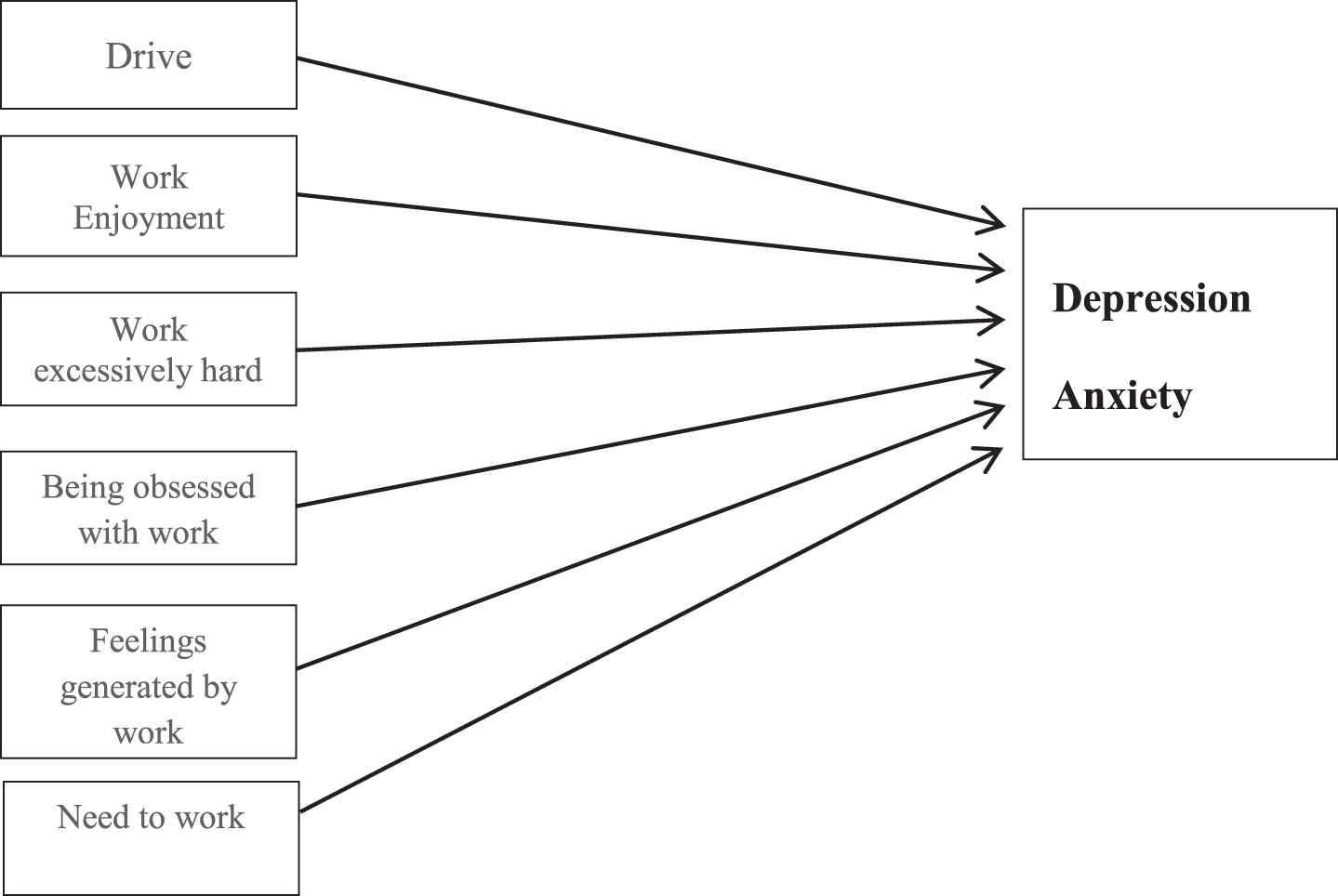
Model followed in this research.
The first model aimed to identify the degree to which these predictor variables were capable of predicting the criterion variable depression. Table 3 presents a summary of the model in which we can see that the predictor variables were: Feelings generated by work (WCS.FW), Excessive Work (duExces), Need to Work (W_NW) and Work Enjoyment (WbEnjoy). The sum of all of these variables accounts for 24.5% of the criterion variable’s variance. The Feelings generated by work (WCS.FW) variable stands out as the best predictor, accounting for 14.3% of variance. The beta coefficient values are among the most important aspects. If we take a look at these coefficients we can see that the predictor variables which were found to be statistically significant were: Feelings generated by work (β= 0.203), Excessive Work (β= 0.226), Need to Work (β= 0.240) and Work Enjoyment (β= –0.190), and all of them were significant, despite not being high values.
The second model aimed to identify the degree to which these predictor variables were capable of predicting the criterion variable anxiety. Table 3 presents a summary of the model in which we can see that the predictor variables were: Excessive Work (duExces) and Feelings generated by work (WCS.FW). The sum of all of them accounts for 20.3 % of the criterion variable’s variance. The Excessive Work (duExces) variable stands out as the best predictor, accounting for 15.7% of variance. The beta coefficient values are among the most important aspects. If we take a look at these coefficients we can see that the predictor variables that were found to be statistically significant were: Excessive Work (β= 0.370) and Feelings generated by work (β= 0.349). All of them were significant.
The results presented above are in line with the concept that certain variables of workaholism (Drive, Enjoyment, Work excessively hard, Being obsessed with work, Need to work and Feelings generated by work) have a predictive power over factors studied in relation to depression and anxiety. Addressing the different factors separately can be of great help in improving the health of workers because it both prevents anxiety and depression and identifies the work addiction factors that have led these issues in the first place.
The first hypothesis is partially fulfilled given that the best predictive model for depression includes four variables: in a positive way Feelings generated by work, Excessive Work, Need to Work, and Work Enjoyment in a negative way. Previous studies have associated work addiction with depressive tendencies, Matsudaria et al. tell us that work addiction is significantly associated with psychological illness [13], Haymon also relates anxiety and depression to workaholism [32], Nie and Sun found that the path from work addiction to depression through job exhaustion was significant [39], and Bartczak et al. found that work addiction was associated with worse mental health in Polish academic workers. In addition, people with higher levels of workaholism had more somatic symptoms, higher levels of anxiety and increased symptoms of depression [56]; a large workload has also been linked to exhaustion and depressive symptoms [57]. Also, Ariapooran positively correlates work addiction with depression, with work tension and overload being the causative factors [58].
The second hypothesis is also partially verified since the best predictive model for anxiety includes two variables that act positively: Excessive Work and Feelings generated by work. Just as some authors found that work addiction correlates with anxiety, Haymon also relates anxiety and depression to work-aholism [32]. Similarly, the study by Serrano-Fer-nández et al. (n.d.) [46] on Work Craving also found a positive relationship between anxiety and Feelings generated by work. Pandey also tells us about the relationship between workaholism and intensifying anxiety [59]. On Feelings generated at work, Spagnoli et al. they found that work-related negative affect could mediate the relationship between work addiction and anxiety before bedtime [60].
Andreassen et al. [61] suggest that workaholics are more anxious than depressed. These authors found that among workaholics, 33.8% reached the detection or clinical limit for anxiety, while the corresponding percentage of workaholics with clinical levels of depression was 8.9%. In our model the percentages are more equal (Depression 24.5% and anxiety 20.3%). Consequently, personal characteristics and work situation can be perceived as threatening and overwhelming, causing anxious people to spend additional time and effort to complete the tasks [61]. Therefore, these people could work excessively as an escape mechanism related to feelings of anxiety and depression [41, 43]. Anxious people fear failure (and review their work several times) and/or reject incoming tasks (overload), while depressed people work more slowly (due to low energy levels) and have to compensate by working more hours to finish the work [61]. In relation to Enjoyment as a negative predictor of depression, we found that people who work long hours enjoying their work are less likely to suffer from work-related stress, burnout and subjective health complaints compared to individuals who feel pressured to work many hours [7].
Conclusion
The present research contributes to the knowledge regarding those workaholism factors that can predict work-related depression and anxiety. It is important to note that both anxiety and depression can be predicted by two variables: Feelings generated by work, and Excessive Work. These two variables predict 18.3% of depression and 20.3% of anxiety. The results have important practical implications that should be considered for adequate strategic management of human resources within organizations, so that they can reduce excessive workloads and detect the feelings that the work is generating in their employees. Thus, addressing these factors separately can be of great assistance in identifying those factors that can help workers improve their health and it will help healthcare professionals to identify the workaholic factors that have led workers to suffer anxiety and/or depression. Detecting these factors in organizations is very important because interventions aimed at reducing work addiction are beneficial both for organizations and for workers themselves.
Conflict of interest
None to report.