



Abstract
BACKGROUND:
Due to the prevalence and increased demand for manual packaging tasks, the concern for worker health and safety has grown.
OBJECTIVE:
This study aims to assess the effects of gender and work postures on subjective discomfort, muscle fatigue, and kinematics during a manual packaging task.
METHODS:
Twenty participants, including 10 males and 10 females, were recruited to perform a 60-minute manual packaging task in sitting and standing postures.
RESULTS:
Discomfort was evidenced by increased the rating of perceived exertion (RPE) values (sit: from 6 to 14.55; stand: from 6 to 17.15) and muscle fatigue was supported by decreased median power frequency (MPF) values for right brachioradialis (RB) (sit: –23.68%; stand: –16.20%), right upper trapezius (RUT) (sit: –20.14%; stand: 11.79%), and right erector spinae (RES) (sit: 8.64%; stand: 11.21%) muscles. Women were more likely to bend forward in a relaxed upper body position, especially while sitting, which may increase the risk of low back pain and women also reported greater discomfort than men, but not in the hands and back. Compared with sitting, the back showed greater muscle fatigue in standing, while muscle fatigue for the shoulders and hands was the opposite.
CONCLUSION:
These findings suggest that work posture should be considered to prevent fatigue in manual packaging tasks. Given the impact of gender on muscle fatigue, work performed by women and men should both be considered. The results can help to develop action strategies and work posture design to prevent musculoskeletal disorders in the manual packaging industry.
Introduction
Manual packaging tasks are physically demanding, requiring many repetitive physical exertions, which can induce muscle fatigue as it involves manual material handling (MMH), packaging, and sealing tasks [1, 2]. Workers repeat packaging activities during working hours, increasing the risk for discomfort and pain [3, 4]. One of the most common occupational health injuries is work-related musculoskeletal disorders (WMSDs) [5–7]. According to a survey from National Institute for Occupational Safety and Health (NIOSH), evidence of a relationship between work-related physical demanding and work-related musculoskeletal disorders has shown that repetitive movements, forceful exertions, awkward or prolonged posture and exposure to vibration contribute to risk factors in work activities [8, 9].
Different from other MMH, manual packaging tasks emphasize the importance of the main hand to the task. In the packaging task, the main hand is responsible for picking up the packaging tool, sealing the product, and other operations, while the other hand is an auxiliary to help complete the task. The division of the tasks between the two hands is quite different. Although the manual task requires little strength, it emphasizes endurance and speed, which are key factors that lead to WMSD [10, 11]. When workers perform packaging tasks, they need to pack products accurately and quickly as piecework (most companies are paid by the amount of work they do). In packaging, workers typically seal one side of a container, place the products, and finally seal the other side. This operation requires little strength, but it needs to be carried out continuously throughout the workday. Mac and Keir reported that a high number of hand exertions combined with prolonged durations provide evidence of higher risk for WMSD in pharmacy assistants [12]. Evidence from previous studies also confirmed that even at low force levels, repetitive and prolonged work tasks lead to reduced recovery time for muscle tissue [13, 14].
With the advent of express delivery, more workers are engaged in express packaging, especially in China. According to a survey from CBNData, more than 300 million couriers work for express companies and the packaging industry [15]. Furthermore, express packaging is highly dependent on human labor due to the wide variety and sizes of goods making it difficult to use machines to pack products. Manual packaging is necessary and indispensable, especially for e-commerce.
In reviewing the literature about manual packaging task studies, it was found that although manual packaging tasks are increasingly common in manufacturing industries, there is little related research on it [15]. However, some studies have reported on MMH with handheld tools, which is somewhat similar to manual packaging tasks. [16–18]. Lu et al. [19] used a subjective questionnaire from 393 operators in the crystal display industry and found the prevalence of WMSD symptoms was more than 30%. Awkward postures, high repetition, and over-weight load were the major risk factors of WMSD. The results suggested gender and work experience had a significant effect on WMSD. Garg and Moore [20] confirmed that if lifting was performed repetitively, the medical hazard extended beyond low-back problems to other musculoskeletal strain and sprain injuries, as well as fatigue-related injuries. Evidence from Houshyar and Kim [21] has shown that prevalent disorders were related to specific body regions such as the lumber, knee, neck, and shoulder areas because of the work posture and activities. Based on previous research, gender and work posture were both the key factors affecting WMSD in MMH. However, the characteristics of the manual packaging tasks are quite different from those of other MMH, and it has not been studied whether these two factors affect the physiological state of the operator in the manual packaging tasks. Although the packaging industry is growing and employing an increasing number of workers because of the increased demand, there is still a lack of research regarding manual packaging tasks. Hence, it is necessary and important to study the impact of work posture and gender to prevent musculoskeletal disorders in this industry.
The purpose of this study is to assess the effects of gender and work posture on muscle fatigue and discomfort during manual packaging tasks. The results of this study will help to develop action strategies and work posture design to prevent musculoskeletal disorders in the manual packaging industry.
Methods
Participants
Twenty participants, including 10 males and 10 females, were recruited voluntarily at Northeastern University. Based on previous studies [22, 23], with statistical significance set at a two-sided level of 0.05, a power of 0.8, a minimum of 10 subjects were needed per group of each gender. The participants were informed about the experimental protocol and written consent was obtained before their participation. The study protocol was approved by the Ethics Committee of Northeastern University. The participants were all right-handed and did not report any upper limb, back, shoulder or lower limb dysfunction, surgery, and joint previous trauma. The average and standard deviation of age, height, and weight of the participants in the male and female groups were 23.08 years (SD = 1.67), 1.72 cm (SD = 0.05), 63.37 kg (SD = 7.85) and 24.25 years (SD = 1.47), 1.63 cm (SD = 0.06), 53.00 kg (SD = 7.24), respectively.
Procedures
All experiments in this study were carried out in the Human Factors Engineering Laboratory of Northeastern University. Before the trial, each participant was required to wear a short-sleeved blouse and shorts. Each participant was tested twice in standing and sitting work postures, respectively. The different conditions were randomized for participants and each subject was asked to perform the task only once a day to avoid fatigue. Before performing work, a training program was provided to ensure the subjects can skillfully carry out the packaging work. The specific experimental process is as follows.
After arriving at the laboratory, participants signed the university’s institutional consent form. The electromyographic (EMG) surface electrodes were applied to the subjects, and baseline measures of median power frequency (MPF) were collected. Then, the subjects performed repetitive packaging work continually for one hour. The task consisted of sealing a package, placing the products, sealing the other side, and placing the package on a transport belt. The size of the package was 260 mm*150 mm*180 mm (96.5 g) and the weight of the product was 500 g. The height of the workstation was 77 cm and the distance between the conveyor and the workstation was 56 cm. The surface EMG data were collected for 5 s every 10 minutes until the end of the protocol and the Borg’s scale of the rating of perceived exertion (RPE) was used for collecting the subjective perception every tenth minute during the packaging simulation task. These measures represented the fatigue condition during the experiment. Furthermore, to assess the effect of gender and posture on kinematics, participants were required to package products with motion capture sensors at the end of the experiment. The motion capture sensors needed to be calibrated before recording the data, and then the participants were asked to repeat the packaging task three times. The subjects were not allowed to speak until there was a questionnaire or a test. The work pace was based on the actual situation of the packaging work, and each subject received a corresponding monetary reward according to their performance.
Data acquisition
Rating of perceived exertion (RPE)
The subjective exertions in the neck, forearm, leg, and hand were obtained from a questionnaire based on Borg’s RPE. Participants provided the RPE, rating 6 (none) to 20 (very, very hard) for the relevant body parts [24] and the measurement time was recorded as T1, T2,..., T7 in 10-minute time intervals.
Electromyography
The Biopac MP150 system (Biopac, USA) was used to collect raw surface EMG data. This unit has a fixed sampling rate of 1000 Hz and band-pass filtering of 10–500 Hz. The output from the Biopac MP150 was linked to data-acquisition software (Acqknowledge 4.2, USA) on a personal computer and raw data were collected in Acqknowledge 4.2. Disposable button electrodes (Xunda, China) were attached to the right brachioradialis (RB), right upper trapezius (RUT), and right erector spinae (RES) as described in existing studies [25–27]. The skin was swabbed with an alcohol pad and the electrodes were applied to the surface along the muscle. Two electrodes were required for each muscle tested with an interelectrode distance of 2 cm for the cervical position. All subjects in this experiment were right-handed, and according to the packaging requirements, the dominant arm and hand (right) were needed to perform actions and tasks. Therefore, it was assumed that the right hand had a greater load in operation, and electrodes were only attached to one side (right) of the body in this study. Furthermore, the leg activity was not restricted while sitting, so the EMG measurement of the leg was not taken as the comparison object of the postures.
MPF measures were used as indicators of local muscle fatigue [28–30]. To obtain MPF measures, subjects stood with their hand holding 2 kg objects in both hands placed 20 cm in front of their chest for 5 s. Baseline measures of MPF were collected before performing the task and then measurements were made every 20 minutes during the task.
Kinematics
Functional assessment of biomechanics software (Biosyn system, Canada) which coupled with the software FAB_recorder was used to assess the kinematic parameters of the participants. It is a wireless motion capture system that consists of 13 sensors attached to different parts of the body and captures data at a frequency of 25 Hz. The system can comprehensively collect various kinematic data including angles, positions, and velocities of body segments in real time. It was previously used to evaluate whole body mobility in Parkinson’s disease and examine the changes in range of motion in cyclists [31]. The data was transmitted to a computer equipped with FAB_recorder that can observe, record, and analyze movement based on a graph of joint angles, speed, and duration. The trunk and pelvis sensors were necessary to determine the center of spatial coordinates. Sensors on the head, forearm, and upper arm were equipped to track the packaging kinematic data. Participants were required to stand in a standard upright position for 30 s while they waited for the inertial sensors to be calibrated. The data were analyzed in FAB-software and exported for statistical calculation.
Data analysis
The analysis of collected data was done using Acqknowledge 4.2, FAB_recorder, and IBM SPSS 22.0. The MPF, calculated by MATLAB r2014a, was selected as an indicator of sEMG and the dependent variables of interest in this study were RPE value, MPF value, and kinematic data. Data were analyzed using the analysis of variance (ANOVA) to compare the effects of independent variables (gender and postures) on the motion of the upper arm, trunk, and head, MPF, and local perceived discomfort. The initial value of MPF was taken as 100% and the percentage of change at different times was calculated. Differences between groups in postures were evaluated by comparing the percent change of MPF in standing and sitting using paired t-test. The gender effect in each posture was calculated by using ANOVA and paired t-test was used for follow up analyses where appropriate. A significance level of 0.05 was used for each dependent variable.
Results
RPE values
Repeated measures ANOVA showed a significant effect of Time for RPE values [F(6, 33) = 237, p < 0.001] after the protocols (from Time 2 to 7 as compared to Time 1). Post-hoc analysis showed the RPE value significantly (p < 0.01) increased as compared to the initial condition.
The change in RPE value under different postures during the repetitive packaging tasks is presented in Fig. 1. Prior to beginning the fatigue test protocol, RPE values for all subjects were 6 (no exertion at all), while the mean RPE values reached 9.35 (light) after 20 min, and 14.55 (between somewhat hard and hard) after 60 min in sitting, while in standing the mean RPE reached 15.83 (between somewhat hard and hard) after 50 min, and 17.15 (very hard) after 60 min. The paired t-test showed a significant effect of Posture for RPE value (t = –3.76, p < 0.05). Compared to the sitting posture, there was a greater RPE value for the legs and back and fewer RPE values for the arms in the standing posture (Fig. 2). Furthermore, there were also Gender main effects on RPE values, showing higher RPE in women (p < 0.05). Figure 3 presents the change of the RPE value under genders, revealing all body regions have higher growth in the women after the 60-min task. Female’s shoulders were more likely to become uncomfortable than the shoulders of male participants and other parts of the body practically different, but not statistically significant.
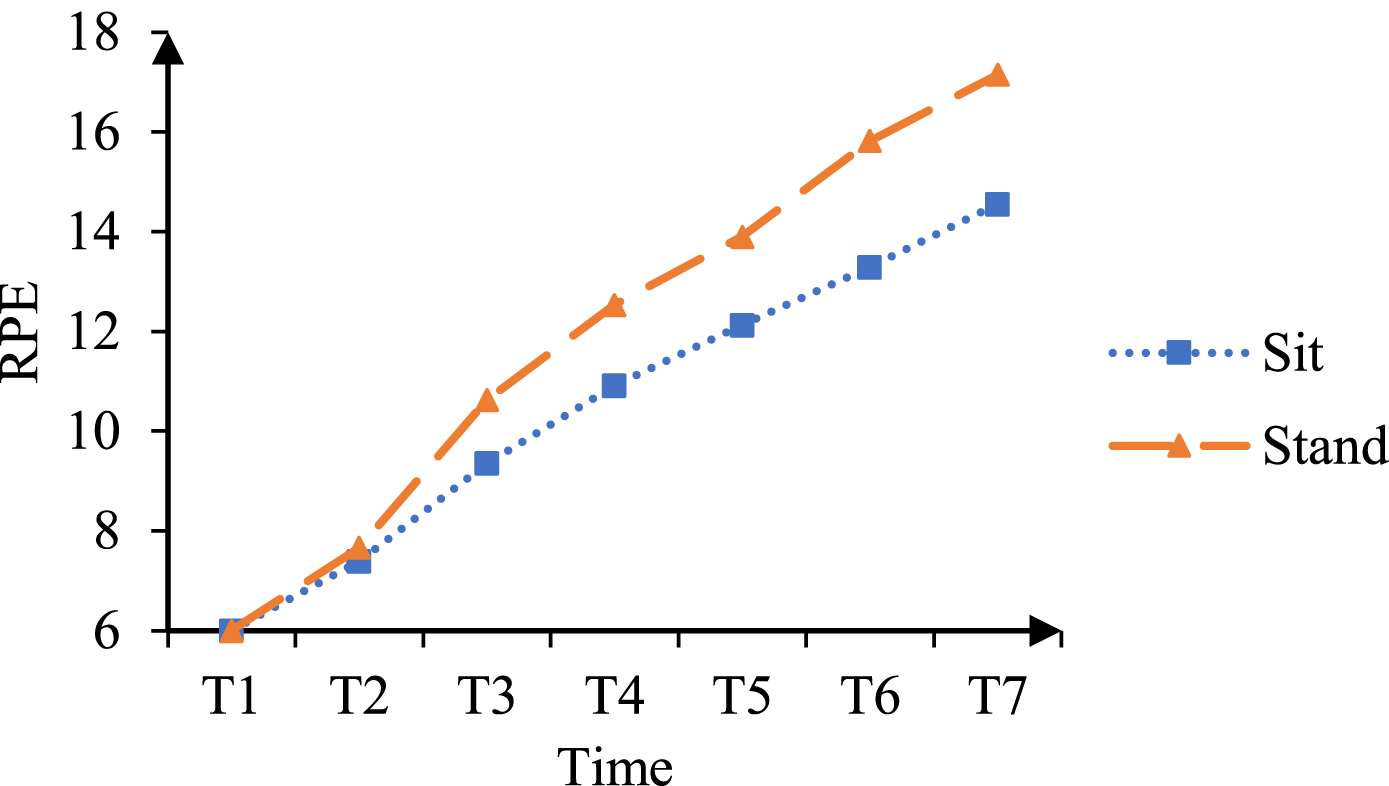
Subjective ratings of the overall discomfort by period for the two postures.

Body region discomfort degree in 2 conditions after the 60-min task.

Body regions discomfort degree in genders after the 60-min task.
Statistical analysis showed that Time effects (all decreases) were significantly found for MPF including three muscles in both postures. As shown in Table 1, compared with the initial value, MPF of RB significantly decreased by 23.68% in sitting (p < 0.01) and by 16.20% in standing (p < 0.05), MPF of the RUT significantly decreased by 20.14% in sitting (p < 0.01) and by 11.79% in standing (p < 0.05), MPF of RES significantly decreased by 8.64% in sitting (p < 0.05) and by 11.21% in standing (p < 0.05). There were also significant Posture main effects on MPF, showing a larger decreased MPF of back and smaller decreased MPF of arm and shoulder in standing. Furthermore, one pair of muscles revealed a significant Gender main effect, the RB muscle [F(1, 38) = 5.74, p < 0.05] with women having a greater decrease in MPF. Compared with the males, females displayed lower MPF values in the shoulder, which means women were more likely to experience shoulder fatigue during a 60-minute manual packaging task.
Changes of MPF for the three muscles
Changes of MPF for the three muscles
The FAB system uses the angular coordinate system to define the spatial coordinates of the human motion shown. In this study, motion capture sensors were placed on heads, trunk, pelvis, and right upper arm to record kinematic data. As can be seen in Table 2, trunk pitch and head pitch motion in sitting was significantly higher in women (absolute value comparison) and there were no significant differences between women and men in standing. Right upper arm motions were significantly different in different genders, except right upper arm roll motion in standing. Men with any postures showed higher value compared with women.
Gender effects on kinematics
Gender effects on kinematics
Notes: Values expressed as mean (SD). P-value of the paired sample t-test or ANOVA, where appropriate. Negative pitch = flexion, positive pitch = extension, negative roll = later flexion to the left, positive roll = later flexion to the right, negative yaw = rotation to the left, positive yaw = rotation to the right.
Results from statistical analysis also showed work posture had significant effects on kinematics, with higher trunk pitch and head pitch motion in sitting. Similar results erect observed for right upper arm yaw. On the other hand, there were no statistically significant differences in other body motion.
Manual packaging tasks are physically demanding and require many repetitions of physical exertions, which can induce physical fatigue as it involves manual material handling, packaging, and sealing tasks. Previous studies have investigated MMH concerning muscle activity and found that increased MMH work could contribute to neck, shoulder, and back pain [32]. In studying the interactions between physical demands of work associated with low back pain, Fernandes has emphasized the importance of physical demands involving trunk bending forward and trunk rotation and confirmed the impact of physical demands on low back disorders [33]. Research has shown that repetitive MMH tasks can cause persistent pain in workers’ necks, shoulders, upper and lower arms [34]. After reviewing the muscle selection in previous studies, RB (arm), RUT (shoulder), and RES (back) were selected in this study.
Local body discomfort and kinematics were affected by work posture. Results from this study showed that compared with sitting, the back had greater discomfort in standing, while discomfort on the shoulders and hands is the opposite. The previous study demonstrated that prolonged standing was contributed to muscle fatigue among the production workers and sitting is a much less strenuous posture than standing because there are fewer muscles needed to keep the body stable [35]. However, sitting for a long time is also not good for workers’ health and increased metrics of localized muscle fatigue and perceived discomfort, especially in the upper and lower back [36]. Working in the standing position is common in many jobs because the workers need to handle heavy products, reach for materials, and pull/push much load [37]. Alternatively, performing such work from a sitting position may lead to a more difficult movement in terms of physical restrictions. For the packaging tasks, whether sitting or standing posture is applicable. Sitting position reduces the risk of leg discomfort, but needs more requirement to raise arms to work on the workstation while standing position is the opposite. The participants in this study were all packed products for 60 minutes in both postures to compare the differences in RPE and muscle fatigue. The results showed that there was a significant increase in RPE and RPE value of standing was significantly higher than that of sitting.
Furthermore, head pitch and trunk pitch were higher in sitting, showing a more negative pitch motion. The results suggested that in a sitting position, the worker is more likely to bend forward in a relaxed upper body position without straining his back. However, evidence from William et al. demonstrated that non-neutral trunk postures, such as forward flexion, lateral bending, and axial twisting, were associated with reports of back pain, which means sitting may increase the risk of low back pain [38]. The interesting finding was although forward flexion increased the risk of low back pain, the results of REP showed that the level of overall discomfort in sitting was significantly lower than standing, suggesting that leg load accounted for a large proportion of the REP. The standing work with repetitive tasks may have increased blood flow and blood pressure in the lower limb, and this change is strongly associated with increased leg discomfort [39]. On the other hand, although leg discomfort was the main cause of high RPE, other parts of the body still scored higher in standing than in sitting. The results of this study are not quite consistent with Cudlip, who measured body discomfort of MMH in sitting and standing and concluded completing tasks in standing generally resulted in lower muscle activity levels and lower body discomfort compared to standing [40]. However, it also has been mentioned that some exceptions existed due to the differences in the weight, frequency, and duration of the task. During long manual packing tasks, sitting had less impact on overall discomfort. The results form MPF demonstrated that significant Time main effects (all decreases) were found for MPF of several muscles in both postures, but the decline rate of MPF was greater in all muscles when sitting except for the RES muscle.
Although the subjective results showed more reports of discomfort in standing, the EMG results were inconsistent. Similar RPE values for the arm and shoulder and RPE values were likely to be influenced by ratings for other body parts, such as the leg (Fig. 2). This is an interesting conclusion and some clues can be found from previous studies. Evidence from Tomei et al. [41] suggested that repetitive work can contribute to the increase of muscular fatigue by inducing mental fatigue. In repetitive manual packaging tasks, the participants unconsciously thought that the discomfort of the arm and shoulder was also high due to overall body discomfort, even though arm and shoulder fatigue was objectively less severe.
Gender is another important factor affecting fatigue when performing manual packaging tasks. Results from this study showed that both discomfort and muscle fatigue increased over time, with women showing greater shoulder fatigue than men. Previous research has indicated gender differences existed in the prevalence of musculoskeletal disorders (MSDs) and psycho-social stresses among the weavers [42]. It suggested female weavers were more prone to developing MSDs in the upper back and lower back, while male weavers were more prone to developing pain in the knee and hand. Gender has also been shown to affect workers’ biomechanics during MMH tasks [43, 44]. Demura et al. [45] reported that there is a gender difference in subjective muscle-fatigue sensation between male and female subjects at demand values of 40–60% maximal voluntary contraction. Many studies have supported that gender is an important factor in the prevalence of MSDs and physical discomfort [46–48].
The results from kinematic data showed trunk pitch and head pitch motion in sitting were significantly higher in women, suggesting women were more likely to bend forward no matter what kind of work posture. From our observation of manual packaging tasks, women reported more discomfort in the shoulder and leg, while the differences between arm and back discomfort were not statistically significant. Evidence from EMG showed that significant Time main effects (all decreases) were found for MPF of several muscles in both genders, but the decline rate of MPF was greater in the female shoulder, which was also confirmed by the analysis of the RPE, but not in back and arm. Some studies found that compared to men, greater incidences of back pain occurred in women, which was not reported in this study [42]. It should be noted that the load requirements and the height of the workstation in this study were the same for all participants. In attempting to explain our findings, it is possible that when working at the same height, due to the differences in height and muscle strength, the demands on the shoulders of female participants are greater and the impact on the back is less. For this reason, women tend not to work with their backs straight, leaving trunk in a relaxed state of bending. On the other hand, because the packaging specifications and the height of the work table are the same, women need to increase the working range of their hands to complete the packaging work due to the difference in physique. From a physiological perspective, this finding may be related to the differences of body data between men and women. Furthermore, many similar studies focused on MSDs, with nearly all studies reporting a higher prevalence of symptoms in women, and results from this study also support this statement [49, 50].
Finally, this study should be considered in light of some limitations. One limitation is that only RB muscle has been considered, while the biceps and triceps are also the main muscles supporting the manual packaging operation. More muscles need to be considered in further research to investigate and study the manual packaging tasks. Another limitation is that small sample used in the study. Future study needs to consider conduct this study in a real express company and more participants are also needed. The main limitation, however, is that only upper body muscles were measured and evaluated, but leg fatigue is also one of the main causes of overall discomfort in standing. Since the movement of the legs is not restricted in sitting, it cannot be effectively measured, and the leg data under sitting are not recorded and compared.
Conclusion
With the rise of the express delivery industry, manual packaging tasks are becoming increasingly common and unavoidable. Due to the requirements of repeatability, persistence, and speed, manual packaging tasks are frequently associated with MSD. This study aimed to assess the effects of gender and work posture on discomfort, kinematics, and muscle fatigue during manual packaging tasks. The results showed both discomfort and muscle fatigue increased over time, with women showing greater shoulder fatigue than men. Compared with sitting, the back had greater discomfort in standing, while discomfort on the shoulders and hands is the opposite. The female workers were more likely to bend forward in a relaxed upper body position while sitting, which may increase the risk of low back pain. These findings suggest that work posture should be taken into account for preventing WMSD in manual packaging tasks and given the impact of gender on muscle fatigue, work performed by women and men should be considered. The results of this study can help to develop action strategies and work posture design to prevent musculoskeletal disorders in the manual packaging industry. Future research should focus on fatigue studies for specific postural packaging operations to make reasonable ergonomics recommendations.
Conflict of interest
The authors declare that they have no conflicts of interest related to this work.
Footnotes
Acknowledgments
The authors would like to thank all volunteers that took the time and effort to participate in the experiment. Particularly, they want to show great gratitude to Prof. Robert Radwin for his guidance and revision. Furthermore, they are grateful to the editor and anonymous reviewers for their impartial evaluation and valuable suggestions.
Funding
This work was financially supported by the National Natural Science Foundation of China (Grant No. 71771045).