




Abstract
BACKGROUND:
Various chemical substances and carcinogens have been presented in medical sciences universities’ educational and research laboratories. For this purpose a suitable ventilation system had to be implemented to ensure the correct operation of the hoods.
OBJECTIVE:
To evaluate the performance of laboratory chemical fume hoods of the University of Medical Sciences using a novel quantitative method.
METHODS:
In this study, 43 chemical fume hoods were investigated in the laboratories of the University of Medical Sciences. The technical specifications of the hoods and their compliance with the standard have been investigated. The hoods face velocity was measured using a thermal anemometer. Quantitative evaluation was performed using the new method of CO2 tracer gas and the results were analyzed using SPSS software version 19.
FINDINGS:
The hoods presented both favorable and unfavorable results in terms of technical specifications and location. The results showed 50.2% of the hoods have visible leakage. Hood face velocity was not suitable for any of the hoods in the case fully open.when half open only 16.3% of the hoods and in the case of 25% open face, 34.9% of the hoods had a good velocity. Most hoods have CO2 leakage even at small amounts.
CONCLUSIONS:
the unsuitable performance of the hoods is mainly due to the unsuitability of the fans, furthermore investigation and correction of technical problems are required. The new quantitative method is a suitable method for routine evaluating chemical fume hoods and can replace the SF6 gas tracer method.
Background
In scientific-research laboratories of the universities, a vast spectrum of chemical and biological materials such as volatile organic compounds (VOCs), aldehydes, halogenic compounds, alcohols etc.is used. Exposure to these pollutants can cause acute symptoms such as respiratory difficulties or chronic symptoms like pulmonary diseases and even cancer. Accidents may occasionally occur as a result of the chemical compounds’ existence in the laboratories [1–3]. Various studies are suggestive of existence of the risk of exposure to chemical materials in universities’ laboratories in such a way that 26.67% of the laboratories of the universities of medical sciences have been found with considerable amounts of risk and 93% of the exposures of the students and researchers working in research laboratories of the universities of medical sciences have been reported with intermediate risks. On the other hand, the emergence of accidents in the laboratories has caused the existence of ventilation system with proper functioning to be of a great importance both in terms of health and security [1, 4]. A study concluded that the scientific laboratories are more dangerous than the industry for such a reason as the slow approach of the educational organizations towards securing of these places [5]. Therefore, in order to have an appropriate ventilation system and supply a secure environment to the individuals, in addition to the proper designing principles observance, the ventilation installations should be regularly repaired and maintained and, of course, the investigation of the chemical fume hoods’ functioning is a must [6, 7]. Proper localization of the hoods in terms of place installation and their positions in respect to the other equipment as well as the position of the doors and windows and existence of pleasant air ventilation systems are amongst the factors influencing the performance of laboratory hoods that should be taken into account in an evaluation of the hoods’ functioning [8]. In order to investigate the performance of hoods, standards have been codified and recommended by the American society of heating, refrigerating and air-conditioning engineers (ASHRAE). The existing methods that are matched with the Standard ASHRAE/ANSI-110-95 include qualitative and quantitative tests. The hoods’ leakage can be qualitatively assessed using the hoods’ face velocity test and visible smoke test and detecting gas test is a quantitative method for the evaluation of a hood’s functioning. Quantitative test Using tracer gas, is a more precise method for investigating the hood’s leakage for it even shows the pollutants’ leakages in ppm and ppb. In quantitative evaluation method, SF6 gas is predominantly used. It is worth mentioning that this gas has disadvantages like SF6 health risks, high costs, unavailability and need for special and costly equipment, despite its high precision in determining hoods’ leakage. It was for the first time in 2015 that a new method was introduced for qualitative evaluation of chemical fume hoods using Co2 detector gas in a study published by Ahn et al. in the US [9]. The study results indicated that in addition to consistency of the method’s results with the results of SF6 tracer gas, it has other advantages like lower risk of CO2 in comparison to SF6 as well as its less costliness.
Various studies have evaluated local ventilation systems as well as laboratory chemical fume hoods, petrochemical labs, water and sewage companies’ labs, etc. using the ASHRAE standard [7, 10–13]. However, there are limited research conducted about the chemical fume hoods of the universities’ labs so far: while many individuals, including technical staff, officials as well as university students, attend such laboratories and the absence of the proper ventilation systems may cause the other adjacent units be exposed to chemical compounds. Thus, the present study aimed to evaluate the performance of the chemical fume hoods in laboratories of the universities of medical sciences using CO2 tracer gas.
Materials and methods
To evaluate the performance of the chemical fume hoods of medical sciences universities’ laboratory, after coordinating with the corresponding units the relevant information was collected regarding the number of the laboratories and chemical fume hoods existent in every lab. In this study, only the chemical fume hoods were studied. The hood’s position was assessed in respect to the door, window and air conditioning diffuser and the adjacent hoods. Moreover, the chemical fume hoods’ hardware was examined and compared based on the existence of bypass, soundness of the hoods’ horizontally sliding sashes/doors and the body materials of the hood. To evaluate the hoods’ blower, the blower’s installation site and the chemical fume hood’s flow rate were investigated; in order to examine the laboratory chemical fume hoods’ ducting plan, bevel-butt joints, ducts’ lengths, materials and shapes and smoothness of the ducts’ wall were also investigated to ensure that no pressure drop would occur.
Qualitative tests
Quantitative tests
In the quantitative evaluation of the performance of laboratory fume hoods, CO2 tracer gas was used which for the first time was introduced by Ahn and et al. [9] in such a way that a mixture of dry ice and hot water were used; CO2 is released as a result of the dissolution of dry ice in the water. Using a CO2-meter device (Model AQ-100 made by KIMO) which is a direct reading instrument and possesses an infrared sensor with the capability of detecting CO2 amounts in ppm, CO2 concentration was measured inside and outside the chemical fume hood and the difference was determined as the CO2 leakage after deducing the background concentration. This way, the hood’s performance was investigated in a quantitative manner [9]. Before each test, environmental CO2 concentrations were measured and subtracted from the average CO2 concentrations during the test (herein after referred to as CO2 leakage). To determine the limit of detection for CO2 leakage, a background measurement of CO2 concentrations was collected for a period of 1 min in a controlled ventilation laboratory without CO2 sources.
To determine the relationship between the velocity in the hood face and the visible leakage amount, the chemical fume hood’s face velocity was classified in three qualitative groups as explained in the following words: Below 80 and more than 150 square feet per minute: Inappropriate; 80 to 100 square feet per minute: Relatively appropriate and 100 to 150 square feet per minute: Appropriate.
The CO2 leakage rates’ report has been also categorized qualitatively in the following form: zero leakage, leakage below 20 ppm (low leakage) and leakage above 20 ppm (high leakage).
Chi-square test and logistic regression were used to determine the agreement between visible leakage and leakage results measured with CO2 meter. Data analyses were performed using SPSS 19 and AMOS 18 software.
Results
In the present study, all chemical fume hoods from various laboratories of the university that reached number 43 were investigated. In sum, 28 laboratories were examined in which 12 laboratories had one hood, 14 laboratories had 2 hoods and two laboratories had three hoods. The frequencies of the hoods and laboratories are shown separately in Table 1. In some of the laboratories such as the pathology laboratories, there were no chemical fume hoods even with the use of such hazardous materials as chlorinated organic pesticides and organophosphates; physiology and histology laboratories, despite the use of such chemical materials as formaldehyde and chloroform, the chemical fume hoods were deactivated.
Frequency of hoods and laboratories in separate faculties
Frequency of hoods and laboratories in separate faculties
Except the domestic animals, fungi and parasite laboratories wherein no pressure differences were documented between the internal and external environments, the environmental pressure has been negative and ranged between -1 and -3 Pa in all of the laboratory units.
In the majority of the laboratories, there were one or several windows in line with the chemical fume hoods in a 90-degrees angle. The distances to the air conditioning systems were within 1.5 meters or more and were predominantly acceptable.
Chemical fume hoods’ hardware
None of the hoods was equipped with bypass, which regulated the pressure inside the hood. In some of the chemical fume hoods, the horizontally sliding sash/door could be regulated difficultly. The ducts were mostly made of U-PVC in large diameters that can cause pressure drop in the hood. The existence of the bevel-butt 90-degrees joints and use of a large number of them has rendered the ducting of some of the hoods inappropriate. In some of the laboratories, the ducts were flexible and in corrugated pipe forms and the walls were not smooth due to their spring-like shapes. In a number of the laboratories, the ducts were not perfectly visible due to the existence of dropped ceiling.
Hoods’ fan
Except the Rehabilitation and Pharmacy faculty, the laboratories of which were of the centrifugal type, the rest of the faculties had non-centrifugal and other kinds of chemical fume hoods. It was observed in some of the laboratories that the axial fan has been installed above the hood chamber. In some of, the blower had been installed immediately after the hood and this, besides creating too much noise and vibration in the hood chamber, caused the improper guiding of the collected contaminants. None of the hoods had their scrubbers or chimneys installed in a proper height past the fan. The hardware and technical situation of the hoods is summarized in Table 2.
Status of technical characteristics of hood
Status of technical characteristics of hood
The performance of the hoods in quantitative terms was investigated using the amount of CO2 gas leakage. The majority of the chemical fume hoods in the Health, Medical and Paramedical faculties did not have uniform and complete suction as evidenced in the visualization of the hood’s stream. The results of the measurement using CO2-meter device were indicative of the contaminants’ leakage. In addition, due to the high rate of leakage as a result of insufficient suction, the CO2 fume’s leakage was completely visible. In the Rehabilitation and Pharmacy faculties, the leakage rates of the chemical fume hoods were a lot lower than the other faculties and leakages were diagnosed only in several limited cases and within trivial amounts. Table 3 presents the amounts of the measured leakages. After visualization of the air flow, the results indicated that 56% of the chemical fume hoods did not have visible leakages and 44% of the hoods had visible leakages with some being trivial and some being notable. The highest leakage rates have been recorded in cases the hood’s horizontally sliding sash was located height and leakages were found mostly occurring in the lower corners of the hoods. In some of the chemical fume hoods, visible leakage was evident in states that 25% of the hood’s face was open.
Percent of lab hoods with Measured CO2 leakage
Percent of lab hoods with Measured CO2 leakage
Note: No leakage: zero leakage, low leakage: leakage below 20 ppm, high leakage: leakage above 20 ppm.
Figure 1 illustrates the amount of visible leakage.
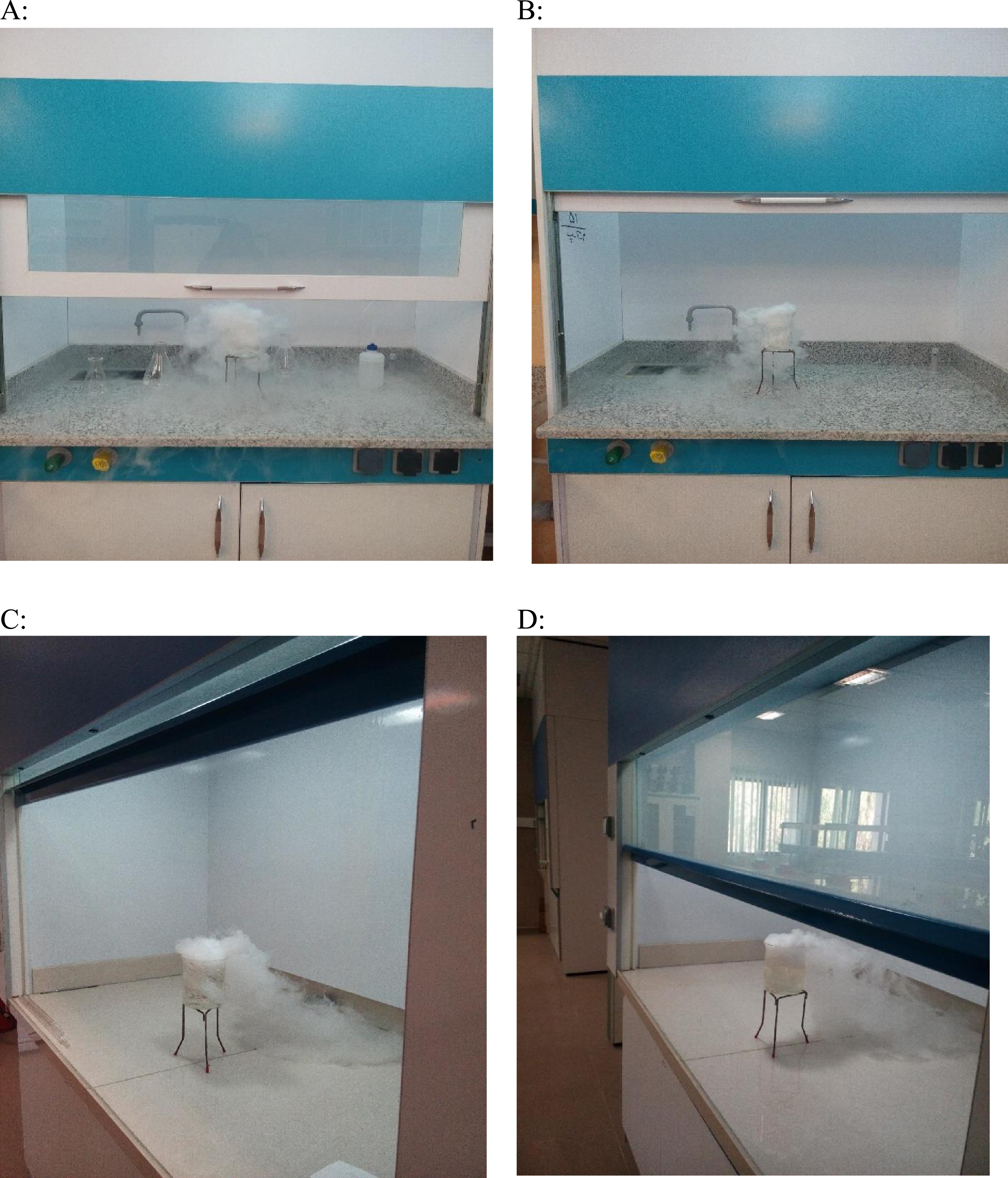
Visualization of the air flow. A: Chemical hood was turned off and without suction. B: Chemical hood was turned on with one-way suction and insufficient. C: Chemical hood with uniform suction when open face was full. D: Chemical hood with uniform suction when open face was half.
The velocity of some of the hoods’ face was very low and nearly zero and this was investigated in various states that the hood’s face was open for 25%, 50% and 100% and identical results were attained. The majority of the hoods were found in an unfavorable situation in terms of their face velocity (Table 4).
The status of face velocity of laboratory hood in different positions of opening hood area

Amount of visible leakage in the chemical fume hoods.
Due to the absence of horizontally sliding door in one of the hoods, it was not possible to set the face area at 50% and 25% opening. Accordingly, the total percentage of the hoods was obtained as 97%. Periodical inspection and investigation of the hoods’ efficiency were not performed annually and there was no report indicating the specifications and dates of the last inspections of the chemical fume hoods.
Some of the hoods in Pharmacy and Rehabilitation faculties occasionally made a lot of noise and this disturbed the present persons due to the smallness of the laboratory’s space and hardness of the surfaces’ materials and the resultant echoing sound in such a way that the researchers preferred not to use the chemical fume hoods due to the noises made by them. The results of the chi-square test indicated that the relationship between the hood’s face velocity and the visible leakage was not significant as documented after the air flow visualization (P-value=0.512). Additionally, there was found no significant relationship between the velocity of the hood’s face and measured CO2 leakage (P-value=0.326).
In general, the hoods in Rehabilitation and Pharmacy faculties enjoyed a relatively better situation due to the fact that they have been recently established and also for the construction of the laboratories in adherence to the latest standards; the hoods of the Health, Paramedical and Medical faculties’ laboratories were mostly worn-out and/or with non-optimal efficiency. Malakuti et al. evaluated the risk of laboratory researchers’ exposure to the chemical compounds in Iran, and found that the riskiest exposures were reported for Health and Medical (Molecular Biology) faculties [4].
In the present study, in order to qualitatively evaluate the hoods’ performance, the hoods’ face velocity and hood stream visualization were used; Co2 detector gas was the test of choice for the quantitative evaluation. Ja’afari et al. state that the fume hood’s face velocity measurement alone does not suffice [12], whereas the hood’s face velocity has been mentioned as a reliable method in the study by Esmaili et al., which investigated the performance of the petrochemical fume hoods for the evaluation of the laboratory fume hoods [10]. Hasbi investigated the performance of the local ventilation systems using such measurement methods as fume hood’s face velocity and Mahalanobis method and the results indicated that the latter was the a better and faster way for determining the performance of the local ventilation systems’ hoods [15]. In the current study, the fume hoods had face velocities with low and nearly zero values and this test was also conducted for various states of the hood face opening, i.e. 50%, 25% and 100% and identical results were obtained. The lowness of the hood’s face velocity has been the result of the absence of proper suction or inappropriateness of the blowers’ flow rates.
The results of the study by Dunn on the leakage from the chemical fume hoods are indicative of the idea that the ambient air ventilators exert an adverse effect on the fume hoods’ performance when they are turned on, but that the effect of the air ventilators on the hood’s face velocity has been minimum in high flow rates of the hoods [16]. In some of the laboratories, hoods are used as a place for storing chemicals and this is considered a sort of insecure storage of the chemicals when the hood is off and exerts no suction. On the other hand, placing of the instruments and chemicals inside the hood took more of their internal spaces and sometimes, due to the great volume of the containers or laboratory equipment, caused disruption in the air flow and reduction in the hood’s output. In the study by Tseng et al., the results indicated that eddy and turbulent flows caused an increase in the leakage of the contaminants hence an increase in the staff exposure [17]. The results of the study that was undertaken in 2015 in the US by Ahn et al. showed that disordered status of the hood does not have a statistically significant effect but it acts as a factor interfering with the others like the height of the sash and thermal load [18]. The relationship between the hood’s face velocity and leakage amount was not found statistically significant after air flow visualization due to the reason that the face velocity of the majority of the hoods has been low and, in some of the hoods wherein 25% of the hood’s face has been open, as well, there has been contaminant leakage to the external environment as a result of the high face velocity. The fume hood’s face velocity was found appropriate in some of the hoods when the face has been open for 25% and 50% of its area. Because of this, no significant relationship was found between the face velocity and leakage amount, while it is expected that the fume hood’s face velocity increases to a certain limit when the leakage decreases, because increasing face velocity results increase the possibility of the contaminants’ entrapment. In the study by Karimizare regarding the evaluation of the air pollution and ventilation systems in laboratories of Tehran’s Water and Sewage Company, three types of hood, to wit ordinary hood, hydrochloric acid hood and biological cabinet were investigated and it was found out that there is a consistency between the results obtained from the measurement of velocity in the hood’s face and the results obtained from the measurement of the air pollutants [11]. The results of the study by Reynders and Saelens indicated that the relatively low air velocity cannot guide the pollutants towards the outlet and the issue is more important about the pollutants featuring densities higher than air [19].
In the present study, CO2 leakage was measured in five points of hood, including the mid-section of the hood’s face and the corners. The study by Tseng et al. in Taiwan confirmed the fume hood’s performance test methods, demonstrated that a solution has to be found for the recognition of the leakage in every spot as well as in close vicinity of the operator and only the measurement of the contamination in the respiratory area of the operator does not suffice reaching a thorough description of the hood’s cabinet [20]. The results of the present study indicated that the highest leakage occurred when the hood’s face was open 100% and the most frequent leakages were found occurring in the lower corners. Moreover, in some of the hoods, visible leakage was found increased when the hood’s face was 25% open and for higher face velocities due to the turbulence of airflow inside the hood and this finding was also confirmed through taking advantage of the devices. In the study by Tseng et al., the results showed that the complex pattern of the turbulent flows passes through the operator and structure for instance in the lower corners of the hood, lateral walls and hood’s entry where the air is sucked in from the peripheral environment by fan. These eddy and turbulent flows cause an increase in the contaminants’ leakage. The most likely sources of the contaminants’ leakage is in the entry and lateral walls of the hood [17, 21].
In the present study, the consistency between the observed leakage results and the measured leakage results has been very low because the leakage in some of the hoods has not been visible by the eyes but CO2 leakages could be detected even in its tiniest amount by the use of CO2-meter device. As is stated in the study by Ahn et al., who performed a quantitative test of the hood using CO2 for the first time, when the leakage ranges between 162 ppm and 239 ppm, the results of the visible and measured leakages match; furthermore, the same results have been documented when using SF6 detector gas [9]. Amongst the reasons that seem to cause drop in the face velocity and air flow rate of these hoods, the following factors can be pointed out: weakness or malfunctioning of the hoods’ blowers, especially in the Health, Paramedical and Medical faculties, the use of bevel-butt joints with 90-degrees angles as well as the defections in the ducting and long ducting and improper connectors and joints.
Conclusions
According to the present study’s results, the majority of the hoods were not in optimal situation in hardware and technical terms and the hoods’ periodical inspections were not performed regularly. Considering the evaluations performed herein, the unfavorable status of the hoods was mostly due to the use of inappropriate fans and defective fans. The hoods’ performance should be regularly evaluated in technical regards by the specialists. The users, including the university students and the staff, should be provided with the required instructions concerning the proper use of the hoods. The quantitative evaluation method based on the use of CO2 detection gas is a credible and reliable method suitable in regard of the cost-effectiveness, consumed time and availability for the evaluation of the chemical fume hoods’ annual performance.
Limitations
This study used a method that could help simplify assessment of hood containment that before in the others study developed. However, the tested conditions in this study represent a small number of variable conditions and operating procedures in laboratory environments. It also seems face velocities impact the CO2 test performance. The amount of dry ice used for hoods with similar physical characteristics must be the same, otherwise the results will be different.
Footnotes
Acknowledgments
The authors thank the Hamadan University of Medical Sciences for the financial support of the study. This paper resulted from a research project (No. 9411136355).
Conflict of interest
The authors declare that they have no conflict of interest.
Funding
This study was funded and supported by the Hamadan Medical Sciences University.