



Abstract
BACKGROUND:
The work organization not only comprises the formal structure but also social interactions, which are developed according to its own rules based on variabilities and professional competences. During real work, there are regulatory processes that result in the development of strategies to meet the requirements of the work organization and maintain health status.
OBJECTIVE:
To understand the regulatory processes involved in work activities and analyze the extent to which the developed strategies are sufficient to protect employees’ integrity and guarantee performance.
METHODS:
This study was carried out in an agricultural implement manufacturing company, whose qualitative procedures were analyzed by combining activity observations, interviews, and self-confrontation.
RESULTS:
In view of the interaction of logic, operators comply with some rules to the detriment of others, based on the decision processes of their individual and collective experience. The availability of resources compatible with activity demands increases the possibility of action and competence development. The cost of regulations for less experienced operators is higher, taking into consideration the level of uncertainty resulting from contradictions and variabilities.
CONCLUSION:
It is necessary to discuss the contradictions manifested in operators’ work routines through interactions between heterogeneous rationalities. From this, it is possible to construct a common reference about the activity and increase the possibilities of action during real work.
Introduction
The work organization (WO) is classically defined as a series of prescriptions, represented by rules and regulations, that determine how to conduct the work processes of a company [1]. On the other hand, according to studies by Bourgeois and Hubault [2], the WO is a dynamic device in which previously established prescriptions and reorganizations during situations combine themselves and are permanently adjusted. Such dynamics are demonstrated in the definition given by Carballeda [3], who sees the WO as a process of social interactions that develops its own rules, considering variabilities, individuals’ uniqueness, and professional competences.
In ergonomics, the term variability is related to the gap between what is predicted and what is accomplished, and its manifestation can affect the context of the company, such as in incidents with equipment and variations in the environment, or the individuals, such as in differences in age and professional experience (inter-individual variability) as well as in variations in an individual’s internal state along the days or years (intra-individual variability) [4]. Because this gap is inherent in work situations, one can define what is required from the employee, defined as the prescribed work or task, and what the employee performs, considered as the real work or activity [5].
From this perspective, the prescriptions alone are not sufficient to manage the variabilities that manifest at work [1]. The decisions arising from the formal structure of the organization are based on aspects related to costs, productivity, and quality; however, the performance results are largely associated with the strategies that employees develop at work based on acquired competences [6]. According to Sznelwar and Hubault [7], studying real work can be a means of understanding that people’s work is a synthesis of production characteristics, production variability, the way the work is organized, the relationships established, the content of tasks, and the individual characteristics and conditions. Thus, the achievement of objectives and completion of tasks occur through contextualized actions and decisions, the context of which is the result of the interactions among a series of factors.
Owing to the variabilities and contradictions encountered during real work, some regulatory processes occur, taking into consideration the demands imposed by the task and the internal state of the operator, whose required performance is compared with the real one. Such contradictions refer to the incompatibilities observed between the work prescriptions or working conditions and what the real work situations demand. Employees then develop strategies to protect their individual and collective health and guarantee the performance of the socio-technical and organizational systems [8]. Inadequate organizational decisions related to work activities can hinder or prevent the construction of strategies by operators, as resources compatible with the needs manifested in real work may be lacking [9, 10].
The operational strategy is defined as a regulatory process developed by employees aiming to organize their competences to meet the demands of the tasks and their personal limits in the face of variabilities, resulting in a set of actions called an operating mode [4]. The possibility of modifying the means and objectives to simultaneously preserve health and achieve the company’s results constitute the so-called margin of maneuver, which is the possibility of action [5]. The greater the margin of maneuver, the greater the possibility of varying the operating modes to make them more suitable for health and effectiveness. Limits of regulation occur when these possibilities of variation are reduced.
The elaboration of strategies can occur in individual and/or collective contexts, the latter being favored by the use of different socio-cognitive resources, for instance, the possibilities of operational synchronization (coordination), adoption of common knowledge about technical rules and procedures, mutual knowledge regarding the work of each member of the group, and use of a common reference to the process status [11].
Hence, when WO management is disconnected from the practices that occur in work routines, there is a risk of making changes that may result in dissatisfaction, health complaints, and reduced performance [12]. The achievement of the company’s goals is facilitated when individuals are involved and participate in the decision-making processes affecting their work [13, 14]. There is a tendency to value team decisions based on individuals’ skills to deal with complex tasks and integrate knowledge acquired from work practices and experience [15].
To make organizational decisions more compatible with real work situations, it is necessary to understand the strategies used by operators, individually or collectively, to deal with the WO variabilities and the conflicts of logic resulting from the interactions among the different prescriptions that manifest during real work. Thus, to develop improvements in organizations, work situations must be transformed to provide adequate resources and meet the criteria of health and effectiveness [16]. From this perspective, the aim of this study is to understand the regulatory processes involved in work activities, as well as to analyze the extent to which the strategies developed are sufficient to protect employees’ integrity and guarantee performance.
Material and methods
This study was carried out in a Brazilian company that manufactures agricultural implements and that has 1,233 employees. The initial data collection aimed to obtain a global characterization of the company’s management and overall knowledge about the main characteristics and difficulties of the different productive sectors. For this purpose, visits to the company were made as a way to interact with and collect information from the industrial director, production managers, quality and occupational health and safety professionals, supervisors, and operators from different sectors. From these dialogs, the analyses were directed to the sector producing plow discs, which is considered the main product of the company because of the volume of production and sales. The choice was also justified by the initial identification of factors, such as variations in product mix and variabilities in raw material and in the functioning of machines, which imply frequent rearrangements and difficulties in complying with safety standards. The activities included in the study of the regulatory processes were those developed in the process of stretching and cutting the plates and in the oven cells, where the discs undergo heating, formation, cooling, and inspection processes. These activities were selected because of the frequent manifestation of the factors mentioned above.
To understand the regulatory processes involved in the execution of work activities, the concepts of prescribed work (prescribed by the company for the operator to do), real work (what the operator actually does in the face of context and individual variability), prescriptive logics (rationality or logic reflected in the prescription), operational strategy (regulatory process developed by the employee to get more possibilities of action), and regulatory limits (when decreasing the possibilities of varying modes of operation) were considered. The documented prescriptions were also analyzed, semi-structured interviews were conducted with professionals from different hierarchical levels and areas of activity, activities were observed with the aid of video recording, and these observations were validated through self-confrontation interviews with the operators. In semi-structured interviews, the researcher asks open questions and can direct the subject with the aim of exploring the responses. The semi-structured interview technique is characterized by a set of questions or issues established in a flexible script around one or more subjects of the research interest to elucidate its object, with free questions, valuing the performance of the interviewer [17].
The analyzed documents corresponded to the physical arrangement of the sector, operators’ job descriptions, technical drawings, work instructions, process mappings, production orders, and organization charts. The analysis of documented prescriptions was important for understanding the prescribed work of operators.
For the interviews, we obtained the participation of industrial directors, manufacturing managers, manufacturing supervisors, two operational leaders, five operators, one quality coordinator, two occupational health and safety professionals, and one industrial engineering representative. The topics in the interviews addressed organizational prescriptions and points of view regarding work organization, and the following aspects were addressed: “what to do,” “how to do it,” division of tasks, interaction between tasks and activities, interaction between operators and hierarchy, and performance requirements and standards. These different elements comprising the concept of work organization were discussed in the interviews, based on approaches that varied according to the hierarchical level, professional performance, and relationship of the participant with the work activities developed in the plow disc production sector.
The observations were directed at the work activities of 13 operators and focused on understanding the production flow and product manufacturing steps, location of workstations and their relationship with the activities, methods of controlling results, means of obtaining information and communication, and difficulties, incidents, and variabilities present in work situations [4]. The analysis validations through the self-confrontation technique were made with five operators, with the aid of their image records in activity and questions such as “what are you doing at this moment?”, “how do you do that?”, “what makes you do that?”, “what do you aim to do?”, among other questions contextualized in the activity [4]. The observations and self-confrontation technique were essential to understand the real work of operators and the context of each analyzed situation.
The interpretation step was essential for the data analysis in this qualitative research. According to Martins [18], the objective is to obtain information about an individual’s perspective and interpret the environment in which the problem occurs; thus, individual interpretations constitute the elements of an organizational mosaic. The content of the interviews was analyzed using the inductive approach, a systematic procedure useful in the analysis of qualitative data, guided by the research objectives [19]. This approach was carried out in five stages: (1) preparation and formatting of raw data; (2) detailed reading for content familiarization; (3) creation of categories according to research objectives and/or readings; (4) overlapping coding; and (5) review and refinement of categories [19]. Six categories were created, and the excerpts of the interviews were categorized into the aspects mentioned above: (1) “what to do,” (2) “how to do it,” (3) division of tasks, (4) interaction between tasks and activities, (5) interaction between operators and hierarchy, and (6) performance requirements and standards. The interpretation of the results obtained was validated with the points of view of the participants based on their experiences and perspectives.
Results
The analyses of the information in this study showed that the understanding of the regulatory processes during the execution of work activities depends on the interactions among a series of variables, information, and points of view. The different logics or rationalities expressed in the semi-structured interviews showed that the elements of the activity, whether in execution or in effective results, are more present in the operators’ statements. From the perspective of professionals in the areas of quality, engineering, and management, there is greater centrality in technical aspects and/or based on their professional areas of activity in the company. Direct leadership, supervisors and leaders, and health and work safety professionals recognize the relevance of some aspects of the activity for the completion of tasks; however, there is difficulty in action in relation to this aspect, as the company adopts a management system based on indicators and compliance with standards, and the debates on difficulties and strategies developed in activity are not yet an everyday reality between operators and operational, industrial, and safety management. These different rationalities influence the real work of operators and interact with other elements such as the operation of technical devices, behavior of processed materials, individual and collective competencies, and the internal state of operators.
In the face of these interactions and the resulting contradictions during the execution of work activities, the operators comply with some rules as prescribed to the detriment of others, which implies the predominance of certain prescriptive logics in the development of real work. In particular, individual and collective experiences guide decision conflicts based on the possible results that the activity can generate for both individuals and the company. Although the prescriptions have different weights in the operators’ decisions, all aspects manifested in the context are considered in the elaboration of the operational strategies. An example is the case in which safety doors must be kept closed during machine operation; however, this does not happen because such a prescription is incompatible with the actual conditions determined by the production process, which requires the operator to frequently enter a restricted area to guarantee the requested results. Thus, new rules of action to guarantee the operator’s safety are built, for instance, to keep the focus of attention on places of higher risk and on the sound emitted by the machine to anticipate incidents.
Figure 1 illustrates the interaction between the factors that interfere in the elaboration of operational strategies, which aim to increase the possibility of action to complete the task, considering the results on health and effectiveness.
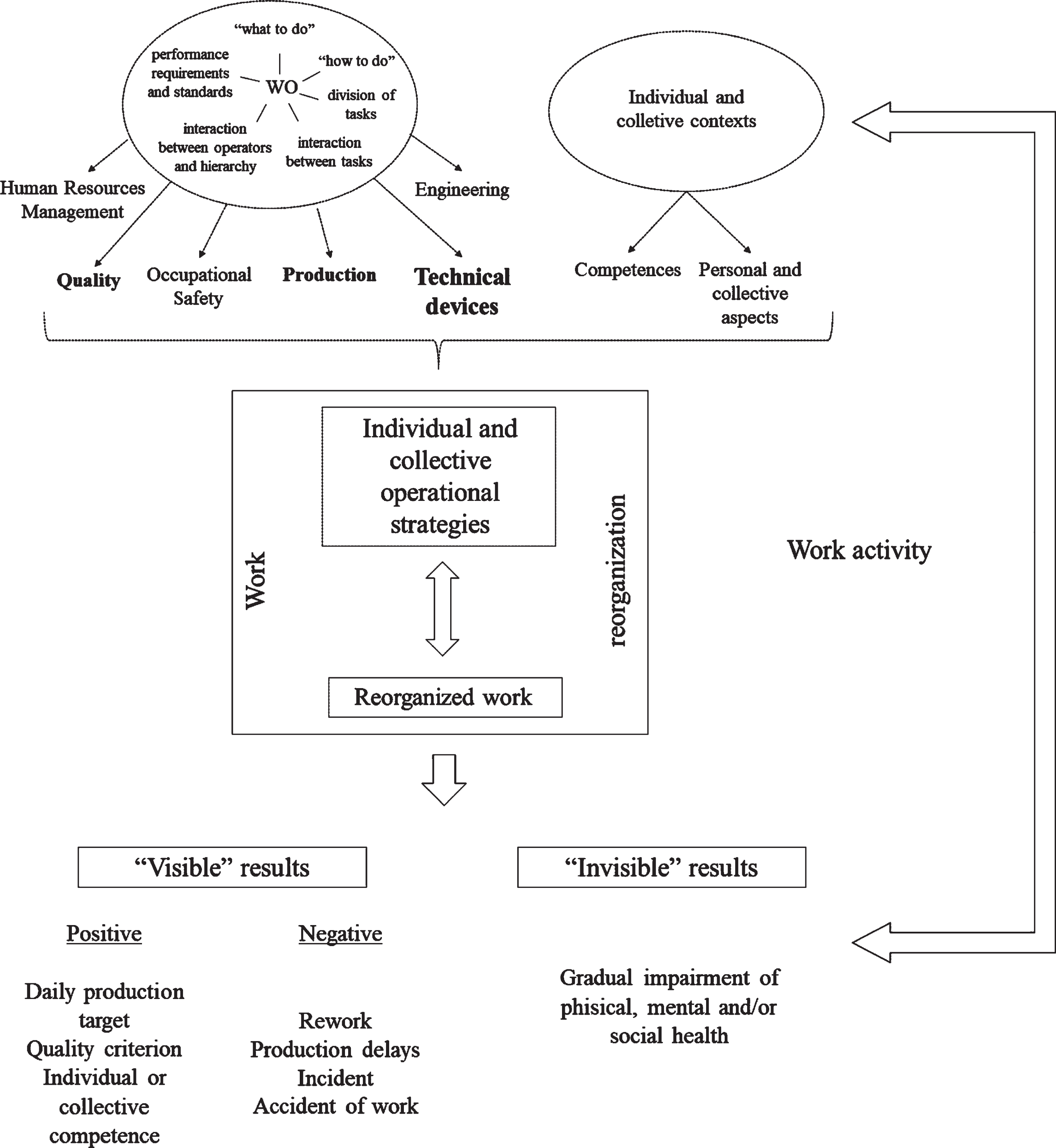
Manifest elements in the reorganization of work during activity.
The operational strategies are designed to regulate work and make the task easier, practical, and compatible with what the contextualized situation requires considering the operator’s experience. Table 1 presents the context of the situations analyzed through the confrontation of prescribed and real work, in addition to the regulatory process characterizations. The regulations occur within a limit because their proper functioning depends on the availability of resources compatible with what the activity requires. Otherwise, the operator’s possibility of action is reduced, and negative consequences for the operator and/or the company may occur.
Confrontation between prescribed and real work and regulatory processes
The results show that competences are important resources for the adoption of the possibility of action to complete tasks despite the variabilities and conflicts of objectives encountered. Therefore, the cost of regulations for less experienced operators is higher considering the level of uncertainty during problem solving in the face of contradictions and variabilities. In addition, technical resources are required in the context of the activity; in their absence, the operators use means that are at their disposal at the moment, such as the use of the forklift headlight to illuminate the coil storage area during transport by means of the overhead crane.
In this study, it was found that work organization prescriptions occur based on various logics or rationalities that underlie the behavior of the prescribing agents. Such determinations can be verbalized, documented, or represented in the technical devices available for performing the tasks. According to Silva and Vasconcelos [20], the organizational decisions related to design emerge as rules and guidelines regarding the characteristics and functionalities of the machines and work tools. However, in real work, the prescriptions interact in a contextualized way, and there are inconsistencies in the action due to the incompatibility between these interactions and the demands of real situations.
The decisions based predominantly on technical aspects or management indicators conflict with the work activities on the shop floor because the actual operating conditions of the machines, such as the variability related to the behavior of materials during operations and the variability of individuals, are not considered in the prescriptions and decision-making processes that affect the operational level. However, as observed in the analyses, these aspects influence the activity results, with consequences for the production process or the individual. The operator competences constructed during the action consider both the interactions between the prescriptions and the contextual aspects of the real work situations, and the know-how allows the development of operative modes adapted to the situations, in order to achieve productive objectives and maintain physical integrity. However, depending on the adequacy of available resources (terms in functionality and adaptation of technical devices, personal or technical skills, and health conditions), consequences, not always visible in the short term, result from the present risks, insecurity, and conflicts of decision-making.
The real conditions for work execution are subject to variations, for example, during the operation of machines and equipment, whose performance can be affected by technical problems that require maintenance and prevent its use for a period of time [10]. Authors such as Simões et al. [21] also cite individual variabilities as changes in the momentary state of health, whose regulation can occur through the development of collective cooperation strategies to control the level of muscle pain without compromising production. Thus, the organizational environment is subject to several variations and an unpredictability that make it difficult to comply with the different procedures and instructions determined by the organization [22]. This gap between prescribed and real work represents the contradiction between what is asked for and what the activity demands [23].
Regarding the fulfillment of some prescriptions instead of others, in this study it was found that the technical devices logic, followed by production and quality, were prioritized higher in the operators’ decision-making processes. Regarding the prescriptions manifested in technical devices, it is important to mention the idea of crystallization, which refers to the fact that every artifact “crystallizes” knowledge, a representation, a user model, and its activity [24]. In this study, the individual and collective experiences built during work routines were very relevant in the regulatory process as they supported and guided the elaboration of the operational strategies from the possible results that the activity could generate.
In this research, collective strategies were relevant to achieving the objectives of the task in order to make it easier and more practical, which was also observed by Picos et al. [25]. To facilitate work and ensure safety during the activity, the operators use their senses, particularly sight and hearing, to assess the progress of the process and anticipate system dysfunction. Similarly, Santos et al. [26] identified the use of sensory resources when sorting recyclable materials on the conveyor belt to anticipate incidents and accelerate operating modes.
The possibilities of coordinating collective work allow the division of tasks and temporal organization among the group members involved in the task through verbal and non-verbal communications [11]. The authors also highlight the importance of building common knowledge about the activity so that there is a mutual understanding of the situation, which is a determining condition for failure management and danger control [11]. In the present study, it was observed that the operators used a search for events already experienced during the collective activity to check if the heating of the disc in the oven guarantees adequate results in the press. The effectiveness of this strategy depends on the use of a common reference to real work, for which the construction can occur in spaces for discussion and clarification of the activity [22].
In this process, the sharing of know-how stands out [27]. It was found in this study that, during work situations, employees develop their operating modes by considering the context variabilities and experience acquired during work execution. The different gestures used according to the situation demands are indicative of the operators’ competences and demonstrate the active role they adopt and play at work [2]. In this research, the operators use terms like “tricks” to express the specific operating modes used when variabilities are found.
The use of operational strategies aims to increase the possibilities of action when variabilities are found, leading to a rupture in some prescriptions determined by the organization and the creation of interacting rules to reorganize the activity and achieve the objectives, taking into consideration the socio-technical and organizational circumstances [1]. Furthermore, in this study, it was observed that the operators improvise tools to assist in problem solving for the completion of tasks. However, some devices are apparently inadequate for the functions assigned to them, causing a distance from safety practices and consequently increasing the risk of an accident at work. This lack of resources that are compatible with the situation demands hinders work execution and can compromise employees’ health. In addition, it can also affect work performance [10]; hence, it is important to consider aspects of the operators’ effective activity in the design processes of work situations [28]. For this purpose, it is necessary to bring decision-makers closer to the everyday reality experienced on the factory floor. Lémonie and Chassaing [27] reported the importance of creating opportunities for the verbalization of tacit knowledge incorporated into employees’ gestures and knowledge situated in the context of work.
During the execution of activities, there is a regulation process that seeks to compare the results obtained in the present circumstances with those expected by the organization so that process adjustments can be made [29]. Considering the indicators presented by the managers in this study, it was observed that the regulation processes are effective as they guarantee the achievement of determined results and the low rate of work accidents. However, we must consider the potential risks and some costs that may be “invisible.” Among these aspects are fear, insecurity, excess responsibility, and physical and mental exhaustion, that is, issues related to the operators’ internal state that accumulate over time and can generate negative consequences for both the operator and company.
Rocha [1] described a work situation in which interventions were made by company management with the aim of reducing the operators’ physical workload. Nevertheless, such actions and new rules created remain disconnected from reality [1]. In other words, the intervention did not originate from work practices, and because of this, the activities were in disagreement with the established instructions [1]. Therefore, although extremely rich and essential to guarantee the company’s production, the regulation processes developed by employees were insufficient to effectively protect their health [1]. Lahoz and Camarotto [30] highlight that ergonomic interventions based on the interaction between analyst and observed make it possible to identify the variables that influence the work process and health of workers.
Limitations and perspectives for future studies
A limiting factor of this study is the scope of the obtained results, as the application in only one company can constrain its generalization. Hence, the importance of expanding the analysis to other organizations with different types of management, strategies, and technologies, which can greatly influence work organization decisions and prescriptions. For future studies, we also suggest discussions about work organization so that the results presented are based on actions to make them occur in a participatory manner and consider the conflicts of logic, variabilities, and margins of maneuver created to perform the tasks.
Conclusion
There is a need to discuss and solve the contradictions raised by the operators regarding their work routines through the interaction of heterogeneous logics and rationalities and the construction of a common reference about the activity. From this starting point, it becomes feasible to make available the resources compatible with what the real work situation demands, thus increasing the margin of maneuver. By enriching the representations of the prescribing agents with elements of the activity, such as variabilities and interactions between prescriptions and technical devices, it is possible to improve the awareness of decision makers about the difficulties experienced in the job and the importance of the activity perspective in organizational decisions.
Conflict of interest
The authors have no conflict of interest to report.