



Abstract
BACKGROUND:
During Finnmarksløpet (FL, one of the longest distance sleddog races in the world), veterinarians are exposed to extreme environmental conditions and tight working schedules, with little and fragmented sleep.
OBJECTIVE:
The aim of this case study was to examine cardiovascular parameters and sleep-wake patterns among veterinarians working within FL, during and after (for a month) the end of the race.
METHODS:
Six female veterinarians volunteered for the study. The participants wore a wrist device for a total of eight weeks in order to passively and semi-continuously record physiological responses throughout the day (i.e., heart rate, heart rate variability, number of steps, and sleep quality). Moreover, perceived sleep quality was assessed by Pittsburgh Sleep Quality Index (PSQI) at three time-points.
RESULTS:
During and for one month after completion of the FL, most veterinarians presented an alteration of cardiovascular parameters and sleep quality. The heart rate circadian rhythm returned to pre-race values within about two weeks.
CONCLUSIONS:
The long-lasting alteration of the veterinarians’ cardiovascular parameters and sleep-wake patterns might have negative consequences for their health in the long-term, especially if similar experiences are repeated more times though the course of a year or season. More research is needed in order to understand the health risks, as well as how to prevent them, among veterinarians in long-distance sleddog races or other similar events.
Introduction
Veterinarians are subjected to levels of work-related stress comparable to other health-professionals [1–7]. In addition to the challenges encountered by veterinarians in their everyday work routines, some veterinarians are exposed to additional, exceptionally challenging, work circumstances in relation to sporting events that involve animals, such as, for example, veterinarians working within long-distance sleddog races. In this particular study, we refer to the Finnmarksløp (FL) as a case.
Tasks and working conditions of veterinarians during the Finmarksløp
The FL is the world’s northernmost and Europe’s longest sleddog race, which has been taking place annually since 1981. It is considered one of the most famous and challenging sleddog races, run over three different distances (1200 km, 600 km and 200 km junior) in wild sub-arctic conditions, across the Finnmark region of northern Norway. During activities such as pre-race checks, and then during the race, race-officials, helpers, volunteers and veterinarians work around the clock with tight schedules, indulging themselves in only little and fragmented sleep. Studies have previously shown that not only the mushers (i.e., the sled driver) but also others working in such events (e.g., race assistants), sleep an average of 3.5 hours per day, with sleep episodes which are often fragmented in two or shorter episodes taking place at irregular times of the day [8–10]. Similarly to the mushers and race assistants, the veterinarians working within these races are also exposed to strenuous conditions, including chronic sleep deprivation, stressful schedules, and extreme temperatures. As in other long-distance sleddog races, normally, veterinarians in the FL must be available at all times, from 2–3 days before the start (when preparatory technical meetings and pre-start veterinary check on all the dogs registered in the competition are done) until the last competitor reach the finish line (usually 8–9 days after the race start and 1–2 days after the first team arrival), resulting in 10–12 days of commitment [11].
Possible health challenges for veterinarians working in long-distance sleddog races
As work-related stress poses challenges for human health and wellbeing [12], the higher levels of stress experienced by the veterinarians (during their everyday work as well as during the FL) can have con-sequences for their health in the long term. Although, to the best of our knowledge, no studies have investigated the impact of work-related stress on cardiovascular health specifically among veterinarians, consistent evidence exists demonstrating increasing risk of coronary heart diseases with increasing job strain and long working hours in the general population [13].
The sleep deprivation the veterinarians’ experience during the FL may also pose a challenge for their health. In healthy adults, the sleep-wake cycle normally shows a monophasic structure with one long period of nocturnal sleep, which is strongly related to daily environmental cycles, such as the daily light-dark cycle [14]. An alteration of the sleep-wake rhythm induces a reduction of sleep quality resulting in a shorter sleep duration during the night [14]. Consequently, not only is an adequate sleep duration important: the time of day when the main sleep period occurs also influences the overall quality and restrictiveness of the sleep [15, 16]. Prolonged periods of sleep deprivation and/or irregular sleep routines might affect the sleep-wake circadian rhythmicity, thus causing an impoverishment of the sleep quality. Furthermore, the disruption of the sleep-wake circadian rhythm induced by such circumstances can make a subsequent sleep recovery difficult to achieve [8].
The stressful working conditions, as well as the reduced amount and quality of the sleep experienced by the veterinarians during the FL may also affect their cardiovascular functions. For instance, it has been demonstrated that insomnia and sleep apnea are associated with an increment in cardiovascular risk and mortality [17, 18], while cardiovascular diseases, e.g. congestive heart failure and myocardial infarction, are related to physiological sleep problems [19]. This bidirectional relationship found between sleep and cardiovascular response is often related to the fact that the autonomic nervous system (ANS) regulates cardiovascular functions during sleep stages, and consequently its alteration induces sleep disorders. On the other hand, sleep problems such as sleep deprivation affect the normal circadian rhythm of cardiovascular responses [14] and consequently the ANS regulations that may induce altered heart rate (HR) responses [20].
As a result of the sleep loss, alongside the work-related stress, the veterinarians working within the FL could be subjected to a higher than normal risk of poor mental and physical health, especially if several of similar events are undertaken during the course of a year or season [9]. Studies have shown that the mushers and race assistants in long-distance sleddog races were subjected to an alteration of their rest-activity circadian rhythms and sleep-wake patterns, which lasted up to one month after completion of the race [10, 21]. It is plausible to expect that similar alterations may occur also among veterinarians. However, to the best of our knowledge, to date no study has specifically investigated the health challenges of veterinarians working in such events. The scientific literature on the health challenges experienced by human participants in long-distance sleddog races is, indeed, relatively scarce [10], with only two studies focusing on or including professional figures (non-mushers) orbiting around the race, such as race organizers and handlers (i.e., the mushers’ personal assistants [8, 9]. Moreover, previous studies on workers within FL were limited either by a short follow-up (i.e., only one week after completion of the race [8] or by the exclusive use of self-reported assessments [9].
The purpose of the study
The primary aim of this study was to examine the in-race and post-race biomarker of health among veterinarians working within the FL. In particular, this case study investigated possible alterations of the veterinarians’ HR circadian rhythm (midline statistic of rhythm [MESOR], Acrophase, and Amplitude), HR variability (HRV; expressed as standard deviation of normal-to-normal intervals over 24 hours [SDNN24]), and sleep-wake patterns (both, objectively assessed and self-reported), during and after the veterinarians’ engagement in the FL. A substantive innovation introduced by this study is the use of Internet of Things (IoT) devices, which allowed monitoring of objective biomarkers of health over a long period of time (i.e., 8-weeks overall).
Methods
Participants
Six of the eight female veterinarians (age = 34.00 + /–2.45 years; weight = 60.75 + /–8.09 kg; height = 169 + /–3.91 cm; BMI = 21.23 + /–2.39 kg/m2) working in the 2020 edition volunteered in this case study. To reduce the intraindividual difference, only female veterinarians were recruited for this study. All veterinarians participating in the study declared to have no clinical condition and to be in good physical shape. They signed an informed consent document after receiving an explanation of the project’s aims, methods, possible risks, and benefits of the study. The authors of this study ensured that the planning conduct and reporting of human research are in accordance with the Helsinki Declaration as revised in 2013. The study has been conducted in accordance with and has received approval by SoBigData++ Ethical committee (BOEL20200727IP).
Protocol
One week before the race, after signing an in-formed consent, the veterinarians filled in a questionnaire composed of three parts on a Google Form: in the first part, the participants provided their background characteristics; in the second part of the questionnaire, the participants’ chronotype was assessed by using the MEQ; finally, the PSQI was used to assess the veterinarians’ sleep quality. Alongside the administration of the initial questionnaire, the participants were asked to wear the IoT wearable, and keep it continuously (day and night) for a total of 8 weeks. The PSQI was subsequently administered two additional times by a Google Form, one week and one month after the end of the race. Because of the lockdown associated with the COVID-19 pandemic, the 2020 race was forced to stop just before the planned end, at Levajok check-point, after 987 km out of the intended total of 1202. All subsequent scheduled races were also cancelled during the lockdown period. So during the post-race assessment, the participants were not further engaged in long-lasting sleddog races, though they may have returned to more regular working routines.
Instruments and questionnaires
IoT wearables (BioBeam, BioBeats, London, UK) equipped with an accelerometer and pulse-based HR sensor were employed to objectively assess biomarkers among the veterinarians before, during, and after the race. These wrist-worn devices, of the shape and size of a wrist watch, can assess the participants’ cardiovascular parameters and activity levels (from which sleep-wake patterns can be derived) in their everyday life [23]. Heart activity measures captured via wrist-worn wearable devices typically suffer from missing values and noise induced by motion artefacts [24]. This can negatively affect the estimation of the HR circadian rhythm and HRV, inducing misleading insights in the assessment of the health status of the individual. For this reason, inter-beat intervals (IBI) data were preprocessed by removing abnormal values (i.e., ectopic beats) and then the missing values (caused both from ectopic beats and motion artefacts) were interpolated at the time when the beats occur via a quadratic interpolation function [24]. This preprocessing approach allowed to minimise error that might be caused by the substantial quantity of missing values [24]. The algorithm used to extract the valid data from the BioBeam is patented by Huma Therapeutics Limited (GB patent, GB202004816D0). The devices were provided by the producer for free based on a scientific research agreement between the University of Pisa (specifically, SoBigData European projects) and BioBeats LTD group. The biomarkers derived from these devices and the ones obtained from questionnaires are described below.
Cardiovascular parameters –HR and HRV were recorded semi-continuously through the wearable devices described above. The HRV data was recorded as the standard deviation of the IBI (average over a 2-minute) every 30 minutes. On the basis of these data, the SDNN24 was computed. SDNN24 is a HRV feature that is commonly used as an indicator of cardiac health [25]. For instance, in a recent study in which the BioBeam device was compared with an electrocardiogram (ECG), it was found that the former provides acceptable estimations of standard deviation of the SDNN24 [26]. The HR data (the mean of 2 minutes recorded every 10 minutes), were used to assess the veterinarians’ HR circadian rhythm by applying a single component cosinor function (Equation 1) to fit the daily HR data:
where M is the MESOR (Midline Statistic Of Rhythm, a rhythm-adjusted mean), A is the amplitude (a measure of half the extent of predictable variation within a cycle), φ is the acrophase (time of the day when the high HR values recurs in each cycle), t is the period (duration of one cycle), freq is the fixed length of the cycle (i.e., 24 hours) and e(t) is an error term [27]. MESOR, Amplitude and Acrophase were used in the study to depict the profile and entrainment of the veterinarians’ HR circadian rhythm.
For each cardiovascular parameter (SDNN24, MESOR, Acrophase, and Amplitude), the values assessed during the week preceding the race were used as a baseline (a reference point with which to compare the in-race and post-race values). The values assessed during the days the veterinarians were engaged with the race were used as an indicator of stress-strain and circadian disruption experienced by the veterinarians. Finally, the parameters assessed in the course of the five weeks following the completion of the race were used to evaluate the veterinarians’ cardiovascular recovery process.
Sleep-wake patterns and sleep quality –These were assessed both, subjectively and objectively. Subjective sleep quality was assessed by Pittsburgh Sleep Quality Index (PSQI) [28]. The PSQI is the most commonly used instrument for assessing sleep in clinical as well as research contexts, which has been deemed having acceptable validity in clinical and non-clinical population [29]. PSQI was developed to provide a simple, valid and standardized measure of sleep quality, and to identify possible sleep disturbances occurring during the previous month. PSQI gives a score ranging from 0 to 21, with values≤5 indicating good sleep quality. The caption of the instrument (which in its original form provides a time reference of one month) was adjusted to require the veterinarians to refer to their sleep in the past week. The PSQI was administered at three time-points: one week before the race (used as a baseline), one week and one month after completion of the race (used to evaluate the veterinarians’ recovery process).
The objective assessments were performed using the wearable devices described above, which indirectly derives the participants’ sleep-wake patterns based on their movement (accelerometer values). More specifically, the following parameters, generated for each day, were used in this study: number of sleep periods throughout the day, total sleep time expressed in hours throughout the day, number of awakening phases in sleep period recorded during all the day, and length of awakening phases recorded during all the day expressed in seconds. The parameters assessed the week before the race were used as a baseline, while the parameters assessed during the days the veterinarians were engaged with the race provided information on the magnitude of the sleep deprivation experienced. The parameters assessed over the 5-weeks period after the race were used to evaluate the veterinarians’ quantity and quality of sleep as an indicator of their sleep-recovery status.
Activity levels –The veterinarians’ physical activity levels were assessed using the same wearable described above. This information was assessed as steps counts (epoch length: 20 seconds), and it was mainly used as an indicator of work-strain during the race.
Background information –This (which was ass-essed for informative purposes) included the veterinarians’ age, weight and height (from which BMI was derived using the formula: height [m] / squared weight [Kg]), and an assessment of their chronotype by the Morningness-Eveningness Questionnaire (MEQ) [30]. MEQ is a self-assessment questionnaire created by Horne and Ostberg in the 1970s to measure preferences for morning versus evening in relation to individuals’ intrinsic circadian rhythms. It consists of 19 multiple-choice questions, with each response option being linked to a numeric value. The sum gives a score ranging from 16 to 86: scores of 41 and below indicate “evening types”, scores of 59 and above indicate “morning types”, while scores between 42–58 indicate “intermediate types”.
Due to the small sample size, the results associated with the primary variable (cardiovascular parameters and sleep-wake patterns) are primarily presented descriptively (25th, 50th and 75th percentiles). For the variables SDNN24, total sleep time, and SPQI, which showed the largest changes during and after the race, results are presented at individual level and by showing detailed trends of the entire monitoring period. Inferential statistics was also performed, although, due to limited statistical power, caution is needed when interpreting the outcome of these analyses. For each variable, one way analysis of variance for repeated measures (ANOVA) based on ordinary least-squares estimation is performed to assess the difference in the data between weeks. Specifically, time (i.e., pre-race, during the race and from 1 to 5 weeks after the end of the competition) was taken to be the fixed effect and time/subjects were taken to be nested random effects. Tukey’s post-hoc test was performed pairwise to compare data from weeks. The statistical significance of the latter test was taken to be 0.05. All the analyses are performed using the Python 3 language programming.
Results
Background information of the veterinarians
The outcomes of the MEQ showed that all veterinarians had an intermediate/moderate morning chronotype (57.00 + /–4.69 MEQ values) indicating that they are accustomed to waking up early in the morning compared to other chronotype groups (i.e., neither and evening) with a peak alertness in the morning.
Work stress, circadian disruption and sleep deprivation during the race
Statistically significant differences were found for the total sleep time (Fig. 1): the participants slept 4.91 + /–1.11 hours per day during the race period, which is statistically significantly lower than the sleep times slept in weeks before and after the race (ANOVA: F (6,36) = 12.47, p < 0.001). Figure 1 shows that all the participants reduce their sleep time during the race period. Moreover, the structure of the sleep-wake cycle (Number of Sleep periods) was altered during the race period showing a biphasic structure compared to pre-race weeks (ANOVA: F (6,36) = 11.35, p = 0.001).

The top plot shows the boxplot of sleep times (hour) per week. The bottom plot shows the mean and standard deviation of sleep hour per day. The bold line refers to the polynomial trend line of sleep time.
During the race period there was a reduction of SDNN24 of about –24.15 + /–7.42 ms compared to pre-race week (p = 0.02). In particular, Fig. 3 shows that all the veterinarians followed this pattern, with SDNN24 values decreasing just before the beginning of the race, indicating increased levels of psychophysiological stress. While three of the veterinarians maintained the (reduced) SDNN24 values throughout the race, the values continued decreasing for the other three veterinarians. In one case, the SDNN24 values were close to the 100 ms threshold, indicating compromise health.
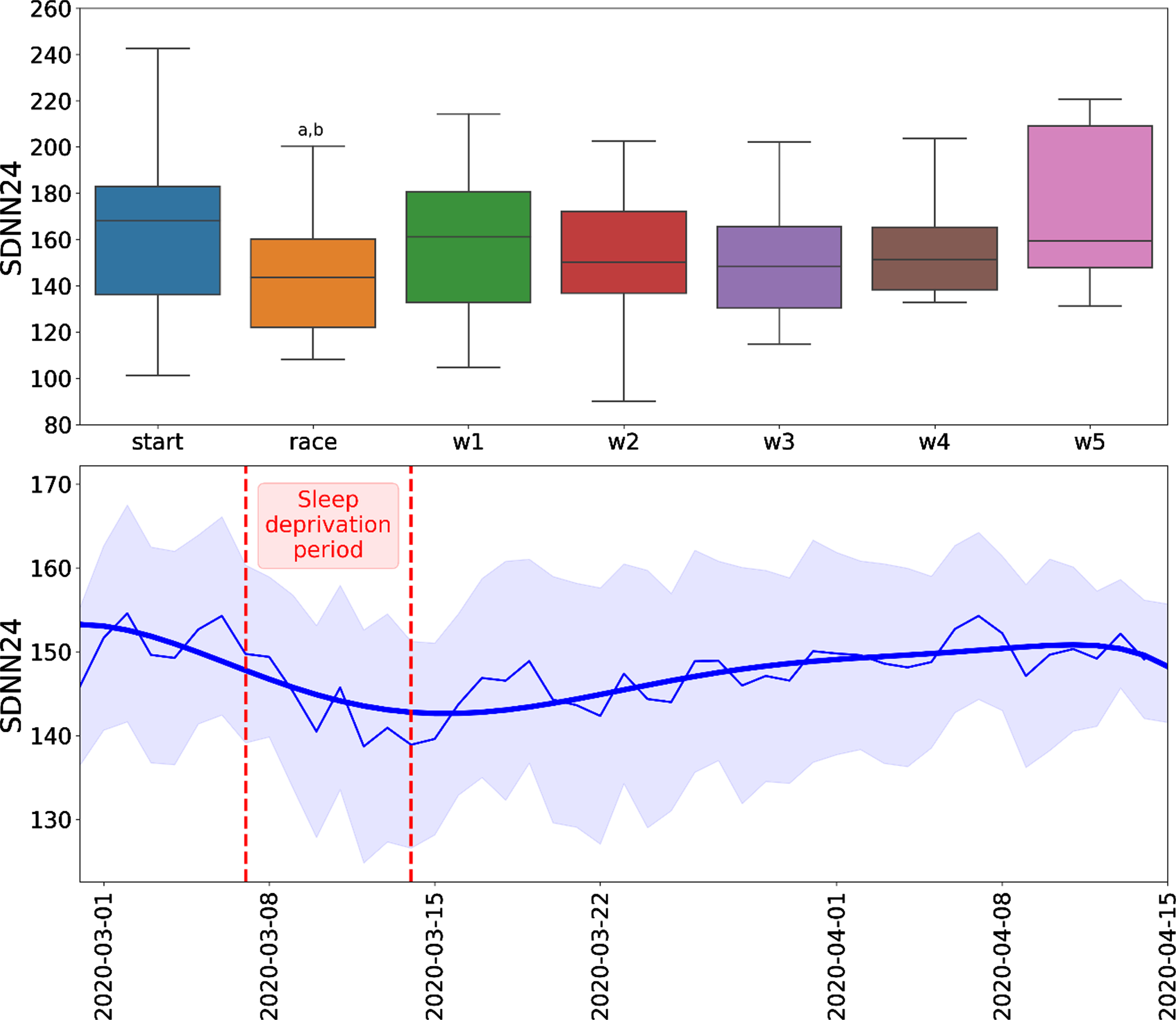
The top plot shows the boxplot of SDNN24 per week. The bottom plot shows the mean and standard deviation of sleep hour per day. The bold line refers to the polynomial trend line of sleep time.
As shown in Table 1, a higher number of steps was recorded during the race period compared to the period before and after the race (ANOVA: F (6,36) = 13.09, p < 0.001). The acrophase of the HR circadian rhythm during the race was shifted forward of about 4-hour earlier than pre-race values, showing also a higher variability compared to pre-race week, which could indicate an alteration of the circadian rhythmicity (Table 1). Similarly, low variability detected in the circadian rhythm amplitude corroborates the fact that the HR rhythmicity was altered.
Descriptive statistics per week. Mean, standard deviation and interquartiles, i.e. first quartile (Q1 –25th percentile), median (50th percentile) and third quartile (Q3 –75th percentile) for all the features in each week
SDNN24 (HRV variable describing the health status of the heart) required up to 1-month time to return at pre-race value (Fig. 3 and Table 1, ANOVA RM: F (6,36) = 9.03, p < 0.001). SDNN24 remained close to values recorded during the race period for 4 weeks (p > 0.05), returning to pre-race values in week 5. In particular, almost all the veterinarians follow this pattern, while only one veterinarian continuously reduces SDNN24 in the post-race period. Differently, Table 1 indicates that both MESOR (ANOVA: F (6,18) = 8.80, p = 0.001) and Acrophase (ANOVA: F (6,18) = 4.28, p < 0.01) require up to 2-weeks’ time to recover after the completion of the race.
The veterinarians returned to a normal sleep routine within one week after completion of the race, as shown by the values of total sleep time (see Fig. 1 and Table 1). In particular, except for one veterinarian, all the veterinarians slept about one hour more in the post-race period compared to the pre-race incurring in a strategy to recover from a stressful period (race). Even if no statistically significant difference was detected in both the number and length of awakening phases during the night, these values appeared altered up to one month after completion of the race, with a peak 2-week time after the race. However, for all of the veterinarians, after an initial improvement of the perceived sleep quality (as based on the PSQI) during the first week following the race, PSQI values reduced again in the assessment performed one month after completion of the races (Fig. 2, ANOVA: F (2,12) = 23.51, p < 0.001).
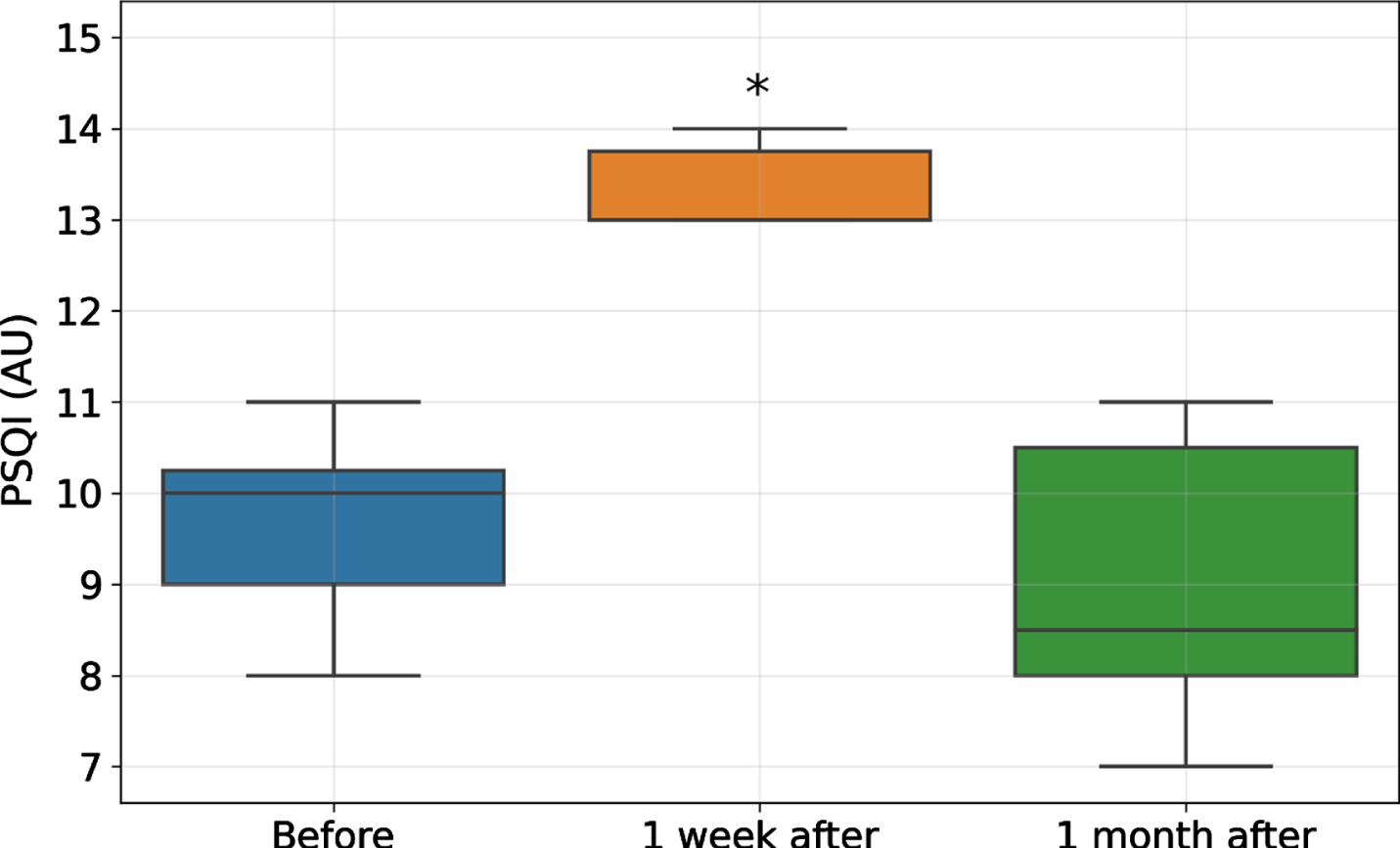
Boxplot of PSQI values recorded before, 1 week after and 1 month of sleep restriction period.
The purpose of this case study was to investigate possible alterations of cardiovascular parameters (HR circadian rhythm and HRV) and sleep-wake patterns among female veterinarians working in a long-distance sleddog race (the FL), and evaluate the recovery process of these parameters after completion of the race. A main innovation in this study was the use of a IoT-based wearable devices, which allowed to assess, in ecological conditions, relevant biomarkers of psychological and physical health before, during and after engagement in an exceptionally demanding work period. The main findings of this case study shows the extremely demanding working conditions encountered by the veterinarians within the FL. For about 10 days, the veterinarians were subjected to high degrees of sleep deprivation and stress, which altered the veterinarians’ HRV (expressed as SDNN24), HR circadian rhythm, and sleep-wake patterns. Furthermore, the study indicates that the cardiovascular parameters remained altered for up to a month after completion of the race. The alteration was especially prolonged for the veterinarians’ HRV (expressed as SDNN24), while the profile of their HR circadian rhythm appeared to become restored within about 2-weeks. While the veterinarians returned to (relatively) regular sleep routines within one week after completion of the race, the perceived quality of the sleep appeared to be altered for up to one month. This was corroborated also by a less consistent increase of the number and length of awakening phases.
Discussion of findings in relation to previous literature
To the best of our knowledge, this is the first study that evaluated biomarkers of health in veterinarians, as most of the literature have predominantly focussed on stress-related work and/or measurements of psychological health [1]. As this study focused on a specific, exceptionally demanding, circumstance (i.e., working within a long-distance sledding race), it is difficult to compare our findings with those from previous studies, which generally focus on the work-related stress and mental health of veterinarians (or veterinary students) during their everyday working life. However, the findings of this case study can provide some insights into the psychophysiological work-related stress experienced by veterinarians when exposed to long working hours and night-shifts. Furthermore, the biomarkers used in this study provides insight into possible mechanisms linking psychophysiological stress with an increased long-term health-risk.
HRV is the fluctuation in the time intervals between adjacent heartbeats and reflects, among others, regulation of autonomic balance and cardiovascular functions such as blood pressure, heart and vascular tone [25]. SDNN24 is considered the “golden standard” for the clinical assessment of cardiac risk, with SDNN24 values below 50 ms indicating high risk, 50–100 ms indicating compromised health, and values above 100 ms are low risk [31]. In the present study, all veterinarians (with the exception of one veterinarian in the second week after completion of the race) maintained SDNN24 values above 100 ms -thus, they never showed SDNN24 values indicating health concerns. However, except for one participant, all the veterinarians presented a reduction of the SDNN24 values following the race. This suggests that similar stressors may potentially lead to health concerns, especially in older individuals or people with previous conditions. To be noticed that most veterinarians were rather young, while SDNN24 values are known to reduce with increasing age and are typically lower in individuals with heart conditions [15]. Also the alterations of the HR circadian rhythms and sleep-wake patterns are indicative of an increased (although temporary and non-alarming) health risk. As cardiovascular functions are strongly linked to a circadian rhythmicity, a well-entrained HR circadian rhythm (with a stable Acrophase, a lower MESOR, and a large Amplitude) is indicative of lower cardiac risk [32].
Sleep deprivation (especially in the form of chronic sleep deficiency) contributes to a number of molecular, immune, and neural changes that may increase the risk for accidents as well as different diseases including cardiovascular diseases, metabolic diseases, and cancer, ultimately leading to reduced lifespan and quality of life [33]. The National Sleep Foundation [34] recommends that adults (26 y or older) sleep for seven to nine hours per day. While few veterinarians showed inadequate sleep routines also before the beginning of the race, most appear to have slept an adequate amount of hours since immediately after the completion of the race. However, the quality of the sleep is also an important indicator of health [35]. Although none of the veterinarians, at any assessment time-points, reported a PSQI≤5 (the cut-off indicating presence of sleep problems), we found that some of the veterinarians had some reductions of the PSQI values up to one month after completion of the race. Paradoxically, the perceived sleep quality was increased during the week after the completion of the race, contradicting the slightly increased number and duration of awakenings. Such pattern has, however, been previously observed in similar circumstances among race assistants and handlers participating in the FL [8], and might be explained by a biased self-evaluation of one’s quality of sleep due to the prolonged exposure to a period with forced sleep deprivation.
Altogether, not only these findings indicate the impact that working in events such as the FL have on the cardiovascular function and sleep-wake patterns of the members of the veterinary team, but also that such alterations require a long time (about one month) to be restored. Moreover, as the alterations of these biomarkers are known to be associated with health issues (e.g., cardiovascular or metabolically diseases), veterinarians should be mindful about the potential health risk of working in such an event or other similar circumstances. Information on the importance of, as well as intervention promoting, appropriate sleep recovery strategies should be provided to veterinarians working on events such as FL, as well as among health personnel working shifts, such as nurses. As a matter of fact, shift-work resulting in irregular work schedules has been consistently found to induce high levels of stress [36] among workers and sleep problems [33], with risk for both the safety of health personnels’ and the patients’ [37, 38]. It has been emphasized that sleep should be made a priority among health personnel working shifts [37], thus such recommendations should be extended also to veterinarians.
Limitations of the study
The main limitation of this study is the small sample size, which is primarily a reflection of the small number of veterinarians that typically work within this kind of competitions (it should be noted that almost all the female veterinarians that worked in this competition were recruited in this study). Caution is needed when interpreting the findings of the cardiovascular parameters and sleep-wake patterns against the respective cut-off values, as the latter normally refer to assessments done in clinical conditions and with instruments different than the IoT-based wearable devices used in this study. Finally, another limitation is given by possible influences of the pandemic and the lockdown on the stress levels of the veterinarians. The race was interrupted just before the planned end, and all other races cancelled, due to the COVID-19 emergency. While this provided the possibility to conduct the post-race assessment with the veterinarians off-duty from high-intensity stressor such as other long-distance sleddog races, it is important to take into account that the COVID-19 pandemics and the lockdown may have induced stress among the veterinarians. Thus, the findings of the post-race assessment need to be interpreted with caution.
Implications and recommendations for future research
This case study provides important, thought preliminary, insight into the mechanisms that link work-stress and sleep loss among veterinarians. Although these findings are primarily restricted to the circumstances encountered during the FL or other similar events (e.g., other long-distance sleddog races), the paper may provide some useful information to veterinarians and their employers on how to improve their working conditions.
Based on the results of this study, it is recommended that the members of the veterinarian team, as well as other race organizers, assistants and volunteers that work within long-distance sleddog races such as FL schedule their shifts in a way that limits possible negative effects on the health of all these participants. Of course, the working schedule for the veterinary team often requires adjustments throughout the course of the races, since the progress of a long-distance competition, and the workload at different checkpoints, are unpredictable. Nonetheless, ensuring shifts with a fixed minimum amount of sleep to all FL veterinarians may help.
In relation to the use of IoT-based devices, future works are encouraged in order to develop algorithms able to detect cardiovascular and sleep problems at early-stage, which may be employed to protect the health veterinary staff, as well as other professional figures exposed to similar working conditions (e.g., prolonged working hours, night shift, and emotional strains).
Conclusion
The period connected to events such as FL can induce acute and long-lasting alterations of cardiovascular parameters and sleep-wake pattern in members of the veterinary team. Veterinarians, as well as other participants in extreme events such as the FL, should be mindful of the risks that strenuous work and prolonged sleep loss can have on their health. The race’s organizers may consider promoting more healthy sleep-wake scheduling among the veterinarians and other workers involved in the race through informative campaigns. Monitoring of biomarkers (e.g., HRV and sleep-wake pattern) during and after such events is also recommended among veterinarians, in order to detect possible problems.
The knowledge generated by this study increases current understanding of the burden undergone by veterinarians and other participants in events such as the FL, but it is also relevant for other shift workers, such as nurses and other health personnel. All shift workers, including veterinarians, may benefit from educational programs on the risks of prolonged sleep restriction and follow-up interventions in order to ensure full sleep recovery. This may be especially important during the current COVID-19 pandemic, which sees, for example, nurses and medical staff involved in a strenuous effort and chronic sleep deprivation that could jeopardize their general health.
Footnotes
Acknowledgments
The authors thank the veterinarians who participated in the study. A special thank is given to Prof. Andi Weydahl (UiT The Arctic University of Norway), who initiated the line of research on the health of participants in Finnmarksløpet over a decade ago. DAC was supported by the National Institute for Health Research (NIHR) Oxford Biomedical Research Centre (BRC).
Conflict of interest
DM and DAC have financial and business interests, because they are related to BioBeats Group Ltd, a company that may be affected by the research reported in the enclosed paper. The funders had no role in the design of the study, in the collection, analyses, or interpretation of data, in the writing of the manuscript, or in the decision to publish the results.
Funding
This work is supported by the European Community’s H2020 Program under the funding scheme H2020-INFRAIA-2019-1 Research Infrastructures grant agreement 871042, www.sobigdata.eu, SoBigData++: European Integrated Infrastructure for Social Mining and Big Data Analytics. The funders had no role in study design, data collection and analysis, decision to publish, or preparation of the manuscript. There was no additional external funding received for this study.