



Abstract
BACKGROUND:
The work integration of people who have recovered from addiction is an essential factor in the maintaining treatment outcomes. However, its multidimensionality has not yet received the attention it deserves.
OBJECTIVE:
To investigate the critical elements shaping the work integration attempts of people who have recovered from addiction and work in Greek social enterprises.
METHODS:
The data was obtained from 25 interviews which were conducted during the field research period; they were processed using the method of thematic analysis.
RESULTS:
Work integration is obstructed by a combination of individual constraints, together with obstacles related to how persons interact with their social environment, as well as with broader political, institutional, and socioeconomic parameters. The participants depended predominantly on the treatment program and their social network for work integration.
CONCLUSION:
The article enriches the existing literature focusing on the workers’ perspective on the issue under study. The complexity of the obstacles and limited support sources highlight both the need for client-centered interventions and design of a state-level work integration strategy. In this context, work environments with the potential of a holistic approach to work integration obstacles, such as work integration social enterprises, remain untapped opportunities.
Introduction
The social (re)integration of people who have recovered from addiction is a complex and dynamic process. Social integration encompasses “any social intervention with the aim of integrating former or current drug users into the community” [1], focusing primarily but not exclusively on housing, education/training, and employment. Finding and/or maintaining employment is a central therapeutic goal, as well as a factor for the evaluation of the stability of the treatment outcome. The positive effects of employment on rehabilitation efforts have been detected in diverse therapeutic contexts [2]. Employment is related not only to maintaining abstinence from substances and remaining in treatment but also with improved social functioning [3, 4]. In Greece, up until the beginning of the economic crisis, finding formal work was a therapeutic community (TC) prerequisite for the phase of social (re)integration to begin. Further deregulation of the labor market and the prevalence of undeclared “cash-in-hand” work in a large portion of it [5] put an end to the existence of that prerequisite, transforming it into a desired goal.
For the scope of this article, work integration is considered obtaining “decent and productive work, in conditions of freedom, equity, security and human dignity” [6]. The association between work and social integration was a result of the turn towards active labor market policies. However, the idea that finding work is synonymous with social integration was put into question when the multiple dimensions of exclusion were acknowledged and the place occupied by labor in modern society receded [7]. Inequalities among employees—which find their ultimate expression in the phenomenon of the working poor [8], the acknowledgment of the contribution of non-paid, non-monetary economy to welfare and social reproduction [9], as well as the various meanings that an employee can assign to their work [10] are some of the most critical factors playing against the equation of work with social integration. The discussion would not be complete without mentioning the significance of the impact work has on health, especially when the former takes place under anxiety-inducing, precarious, and/or alienating conditions [11].
The multidimensional reality of work and social integration of people who have recovered from addiction has not yet received the attention it deserves. This article attempts to contribute toward this direction, focusing on crucial elements that defined the work integration effort made by Greek social enterprise employees who are recovered addicts. For a better understanding of the research rationale, there will be an analysis of the factors shaping the work integration effort of that particular population group, the relationship between substance abuse and unemployment, in addition to the particularities of the reality in Greece. The methodological approach and results that follow highlight the multiplicity of obstacles and a certain lack of factors facilitating work integration. In the discussion, we examine the results juxtaposed with existing knowledge. The article is completed with the conclusions and research limitations.
Barriers and facilitators to work return after addiction
Durkheim [12] was the first to highlight the importance of work to social integration. Work, far from merely providing livelihood, is assigned multiple and interacting meanings, as it is a part of individual identity, provides an outlet to existential needs, and shapes social relationships [13].
The substance abuse-unemployment relationship is bidirectional and multidimensional. Extended unemployment along with precarity or loss of employment are important relapse factors [14, 15]. Particularly in recession periods, resorting to psychoactive substances is a way to deal with the stress-inducing conditions of precarity and unemployment [16]. On the other hand, substance abuse is one of the principal obstacles to finding employment [17].
Many of the obstacles to work integration faced by people suffering from addiction are shared with other social groups threatened by or facing social exclusion. Literature is often subject to a dichotomy that differentiates personal and structural obstacles. Country’s data reveal extremely high rates of unemployment or temporary employment in addition to a significant length of principal substance abuse, educational gaps, unresolved legal issues, and health concerns [18], all of which may influence people’s efforts of integrating into the labor market and society. Structural obstacles are, among others, the financial crisis and its impact on the labor market; social stigma which affects public expression but can also take the form of employer prejudice [19] and discrimination [20]; infrastructure- and service-related matters, including public transport and childcare. Furthermore, they include specific impediments, as are the demands of the treatment program and the cooperation mismatch between the competent services of treatment and employment promotion [1]. They are also related to employment promotion policies, such as the inefficient funding of training programs [21], providing insufficient incentives to enterprises, or even the absence of a strategy for the creation and empowerment of social enterprises. Finally, we should not ignore the impact of workfare programs acting for increasing the flexibilization of the work market, wage compression, and consolidation of precariousness [22].
An important personal factor facilitating work integration is the employment readiness parameter. Employment readiness refers to how an individual in recovery finds ways to deal with personal constraints, to work toward their self-empowerment and the enhancement of their employment prospects [23]. Staying in and completing treatment improves the possibilities of finding employment [24], which is not surprising considering that treatment enhances facilitating factors such as maintaining abstinence from substance use, motivation reinforcement, education and training opportunities, and the building of a supportive social environment [25]. Certain vocational rehabilitation interventions can also help in finding steady employment [26]. Finally, people who were employed at the time they joined treatment had more chances of working a year later [27].
Treatment demand and social reintegration indicators in Greece
In 2018 in Greece, 11,395 individuals were in the main stage of treatment for substance abuse problems. Around 21.2% participated in psychosocial interventions, based primarily on the TC approach, while the rest received substitution treatment. In the same year, 3,698 people demanded substance abuse treatment, most of whom (53.2%) were unemployed (this percentage becomes 41.4% when we count only first-time clients) whereas only one out of five had steady employment (21.4%). The general unemployment rate was 19.31% [28]. Out of this number, 493 completed their treatment, while 603 were users of social (re)integration services, which are mainly provided by programs which adhere to the psychosocial treatment approach. About 66.5% were employed or managed to find employment within the year [18]. Therefore, there are a few hundreds of people recovering from addiction who are seeking employment every year while their exact number remains unknown. Those who manage to find employment are mostly absorbed by either the free market or the services of the broader public sector through fixed term (eight months) public employment programs. At the time of writing, no studies have been published on the effects of COVID-19 on the people who have completed substance abuse treatment.
Social enterprises in Greece
The term “social enterprise” (SE) refers to hybrid organizations that produce services or goods as a means to fulfill social aims. They transcend the limits of economic sectors, use mixed resources, and are active in various fields of production. Acknowledging their diversity, the EMES (L’EMergence de l’Entreprise Sociale en Europe) International Research Network suggested an operational definition, introducing nine criteria in three dimensions (economic/entrepreneurial, social, and participatory governance) [29]. When the main purpose of a social enterprise is the return or integration of individuals and groups that are threatened by or experience social exclusion to the labor market, then it is called the Work Integration Social Enterprise (WISE).
The history of SEs in Greece, which began in the middle of the 1980 s, is associated with the deinstitutionalization of people suffering from mental health problems, and with women availing equal opportunities of participation in the socioeconomic life [30, 31]. Two and a half decades later, the economic crisis became a milestone for the development of social economy in the country, since more than three-fourths of the formal and informal projects were created after the crisis broke out [32].
Hence, the field of social economy has undergone radical changes in the last decade, having been enriched with a variety of diverse projects. The focus has been directed away from social/work integration and closer to facing the consequences of the economic crisis—to mutual help, environmental protection, and self-management [33]. An indicator of this tendency is the fact that within the specific legal entity of Social Cooperative Enterprises (Koin.S.Ep.), only a mere 2.0% were about the integration of vulnerable groups such as people with disabilities, mental health problems, or recovering from substance abuse [34]. A law that envisages the creation of Social Integration Cooperatives for people recovering from addiction (Koin.S.Ep., Law 4600/2019) was voted in recently, but there is still no such form of enterprise to be found.
The largest organization for the psychosocial treatment of addiction (Greek Therapeutic Communities Organization – KETHEA), which is a private legal entity with over 85% state funding, maintains production workshops offering both apprenticeships and permanent employment to people recovering from addiction. Apart from that, there have been only two new SEs for people recovering from addiction in the last three years. It is to be concluded that in Greece, this particular field is still in its embryonic stage. People in recovery from addiction who are employed in the SE field achieve this primarily through integration SEs with a different target group, such as people with a history of mental health problems or the homeless. A smaller percentage are employed in SEs without integrational goals—a condition that is mostly a result of coincidence.
Purpose
Background
The data of the present article is part of a Ph.D. research project centered on the work experience of Greek SE employees who have recovered from addiction. The research was based on two pillars: the work integration difficulties faced by a significant portion of the aforementioned population and acknowledgment of the contribution of SEs to the health and welfare of their employees. Taking into consideration the low penetration of people recovering from addiction into Greek SEs, the paper aims to investigate the quality characteristics of the such organizations’ work environments, considering the fact that these could turn them into a valuable work integration outlet for the former. Studying some critical elements of the work integration experience of employees after recovery will help to better understand the issue at hand. The narratives that are presented and analyzed in the article include a) the job-seeking period of the participants, as well as b) their work experience before getting hired by the SE at which they worked when the research took place. An examination of their work experience in the SE will be the object of a subsequent analysis.
Given the crucial obstacles faced by a large number of recovered individuals in their quest for employment, bearing in mind the importance of the latter as a favorable factor to recovery preservation, this article focuses on the following research question:
Method
Data collection and participants
As already discussed, the above question was addressed in a field research study that took place in SEs employing people that have recovered from addiction in Greece. The tool used was a structured questionnaire with open- and closed-ended questions. The questionnaire was tested in a five-interview pilot with SE employees who had completed addiction treatment programs. The purposeful sampling strategy was utilized, commencing with locating SEs—which had offered positions to those who had recovered—through the country’s recovery programs, stakeholders, experts, members of support agencies in the field of Social Solidarity Economy (SSE), the National Registry of Social and Solidarity Economy (2019-10-01 edition), as well as the research participants themselves through the snowball method.
From the 25 enterprises found, five were excluded since they did not fulfill the criterion of employing at least one recovered individual at the time of the research. One more enterprise—newly-founded—was excluded since it had begun its activities on May 2020. Hence, 19 enterprises employing a total of 67 recovered people were located. In 13 of these, the participation of at least one recovered person was secured. Finally, after informing all potential participants through SE representatives/gatekeepers, 25 agreed to participate and formed a convenience research sample. The interviews took place during the first semester of 2020. The author was the sole interviewer meeting one participant at a time using a digital voice recorder. The author’s familiarity with interviewing derives from his training and professional experience as an addiction psychologist.
Although the use of structured questionnaires has been associated with standardized interviewing, a different approach was followed for this research. Namely, there was a possibility of rephrasing questions that the participants had trouble understanding. The researcher could also ask additional, specific questions in case an answer was vague to arrive at a more precise one. Probing questions were also posed, which were necessary to encourage the participants to elaborate on the issue at hand [35].
The typology of the SEs participating in the research, based on the International Comparative Social Enterprise Models (ICSEM) project [36] is as follows: Eight enterprises are classified under the Social Cooperative (SC) model, as they are cooperative enterprises; Two enterprises are classified under the Social Business (SB) model, as they are sole proprietorship enterprises pursuing a balance between economic and social goals; One enterprise is an Entrepreneurial Non-profit (ENP), a Civil Non-Profit Company aiming at creating jobs for people living in vulnerable life situations; Two enterprises belong to the Public Sector Social Enterprise (PSE) model, as they are part of a legal entity under the private law of the Ministry of Health (General Government Body).
Participant demographic data
Participant demographic data
*Post-secondary vocational education & training. †High school. ‡Junior high school.§Primary.
People recovered from addiction were the main target group for the five enterprises. Regarding the work integration model, most of them offered permanent employment (6), one offered an apprenticeship, three adhered to a mixed model, i.e., permanent employment for a certain number of employers, while the others catered to a traineeship/transitional employment. Finally, four did not follow any model, since they did not have work integration among their basic purposes. The transitional employment model is not particularly popular; only two enterprises mentioned that they had helped their employees integrate the free market in the last three years.
The majority of the participants were men (76%), of Greek nationality (88%), 43 years old on average, and secondary education graduates (44%). Most (64%) were employed in the SEs as unskilled workers (9th category ISCO-08). For 23 employees, work was their major source of income, while for 10, it was their only source of income.
Before the interview, the participants were informed in detail about the research goals, interview procedure, measures taken to secure confidentiality, including their right to ask questions, ask for a part of the interview to be deleted/left out, or for the recording to cease, as well as their right to quit the interview. After the participants were briefed, they signed an informed consent document which was drafted taking into account the Ethics Code of the American Psychological Association (APA) [37].
Analysis
The method employed to process the qualitative data of the questionnaire was that of a reflexive thematic analysis (TA) approach [38], with the program MAXQDA Analytics Pro 2020, which is a method allowing for the organization and analysis of shared meanings, aiming to describe or interpret. It can be used to describe the perspectives, practices, experiences of specific social groups, or specific dimensions of their lives. In this case, TA was used to locate patterns of shared meaning in the experiences of the participants. This research followed an inductive path focusing primarily on the semantic content of the interviews from a phenomenological perspective [39], which aimed to examine the lived experiences of people that have recovered from addiction in their attempt to integrate into society and the workplace. The subjectivity of the participants’ experiences was, thus, acknowledged and their “common ground” was determined without resorting to an exhaustive analysis of the conditions and structures in which those experiences emerged [40]. The analysis encompassed the entirety of the interviewing material and not only the selected questions. Its procedure evolved through the phases suggested by Braun et al. [38], namely data familiarization, initial coding, searching for themes, reviewing potential themes, defining and naming themes, and, lastly, writing the analysis. The analysis was conducted by the researcher himself.
As mentioned above, the sample size was not based on the criterion of data saturation, but on conducting as many interviews as possible. This choice is related to the data analysis approach. The concept of saturation isn’t notably useful and compatible with reflexive TA. Instead of unilateral adherence to saturation for the determination of the sample, Braun and Clarke suggest a pragmatic approach. This approach takes into account deadlines, financial limitations, funding or journal requirements, and, finally, the study’s frame [41]. In this research, limitations are connected with the spatial frame, as the number of SEs fulfilling the research’s criteria was small.
Results
The participants consider work integration a procedure full of challenges and obstacles that can be facilitated by certain factors. This is the overarching theme which answers the above research question. This is comprised of two themes and eleven subthemes. At first glance, the experiences of the participants make up two opposing poles: one containing those who were met with serious obstacles in their quest for employment, and the other of those whose efforts were successful after a short while. However, a more careful reading reveals that often, these solutions were a product of necessity and did not offer enough satisfaction.
Theme 1: Obstacles to work integration
The obstacles to work integration theme took shape through subthemes that mention the participants’ personal constraints, role of previous work experiences, eventual absence of work experience and competencies, non-completion of an education cycle, accumulated disappointment due to lack of demand and high unemployment rates, challenge of balancing the demands of a treatment program and educational/vocational integration goals, and, finally, the consequences of disclosing their substance use trajectory to an employer. Here, we observe a combination of—i) personal constraints which demand client-centered support and intervention, ii) interpersonal problems related to claims for decent work conditions and identity-related issues, as well as iii) obstacles related to the provision of integral care and rehabilitation as well as the flexibilization of the labor market and amplified unemployment. It is worth mentioning that the data analysis did not depict any differences related to gender, level of education, and previous service. However, data may not be sufficient in revealing this kind of differentiation.
The majority of the participants faced significant obstacles to their work integration. A point of interest is that they rarely mentioned only one obstacle or category, which is an indicator of both the challenges faced by people recovering from addiction and the need for client-centered interventions. The figure presented below displays the co-occurrence of obstacles in the interviews (minimum level of co-occurrence = 5), where the thickness of the lines indicates the frequency of occurrence.
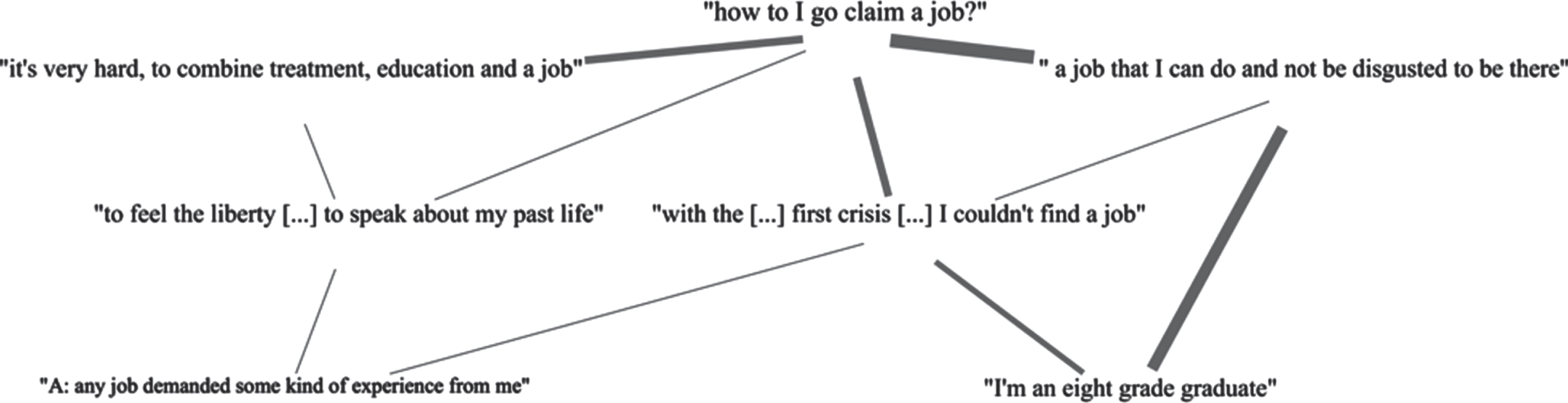
Obstacles co-occurrence.
The first subtheme refers to personal constraints that impede and curtail the materialization of the aforementioned goal. The participants need time to adapt in order to regain contact with their social circumstances. Social anxiety is particularly intense and leads to withdrawal behaviors at the exact moment a person has to step outside their comfort zone. Worse, it does not limit its presence to job seeking but permeates other social situations:
“Can you believe that after nine years in (prison), I wouldn’t get on a bus. Once I got on one, when it got crowded, I got off and walked home. Even worse after: one or two years that I had to one and a half year to start looking for a job and get out, go introduce myself, tut, it’s really tough, for us, uh: the psychological part, it’s really really tough” (Stelios: 95).
Good working conditions are a desired but hard-to-achieve goal. Respect for employees, decent, fair wages, and acknowledgment of their rights constitute a demand of a large portion of the population. Many participants’ previous work experiences are painted with dark colors and take many forms: lack of communication for business closure that leaves an employee hanging, bad behaviors, discrimination, undeclared or underpaid part-time employment with “flexible” hours under a constant pressure regime:
“I distributed flyers for two thirty-five (2.35) euros per hour. And we happened to work for three hours. So, a starvation wage, more like. [...] Not to mention running like crazy to distribute the flyers and them, still not happy. I’d lost six to seven kilos” (Ilias: 85–89).
We meet subsequently with two subthemes that highlight personal flaws and, more precisely, an incomplete educational trajectory and the lack of training/work experience. Those are distinct since their gravity can vary significantly from one job post and employer to another. Filling in the gaps of formal education is a landmark, an achievement with both practical and symbolic value. Graduating from the nine-year compulsory education is important predominantly for the aforementioned dimensions and less as a means for knowledge acquisition: “I would really like to have my school leaving certificate, man. For the paper’s sake, ok? Because I’m not gonna learn anything from school now” (Thomas: 125).
A serious obstacle to work integration is the lack of skills and total absence of work experience. In this particular subtheme, the acquisition of work competencies is perceived as non-certified, informal learning. This learning is acquired through job posts offering knowledge and skills. A CV is considered a means to put oneself forward. A poor CV severely limits the possibility of penetrating the labor market: “There is definitely some degree of difficulty because [...] you have to compose a resume, you have to [...] present yourself in a certain way, you have to show what you know. I don’t know much” (Thomas: 315). Therefore, manual, unskilled labor helps with livelihood but does not seem to have a place in a CV. In other cases, cycles of education and training are opened but never completed since they often follow the degree of control of substance use. Notably, except for one participant, volunteering to acquire skills that may enhance work prospects is missing.
The next subtheme draws attention to the limited job offers caused by the financial crisis. Unemployment is not solely based on personal deficits and obstacles:
“Look, based on my CV, and: I can say that I have a relatively good one [...] I couldn’t find, I saw also: younger ones [...] in the program, with good CVs, and they couldn’t find either. So that wasn’t the issue: maybe the crisis the country is going through [....] and all that: has something to do with that” (Effie: 63–67).
Mass unemployment provokes negative feelings that sometimes lead to a higher sense of motivation—“I was also a bit desperate; you see [...] time went by and I couldn’t find a job and I’m thinking ‘I have to do something”’ (Ilias: 82–83)—sometimes to resignation; “I was soon disappointed because I saw, ‘man’, that there was a big wave: [...] many people you see [...] were jobless” (Dionysis: 63). Finally, largely mismatched employer demands and incomes are a source of discontent.
Several participants focused on the difficulty of simultaneously achieving important goals. Continuation of the treatment up to the reintegration phase, finding employment, and, for some, completing an educational cycle put the challenge bar high. Employment choices are limited, while often, an agreement with the employer is required for the employee to enjoy some degree of flexibility. Under those circumstances, the challenge is twofold: not only finding appropriate employment but also keeping it. A typical day involving work, treatment, and education imposes a fast-paced lifestyle:
“I remember [...] I used to work mornings [...] in another cleaning services business, I rushed home, [...] gobbled some food, getting dressed while eating, went to the groups, we had changed their hours, because at six o’clock, I had to go and finish secondary school, at the western district” (Stelios: 459).
At the reintegration phase, treatment programs suggest finding morning employment, so that a member can attend the groups or transitional school in the afternoon. This is not always possible, though, given the already limited job offer but also the fact that the typical eight-hour day is an unknown word in many work sectors. Some participants found the attitude of the programs contradictory, implying that they ignore the reality of the market.
The last dimension of difficulties in work integration is the disclosure of the participants’ past. Disclosure can come about by examination of the CV or as a result of the need to simultaneously support the goals mentioned in the previous subtheme. Chronological gaps in a CV are noticed, they provoke reasonable questions and are often negatively evaluated by employers. The candidate may not be ready to answer these questions honestly since the disclosure of addiction issues usually requires a relationship of trust and, thus, time. Not everyone handles disclosure in a similar way. Regardless of how they deal with it, most participants consider the possibility of speaking about their past without facing negative consequences for their honesty an important element to social and work integration. However, losing a job after disclosure is not a rare occurrence:
“Then I had as an example when I went to a job, at a [...] bakery: and since I liked it and I bonded, because I was desperate for a job, so: when I went there, to be at peace with myself, and them with me, at some point: after a week, um, I went to the manager and told him: see here, um, I’m from KETHEA, um, and upon hearing this he says ok, no biggie, um, on the way to the (clears throat) program—because we still stayed at the program while looking for a job—um, in the afternoon he texts me to come and get my wages ... So at that point [...] it became most: in my mind that, look, it’s bad talking about it” (Era: 13).
Aid by the treatment program and social-networking were of utmost importance for numerous participants when it came to facilitating factors to a successful job-seeking. In other cases, it meant turning toward unskilled jobs or making use of their previous work experience. This theme emphasizes the significance of the program’s support, which can make suggestions, bring people in contact, or even offer a job—either transitional or more permanent. Its contribution, however, goes beyond that; the program offers a new network of supportive relationships necessary for the stabilization of the therapeutic outcome, additionally assisting, among others, work integration.
For some participants, it was relatively easy to find work during treatment or after its completion. Some among them admit to eventual difficulties which, however, either did not last for long or were rather easy to overcome. There is definitely a need for more targeted research on the profiles of people that have recovered from addiction in Greece who find work easily and those who face great difficulties.
As discussed above, the contribution of the treatment program was pinpointed as the most important facilitating factor to accessing the labor market. Its support can assume many forms, such as a job offer in one of its own SEs, as a graduate—recovery counselor, networking with other (social) enterprises, employment promotion agencies, or employers. Stephanos has worked for more than 20 years at one of the program’s SEs that he himself attended: “I consider myself a lucky man, as in I came here straight away, right after finishing the program” (Stephanos: 77).
An important source of job offers is the participants’ social network. Among the network members, a prominent place is occupied by peers, other members of the treatment program the participants attend: “I didn’t face any difficulties; on the contrary, I was very lucky, because work started right when I was in the middle of the recovery phase, um, period in the program by a graduate who owned a cleaning service” (Stelios: 65).
Finding a job easily often means accepting positions that are eloquently described as “jobs of necessity.” Although which are these jobs? They are unskilled, low-salary, more often than not precarious jobs in health hazard environments; positions for which the demand is always relatively high and to which many participants turned for an immediate solution to their livelihood issues. Manos, 40 years old, mentions:
“Jobs, right [...] delivery, construction sites, that kind of jobs, right? [...] It wasn’t hard for me to find, if there’s a will, you find a job. [...] Ok, maybe a bit of a tough job but [...] if there’s a will, you just do it” (Manos: 79–87).
Finally, previous work experience was the definitive game-changer to a successful job-seeking for some participants.
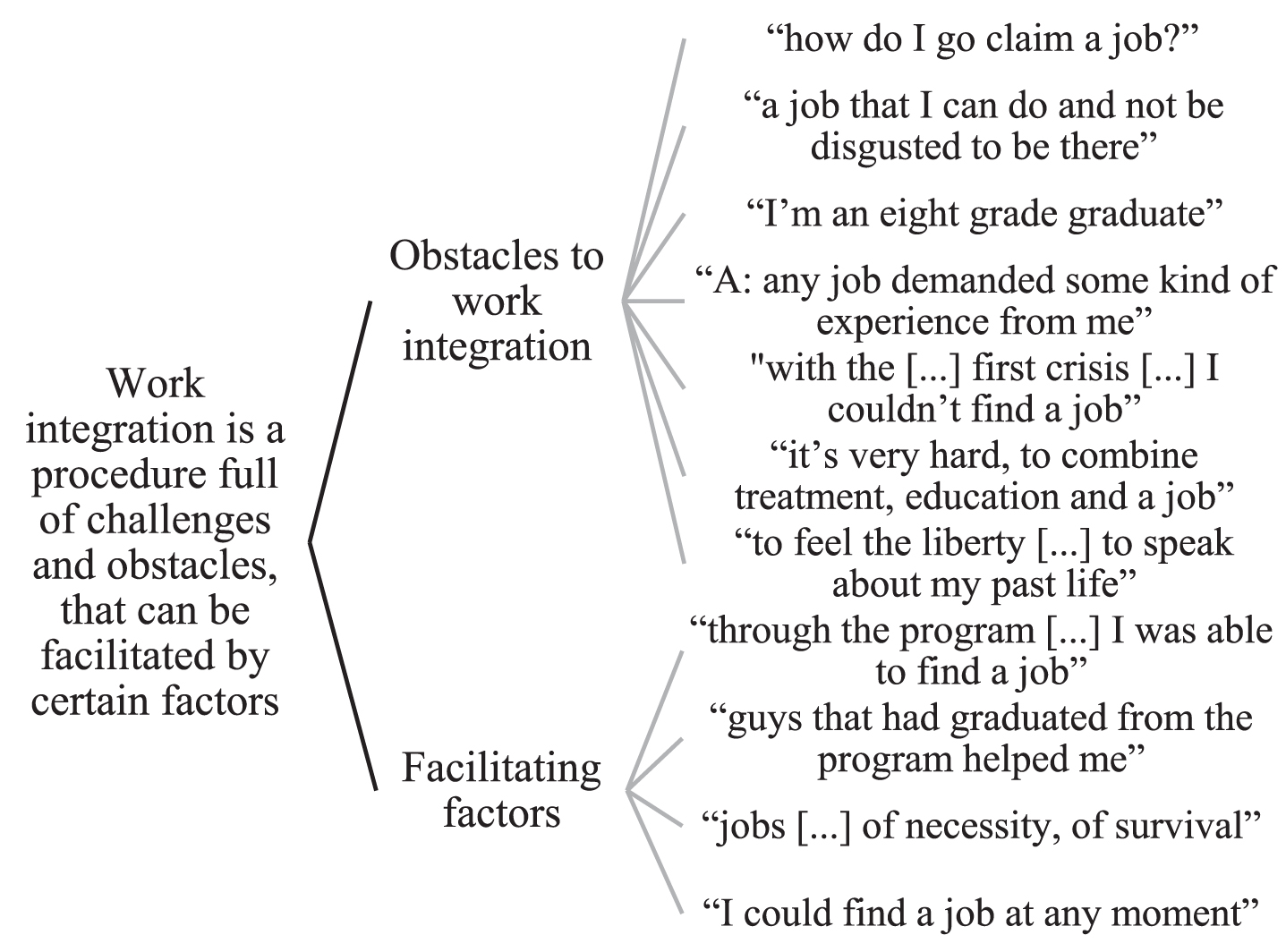
Thematic map.
The above analysis highlighted two main dimensions of the work integration experience of the participants who recovered from addiction and work in social enterprises in Greece. The emerging themes concern the obstacles faced and the facilitating factors; the discussion of the former will follow the Richardson & Epp [15] distinction between micro-, meso-, and macro-level factors.
Micro-level obstacles
This category encompasses the subthemes “How do I go claim a job,” “I’m an eight-grade graduate,” and “A: any job, demanded some kind of experience from me”—personal constraints, i.e., pertaining to the degree of employment readiness, a low educational level, and insufficient work experience.
Regarding the degree of employment readiness, previous research [42] discerned three critical dimensions: convictions, feelings, and awareness of limitations, such as CV gaps. These dimensions emerged through the participants’ discourse. Since they believe that much time is necessary to attain employment readiness, they experience fear and stress before the work challenge, further encountering a lack of confidence and low self-esteem. Moreover, they are aware of their limited interpersonal skills, in addition to their appearance- or age-related matters. These difficulties reveal that the often unidimensional focus on skill and work experience acquisition does not suffice to prepare people that have recovered from addiction for employment, but it should be accompanied by other interventions to lift practical impediments, improve health [23], and reinforce their perception of self-value [42].
Completing compulsory education is considered a formal qualification that increases the chances of finding employment. Treatment programs play a determining role in obtaining this qualification [24]. Although the percentage of treatment program attendees without a high school leaving certificate has declined by 12.4 percentage points since 2002 [18], it remains high (47.7%) compared to that of the general population in the same year (26.6%, ages 25–64) [43]. Based on data from the same year, unemployment rates of those who have not finished high school are significantly higher (49.6%) than those of who have (39.1%) [44].
Limited work experience and the lack of specialization are the final factors determined by the participants on this level. There arise two critical issues related, on the one hand, to labor market fluctuations in demands of skills and experience and, on the other, to how the gaps of people who complete recovery programs can be filled. Concerning the first issue, soft skills seem to weigh more than formal qualifications in the market since the former makes it easier for an employee to adapt to different environments and demands [45]. These kind of skills are nurtured in traineeship programs in actual work environments, such as the one taking place at the KETHEA productive units [46]. As far as skill and work experience acquisition is concerned, the contribution of vocational training programs seems to be of limited value [26]. The Gourgiotou research [47] on members of recovery treatment programs who attended vocational training programs exhibited that the key factor to finding employment was the attendance of the treatment program since, as was previously mentioned, finding a job is perceived as an important therapeutic goal, and the orientation and pressure toward this direction is relentless.
Meso-level obstacles
At the meso-level, we encounter obstacles related to how the participants interact with their social environment—more specifically, with work environments. Two subthemes fit here: “a job that I can do and not be disgusted to be there” and “to have the liberty [...] to speak about my past life.”
The first highlights work conditions. Many participants’ backgrounds are filled with undeclared work, precarity, low income, workplace bullying (belittlement, unreasonable work demands), and, in one case, race discrimination. “Bad jobs” are a threat to physical and mental health, undermining the recovery process in a period when stability and positive prospects for the main aspects of life are of critical importance [48, 49]. In Greece, undeclared work equals or surpasses 25% of the GNP for the last 30 years [5, 50], a fact which confirms the timelessness of this phenomenon. According to controls by the Hellenic Labor Inspectorate (SEPE), undeclared workers were found in 14.29% of enterprises on average for the years 2014–18 [51]. Greece is classified in the second-to-last category in the protection of workers’ rights among countries where workers are exposed to employer arbitrariness despite there being an adequate legislative framework [52].
The second subtheme concerns handling the disclosure patterns of a past in substance abuse and addiction. Disclosure can come either as an internal need or as a “necessary evil” in order to answer CV-related questions or regulate timetable issues. According to Harding [53], mid-way between avoidance of disclosure and full disclosure a third strategy is found—that of conditional disclosure, where the employee attempts to help lift the prejudices associated with their social group by setting an example. This is a strategy of dealing with social stigma, mentioned by Dionysis in the subtheme title. Goffman [54] mentions three types of stigmas, classifying addiction into the second type—character flaws. Since, in this case, there are no obvious differences in appearance or origin, people suffering from addiction find themselves in a constant negotiation about where, when, and to whom they will disclose. Many participants were faced with the negative consequences of disclosure, either in the form of discrimination or dismissal. The ex-addict (and often ex-inmate) stigma is often internalized and leads to self-sabotage. Self-stigma results either from awareness of personal constraints caused by addiction or the expectation of being stereotyped [55], a procedure of acceptance and internalization of social stances and conceptions concerning addiction [56]. The fear of stigma is well-grounded, as personal characteristics or other forms of stigma like criminal records and/or mental health problems may interact with the stigma of addiction, lead to severe/multiple stigmatizations, and cause a serious impact to work experience and relations with employers and peers [57].
To sum up, these two subthemes express substantial fears of KETHEA members trained at the ITHAKI TC productive units [46]. More recently, research presented that former substance users, former inmates, and underage delinquents were the social groups to mention having suffered discrimination in the workplace more often than any other vulnerable social group [58].
Obstacles at the macro-level
Two subthemes pertain to this level, the first of which concerns the consequences of the financial crisis on the labor market and the second the ability to balance treatment and work, combined with other important personal goals, such as the attempt to complete an educational level.
Much has been written about the ways in which the financial crisis completely deregulated the labor market in Greece. Awareness of the gravity of this phenomenon could eventually help to some degree in managing the psychological impact of unemployment. Other points of interest are the dimensions of work flexibilization highlighted in subtheme 1.2, as well as that of the working poor [59], who made up—already before the crisis—one of the highest percentages in Europe and still far away from the European average [60]. In July 2013, the unemployment rates reached 27.90%, the highest ever recorded in the country (1953–2019) [61]. It particularly hit young people, immigrants, women, and people with a low level of education hard while causing the numbers of the long-term unemployed to skyrocket [62]. Although no studies are focusing on the population of people that have recovered from addiction, we can reasonably assume that this group experienced the consequences of the crisis more intensely compared to the general population. With the wounds of the financial crisis in the country not yet healed, the impact of the COVID-19 pandemic on employment is severe [63] and affects more people with a low educational level [64].
The second factor at this level is the participants’ attempt to find a balance, allowing for the parallel attainment of critical recovery and (re)integration goals. The energy required for the realization of these goals can make them mutually exclusive and place the recovered person in a position of conflict with the treatment program in order to prioritize. The often-unyielding demands of the program in terms of duration and frequency of attendance limit the chances of securing employment even more or otherwise put to the test those people who were already employed when they joined the program. Assuming that an ideal job for an open program or the reintegration phase is a morning eight-hour shift, current realities seem to demand that the treatment programs adapt to facilitate their members in combining their therapeutic effort with finding and maintaining employment, as well as with other goals, such as reconnecting with education. If they do not, then the weight falls solely on the person in recovery, who then has to choose between either abandoning a functional part, like employment, or ask for flexibility and, thus, face potential disclosure or even reject job offers. Turning to self-employment or cooperative economy is not a panacea since they also have their prerequisites and particularities.
The second theme that emerged through this research concerns facilitating factors to a successful job-seeking. The key factors for participants not met with significant obstacles during this process was support from the treatment program, a network of peers, and previous work experience. Another factor is the decision to resort to necessity jobs in order to immediately resolve the livelihood issue.
Research on members of the KETHEA therapeutic communities [24], the majority of whom (64%) were unemployed when they joined treatment, reveals that the unemployment rate five years after treatment was a bare 12.8%. 83.6% of those maintaining abstinence worked in full-time jobs compared to only 44.1% of those in relapse. Employment rates were positively influenced by the duration of treatment attendance since the longer a person stayed in treatment, the higher the chances for them to be in full-time employment. This data, of course, came from a time (early 2000 s) when labor market conditions were fairly different compared to a decade later when the country was caught in the whirlwind of the financial crisis, but they still carry relevance. Additionally, Gourgiotou [47] confirms the contribution of a treatment program to finding employment. In programs where finding a legal paid employment was a sine qua non of the therapeutic context, it reached 100% rates (KETHEA therapeutic communities). On the contrary, in programs without this prerequisite (Greek substitution treatment units), rates of success in finding employment were only 12.1%. Further, recent evidence from the 2016–18 period confirms the impact of treatment programs in supporting their members to find employment [18]; evidence of that fact has also been found in studies abroad [23], without implying, however, that there is an unbreakable bond between completing treatment and finding employment [65].
The next facilitating factor was the participants’ social networks, either in the form of a group of peers—fellow treatment attendees and graduates—or via friends, acquaintances, and former employers. The field of peer (ex)users of psychoactive substances’ support in the employment sector is worthy of more investigation [15]. In Greece, job seekers and employers alike seem to benefit more from personal relationships and a network of contacts than from official employment promotion agencies [66]. Recent research on public Professional Training Institute graduates who found employment within six months after graduation (N = 479) substantiated this by revealing that the most important (37%) facilitating factor was the aid of friends, acquaintances, and kin [67].
Besides, finding employment easily was assumed by some participants to be closely associated with low-satisfaction positions, accepted only for survival reasons. Finally, some participants started their therapeutic efforts as self-employed professionals. Elements such as working skills in specific sectors and a pre-existing clientele were considered essential tools to maintain connection or reconnect with the world of employment.
Strengths and limitations
The present article aspires to enrich the research on work integration of the people that have recovered from addiction by adding a qualitative approach to the way their experience is perceived. It is the first research of its kind in Greece. The attempt to reconstruct the trajectory began from the reintegration phase in the treatment program until work integration offered rich material and helped highlight the shared meanings and experiences of the participants. The researcher’s work experience in the field of addiction was also a defining feature in every stage of the research procedure.
The paper focused exclusively on SE employees and aimed to call attention to those critical factors that shaped their work integration experience. It follows that, due to the nature of the research itself, we cannot generalize the results to the entire community of recovered people in the country. Furthermore, despite our efforts to have employees from every SE found to employ people in recovery participate in the research, this was not possible. The research did not consider the gender parameter, which can differentiate the work integration experience a great deal. Although the sample included recovered individuals who belong to specific subpopulations such as mothers with preschoolers, people with dual diagnosis, and former inmates, we have not focused on how those dimensions contribute to the work integration trajectory. The sample does not include people who have completed or are currently attending substitution programs since no such employees were located. Another element that remains unexamined is the fluidity of work integration, since more than half of the workers have been working for less than two years in their SE. Given that work integration is subject to fluctuations, a prospective study of this issue would not be amiss. Overall, a longitudinal research design is expected to provide richer material. Future studies should rely on larger samples and at least two independent researchers to minimize personal bias.
Conclusion
The article examined the experiences of people that have recovered from addiction during their work integration attempt. The data depicted the multidimensional and multilevel character of the obstacles to work integration and, to some degree, revealed their eventual interdependence. A combination of personal constraints, along with obstacles related to a person’s interaction with their social environment, and with broader political, institutional, and socioeconomic parameters obstructing work integration were presented. The participants depended mostly on the treatment program and their social network for their work integration, which potentially reveals a paucity of policies and measures dealing with the issue. This data can contribute to the design of facilitating interventions and policies without reproducing the impasses of the past. A cross-sectoral and intersectional interdisciplinary cooperation is required, but, most of all, a long-term strategy that does not exhaust itself at the opportunistic use of co-funded training and counseling programs is necessary, instead, creating new work environments, changing the terms concerning values, conditions, human relationships, and distribution of power. Those kinds of environments, of which SEs are often an example, are untapped opportunities.
Ethical approval
Not applicable.
Informed consent
All participants signed an informed consent form prior to enrollment.
Conflict of interest
The author declares that he has no conflict of interest.
Footnotes
Acknowledgments
The author is grateful to the participants who shared their experiences. Also, special thanks to Professor Christos Papatheodorou for his comments and suggestions.
Funding
The author reports no funding.