



Abstract
BACKGROUND:
The emotional management of workers can not only increase the efficiency of work, but also contribute to the improvement of the productivity of a company.
OBJECTIVE:
This scoping review surveyed the literature to identify the relationship between postural expression and emotion during sedentary tasks.
METHODS:
We searched relevant literature published up to December 1, 2019 using seven electronic databases (PubMed, CINAHL, Embase, Web of Science, PsycINFO, IEEE Xplore, and MEDLINE Complete).
RESULTS:
A total of 14 publications were included in this scoping review. It was found that the application of pressure sensor and camera-based measurement equipment was effective. Additionally, it was proposed to predict the emotional state of the worker by using forward and backward movements as the main variable as opposed to left and right movements. The information-based analysis technique was able to further increase the accuracy of workers’ emotion prediction.
CONCLUSIONS:
The emotion prediction of workers based on sitting posture could be confirmed for certain movements, and the information-based technical method could further increase the accuracy of prediction. Expansion of information-based technical research will further increase the possibility of predicting the emotions of workers based on posture, and this will in turn promote safer and more efficient work performance.
Introduction
Emotions are reactions to subjective experiences and thoughts and are associated with physiological and behavioral changes in humans [1, 2]. Generally, people experience various feelings when performing purposeful tasks or engaging in certain occupations. In recent years, researchers have expressed a growing interest in detecting the emotions individuals experience while performing activities in work environments. Furthermore, it has been shown that stress from excessive workloads can be related to work efficiency [3–5].
Workers experience a positive flow of emotions and have a clear sense of purpose when difficulties and abilities are balanced. This natural flow of emotions evokes pleasant emotions during work participation [6]. Engagement during work is the behavior wherein workers are fully invested in completing a task and focused in achieving a result [7, 8]. Positive emotions during work not only increase the concentration of workers, but also improve their performance, thereby giving them a sense of accomplishment. This has been shown to have a positive effect on the job retention rate of workers; the management efforts of employers improve the emotional state of workers, which in turn contribute to the improvement of productivity. Therefore, it is important to develop a method that can reduce the burden on workers and predict their emotional state during specific tasks [9].
Emotional problems can often be identified earlier than cognitive problems and can therefore be important predictors of cognitive problems [10–15]. Certain approaches to the detection of emotional states have been suggested, but most of these have not been standardized or generalized [16]. It is possible for facial and postural expressions to be analyzed automatically in real-time. It is therefore important to understand the interaction between emotions and facial and postural expressions. However, relatively little is known about the interaction between emotions and postural expression [17]. In addition, there has been a growing interest in user discomfort regarding wearable devices such as smart glasses and smart watches, with researchers finding that users felt uncomfortable with continuous use of these devices. For this reason, researchers have suggested real-time assessment through embedded sensors placed on objects used frequently in daily life.
In white-collar or blue-collar jobs, many workers spend a majority of their time in a sitting position. Although physical activity is one of the basic functions of human beings, the amount of sedentary activity time is increasing worldwide [18, 19]. Common examples of sedentary behavior are computer or other screen-based use and viewing and desk-based tasks. In all of these activities, a majority of time is spent in a sitting position. Clearly, the sedentary work of blue-collar workers compared to white-collar workers is not often mentioned. Blue collar work can be described as non-clear occupational roles within an industry (e.g. driver, electrician or factory worker) [20].
With the increasing use of technology, sedentary work is taking up a majority of workers’ time. In a previous study, the maximum sitting time for young adults per day was estimated to be 9.2 hours [21]. Thus, the sitting position can be a favorable condition for real-time access to physical and emotional information that may affect an individual’s ability to perform their work. The sitting position enables easy and convenient detection of information that can explain one’s emotional state. This scoping review surveyed the literature to identify the relationship between postural expression and emotion during sedentary tasks.
Methods
We searched seven electronic databases for relevant literature published as of 1st December 2019. We used the framework proposed by Arksey and O’Malley, which has a five-stage review process [22]. First, we reviewed relevant research and selected three research questions. These are the initial exploratory research questions: (1) Can postural expression while performing sedentary tasks be considered as a predictive variable of human emotions? (2) What are the tools and measurement variables that can predict emotions through changes in sitting posture? (3) What are the future research directions and key considerations?
The following eligibility criteria were used: (1) journal article (2) published from 2008 to 1st December 2019, (3) written in English, (4) aimed at confirming the relationship between seated posture and human emotion through a study. Exclusion criteria were: (1) non-human studies, (2) studies involving mental problems, (3) not using a chair in the study, (4) treatment studies of musculoskeletal problems, and (5) training studies for emotional regulation. We used the terms mentioned in a list of sitting posture-related (sitting posture OR on the chair OR on the table) and emotion-related (emotion OR motivation OR affective OR expression OR mood) items as search terms in conjunction with “sensor, system, device, detection, and recognition” to identify relevant research articles from seven electronic databases (PubMed, CINAHL, Embase, Web of Science, PsycINFO, IEEE Xplore, and MEDLINE Complete). Discrepancies in the extracted data were discussed between the two reviewers until an agreement was reached or, if necessary, were resolved through arbitration by a third-party reviewer. A flow diagram shows the process of study selection (Fig. 1).
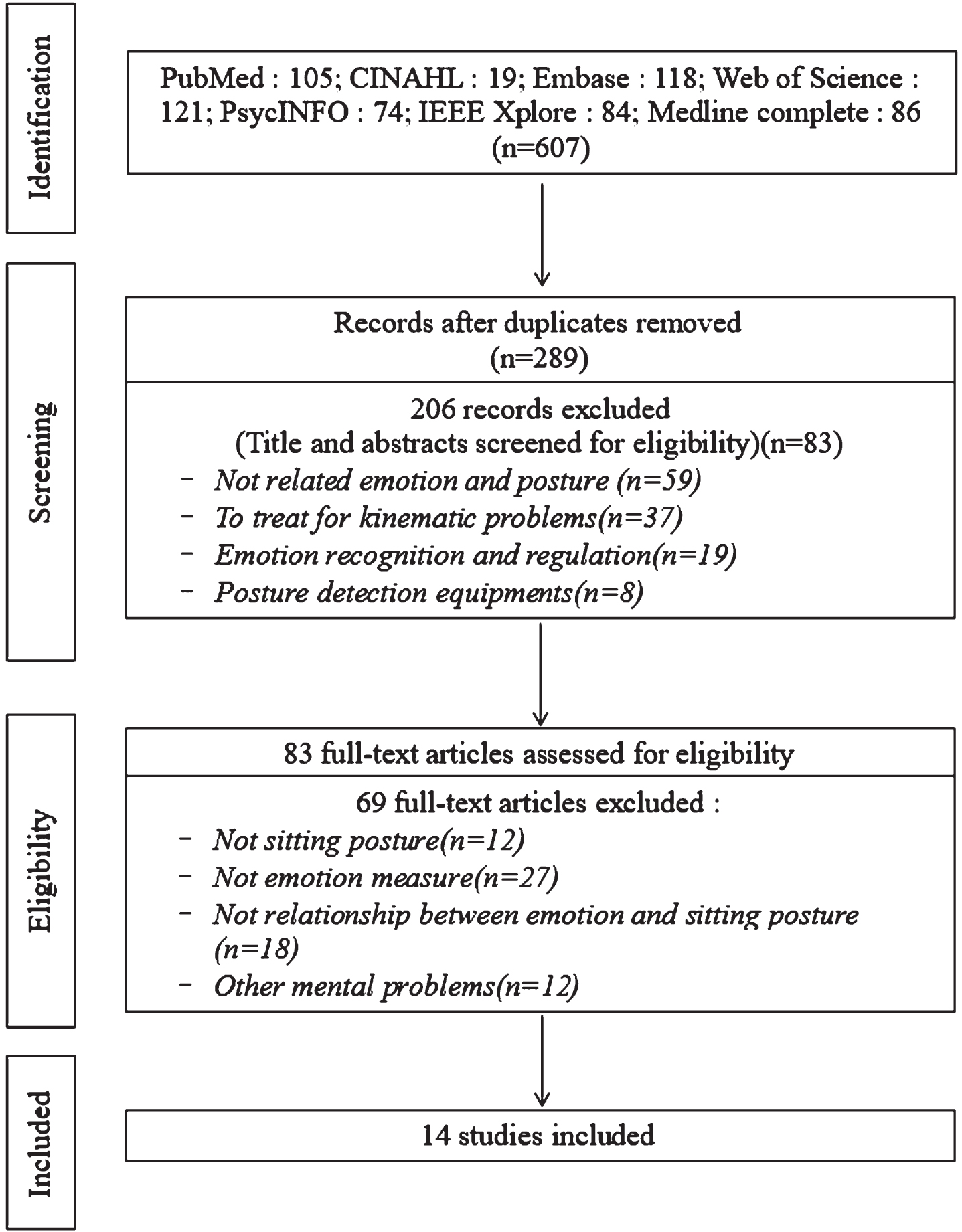
Flowchart illustrating the inclusion process.
Characteristics of sedentary tasks in the studies
To compensate for the absence of previous studies, studies that can be explained in a similar working environment were selected for this review, and the results were synthesized. Sedentary tasks in these studies were classified into three types. First, cognitively demanding tasks were applied in seven studies. Three articles used settings based on game environments [14, 24] and four articles utilized challenging tasks that required a logical reasoning process [25–28]. Second, the researchers defined emotion-related activities. Four studies predicted emotion-relevant actions set by researchers using measurement equipment [2, 29–31]. This was not a process of discovering a change of posture according to workers’ natural emotional change, but an experimental situation to define and distinguish posture based on emotion. Third, a media-related task was applied in two studies [32]. This study used videos that induced emotions (Table 1).
Summary of study characteristics and key results from 14 studies
Summary of study characteristics and key results from 14 studies
ECG: Electrocardiogram, EDA: Electrodermal activity, GER: Gesture Emotion Recognition, HMM: Hidden Markov Model.
Despite the development of technology and automation, it is still a labor-intensive industry. In the case of office work, even in the absence of physical stress, mental stress causes various emotional states in workers (e.g., joy, anxiety, excitement, relaxation). In addition, these emotional states can have an effect on workers’ (1) cognitive states such as attention and motivation, (2) decision-making ability to solve problem situations, (3) sleep disorders and headaches, and so on. It can also be linked to problems such as mental and physical health conditions [33, 34]. These impacts in-turn affect job performance in areas such as safety, health, quality, and productivity [35]. Generally, measured emotional variations represent emotional dimensions such as arousal, valence, and dominance. Valence can be explained as the way in which an individual judges a stimulus (unpleasant vs pleasant), and arousal can be conceptualized as ranging from calm to excited, varying based on the degree of stimulation an individual feels about a stimulus. Finally, the term dominance/control refers to an individual’s sense of control over a given stimulus [36]. Our review confirmed that most studies considered high-arousal negative-valence (e.g., frustration), low-arousal negative-valence (e.g., boredom), and high-arousal positive-valence (e.g., joy) (Table 2).
Summary of study characteristics and key results from 14 studies
Summary of study characteristics and key results from 14 studies
FER: Facial Emotion Recognition, GER: Gesture Emotion Recognition, J48: J48 decision tree, NB: Naive Bayes classifier, RF: Random Forest.
In most studies, we confirmed that the tendency to tilt backward indicates a high-arousal positive emotional state, and to tilt forward indicates a high-arousal negative emotional state. However, there were no significant differences noted between left and right movements. We analyzed the relationships between the arousal and valence aspects and postural expression during sedentary tasks in each study [17, 31]. High-arousal was associated with the vertical posture. Arousal was influenced by the difficulty level of a task and affected body movements when involving a cognitive process [28]. There is evidence of an increase in arousal when frustration or challenge is experienced. Additionally, the number of movements was related to high-arousal states [24]. Positive valence was associated with the body leaning backward on the chair. The number of movements is also influenced by the difficulty level of a task. Frustration and boredom lead participants to adopt a posture defined as a forward tilt or decrease in posture height (slumped posture) [17, 31]. In addition, high-arousal negative-valence (e.g., fear) showed more marked relationships with posture changes than low-arousal negative-valence (e.g., shame) and high-arousal positive-valence (e.g., joy) [2]. Some studies have introduced a learning machine system that can analyze data; these studies suggested a new approach that could increase the recognition rate through a building system that combines the recorded data of facial expressions, body postures, and hand gestures [2, 32] (Table 2).
Emotion detection tools in sedentary tasks
The emotion detection tools used to assess the change of posture expression in studies were motion tracking, depth-image sensor, pressure sensor, and accelerometer. Most of these tools evaluated pressure or movement on the chair during sedentary tasks. Six studies used pressure sensors and accelerometers to detect emotions while sitting and working [2, 29–31]. One study was conducted using only a pressure sensor without an accelerometer [16]. The variables measured through the equipment were analyzed by defining the main variables such as facial muscle movement, expression change, gaze change, and head, arm, wrist, trunk, leg, and ankle movement. In most of these studies, head, torso, arm, and wrist movements were measured and analyzed as major variables. Some studies also used high-resolution cameras or camcorders to detect emotions while participants performed sedentary tasks. Among the selected studies, five studies [23, 32] were used, and two cases of depth sensors using body type characteristics were used [14, 27] (Table 2). Interestingly, in two studies, measurements using physiological variables such as ECG (electrocardiogram), EDA (electrodermal activity), and breathing rates were simultaneously applied. These devices confirmed heart rate and parameters of skin electrical activity. In addition, in four studies, motion patterns were analyzed using a machine learning algorithm-based analysis method to predict the emotions of workers through motion pattern analysis and to predict patterned motions (Table 1).
Discussion
In this scoping review, the characteristics of postural expression based on emotional states were compared, and the applicability of techniques to detect workers’ emotional states was explored. Workplace environmental factors can promote success or, if unresolved, reduce work efficiency and increase job-related stress. The latter can lead to reduced job performance and reduced retention of employees [37]. Most postural expressions found in this review were analyzed based on the characteristics of participants’ postures when sitting on a chair, and the differences between various tasks were compared.
This scoping review was conducted to address three main research questions. First, “Can postural expression while performing sedentary tasks be considered as a predictive variable of human emotions?” In particular, the emotional variables of frustration, shame, and pleasure were more clearly distinguished emotional variables and were highly related with significant changes in the body [2, 23–32]. Higher levels of arousal in experimental work allow for higher levels of detection through posture-related variables [17, 30]. Back-and-forth movements from a sitting position, as evident in the literature, were relatively related with positive and negative emotional responses to tasks. It is interesting to note that some studies have pre-defined emotion-based behavioral traits and then studied the predictability of defined movements [2, 29–31]. This study focuses on the possibility of identifying emotional state based on the movement of workers by defining human movement characteristics in advance; therefore, it can be assumed that these studies are more advanced than the discovery of the movement characteristics.
Negative emotional states in the work environment affect individual productivity, but few studies have investigated how to detect and manage these emotional changes [38–41]. Clearly, confirmation of the feasibility of these measures would be beneficial in clearly distinguishing the characteristics of postural expression for each task and providing appropriate task-context adjustments.
To answer the second research question, “What are the tools and measurement variables that can predict emotions through changes in sitting posture?”, the techniques used to measure emotional changes were motion tracking, pressure sensors, depth image sensors, and accelerometers. In particular, the method of evaluating the pressure or movement exerted on the chair during the activity was most often used. Most motion detection systems can be classified into three categories: wearable sensor-based, ambient sensor-based, and computer vision-based methods. Wearable sensor-based methods generally rely on accelerometer sensors attached to the user’s body [42]. The ambient sensor-based motion detection system uses external sensors built into the environment, including pressure sensors, acoustic sensors, and EMG sensors [43–45]. Pressure sensors are commonly used because they are low-cost and unobtrusive. However, a major drawback of these sensors is the low detection accuracy (less than 90%) [46]. Our review found that the use of pressure sensors was high. The problem of precision was countered by combining it with other equipment and utilizing data mining algorithms to increase the accuracy of the distinction [14, 27]. Increasing precision by combining pressure sensors with other measurement elements should be considered in future research plans to identify and measure the emotional changes of workers. Additionally, attention should be paid to a specifically important method: a camera that provides a depth map in real-time and is a detection and tracking method that can reliably extract the trajectory of the body, which has proven useful for precise motion detection [47]. In general, omnidirectional cameras are useful if a wide field of view is required. In addition, thermal imaging video cameras that detect the amount of heat radiation emitted/reflected from objects in the scene may provide valuable information for reliable motion detection [48]. However, the disadvantage of the existing equipment is its high cost, leading to its limited application in general environments. Recently, however, Kinect’s sensor was proposed to detect human motion [49]. The depth map provided by the Kinect sensor is sufficient to extract people from the background [49, 50]. In addition, people can be detected at any time by estimating a dense depth map based on the spot pattern of the infrared laser [50].
In the future, the application of a technology that can extract camera-based measurement will be an effective method to detect the emotional state of workers. In addition, data mining and machine learning methods can be applied to increase the accuracy of distinguishing emotional states based on movement. In everyday life, people develop a variety of postures and movements. Pattern recognition and classification is an important detection method to differentiate normal activities from changes in movement due to changes in emotion [51]. Feature extraction and selection is the process of identifying relevant features or attributes in collected data [52]. Decision trees (DT) is one of the oldest algorithms used in motion pattern classification problems [53]. This review showed that extremely randomized trees spent less time training the model compared to random forest (98.66 seconds) and gradient boosting trees (2291.03 seconds). In addition, postures according to emotions could be classified through J48, SVM (Support Vector Machine), and Naive Bayes classifier (NB) to confirm the detected movement. Among these, J48 was the most effective classification system [14, 27]. Recently, these methods have been used in diagnostic and prognostic models for neuromuscular and musculoskeletal pathology and fall prediction, focused on activity perception-clinic patient monitoring [54]. As such, machine learning methods are expanding in motor biomechanics and were attempted in two of the studies included in this review. Predictive modeling can be used to map input data to a given output and predict future events with confidence. This is one of the significant methods and trends in recent research. Prediction is necessary and important in human life. Recently, machine learning has been widely used as a method that can easily perform such predictions. In general, applying a machine learning algorithm can generate a predictive model for a target variable. Machine learning methods will increase the availability of interpretation and prediction of external information [55].
The third question guiding this review was, “What are the future research directions and key considerations?” There are some points in this review that warrant caution when interpreting the results. The studies selected for this review did not use an actual working situation as an experimental situation. Additionally, since the applied task is not selected as the actual work content, there may be limitations in generalization of the results. However, we can generalize these findings to a certain extent since most work is cognitive-based, and negative emotional changes such as job stress appear prior to physical changes. Therefore, the work of this review will be the result of having the possibility of generalization of the work environment of physical and mental workers. These measurement systems of workers’ emotions can be an important safeguard, especially for white-collar workers. However, most job characteristics involve unpredictable situations, and it can therefore be difficult and impractical to clearly understand a person’s emotions while sitting. However, predicting the emotional state of workers by applying the analysis method through the accumulation of long-term behavioral variable data can be an applicable system [56–58].
Another important topic covered in this review is applied skills for measurement. Several documents have emphasized the possibility of applying additional technologies to the working environment such as prediction algorithms and data mining or machine learning classifiers. The realization and use of methods that can predict the emotional state of a worker is a new field of research that can enhance work experiences [56–59]. These benefits can be extended to workers in various occupations. However, more research is needed to investigate whether these methods are an alternative to identifying the emotional state of the worker. It will be important to investigate how to securely apply such methods to identify the reactions and adjustments of workers to conditions of the work environment [60–63].
Continuously measuring the emotional state of workers in the workplace can provide important information to reveal how workers’ emotions change in the workplace. Data-based analyses have recently begun to be used in various fields such as e-health, e-learning, and recommendation systems. A system that analyzes and interprets information based on data accumulated over a long period of time has great potential in various areas, including mental health monitoring. Given the importance of mental health in modern society, researchers will now have to find a way to accurately recognize human emotions and develop realistic applications and efficient intervention plans to maintain mental health. For example, a workplace system with an emotion recognition module will be able to monitor the psychological state of workers in real time and accordingly provide the appropriate response and treatment when required [64, 65].
A limitation of this review is that there is no study on actual workers, and generalizability of the working environment is limited. Thus, detailed information regarding job types and individual characteristics of workers cannot be provided. In addition, the majority of experimental participants were 20 to 40 years of age, while the overall age range of actual workers has been found to mainly fall in the range of 30 to 50 years.
Conclusion
Back-and-forth movements from a seated position were relatively associated with positive and negative emotional responses to tasks. Measuring equipment based on pressure sensor and cameras were effective in understanding worker movements in response to their emotions. Their emotions could be predicted from their sitting posture when associated with movements; using a data-based technical method here could further increase the accuracy of the predictions. An expanding use of such data-based technologies in predicting workers’ emotions to ensure their safety while achieving more efficiency and productivity will result in further advances in workers’ emotion prediction technology.
Conflict of interest
None to report.