



Abstract
BACKGROUND:
Despite constant technological evolution, the forestry sector is still characterised as one with the highest risk of occupational accidents. There is no doubt that accidents penalise workers considerably, as well as the companies, insurers, and, consequently, the society, to which many of the costs are externalised, namely in cases where the worker is incapacitated and unable to work.
OBJECTIVE:
The aim of this work is to analyse data on occupational accidents in forestry operations in Brazil between 2007 and 2018 in both native and planted forests.
METHODS:
Data were made available by the Brazilian Statistical Directory of Accidents at Work.
RESULTS:
The results show that, although most accidents occurred in planted forests, mortality was higher in native forests. It was also found that, overall, the rate of serious accidents resulting in an incapacity to work and, consequently, sick leave is considerably high.
CONCLUSIONS:
These results highlight that integrating an occupational safety system into a forest management system is crucial for reducing work-related accidents in both native and planted forests. However, the success of this measure will only be effective if it is accompanied by a review of both the Brazilian labour policy and the Brazilian occupational safety management policy, to ensure compliance with legislation, mainly on the part of outsourced companies.
Keywords
Introduction
Brazil is a country with approximately 497 million hectares of forest cover (58% of its territory), representing the second-largest forest area in the world, after Russia [1]. The Brazilian forestry sector stands out for being responsible for the production of 91% of the wood consumed worldwide and represents a 6.4% weight in Brazil’s GDP. Native forests represent most of this area when compared to planted forests [2].
In the wood production process, the raw material may come from planted or native forests [3]. Intensive labour and hard is required to meet the demand for wood production and, additionally, tend to be underpaid. In contrast, labour in urban centres tends to be lighter and better paid. Under this circumstance, it is very difficult to recruit workers to formally assume a job in the forest. As a way of responding, not only to the high costs of the workforce that is difficult to attract and maintain, but also as a way to increase productivity and competitiveness in the market, many companies have invested in the mechanisation of forest work [4].
While working in the forest, workers are exposed to various risks of accidents. The main risks are related to exposure to physical, chemical, biological, and ergonomic agents and related to their routine displacement of work to the residence and vice versa. The most frequent accidents are associated with at least one of the following factors [5–13]: Workers’ inexperience and/or negligence in complying with protocols, procedures, and safety standards; Workers’ incorrect use of equipment and tools or the lack of periodic maintenance of tools and machines; Deficient planning of operations (a lack of specific training, on both the use of equipment and tools and on general occupational safety issues); Intense psychological pressure on workers to produce as much as possible; Precarious employment relationships that do not take into consideration the workers’ physical fatigue, related to both the long daily travel between home and the workplace, and the harshness of the work itself, typically monotonous and carried out over long hours (> 8 hours per day), often with an insufficient number of breaks); Adverse environmental conditions associated with the local weather and terrain, worker exp-osure to intense noise and vibration from mach-inery and equipment, chemical agents emitted from machinery, and biological agents such as insects, wild animals, and poisonous plant species.
Therefore, workers are often exposed to situations where their safety and health can be compromised.
Despite the introduction of mechanisation to reduce the harsh conditions, the forestry industry from all over the world remains a very demanding industry with high rates of occupational accidents [6, 14–18]. Brazil is no exception, and data from work-related accidents in forestry operations in this Country analysed for the periods 2007–2013 [19] and 2010–2014 [20] confirm this. Since then, no scientific work related to this topic has been published. In this context, this research aims to consolidate and extend the data period span of the previous analysis (for the periods 2007–2013 and 2010–2014 by carrying out a synthesis of the main official data from work-related accidents in both native and planted forests in Brazil between 2007 and 2018 and, at the same time, to reflect on its evolution and the suitability of the current safety and health policies and legislation regarding these occupational accidents.
Materials and methods
In this work, data regarding work-related accidents in forestry operations, in both native and planted forests in Brazil, between 2007 and 2018 were gathered from the Statistical Yearbook of Accidents at Work (AEAT) of the Brazilian Ministry of Economy (https://www3.dataprev.gov.br/aeat/inicio.htm, last accessed on March 22, 2021). This organisation collects information from the CAT (Communication of a Work-Related Accident) reports submitted to the INSS (National Social Security Institute of Brazil). Both entities are supervised by the Special Secretariat of Social Security and Labor of the Ministry of Economics. Then, data synthesis was conducted to analyse the information.
The information was compiled in Excel spreadsheets (version 16.50 for Mac), and typical descriptive statistics was conducted. In addition, and considering that the output values do not allow a more precise interpretation of accident occurrences as they tend to accompany the eventual increase (or reduction) of the studied population, incidence rates were computed. The incidence rate is an indicator of the relative risk that a given event will occur (or has occurred) in a given population in a given period. It neutralises the effect of a possible misinterpretation of the data due to fluctuations in the population. The following incidence rates were considered interesting to ascertain.
Professional diseases, those provoked or triggered by the exercise of forest work, were considered outside the scope of this research.
Typical accident incidence rate
The accident incidence rate is an indicator of the intensity of accidents. It expresses the relationship between working conditions and the average number of workers exposed to those conditions. This relationship is the most general and simplified expression of risk. The specific incidence rate for occupational accidents in the forest is defined as the ratio between the number of new accidents each year, that is, registered with CAT and for which it was possible to identify the reason for the accident, and the population exposed to the risk of having an accident. Equation 1 shows the typical accident incident rate A due to forest work for 12 months and every 1,000 workers, N A corresponds to the total number of accidents due to forest work (12 months), and N W corresponds to the average annual number of forest workers (12 months).
The incidence rate for temporary incapacity to practice the profession is computed according to Equation 2. Incap corresponds to the incidence of accidents rate due to forestry work that resulted in temporary incapacity to exercise the profession for 12 months and 1,000 workers. NA _ incap corresponds to the total number of accidents due to forest work that resulted in temporary incapacity to practice the profession (12 months). N W corresponds to the average annual number of forest workers (12 months).
The mortality rate measures the relationship between the total number of deaths resulting from occupational accidents in the year and the population exposed to the risk of accidents. It can be computed according to Equation 3. D corresponds to the mortality rate due to accidents that occurred while carrying out forest work in 12 months for every 100,000 workers. D A corresponds to the total number of deaths that occurred due to accidents caused by forest work (12 months).
Occupational accidents in the forestry industry have maintained a relatively high number of recorded cases countrywide. Between 2007 and 2018, a total of 21,298 work-related accidents were registered that were due to forestry activity in both planted and native Brazilian forests. The total number of accidents consistently surpassed 1,000 per year (Table 1). These numbers do not include the accidents in auxiliary activities that, although supporting forest exploration, are performed outside the forest. In this period, the largest number of accidents occurred in 2008, with an increase of 147% over 2007. Since then, a global decrease in the annual number of accidents has occurred (Fig. 1). A reduction in the number of accidents of 40% was recorded between 2010 and 2017.
Main statistical descriptors for the number of total work-related accidents per year due to forestry activity in Brazil between 2007 and 2018
Main statistical descriptors for the number of total work-related accidents per year due to forestry activity in Brazil between 2007 and 2018
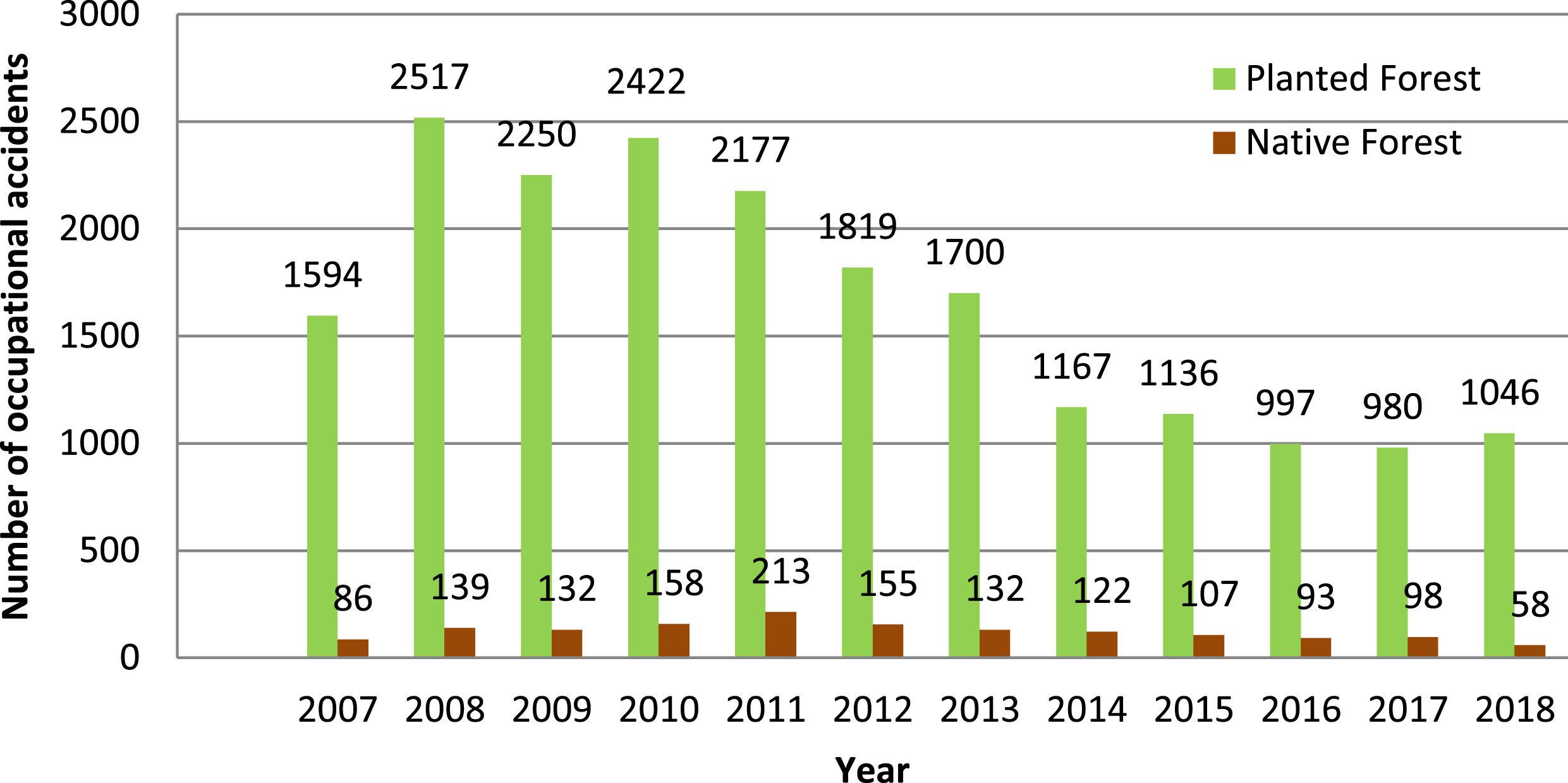
Number of total work-related accidents per year, by type of forest (planted and native forests) in Brazil between 2007 and 2018. (Source: Brazilian Statistical Directory of Work Accidents, AEAT.).
According to the type of forest where the activity was conducted, a close examination of accident numbers shows that most of them occurred in planted forests. However, after 2010, this number began to decrease consistently, reaching a minimum in 2017. An increase in occupational accidents in native forests occurred between 2007 and 2011 (Fig. 1).
The incidence rate of work-related accidents between 2007 and 2013 in planted forests was above 20 cases per 1,000 workers. After 2013, this rate started a gradual decrease until 2017, when there were only 13 accidents per 1,000 workers reported. In the native forests, no pattern was observed for the rate of accidents. However, it can be observed that this rate increased from 6 to 13 accidents per 1,000 workers between 2007 and 2011, and in 2014 an exceptional value occurred of 16 accidents per 1,000 workers, almost the same rate as reported for planted forests (Fig. 2).
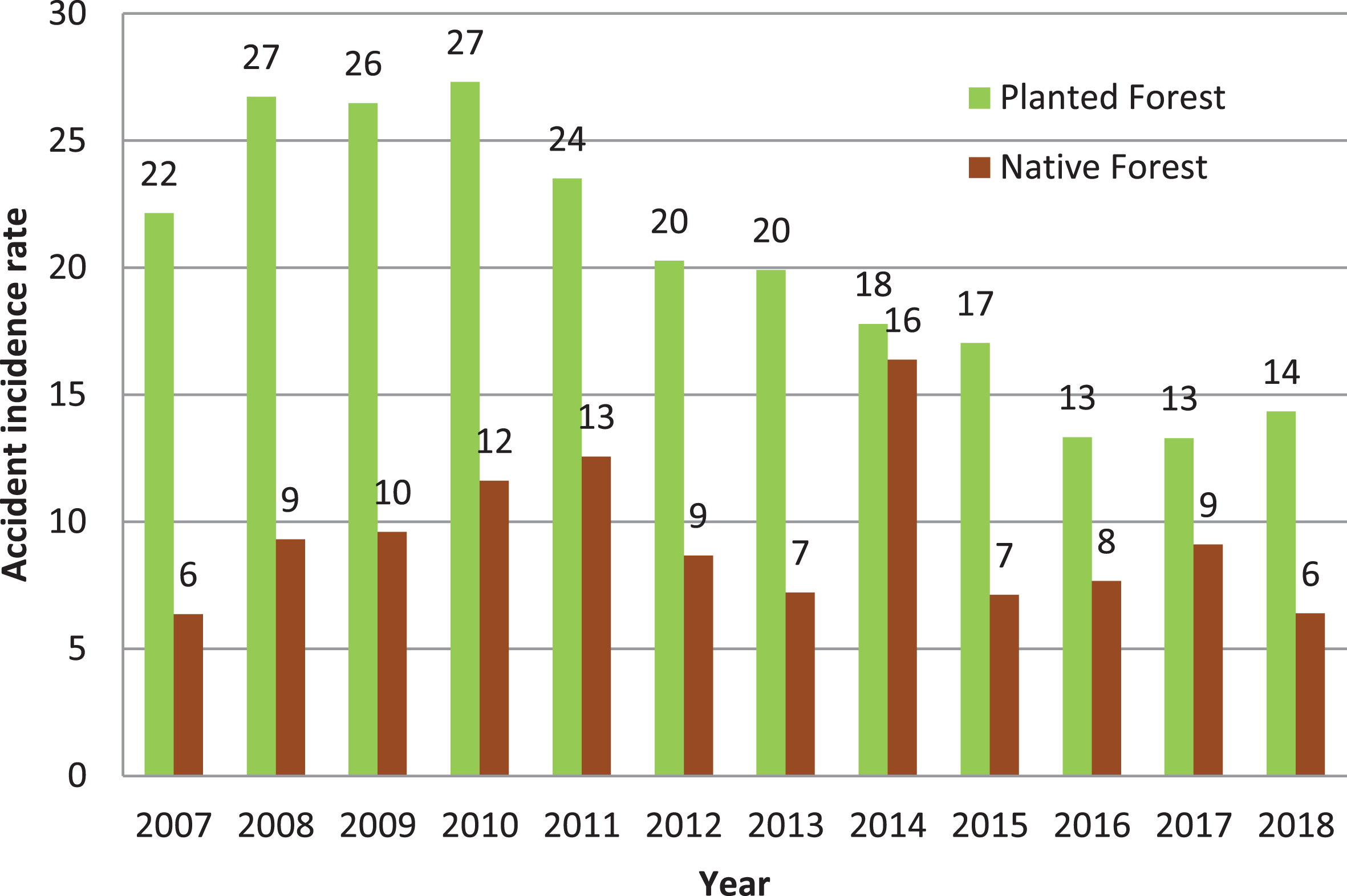
Work-related accident incidence rate, per year and type of forest (planted and native forests) in Brazil between 2007 and 2018. (Source: Brazilian Statistical Directory of Work Accidents, AEAT.).
Fractures and cuts, lacerations, bruises, and punctures are among the most frequent injuries reported [5–8]. In addition to these accidents, work-related illness can prevent workers from working temporarily or even permanently, and deaths can also happen. Concerning paid work-leave permits due to accidents in the forestry sector, 1,879 cases were reported between 2012 and 2018, and the accident rate decreased by 45%. Inspecting the numbers according to forest type, the temporary incapacity incidence rate in planted forests was higher than in native forests. In planted forests, a peak of 34 per 1,000 workers occurred in 2008 and remained constant in 2009 and 2010. This was followed by a gradual decrease (with some small oscillations) until 2018, when the temporary incapacity incidence rate was halved (Fig. 3). For native forests, despite the lower numbers when compared to planted forests, no pattern, not of increase nor decrease, was observed.
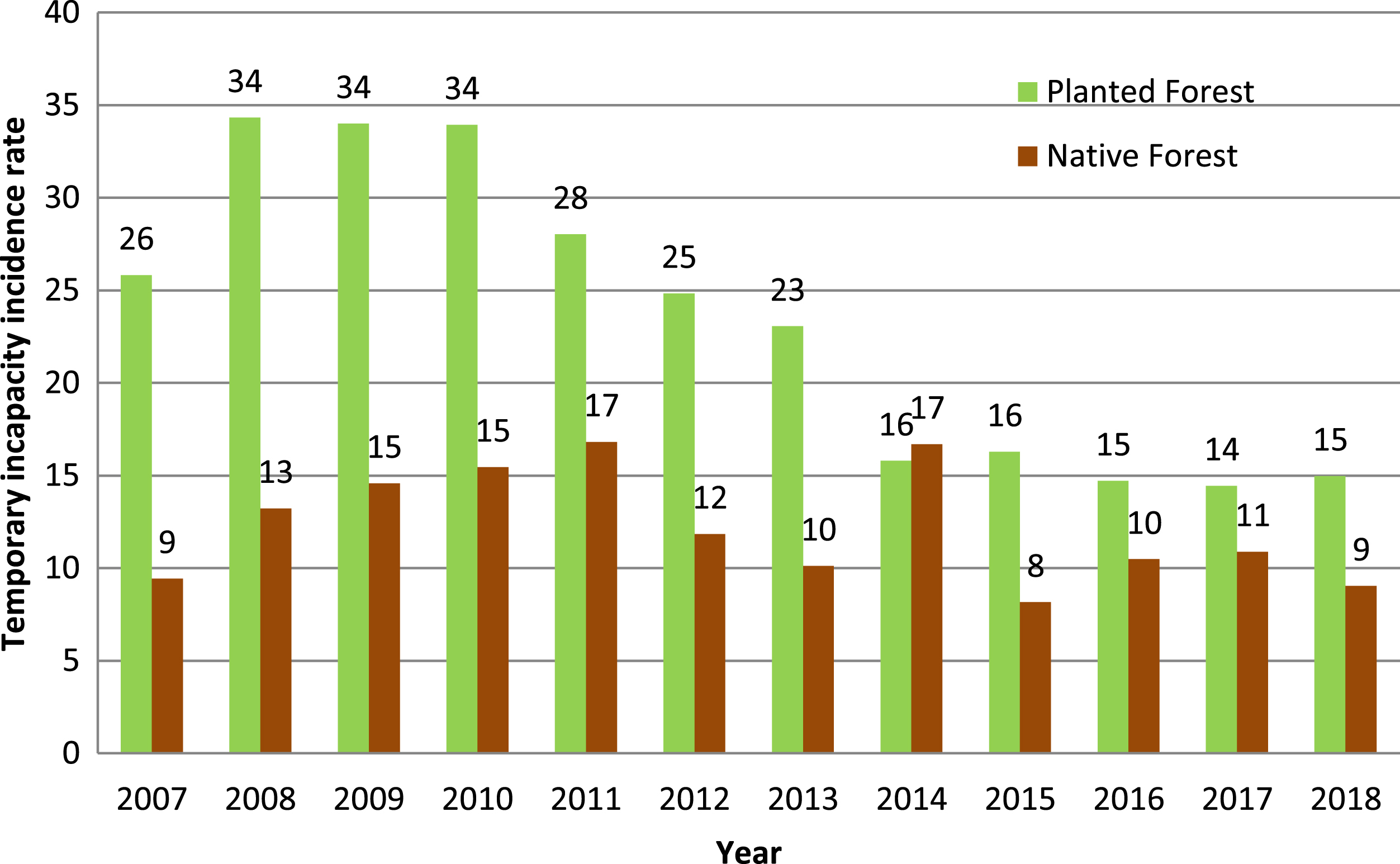
Temporary incapacity incidence rate, per year and type of forest (planted and native forests) in Brazil between 2007 and 2018. (Source: Brazilian Statistical Directory of Work Accidents, AEAT.).
The data for the mortality rate for work-related accidents in the forestry sector between 2007 and 2018 show great variation between years and forest types (Fig. 4). For planted forests, the greatest mortality rate occurred in 2007, with more than 30 deaths for 100,000 workers. In the following years, this rate varied without a specific tendency. In fact, although the total number of accidents decreased, the rate of fatal accidents did not follow this trend. For native forests, mortality rates are higher than in planted forests, also with no specific tendency. However, the year 2014 is highlighted as showing the highest mortality rate, reaching a value of 81 work-related fatal accidents per 100,000 workers.
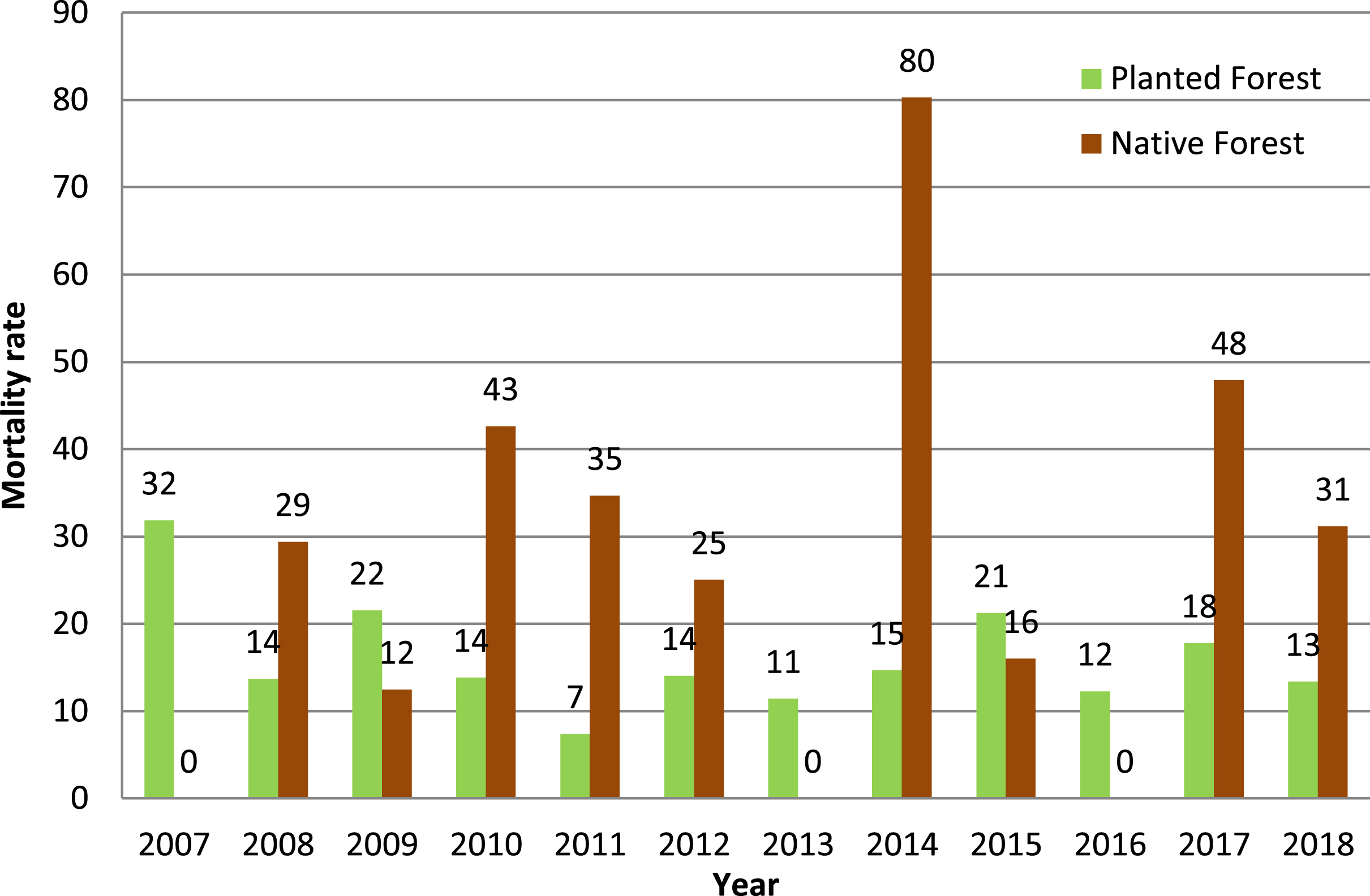
Mortality rate due to work-related accidents per year and type of forest (planted and native forests) in Brazil between 2007 and 2018. (Source: Brazilian Statistical Directory of Work Accidents, AEAT.).
The number of work-related accidents resulting from forestry activity between 2007 and 2018, in both planted and native forests in Brazil, is high and consistently surpassed 1,000 per year. However, since 2010, the total number of occupational accidents in both planted and native forests shows a decreasing trend. These facts are consistent with data from previous research on work-related accidents in forestry operations in Brazil, namely for the periods 2007–2013 [19] and 2010–2014 [20].
It is not surprising that in all countries for which comparable statistics are available, forestry once had one of the highest occupational accidents rates per employee than other sectors of the economy [21]. Nevertheless, the introduction of mechanisation in the forestry sector, along with consistent technological evolution to improve the use of safety devices in tools and forestry equipment, has led to improvements in the mechanised harvesting processes, allowing a substantial reduction in operating costs, and in parallel, an improvement in working conditions [19, 23].
The overall reduction in occupational accidents in the period 2012–2018 may also be related to the implementation, in Brazil, of the Accident Prevention Factor (FAP) measure in 2010, which provides for contributions by companies to an Occupational Accident Insurance (SAT) program for workers. The FAP was created to encourage the improvement of work conditions and workers’ health and stimulate a culture of prevention in companies because firms with higher accident rates pay higher taxes. Those with fewer accidents pay less. In effect, employers have realised the financial burden of neglecting health and safety at work and have become more assertive about applying effective protection measures in their companies, in compliance with NR-31 legislation. NR-31 aims to establish the precepts to be observed in an organisation and in the work environment to make the planning and development of forestry activities compatible with safety and health in the work environment. Its application is follows NR-28, which assigns penalties in cases of noncompliance.
The rate of occupational accidents in native forests is substantially greater than in planted forests, although they follow the same tendency. Again, the most appropriate justification for this fact may be related to mechanisation. Once, native forests posed limits to mechanised techniques due to their inherent characteristics and legal aspects surrounding the use of machinery in these forests.
Mechanised and semimechanised operations involve extracting timber through the use of heavy machinery. Ideally, machine operators should be assigned to a single machine type based on their mastery of its operation. Whether planted or native forest, when mechanisation is not technically and economically feasible, semimechanised harvesting of trees using chainsaws is the practice most applied in Brazil (David et al., 2014) and all over the world [12–24]. The use of chainsaws explains the persistence of the high number of occupational accidents in forestry. Tree cutting and felling using portable chainsaws are among the most dangerous activities in timber harvesting operations. It is widely known to expose workers highly to hazards [25, 26]. According to the SmartLab platform (https://smartlabbr.org/sst) from the Brazilian Public Ministry of Labor (MPT), the most frequent injuries that lead to death because of the improper use of equipment in native forests between 2012 and 2018 were injuries to the head (27%), cranium (20%), and legs (13%). In planted forests, fatal injuries were to the head (13%), multiple body parts (13%), and abdomen (11%).
The likelihood of a worker suffering an accident at work is related mainly to the improper handling of chainsaws [27]. However, it is also related to the absence of adequate breaks during working hours, lack of training to perform the task, and lack of awareness of compliance with safety standards [10, 16]. In fact, not all Brazilian forestry companies invest in training, particularly safety training, and the provision of safety equipment [28], and workers often admit to breaking safety rules in response to the time pressure to meet targets [11–29]. So, although workers have high personal motivation to work safely, they admit to underestimating workplace hazards [30, 31]. In this context, and considering that the adoption of safe work practices depends on both the worker’s motivation to act safely and on an organisational climate that promotes and reinforces safe work habits, adequate training appears to be an obvious approach to reducing occupational accidents. Workers’ training on the use of machinery and tools, as well as personal protective equipment (PPE), was identified as being of great importance towards reducing occupational accidents [6, 26].
The flexibility of labour relations promotes outsourcing, transferring certain services to third parties and allowing other forms of contracting to replace formal, regulated, and relatively stable employment. In the forestry sector, this job assignment model is traditionally used to reduce the cost of activities, from planting to harvest and going all the intermediate stages. However, in the last decade, outsourcing has become more concentrated in manual and semimechanised tree harvesting, recognised as the most dangerous and costly. In Brazil, subcontracting, self-employment, and precarious employment relationships are usual in the forestry sector, which may also be one reason why a high rate of occupational accidents due to forestry operations persists [10, 30].
Another aspect that should be highlighted concerns the accuracy of the data. According to Brazilian Law no. 8213/1991, a Work Accident Report (CAT) must always be created, regardless of the severity of the work accident. However, the number of occurrences presented in the databases consulted refers only to reported accidents and accidents where workers or companies received benefits from the National Social Security Institute (INSS). Therefore, self-employed workers (who make their own social security payroll tax payments), rural landowners and their relatives (who often carry out activities informally, without social security payroll), and illegal and clandestine workers were also not counted in the records. Thus, the low number of accidents in some years may be due to underreporting by employers. This type of behaviour had already been identified in an analysis of accidents at work in Brazil between 1994 and 2004. In several studies, low notification by companies of the occurrence of accidents at work to the official bodies was pointed out as a way to hide the reality of working conditions and avoid economic sanctions [17, 29].
The use of outsourcing is common. Companies that provide these services invest little in workers’ safety, and the companies often temporary workers with no contractual relationship. However, at the same time, they demand high levels of productivity [32]. The introduction of regulations for outsourcing companies may have contributed to reducing work accidents in forestry operations in Brazil.
It is also important to emphasise that the decrease in the total number of accidents over the years analysed in this study was accompanied by an increase in the certified productivity of the forestry industry. This is shown by statistical data from 2010 to 2017 published by the Forest Stewardship Council (FSC), which show that in 2010 there were 4,720,645 ha of managed forests and 63 certified forest management units [33], while in 2017, these numbers were 6,185,805 ha and 114 UMF, respectively [34]. In the last two decades, the market began to demand guarantees that forestry goods were not produced through illegal activities. One of the instruments developed to this end was forest certification, represented in Brazil by the Forest Stewardship Council (FSC) and CERFLOR/PEFC systems. Certification, besides verifying that a forestry management system is operating within the standards of the certification parameters, also requires that these operations comply with national labour legislation and occupational safety and health legislation, namely NR-31, which was approved in 2005 [35]. Therefore, the reductions in the number of accidents over this period may also have occurred due to the higher standards instituted by certification processes, which forced this sector to operate under strict safety policies, whereas before, the sector operated practically without adequate legislation and enforcement. Around the world, the implementation of management systems through forest certification has positively affected the management of occupational health and safety procedures and, consequently, resulted in a decrease in occupational diseases and accidents [36]. However, reports from certification results may vary significantly between companies [37].
The occurrence of accidents in the forest sector is directly attributed to the risk conditions that workers are exposed to. Frequently mentioned are the lack of use of or breaking down protection mechanisms when using heavy equipment, the methods used to carry out the forestry work, and, finally, the often-aggressive nature of the environment in which forestry work is carried out.
As in previous scientific reports, the enormous numbers of occurrences persist and suggest the need for reflection and subsequent mitigation. Measures to be put into practice by companies to reduce these rates have been pointed out, including the following: A complete identification of occupational risks should be guaranteed at the time the work planning is done. Training on occupational safety, as well as the offer of suitable PPE, should be guaranteed to all workers. Supervision of compliance with occupational safety rules should be guaranteed in all the activities. Enforcement of corrective measures in the event of setbacks should be guaranteed [19, 38].
Additionally, not only the workers themselves should be responsible for the implementation of safety mechanisms and have greater participation in preventative actions, but also the government should be much more involved in adjusting existing legislation, as well as in providing orientation on how to enforce compliance [29, 40].
Although these measures have been identified in several scientific publications, the high numbers of accidents verified indicate that measures to reduce workers’ exposure to the risk of accidents at work are far from being implemented. Therefore, to mitigate the risk so that the number of accidents at work continues to decrease, it is necessary and urgent to develop intervention strategies not only in working conditions (micro-level) but, fundamentally, in public policies for inspection of employment conditions. Once the risk is minimised, the number of occupational accidents will be reduced, and positive repercussions on the lives and health of workers and their families and the economy of companies and the social security system will be achieved.
Conclusion
Work-related accident rates in Brazilian native and planted forests from 2007–2018 are high and suggest a more profound and detailed analysis of the numbers, although they have generally decreased since 2010. These accidents are often severe and lead to leave from work and even death. When native and planted forests were analysed separately, it was verified that data from planted forests decreased over the years, while in native forests, data oscillated. This variation in the number of reported accidents may be due to several factors, namely underreporting. The fact that this activity takes place in remote and rugged to access places compromises the effectiveness of the inspection and, consequently, to greater negligence in the fulfilment of the legal obligations. It is important to emphasise that in native forests, the injuries that lead to death during the period 2007–2018, and in which the head was the principal part of the body injured, representing 47% of all cases. The decrease in accident rates is related mainly to mechanisation and the implementation of forest certification schemes and legislation. The main reasons for occupational accidents are that forestry workers predominantly conduct their activities in a semi mechanised manner, without convenient PPE, and with poor motivation for safe attitudes and behaviours at work. These general conditions associated with precariousness leave them exposed to a greater risk of accidents.
In short, the information here presented is a synthesis released to easily spread a piece of crucial information on occupational accidents in Brazilian forests - the incident rate, the mortality rate, and the incapacity rate due to these types of accidents persist since decades and it is urgent to accelerate not only the implementation of corrective actions, such as the improvement of the process of monitoring compliance with safety legislation of work in forestry companies, but also to review the Brazilian labour regulations related to outsourced work to include the guarantee of compliance with the minimum requirements related to safety practices in forest management so that the number of occupational accidents, both in native and planted forests, continues to decrease.
Footnotes
Acknowledgments
The authors express their thanks to the CERENA’s strategic project FCT-UIDB/04028/2020, to the Biomechanics and Health Unit of the Associated Laboratory for Energy, Transports and Aeronautics (LAETA/INEGI), and to the Doctoral Program in Occupational Safety and Health of the University of Porto for all the support.
Conflict of interest
The authors declare no conflict of interest.