



Abstract
BACKGROUND:
Comprehension of the complex shape of the auricle and how it differs in terms of factors such as sex, age, and side have become an imperative aspect of the fabrication and service delivery of products that are natural, functional, and healthy for users.
OBJECTIVE:
This study was aimed at providing a clear understanding of the anthropometric characteristics based on age, sex, size, and side and shape type of the auricles of mainland Chinese samples.
METHODS:
Casting and 3D scanning were employed to obtain eighteen auricular measurement variables from 1120 subjects (aged 15–79). Examination of sex-related and bilateral differences were conducted. Furthermore, factor analysis was employed to establish the factors associated with the variations in auricular shape. Also, hierarchical cluster analysis was performed to classify the auricular shapes of individuals.
RESULTS:
The auricular inclination angle, conchal depth and tragal height did not exhibit any specific trend across the age groups. No significant bilateral difference was observed in both genders. The auricular shapes were classified into five types according to six major factors.
CONCLUSIONS:
It was observed that measurement variables of the Chinese auricles changed continuously with age, with most of the linear variables exhibiting a steady increase. The apparent strong association between the auricular types and age groups indicate that a person’s auricular shape may change with age.
Introduction
The auricle is one of the distinctive features of the human face and is particularly important in determining human appearance. It also acts as the first element of a series of stimulus modifiers in the auditory apparatus [1, 2]. The auricle is of particular interest to researchers and designers today owing to the appearance of the auricle, which has been associated with significant cultural, social, physiological, and psychological roles [3–5]. Ear-related wearables have had profound impact on our lives owing to their ability to provide a mechanism for instant communication, entertainment, hearing protection and noise pollution reduction [6, 7]. Consequently, it is logical for human factors to be taking into consideration by ergonomic designers as well as use anthropometric data to optimize and produce fitting, comfortable and functional products worn by users [8–15].
Most of the ear-related wearables can be categorized into over-ear (i.e., headphones, headsets), in-ear (i.e., earphones, in-ear hearing aids) and behind-ear (i.e., behind-ear hearing aids, sports earphones) types based on the wearing position (head, external acoustic meatus, and auricle) [3, 16]. The auricle is the primary part of the human external ear that interface with the related wearables employing current technology [3, 17]. The auricular size and shape have close correlation with race, sex, side and age [1, 18]. Comprehension of the complex shape of the auricle and how it differs based on factors such as sex, age, and side have become an imperative facet in the fabrication and service delivery of wearable products, making these products highly natural, functional, and healthy for users [4]. Over the past three decades, new key measurement variables have frequently been proposed to accommodate the different types and functions of ear-related wearable devices. The number of measurement variables required to characterize the auricular shape has increased to nearly twenty, including linear and angular measurement variables of the auricle, lobe, (cavum) concha, tragus and ear protrusion [7, 17]. In order to facilitate individual design strategy for various ages or a wide age range, age-dependent studies are needed and essential taking into consideration the fact that ear dimensions undergo various changes during a lifetime [1–3].
Previous studies have also shown that the anthropometric qualities of the auricle vary among people from different geographical regions. Bilateral asymmetry of the auricle was apparent for the males of Central India except for auricular length, width and conchal length; the auricular length and width were larger in the right-sided auricle across all age groups [19]. In another study, with subjects recruited from twenty-one states of India, it was reported that auricular length and width were larger in the left-sided auricle for both genders [20], which is similar to the results of studies conducted among the Turkish population [21]. Wang et al. [22] have reported their results of the study conducted on auricular measurement variables among the North Han Chinese population. They also mentioned that the auricular morphology may differ from one geographical region of China to another.
There are three common methods used in measuring human auricles: direct measurement, photogrammetry and three-dimensional (3D) scanning [3, 24]. In comparison with the other two methods, 3D scanning could minimize the measurement errors induced by skin deformation and parallax distortion, which can help to surmount the limitations in accuracy associated with the use of direct and photogrammetry measurement techniques [17, 24]. Recent application of non-contactable computed tomography (CT) has facilitated comprehensive measurement of variables of the auricle including its linear and angular measurement variables of the lobe, concha, tragus and ear protrusion [22]. Furthermore, Lee et al. [17] measured the auricle employing casting and 3D scanning. Casting and scanning are efficacious methods for studying ear anthropometry [17, 26]. However, few studies have focused on the anthropometric analysis of Chinese auricles employing a wide age range and diverse geographical areas using 3D data.
Therefore, this study was aimed at providing a clear understanding of the anthropometric properties of Chinese population in the design of ear-related wearables. The specific objectives of this study were to: (1) measure and analyze the auricles of subjects (with a wide age range) from different geographical regions of mainland China employing casting and 3D scanning; (2) classify the auricular shapes of individuals. In this study, eighteen measurement variables were selected employing literature review. A total of 1120 Chinese subjects from 30 provinces were recruited for this study. Furthermore, both sides of the auricles (N = 2240) were measured indirectly using 3D scanning; the growth trajectory, sex-related and bilateral differences, as well as factors associated with the auricular shape variations, and shape types were analyzed.
Materials and methods
Measurement variables
According to Stavrakos and Ahmed-Kristensen [27], Lee et al. [17], Roebuck [28], and Fu and Luximon [29], the anatomical and anthropometric characteristics of the auricular structure including helix, concha (cymba and cavum), tragus and lobule could provide a reference for the ear-related wearables options and fittings (i.e., over-ear, in-ear and behind-ear wearables). Hence, eighteen measurement variables associated with the variations of the auricular shapes for ear-related product design were selected through literature review [1, 16–40] (Fig. 2): (1) Auricular length (AL), (2) auricular width at postaurale (AWP), (3) auricular width at the incisura anterior auris posterior (AWI), (4) lobular length (LL), (5) lobular width (LW), (6) ear morphologic length (EML), (7) auricular inclination angle (AIA), (8) conchal length (CL), (9) conchal width (CW), (10) cavum concha length (CCL), (11) cavum concha width (CCW), (12) tragal height (TH), (13) tragal length (TL), (14) ear protrusion at superaurale-level (EPS), (15) ear protrusion at tragal-level (EPT), (16) conchal depth (CD), (17) concho-mastoid angle at postaurale (CAP), (18) and concho-mastoid angle at otobasion posterius (CAO). Among those variables, AIA, CAP and CAO were angular variables, the rest were linear variables.
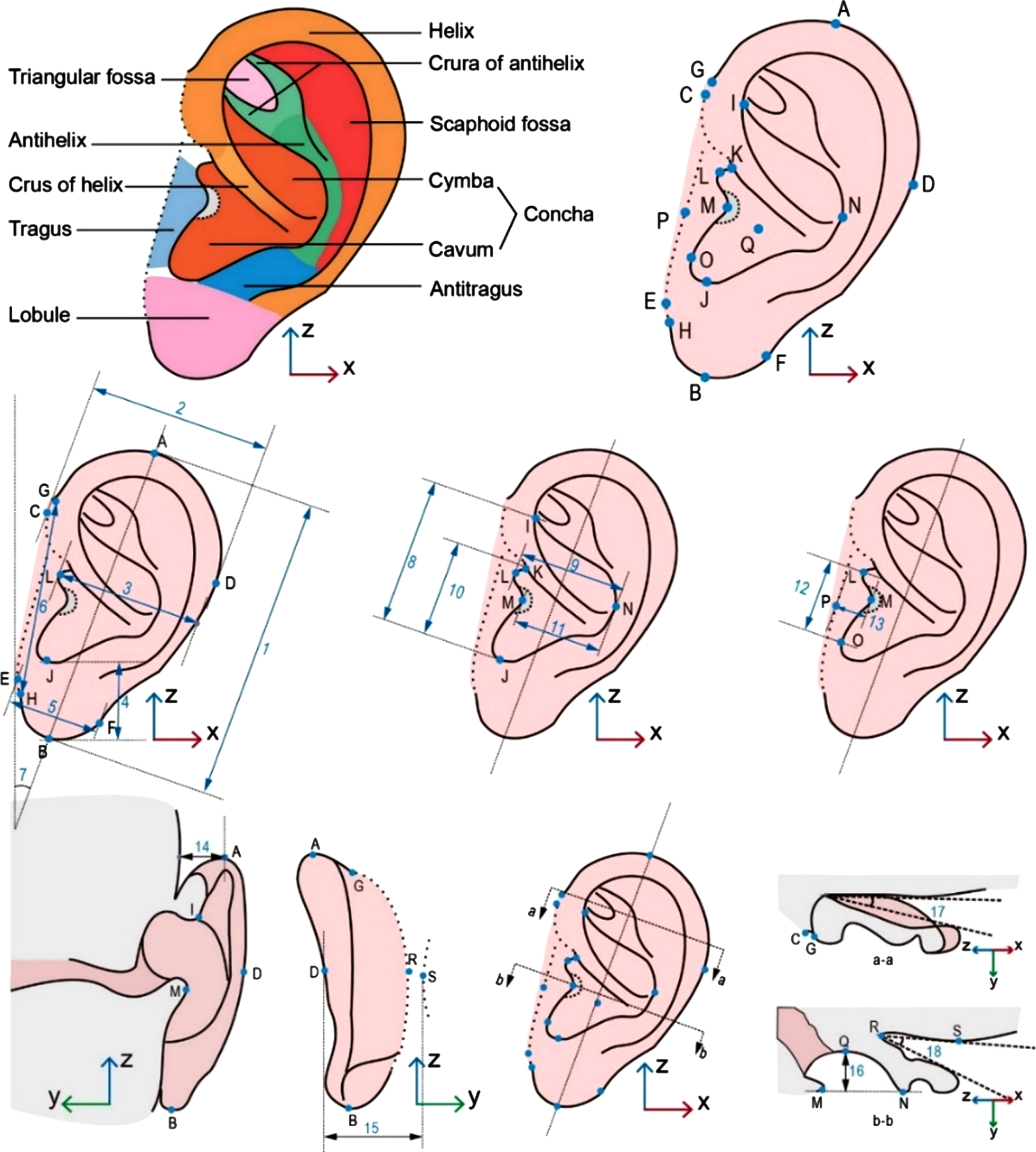
Landmarks and measurements of the auricle. Landmark: (A) superaurale, (B) subaurale, (C) preaurale, (D) postaurale, (E) lobule anterior, (F) lobule posterior, (G) otobasion superius, (H) otobasion inferius, (I) anterior cymba concha, (J) incisura intertragica inferior, (K) superior cavum concha, (L) incisura anterior auris posterior, (M) tragion, (N) posterior concha, (O) lowest point on the lower border of tragus, (P) cardinal point of tragus, (Q) medial concha, (R) otobasion posterius, (S) anterior mastoid. Measurement variables: (1) AL: auricular length, (2) AWP: auricular width at postaurale, (3) AWI: auricular width at the incisura anterior auris posterior, (4) LL: lobular length, (5) LW: lobular width, (6) EML: ear morphologic length, (7) AIA: auricular inclination angle, (8) CL: conchal length, (9) CW: conchal width, (10) CCL: cavum concha length, (11) CCW: cavum concha width, (12) TL: tragal length, (13) TH: tragal height, (14) EPS: ear protrusion at superaurale level, (15) EPT: ear protrusion at tragal level, (16) CD: conchal depth, (17) CAP: concho-mastoid angle at postaurale, (18) CAO: concho-mastoid angle at otobasion posterius.
The length variables (AL, EML and LL) and width variables (AWP, AWI and LW) of the auricle and lobule were employed to establish the shape and size of the auricular contour; these variables can also be used to design the shape of earmuffs/ear-cups of the over-ear wearables. The vertical distance (CL, CCL and TL), horizontal distance (CW, CCW) and depth/height distance (CD and TH) of the concha and tragus were selected to aid and facilitate the design/placement of body prototype on in-ear devices. The relative spatial position of the auricle on human head was established employing the inclination (AIA) and ear protrusion variables (EPS, CAP, EPT and CAO). The AIA was used to identify the angular association between the auricle and human head and can also be utilized to design the angle between earmuffs/ear cups and arm member of the over-ear wearables. The EPS, EPT, CAP and CAO can be employed in designing the sectional shape and size of the ear band of the behind-ear wearables.
In order to have a uniform and unbiased representation of the Chinese population across geographical areas in terms of diversity, a total of 1120 Chinese subjects (560 males and 560 females, aged 15 to 79) from 30 provinces were recruited from eight metropolitan and hub cities of mainland China (Fig. 1) between 2018 and 2019. All eight cities are notable traffic congestion focal point in mainland China and have been the sampling locations of previous anthropometric surveys [41, 42]. The auricular length of the Chinese auricles attains maturity at age 14; thus, in this study, the age range of sampling started at 15 years [35]. The criteria employed to divide subjects into age-based strata was the 10-year gap interval [3, 19]. All subjects were divided into seven age groups: 15–19 (10 s), 20–29 (20 s), 30–39 (30 s), 40–49 (40 s), 50–59 (50 s), 60–69 (60 s) and 70–79 (70 s). Each age group was composed of 80 males and 80 females (Table 1). At least 2 subjects (1 male and 1 female) in each age group emanated from the same native province (Fig. 1). Exclusion criteria included subjects with a prior history of hereditary or congenital deformity, trauma, surgery, maxilla-facial abnormality, and ear piercing of the auricle. None of the subjects were genetically related to each another.
Demographics of subjects (N = 1120)
Demographics of subjects (N = 1120)

Distribution of subjects in each sampling location: according to the Sixth National Census of China in 2010 (http://www.stats.gov.cn/tjsj/pcsj/rkpc/6rp/indexch.htm.), 94.41% Chinese population live in the 43.24% land area on the southeast side of the Hu Huanyong Line. Sampling cities on the southeast side of the Hu Huanyong Line: Shenyang (northeast China), Tianjin (north China), Xuzhou (east China), Shanghai (east China), Fuzhou (southeast China), Guangzhou (south China) and Xi’an (mid-west China). Sampling cities on the northwest side of the Hu Huanyong Line: Lanzhou (northwest China).
Both sides of the auricles were measured indirectly using 3D scanning (Fig. 3). Subjects’ head and ears were scanned employing EinScan-Pro+ HD Scanner (SHINING 3D Inc., China; accuracy: 0.05 mm, space point distance: 0.25 mm). The concha was casted employing ABR impression materials (SOUNDLINK, Inc., China) and scanned utilizing 3D scanner. The 3D scans of the auricle were merged with concha and meshed using RapidForm XOR3 (INUS Technology, Inc., Korea). Auricular measurement variables were measured by extracting 3D parameters of corresponding landmarks that were marked utilizing RapidForm, and then calculated with Matlab R2018a (MathWorks, Inc., USA). Landmarks were marked manually on the 3D ear scans by a single researcher. The intra-measure reliability of landmarks was assessed employing the method developed by Lee et al. [43]. Based on a randomly selected model from the database, each landmark was recognized and marked three times on the 3D scans by a single researcher with at least 24 hours between markings. The standard deviation (SD) and coefficient of variation (CV) of the repeated measurement variables had to be smaller than 2 mm and 5%, respectively to be considered reliable.
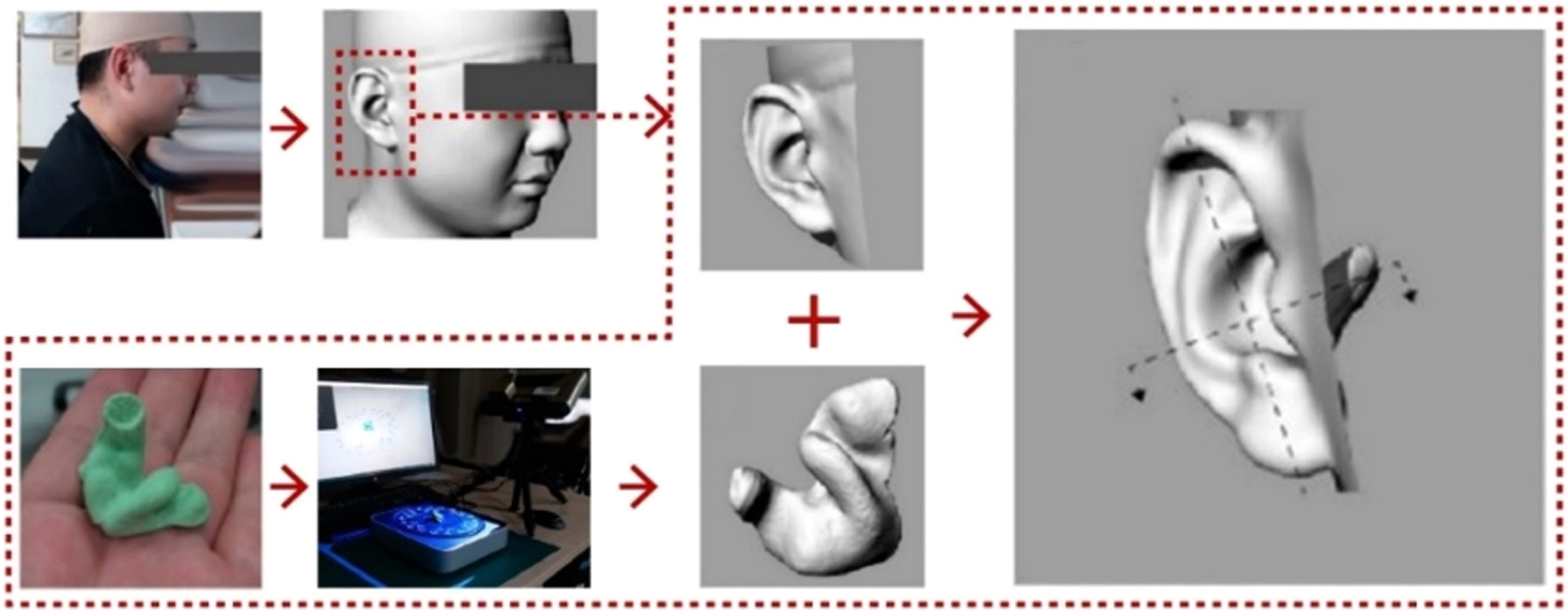
3D scanning of the auricle.
Statistical analysis was conducted at α= 0.05 with Matlab, and p < 0.05 was considered statistically significant. Differences in auricular data across the different factors (gender, auricle side and age group) were analyzed employing parametric statistics based on verification of normality using the Kolmogorov-Smirnov and Levene’s test. A correlation analysis was carried out employing Pearson correlation coefficient (r) to identify the correlation between the auricular measurement variables and age. Paired sample t-test and independent sample t-test were conducted to investigate the bilateral and sex-related differences. A one-way analysis of variance (ANOVA) with Student-Neuman-Keuls multiple comparison test (SNK test) was performed to compare the auricular measurement variables of the different age groups, as well as the cluster mean factor scores of the different auricular shape types.
Prior to the factor analysis, the Kaiser-Meyer-Olkin (KMO) test and Bartlett’s test were conducted to ascertain the suitability of the data for further analysis (Fig. 4). KMO >0.6 and p-value of the Bartlett’s test <0.05 were considered suitable [44]. Utilizing the auricular data, factor analysis (varimax orthogonal rotation) was employed to determine the factors associated with the variations in shape [24, 45]. Z-scores of the auricular data were derived for the factor analysis to forestall the effects of different units on the analysis. A hierarchical cluster analysis (HCA) was conducted to classify the auricular shape of individuals into groups with similar factor scores. The Euclidean distance was employed as the similarity distance measure, and the Ward’s minimum variance technique was used as the linkage method for the HCA. The ward’s minimum variance method which could present the results as the intra-cluster subjects would be in close proximity to the cluster centroid position and be far away from extra-cluster subjects with respect to determination of typical features for each cluster [4, 46]. Cubic clustering criterion (CCC), pseudo-F and pseudo-T-squared, which are the indicators of cluster number criteria, were utilized to obtain the final cluster number [47, 48]. Pearson’s chi-squared test was employed to examine the association between auricular types and age groups.

Flow chart of the auricle shape classification.
There were no significant bilateral differences in auricular measurement variables between both genders (Table 2). Auricular measurement variables were larger in the left-side (p > 0.05) except for CAO (both genders, p > 0.05) and AIA (female subjects, p > 0.05). The results revealed that only LW, CCL, TL and TH were not significantly different between the male and female subjects (p > 0.05). Fifteen auricular measurement variables had a significant correlation with age, with the exception of AIA, TH and CD (p < 0.05). The results of correlation between auricular measurement variables and age are presented in Appendix 1. The AIA, TH and CD did not exhibit any specific trend across the age groups (Table 3), which was in consonance with the results of correlation analysis. Only data of the left-sided auricles were utilized for the HCA to classify the auricular shapes due to the similarity (no significant bilateral differences) between the left and right ears: the mean difference of linear measurement variables was less than 0.34 mm; for angular measurement variables, it was less than 0.4°.
Auricular measurements for 2240 ears (1120 subjects)
Auricular measurements for 2240 ears (1120 subjects)
AL: auricular length; AWP: auricular width at postaurale; AWI: auricular width at the incisura anterior auris posterior; AIA: auricular inclination angle; LL: lobular length; LW: lobular width; EML: ear morphologic length; CL: conchal length; CW: conchal width; CCL: cavum concha length; CCW: cavum concha width; CD: conchal depth; TL: tragal length; TH: tragal height; EPS: ear protrusion at superaurale level; EPT: ear protrusion at tragal level; CAP: concho-mastoid angle at postaurale; CAO: concho-mastoid angle at otobasion posterius * Paired-samples t-test for bilateral difference, p < 0.05 (2-tailed). Δ Independent t-test for sex-related difference, p > 0.05 (2-tailed). ++Correlation with age is significant at the 0.01 level (2-tailed). +Correlation with age is significant at the 0.05 level (2-tailed). α= 0.05.
Comparison of auricular measurements between age groups
AL: auricular length; AWP: auricular width at postaurale; AWI: auricular width at the incisura anterior auris posterior; AIA: auricular inclination angle; LL: lobular length; LW: lobular width; EML: ear morphologic length; CL: conchal length; CW: conchal width; CCL: cavum concha length; CCW: cavum concha width; CD: conchal depth; TL: tragal length; TH: tragal height; EPS: ear protrusion at superaurale level; EPT: ear protrusion at tragal level; CAP: concho-mastoid angle at postaurale; CAO: concho-mastoid angle at otobasion posterius a, b, c, d, e, f:, g: Multiple Comparison Results of SNK Post Hoc Test, the same superscript on mean values indicated no significant mean differences between age groups. *: p < 0.01 is significant for ANOVA tset. α= 0.05.
Eighteen auricular measurement variables were categorized based on six major factors (Eigen value >1, Table 4, Fig. 5), which were the factors associated with the auricular shape variations in this study (KMO = 0.611, Bartlett’s test sig.<0.001). Factor 1 (auricular contour) described the attributes of auricular contour including AL, AWP, AWI, EML, LL, LW and CL. Factor 2 (which consisted of tragal and cavum concha lengths) described the characteristics of tragal and cavum concha lengths (TL and CCL), respectively. Factor 3 ((cavum) concha length) described the width attributes of concha and cavum concha including CW and CCW. Factor 4 described the linear and angular measurement variables associated with the anterior protrusion including EPS and CAP. Factor 5 described the linear and angular measurement variables related to the posterior protrusion including EPT and CAO. Factor 6 described the measurement variables that had no significant relationship with age including AIA, TH and CD.
Factor analysis result for the auricular measurements
AL: auricular length; AWP: auricular width at postaurale; AWI: auricular width at the incisura anterior auris posterior; AIA: auricular inclination angle; LL: lobular length; LW: lobular width; EML: ear morphologic length; CL: conchal length; CW: conchal width; CCL: cavum concha length; CCW: cavum concha width; CD: conchal depth; TL: tragal length; TH: tragal height; EPS: ear protrusion at superaurale level; EPT: ear protrusion at tragal level; CAP: concho-mastoid angle at postaurale; CAO: concho-mastoid angle at otobasion posterius a. Rotation converged in 5 iterations. Rotated component coefficient values of items which categorized to each factor are showed in bold (factor loading >0.4). Overall % of Variance = 72.245.

Factors associated with the auricular shape variations in this study: (1) AL: auricular length, (2) AWP: auricular width at postaurale, AWI: auricular width at the incisura anterior auris posterior, LL: lobular length, LW: lobular width, EML: ear morphologic length, AIA: auricular inclination angle, CL: conchal length, CW: conchal width, CCL: cavum concha length, CCW: cavum concha width, TL: tragal length, TH: tragal height, EPS: ear protrusion at superaurale level, EPT: ear protrusion at tragal level, CD: conchal depth, CAP: concho-mastoid angle at postaurale, CAO: concho-mastoid angle at otobasion posterius).
The HCA dendrogram is included in Appendix 2. Only pseudo-F had global optimal solution (n = 5, pseudo-F = 102, Fig. 6). Consequently, the cluster number was established as five. In this study, the auricular shapes were grouped into five types (Fig. 7, Table 5). A strong association was observed between auricular type and age group (χ2 = 568.415, p < 0.001; Cramer’s V = 0.752, p < 0.001). The distribution of the subjects across the auricular types and age groups is shown in Figs. 8 and 9, respectively. The short verbal descriptors of the five types were given based on their cluster mean factor scores and dimensions (Tables 5–7):
Type I had the smallest auricular contour, the second shortest cavum concha and tragus, the below average (cavum) conchal width (Factor 3), the below average anterior protrusion, the smallest posterior protrusion, and the below average inclination angle, tragal height and conchal depth, which corresponds to factors 1, 2, 3, 4, 5 and 6, respectively.
Type I had the smallest auricular contour (Factor 1), the second shortest cavum concha and tragus (Factor 2), the below-average (cavum) conchal width (Factor 3), the below-average anterior protrusion (Factor 4), the smallest posterior protrusion (Factor 5), and the below-average inclination angle, tragal height and conchal depth (Factor 6).
Type II had the above-average auricular contour (Factor 1), the second longest cavum concha and tragus (Factor 2), the below-average (cavum) conchal width (Factor 3), the largest anterior protrusion (Factor 4), the largest posterior protrusion (Factor 5), and the smallest auricular inclination angle, tragal height and conchal depth (Factor 6).
Type III had the second smallest auricular contour (Factor 1), the longest cavum concha and tragus (Factor 2), the below-average (cavum) conchal width (Factor 3), the below-average anterior protrusion (Factor 4), the above-average posterior protrusion (Factor 5), and the largest auricular inclination angle, tragal height and conchal depth (Factor 6).
Type IV had the second largest auricular contour (Factor 1), the above-average cavum concha and tragus (Factor 2), the widest (cavum) concha (Factor 3), the smallest anterior protrusion (Factor 4), the below-average posterior protrusion (Factor 5), and the second smallest auricular inclination angle, tragal height and conchal depth (Factor 6).
Type V had the largest auricular contour (Factor 1), the shortest cavum concha and tragus (Factor 2), the narrowest (cavum) concha (Factor 3), the below-average auricular protrusion (Factor 4, Factor 5), and the above-average auricular inclination angle, tragal height and conchal depth (Factor 6).

Result in the criteria for the number of clusters (CCC: cubic clustering criterion).
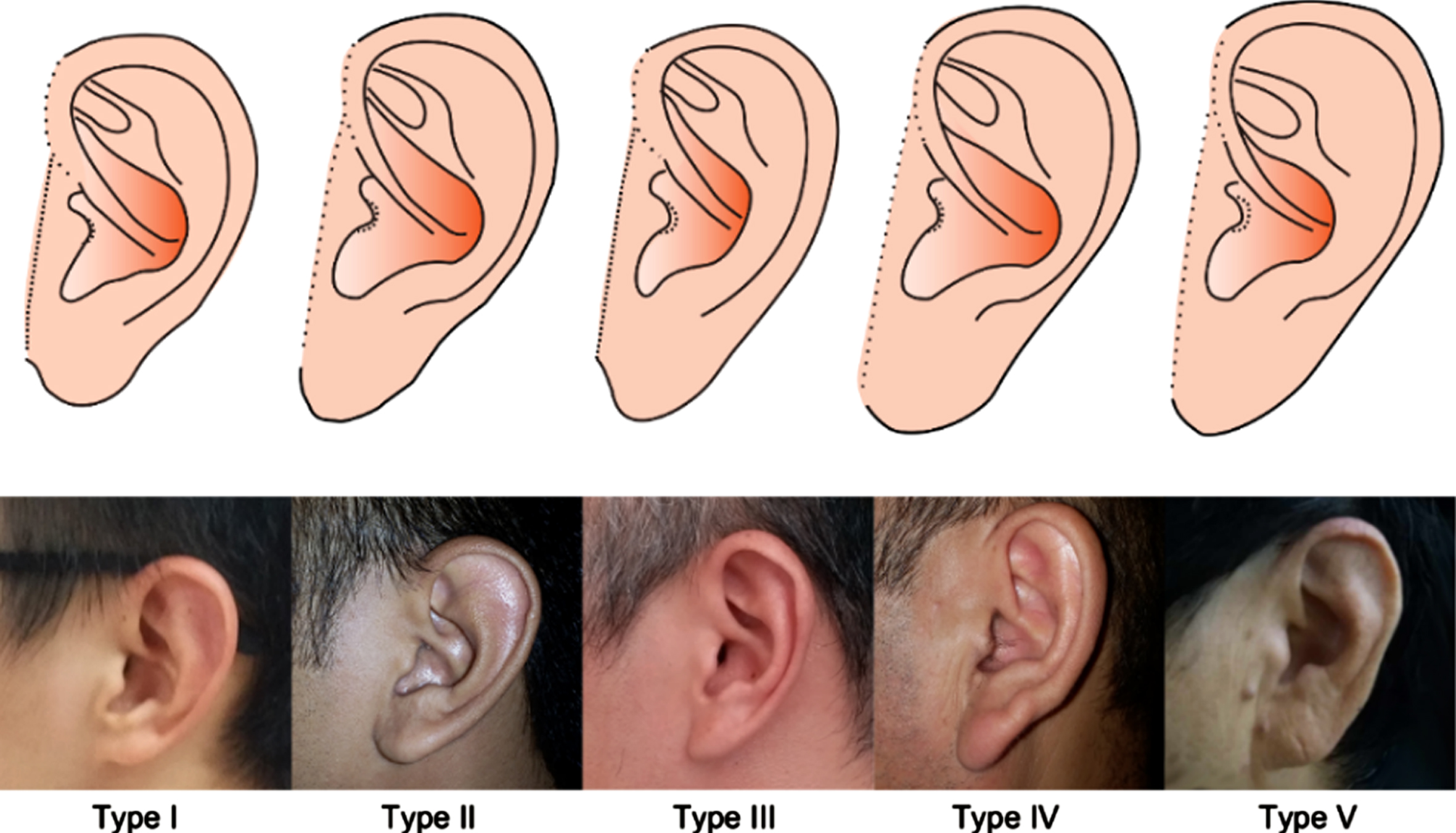
Subjects of different auricular shape types shown in the lateral plane.
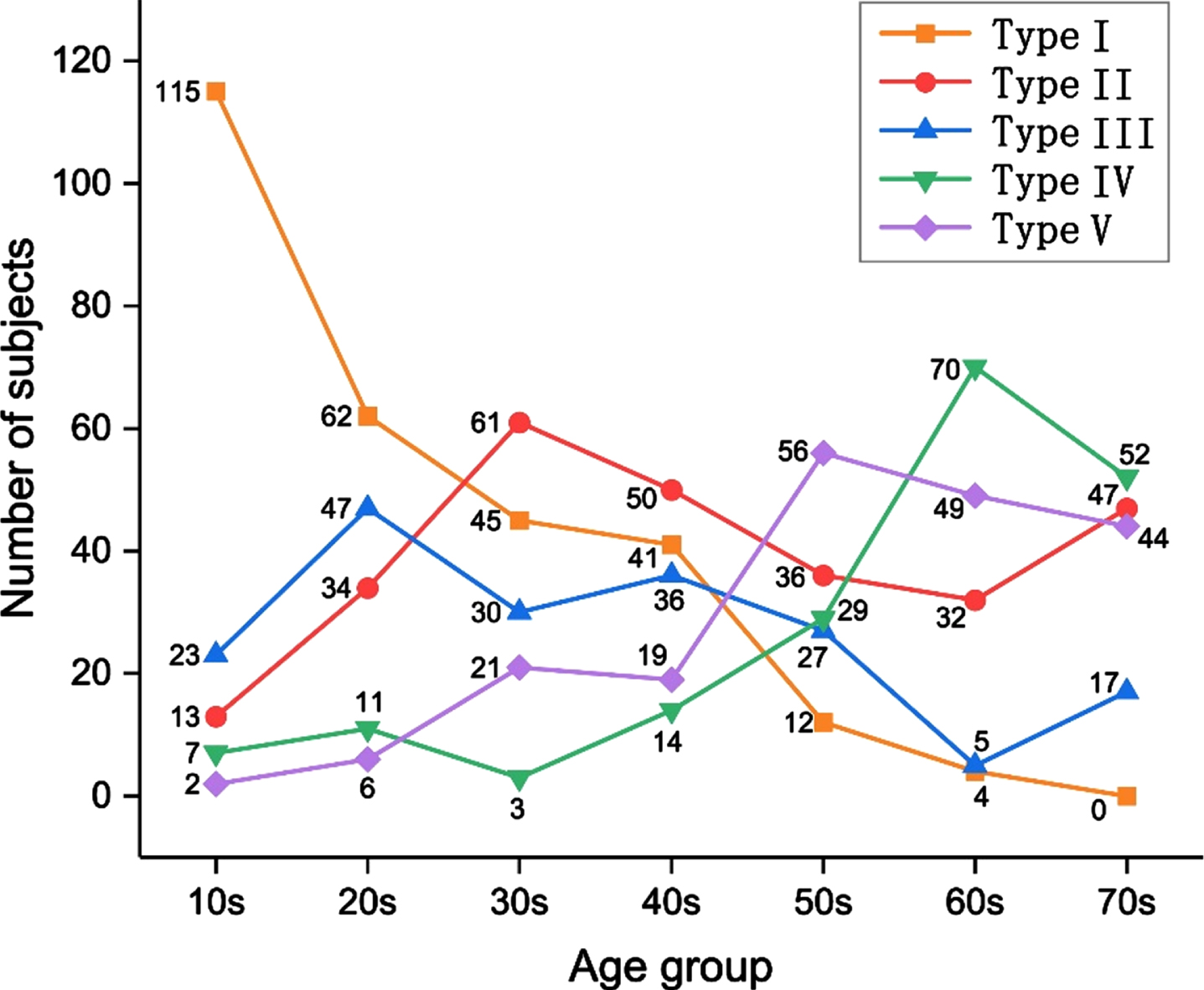
Distribution of subjects across the auricular types and age groups.

Scatter plots of Factor 2 (tragal length and cavum concha length) and Factor 3 ((cavum) concha length).
Mean factor score (cluster centroid position) across clusters
a, b, c, d, e: Multiple comparison results of SNK Post Hoc Test, the same superscript on mean factor scores indicated no significant mean differences between clusters/types. α= 0.05.
Summary data of auricular measurements by auricular type category (left auricle)
AL: auricular length; AWP: auricular width at postaurale; AWI: auricular width at the incisura anterior auris posterior; AIA: auricular inclination angle; LL: lobular length; LW: lobular width; EML: ear morphologic length; CL: conchal length; CW: conchal width; CCL: cavum concha length; CCW: cavum concha width; CD: conchal depth; TL: tragal length; TH: tragal height; EPS: ear protrusion at superaurale level; EPT: ear protrusion at tragal level; CAP: concho-mastoid angle at postaurale; CAO: concho-mastoid angle at otobasion posterius.
Summary data (mean values) of auricular measurements by age group and auricular type category (left auricle)
AL: auricular length; AWP: auricular width at postaurale; AWI: auricular width at the incisura anterior auris posterior; AIA: auricular inclination angle; LL: lobular length; LW: lobular width; EML: ear morphologic length; CL: conchal length; CW: conchal width; CCL: cavum concha length; CCW: cavum concha width; CD: conchal depth; TL: tragal length; TH: tragal height; EPS: ear protrusion at superaurale level; EPT: ear protrusion at tragal level; CAP: concho-mastoid angle at postaurale; CAO: concho-mastoid angle at otobasion posterius.
For ear-related wearables, comprehension of the complex shape of the auricle and how it differs on the basis of gender, age and side is an imperative factor for consideration in relation to the users of such devices [3, 29]. This study provides a general understanding of anthropometric attributes based on age, gender, side and shape of mainland Chinese samples, which could be employed as a reference to bolster the suitability, comfort and functional capacity of ear-related wearable devices.
The anthropometric characteristics of the auricle which differ among ethnicities or geographical regions may be attributed primarily to genetic factors or genetic predisposition [49]. In order to reduce the impact of genetic factors or genetic predisposition from certain sampling locations reported in previous studies [22, 50], the subjects were recruited from Northeast China (Shenyang), North China (Tianjin), East China (Xuzhou and Shanghai), Southeast China (Fuzhou), South China (Guangzhou), Midwest China (Xi’an) and Western China (Lanzhou) with a view to having a wide diversity of population that represents an extensive geographical area (Fig. 1). Additionally, none of the subjects were genetically related to each another in this study.
Numerous ergonomic studies have shown that auricular dimensions continue to change with age [3, 28], and most of the linear measurement variables exhibited a steady increase with age [16, 17]. This could be attributed to the design strategy employed in the fabrication of hearing aids or protection devices, especially for aged individuals [51]. The results of this study buttressed this observation in most of the measurement variables (Table 3). In order to fully perform the shape characterization of the auricle, the results of eighteen measurement variables were presented in this study. Some measurement variables had similarities in growth trends (Table 3), which also reflected in the factor analysis results (Table 4). Therefore, the factors associated with the auricular shape variations established by factor analysis were introduced to describe the growth trajectory of the Chinese auricles in this study:
Auricular contour (Factor 1, including AL, AWP, AWI, EML, LL, LW and CL) increased continuously with age in relation to length and width; only auricular length increased significantly between every two age groups.
Both cavum concha length and tragus length (Factor 2, including TH and CCL) increased significantly in the 20 s and 40 s and decreased insignificantly in the 70 s.
The concha width and cavum concha width (Factor 3, including CW and CCW) followed the trend in Factor 2; both of them experienced another significant increase in the 50 s.
The anterior protrusion (Factor 4, including EPS and CAP) increased significantly in the 30 s and decreased significantly in the 60 s; the dimensions of Factor 4 in the 70 s was close to those in the age bracket of 15–19;
The posterior protrusion (Factor 5, including EPT and CAO) decreased significantly in the 50 s and older groups. The dimensions of Factor 5 in the 70 s was also close to those in the age range of 15–19, but the concho-mastoid angle at otobasion posterius in the70 s was the smallest.
The auricular inclination angle, conchal depth and tragal height (Factor 6) had no significant correlation with age.
Among the linear measurement variables, lobular length exhibited the largest overall rate of increase (≈32%) in size as age increased, which is in consonance with the findings of [3, 52]. In this study, none of the subjects had the habit of ear piercing or wearing earrings (i.e., earrings), which can notably induce morphological changes in the lobular dimensions [1, 49]. The highest growth rate exhibited by lobular length was attributed to the decrease in resilience and elasticity of the skin [21, 52]. Azaria et al. [52] reported that the lobes were not symmetrical in the general Iranian population, which can also be observed among Central Indian males [19] and Sudanese Arab population [49]. The results of this study revealed that the non-pierced Chinese lobes were not significantly different in length and width for both sides of the auricle (Table 2), which could be useful in providing available data for the design of earmuffs, ear cups, earrings [3] and health monitoring devices (i.e., lobe-based blood glucose monitor) for Chinese users, as well as a reference for the comparison of different ethnicities.
Ear protrusion plays a key role in the clinical diagnosis of congenital anomalies and syndromes. It offers an indication for surgical correction [19], and also important in helping to map out blueprints and strategies for the design of wearables (i.e., bone conduction headphones, behind-ear hearing aids) linked to age-related and occupational hearing loss [6, 17]. In this study (subjects aged 15–79), the age range of a group was determined by an interval of 10 years according to Jung and Jung [3], and Purkait and Singh [19]. This culminated in a finding that was not reported in previous studies: the ear protrusion (lengths and concho-mastoid angles) was similar (not significant different) between ages 15–19 and 70–79. Janis et al. [53] reported that the ear protrusion was induced by an increase in conchal depth and/or unfolding of the antihelix. Since the conchal depth did not show the definite changing trend with age in this study (Table 3), the growth trends of the anterior and posterior protrusion in the Chinese samples which was shown by the linear and angular measurement variables may be attributed mainly to the increase in the unfolding of the antihelix.
The bilateral differences are important information in the design of paired form ear-related wearables because it produces a natural and harmonious appearance of products for users [6, 54]. According to Wang et al. [22], for the northern Chinese population, the auricular length, auricular width, tragal length and tragal height were bilaterally different in males; the tragal length and conchal length were bilaterally different in females, and all these differences were statistically significant. The results of this study revealed that there were no significant bilateral differences between both genders in relation to the 2240 Chinese auricles from multiple geographical regions of China investigated in this study. A reasonable template of the human body (i.e., shape, posture and activity) is an important reference for ergonomic research and design applications [18, 54]. Consequently, it is reasonable to provide users with the auricle template based on the geographical regions they live or emanate from, which could be employed to produce a more natural appearance of products for potential users. Wang et al. [22] also demonstrated that most auricular measurement variables were larger in the left-side for northern Han Chinese. This aligns with the results presented in Table 3, which shows that only concho-mastoid angle at otobasion posterius was larger in the right-side for both genders, as well as the auricular inclination angle for females.
According to the clustering results of the auricular shapes, Type I (small auricular contour with small posterior protrusion type, 24.91% subjects) and Type II (above average auricular contour with large auricular protrusion type, 24.38% subjects) were more prevalent compared to other types for both genders in this study (Table 5). About 72% auricles among age 15–19 were Type I, 90% auricles in age 60–79 were Type IV (large auricular contour with small anterior protrusion type) and Type V (large auricular contour with a small tragus and cavum concha type). Among the five auricular types, Type I subjects’ number decreased in trend from the younger groups to the older groups, while the opposite was observed in the trends of those in Type IV and Type V (Figs. 8, 9, Table 7). Furthermore, the strong association between the auricular types and age groups also indicated that a person’s auricular shape may change with age. However, this hypothesis requires further study for verification.
Most current ear-related products are available in only one size, and a one-size-fits-all design approach may not be optimal, especially for younger/elderly users with smaller/bigger ears [24, 51]. Since it is not similar to clothing and shoe materials, ear-related wearables need to fit well over, in-side and behind the ear [3, 24]. Hence, an overall size classification (S-M-L sizing system) would not be adequately suitable for the complex structure of the ear [18]. Therefore, this study employed the Hierarchical Cluster Analysis (with Ward method and Euclidean distance) to group the Chinese auricular shapes into five types based on six factors associated with auricular shape variations, which provided the shape types and corresponding size reference (Tables 6, 7) for users in different age categories in relation to the design of ear-related wearables. We recommend that a sizing system of ear-related wearables that will combine the results of this study with the S-M-L sizing methods should be established in order to optimize the suitability, comfort and functional capacity of products worn by users in the next step. Additionally, for the Chinese users aged 15–19, it is recommended that Type I should be selected as size reference. For users aged 60–79, it is recommended that Type VI and Type V should be selected as size reference.
China is a multiethnic nation, 92% of the population is Han Chinese, and some Chinese minorities have a rather small population, making it difficult to cover them all through random sampling technique (http://www.stats.gov.cn/tjsj/pcsj/rkpc/6rp/indexch.htm). Subjects recruited for this study emanated from twelve ethnic groups of China (83% of them were Han Chinese): Han, Mongol, Hui, Manchu, Korean, Miao, Zhuang, Dong, Uyghur, Dai, Yi and Bouyei. Consequently, the non-representativeness of the anthropometric characteristics of all ethnic groups of China as revealed by the results of this study is a limitation of this study. In this regard, further research is needed to incorporate and update the data from different ethnic groups. The second limitation is that the results of this study had limited ear dimensions that could only assist in the fabrication of specific wearables for the auricles. Also, high values were not obtained in this study for the KMO validity test and total variance rate of factor analysis. These results showed the proportion of variance among the variables, which was induced by underlying factors, bordering on mediocrity. More specific and subtle findings may be obtained with larger sample size; thus, necessitating further studies in this regard. The findings of this study are connected to the Chinese population and provides an understanding of anthropometric variations of the auricle in the design of ear-related wearables. Therefore, further research is required to evaluate the growth trajectory of the auricle in other population.
Conclusions
An adequate understanding of the shape of the auricle is critical to enhancing the suitability and comfort of ear-related wearables for target users. This study provides a comprehension of the anthropometric attributes of normal auricle based on the 3D data (casting and 3D scanning approaches) of 1120 Chinese subjects aged 15–79 including the growth trajectory, sex-related and bilateral differences, factors related to the auricular shape variations, and shape types. Measurement variables of the Chinese auricles changed continuously with age; also, most of the linear measurement variables exhibited a steady increase. No measurement variable demonstrated significant bilateral difference in both genders. Most auricular measurement variables were not significantly different between the male and female subjects. The proposed six major factors associated with the auricular shape variations could describe the growth trajectory of the auricle appropriately and distinctly. Auricular contour (Factor 1) increased continuously with age in length and width; cavum concha length and tragus length (Factor 2) increased significantly in the 20 s and 40 s and decreased insignificantly in the 70 s. Furthermore, the (cavum) concha width (Factor 3) followed the trend in Factor 2, and experienced another significant increase in the 50 s; the anterior protrusion (Factor 4) increased significantly in the 30 s and decreased significantly in the 60 s. In addition, the posterior protrusion (Factor 5) decreased significantly in the 50 s and older groups; the auricular inclination angle, conchal depth and tragal height, which had no significant correlation with age (Factor 6), showed no specific trend across the seven age groups. This study provides five auricular shape types based on data of 1120 Chinese subjects for future sizing system in relation to optimization of the suitability, comfort and functional capacity of ear-related wearables. Type I (small auricular contour with small posterior protrusion types) and Type II (above average auricular contour with large auricular protrusion type) were more prevalent compared to other types for both genders. It is recommended that Type I should be selected as reference for users in the age bracket of 15–19, and Type VI (large auricular contour with small anterior protrusion type) and Type V (large auricular contour with a small tragus and cavum concha type) as reference for users aged 60–79. In addition, the strong association between the auricular types and age groups demonstrate that a person’s auricular shape may change with age.
Ethical approval
The study was approved by the University Ethics Committee (No. 201502024).
Informed consent
Informed consent was obtained from each subject prior to enrollment. The informed consent of the subjects below the age of 18 was obtained from their legal guardians.
Footnotes
Acknowledgments
The authors are thankful to the participating individuals for their time and effort. They thank Mr. Z. Fan (ICBC Xuzhou Branch) for his support in sampling. This study is partly supported by the Special Project of National Civil Aircraft (Grant No. MJ-2015-F-018), National Key R&D Program (Grant No. 2019YFB1405701 and 2019YFB1405702). Additional support was obtained from the University of California Berkeley/San Francisco Ergonomics Research Program.
Conflict of interest
The authors declare that they have no competing interest.
