



Abstract
BACKGROUND:
The prolonged usage of digital displays leads to visual strain and, in turn, impairs psychological well-being. The practice of Yoga is said to enhance psychological functions and reduce visual strain.
OBJECTIVE:
The present study assessed the effect of the trataka (Yogic visual concentration) practice on the visual strain, mind-wandering, and mindfulness.
METHODS:
One hundred six volunteers equally distributed in the experimental and control groups completed the study. Visual Fatigue Scale (VFS), visual symptoms checklist (VSC), mind-wandering questionnaire (MWQ), and State Mindfulness Attention Awareness Scale (SMAAS) were administered at baseline and at the end of two weeks.
RESULTS:
All variables were similar at the baseline in both groups, and significant differences were noted at the end of two weeks between both groups. There was a significant reduction in VFS and VSC scores, MWQ, along with an increase in SMAAS scores in the experimental group. Although there were significant changes in VFS, MWQ, and SMAAS in the control group, the magnitude of change was minimal.
CONCLUSIONS:
The practice of trataka was found to reduce the visual strain, mind wandering while improving the state mindfulness. The practice can be implemented to mitigate visual strain and associated psychological implications due to prolonged exposure to digital displays, which has increased during the COVID-19 pandemic.
Introduction
With the dawn of technological advancement, the use of digital displays in the form of computer screens, smartphones have become common. After the initial years, where digital displays were limited for professional purposes, it has now percolated personal and social lives. With the thrust on digital/ e-learning, users from all age groups are using the digital displays extensively. The use of such displays has increased rapidly due to the current COVID19 pandemic, where a large number of people were confined to working/learning from home [1, 2].
Although the use of technology has many adv-antages, such prolonged usage leads to health implications. Visual strain or eye strain is a subjective symptom of ocular fatigue, discomfort, lacrimation and headache, blurry vision, sensitivity to light [3]. Prolonged and improper usage of visual displays leads to irritation, dryness, eye strain, tiredness, burning sensation, redness, and blurred vision [4]. Visual fatigue and discomfort are associated with the usage of smartphones [5]. There was a significant correlation between ocular pain and tiredness, eye-related tiredness, eye-related pain with increased orbicularis oculi muscle load blood flow during computer work [6]. Prolonged computer or smartphone usage can also lead to musculoskeletal discomfort of the neck, lower back, and upper limbs, as well as psychosocial problems [7, 8]. Increased digital screen time, near work, and limited outdoor activities were associated with myopia’s onset and progression [9]. Besides, prolonged use of digital screens has a negative impact on psychosocial well-being and decreases performance in adolescents [10, 11]. The usage of smartphones is known to affect learning, memory, and recalling [12].
There is a tendency for mind-wandering due to prolonged usage of digital displays [13]. Studies indicate role of mind-wandering in impairment in task performance [14], unpleasant emotions, negative mood, depression [15]. Stress, anxiety and mind-wandering are interconnected and are known to impact cognitive functions [16, 17]. It also leads to poor scholastic performance among students [18].
Due to the digital revolution, it is not possible to skip the usage of screen time. Thus, strategies for reducing the effects of digital display usage need to be emphasized. A review on visual discomfort management stated that 90% of display device users experience digital eye strain symptoms. The study suggested few strategies to overcome the symptoms and enhance productivity at work, such as intermittent blinking and eye exercises, lubricant eye drops, digital color filters, etc. [19]. However, there is a need for a holistic approach to reduce visual strain.
In recent years, Yoga has evolved as multidisci-plinary holistic mind-body practice, positively imp-acting health and disease [20, 21]. There are very few studies evaluating the effects of yoga practices on vision. A study evaluated a combination of yoga practices on visual discomfort using a self-rated questionnaire. After sixty days of intervention, the yoga group showed a reduction in visual discomfort than the waitlisted group [22]. The nursing and optometry students showed decreased eye fatigue scores after 30–60 min practice of yogic eye exercise [23, 24]. The eye movements can bring a state of relaxation and a level of wakefulness [25]. Yoga-based meditation and yogic breathing also were beneficial in reducing mind wandering and anxiety and increasing attention [26, 27]. Mindfulness practices are effective and efficient techniques to improve cognitive function and reduce mind wandering [28]. Thus, yoga practices might have a potential role to play in managing visual strain and its consequences.
Trataka, a practice described in Hatha Yoga texts, involves fixing the gaze on a steady object until tears are shed. Traditional texts narrate the practice to be useful for eye disorders, fatigue, and insomnia [29]. A recent study indicated a beneficial role of trataka in improving sleep quality and reducing insomnia [30]. Studies done on trataka report a beneficial role in eye disorders but failed to elicit objective changes in refractive errors [31, 32]. There is a paucity of scientific studies on trataka in visual strain, for which it may potentially have a positive impact. Thus, we undertook the current study to evaluate the effect of trataka in reducing visual strain and promoting psychological well-being in participants subjected to prolonged use of digital displays due to studying from home due to the COVID-19 pandemic.
Materials and methods
Trial design
This study followed a single-center randomized, parallel-group trial. The subjects were divided into the experimental and control groups with an allocation ratio of 1:1.
Participants
Three hundred healthy volunteers from a university in South India were briefed about the study protocol, out of which 219 provided consent to participate in the study. The inclusion criteria were normal vision (6/6) on Snellen’s chart, regular physical and psychological health assessed by a physician who otherwise had no role in the study. We included participants who used digital displays for more than 4 hours/day. We excluded volunteers who had any known eye disorders, including refractive errors, color blindness, glaucoma, cataract, or any history of ophthalmolo-gical surgeries. Participants with a known history of cognitive or neurological disorders, respiratory or cardiac, and sensory abnormalities were also exc-luded. We also did not include participants who had a habit of smoking or alcohol consumption. Finally, 110 subjects were recruited for the study and were randomly assigned to the experimental or control groups. In total, 106 participants completed the trial. The schematic representation of the flow of the trial profile is presented in Fig. 1.
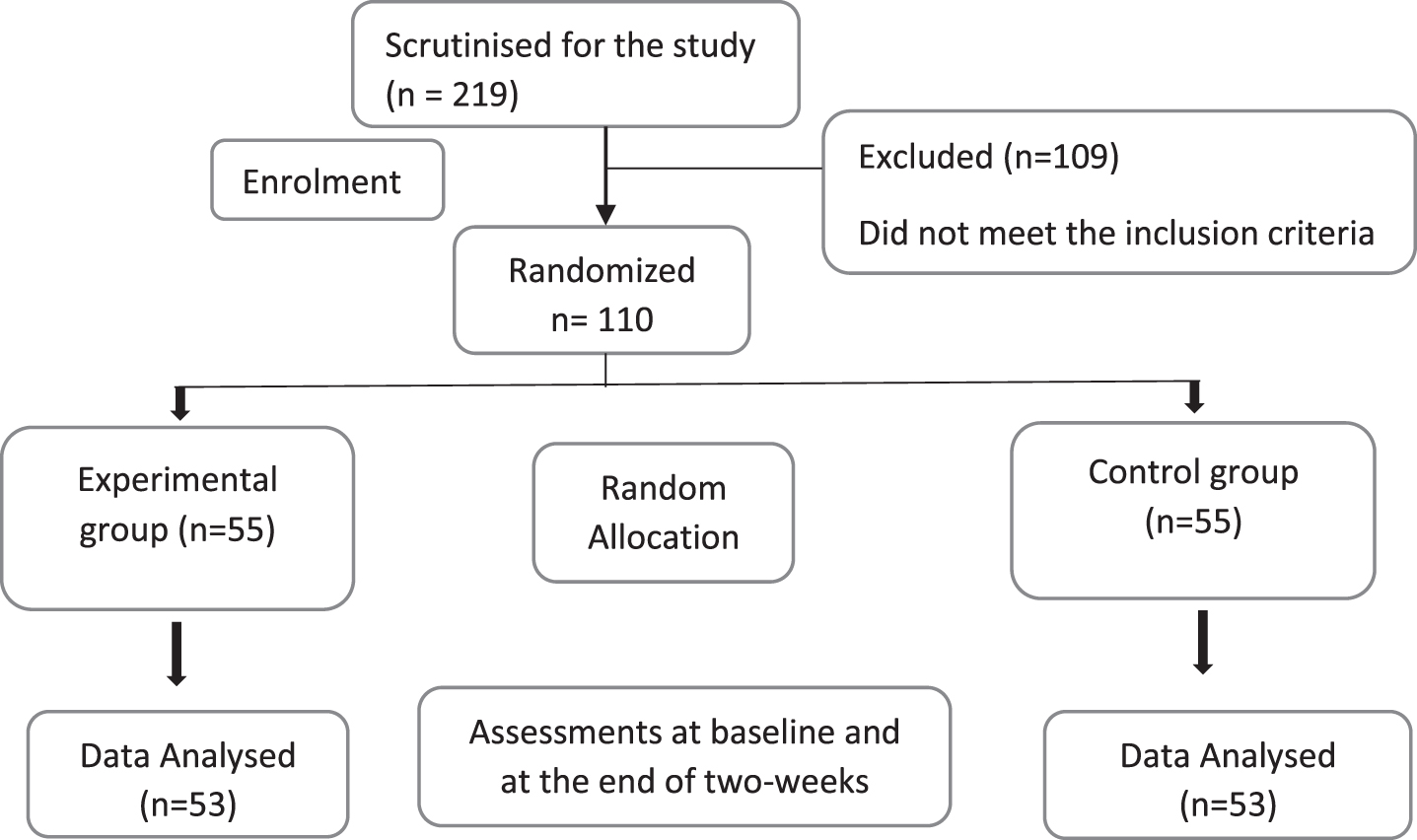
Trial profile.
The sample size was calculated using G*Power computer program [33]. Recommended sample size in each group was 48 participants, considering a previous study on the effect of Yoga breathing on mind-wandering and mindfulness [27]. Alpha was 0.05, and the power was 0.8, and the effect size was found to be 0.58. Considering the possible attrition, we decided to take 55 participants in each group.
Randomization
The eligible participants were stratified based on gender before randomization. The random number sequences were generated using a web-based computer program (https://www.randomizer.org/). The allocation sequence was concealed using sequentially numbered, sealed, opaque envelopes. The study investigators and outcome assessor were blinded.
Ethical consideration and trial registration
The university’s Institutional Ethics Committee approved the study. Written informed consent was obtained from individual participants before their recruitment to the study. The study was registered with the Clinical Trial Registry of India (https://ctri.nic.in, CTRI/2021/01/030737).
Intervention
Experimental group
The study was carried out for two weeks. The experimental group performed trataka for 20 min/day, six days/week, for two weeks. Throughout the practice, the participants were seated comfortably on the floor in the cross-legged position. The practice consists of 2 distinct stages. As a preparatory stage of trataka practice, eye exercises were done, including eyeball movements in the horizontal, vertical, and diagonal, and circular directions. These were performed with eyes open in a well-lit room. The duration of this stage of practice was 5 min. The second stage is the practice of gazing at the candle flame in a dark room, where the candle was placed at the participant’s eye level at a distance of 2 meters. The participants were asked to fix their gaze on the candle’s flame for about 2 to 3 minutes without blinking eyes. Then they were asked to visualize the candle flame between the eyebrows with closed eyes. This process was repeated for three rounds. Later, subjects were asked to defocus and practice concluded in silence with the prayer. This stage lasted for a total duration of 15 min. The instructions for the practice were played through a pre-recorded audio to maintain uniformity of the practice. Daily attendance was taken following the practice.
Waitlist control group
The control group participants were asked to continue their routine daily activities for the follow-up duration of two weeks. Following the two weeks, they were offered the same intervention as trataka.
Assessments
The impact of digital displays was assessed using the self-report measures as primary and secondary outcome variables. The primary outcome variable was a mind-wandering questionnaire (MWQ). The secondary outcome variables were a visual fatigue scale, self-reported fatigue, a symptom assessment checklist, and a State Mindfulness Attention Awareness Scale (SMAAS).
Visual Fatigue Scale (VFS)
The scale consists of six items: 1) I have difficulties in seeing; 2) I have a strange feeling around the eyes; 3) My eyes feel tired; 4) I feel numb; 5) I have a headache; 6) I feel dizzy looking at the screen. Each item was rated on a 10-point Likert scale [34].
Self-reported visual strain using a fatigue and symptom assessment checklist (VSC)
A specially designed checklist of the visual strain and fatigue symptoms was administered to the participants before and after two weeks of the practice of trataka and control groups.
Mind-wandering questionnaire (MWQ)
A reliable and validated five-item self-rated questionnaire, in which subjects were asked to fill up responses on a scale of 1 (almost never) to 6 (almost always); Cronbach’s alpha = 0.850 [28]
State Mindfulness Attention Awareness Scale (SMAAS)
A reliable and validated tool to assess state mindfulness was administered to subjects. The questionnaire contains five questions to be answered on a scale of 1 (not at all) to 6 (very much); Cronbach’s alpha = 0.92 [35].
Data extraction
For VFS, VSC, and MWQ, an average of all scores on the Likert scale was calculated and reported. For SMAAS: reverse scoring was performed for all items, and an average of all five values calculated for the final score.
Data analysis
The data were extracted using questionnaire manuals and organized in Microsoft Excel version 2016. Data analysis was done in JASP statistical package version 0.14.1 [36]. Data were analyzed for normality using Shapiro Wilk’s test and were found to be not normally distributed. Thus, the Mann-Whitney U test was performed to compare the differences between groups. Wilcoxen Signed Rank test was performed for the within-group changes, and Spearman’s rho was evaluated to determine correlations between the variables.
Results
Hundred and ten participants with a mean (SD) age 21.75 (2.48) years took part in the study with an allocation ratio of 1:1. Two participants each were lost to follow up from experimental and control groups. Finally, the data for 106 participants were analyzed. The demographic data are represented in Table 1.
Demographic characteristics of the participants at baseline
Demographic characteristics of the participants at baseline
The two groups did not significantly differ for all the variables at the baseline. There was a significant difference noted in the post values of MWQ scores (p = 0.01), VFS scores (p = 0.002), VSC scores (p = 0.002) and SMAAS scores (p = 0.01).
Within group changes
There was a reduction noted in MWQ, VFS, and VSC scores (p < 0.001) in the experimental group, along with an increase in SMAAS scores (p < 0.001). Significant reduction in the MWQ scores (p < 0.001) and VSC scores (p < 0.05), along with an increase in SMAAS scores (p < 0.05) were noted even in the control group. However, the magnitude of change was lower in the control group. The changes within and between-group are summarized in Table 2.
Summary of the results
Summary of the results
Significant positive correlations were found bet-ween MWQ in VFS (Spearman’s rho = 0.546; p < 0.001) and VSC (Spearman’s rho = 0.508; p < 0.001). SMAAS scores were negatively correlated to MWQ scores (Spearman’s rho = –0.675; p < 0.001) as well as VFS (Spearman’s rho = –0.516; p < 0.001) and VSC scores (Spearman’s rho = –0.456; p < 0.001). There was a strong positive correlation found bet-ween VSC and VFS scores (Spearman’s rho = 0.830; p < 0.001). The correlation statistics are depicted in Table 3.
Pairwise correlation between the dependent variables
Pairwise correlation between the dependent variables
Note: The values reported are for the Spearman’s rho. *** = p < 0.001.
Participants were encouraged to report any adverse effects to the investigators throughout the study. Other than two participants in the experimental group, who reported mild headache following the practice of trataka on the first day, no adverse events were reported.
Discussion
In the current study, the effect of the two-week practice of trataka was found to reduce self-reported mind wandering & Symptoms of Visual Strain along with enhanced state mindfulness. Further, we also noted a positive correlation between mind-wandering with symptoms of visual strain, and both were negatively correlated with state mindfulness. These findings indicate that the practice of trataka can be used to reduce visual strain and its consequences on psychological well-being. This is the first study assessing the effects of trataka on visual strain, mind-wandering, and mindfulness to the best of our knowledge.
Several benefits of the digital revolution are known. During the current COVID-19 pandemic, work and learning made us realize the umpteen possibilities associated with the digital revolution. However, excess use of digital displays has led to several physical and psychological implications, including increased visual strain and mind-wandering. A few studies have explored the possibility of the use of yoga techniques for managing such situations. A combination of yoga practices for sixty days reduced visual discomfort among computer professionals [22]. The six weeks of yoga-based eye exercise reduced optometry student’s eye fatigue symptoms [24]. Another study indicated a reduction in visual fatigue among twenty nursing students following yoga practices [23]. The results of the current study concur with these earlier studies on yoga-based techniques for managing visual strain.
The reduction in mind-wandering and increased state mindfulness is similar to earlier studies on yoga practices such as yogic breathing [27] and meditation techniques [26]. A systematic review mentioned that yoga and meditation intervention nurture mindfulness and may be feasible and effective for building resilience in childhood and adolescence [37]. A randomized controlled trial showed meditation practice could increase mindfulness and reduced mind-wandering [38]. However, the effect of trataka on these domains was not explored before our study. Earlier studies on trataka have shown an improvement in cognitive performance and reduced anxiety [39, 40]. Such enhanced cognitive functions could be due to improved mindfulness and reduced mind wandering. The observations from our study indicate the beneficial role of trataka in such psychological domains.
The possible mechanism of action for reducing visual strain could be giving deep rest to the extraocular muscles through trataka. Traditional texts of Yoga describe the practice of trataka to induce such relaxation to the eyes [29]. Also, gazing at one point could reduce mind-wandering and increased mindfulness. Earlier studies indicate that the practice of trataka may lead to a meditative state of mind [41]. Besides, reduction in visual strain may have contributed to better mindfulness and reduced mind-wandering. Since mind-wandering and mindfulness are related to the emotional state of the individual [27, 42], the practice of trataka may have led to emotional regulation. Such positive emotional regulation is also associated with other yoga techniques [43, 44].
Working/studying from home has become the new normal. There are several ergonomic implications of working from home, such as musculoskeletal pain, discomfort, as well as fatigue [1, 2]. Yoga practices could be helpful in such conditions [45]. The current study focused on the implication of prolonged digital display usage, and checking the effects of trataka on other physical discomforts was beyond the scope of the study. Other limitations of the study include using only self-rated questionnaires to assess visual strain, mindfulness, and mind-wandering and short follow-up duration. Future studies may explore the attention-related tasks as well as the neurological correlates of changes associated with trataka. The application of yoga practices for influencing ophthalmological disorders is in a nascent stage. Further studies on trataka with visual strain may use clinical assessment tools such as tear break-up time, corneal fluorescein staining, tear osmolarity, ocular scattering index, and an objective tool like the tear film thickness.
Conclusions
The practice of trataka was found to reduce the visual strain and mind-wandering while improving the state mindfulness. The practice can be implemented to mitigate visual strain and associated psychological implications due to prolonged exposure to digital displays, which has increased during the COVID-19 pandemic.
Conflict of interest
None to report.