



Abstract
BACKGROUND:
Work-related musculoskeletal disorders (WMSDs) are leading cause of injuries among economically backward workers employed under small scale metal casting units especially in developing countries. In India, most casting unit’s falls under small and medium enterprises having inadequacy of advanced technological equipment’s due to several economic constraints and rely intensively on manual labour. Foundry work is very much prone to WMSDs involving much physical interaction of workers with their jobs which includes several risk factors.
OBJECTIVE:
The study objectives were to analyse the musculoskeletal risk prevalence among small scale casting workers using ergonomic assessment tools and statistical approach.
METHODS:
In present study, WMSDs risk prevalence has been examined using Rapid Entire Body Assessment (REBA) and virtual ergonomics. Further, risk evaluations were analysed using Mann–Whitney U test and Taguchi L25 orthogonal array.
RESULTS:
Results revealed manual handling task as being most vulnerable followed by the fettling section. Statistically significant differences were observed (p-value < 0.05) among all the work-sections except lift-lower task and molding section (p = 0.361; p > 0.05) for left side region; and lift-lower task and fettling section (p = 0.230; p > 0.05) for the right side region, where differences were not statistically significant. ANOVA results indicated that workstation height followed by population percentile and object weight were dominant factors significantly affecting the response parameter i.e. L4-L5 spine compression (p-value < 0.01); however workstation width (p-value > 0.05) had no significant effect.
CONCLUSION:
The present study may guide foundry industrialists in analysing the mismatch between the workers’ job profile and redesigning existing workstation layouts in small scale foundries based on minimizing the WMSDs risk severity associated with the work tasks.
Keywords
Introduction
In developing countries, workers employed in metal casting industries are often exposed to musculoskeletal disorders (MSDs), which refers to injuries and disorders that affect the human musculoskeletal system (i.e. muscles, tendons, ligaments, nerves, discs, blood vessels) [1]. Foundry work is very much prone to work-related musculoskeletal disorders (WMSDs) involving intensive physical interaction of workers with their jobs including various processes like molding, pattern and core making, melting and pouring, degating, surface cleaning and finishing. There are various risk factors like manual handling, awkward posture, repetitive actions, excessive force, vibration, poor working conditions, age, gender, unawareness and lack of discipline which contributes to WMSDs symptoms [2]. Indian foundry sector is the world’s second largest casting producer which gives employment to around 0.5 million people directly and around 0.15 million indirectly, where abundant group coming from economically weaker sections of the society [3, 4]. In India, most casting industries falls under small and medium enterprises (SMEs) having inadequacy of advanced technological equipment’s and automation due to several economic constraints, therefore relying intensively on manual labour [5]. In developing countries, industrialists are less concerned about the implementation of ergonomic principles in workplace due to various factors like implementation cost, return on investment, productivity losses and lack of awareness. However, awareness among employers could be developed by providing proper guidance on ergonomic principles and associated health risk hazards involved and understanding the subsequent potential benefits in implementing ergonomic solutions/guidelines [6, 7].
Previous studies observed that improper posture and intensive physical work were leading cause for WMSDs in casting industries while performing activities like pushing, pulling, and lifting tasks [8–10]. Also, repetitive bending and twisting during work may significantly affect the workers performance and cause potential postural stress [11]. Also, higher prevalence of lower back injuries were attributable among those involved in manual handling tasks than workers doing less manual work [12, 13]. Heavy work-loads could impose high compression force on spine, which may lead to discs injuries in workers [14]. Researchers identified that overexertion, poor lifting techniques and inappropriate postures adopted due to unstructured work conditions were leading cause of WMSDs among foundry workers [15–19]. This occupational hazard is major cause of workplace injuries among foundry workers that influences their wellbeing, yet additionally the development and efficiency of the industry. On the off chance that these symptoms are not managed on time, it could cause severe musculoskeletal health issues among workers in future. So, there is an utmost requirement for corrective ergonomic measures that could be performed with emphasis on reducing the associated WMSDs risk levels. Several ergonomic assessment tools like Rapid upper Body Assessment (RULA), Rapid Entire Body Assessment (REBA), Ovako Working Posture Analysing System (OWAS), National Institute for Occupational Safety and Health (NIOSH) lifting equation may effectively be used for the assessment of WMSDs risk. Anthropometric studies are also beneficial in evaluating and redesigning the existing work system, so as to ensure that prevailing conditions accommodate the specified target audience satisfactorily [20–22]. Similarly, digital human modelling (DHM) and simulation based approach (CATIA, DELMIA, Tecnomatix Jack, etc.) by creating virtual work environment and applying ergonomic assessment tools to predict the user comfort level have also been proved to be effective [23–26]. Keeping all that in mind; the objectives of the present study aims at; (i) Assessing work-related musculoskeletal risk prevalence among small scale casting workers using REBA (ii) Digital human modeling w.r.t population percentile database using workers’ anthropometric data and creating virtual work-environment based on the actual work-conditions followed by analysing the effect of work-station parameters using statistical tools.
Materials and method
The study was carried out in small scale metal casting industries located in Haryana region of Northern India. Respective foundry units were leading manufacturer/supplier of gray cast and spheroidal graphite (SG) iron castings for original equipment manufacturer (OEM) and automotive clients. Concerned authorities and participants were informed about the purpose of this study and informed consent was taken and were assured about the data privacy that the collected information will be kept confidential and utilized for research purpose only. The work flow for present research study has been depicted in Fig. 1; commencing with work observations, anthropometric data collection, and digital human modelling in CATIA V5 followed by analysing work-tasks using REBA ergonomic assessment tool and further analysing the effect of workstation parameters using Taguchi L25 statistical analysis. Also, WMSDs risk assessment using REBA analysis for different work-sections was compared using non-parametric Mann–Whitney U test.

Work-flow for present study.
The sample size was determined based on standard recommendations by ISO (International Organization for Standardization) 15535:2012; with minimum sample size evaluated based on the respective expression as depicted in equation 1 [27]; where n = required sample size, α is relative accuracy (assumed α= 1.5%; for 95% confidence (z –value = 1.96)), and CV is coefficient of variance ((standard deviation/mean)×100). Previous anthropometric study conducted on male industrial workers of Haryana [28] has been utilized to avoid biased estimation (considering male stature data characteristics; mean (
The equipment’s used for collecting the static anthropometric variables includes counter based Holtain limited Harpenden anthropometer kit. Also, a standard digital 12 inch. Vernier caliper, anthropometric measuring tape, and digital weighing scale (with detailed specifications depicted in Table 1) were used to collect the worker’s hand dimensions, circumferential dimensions and body weight respectively. Each worker was examined separately and was informed about the purpose of the study. For the study, 24 static anthropometric dimensions were considered as described in Table 2. Normality of the raw anthropometric data was analysed using statistical tools like visual inspection (Q-Q plots, histograms) and Shapiro-Wilk test (p-value > 0.05). Majority of the observed anthropometric values were found following the normality assumptions (normally distributed) across the variables.
Specifications for measuring instruments
Measured anthropometric dimensions w.r.t percentile values
The anthropometric variables have been utilised for creating the digital human models (manikins) of the foundry workers. Table 2 depicts the workers population percentile database (at five different percentile levels varying from 5th percentile to 95th percentile) based on the measured anthropometric dimensions (24 static anthropometric dimensions; all dimensions are in centimetres (cm) unless otherwise specified) with respective variable reference code used in ergonomic design and analysis module in CATIAV5R20.
Manual observations of the work-conditions followed by video recording of analysed work tasks performed by workers were captured using high-definition camcorder (Sony HD Handy-cam) placed on a tripod stand from which work pictorial-frames were extracted using video-editing software. Video-recordings were performed from two different angles (front/side view angles) utilising two camcorders simultaneously such that it covers and records the entire body movements of the worker. The extracted work pictorial frames from the recorded videos comprises of different views as depicted in Fig. 2. However, few constraints were present due to uncontrollable factors such as work space limitations and adhering to industrial policies/guidelines while video recording. Keeping all that in mind the posture assessment was performed without interrupting the worker’s operation process.
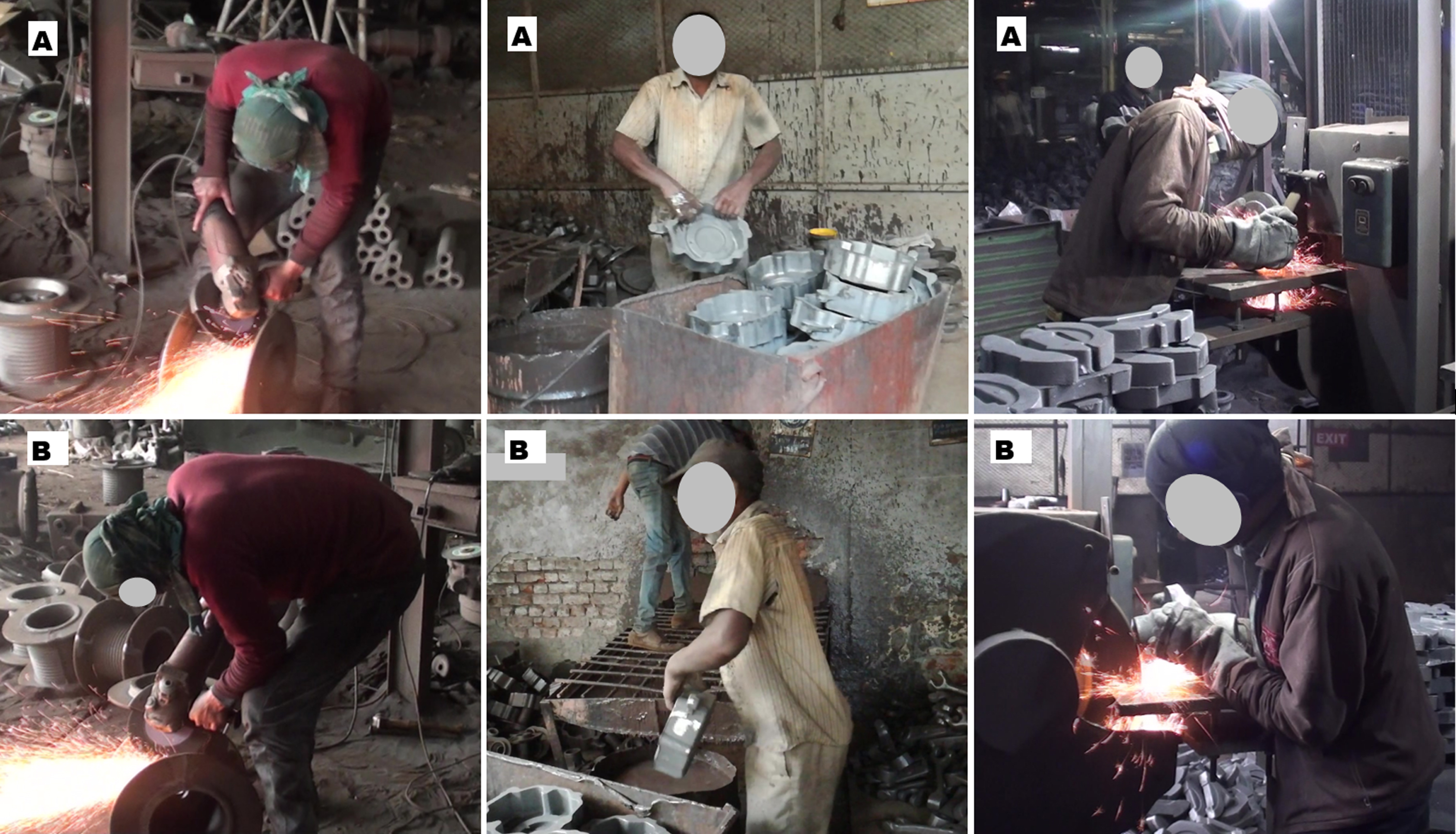
Work-pictorial frames from two different view angles (A: 1st view; B: 2nd view).
The captured snapshots were further analysed and sorted out based on several factors such as awkward postures, static stance sustained for longer periods, image quality, work task and orientation. The selected snapshots were analysed in Solidworks 2015 2D sketch module using cross-marks, lines and angular dimension tools, so as to locate the anatomical positions/key point landmarks more effectively and thereby computing body segments inclination angles which were further used for ergonomic evaluation using REBA.
REBA is an ergonomic assessment tool [29], which uses a systematic process to evaluate whole body postural MSD risks associated with job tasks, consisting of single page worksheet having two sections. Section (A) includes neck, trunk, legs, whereas section (B) includes arms & wrists. This observational tool also includes the force/load, coupling analysis, and activity scores. Using the REBA worksheet, a score will assign for each of the body regions in the worksheet and after compiling it generates a single score that represents the associated risk level. REBA analysis was performed using a REBA score sheet in excel (.xls) format. The Risk scoring range for REBA is defined as follows: score –range 1: negligible risk with no necessary action required; 2–3: lower risk with actions may be necessary; 4–7: medium risk with actions necessary; 8–10: high risk with remedial actions required soon; 11–15: higher risk with urgent necessary actions required.
Biomechanics single action analysis (BSAA)
In CATIAV5 human activity analysis module; BSAA tool evaluates the bio-mechanical content on the users’ static posture and yields information in terms of lumbar spine load (i.e. 4th lumbar –5th lumbar (L4–L5) compression, L4–L5 moment) and notifies whether it exceeds the recommended limits [30]. In present study, BSAA tool has been utilized to perform simulations for virtual work environment based on the considered anthropometric measurements and observed work conditions.
Statistical analysis
Descriptive and inferential statistics has been performed using leading statistics software packages. IBM SPSS 26.0 software was used for analysing the data, further non parametric Mann–Whitney U test was performed for comparing WMSDs risk among different work sections. Also, Minitab 17 software was utilised for conducting Taguchi L25 orthogonal array (OA) and ANOVA analysis.
Results and discussion
Work-posture assessment using REBA analysis
All subjects were male participants with demographic details as follows; age (in years): mean (37.97), SD (9.318), range (22–56) and work characteristics as job tenure (in years): mean (11.25), SD (6.225), range (2–25). Around 92.5 % participants were right handed, with only 7.5 % reported left hand as their dominant hand. A total of 216 work postures were analysed from a group of 57 workers using the REBA assessment worksheet under four different work-sections (fettling, lift/lower task, push/pull task, and molding) for both right (R) and left (L) side regions separately. Work postures attained by the casting workers during different work operations are depicted in Figs. 7–9). The respective analysis score results were compiled and evaluated in context of WMSDs risk severity corresponding the work-posture. The scores evaluated from the analysis results were expressed in terms of associated risk level and work posture percentage. Table 3 depicts the scoring data of final REBA results. It was found that 24.07% & 46.30% of the work postures (in left side region) and 27.78% & 48.15% of the work postures (in right side region) were under very-high risk and high risk level category. The results recommended that investigations and changes might be performed immediately to reduce the WMSDs risk level. Around 29.63% (L) and 24.07% (R) work postures were at medium risk (recommended that necessary actions must be taken), whereas no work postures (either in left or right side regions) were found to be at negligible risk or lower risk level. The average REBA score for 216 work postures was found to be 8.56 (L) and 8.95 (R); with SD: 2.27 (L), 2.12 (R). The analysed work postures were categorized into four categories i.e. fettling, lift/lower task, molding and push/pull task. From results (job-task wise distribution of REBA score shown in Table 4), it was found that push/pull task section was the most affected region; with 66.7% of the work postures (for both left side & right side region) at very high risk. In the same section, 33.3% of the work postures were at high risk (for both regions).
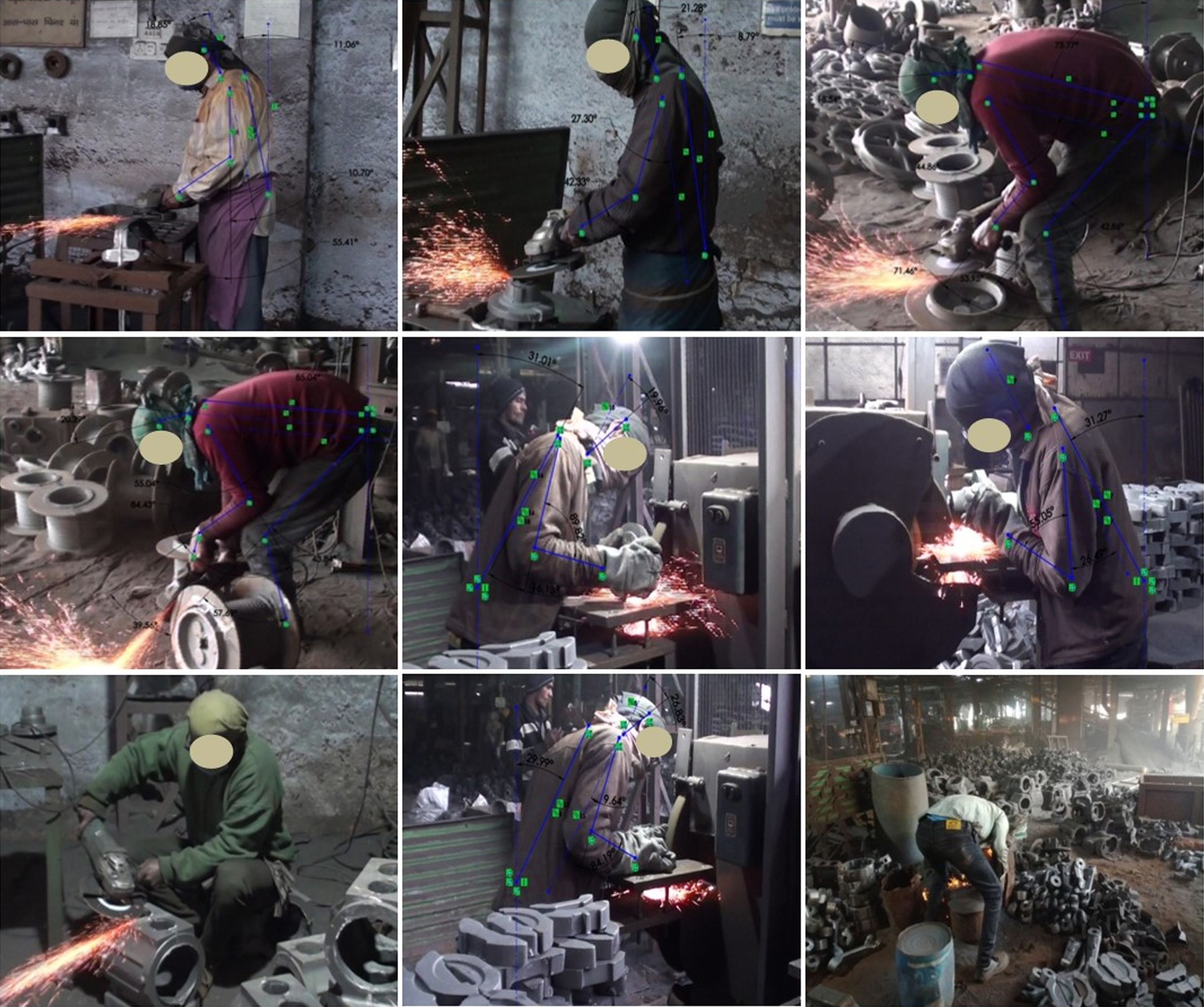
Postures attained during fettling work.

Postures attained during molding work.

Postures attained during manual material handling (MMH) work.
MSDs risk level evaluation of work postures (N = 216) using REBA score
Job task wise distribution (REBA score)
In lift/lower task, few work postures in the right side region were at very-high risk; with 57.15% and 42.85% of the work postures at high risk (for left side & right side region respectively), whereas around 42.85% of the work postures were at medium risk. In molding section, fewer work postures in right side region were found to be at very high risk level as compared to left side region followed by 47.06% (R) and 35.29% (L) work postures at high risk with remaining work postures were at medium risk level category. In fettling section; 23.81% (L) and 33.34% (R) work postures were at very high risk. In the same section, 57.14% of the work postures were at high risk (for both regions) with fewer work postures (19.05% (L) & 9.52% (R)) at medium risk. From the results, no work posture in any job section was found to be at negligible or lower risk level. An average REBA score for each job task is calculated as shown in Fig. 3. It was observed that push/pull task section has the highest average score of 10.78 (L) and 11 (R) followed by fettling section (9.09(L), 9.38(R)); then lift/lower task (7.43(L), 8.71(R)) and molding section (7.17(L), 7.41(R)) respectively.
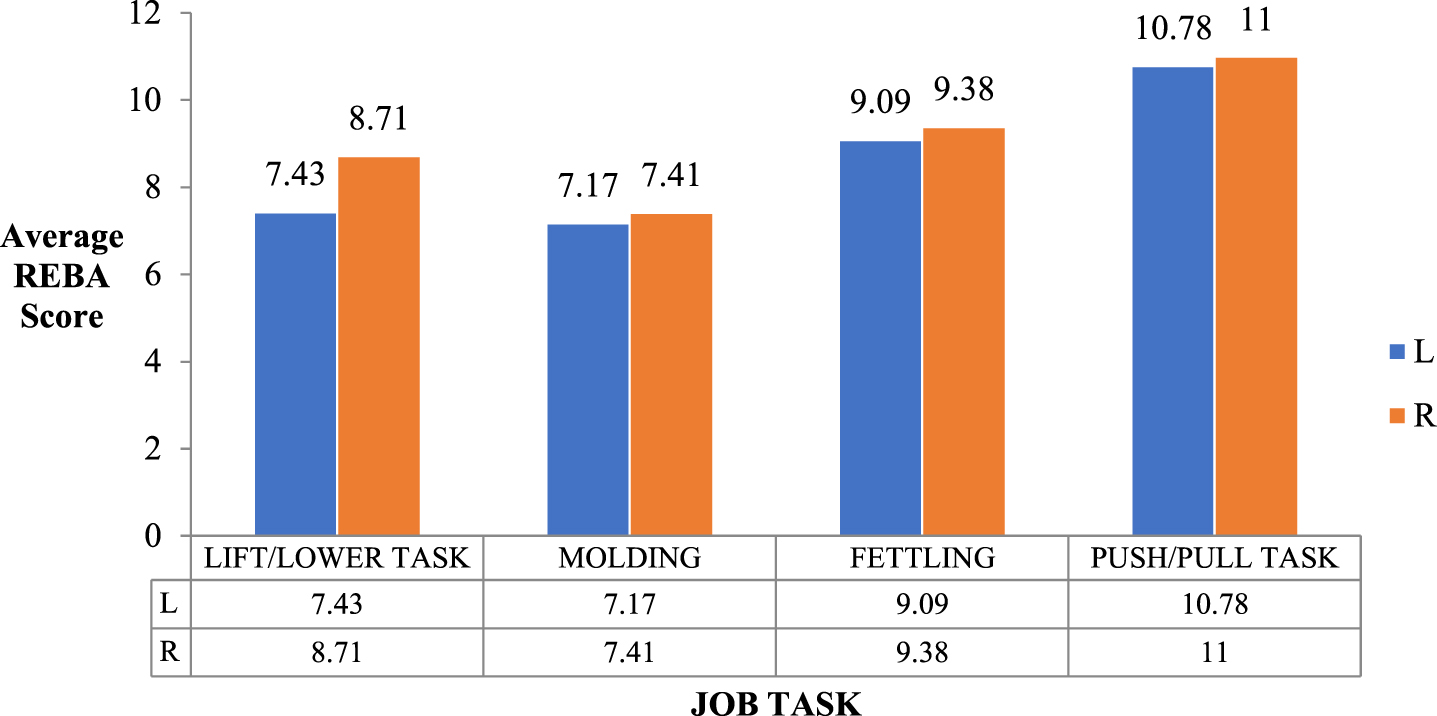
Average REBA score for different Job profile (left (L) and right (R) side body region).
From the analysed work postures under different work sections, observed coupling scores varied from “fair” (acceptable hand hold but not ideal) to “poor” (hand hold not acceptable although possible) hand hold; indicating associated score values of 1 and 2 w.r.t the coupling analysis. In specific work operations such as molten metal pouring using shank ladle, pulling activity in shot blasting, and bench grinding task the associated coupling was determined to be poor; however in work operations like angle grinding, core-making, machine molding task a fair coupling was observed. In most of the analysed work tasks, activity score varied from 1 to 2 due to several associated factors like repetitive actions, static pose held for longer time span, and activity causing rapid reach changes in work stance.
Risk index (RI) provides an indication of severity associated with the evaluated MSDs risk. A REBA score of 4 is usually considered as the designed/reference goal. For REBA the risk index varies from 1 to 3.75; where 1 indicating a nominal risk and as RI increases subsequent MSDs risk significance also increases. Table 5 shows the evaluated RI for different work sections. Higher RI values were observed for MMH (push/pull task) and fettling work sections followed by MMH (lift/lower task) and molding work sections. Results revealed that right side regions were exposed to higher RI values as compared to left side region for all the analysed work sections.
Risk Index (RI) evaluation for REBA
Risk Index (RI) evaluation for REBA
WMSDs risk assessment using REBA analysis for four different work-sections was compared using Mann–Whitney U test for both left and right side body regions as shown in Table 6. Statistically significant differences were observed (p-value < 0.05) among all the work-sections except lift-lower task (MMH) and molding section (p = 0.361; p > 0.05) for the left side region and lift-lower task (MMH) and fettling section (p = 0.230; p > 0.05) for the right side region, where the difference was not statistically significant.
Paired comparison among different work-sections for REBA
Paired comparison among different work-sections for REBA
REBA results revealed MMH task (push/pull) being most vulnerable followed by fettling section. In push/pull task higher scores were attributable to the shot blasting operation (involving raw castings to be placed in the shot blasting chamber). In fettling section; awkward postures, use of vibrating tools, repetitive actions and postures attained for longer duration during the finishing operation may be considered accountable for higher WMSDs risk level. In MMH task (lift/lower); higher risk values were observed in the right side body region; which may be due to frequent use of dominant hand in lift/lower operations. Under molding work-section; higher WMSDs risk scores (under high risk: 8–10, and very high risk category: 11–15) were accountable to the metal pouring operation (involving shank ladle operated by two workers for molten metal pouring), indicating highly labor intensive work-task. However, medium risks were related to other analysed work tasks (mold-making, core-making were found less vulnerable) in molding section (except tasks involving molten-metal pouring), which may be due to mechanization involved in the mold making process equipment; thus less labor intensive as compared to other work tasks.
In present work, Taguchi L25 orthogonal array (OA) was performed while considering four factors with five levels of variation as described in Table 7. Previously, few research studies have also implemented Taguchi optimization technique in analyzing the workstation parameters under different work sectors [31–33]. So, in present study an attempt was made to analyse the effect of workstation parameters using Taguchi L25 OA. Table 8 depicts the model matrix for L25 OA. L4–L5 (fourth lumbar –fifth lumbar vertebrae) spine compression value (in newtons) was considered as the response parameter. Biomechanics Single Action Analysis (BSAA) tool evaluates the biomechanical data on workers’ manikin for given static posture and yields output information as the lumbar compression load i.e. L4–L5 spine compression.
Considered parameters with five levels of variation
Considered parameters with five levels of variation
Taguchi L25 orthogonal array with four parameters at five levels each
In present study, workers’ population percentile at five different levels (i.e. 5% ile, 25% ile, 50% ile, 75% ile and 95% ile) has been taken into consideration as depicted in Fig. 4. Parameters like workstation height, width, and object weight were selected based on the existing work-conditions; with actual workstation height varying from 620 mm to 700 mm (sometimes workers were using additional support blocks for holding the respective job; providing height addition of 100 to 200 mm), while workstation width was found to be varying between 540 mm to 650 mm. Although object weight was considered based on the weight of the manipulated object/handheld vibrating tools varying between 4.2 Kg to 6.1 Kg. However, additional levels of variation among respective parameters were considered for the present study.

Workers manikins (DHM) at different population percentiles.
Fewer assumptions were taken into consideration while performing the current study, with details as follows: neck flexion angle (variation between 15° to 17°, upper-arm flexion (from 20° to 24°), and lower-arm flexion (from 45° to 49°) for selected population percentiles in conjunction with respect to suitable work-surface visibility (based on vision analysis) and also considering hand-work surface clash detection. Twenty five simulations were performed (as shown in Fig. 5) based on the respective model matrix for L25 OA. Further evaluations were performed using Minitab 17 software package; analysis of means (ANOM) and analysis of variance (ANOVA) were computed for the analysed variables.

Human activity analysis for respective virtual work-environment.
From the ANOM results (considering “smaller is better” criteria for selected response parameter i.e. L4–L5 spine compression value), it was observed that smaller workstation height contributed significantly to higher spine compression values (Fig. 6). However, workstation width showed least variation w.r.t spine compression yet population percentile followed by object weight showed statistically significant contribution to the response parameter as shown in Table 9. From ANOVA results (Table 10), it was observed that workstation height followed by population percentile and object weight were dominant factors significantly affecting the response parameter (p-value < 0.01); however workstation width (p-value > 0.05) had no significant effect.

Analysis of Means (ANOM).
Response table for means
Analysis of variance (ANOVA)
Few limitations associated with the present study have been identified. Smaller sample size was observed in the study, although it was in accordance to the minimum sample size determination. However, a study would be performed in near future with larger sample size for more in-depth analysis. In present work Taguchi L25 OA was utilised to analyse the impact of workstation parameters on WMSDs risk severity related to lower back among targeted audience (i.e. casting workers). Based on the selected factors; BSAA ergonomic assessment tool (biomechanical analysis) was best suited to serve this purpose as it evaluates the MSDs risk severity associated with the lower back region (L4–L5 spine region, in terms of spine compression loading). However, it may be regarded as a study limitation, as few other injury prone areas like neck (C- spine), upper arms, and wrist regions need to be assessed to gain more valuable insights. But due to the software limitations (BSAA tool evaluating compression loading only in L4–L5 spine region) and the selected parameters, other joint injury areas could not be assessed. Although, keeping these study limitations in mind a futuristic study could also be performed w.r.t other WMSDs affected body areas.
Conclusion
The present study indicates that workers employed under small scale foundry units are exposed to excessive labor intensive work with high risk-severity for work-related musculoskeletal disorders (WMSDs). Factors like manual work demands, poor workstation design, repetitive actions, heavier loads and awkward postures held for longer duration may be considered attributable to this occupational health hazard.
Posture analysis using REBA indicated high WMSDs risk-severity associated with most of the analysed work tasks; with manual material handling (push-pull task) task followed by fettling work being the most critical regions.
WMSDs risk assessment using REBA analysis for different work-sections was compared using Mann–Whitney U test for both left and right side body regions; with statistically significant differences observed among all the respective work-sections except lift-lower task and molding section for the left side region and lift-lower task and fettling section for the right side region (p > 0.05) respectively. Medium risks were attributable to mold-making work tasks which may be due to mechanization involved in the process equipment and thus less labor intensive as compared to other work tasks, which indicates the importance of process mechanization in reducing WMSDs risk exposure.
From Taguchi analysis, it was observed that smaller workstation height contributed significantly to higher spine compression values. However, workstation width showed least variation w.r.t L4–L5 spine compression, yet population percentile followed by object weight showed statistically significant contribution to the response parameter. It was observed that workstation height followed by population percentile and object weight were dominant factors significantly affecting the response parameter, but workstation width had no significant effect.
Suggestive improvements like using sit/stand stools, fixtures, work-surface height modifications, and tool redesign in conjunction with preventive measures (such as modified work techniques, job rotation, vocational training, and suitable work-rest periods) may be considered beneficial in minimizing the WMSDs risk-severity and improving the prevalent work conditions.
Conflict of interest
The authors declare that there is no conflict of interest with any financial organization regarding the subject matter or material discussed in this manuscript.
Footnotes
Acknowledgments
The authors are immensely grateful to the foundry workers who showed their willingness to participate in this study.