



Abstract
BACKGROUND:
Health promotion is an important strategy for companies as it helps identify risks at work and the health needs of workers. Nursing, as a profession committed to promoting decent work, plays an important role in this strategy.
OBJECTIVE:
This manuscript aims to discuss the experience of the Nursing Service in the construction of knowledge about work, to support actions in favor of health promotion.
METHODS:
This is a discussion article in the field of occupational health conducted at a Research Center in the nuclear area.
RESULTS:
Based on actions centered on guidelines on lifestyles and scheduling visits to the workplace, with the Internal Public Health Commission, limitations were identified that allowed us to discuss and understand the role of nurses as occupational health professionals.
CONCLUSION:
Knowing the work and understanding it in its specificities and limitations of the production process has allowed to expand the possibilities of action with workers to transform working conditions and promote health.
Introduction
Health promotion can be defined as a transversal strategy to identify risks to the health of groups and their needs, with a view of elaboration of interventions to reduce vulnerability with the participation of all those involved [1]. In the workplace, health promotion should be provided in conjunction with the activities and actions developed in the production processes in a participatory and dialogical way [1, 2].
Nursing as a profession that is part of the Specialized Service in Safety Engineering and Occupational Medicine must collaborate with work-related disease/illness prevention actions and strategies to promote worker health. However, a study carried out in companies in southern Brazil showed that nurses had a fragmented action in the field of worker health, marked by administrative activities and with little surveillance action in the workplace [3].
In 2019, the Nursing Now campaign was launched in Brazil through collaboration between the Federal Nursing Council and the Collaborating Center of the World Health Organization (WHO) with the aim of providing visibility and appreciation for professional nurses, recognizing its importance in raising the quality of the assistance provided at different levels of health care [4]. In the field of occupational health, its importance is no different, being an important profession for the promotion of the well-being of all, through interventions for decent, inclusive, and productive work [4, 5].
Since health and work processes are dynamic and interrelated, health practices must consider the real conditions of life and work [6]. The analysis of the way people work and relate and the conditions in which they develop their activities makes it possible to understand the health processes of workers and allows the construction of strategies to improve production systems and promote health [6–8].
Although there are few studies on the role of nurses in promoting workers’ health and its limitations [9–14], their importance in promoting health and safety in work environments is recognized, with a practice based on research and a multidisciplinary theoretical framework [15]. Seeking to contribute to the knowledge in this area, this manuscript aims to present a discussion of professional nursing practice in a Research Center in the nuclear area, with work as central and directed to the promotion of workers’ health.
Methods
This manuscript was developed in the context of a research project called “A study of work processes in a Teaching and Research Autarchy in the nuclear area: an action research in the field of workers’ health.” These discussions were produced from the professional experience of the Nursing Service (NS) at the Nuclear Research Center, which started in 2014. It is a qualitative research approach [16] that describes and discusses the reflections produced since the creation of the NS and the meaning of the experience, through elements for problematizing the relationship between work and health and the role of the nurse [6].
The main data sources for the construction of this experience report were the nurses’ field diaries (first author of this research), whose notes provided information on the phases of the NS and the reflections carried out on work situations; and the documents produced exclusively or collaboratively by this service, which most characterized its phases: nursing evaluation form in the workers’ consultations in the annual periodical examinations, inspection reports of the workplaces by the Internal Health Commission (IHC) and the field observations of the first author’s doctoral thesis, of which this work is a part. The description and discussion of the NS trajectory is based on the following question: how the NS has collaborated with the promotion of workers’ health (demand placed by the institution), knowing the conceptual complexity of health circumscribed in the field of work? As the first nurse selected in a public examination to work in this government institution, it was necessary to build a practice that responded to this demand.
Based on the Nurse’s reflections, the documents mentioned and the limitations of the proposed actions, the description of the report is divided into 3 phases: 1) knowing and evaluating the health of workers in the periodic annual examinations; 2) joining efforts with ICH and the new challenges for health promotion; 3) work as a guide for actions to promote workers’ health. The identification of each theme required a critical reading of the history of this service, from the institution’s demand for this professional category providing services for the promotion of workers’ health and its development in light of the demands that arose.
This discussion follows the ethical precepts of Resolution 466/2012 of the National Health Council in Brazil.
Results and Discussion
Nursing in a Nuclear Research Center: Meeting the workers
The NS started at the Nuclear Research Center in 2014. The Center is an autarchy that conducts research and training for future workers to work with radioactive elements, in its various activities, such as extraction and research of radioactive ores, research and production of new radiopharmaceuticals, studies of radiation exposure to workers and patients during mammography, radioactive waste management, and other issues.
It was the first time that the organization hired a nurse to work with health promotion through lectures, construction of educational materials, and individual guidance. Until December 2014, there was only one nursing assistant who helped occupational physicians in urgent and emergency care. The Research Center sought to expand the performance of the health team, which until then focused on the evaluation of annual periodic examinations (for screening for hematological and metabolic disorders, as well as breast, uterus, and prostate cancer) and in the treatment of occupational accidents and occasional complaints from workers.
The first year of this work was marked by doubts about how to do this “health promotion” work. Initially, the NS sought to know who the workers were (age, gender, profession, working time, area of expertise). The clinic did not have a computerized system, and hence, it kept the workers’ information in clinical files, in Microsoft Word format or in the physical records of each one. Such files contained information, such as use of medications, history of illness, and results of laboratory tests and/or evaluations of medical specialties.
At that moment, it became evident that, if the purpose was to describe the morbidity profile of workers, these files would be an initial path for such a task; however, the overview of the health situation would be far from being known. The available data did not show any information on working conditions, much less on the relationship between work and health.
To build this situational diagnosis, a nursing consultation with each worker was proposed. This consultation was made prior to medical evaluation, during periodic examinations, to investigate information about the work of each employee of the institution — what they do in their laboratories and what is their perception of the task and/or their complaints?
The individual Nursing Consultation provided better information on the workers; however, there was a repetition of data from nursing reports, especially nursing diagnoses, according to NANDA-I taxonomy (2018–2020), which seemed to be the same for almost all workers: 1) risk of impaired liver function, 2) risk of unstable blood glucose, 3) risk of metabolic imbalance syndrome, and 4) disturbance in sleep patterns [17]. Although there was information about workers and their work contexts, the diagnoses still seemed limited to laboratory tests and the specialists’ view of the general complaints presented by the workers.
Giving guidance on “lifestyle” and hearing complaints about work, without knowing it, concretely, did not allow the NS to propose effective actions. It was asked if the guidelines carried out — usually advised to practice 150 minutes of physical activity a week and a diet centered on fresh foods — were effective in promoting the health of those workers. Given this initial discussion, it sought to enhance the role of the NS at the institution through another strategy: the creation of the Internal Health Commission.
Joining efforts with the Internal Health Commission and the challenges to promote health
Within the scope of the Federal Public Administration, in Brazil, the Internal Health Commission (IHC) is highlighted as one of the key members for the implementation of strategies for health and safety at the Work policy of the Federal Public Servant. This commission focuses on preventing health risks, discussing a better organization of work processes, and promoting the social participation of workers in these discussions [18].
In the creation of the IHC, it sought to compose a commission with professionals from different attributions and who worked in different laboratories/sectors of the institution. In this way, it was believed that it could get closer to workers in their work contexts.
The members of the Commission worked by interacting with colleagues in their sector and bringing the demands reported by them. The Commission carried out monthly visits to the workplace, to assess the conditions of the working environment and to dialog with workers about their complaints. Assessments of the work environment were carried out through forms created by the Occupational Safety team and the NS.
The participation of the nurse in IHC provided an approximation of the real work contexts. It was possible to identify problems and discuss solutions in a closer way to workers in their workplaces. This discussion took place with the ICH’s multidisciplinary team (engineers, social workers, occupational safety technician, occupational physician, secretaries and laboratory technicians). However, ICH was unable to respond to the questions raised by workers. Their difficulty was justified by the lack of a budget for implementing the solutions. Most of the problems identified were related to the need to adapt to the workplace: walls with infiltration, gas cylinders outside the intended area, absence of an emergency kit in the warehouse for an incident involving the spillage of acids, need to install exhaust in some laboratories, etc. Thus, ICH’s action was limited to identifying problems and attempting to forward solutions to hierarchical superiors. There were no actions to deepen their understanding, recognize and encourage the participation of workers in creating solutions. Throughout this journey, it became clear that IHC was powerless to resolve the issues presented. Although IHC identified the problems, it was not able to deepen the understanding to promote the necessary transformations.
After all, knowing that health promotion actions contribute to the Agenda for decent work [19], how would the ICH reports on structural problems in the workplace, or on the absence of some items for work, be collaborating with that perspective? Despite the importance of workplace conditions being essential for health promotion, one aspect was not being addressed in this description and analysis: how workers work.
Knowing the work for the promotion of workers’ health: Building a work clinic
In the second half of 2019, IHC was notified of chemical contamination in lab coats from the radioactive ore research sector at the institution. The commission paid a visit to the sector to record the accident.
Seeking to understand this situation, the nurse started a process of systematic observation inside the laboratory, together with the workers [6]. In this phase, the nurse’s participation was not just as a member of the ICH, but as a researcher who sought to understand this social phenomenon during his doctoral field research. It was no longer an interview with a pre-prepared script, but a dialog based on the ways of doing the job. He sought to understand the unforeseen and incidents at work, the skills, the invisible initiatives, the commitments made between production and safety, the risks incurred by workers, and their perceptions about the consequences for health.
After a few days of going to the laboratory and talking to the workers, he was introduced to an unusual situation. The ore that was supposed to be purified by means of a physico-chemical process of separating the radioactive elements, thorium and uranium, from the ores of interest, in this case niobium and tantalum, had “become stoned” inside the machine. To carry out the purification and keep the ore in a liquid/paste state, operators added acid and water to the machine, but they were still unsuccessful.
Finally, the workers manually removed stones formed inside the machine. This situation enabled a series of discussions with the workers, questioning the notion of risk and, through it, the role of NS in this context.
The analysis carried out in these situations often ends up pointing out unsafe acts and/or psychologizing determinations of the worker, such as “one who is not aware of the risk,” or who has not thought about the possible consequences of his actions. However, when listening to workers, seeking, together with them, to build a discussion centered on work, this analysis becomes more complex.
If, on the one hand, the manual removal of radioactive material can be configured, at first, as a situation of transgression, in which the worker puts himself at risk, on the other hand, the non-removal of this material from the machine and, consequently, its loss, could cause the research to be interrupted. This situation highlights the conflict experienced by workers in many situations, in which work and health seem incompatible. The worker is taken to take risks.
To better understand this problem and propose strategies that allow the work to be carried out and that do not compromise health, it is necessary to discuss the concept of harmfulness. The harmfulness of work is related to the lack of autonomy or obstacles to the worker’s action in the face of the dynamics of real work [20]. During the discussions about this “unusual situation,” between the nurse and the workers, they pointed out two important issues for understanding the harmfulness: their perception of the risk and the particularities of the equipment, where the ore had become stoned.
Regarding the perception of risk, it was evident that workers knew about the possible consequences of their actions, and these were justified by statements, such as: “If I am afraid [of radiation], I will not work” (OP1).
The machine, on the other hand, was unable to seal the solution contained in its interior and the contact with the ambient air caused the “stoning.” It is worth mentioning that after notification of the accident, there was no recurrence of contamination of the lab coats, which was due to the stagnation of the research that needed to be reformulated to purchase new equipment that would meet the specifics of the work, which had not been discussed with the operators.
Working already involves a dynamic that goes beyond any previously defined procedure, requiring the worker to create actions to transform the prescribed work (the task) into a possible work (the activity, or real work), as illustrated in Fig. 1 [6]. In dealing with basic research in search of innovation, this complex relationship between work and health is no different. From a broader perspective, it is worth noting that health is more than fitting into a pattern of normality and following rules, it is necessary to be able to create new rules of life and work, because “the normal thing is to live in an environment where fluctuations and new events are possible” [21(pp188)].

Making the diagnosis about real work [6].
From the perspective of safety and radiological protection, the conclusion of this report is summed up in the recommendation to disable the machine and the stone material inside it, transforming them into radioactive waste. However, what stands out in this case is the importance of knowing the obstacles that have arisen for the execution of the work and the need for the collective construction of solutions. It is not a matter of judging the decisions made by workers in the face of such unforeseen circumstances as right or wrong, but because work is one of the factors that interfere with the subjects’ health conditions, the construction of knowledge about this factor for health promotion must be born from this practice, “unrelated to the expert’s posture that is satisfied only with the application of his knowledge” [22(ppviii)].
Thus, it is important to highlight that the NS did not abandon the practices initially reported, but given the limitations presented in the first two phases of action (Fig. 2), a paradigm shift was necessary, making the work the starting point for discussing health issues from a promotional perspective and with concrete elements of its context: the division of labor, the information available for its execution, the necessary equipment, the complexity of the processes and products and, of course, the workers.
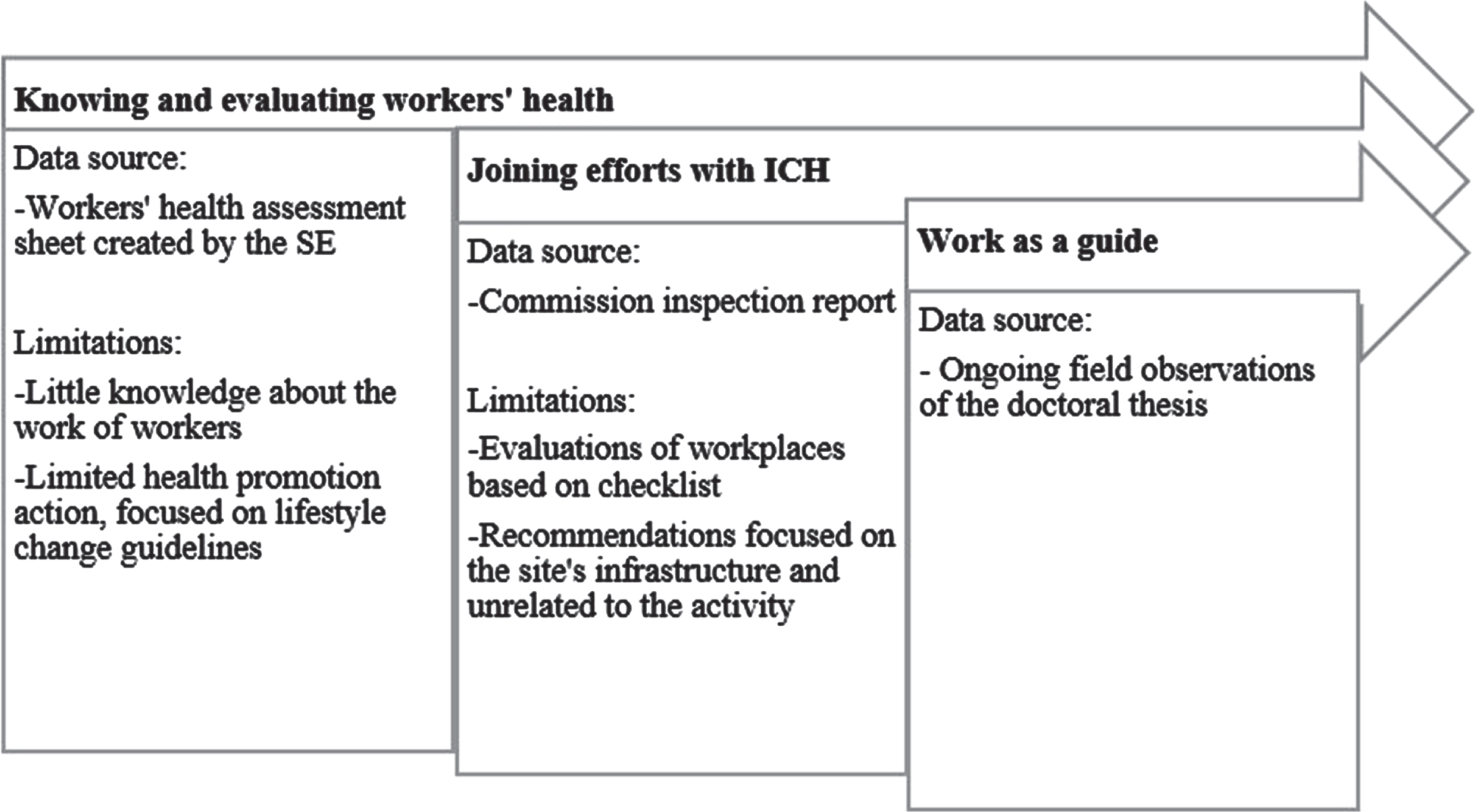
Phases of the Nursing Service.
The trajectory of the Nursing Service has been a constant learning process in the construction of a practice oriented toward health promotion. Nurses’ place of work is not just in the occupational health clinic, but also where the work of the other, in fact, takes place. Knowing the work allows Nursing to enter a scenario of possibilities. Since nursing is a profession committed to the promotion of workers’ health, it is essential for Occupational Health Nurse to know, discuss, and intervene in real work.
Ethical approval
Ethics Committee - René Rachou Institute – Fiocruz Minas. Certificate of Presentation of Ethical Appreciation: 30808020.6.0000.5091. Report number: 4.084.770.
Informed consent
Not applicable.
Footnotes
Acknowledgments
The authors have no acknowledgments.
Conflict of interest
The authors declare no conflict of interest.
Funding
The authors report no funding.