



Abstract
BACKGROUND:
Today, dual-career couples are becoming increasingly prevalent around the world. Due to the nature of the life of this group of people, their sexual and marital life can be damaged.
OBJECTIVE:
The aim of this study was to develop a psycho-educational model based on the lived experiences of dual career couples who are dissatisfied with sexual relations and its effectiveness on sexual satisfaction.
METHODS:
This research was done based on a mixed (qualitative and quantitative) method. The qualitative part was performed using the phenomenological method and 13 couples were selected for semi-structured interviews using the purposive sampling method. In a small part of this study, a single case plan (AB plan) was used, and three couples were selected from those who referred to counseling centers in Ardabil and underwent counseling interventions. In a small part, the Sexual Satisfaction Questionnaire was used to measure the changes of couples during the implementation of the intervention program. The information obtained in the qualitative part was analyzed through content analysis and the quantitative part was analyzed using visual analysis, clinical significance and recovery percentage.
RESULTS:
Based on the results obtained in the qualitative analysis section, the experiences of sexual dissatisfaction of dual-career couples can be classified into 10 main themes, 20 sub-themes and 30 categories that affect the sexual satisfaction of dual-career couples. The results of the quantitative section indicate that the designed psycho-educational model has led to an increase in sexual satisfaction of dual-career couples.
CONCLUSION:
Achieving sexual and marital satisfaction and finally mental health and reducing divorce is a process that begins with pathology in the cultural context and is achieved by emphasizing indigenous culture through developing a counseling package for appropriate intervention by therapists and counselors.
Introduction
The dual career phenomenon has become increasingly prevalent worldwide [1]. Although economic wellbeing is often provided among dual-career couples who have fewer material concerns, some of them may be faced with a variety of job-family conflicts. These conflicts could be due to several factors, such as job stress, heavy workload, role conflicts, childcare problems, adult care, and issues related to job-family balance and personal needs [2].
Among dual-career couples, a kind of role conflict exists in which role pressures resulting from working roles interfere with the roles of individuals in the family [3]. Shimazu [4] found more work and workaholism in women than in men, which can lead to job-family conflicts. Moreover, it has been reported that job-family conflicts may lead to a wide range of negative consequences, thereby decreasing marital satisfaction with and enjoyment of life moments [5, 6]. Couples’ sexual satisfaction is dependent on their perception of the sex life. Sexual satisfaction is a variable that can be distinguished from sexual function and is something beyond sexual pleasure [7], in the importance of which one can say that couples can have good sexual performance at any stage of the sexual response, yet they cannot experience marital and sexual satisfaction [8]. Marital and sexual satisfaction can be influenced by education, employment, job-family conflicts, marital problems, functional factors, gender role conflicts and workplace health [9–11]. Past research shows that marital burnout, marital conflicts, marital problems, and psychological problems are more often observed among dual-career couples, and that there is a significant association between employment and marital problems among them [12].
The role of sexual and marital problems among couples in psychological, physical, and social dimensions, such as work environment is significant [13]. In addition, there are financial and role conflicts in some dual-career couples. Besides, marital issues affect these problems and role conflicts in the field of work and the family [10]. Accordingly, one could say that marital dissatisfaction is a variable that is directly and indirectly affected by many factors and also affects different aspects of life.
Considering the number of domestic and Iranian studies on marital and sexual problems of dual-career couples [14–18], it can be said that context and culture play an important role in how and causes of marital problems, especially sexual and marital problems of dual-career couples.
Therefore, designing a psycho-educational program to promote sexual satisfaction requires identifying the factors affecting sexual and marital dissatisfaction of dual-career couples based on their lived experiences in a particular culture. But so far, no qualitative Iranian research has been conducted that can investigate the factors affecting the sexual dissatisfaction of working couples from their lived experiences. Thus, it is necessary to pay attention to this group in order to prevent and treat their marital problems. Therefore, the aim of this study is to develop a psycho-educational model based on the lived experiences of dual-career couples dissatisfied with sexual relations and its effectiveness on sexual satisfaction.
Method
The design of this study was a mixed exploratory design (exploratory sequential mixed), during which the results of the first stage (qualitative stage) caused the formation and enlightenment of the second stage (quantitative stage). According to the purpose of the research, in the qualitative part, the phenomenological method was employed and in the quantitative part, the single-subject experimental design was used.
Participants in the present study were dual-career couples who were dissatisfied with sex. They were called and referred to counseling centers in Ardabil County from 2019 to 2020. The participants were selected and invited to participate in this study from the statistical population using the purposive selection method (10 couples), snowball sampling (3 couples), and a combination of extreme or deviant case sampling. After calling the counseling centers and couples who refer to them, necessary screenings such as initial interviews and sexual satisfaction test, sampling of dual-career couples were performed.
Criteria for entering the study included perception of sexual and marital dissatisfaction by the volunteers participating in the study and having experienced at least 2 years of marriage life because Houston et al. regard the duration of marriage as one of the factors affecting marital satisfaction [19]. Another inclusion criterion was having at least one child because Tung et al. found that the number of children was associated with marital satisfaction [20]. Other inclusion criteria were full-time employment of couples at public and private institutions, lack of drug or alcohol abuse, non-use of psychiatric drugs, lack of mental health problems, not having referred to courts for divorce during the research, lack of recognition of sexual dysfunction in either of the couples, and having no history of marital infidelity. The exclusion criteria were having psychological disorders and physical illnesses as well as lack of entry criteria. After semi-structured interviews with 11 couples, data were saturated. However, to increase diversity of concepts and ensure data saturation, interviews were continued with 2 other couples. In the end, 13 couples were analyzed.
The interviews that were conducted, both at couple and individual levels at the counseling center, lasted from 60 to 90 minutes. Depending on the circumstances, interviews were conducted individually and as a couple. Next, the interviews were recorded and transcribed one by one. They were started with the questions “Are you generally satisfied with your marriage?” and “What is your experience of married life?” Next, answers to questions, such as “What are your couple’s barriers to the quality of married life?” were guided. Aliases (participants 1, 2, etc.) were used to preserve the subjects’ details in the reports. To increase generalizability of the findings, it was attempted to differentiate the participants in terms of occupation, age, income, and education.
For the quantitative part of the research, the method used was a single-case experiment. Since single-case designs are not implemented in groups, they do not require a large sample size and can be implemented with several couples or subjects. In this study, three couples were purposefully selected as a sample with the consent of both couples and being volunteers. Sufficient explanations were given to the couple about the conditions of the sessions and their number. After that, by observing all the ethical issues and selecting the participants, the intervention package designed from the quality section and library study was performed in presence of couple, and in some cases and sessions, it was conducted individually.
Larson standard sexual satisfaction questionnaire [21]
This questionnaire has 25 questions and measures sexual satisfaction based on a five-option Likert scale (always 5 to never 1). A score between 25 and 41 indicates low sexual satisfaction, a score between 42 and 84 indicates moderate sexual satisfaction, and a score above 84 indicates high sexual satisfaction. Higher scores indicate high sexual satisfaction and lower scores indicate sexual dissatisfaction or low sexual satisfaction. Cronbach’s alpha coefficient calculated in the study by Bahrami et al. [22] for this questionnaire was estimated above 0.70.
Statistical analysis
When all interviews were conducted, the thematic analysis method was used to analyze the data obtained from the interviews [19]. The main method of data analysis in single-case designs is the use of shape and visual analysis. In visual analysis, the obtained data can be analyzed in terms of level (using indicators such as average), trend (data slope that can be ascending, descending or non-sloping) and variability in different stages [23]. In addition, the criterion of clinical significance is used to analyze the data. Reliable change index was used for clinical significance [24]. For this index to be statistically significant, the result must be equal to or greater than 1.96 (RCI >1.96) [30]. Formula 1: Reliable change index:
Also, the percentage recovery formula [2] was used to objectify the recovery rate. The following formula was used to objectively measure the improvement rate. According to Balnchard, according to this formula, a 50% reduction in symptoms is considered a success in treatment; scores between 25 and 49% are indicative of a slight improvement; and finally, a reduction in symptom scores below 25% is considered as a failure in treatment [25]. Formula 2: Improvement rate:
A total of 13 couples participated in this study, whose demographic information is given in Table 1 (numbers 1 to13 were assigned to couples in this section). As Table 1 shows, research subjects were from different strata of society with different levels of education. The duration of the research subjects’ marriages varies from 5 to 20 years.
Demographic characteristics of research subjects in terms of marital dissatisfaction
Demographic characteristics of research subjects in terms of marital dissatisfaction
In this study, two main occupational themes were obtained in terms of marital dissatisfaction among dual-career couples, which included “work-family conflicts” and “financial conflicts". Besides, 5 sub-themes and 14 categories were obtained. Table 2 shows a summary of qualitative findings of this research.
Themes of sexual dissatisfaction among dual-career couples
Summary of educational-psychological package
Demographic characteristics of dual career couples participating in the study
According to Table 2, data analysis in this theme has led to the production of 24 primary concepts, 4 categories, and 2 sub-themes.
Examples of couples’ responses to the semi-structured interview are given below:
“I did not believe that after marriage my body would be so damaged that I would even be ashamed to show it to my spouse. I’m worried that it will get worse. . . ” (Couple No. 7). “I wonder if I could satisfy my husband. . . ” (Couple No. 11).
Maladaptive beliefs and emotions
According to Table 2, data analysis in this theme has led to the production of 45 primary concepts, 5 categories, and 3 sub-themes.
“I think husband and wife should know what their spouse wants and they do not need to tell each other if they really love each other. . . ” (Couple No. 10).). “I do not want my spouse to know that I am enjoying our relationship. . . ” (Couple No. 2).
Lack of individual capability development
According to Table 2, data analysis in this theme led to the production of 55 primary concepts, 5 categories, and 2 sub-themes.
“We sleep apart when we get upset with each other. Especially when I’m nervous about my husband, it’s impossible for me to think about having a sexual relationship. “Even if I want it myself or my husband. . . ” (Couple No. 7).
“In general, I can say that he is not a person of responsibility, whether in the dimension of emotional relationship or other aspects of life, and this has damaged me and our relationship and generally, our marital life” (Couple No. 12).
Use of unhealthy defense mechanisms
According to Table 2, data analysis in this theme has led to the production of 10 primary concepts, 2 categories, and 1 sub-theme.
“I do not like my body; in general, I feel that my husband does not like my body very much” (Couple No. 4).
Marital dysfunction
According to Table 2, data analysis in this theme has led to the production of 56 primary concepts, 4 categories, and 2 sub-themes.
“Life has become really boring. I feel that I’m like a man and our problem is that I do what my husband has to do. I lost that feminine spirit I had in my early life” (Couple No. 10).
Low sexual relationship quality
According to Table 2, data analysis in this theme has led to the production of 184 primary concepts, 11 categories, and 3 sub-themes.
“No, our sex has never been such that my husband wants to touch my genitals, play with them or experience those special emotions” (Couple No. 11).
Low sexual assertiveness
According to Table 2, data analysis in this theme has led to the production of 41 primary concepts, 4 categories, and 2 sub-themes.
“Yes, there have been times when I wanted to, but no, I do not remember insisting on a relationship, but my husband did insist so much” (Couple No. 5).
Work-family conflict
According to Table 2, data analysis in this theme has led to the production of 66 primary concepts, 4 categories, and 2 sub-themes.
“My husband always says you do not give me time and your work is more important than me. . .” (Couple No. 13). “Spouse encouragement can be very effective. In general, my husband does not know the duty of a man whose wife is employed. . . ” (Couple No. 13).
Financial conflicts
According to Table 2, data analysis in this theme has led to the production of 65 primary concepts, 10 categories, and 3 sub-themes.
“I miss the fact that once I have my full salary and I can decide for myself. It seems that I am not a human being at all. . . ” (Couple No. 11).
Designing an educational psychological package
The content of counseling sessions was compiled in 10 sections based on qualitative findings and theories of psychotherapy and communication enrichment. Intervention at the individual level based on cognitive-behavioral, emotion-focused and insight-focused therapy:
Couples’ sexual problems can have an individual background. So that each of couples can experience different personal problems depending on the specific circumstances of their lives. In such a way that family contexts, family interaction patterns and the main family in general appear in the form of psychological problems with individual contexts in each couple.
Objectives of this level of intervention: Promoting general and sexual self-esteem Change in dysfunctional sexual beliefs of individuals Promoting self-differentiation and individual responsibility in the marital relationship (marital identity) Increase awareness of attachment style and change it to adaptive attachment Couple-level intervention based on sexual enrichment, behavioral, structural and systemic therapy theory:
These sessions focus on the couple’s relationship and identify its harms. Many marital problems are rooted in maladaptive relationships, and sexual dissatisfaction is sometimes manifested in these relationships. Therefore, focusing on increasing the level of sexual satisfaction through enriching sexual intercourse and reducing the incompatibilities of a married couple can have a positive effect on improving the performance of couples in marital life.
Objectives of this level of intervention: Detecting triangulations and eliminating them Strengthening identity and gender roles and reducing the effect of identity tension line Enriching sexual relationships Promoting sexual self-disclosure Increasing the couple’s awareness of the destructive role of family work conflict problems Reducing job-marital conflicts
Ten experts were considered for content validity (necessity and relevance of the topics of psycho-educational package sessions). Experts with doctoral degrees were classified into three areas: psychology, psychometrics, and counseling. Four clinical psychologists, four counselors and a psychometer were selected to measure content validity, each with more than five years of experience in individual therapy, couple therapy, and scale construction in the field of psychology. After receiving the opinions of these experts, the value of CVR was 0.69 and the value of CVI was 0.85.
Evaluation of the effectiveness of the educational psychological package on sexual satisfaction of dual-career couples
During the first to third weeks (baseline), participants responded to the research tool, and in the fourth week, while the other subjects were still in the baseline stage, the first couple entered treatment. In the fifth and sixth weeks, the second and third couples entered the treatment sessions, respectively. Subjects responded to the research tool in sessions No.2, No.4, No.6, No.8 and No.10 At the end of treatment, three follow-ups were performed on all subjects.
Of the couples participating in the study, the first couple has been married for 12 years and the second couple has been married for 8 years. The minimum age for women at the time of marriage is 19 and the maximum age is 24. For men, the minimum age at the time of marriage is 23 and the maximum age is 33. The results of Table 2 show the demographic information of the couples participating in the study. Table 5 shows the intervention process for the three pairs.
Intervention process
Intervention process
As can be seen in Table 6, the means of sexual satisfaction before the start of treatment for the first to third couples are 55.16, 57.37, and 58.4, respectively, and after treatment, the means of the variable are 70.2, 71.8, and 73 and in the follow-up stage, they are 70.66, 72.33, and 73.66, respectively, which have increased compared to the baseline stage.
The process of changing subjects’ sexual satisfaction of dual-career couples
The reliable change index after treatment for the first to third couples is equal to 2.83, 2.71, and 2.74, respectively, and the reliable change index in the follow-up stage is equal to 2.92, 2.81, and 2.87, respectively. It shows that for all three participants, these values are higher than the standard value (RCI >1.96.). Therefore, the performed intervention has significantly increased sexual satisfaction. The percentage of improvement shows that this intervention was effective between 25 and 27% in the treatment phase and between 26 and 28% in the follow-up phase.
Figure 1 shows that the level (average) of sexual satisfaction scores of all three couples in the treatment and follow-up stages has increased compared to the baseline stage. According to the dual conservative criterion of Fisher et al. [23], the number of points in the plotted data (4 points) is above the line, predicting the level and trend. Therefore, this increase in scores is interpreted as significant.
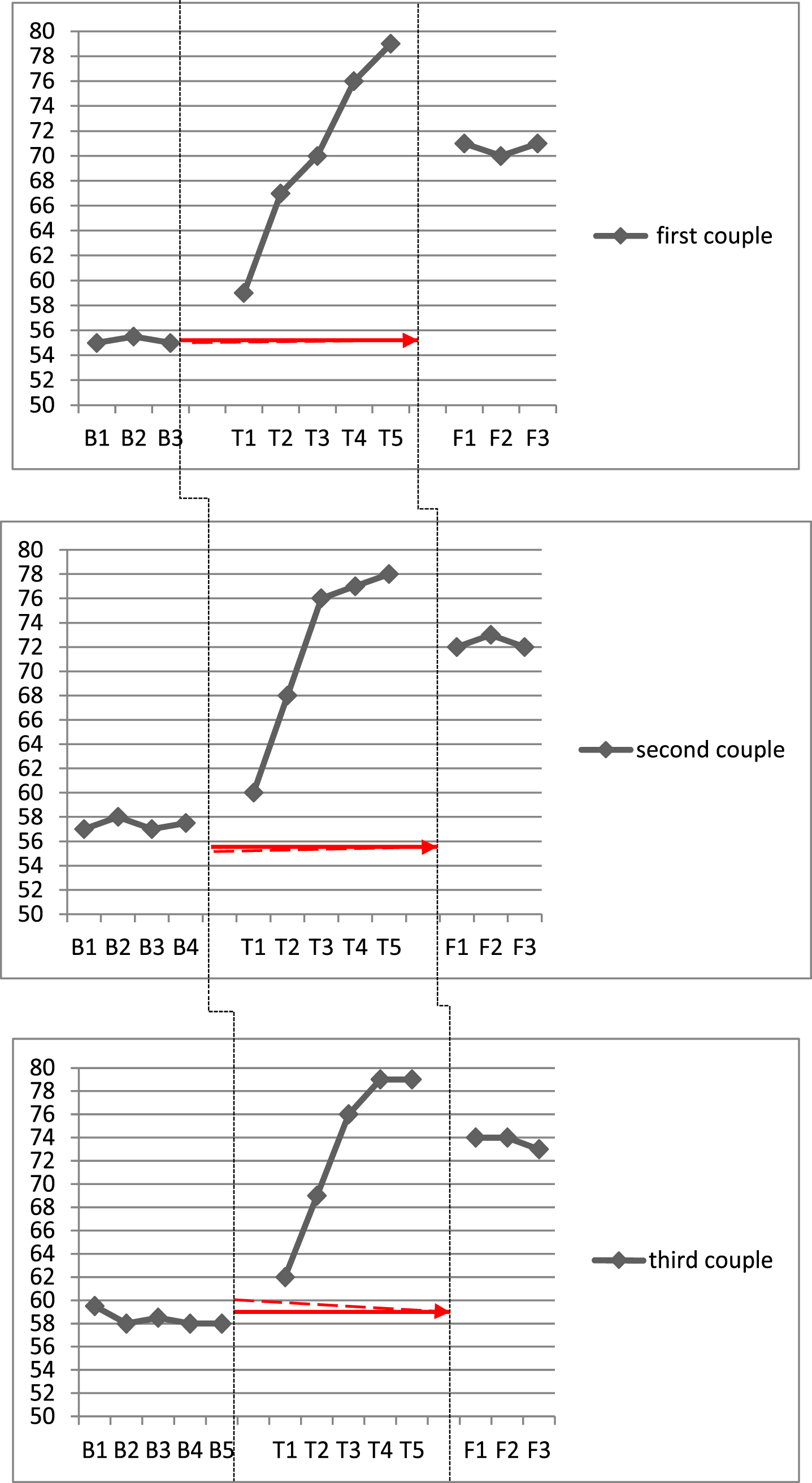
Visual analysis of sexual satisfaction. B = baseline, T = treatment, F = follow-up.
The themes obtained from the qualitative part of this study show that some experiences can jointly cause marital and sexual dissatisfaction with different mechanisms in non-employed couples or specifically in dual-career couples.
The effect and relationship of these themes, directly and indirectly, on the sexual satisfaction of couples have been observed in other studies, which is somewhat consistent with this study. Regarding the role of sexual self-esteem in sexual performance and sexual satisfaction of couples, Peixoto et al. [26] have shown that sexual self-esteem plays a mediating role between sexual performance and sexual satisfaction; this is indicative of the importance of sexual self-esteem and effect of the performance of individuals in sexual stages and knowledge on it and its effect on sexual satisfaction [27]. When couples, whether male or female, have a negative and unattractive perception of their own bodies due to negative feedback from the spouse or due to cultural, social or psychological issues, so that they doubt their physical attractiveness to their spouse, they will have sex with a focus on the feelings of the spouse, not themselves, which can cause a kind of functional anxiety in the person that can greatly affect the satisfaction in the relationship and sexual action.
Another theme was dysfunctional beliefs and incompatible emotions. Research shows that women are more likely than men to have sexual myths and these myths affect sexual health and satisfaction [28]. In general, dysfunctional sexual beliefs and sexual myths can negatively affect the dynamism, diversity and vitality of sex. The fact that a man or woman enters a relationship and lives with the myth that sex without orgasm is worthless will certainly not meet the expectations of a romantic relationship.
Another main theme of this study was the lack of development of individual capabilities in categories such as differentiation, insecure attachment style and low responsibility. Studies have shown that self-differentiation and attachment style can affect sexuality and can be associated with sexual satisfaction by affecting sexual and marital relationships [29]. According to previous research [30], it can be said that insecure attachment style and fear of intimacy can reduce self-differentiation and its level in couples; so that couples in emotional situations cannot express their emotions and postpone their emotional and sexual desires, and so to speak, make rational decisions and upset the balance between reason and emotion and act undifferentiated. In addition, the results of some studies have shown that differentiation can enrich romantic relationships between couples and predict sexual and marital satisfaction by increasing communication behaviors [31].
The use of unhealthy defense mechanisms is another topic that the couple reported. There are problems in any relationship, but some couples use unhealthy or ineffective defense mechanisms to escape these problems or to deal with them to reduce anxiety, which is not only not useful but also negatively affects the quality of sex. The defense mechanisms used in examining the views of the actors in this study were rationalization and projection imitation. Both of these mechanisms are unhealthy and can seriously damage couples’ relationships when employed.
Marital dysfunction is another theme that has had issues such as problems with gender roles and sexual identity and disruption of subsystem roles. Some similar studies show that dual-career couples experience more ambiguity in the role and gender role conflict and the resulting marital conflict compared to couples whose one of them is working [32].
One of the categories obtained in the marital dysfunction section was triangulation. Creating a triangle with an external element in a couple’s relationship can affect marital and sexual satisfaction [33]. Creating a triangle affects not only the marital relationship but also other dimensions, such as reducing the parent-child relationship and preventing the growth of children [33].
Another topic was the quality of sexual intercourse, which had categories such as low sexual intimacy, difficulty in verbal and non-verbal sexual communication, and failure to meet the sexual expectations of couples.
The existence of sexual intimacy in the relationship between husband and wife as a mediating factor reduces daily tensions and conflicts, heals wounds, launches appropriate confrontations, and generally increases marital satisfaction in the relationship between couples, which makes sexual intercourse between two people satisfactory [34]. Therefore, it can be said that one of the most important factors influencing sexual satisfaction in dual-career couples is sexual intimacy [35].
Byers and Macneil [36] consider communication style (verbal and non-verbal) during sexual intercourse as factors affecting sexual satisfaction. In a qualitative study on Iranian couples, Golparvar and Hassani [37] showed that audio-visual interaction in sexual intercourse distinguishes between satisfied and dissatisfied couples. According to these studies, the existence of inappropriate verbal and non-verbal sexual behaviors or incorrect verbal and non-verbal feedback in marital life and during sexual intercourse can be due to various reasons, including decreased sexual self-esteem [38], ambiguity in the relationship, lack of communication before the start of sexual intercourse and the reduction of mental health of each couple, have an effect on reducing the sexual satisfaction of dual-career couples. The existence of unrealistic expectations and failure to meet sexual expectations among working couples can have intergenerational, analytical, and doctrinal origins, as well as difficulty in gender roles. Byers and Macneil [39] found evidence that men’s perception of their wives’ sexual preferences increases their sexual satisfaction.
Another topic found was low sexual self-disclosure. Sierra et al. [40] conceptualized sexual self-disclosure on the general concept of human rights based on autonomy. Nazari, Beyrami and Bai [41] reported low levels of sexual self-disclosure in educated women. Also, a study conducted in 2021 showed that if women start sexual relationships and having dare, men will experience more sexual satisfaction [42].
Other themes included work-family conflict and financial conflicts between dual career couples. When responsibilities, worries, and pressures shift from one field of work and the family to another, the balance of vision and responsibilities between dual-career couples is upset, thereby exposing them to marital and occupational burnout. Work-family conflicts negatively and work-family enrichment positively affect marital and sexual satisfaction in dual-career couples [43]. Jurković showed that work-family conflicts would reduce sexual wellbeing and quality of marital relationships [44]. According to research, husbands with a more traditional view of gender roles experience more marital dissatisfaction [45].
In general, if spouses, especially husbands, do not make changes to their traditional sexual roles in their married life, that is, if they do not adapt to living conditions, they will most likely experience marital conflicts as well as marital and sexual problems.
Financial conflicts are caused by the income of working couples. This would include the themes of financial preference, financial violence, and inappropriate financial relationships, which are reviewed in this section.
In line with the present study, Rahimi et al. showed that financial preferences and financial incentives, and in contrast, a lack of financial preferences were important components in conflicting and non-conflicting dual-career couples [18]. Besides, research conducted by Yurovich showed that dual-career couples seeking divorce had different conceptions of money, including individuals [46].
To explain this theme and its role in sexual and marital dissatisfaction, one could say that when the need for respect and values is not met in a person, they cannot be satisfied, thereby not enjoying sexual life and marriage. To examine the third theme, i.e. inadequate financial relationships, the results of the study of Richlin and Hansen showed that perception of justice and equality in dual-career couples would be related to marital adjustment [47].
Some of the subjects’ statements were about unfairness of their spouses’ behavior and financial performance. According to the statement, “all costs are borne by me", couples’ perception of stressful conditions and limitations would seriously damage the quality of their marital relationship, especially sex [48]. Accordingly, lack of financial management skills in dual-career couples would cause confusion in their financial relationships, thereby making them get engaged in chronic marital conflicts. Chronic conflicts play a negative role in couples’ sexual lives.
The effect of psycho-educational package on sexual satisfaction
The findings of the present study showed that all three couples (subjects) had some changes in the dependent variables (sexual satisfaction). This increase in follow-up shows both the stability of treatment and time consuming effects of education and promotion of sexual function and, of course, sexual satisfaction in dual career couples.
The results of the present study can be considered in line with the results of research [49, 50] which showed that relationship enrichment programs are effective in improving the quality of life of couples. Also, Dargahi et al. [51] showed that the relationship enrichment approach can reduce employee job stress. Considering the importance of reducing job stress in increasing marital satisfaction this study can be considered in line with the results of the present study.
The emphasis of this approach is on behavioral aspects, and couples’ relationships. Even if there is a cognitive factor in sexual problems, it is the changes in behavior that are considered to address the cognitive background. This program has been focused on setting up a satisfied sexual relationship instead of an enjoyable sexual relationship, and underlined the own ability of a couple to maintain the relationship. The quality of having a sexual relationship and developing skills in it are important for meeting the sexual and emotional demands for enhancing sexual satisfaction. Realization of the potential abilities and adapting these potentials to efficient behaviors are considered promising cases in establishing and achieving satisfaction in their own mate.
In fact, in addition to reducing couples’ psychological and personal problems, such as low sexual self-esteem, which itself affects sexual satisfaction [52], it increases their intimacy and emotional-sexual involvement, which can have a positive effect on other aspects of life.
Research reports show that conflict incompatibility and poor performance of parental and spouse duties as the main sources of stress have detrimental consequences for the physical and mental health of working people [53]. A relationship enrichment program aimed at improving the performance of dual career couples (such as proper compatibility with living conditions) can improve the couple’s marital satisfaction, which in turn will increase sexual satisfaction. Therefore, there is a two-way relationship between sexual satisfaction and marital satisfaction. So that when asexual relationships improve, sexual relationships will be enriched under its influence and couples will experience satisfying sex. So programs based on enriching the couple relationship can establish overall satisfaction in couples by strengthening the various dimensions of the relationship. It also considers the attempt to achieve the desired situation by understanding the differences and similarities as a function through which individuals in addition to the couple’s identity and meeting the needs of the spouse try to satisfy their individual needs without harming their spouse, and to build interpersonal relationships that are, in fact, the basic foundation for sexual and marital satisfaction by learning skills that are compatible with both couples’ lives and managing job-family conflict.
This research was conducted on dual-career couples in Ardabil County. To generalize the results to other working couples and cultures, enough care must be taken. It is also suggested that in future research, healthy dual-career couples and their characteristics be studied and compared with the present study.
Conclusion
Based on the findings of the present study, the sexual dissatisfaction of working couples can be explained in different marital dimensions that can be common between employed and non-employed couples with separate mechanisms. Due to the lack of qualitative research in this field, the findings of the present study can be practically applied in the fields of pathology, prevention and treatment of marital and sexual problems in working and even non-working couples in the form of protocols designed in private counseling centers and organizations.
Ethics statement
This research was taken from a doctoral dissertation submitted to the University of Mohaghegh Ardabili. The study was approved by the Ardabil University of Medical Sciences (ethics code IR.ARUMS.REC.1398.598).
Footnotes
Acknowledgments
The authors thank all couples who helped them with this research.
Conflict of interest
None to report.