



Abstract
BACKGROUND:
The importance of virtual work is growing. Especially in knowledge-intensive, dynamic and international sectors, virtual teams have become an ubiquitous work form, promising more flexibility and higher performance. To solve complex problems they have to share and assimilate knowledge, but it is difficult in virtual contexts to overcome social distance and to avoid communication issues. Knowledge sharing in virtual teams may be more prone to errors and take more time.
OBJECTIVE:
Current studies mainly consider a one-sided perspective, either focusing on technical or human influencing factors for effective knowledge sharing in virtual teams, but not on the interaction between these. This study addresses that gap by exploring success-critical factors for knowledge sharing by using the socio-technical systems-approach.
METHODS:
The database of the study consists of 26 in-depth interviews. The interviews were partially structured and based on the Critical Incident Technique. Using a deductive categorization scheme consisting of four main categories and 21 subcategories, the frequencies and overlaps of influencing factors on successful knowledge sharing in virtual teams were examined.
RESULTS:
Each critical incident reported included factors from all four main categories (technology, structure, people and task) with specific frequencies and connections. Structural influencing factors as well as technological factors are mentioned particularly frequently together.
CONCLUSION:
The results of the study underline the importance of an integrated socio-technical view on knowledge sharing in virtual teams. Technical and social factors need to be considered simultaneously. The findings can be used for designing and optimizing knowledge sharing processes in virtual teams.
Keywords
Introduction
In order to be able to use the possibilities of a globalized world and generate high economic benefits, companies form networks and work together across organizations [1]. Virtual teams represent an essential new form of work organization [2, 3]. More than 60% of multinational organizations already use virtual teamwork [4]. This development is further intensified by the Sars-CoV-2 (COVID-19) pandemic and the associated increase in home office jobs [5–7]. Virtual work forms increase the flexibility and autonomy of employees, as they can organize their work independent of their workplace. At the same time, these work forms enlarge the demands of the work organization of employees, which can lead to enhanced experiences of stress [8]. Compared to conventional teams, members of virtual teams suffer more from interpersonal problems, stress and misunderstandings in communication due to their social distance and cultural differences [9, 10]. Therefore, it is of great importance to act in a preventive manner with suitable support measures to avoid illness and prolonged absenteeism of team members as a consequence. In order to ensure this, it is necessary to gain a deeper insight of collaborative work and the associated challenges in exchange processes.
In this context, a virtual team means a group which jointly solves tasks across geographical, temporal and organizational boundaries using information and communication technologies (ICT) [11]. Since the tasks to be dealt with are usually determined by a high degree of complexity, the success of the virtual team depends on whether it is possible to bring together the specialized, distributed knowledge [12]. The decisive prerequisite for this is a successful exchange within the team, which enables effective problem solving and innovations [13, 14].
ICT ensures that relevant knowledge can be presented, interconnected and transferred between team members. This leads to special challenges. The physical distance reduces the direct interactions between team members. In the present COVID-19 pandemic, personal contacts with colleagues are almost non-existent. Thus, the sole through ICT-mediated knowledge sharing process leads to ineffective communication, productivity losses and is perceived by employees as a burden [15, 16]. Further, these changes in communication result in decreased physical and mental well-being [17]. The development of a team culture, team cohesion and trust are made more difficult. A lack of trust and openness within the team has a negative effect on the success of knowledge sharing [12, 18–21]. In order to prevent stress-related illness of employees as well as to support the process of knowledge sharing, a demanding task for all involved members of a virtual team, a closer look at the influencing factors discussed in research is required [22]. With regard to previous study results, it is noticeable that primarily socio-structural or technological topics are in focus. Task-specific peculiarities are largely neglected [23]. Although initial studies create a connection between people, technologies and tasks [24], the interrelation between these has hardly been considered so far [25]. We address this research gap with our study. Its aim is to contribute a systematic understanding of the knowledge sharing process. For this, we use a holistic, integrative perspective to consider the influencing factors. Our research questions are: Which influencing factors favor the successful exchange of knowledge in virtual teams from a socio-technical point of view? Which influencing factors occur together? To do this, we use a socio-technical approach to visualize how members of a virtual team interact with each other using the available technical systems [26].
After presenting the theoretical background, we provide an overview of the empirical research on knowledge sharing in virtual teams over the past 10 years. This builds the basis for the derivation of a deductive category system. In order to analyse factors influencing the success of knowledge sharing, we analysed 148 descriptions of critical knowledge sharing experiences of virtual team members. These are based on 26 in-depth interviews. Our results include an integrative, holistic systematization of influencing factors of virtual knowledge sharing and their common occurrence. Resulting from the discussion, we derive implications for further research and practice.
Knowledge sharing in virtual teams
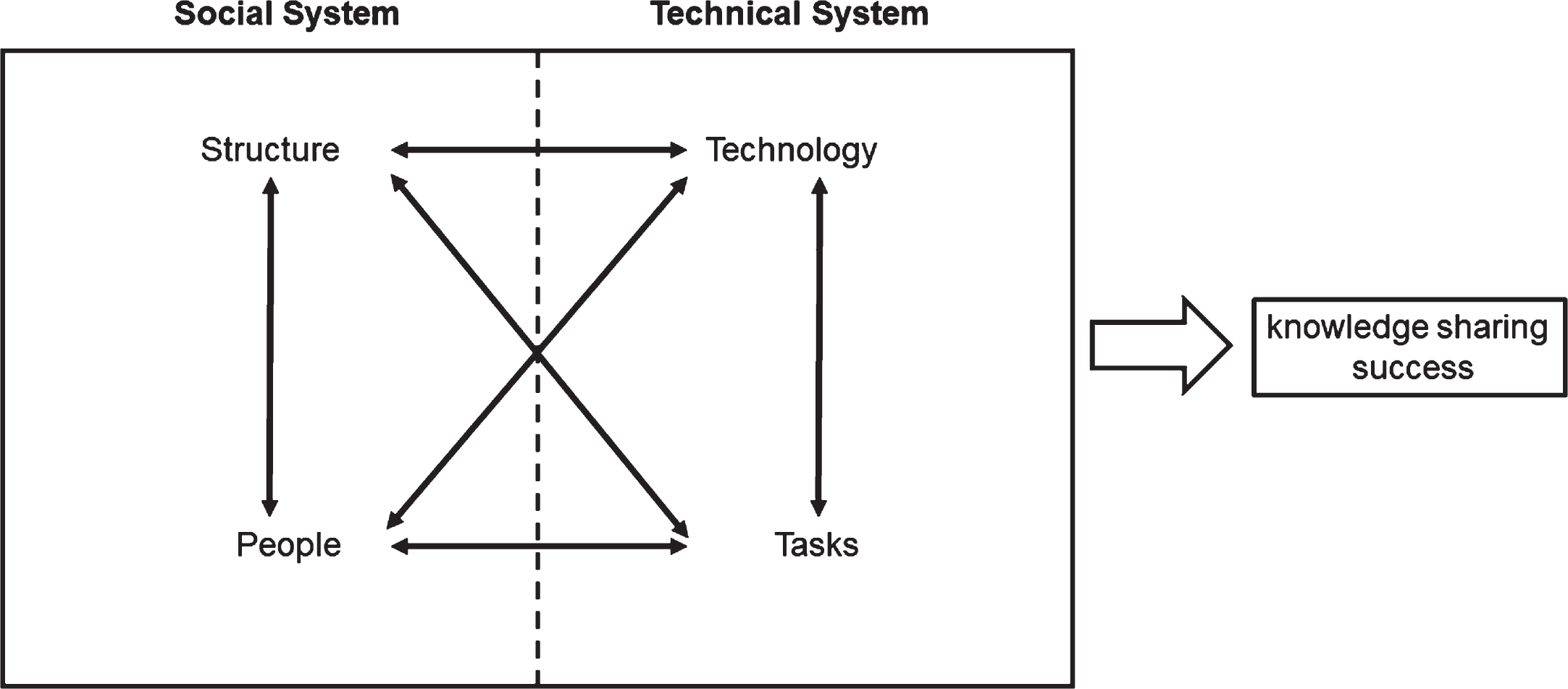
Interacting subsystems of the STS approach [42].
As mentioned in the definition in the first section, virtual teams have to deal with geographical, temporal and organizational boundaries [11]. Their success depends on their ability to share distributed and heterogeneous knowledge of team members and its effective use to stay innovative [2, 18]. In the literature, the terms knowledge and information are often used synonymously. This view neglects the difference between the two terms. Information is a steady and continuous stream of messages or meanings which might add, substitute or renew knowledge [27]. Only the combination of received information taking into consideration own prior made experiences as well as the application of this information in a specific context leads to the creation of (new) knowledge [28]. One of the main tasks of knowledge management is the correct interpretation of existing information, as the mere access to information does not guarantee the correct interpretation and the meaningful application of knowledge. Knowledge management thus goes beyond pure information management. Targeted knowledge management includes the phases of identification, generation, sharing, modification, storage, and implementation of knowledge [29]. The phase of knowledge sharing for virtual teams represents a new challenge, in the design of which the problems mentioned before must be taken into account.
In the following, knowledge sharing in virtual teams means all actions of team members that aim to make knowledge available to each other or to other stakeholders [30, 31]. In addition, the exchange of knowledge can be seen as an active process and always aims at influencing individual experiences. An interdisciplinary exchange in the team enables the combination of knowledge to create new approaches and is therefore the basic requirement for generating innovation [32, 33]. Thus, knowledge sharing processes have to be reframed to a more strategic and dynamic perspective so organizations can thrive in the face of current and future challenges and foster organization’s competitiveness.
In contrast to the concept of “knowledge transfer”, which describes the one-sided transfer of explicit knowledge elements, the term “sharing” implies dynamic processes of interpersonal, interdisciplinary interaction [31], e.g. in the context of discussions and problem solving. In the following, knowledge sharing in virtual teams is understood as a social, interactive process that is conveyed via communication media. Here, a distinction can be made between synchronous and asynchronous knowledge sharing. Synchronous knowledge sharing includes immediate, direct and simultaneous interaction processes between team members, e.g. via chat, telephone or video conference. Asynchronous knowledge sharing refers to indirect and time-delayed forms of exchange, e.g. via email or electronic documents [34]. Since knowledge sharing in virtual teams depends on effective social interactions and technological possibilities at the same time, various aspects and influencing factors must be taken into account for its success: technological resources, social aspects and organizational circumstances in order to cope with complex tasks [22].
Despite increasing popularity of virtual teams, there are a number of issues of how these can effectively use, share, and integrate their knowledge. Especially the dependence on technological communication media is a critical challenge for successful knowledge sharing [6, 35]. In order to comply with the complexity and specific task challenges, the whole system including social and technical factors has to be considered [22]. We can achieve this goal by using the socio-technical system approach (STS approach) [36]. Therefore, in the following virtual teams are seen as open socio-technical systems.
Only the STS approach allows this by understanding teams not simply as a technical system with replaceable individuals who are added and adapted [37]. Rather, targeted interactions between team members and the technical systems are mapped [38]. The technical and social dimensions of cooperation are coordinated with each other. For this purpose, we use the definition of socio-technical factors provided in the approach: The social system, consisting of people embedded in relationships and the organizational structure and the technical system, containing technology and procedures for performing tasks. This approach enables us to understand how team members apply technology in a particular task environment in order to be successful [40].
Hereby, we follow the point of view of other authors and consider knowledge sharing in virtual teams as a socio-technical phenomenon where basic social constructs need ICT support [41]. It is acknowledged that the integration of technical and social perspectives enables teams to manage knowledge more effectively [26].
Figure 1 shows the assumed complex interactive relationships and differentiates the subsystems according to the STS approach. We suppose that all four subsystems are in interaction with regard to their influence on knowledge sharing processes in virtual teams. Thus, they build the framework of our influencing factor analysis of successful virtual knowledge sharing.
State of research
In order to map the state of research, we analysed empirical studies that deal with knowledge sharing in virtual teams indexed on SCOPUS database. This database represents the most comprehensive data source to retrieve peer-reviewed publications for emerging fields of study [43]. The following query: TITLE-ABS-KEY(“Knowledge Management” OR “Knowledge Sharing” OR “Knowledge Transfer” AND “Virtual Teams” OR “Global Teams” OR “Distributed Teams”) was performed. To ensure the generalizability and comparability of the study results, in particular publications from the last decade (2010 to 2020) were included in the search, as comparable technological possibilities were available and virtual teamwork was developing rapidly at the same time. Furthermore, to ensure a high degree of quality, we only included publications that were peer-reviewed in the analysis. Finally, 46 studies were taken into account in the presentation of the state of research. We clustered the publications according to the subsystems of the STS approach (Social System: structure and people; Technical System: technology and tasks). In the following we assign the topics of previous research to all subsystems. Subsequently we create subcategories from the empirically verified results. These are then transferred to a deductive category system (see Table 1).
Distribution of studies on the systems and subsystems of the STS approach
Distribution of studies on the systems and subsystems of the STS approach
Social system
At the structural subsystem there is a large number of studies that we assign to six subject areas. First, the special challenges that arise from distributed work or (1) team distribution were taken into account. Opportunities such as regular face-to-face meetings are discussed in order to master them [20, 45]. In this context, it is proven that the (2) transactive memory of the team favors virtual knowledge sharing [46].
Davidavičienė et al. 2020 show that a lack of communication rules and norms in organizations as well as a bad organizational climate have a negative impact on knowledge sharing in virtual teams [47]. Flat hierarchies and autonomy of team members favor knowledge sharing across geographical and temporal boundaries [24]. The concept of (3) organizational culture encompasses both aspects. Their influence on knowledge sharing has already been confirmed in traditional teams [48] and also seems to exist in virtual settings.
Another essential prerequisite for knowledge sharing is the access to (4) organizational resources, e.g. time or budget [46, 50]. It has also been proven that institutionalized (5) rules and norms of virtual teams have a positive effect on the success of knowledge sharing [51]. This includes the regularity [52, 53], the setting and the formalization of the sharing processes [51, 54], a supportive environment [18, 55] and organizational routines and mechanisms [49].
Further, manager support is a basis for the success of virtual knowledge sharing [47, 56–58]. Thus, with regard to (6) leadership, the results of previous research on knowledge sharing can be transferred to virtual teams [57, 59].
At the people subsystem, (7) trust in virtual teams is a key requirement for the success of knowledge sharing [52, 60–67]. The (8) team culture provides additional support [18, 68]. This includes a collective mindset to be open to the knowledge of others [69]. Further positive effects on knowledge sharing exist for (9) cohesion [67] and (10) shared understanding [18, 71]. Shared understanding expresses itself among other things in shared team tasks [72], language [21] and vision [61]. Another well investigated topic in the research literature is team cooperation. Especially, the constructive (11) communication between team members [21, 72–75] and (12) the team climate [76] are discussed. These are supported by the social characteristics of the team members [77] and the cooperation in the team [60, 78]. The (13) team composition has also a positive impact on the success of knowledge sharing through a focus on heterogeneous knowledge, team size and skill variety [62, 79–81].
With regard to the members of a virtual team, the literature discusses three influencing factors. The (14) capabilities of team members favor the exchange of knowledge, e.g. communication skills [57] and self-efficacy [79]. The (15) motivation is also considered and the contribution of the will to share knowledge has been empirically confirmed several times [24, 65]. The (16) expertise of the team members, measured by experience and competence, is also taken into account for the knowledge sharing process [55, 82].
Technical system
The second system that is emphasized in the STS approach is the technical system. For its two subsystems technology and tasks, we were able to identify studies demonstrating the influence on the success of knowledge sharing.
We can assign the results of the tasks subsystem to two subcategories. Next to (17) task characteristics, which includes absence of task conflicts [47] and the complexity of the tasks to be performed [24, 71], the (18) interdependency of the tasks is an influencing factor on the success of the knowledge sharing [53, 62]. For example, de Guinea et al. (2012) show that virtual collaboration increasingly leads to task conflict because communication is less common [53]. The effect increases the higher the degree of virtuality of the collaboration [53].
In the technology subsystem two topics were examined. With regard to (19) technology requirements, the information and communication technology (ICT) used are analysed and investigated [47, 83]. This results in technology frameworks related to the challenges of virtual teamwork [75]. The specific requirements for the tools, system performance, system design and system assurance [24, 69], the interface fidelity [55] and connectivity are discussed [74].
Another research focus on the topic is (20) media richness. This is of great importance when encountering the challenges of virtual teamwork [18, 70]. Specific technology solutions such as knowledge management tools and collaborative software were explicitly tested for their usefulness for the knowledge sharing process in virtual teams [18, 84]. Here, especially media choice [21], the general use of technological tools [70] and the importance of technological support for successful use are taken into consideration [85].
Quantitative consideration
In addition to the qualitative content, we also analysed the various systems of the STS approach in the studies (n = 46). As shown in Table 1 below, the social system has been examined most intensively (n = 30). It is noticeable that mainly the combination of the subsystems people and structure (n = 16) is taken into account in research. In contrast, only seven studies each allocated exclusively to structural or the people subsystem. The first interaction effects can be demonstrated in this way.
In contrast, only two studies deal exclusively with the technical system in general. Task-specific issues are not investigated so far.
The two subsystems, social system and technical system, are considered in 14 publications. Five contributions integrate two subsystems: structure and technology (n = 1), people and technology (n = 3) and structure and task (n = 1). Most of the research results include three subsystems of the STS approach: people, task and technology (n = 1), people, structure and technology (n = 5) and structure, technology and task (n = 2). Only one study takes all four dimensions of the STS approach into consideration [24]. It is worth noting that even while considering several subsystems, no comprehensive analysis was carried out in any study. Instead, only single categories of the subsystems have been focused on in an isolated manner. It demonstrates a detached contribution to the success of knowledge sharing with regard to either the people or structure, technology and task subsystem. A more comprehensive approach has been provided by conceptual work that calls for all STS subsystems to be investigated [22, 26].
So far, there has been no comprehensive, integrative consideration of the influencing factors and framework conditions for successful knowledge sharing in virtual teams. Above all, the additional consideration of the task conditions seems essential, since different effectiveness models of teamwork suggest their relevance [86, 87]. This is also evident in the STS approach: the task area interacts with the technical and social framework [40, 88]. This research gap is the focus of our study.
Method
Critical incident technique
A qualitative approach for a comprehensive and integrative analysis of knowledge sharing is preferred. This approach allows us to show influences that have not yet been taken into account and therefore contribute to the further development of the current state of research [89, 90]. The 26 semi-structured interviews conducted are grounded on the Critical Incident Technique (CIT) introduced by Flanagan [91]. The CIT is a qualitative research method that enables the discovery of success-critical behaviours in specific work context situations [92]. Since the current study aims at an integrative and holistic view on knowledge sharing in virtual teams, the behavioural focus of the CIT was widened to socio-technical influences. The critical incidents examined in this study, consider success-critical virtual knowledge sharing processes. The participants described the situations as concretely and comprehensively as possible, including information about the occasion, the outcome and the people involved in the specific knowledge sharing situation. The situation descriptions should evoke the feeling of having observed the situation oneself [91].
Sample
The sample of the present study consists of 26 semi-structured interviews with virtual team members of six companies. The interviews lasted between 30 and 60 minutes and the interview material contains in sum ∼1200 minutes. All interviewed team members had at least three years of experience in working in virtual teams in general and had worked in their current team for at least six months. They worked in cross-functional positions as team leader, IT engineers, consultants and project employees. 73% of the participants were male (19 of 26) and 27% were female (7 of 26). The interviewed virtual team members reported between two and eleven critical incidents (M = 5.77; SD = 2.34).
Data analysis
The evaluation of the critical incidents was carried out as a deductive process, consisting of application of the standardized, theory-driven categorization system. In our approach, we were guided by the method of structuring, especially the deductive category assignments, according to Mayring [93]. This methodology aims to derive a certain structure from the academic literature. This structure is transferred to a deductive category system. All text components addressed by the categories were systematically extracted from the material. Thereby, the analysis process had the following five steps:
First, the deductive category system was created on the basis of the previously performed literature review and the central results of the studies set (see Section 4. State of research). In sum four main categories and 20 subcategories were defined and backed up with specific coding rules and anchor examples. The resulting category system and coding scheme is shown in Table 2.
Description of the category system
Description of the category system
Second, the data was prepared for the coding process. For this purpose, the transcribed interviews were transformed into a list of critical incidents. 148 critical situations of knowledge sharing resulted as basic analysis units. These were formulations that explicitly describe a distinguishable influencing factor, a result or a reason for the exchange of knowledge in the respective situation.
Afterwards, in step 3, two independent authors based on the standardized coding scheme coded each statement and assigned it to one of the 20 subcategories. The average interrater reliability was satisfactory (Cohen’s kappa = .83). All disagreements were discussed until consensus was reached.
In step 4, statements that could not be assigned to any category were inductively coded and assigned to one or more new categories. The procedure was based on the inductive analysis process according to Mayring [93]. A new subcategory (coordination) resulted for the structural subsystem.
Finally, frequency analyses were carried out in order to determine the occurrence of main and subcategories. Furthermore, the overlap of categories was analysed and visualized in MAXQDA 2020 using code relation maps.
Influencing factors of successful knowledge sharing
We were able to assign statements from interview material to both, social system (n = 736) and technical system (n = 376). In addition, we found evidence for all four subsystems of the STS approach (see Table 1). In the social system, the structure subsystem is most frequent with 436 codings. Here, statements for the six subcategories, which were extracted from previous research could be identified in the data. Striking is the high number of statements describing rules and norms of knowledge sharing (5. rules and norms, n = 229). Our analysis shows that 104 statements relate to the concrete, structured process during the event of knowledge sharing. 125 descriptions deal with cooperation conditions like formalized processes, routines or the regularity of the sharing process (5a. Guidelines). In order to adequately consider both aspects in the evaluation and interpretation, we expanded the category system inductively at this point to include subcategory 5b. coordination. This category includes explicit coordination mechanisms that are used in the team, including the creation and implementation of plans and structures as well as moderation techniques. They aim to initiate a uniform procedure [11].
To examine both aspects in the evaluation and interpretation, we expanded the category system inductively to include subcategory 5b. coordination. This category includes explicit coordination mechanisms used in the team, the creation and implementation of plans and structures as well as moderation techniques. They aim to initiate a uniform procedure [11]. The distribution of the frequency of statements of each subcategory is shown in Table 2.
Second most often, statements could be assigned to the subcategories 3. organizational culture (n = 52) and 6. leadership (n = 57). Considerably less statements could be identified to 2. transactive memory system (n = 35), 4. organizational resources (n = 34) and 1. team distribution (n = 29).
At the people subsystem, we were able to extract 300 descriptions. The participants made most of the statements on 14. capabilities (n = 76), followed by 15. motivation (n = 41) and 16. expertise (n = 41). Further, the interviewed team members mentioned incidents that correspond to the subcategories 12. team climate (n = 33) and 7. trust (n = 29). For 10. shared understanding and 13. team composition we found each 23 comments. We assigned a total of 16 incidents to 8. team culture. The topics 11. communication (n = 10) and 9. cohesion (n = 8) could be also identified in the critical incidents by the authors.
The categories of the technical system are task (n = 105) and technology (n = 271). In both we were able to provide evidence for the deductively determined subcategories. With regard to the tasks, especially 17. task characteristics (n = 66) and 18. interdependencies (n = 39) were described. Technological components were mentioned particularly frequently with 19. technological requirements (n = 144) and 20. media richness (n = 127).
Common occurrence of influencing factors
To analyse how the main categories and subcategories were distributed across all reported success-critical situations and which overlaps and accumulations in their occurrence exist code-relation-maps were created with MAXQDA. Code maps visualize selected codes on a map depending on their frequency and common occurrence in the data material. The more overlaps two codes have, i.e. the more similar they are in the data, the closer they are placed together. The common occurrence of several categories within the same critical incident was used as a creation criterion of the code maps. Thus, a code map shows the frequency with which codes occur together in a critical incident. The closer the single codes are to each other, the more often they occur together. The line thickness also shows the frequency of the common occurrence. The thicker the line, the more often both codes appear within an incident. In Fig. 2 and Fig. 3, all connections with a frequency of n = 20 are shown.

Common occurrence of the main categories.
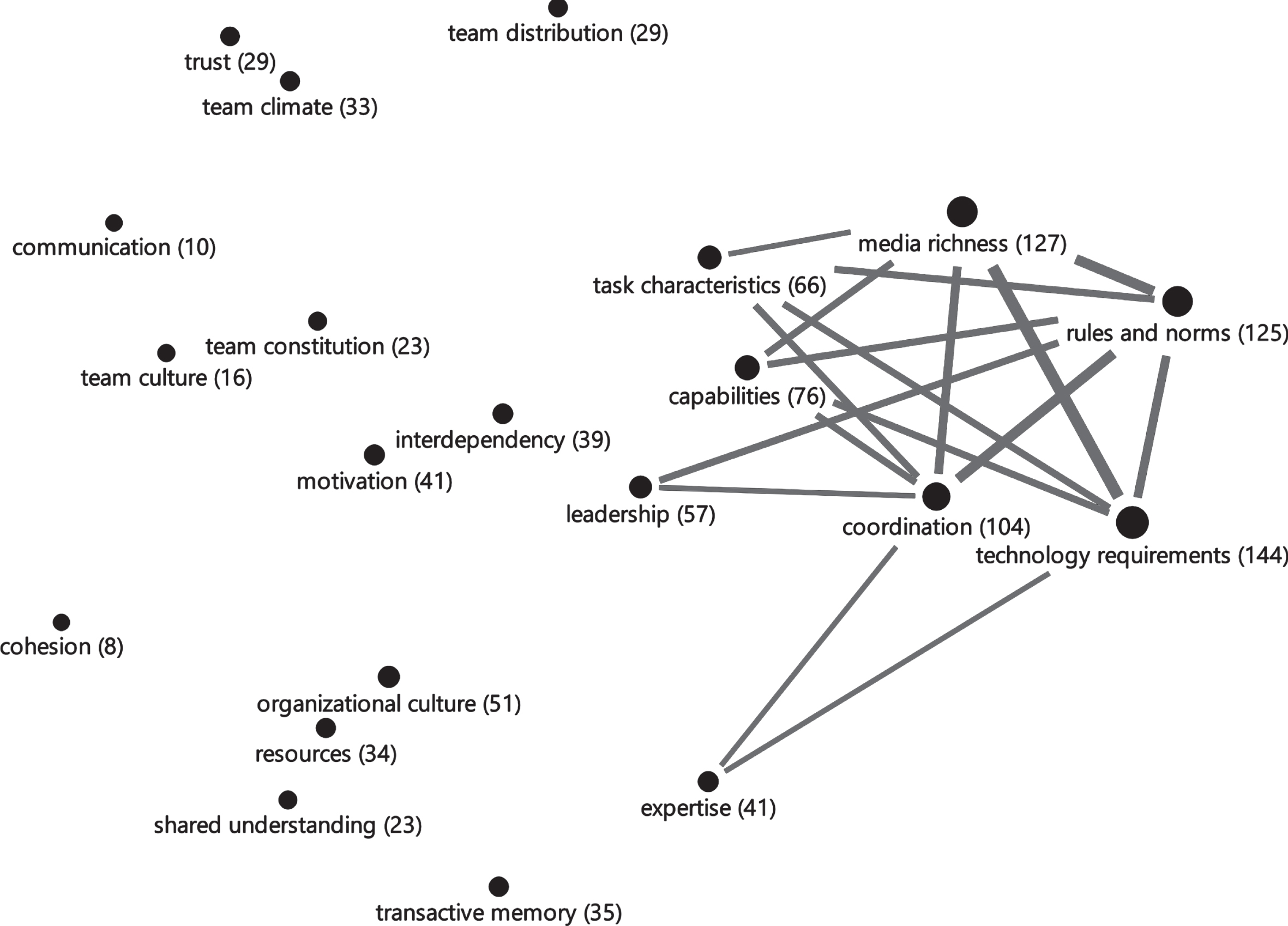
Common occurrence of the subcategories.
Figure 2 illustrates the code relations model of the four main categories: technology, task, structure and people. It is obvious that technology and structure were often mentioned together and are closely related. A similarly strong connection between structures and people exists. Figure 3 shows the code relations model for all subcategories. Particularly strong connections can be observed between the technological subcategories technology requirements and media richness, the structural subcategories guidelines, coordination and leadership as well as the task characteristics and expertise and capabilities. These categories occur particularly frequently and mostly together within the several critical incidents.
Coding Maps showed that each reported incident included factors from all four main categories, which showed specific frequencies of occurrence: structure (n = 436), people (n = 300), tasks (n = 105) and technology (n = 271) (see also Figure 2 and Figure 3). In addition, we were able to find statements for all 21 subcategories. This suggests that all four subsystems interact together on the success of knowledge sharing. Further, it indicates that our deductive category system is suitable to systemize influencing variables on knowledge sharing in virtual teams.
Influencing factors of successful knowledge sharing
The results show that the deductive category system was confirmed with the present study data. Based on a frequency analysis, the understanding of the importance of single influencing factors was sharpened as well as extended.
As our analysis shows, participants mentioned categories of the structural subsystems often (n = 436). Suitable structural conditions within organizations and teams thus seem to have a relevant influence on knowledge sharing. The high number of codings on guidelines (n = 229) and coordination (n = 104) shows that planning, structuring and moderation play a relevant role in the majority of the critical incidents. Compared to previous research, these findings present an advancement of knowledge with regards to the understanding of knowledge sharing. Based on Piccoli et al. coordination and rules include all efforts to proceed uniformly in virtual meetings [11]. In addition, organizational routines, such as regular knowledge sharing appointments, represent an important opportunity for the participants to meet the challenges of geographically and temporally distributed cooperation. Supportive leadership of virtual teams is also one relevant structural factor. Participants mentioned the role model function of team leaders and the organizational culture as success-critical factors. This reorganizes the previous understanding of relevant influencing factors by clearly emphasizing the importance of organizational culture. In particular, flat hierarchies autonomy and participation as well as an equal communication style positively influence knowledge sharing, all which has been neglected in research in the past [24, 47]. Further constructive error management including openness to talk about problems was mentioned as beneficial. This factor has already been proven for traditional teams [122, 123] and also seems to play a role in virtual contexts [6, 124].
Furthermore, in our data we found 35 descriptions, which indicate team memory (transactive memory system) as an influencing factor. This confirms previous findings on the importance of transactional knowledge systems for effective cooperation and knowledge sharing [125, 126]. A functioning transactive memory system assists the team members with the quick and efficient identification and usage of relevant resources of knowledge. The past insights of successful knowledge sharing in virtual teams is also extended in this regard.
With a total of 300 codings we can show that the people subsystem plays a relevant role for the success of the knowledge sharing incidents. Regarding individual aspects, capabilities (n = 76) are mentioned about twice as often as motivation (n = 41) and expertise (n = 41). This may be due to the fact that the subcategory contains a large number of different individual properties, e.g. technical affinity, communication skills, reliability, open mindedness, attention and concentration. Since a great advantage of teamwork is to bundle heterogeneous knowledge [105], expert knowledge can be seen as a critical factor for successful knowledge sharing.
With regard to teamwork, participants most frequently mentioned aspects of team climate (n = 33) and trust (n = 29), which are also given intensive consideration in current research [18, 70]. In addition, the topics of shared understanding (n = 23), team culture (n = 16), communication (n = 10) and cohesion (n = 8) are mentioned in the critical incidents. In virtual teams, social factors are particularly important for successful collaboration, since direct interactions and communication are restricted by the use of ICT [7, 127]. Furthermore, team members hardly know each other personally and often work together for a limited period of time. In consequence members in virtual teams pay high attention to mutual trust, shared understanding and beneficial team climate for knowledge sharing. That highlights the importance of a functioning team and shows clear implications for managers and moderators.
In the current research, factors of the technical system have been given considerably less attention than aspects of the social system (see Table 1). In particular, task-related factors have hardly been considered in previous studies on knowledge sharing. This is surprising since the importance of task characteristics as a relevant moderating factor has already been manifested in teamwork research [113]. One possible explanation is that research on virtual work has only gained increasing importance in the last decade. Research on influencing factors and moderators is therefore just beginning.
Referring to the technical system, our analysis is one of the first to show that besides technological and task-related factors have an influence on knowledge sharing. We identified 271 statements on the technological subsystem as well as 105 statements on the tasks subsystem. Only two categories could be assigned in a deductive manner. However, both have been cited very often, which might indicate a prominent role for the knowledge sharing process. Within the task subsystem, both the task characteristics (n = 66) and the task interdependence (n = 39) contribute to success as mentioned by the respondents. This shows that the findings from team research must be transferred to the knowledge sharing process in a virtual context [86, 87]. In addition to complexity as a constituent characteristic for virtual team tasks [105, 113], the participants named clarity and transparency as a challenge for cooperation. This was also shown in the research results [59, 113]. Further, the present findings on task interdependence confirm the claim made by Klonek et al. (2021), that managers should use task interdependence through meaningful overlaps in virtual teams in order to positively influence team function and performance [6].
Since interaction and communication in virtual teams mainly depend on ICT, technological factors are constitutive for knowledge sharing. Study participants mentioned both technological requirements (n = 144) and media richness (n = 127) as criteria for effective knowledge sharing. With regard to technical requirements, aspects of usability, synchronous processing of documents and creative techniques were mentioned.
The second subcategory, media richness, refers to the reduction of information ambiguity by using different communication channels [119, 120]. Media richness depends strongly on the characteristics of the respective, relevant medium such as text, image, audio and video [128]. Virtual work in particular shows that team members use rich media to solve their tasks [121] and to create a feeling of being in the same room together [70], which are relevant prerequisites for knowledge sharing. Media richness is therefore an important parameter for the technologies used and help to link social influencing factors with technological decisions.
Common occurrence of influencing factors
Our analysis of the common occurrence of influencing factors indicates that all four subsystems of the socio-technical team system are simultaneously relevant. We were able to show that categories from the technical and social system were named in most of the incidents described (see Figs. 2 and 3). Despite social factors being mentioned more often overall, it can be concluded that all subsystems (structure, people, technology and tasks) play a role for the success of knowledge sharing. This reflects the basic assumption of the socio-technical system approach as well as proves the consideration and practical application of this holistic approach [38].
The analysis of the occurrence of the main categories shows that the task characteristics are particularly often associated with the structural subsystem, but also have connections to the people and technological subsystem (see coding map in Fig. 2). One reason may be that team task requirements play an important role for the benefit and success of specific team structures [129] since they help to determine the necessary rules and standards as well as suitable coordination mechanisms for knowledge sharing. For example, the use of implicit and informal communication in virtual teams is restricted due to their low face-to-face contact [7]. As a result, explicit structures such as written rules, norms and structures are crucial for successful coordination and the completion of complex tasks [130]. Further, the results indicate that task requirements (e.g. task complexity) may have an influence on the technological subsystem [35]. Furthermore, there are strong connections between the structural, technological and people subsystems. This indicates that organizational and team structures have an influence on the way existing technologies are used for knowledge sharing and vice versa [26]. Also the strong connection between the people and structural subsystems indicates that existing structures and certain individual characteristics of team members are mutually dependent. Therefore, a holistic understanding of the knowledge sharing process in virtual teams must include the consideration of the task.
The analysis of the 21 subcategories and their connections shows an even more differentiated picture of the relationships between the four subsystems. As the coding map in Fig. 3 shows subcategories (technology requirements and media richness) represent central connection nodes. They are at the center with the most frequent relationships to the other subsystems (structure, task and people). The centrality of the technological subsystem is not surprising since nearly all interactions between team members in virtual environments are mainly based on electronic media. Accordingly, social interaction and knowledge sharing are affected by the degree of media richness and the technological requirements available to the team members [7]. Furthermore, there are particularly strong links between the subcategories media richness, technological requirements and the subcategories rules and standards, coordination and leadership. This confirms our assumption that existing structures influence the way technology is used for knowledge sharing. Also the role of leadership for technology usage becomes apparent. Team leaders take on a role model. They influence individual behavior and structure within meetings [124]. In addition, they decide on the technologies used, secure shared document filing and thus create the basis for effective knowledge sharing [6]. At the same time, the technology used may have an effect on the formation of various structures and rules by specifying which meeting or communication rules are useful in a particular media environment and which leadership behavior is more expedient.
Our results also indicate that the task characteristics are closely related to various subsystem variables. That is, participants mentioned task characteristics often together with the two technological subcategories technology requirements and media richness, the three structural subcategories rules and norms, coordination and leadership and the two people subcategories expertise and capabilities. As already discussed above and assumed in the socio-technical approach, the interlinkage of task characteristics with other categories indicates their moderating role in the development of other system variables [129].
Finally, the connectivity of the subcategories illustrates the role of individual characteristics and requirements for successful knowledge sharing. Both, capabilities and expertise, of team members relate to technical and structural subcategories. From this we conclude that individual requirements affect how technology is used for knowledge sharing. At the same time, individual skills and know-how may influence the way in which certain rules and structures develop in the context of virtual communication.
Conclusion
Implications
Due to the COVID-19 pandemic, many employees work from home and therefore are dependent on successful virtual knowledge sharing with their team to complete their tasks. ICT offers a variety of supportive tools to enable this. The exchange of knowledge in virtual teams is a basic requirement for organizations to ensure the organization’s competitiveness, since the generation of innovations depends on the success of the interdisciplinary and interpersonal knowledge sharing [32, 33]. Nevertheless, members of virtual teams still perceive the lack of personal contact as stressful and more time consuming [15, 16]. Insufficient exchange of knowledge is accompanied by decreased mental and physical well-being as well as an increased rate of absenteeism [15, 16].
Therefore, findings of influencing factors of successful knowledge sharing and their common occurrence can play a role in finding concrete implications to optimize virtual teamwork, which in turn can prevent illness of employees. We were able to show that various influencing factors simultaneously act on the knowledge sharing processes in the examined teams.
Structural influencing factors, especially rules and norms, organizational culture and leadership were mentioned particularly frequently. Rules and norms can be drawn up by team members and managers consistently defining clear structures, communication rules, and suitable moderation methods in meetings. Furthermore, flat hierarchies and the implementation of an open error culture are just as beneficial as the establishment of commitments in interpersonal relationships. It is also important that team leaders have a consciousness for their role model function and live it actively in the working day [58].
Further, we were able to point out in particular the importance of individual skills and abilities (capabilities, expertise and motivation), but also social aspects at the team level (team climate, trust and shared understanding). Individual prerequisites can be supported through workshops and personnel development measures and should also be taken into account when composing the virtual team. Further, it is important to promote cohesion within a virtual team. Regular personal contacts between team members as well as opportunities for informal exchange favor the development of social relationships and build the basis for trust, team climate and shared understanding.
Moreover, rich media and clear technology requirements contribute to the success of knowledge sharing. When selecting communication media it has to ensure that they have an appropriately high level of information richness and several communication channels (image, sound and text input) in order to promote the interactivity of the sharing process and to be able to present complex issues. It is also advisable to use synchronous communication channels in order to enable direct feedback without delay.
In summary, based on the common occurrence of the different subsystems and its various influencing factors it can be deduced that they have to be considered integratively. Thus, structural people, technological and task related factors have to be taken into account and managed at the same time and in a holistic point of view. The quality of knowledge sharing processes can be increased by combining and optimizing various influencing factors. These findings can be used to design and improve knowledge sharing processes in virtual teams. Negative consequences of ineffective communication in virtual space and the resulting disadvantages for employees and companies can thus be actively counteracted.
Limitations and perspectives of the study
The results of this study have to be considered with various reservations. The results are based on a qualitative research method. Semi-structured interviews were carried out based on the Critical Incident Technique [91]. The qualitative approach offered us the advantage to collect and analyse relevant influencing factors of the knowledge sharing holistically and comprehensively as well as embedded in the respective team context. In addition, we were able to demonstrate the connections between several influencing factors with qualitatively code maps. A disadvantage, however, is the limited generalizability and informative value of the available qualitative data as well as the type and size of the sample [131].
Further research is required in order to quantitatively analyse the indicated frequencies and connections between the influencing factors found. It would be very promising to examine by using regressions or structural models the interactions between various social and technological influencing factors, to analyse and validate their specific directions and strengths of influence in relation to successful knowledge sharing.
Moreover, it is unclear to what extent the identified influencing factors have a direct causal relationship on the success of knowledge sharing and to what extent there are disruptive effects between various influencing factors. To investigate this in detail experimental field studies are obvious.
Another future research perspective relates to the content specification of the success factors. It is interesting, for example, that the participants highlighted cultural aspects as a critical success factor in the knowledge sharing process. In interorganizational cooperation in particular, overcoming cultural differences could therefore play a decisive role in constructive cooperation between teams. Future studies should address this topic and examine the differences to traditional team settings and the overlap of various cultures in teams. In the future, leaders in the organization must take into account the requirement of virtual teams [132]. Our results show that a leader who goes ahead and sets a good example is a good coach. He coordinates, motivates and supports the knowledge sharing process among the team members. Crucial for success is the enablement of the team members by the leader to make independent decisions and structure their tasks independently as well as coordinate these themselves within the team (democratizing). This represents a definite shift from a traditional hierarchical leadership style based on a top-down approach to a more bottom-up driven approach [132].
Ethical approval
Not applicable.
Informed consent
Not applicable.
Conflict of interest
None to report.
Footnotes
Acknowledgements
Not applicable.
Funding
This article was created as a part of the WiViTe project. The WiViTe research project is funded by the Federal Ministry of Education and Research (BMBF) and the European Social Fund (ESF) within the program “Future of Work” (funding number 02L17C570 –02L17C574). The authors are responsible for the content of this publication.