



Abstract
BACKGROUND:
The participative design of work processes is hampered by as-yet unresolved challenges. A root cause is seen in high information-pass-on-barriers. Virtual Reality (VR) may have a significant potential to overcome these challenges. Yet, there is no systematic understanding of which advantages provided by VR can support the participative design of work processes.
OBJECTIVE:
The present study aims to assess the potential of VR to support the participative design of work processes by conducting an integrative literature review identifying the advantages of VR in general work contexts and mapping them to known challenges in participative design of work processes.
METHODS:
The integrative literature review was conducted based on 268 sources of which 52 were considered for an in-depth analysis of the advantages offered by VR.
RESULTS:
The resulting conceptual framework consisted of 13 characteristic-related advantages (e.g., immersion, interactivity, flexibility) and 10 effect-related advantages (e.g., attractivity, involvement, cost efficiency) which readily address known challenges in the participative design of work processes.
CONCLUSION:
Mapping the advantages of VR to the challenges in participative design of work processes revealed a substantial potential of VR to overcome high information-pass-on-barriers. As such, employing VR in work process design initiatives represents a fruitful avenue for the promotion of prevention and employee health.
Introduction
Facing ongoing digitalization and dynamic markets, organizations must adapt, improve, and, in some cases, completely redesign their work to sustain their competitive strength [1]. Specifically, the improvement of work processes is a promising approach for more efficient, healthy, and sustainable work [2, 3]. By reducing regulation hindrances or by increasing employee control, improved work processes can promote prevention and employee health with positive effects on employee satisfaction, mental wellbeing [4, 5], and reduction of stress [6]. Moreover, adequately designed work processes can increase the efficiency of organizational operations while improving products, services, and ultimately increasing profits [7]. With preliminary work showing potential for social software to benefit process management [e.g., 8, 9], it is highly promising to examine how advantages of Virtual Reality (VR) as a new technological environment can further support the design of work processes.
In the context of work process design, the participation of employees is of high importance for at least four reasons. First, by involving employees as situational experts, their otherwise tacit knowledge of the work processes and their process experience can be incorporated and taken advantage of [10–12]. Second, participation allows employees to contribute creative ideas and pragmatic solutions that better reflect organizational reality and that induce feelings of responsibility and efficacy among the employees [13, 14]. Third, participation of employees ensures that employees’ needs are actively matched with the design of work processes [15] which has been shown to increase employee health and engagement [16, 17]. Fourth, the participation of employees is essential for fostering the change support required for the successful adoption and implementation of new work processes [18–20].
However, substantial difficulties, which have not been resolved, are encountered when involving employees in work process design. In particular, high information-pass-on-barriers [8] are considered a root cause of two major challenges – i.e. model-reality-divide and lost innovations – which typically occur in the context of process design initiatives (see Fig. 1).
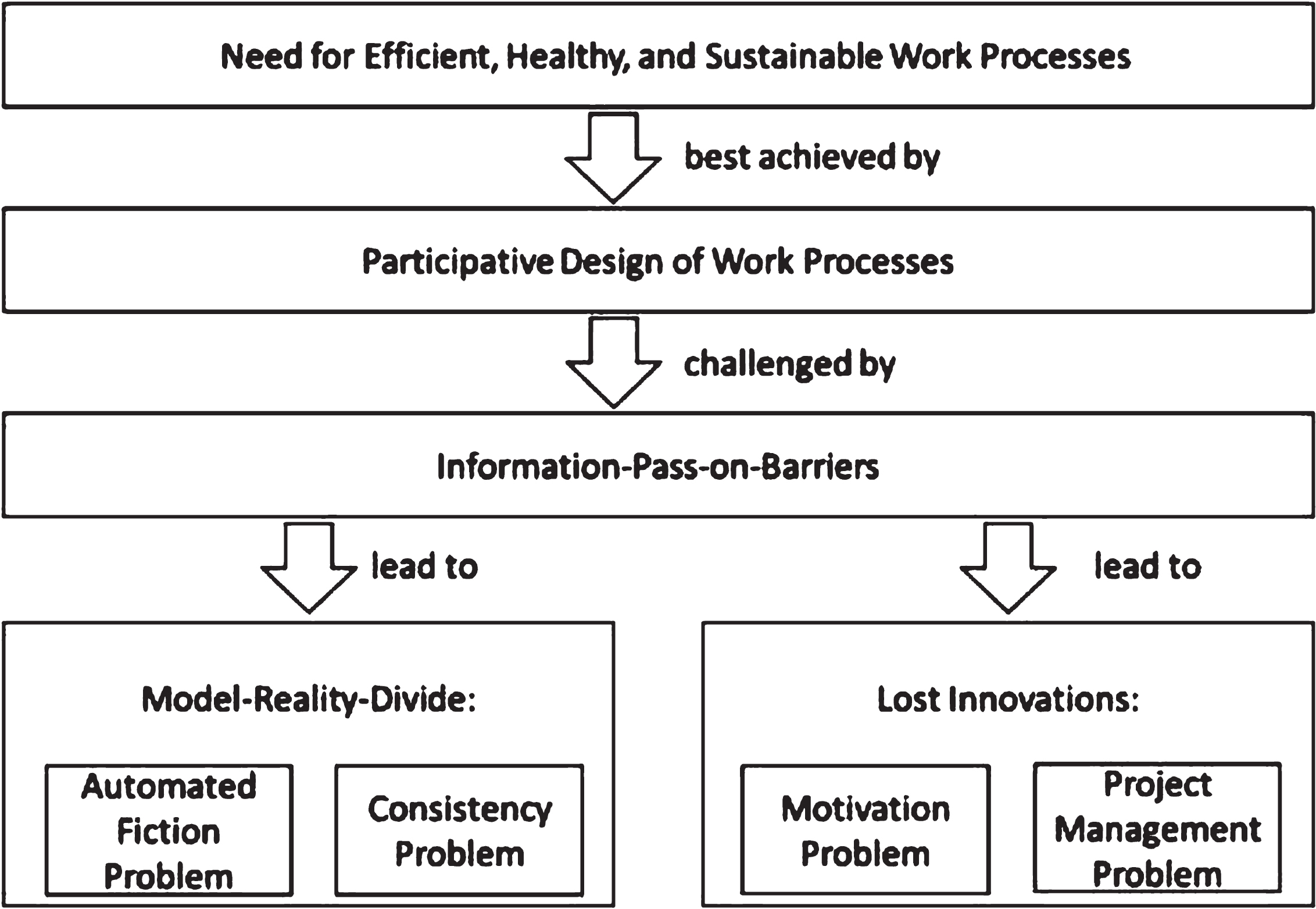
Challenges in participative design of work processes.
First, the model-reality-divide describes the problem that the documented work process and its real-world execution are not sufficiently aligned [21]. In particular, the automated fiction problem illustrates that models of work processes are based on ideal conditions and idealized assumptions which do not sufficiently reflect real-life organizational practice [22]. Moreover, the model consistency problem refers to a lack of consistency between the developed model of a work process and its implementation in the organization [23]. Such problems can be attributed to the complex and context-free nature of established process notations [24]. In response, organizations are often required to either invest in extensive training for employees who are novices in process modeling or employ external process modeling experts who are unfamiliar with the execution and organizational embedding of the specific work processes.
Second, the challenge of lost innovations indicates that innovative ideas for the improvement of processes often remain unrecognized and unrealized [8]. Specifically, the motivation problem suggests that the motivation of employees to actively engage in work process design and contribute ideas for improvement is rather low [25]. Additionally, the project management problem describes that managing work process design initiatives in itself poses considerable challenges [26]. To effectively design work processes, multiple stakeholders and experts must be involved in planning, developing, and implementing work processes [27]. As such, there is a need to align multidisciplinary viewpoints, concepts, and ideas, as well as to manage the emerging multitude of model variants and versions in terms of documentation and resource allocation [28].
Aiming to overcome these challenges there is a growing stream of research on social software enabling the participative design of work processes [9, 29]. Social software is software that promotes participation and interaction by ensuring that objects are shared among individuals to create “new forms, concepts, ideas, mashups and services” [30, p.665]. While different approaches have been suggested for participative process modeling [e.g., process modeling with storyboards: 31–33, process modeling with 3D computer simulations: 34–37], Virtual Reality (VR) has been used in recent prototypical applications to enhance participative process elicitation and modeling [24, 38–40], as well as to develop new social software with enhanced interaction [e.g., 41]. In general, VR can be described as the use of “immersive technologies to simulate interactive virtual environments or virtual worlds with which users become subjectively involved and in which they feel physically present” [42]. In this regard, VR can be considered a new technological environment for social software as it utilizes head-mounted-displays (HMDs) for creating high levels of immersion and interaction. In particular, the interplay between software, hardware as well as human and environmental factors enables an overall experience for the user “as if it were the real world” [43, p. 1]. With new opportunities for effective participation, interaction and communication, VR may provide a highly promising technology to address the as-yet unresolved challenges in the design of work processes [44]. Going beyond technical approaches which develop specific software prototypes for selected applications, it is necessary to understand which advantages of VR in general can support the participative design of work processes to fully assess and effectively unleash its potential.
Taking a broader perspective on applications of VR in work contexts, a growing pool of knowledge about its advantages is already available. Indeed, first literature reviews summarize applications of VR in the context of work safety [45], in the context of rehabilitation programs [46], or in the context of learning performance [47]. Besides applications of VR which focus on employee learning and skill development, applications of VR can be found that aim at more active participation of employees in design or feedback tasks [48]. In particular, studies in the context of workplace ergonomics [49–51] make use of VR to involve employees in identifying ergonomic problems at an early stage. Yet, in terms of the advantages which VR provides for the participative design of work processes, it should be noted that the perspectives in the literature are often limited to specific sectors and application areas. So far, no comprehensive overview has been undertaken on which advantages of VR have the potential to overcome the problem of high information-pass-on-barriers hindering effective participative work process design.
The aim of this study is to assess the potential of VR to support the participative design of work processes by conducting an integrative literature review [52] identifying the advantages of VR in the general work context and mapping them to known challenges of participative work process design. In line with Rowe [53] the current study has multiple goals with a focus on describing and understanding. Building on the goal of describing, a first objective is to provide a general overview of themes and patterns in the emerging field of work-related VR literature by taking on a broad scope in the literature review. Related to the goal of understanding, a second objective is to develop a comprehensive framework for classifying advantages of VR by an in-depth analysis and systematic integration of the relevant literature. Building on the synthesis of advantages provided by VR, a third objective is to discuss advantages of VR with specific reference to work process design and therefore advance our understanding of its potential for reducing information-pass-on-barriers and overcoming the common challenges of the model-reality-divide [21] and lost innovations [8].
The integrative literature review and focused discussion of the advantages provided by VR for the participative design of work processes contribute to the current research in multiple ways. First, the study offers an overview of main topics and patterns across different application areas in the emerging field of VR in the work context. Second, the comprehensive framework has considerable potential to bring together and inspire previously rather unconnected areas of application and their corresponding research streams. Third, by mapping the advantages of VR to challenges in participative design of work processes, the potential of VR to support the participative design of work processes will be highlighted to guide research and organizational practice on software-supported process modeling. Overall, the study advances our understanding of how VR can address typical challenges in the context of work process design and provide an environment for employee participation which enables an employee-oriented development of more efficient, innovative, healthy, and sustainable work processes.
Methods
Search strategy
To identify advantages of VR in work contexts involving employees, relevant literature was searched and synthesized with the help of a multi-stage analysis [54]. In line with predefined stages according to vom Brocke et al. [54], the first step was to determine the scope of the literature analysis. Specifically, with the aim of achieving a broad coverage of literature in relation to the research question, the results are reported neutrally. Furthermore, the review considered a potential readership of both scientists and practitioners.
As a second step, the literature data bases of Scopus and Web of Science were used to retrieve relevant literature, as their diverse resources complement each other [55]. Each database was searched using a generic search term aimed at VR as technology combined with four specific sub-search terms that explicitly limited the search to different typical work contexts involving employees.
The generic search string was: „virtual reality“ OR „head-mounted display“ OR „HMD“ OR „virtual reality environment“ OR „VR environment“ specified by each of the following sub-search terms: (1) „work“ OR „work process“ OR „work design“ OR „organization“ AND „employee“, (2) „workplace“ AND „train*“ OR „educat*“ OR „workshop“ OR „coach*“ OR „instruct*“ OR „demonstrat*“ AND „employee“, (3) „indust*“ OR „business skills“ AND „employee“ OR „leader“, and (4) „involve*“ OR „participa*“ AND „employee“.
The designated time frame was set to sources listed in the databases from 2014 to April 2021. Starting in 2013, a new generation of VR technology was made available in form of a more sophisticated and affordable HMD [56]. While this development enabled broader access to high quality and highly immersive VR systems, some latency of actual use in planning and conducting research or developing practical applications, as well as latency of the respective publication needs to be considered [56, 57]. Hence, the literature review was limited to sources published starting with 2014 in order to increase the possibility of narrowing down the search results to applications based on the new generation of VR technology.
In a third step, the 464 sources found were complemented by additional literature from a free literature search involving broader sources on the application of VR (four sources) and literature from a project that specifically addressed VR in the context of process modeling, learning, and design (10 sources). All 478 sources were searched for duplicates, which were then removed (see Fig. 2). The remaining total of 268 sources served as the basis for the visual mapping of key terms and their relationships to enable a basic understanding of the main concepts and foci in the identified literature.

Literature review process.
In a fourth step, the literature was used for an analysis of the content [54] to supplement the general visual overview and gain a more in-depth perspective on specific advantages of VR in the work context. In addition to the 14 sources from the free literature search, the 254 sources from the data base search were read and filtered based on title, abstract, and keywords considering the following inclusion and exclusion criteria.
Due to the novelty of immersive HMDs and with the aim of covering a broad range of advantages provided by VR in the work context, sources meeting the following inclusion criteria were included (e.g., Snyder et al., 2019): 1.) journal article, conference paper, book, and book chapter, and 2.) written in English. The excluded criteria were: 1.) sources with a focus on non-immersive, CAVE automatic virtual environment technologies, or augmented reality, 2.) sources with a strong focus on a consumer context, and 3.) sources from applications which are not directed at a defined work context (e.g., erotic industry, school learning sector, relaxation therapies).
Applying these inclusion and exclusion criteria, 83 sources were identified as potential candidates for the final step of the literature search. Once the suitability and availability of the full-texts had been considered, 38 sources from the initial data base search and the 14 sources from the free literature research were included. In total, the in-depth analysis of the specific advantages of VR in work contexts involving employees was based on 52 sources.
For getting an initial overview of the main concepts and foci in the identified literature a visual mapping of the key terms and their relationships based on the 268 sources, was carried out using VOS Viewer [58]. The following information from the 268 sources were extracted: author, title, year, source, source title, abstract, author keywords, and index keywords. For the visual mapping, key terms and “word relationships” from the titles and abstracts of the sources were evaluated and depicted. Similar to other research using the VOS Viewer [59, 60], the default settings were taken to determine the threshold limits. Therefore, thresholds for the analysis were set at 12 occurrences of the terms and at 63 as number of terms to be selected (both by default). In the resulting visual map, the diameter of node for a specific key word is greater the more frequently the key word is mentioned. The connections and proximity of key terms and identified clusters represent the closeness of the “word relationships”.
To gain a deeper understanding of the specific advantages of VR in the work context, a content analysis of 52 selected sources was performed. A concept matrix was used to identify, compare, and summarize the advantages of VR mentioned in the sources. The categories of the concept matrix were determined iteratively during reviewing and rating the extracted advantages. The advantages included in the final concept matrix were categorized by two independent raters. Unclear quotations or the inclusion of new categories were discussed by the two raters. The Cohens Kappa achieved by the two raters was .69, showing a substantial agreement [61]. To present the final concept matrix, disagreements in the categorizations were discussed and resolved by rater consensus.
In an additional step, a trend analysis was performed which aimed at the distribution of the sources and their application areas across the given time-period. Furthermore, the sources from the different applications areas were reviewed to extract visual examples of the VR applications as show cases of different implementation opportunities. In a final step, the authors discussed and mapped the identified advantages regarding their main applicability to the known challenges of the model-reality-divide [21] and lost innovations [8].
Results
Visual mapping of key terms and their relationships
In the middle of the resulting visual map (cf. Fig. 3), the concept of “reality” is shown very prominently as the most mentioned key term. At the same time, “reality” represents the center around which three interwoven clusters of key terms form overarching patterns among the sources.
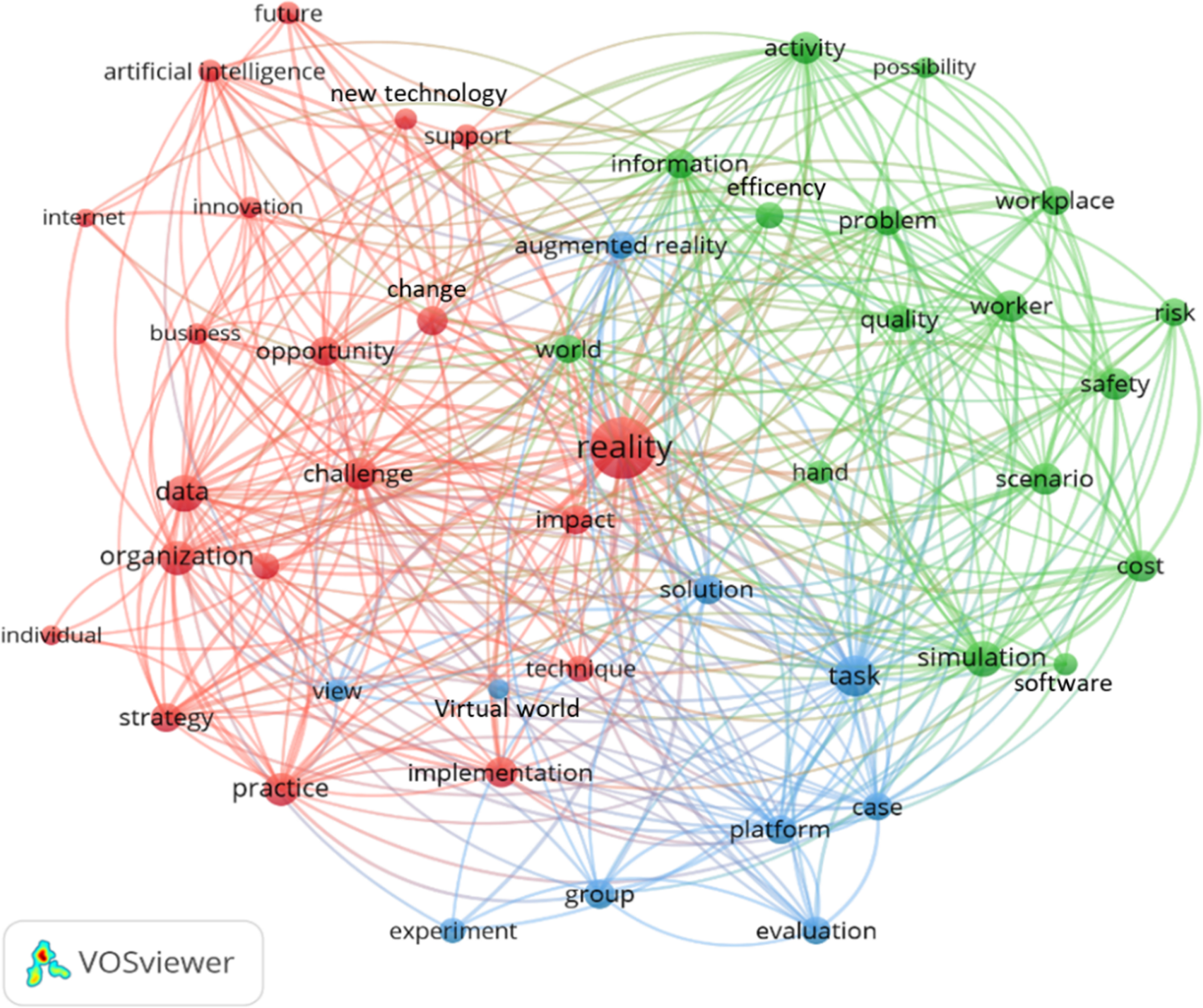
Visual mapping of key terms and their relationship (exported from VOS Viewer).
The red-colored cluster, as a first pattern of key terms, represents a strategic, organizational perspective on the application of VR. Specifically, the red-colored cluster reveals organization, data, practice, strategy, challenge, opportunity, change, and impact as most relevant key terms. Further, reflecting a technological perspective, VR technology is positioned along with artificial intelligence, internet, and new technology in general.
Concept matrix of effect-related advantages provided by VR

Note. The percentages in the first row (Total) indicate the relative amount of mentions across all selected sources. The numbers in the cells below reflect the number of sources which mention a specific advantage. The circles are rounded visual representations of the relative amount of mentions within a specific application area.
The green-colored cluster, as a second pattern of key terms, refers to the activity-related application of VR in the context of workers and the workplace. As such, the cluster reveals benefits of VR in relation to increasing safety and minimizing risks at work. In addition, further key terms referring to the advantages of VR are efficiency and quality.
The blue-colored cluster, as a third pattern of key terms, represents a cluster that revolves strongly around task-related application. Key terms from this perspective, such as platform, solution, evaluation, and experiment, highlight that VR is discussed as a supportive instrument in task-related contexts.
Regarding the potential of VR for the participative design of work processes, it can be noted that each cluster points to relevant advantages: the red cluster points to innovation related to VR, the green cluster conveys aspects like safety, quality, or efficiency, and the blue cluster highlights the potential of VR as a platform to work on tasks. While the visual approach helps to provide an initial overview of important key terms and overarching patterns among the sources, these results are represented at a high level of abstraction and indicate a pressing need for closer examination.
The content analysis identified 13 characteristic-related and 10 effect-related advantages as main advantages of immersive VR in the context of work involving employees (see aggregated concept matrix in Table 1; the detailed matrix showing ratings for each source is available from the authors upon request). Characteristic-related advantages refer to aspects that describe characteristics of VR technology and its implementation. Effect-related advantages comprise beneficial effects at a personal or organizational level that result from the application of VR. Of all 416 mentions of advantages in the contributing sources, 60% are characteristic-related and 40% are effect-related.
Concept matrix of characteristic-related advantages provided by VR
Concept matrix of characteristic-related advantages provided by VR

Note. The percentages in the first row (Total) indicate the relative amount of mentions across all selected sources. The numbers in the cells below reflect the number of sources which mention a specific advantage. The circles are rounded visual representations of the relative amount of mentions within a specific application area.
The most mentioned characteristic-related advantages of VR are immersion / feeling of presence, which is mentioned in 37 sources (71%), interactivity / feeling of control, with mentions in 35 sources (67%), and realism, which is mentioned in 33 sources (63%). The least mentioned characteristic-related advantages of VR across all sources are multi-dimensionality (7 sources – 13%), controllability (6 sources – 12%), and integrated documentation (2 sources – 4%).
The most frequently mentioned effect-related advantages are learning success / learning effectivity, which is mentioned by 38 sources (73%), cost and time efficiency, which is stated by 24 sources (46%), and attractivity / positive emotional impact, with mentions in 20 sources (38%), as central advantages of immersive VR. The least mentioned characteristic-related advantages of VR across all sources are employee retention (1 source – 2%), creativity / inspiration (6 sources – 12%), and ease of collaboration (9 sources – 17%).
Sorting the sources into categories based on application areas reveal that 36 sources (69%) focus on training, education, and personnel development, out of which 10 sources pertain to safety training. Of the remaining sources, 10 sources (19%) focus on work and process design, three sources (6%) on product design and engineering, while three sources (6%) had a general focus on VR applications. Referring to the publication years of the included studies, only eight relevant studies were published in the periods of 2014 to 2017, 10 studies in 2018, 14 studies in 2019, and 15 studies in 2020. Also in 2021, 5 studies could already be included by the end of the search in April. In terms of application areas, however, no substantial differences across the years could be identified. Figure 4 provides examples of VR applications in the different application areas.
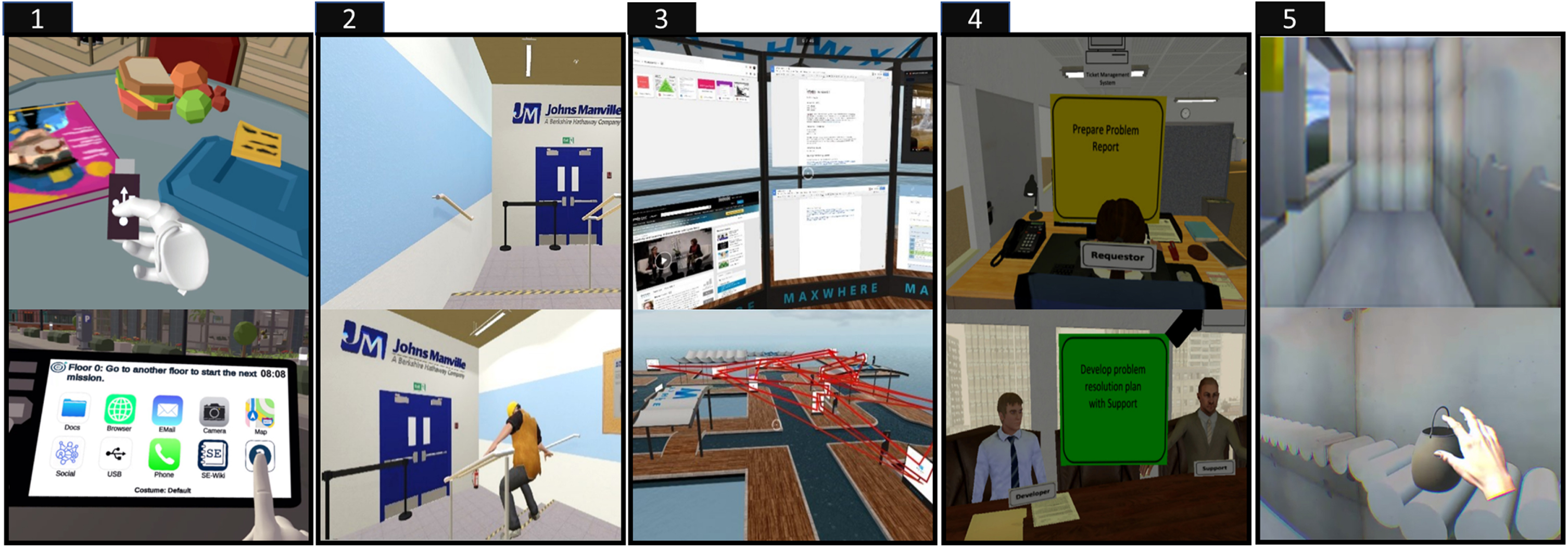
Visual examples of VR implementations in the different application areas. Note. 1: General Training and Education – Jansen and Fischbach [80, p. 61]; 2: Safety Training – Lacko [67, p. 2–3]; 3: Personnel Development –Bujdoso et al. [102, p. 4–5]; 4: Work and Process Design –Leyer et al. [90, p. 5–6]; 5: Product Design and Engineering – Wolf et al. [70, p. 459].
Looking at the advantages identified in the application area of work and process design, three characteristic-related and two effect-related advantages are mentioned by at least half of the 10 sources. As characteristic-related advantages, the interactivity / feeling of control with nine mentions and immersion / feeling of presence with seven mentions, as well as realism with six mentions are highlighted. As effect-related advantages, the design of virtual prototypes is mentioned in six sources and learning success / learning effectivity is mentioned in five sources. Compared to the overall results the characteristic-related advantages mentioned in the application area work and process design (wpd) are well aligned, as interactivity / feeling of control (wpd: 90%; overall: 67%), immersion / feeling of presence (wpd: 70%; overall: 71%) and realism (wpd: 60%; overall: 63%) are the three most mentioned characteristic-related advantages for both. For the effect-related advantages the comparison shows some differences. Specifically, the design of virtual prototypes (60%) and learning success / learning effectivity (50%) are among the top two effect-related advantages for work and process design, compared to learning success / learning effectivity (73%) and cost and time efficiency (46%) in the overall results.
Mapping advantages of VR to challenges of participative work process design
In contrast to the particularly frequently mentioned advantages, some advantages appear less frequently in the application area work and process design compared to the overall results. Concerning the characteristic-related advantages, independence of time and space (wpd: 0%; overall: 31%), nonharmful environment (wpd: 10%; overall: 44%), infinitivity / transcending reality (wpd: 20%; overall: 42%), and real-time tracking / feedback (wpd: 10%; overall: 38%) are less frequently mentioned compared to the overall results. Concerning the effect-related benefits of VR, user activation and involvement (wpd: 10%; overall: 31%), and increased safety of work (wpd: 10%; overall: 33%) are mentioned less often compared to the overall results.
Beside these rather below-average advantages, one effect-related advantage in the context of work process design appears particularly frequently compared to the overall mentions. This is the aspect of design of virtual prototypes, which is mentioned in 60% of the work process design sources, but can only be found in 33% of all sources.
Table 3 provides an overview of the characteristic-related and effect-related categories along with specific quotes that reflect the content of the different advantages mentioned for immersive VR. Additionally, the identified advantages are mapped regarding their main applicability to the known challenges of the model-reality-divide [21] and lost innovations [8].
The
To overcome the
Discussion
The digital transformation occurring in organizations requires adaptation and redesign of work processes. In this context, process management is a common approach for analysis and improvement. In order to create efficient, accepted, and healthy work processes which reflect organizational realities and employees’ needs, employee participation in the design of work process holds a great potential. Yet, actively involving employees in the design of work processes often encounters considerable challenges in organizational practice. While there is growing knowledge about the advantages of VR applications in different work-related application areas, the potential of VR to overcome the unresolved challenges in participative design of work processes has not yet been systematically explored. Therefore, an integrative literature review was conducted to identify the advantages of VR from the general work context and assess their potential to support the participative design of work processes.

Mapping VR advantages to challenges of model-reality-divide and lost innovations.
In a first step, a visual map of the main concepts and key term relationships in the literature revealed three interwoven clusters which reflect different perspectives on the application of VR in the work context. While one pattern mainly centered around an organizational and strategic perspective including business potentials and challenges (red cluster), the other two patterns referred to specific application areas and effects, which either focus on VR as a platform for collaboration and task accomplishment (blue cluster) or on work-related applications and effects (green cluster). Each cluster showed first indications of advantages provided by VR: innovation related to VR is found in the strategic realm, work-related applications showed benefits such as safety, quality, or efficiency, whereas collaboration is highlighted from the perspective of VR as a platform. Hence, the clusters revealed by the visual overview already lend some initial support to the idea of using VR as environment for better participation and interaction. Yet, the visual overview remained at a rather abstract level and highlighted the need for a more detailed examination of the identified literature.
Discussion of the in-depth analysis and comprehensive framework
Going beyond the visual overview, the in-depth analysis of the VR advantages mentioned in the final 52 sources revealed 23 advantages reflected in two broad categories (see Tables 1 and 2). The first category of the comprehensive framework covers more than half of all mentioned advantages and is closely tied to characteristics of VR and its implementation. The top characteristic-related advantages of VR are immersion / feeling of presence, interactivity / feeling of control, and realism. These three characteristics are often found in definitions of VR [e.g., 42, 62] to differentiate VR from other information and communication technologies.
The second category of the comprehensive framework comprises beneficial effects at a personal or organizational level that result from applications of VR. The most mentioned effect-related advantages are attractivity / positive emotional impact, learning success / learning effectivity, and cost and time efficiency. Indeed, the top mentioned advantage is learning success / learning effectivity, which is found in 73% of the sources. This certainly reflects the fact that most of the sources identified in the literature search represent the application area of training, education, and personnel development. However, the argument for an increased learning success through VR can also be found in other application areas [e.g., 63–66].
Discussion of advantages provided by VR in the context of work and process design
Having identified the advantages of VR from a broader perspective in the general work context clearly extended the current view of VR in the context of work and process design. Specifically, relevant advantages of VR were identified that were not yet reflected in the work- and process-related literature. Hence, the comprehensive framework of advantages provided by VR enables a systematic assessment of its potential to overcome known challenges in the participative design of work processes (see Fig. 5). Indeed, many of the characteristic-related and effect-related advantages of VR have the potential to reduce
Regarding the
Moreover, realism might help to incorporate real-world contextual information and thus reduce the
In addition, with infinitivity / transcending reality, context integration in VR can go beyond existing work processes and, hence, may provide a platform which is able to reduce the
Furthermore, VR-specific advantages have the potential to overcome the
Regarding the
Additionally, VR provides the means to overcome
Application, trends, and challenges of VR
The synthesis of advantages provided by VR in the work context offers several avenues for the application of VR in the work and process (re-)design and implementation. Following the general trend of increasing VR application in work contexts observed in the literature review, more examples in different application areas become available (see Fig. 4 for examples). Along with the growing availability of work-related VR software and the comparatively low purchase costs of VR hardware [e.g., 51], organizations are provided with increasing opportunities to employ VR and make use of its advantages for participative design of work processes in various project phases (e.g., analysis, design, training, evaluation).
A closer look at the usage of VR in the application areas of work and process design as well as product design and engineering shows that currently the involvement of the user is in many cases realized in a single user setting. In this setting, one user at a time enters the VR to perform tasks [38, 93] or performs the tasks partly in VR and partly outside of VR in an iterative manner [94]. Recent technological advances in the field of VR, and in particular the use of real-time multi-user applications, may also create new opportunities for simultaneous collaboration [48] which has a great potential to provide an even stronger contribution to the participative design of efficient, healthy, and sustainable work.
Moreover, the visualization of the work process in the virtual environment (see Fig. 4) may not only help to improve work processes, but also to get feedback on the visualized work environment. Whereas problems of process design are often attributed to its context-free nature [24], the combined representation of work processes and their contexts in VR may allow employees to identify obstacles in the work environment and reveal ergonomic problems [49–51], even for early designs of future work environments.
Beyond participative work process (re-)design, existing research shows that simulating critical and dangerous situations in VR also allows for adequate training of suitable behavior to prevent accidents and the risk of harmful situations [e.g., 95]. Additionally, making use of real-time motion-tracking and interaction with objects in the virtual environment allows to test visibility, reachability, handling and lifting, as well as human-machine interfaces and critical situations in a participative manner [50, 51]. While automatic algorithm-based evaluations will become more and more available, VR is currently primarily used to enable better designs, learning, and evaluations by humans [51].
Beside the promising prospects of VR in terms of promoting prevention and employee health in organization by providing a mighty environment for participative modeling, immersive training, and human-oriented evaluation of work processes, some current limiting factors and challenges must also be dealt with. As VR technology is still not widely used, employees in many cases have little experience with navigation and interaction within the virtual environment. Hence, albeit its advantage of intuitive and natural interaction, resources are required in preparing employees before they can engage in the design of work processes [24]. Further, current HMDs completely cover the field of view, removing real-world points of orientation. Together with technical aspects such as refresh rate and sensorimotor contingencies, this can lead to cybersickness, which makes long-term usage challenging [96]. In addition, some actions in VR are not yet efficiently designed, such as entering text using a VR keyboard [97]. While the costs of VR hardware are comparatively low, costs for the initial development of virtual environments can be substantial. However, new technologies such as LiDAR sensors can enable more efficient development of virtual environment in the future [98].
Limitations
Due to the nature of a review, some limitations should be considered in its interpretation. First, the focus of our work was on the advantages of immersive VR in the design of work processes. Hence, we did not specifically consider challenges or disadvantages related to VR applications as part of the literature review. Moreover, other relevant technologies, such as augmented reality, mixed reality, and desktop VR or 360°- videos, were not considered in this review. Thus, future research on the disadvantages of VR as well as on other technologies which also might support participative process modeling can help to obtain a more holistic picture of technology support for work process design.
Second, the definition of the search terms, as well as the applied inclusion and exclusion criteria could lead to important findings from other sources being ignored. For example, we limited the search to literature published from 2014, assuming that a new generation of immersive VR technology would lead to more robust research results. Additionally, only manuscripts written in English were taken into consideration. Moreover, sources that were not available had to be excluded, including unpublished academic research and organizational reports. As the focus was on searching databases, not on searching individual journals or references for other relevant sources, the chances are given that we might have missed some relevant sources. However, compared to other literature reviews on VR [45:16 finally analyzed papers, 47:35 sources], a substantial number of sources was identified which cover a broad range of application areas.
Third, most of the identified literature was found the application area of training, education and personnel development. As the focus was on the work context, this may also indicate that the work and process design literature is not closely related to the general work literature. Yet, as can be seen in the current study, all identified research streams can certainly benefit from a stronger integrative perspective.
Fourth, the classification of categories for the content analysis of the advantages included a subjective component. Other researchers might have developed more or less fine-grained categories. In particular, we aimed to reduce subjectivity by employing two raters who showed substantial agreement and discussed disagreements to establish the final concept matrix.
Finally, our literature review was confined by the limitations of the included manuscripts. Specifically, the quality of the studies was not an exclusion criterion meaning that all sources were treated as being equally relevant. It should be noted that we did not explicitly differentiate between assumed advantages and empirically supported advantages of VR. Indeed, the review revealed that at the current status of literature more empirical research is needed to back up the identified advantages across the various application areas. Hence, future research is needed to systematically investigate characteristic-related and effect-related advantages of VR, as well as their interplay.
Conclusion
Aiming at assessing the potential of VR for mitigating known challenges in the participative design of work processes, the integrative literature review of VR applications in work contexts involving employees revealed two broad categories. Going beyond existing perspectives, 13 characteristic-related and 10 effect-related advantages of VR were identified by summarizing advantages of VR related to different application areas. At a general level, the synthesis of advantages provided by VR supports its high versatility and potential for more actively involving employees in work contexts. Focusing on the potential of VR to support the participative design of work processes, the identified advantages show a strong fit with known challenges usually encountered in practice. With its potential to overcome information-pass-on-barriers giving rise to these challenges, VR is highly promising as a new environment for employee participation in the design of work processes. In particular, VR brings together the design of work processes and work contexts which enables holistic considerations and evaluations of human work in a participative manner. As such, employing VR in work process design initiatives represents a fruitful avenue for the promotion of prevention and employee health.
Ethical approval
Not applicable.
Informed consent
Not applicable.
Conflict of interest
The authors declare that they have no conflict of interest.
Footnotes
Acknowledgments
The authors would like to thank Annika Böschen for her support in the early stages of the study.
Funding
This research is funded by the research project SoDigital (German Federal Ministry of Education and Research, co-funded by the European Social Fund, funding code 02L18B570 - 02L18B575) as well as by the “Graduiertenkolleg va-eva: Vertrauen und Akzeptanz in erweiterte und virtuelle Realitäten“ [Graduate research group va-eva: Trust and Acceptance in Augmented and Virtual Realities] at the University of Osnabrueck.