



Abstract
BACKGROUND:
The dropping out of university students is a serious problem faced by higher education all over the world. Studies have shown that academic hardiness is a positive psychological variable to prevent students from dropping out of university and academic burnout. Psychological hardiness can reduce the dropping out by increasing university students’ academic engagement and academic achievement.
OBJECTIVE:
This study aims to discover the influence of psychological hardiness on university student’s academic achievement and the mediating role of academic engagement in the relationship between psychological hardiness and academic achievement. A cross-sectional study was conducted among 615 participants.
METHODS:
Pearson correlation coefficients were conducted to analyze the relationships between psychological hardiness, academic engagement and academic achievement. Mediation analysis was used to evaluate the mediating role of academic engagement in the relationship between psychological hardiness and academic achievement.
RESULTS:
The research indicated a closely significant association between psychological hardiness, academic engagement and academic achievement. Psychological hardiness can directly predict academic achievement and can also indirectly predict academic achievement through the intermediary effect of academic engagement.
CONCLUSION:
This study could have important implications for research by linking psychological hardiness and academic achievement. The results suggest that universities should pay attention to the positive role psychological hardiness plays in improving university students’ academic achievement. This study also benefits the university administrators, especially, those dealing with university students at the risk of dropping out and high academic stress.
Keywords
Introduction
The dropping out of university students is a serious problem that higher education faces worldwide [1]. Students are increasingly dropping out of university because of various reasons [2]. They include demographic (gender and age), individual (social background and school performance), psychological (motivation and attitudes), institutional (teaching quality and learning environment), and national determinants (financing policy) [3–6]. There has been an increase in research on the benefits of students’ positive psychological emotions on their well-being and academic performance [7, 8]. One of the positive emotions is psychological hardiness, which was conceptualized as a personality style that contributes to psychological well-being [9]. Another important factor related to university student’s academic performance and achievement is academic engagement. A survey from American research universities showed that academic engagement is key to explain how students devote themselves to their college education [10]. Psychological hardiness and academic engagement are effective factors in improving students’ learning and academic achievement.
As a protective psychological factor, psychological hardiness can reduce the dropping out by increasing students’ academic engagement and academic achievement. It especially increases the resilience to deal with psychological challenges [11]. Hardiness is a predictor of student achievement [12]. Psychological hardiness acts as a mediator between sense of belonging to school and academic achievement [13]. Another term related to students’ academic achievement is academic engagement. Academic engagement has been regarded as an important component of academic achievement [14]. Dogan’s research demonstrated cognitive engagement, one of the sub-dimensions of academic engagement, predicts academic achievement [15]. However, King’s research pointed out behavioral and emotional engagement positively correlated to academic achievement [16]. Most prior researches have discussed the direct relationship between psychological hardiness, academic engagement and academic achievement [13, 18], but has ignored the possible mediating role of academic engagement. However, it is conceivable that psychological hardiness is related to achievement if academic engagement is present as a mediating mechanism.
This study aims to discover the influence of psychological hardiness on university student’s academic achievement and the mediating role of academic engagement in the relationship between psychological hardiness and academic achievement. Previous studies on students’ academic achievement focused on the influences of teaching quality and learning environment and they seldom showed their concern for psychological hardiness on academic achievement [3, 19]. This study attempts to provide a deeper understanding of the mechanism between psychological hardiness, academic engagement and academic achievement. The participants were asked to complete two scales: Hardiness Scale (HS) and the Utrecht Work Engagement Scale-Student (UWES-S). Then the data collected from two scales are analyzed to verify whether psychological hardiness, academic engagement and academic achievement are related. This study employed the correlation design to explore the associations between psychological hardiness, academic engagement and academic achievement. And the intermediary effect design was used to test the intermediating effect of academic engagement in the relationship between psychological hardiness and academic achievement.
This study contributes, theoretically and practically, to the growing body of literature on relationship between psychological hardiness, academic engagement and academic achievement in several ways. This study highlights the importance of interweaving the concepts of psychological hardiness and academic achievement. In addition, our study contributes to the research on the association between psychological hardiness and academic achievement is innovative because it emphasizes the intermediate role of academic engagement. This study also benefits the university administrators, especially, those dealing with university students at the risk of dropping out and high academic stress. Administrators could improve students’ achievement by increasing students’ hardiness. It would help reduce the dropout rate, promote the graduation rate and the sustainable development of the university.
This paper is organized as follows. Section 2 illustrated the systematic literature review on psychological hardiness, academic engagement and academic achievement. Based on the previous studies, we put forward the hypothesis and followed by conceptual model at the end. Section 3 describes the method and data measurement. This study uses correlation analysis and intermediary analysis to test the direct and indirect effects of variables. The results are reported in Section 4. Section 5 demonstrated the further discussion on main findings. In Section 6, we present the contributions to theory and practice development. Then, the limitation and future research are showed in Section 7. Finally, conclusions may be found in Section 8.
Literature review and hypothesis development
Psychological hardiness and academic achievement
Previous studies have indicated that learning is a major source of stress for university students due to the requirement of examinations and graduation; meanwhile, they also have to handle other matters such as financial issues, employment or interpersonal relationships [20]. The research on psychological hardiness reported that hardiness can enhance individual’s health and performance when coping with stressful situations [21]. Thus, psychological hardiness can be perceived as a necessary drive for performance and quality of life [22, 23].
Kobasa proposed the concept of hardiness to describe those personality traits that protect individuals from a stress injury in highly stressful situations. Hardiness refers to personality characteristics or attitudes that help an individual in manage stressful and adverse circumstances [24]. It provides courage and motivation to turn a threat or debilitating experience into growth opportunities [24, 25]. Hardiness consists of three components: commitment, control, and challenge. Commitment means an ability to feel deeply involved in or committed to the activities of their lives. Control means that the belief that they can control or influence the events of their experience and challenge is the anticipation of confrontation for further development [26].
In the context of university students, psychological hardiness as a protective factor plays an essential role in how students face academic challenges [17]. Psychological hardiness is an effective factor in students’ learning and plays an important role in academic success [27]. Hardy students can integrate commitment, control and challenge to handle problems in their lives [28]. Several studies have explored the role of hardiness in the learning behaviors of university students. Nguyen et al. found that students have to deal with the psychological problems generated by stress which may affect their ability to study and manage their lives effectively [29]. Research by Abdollahi et al. revealed hardiness could prevent undergraduate students from stress and suicidal ideation [30]. A total of 202 university students’ participants showed that three dimensions of academic hardiness were strong predictors of academic self-efficacy [31]. Based on these findings, we propose the following hypothesis:
H1: Psychological hardiness positively predict university students’ academic achievement.
Psychological hardiness and academic engagement
Various factors may lead to dropout problems, like negative life events [5] and resilience [32]. A survey conducted in University of Hail showed that undergraduate dental students have been identified as having a high level of stress [33]. Psychological hardiness and academic engagement are effective factors in students learning and academic success [34]. Previous researches indicate that psychological hardiness had negative relationships with academic procrastination. Interaction-moderation analysis demonstrates that psychological hardiness acts as a buffer in the relationship between evaluative concerns perfectionism and academic procrastination [30]. Student engagement is a part of quality assurance determinations in higher education [35], and it also has a strong correlation with the positive outcomes of student learning [36].
Bue et al.’s study showed a positive relationship between psychological hardiness and work engagement involving 171 service members [37]. Choi and Kang’s study revealed that hardiness was a predictor of work engagement [38]. Kuo et al. reported that academic hardiness mediated between learning self-efficacy and engagement in MOOCs [39]. Previous studies showed a positive relationship between academic engagement and positive personal variables, such as positive emotions [40] and subjective well-being [41]. However, there is little research directly addressing psychological hardiness and academic engagement. We propose the following hypotheses to explore the possible relationship between psychological hardiness and academic engagement.
H2: Psychological hardiness positively predicted university students’ academic engagement.
Academic engagement and academic achievement
Students’ achievement and retention continue to be of concern for higher education institutions [42]. In recent years, engagement, originating from workplace, has attained importance within studies related to students’ academic achievements [43, 44]. Student engagement is necessary for university student success [45]. Henning argued the importance of students’ engagements to student learning and institutional success [46]. However, Johnson and Stage showed that high impact practices especially student engagement may not increase graduation rates at public universities [47].
Engagement gained its attention in the education literature due to the rise of positive psychology, which focus on optimal development and positive aspects and not on dysfunction [48]. Schaufeli et al. defines engagement as a positive, fulfilling, and work-related state of mind characterized by vigor, dedication, and absorption [49]. Vigor refers to high levels of energy and resilience, the willingness to strive in one’s job, not being easily fatigued, and persistence in the face of difficulties. Dedication refers to a strong involvement in one’s work, accompanied by feelings of enthusiasm and significance and by a sense of pride, and inspiration. Absorption refers to a pleasant state of total immersion in one’s work, characterized by time passing quickly and being unable to detach oneself from the job.
There is evidence for a positive relationship between academic engagement and academic performance [18, 50]. However, there is no consensus regarding the relationship between each dimension (vigor, dedication and absorption) and academic performance. Serrano and Andreu found a positive association between academic performance and the three engagement dimensions (i.e., vigor, dedication and absorption) in a sample of adolescents [41]. Meanwhile, Salanova et al. found that vigor and dedication related to academic performance of university students [18]. However, Manzano demonstrated that only dedication predicted academic performance of university students [50]. Therefore, the study aims to testify the relationship between academic engagement and academic achievement of university students. We propose the following hypothesis based on the argument:
H3: Academic engagement will positively mediate the relationship between psychological hardiness and academic achievement.
Conceptual framework
The framework does not claim to depict all the influences and relationships, but rather to disaggregate and organize the central variables and relationships between them [51]. The aim of this framework is to clarify how psychological hardiness as well as academic engagement correlate with academic achievement. As well as being valuable for guiding further research, the framework is a useful tool for interventions aimed at improving student’s academic performance. Researches have highlighted psychological hardiness plays an important role when students faced academic challenges [17, 27]. And academic engagement has also been found to be associated with academic performance [40, 41]. However, most prior research only considered the direct relationship between psychological hardiness, academic engagement and academic achievement separately, but has ignored the possible mediating role of academic engagement.
The study attempts to explore a deep understanding of the mechanism underlying the association between psychological hardiness and academic achievement. Meanwhile, academic engagement as a potential meditator is tested to explain how psychological hardiness impacts on academic achievement. The mediating role is undergirded by the assumption that students with higher level of psychological hardiness can deal with stressors effectively than lower counterparts [52], they are likely to engage more in academic learning that facilitate the achievement of academic goals [13]. The correlation model and mediation model between psychological hardiness, academic engagement and academic achievement will be identified using correlation analysis and mediation analysis.
Methodology
Sample
This study aims to discover the influence of psychological hardiness on university students’ academic achievement and the mediating role of academic engagement. In 2015, Chinese State Council released “Double First-class Initiative” to improve the global competitiveness of HEIs in China. China university are facing the pressure of students’ enrollments and quality of education [53]. It is necessary to take initiatives to improve students’ academic engagement and academic achievement. Participants were from a Chinese public university to explore the relationship between psychological hardiness, academic engagement and academic achievement. All the respondents were Chinese and studying full-time. The students studying overseas and part-time programs were excluded from this study. It is because this study explores the relationship between hardiness, academic engagement and academic achievement in the Chinese context.
We distributed 650 questionnaires in this survey and collected 615 of them, accounting for 94.62% of the total. Out of the 615 questionnaires, 31.1% were male and 68.9% female. Among them 31.5% were freshman, 21.8% sophomore, 20.7% juniors, and 26% seniors. It accounted for 59.9% majors in arts, 16.3% major in science, and 24.4% major in engineering. Table 1 shows a demographic breakdown of categorical variables (gender, class standing, program). All respondents signed written consent forms to ensure their willingness to participate in the study and follow its ethical standards (according to the Declaration of Helsinki).
The demographic breakdown of categorical variables
The demographic breakdown of categorical variables
All participants completed two self-reported scales with adequate reliability and validity: Hardiness Scale (HS) and the Utrecht Work Engagement Scale-Student (UWES-S). Lu and Liang developed the HS that had 27 items divided into four dimensions: commitment (6 items, e.g., Studying brings me happiness), control (8 items, e.g., I will keep calm in the face of criticism from others), challenge (7 items, e.g., I take difficulties as challenges rather than threats), and perseverance (6 items, e.g., Any difficulties can be solved if you persist) [54]. The scale measurement was on a 5-point Likert scale (1 = totally disagree, 2 = disagree, 3 = not sure, 4 = agree, 5 = totally agree). High scores indicate high levels of hardiness. The internal consistency coefficient of the overall scale was 0.93 that indicated the scale has good reliability. The internal consistency coefficients for commitment, control, challenge, and perseverance were 0.81, 0.85, 0.79, and 0.74, respectively, which were significantly higher than the acceptable cutoff of 0.70. The average variance extracted (AVE) for commitment, control, challenge and perseverance were 0.65, 0.67, 0.63 and 0.62 respectively, and the composite reliability (CR) for commitment, control, challenge and perseverance were 0.92, 0.88, 0.87 and 0.85 respectively. AVE equal to or more than 0.5 shows high convergent validity and CR should be more than 0.7 to indicate high internal consistency [13]. In addition, the correlations of study variables did not exceed the square root of AVE (Table 2). It confirms that the hardiness scale has good structure validity in China.
Discriminant validity and correlation among study variables of hardiness scale
Discriminant validity and correlation among study variables of hardiness scale
Note. ***p < 0.001. aDiagonals represent the square root of average variance extracted, whereas the rest of the entries represent the latent variable correlations.
The academic engagement scale uses the Utrecht Work Engagement Scale-Student (UWES-S) by Schaufeli et al. [37]. It includes 17 items with three dimensions: vigor (6 items, e.g., When I get up in the morning, I feel like going to class), dedication (5 items, e.g., I am enthusiastic about my studies), and absorption (6 items, e.g., I am immersed in my studies). The Cronbach’s α coefficients of scale were 0.88, and 0.84, 0.71, 0.76 for vigor, dedication, and absorption subscale, respectively. The scale also uses the 5-point Likert scale (1 = totally disagree, 2 = disagree, 3 = not sure, 4 = agree, 5 = totally agree). Confirmatory factor analysis supports the three-factor structure of academic engagement (χ2/df = 2.49, RMSEA = 0.048, GFI = 0.91, RFI = 0.96, AGFI = 0.94, NFI = 0.93, CFI = 0.95, IFI = 0.93). The higher the score, the higher is the level of academic engagement. The convergent validity (AVE) for vigor, dedication and absorption is 0.77, 0.75 and 0.77 respectively, and the composite reliability (CR) for vigor, dedication and absorption is 0.91, 0.87 and 0.89 respectively. In addition, the root of AVE values were much larger than the intercorrelations between subscales (Table 3). It fits the requirements of good structure validity.
Discriminant validity and correlation among study variables of UWES-S
Note. ***p < 0.001. aDiagonals represent the square root of average variance extracted, whereas the rest of the entries represent the latent variable correlations.
Finally, university students’ academic achievement is measured by the cumulative grade point average (GPA) over their college experience to date. Consisting with the Chinese system of qualifications, GPA range from 1(low) to 5(high). The data was reported by students themselves.
Pearson correlation coefficients were used to examine the relationships between psychological hardiness (i.e., commitment, control, and challenge), academic engagement (i.e., vigor, dedication and absorption) and academic achievement. Then we conduct bootstrap medication analysis to evaluate the mediating role of academic engagement in the relationship between psychological hardiness and academic achievement.
Results
Descriptive statistics and correlation analyses
Pearson correlation coefficients were conducted to analyze the relationships between psychological hardiness, academic engagement and academic achievement. The results showed a significant positive correlation between them (Table 4). The correlation coefficient between psychological hardiness and academic engagement, academic achievement is 0.68 and 0.28 respectively. Moreover, the correlation coefficient between academic engagement and academic achievement is 0.29. Each dimension demonstrated a significant positive association (p < 0.001). It is necessary to further test the intermediary effect between them to reveal the internal influence mechanism.
Correlation analyses between psychological empowerment, academic engagement and academic achievement
Correlation analyses between psychological empowerment, academic engagement and academic achievement
Note. ***p < 0.001.
When controlling gender, class standing and program, PROCESSOR macro complied by Hayes is used to test the intermediary effect of academic engagement in the association between psychological hardiness and academic achievement [55, 56]. The results (Table 5) show that psychological hardiness has a significant predictive effect on academic achievement (β = 0.68, t = 7.00, p < 0.001), supporting H1. And when the intermediary variable is added, the direct predictive effect of psychological hardiness on academic achievement is still significant (β = 0.36, t = 2.63, p < 0.01). Psychological hardiness has a significant positive predictive effect on academic engagement (β = 0.54, t = 24.03, p < 0.001), supporting H2. Meanwhile, academic engagement also has a significant positive predictive effect on academic achievement (β = 0.61, t = 3.49,p < 0.01).
Mediational model of academic engagement in the relationship between psychological hardiness and academic achievement
Mediational model of academic engagement in the relationship between psychological hardiness and academic achievement
This study used non-parametric bias-corrected bootstrap to test the mediation effect. Bootstrap is a nonparametric method that samples with replacement [57]. For each data set, a and b were calculated in each bootstrap sample. This process was repeated a total of 5,000 times for each data set, yielding 5,000 bootstrap estimates of ab. A percentile-based 95% confidence interval for ab was constructed by finding the two bootstrap estimates of ab in the sample of 5,000 defining the 2.5th and 97.5th percentiles of the distribution [58]. The direct effect of psychological hardiness on academic achievement is 0.36, accounting for 51.95% of total effect. The indirect effect of academic engagement on academic achievement is 0.33, accounting for 48.05% of total effect. Since the bootstrapped 95% confidence interval did not contain zero, the direct and indirect effect was significant, indicating that psychological hardiness can directly predict academic achievement and indirectly predict academic achievement through the intermediary effect of academic engagement, supporting H3. The specific path of the impact of psychological hardiness on academic achievement is shown in Table 5 and Fig. 1. In short, as Table 5 and Fig. 1 shows, the results indicate that academic engagement significantly and positively mediated the effect of psychological hardiness on academic achievement.
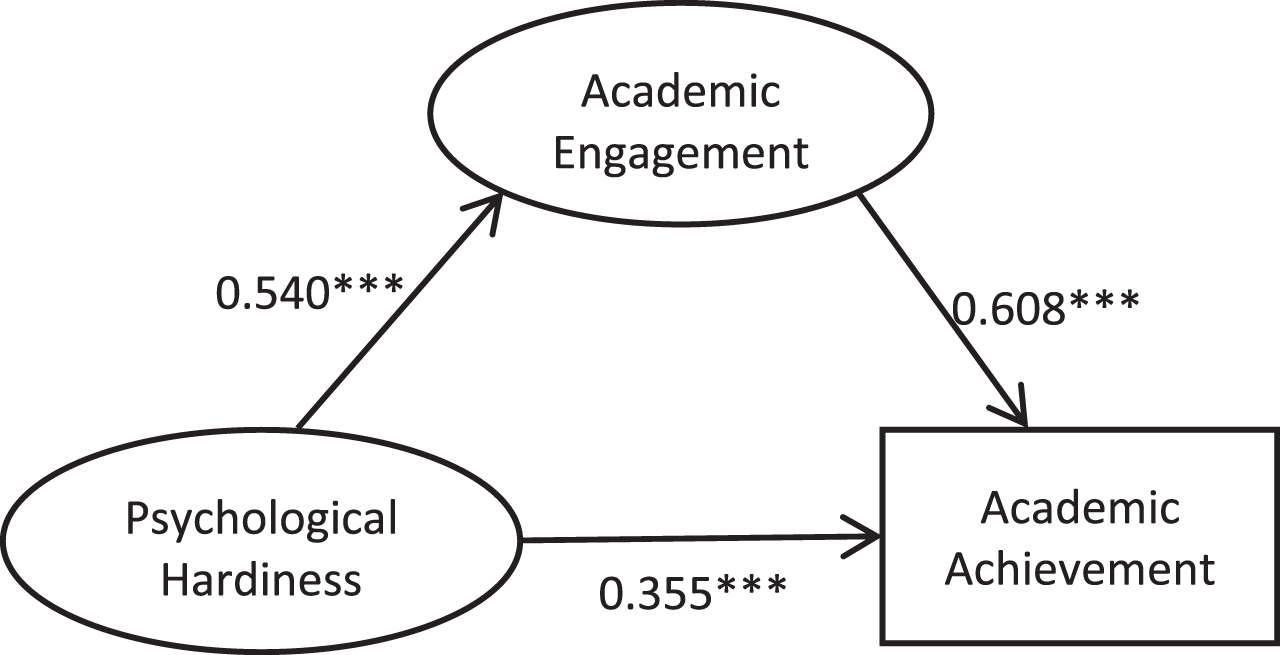
A mediation model of academic engagement in the relationship between psychological hardiness and academic achievement.
The results showed a significant positive correlation between psychological hardiness, academic engagement and academic achievement. Intermediary effect analysis shows that psychological hardiness can directly affect university students’ academic achievement and indirectly affect students’ academic achievement through academic engagement as an intermediary variable. Overall, the results supported H1, H2 and H3.
Firstly, psychological hardiness can directly and significantly predict university students’ academic achievement, supporting H1, which is consistent with previous studies [28, 31]. Academic hardiness can explain why some students are willing to pursue academic challenges, while others avoid challenging academic courses due to being afraid of damaging academic performance [31]. Law found student exhaustion levels to be extreme when compared with those of traditional high-exhaustion occupations and coursework involvement was a significant predictor of student exhaustion [59]. Nguyen et al. suggested that universities could enhance students’ quality of life and academic performance by providing programs to cultivated students’ psychological hardiness [29].
Secondly, psychological hardiness has a positively predictive effect on academic engagement, supporting H2. A higher level of students’ psychological hardiness positively correlates to a high level of academic engagement. Previous researches showed that hardiness positively predicted the level of engagement of sports athletes, adult worker and students, and negatively predicted the level of burnout, which proves there is a wide association between hardiness and engagement in different fields [60–62]. Students with a high sense of hardiness believe that they can perform well [63]. Students with higher psychological hardiness tended to stay active and involved in academic activities, even facing challenges or difficulties. If one is better at a challenge, they perceive difficulties as a normal part of living, and an opportunity to learn, develop, and grow wise [25]. Therefore, since psychological hardiness positively influences academic engagement, the results demonstrate the importance of improving students’ psychological hardiness to encourage their academic engagement.
Finally, the results revealed that academic engagement plays a significant intermediary role between psychological hardiness and academic achievement. Psychological hardiness increased academic engagement, which increased academic achievement, supporting H3. Previous research reported that academic engagement mediates the relationship between academic performance and personality trait such as emotional intelligence, positive emotions and self-efficacy [41, 65]. Similarly, psychological hardiness could be considered as a personality trait that improve academic achievement through increasing academic engagement. Those students who can manage stressful situations feel stronger, more involved and immersed in their studies, which may enhance their academic performance [66]. Thus, it maybe concludes that enhancing university students’ psychological hardiness is a useful strategy to improve academic achievement to reduce the dropout rate.
Implications
This study helps provide a theoretical and practical foundation for university administrators and students. Students with higher hardiness reported higher engagement, compared to their low-hardy counterparts [52]. Consistent with previous researches, the results showed students who experienced more engagement in their studies had a greater probability of achieving high academic performance [67]. Academic engagement is a prerequisite for academic performance [15, 45]. This result is consistent with extensive research that demonstrated a significant relationship between academic engagement and academic performance [36, 47]. Furthermore, the study confirmed the mediating role of academic engagement between psychological hardiness and academic achievement. Students display the moderating effect of academic engagement on academic performance by deep involvement in their studies.
Higher education institutions should pay attention to the needs and expectations of students and constantly improve their ability to meet these needs and expectations [68]. The results provide evidences for design training and programs oriented to improve university students’ academic performance. Universities should provide programs, such as stress relieving strategies and hardiness training to improve the students’ hardiness scores. Stress relieving strategies are quite significant to get rid of stress in university engineering students [69]. Students, who completed a semester-long hardiness training course at a 4-year university, scored higher in hardiness [25]. Universities should cultivate a sense of supporting and belonging, which are core components for student performance [30]. To do so, university is encouraged to create outlets for students to display their emotions and grievances and counselling services for students’ mental well-being [70]. When students receive satisfactory supervisory support, good peer relationship, and organizational support, they will be more engaged in learning and tend to remain in university long-term. Especially as work-from-home becomes a universal experience and the “new normal” during the COVID-19 [71], it is of utmost importance to keep university students’ academic engagement and academic achievement. For students, they should increase the level of psychological hardiness, perceive academic challenges as chances to grow and maintain the engagement withuniversity.
Limitations and future directions
These results are suggestive rather than definitive due to the study’s limitations. First, we took the study sample from a university. Although this does not substantially impact the research results, it affects the popularization of the results. Future research could expand the sample groups, making the results more representative and extensive. Second, this study adopted a cross-sectional design to collect data that established the causal relationship between psychological hardiness, academic engagement and academic achievement. Statistical mediation analysis provides a detailed examination of potential causal relationships between the evaluated variables but not causal relationships [56]. Thus, future studies should use a longitudinal research design to investigate the relationship among the variables. In addition, the GPA data was self-reported by students which could increase the risk of common method biases (e.g., social desirability) [66]. Future research will use GPA provided by universities.
Conclusion
This study aims to understand the relationship between psychological hardiness and academic achievement and the mediating role of academic engagement. The results show that psychological hardiness, academic engagement and academic achievement are positively correlated. Moreover, the results confirm that psychological hardiness improves academic achievement through increasing academic engagement. The results highlight that psychological hardiness is important to increase academic achievement, which helps to decrease the risk of dropping out. University should create a conducive organizational climate that allows students optimal growth, thus, improving students’ academic achievement, which is beneficial to students’ retention. The results provide effective strategies for university administrators to design counseling and training programs to improve students’ academic performance. The findings expand the research on the relationship between psychological hardiness, academic engagement and academic performance as well as provide theoretical and practical implications for university administrators and students.
Ethical approval
This study was approved by the Ethical Review Committee of Bohai University (No. BHU-2021-79). The study was performed in accordance with the 1964 Declaration of Helsinki and later amendments.
Informed consent
Written informed consent was obtained from all participants prior to enrolment in this study.
Conflict of interest
No potential conflict of interest was reported by the authors.
Footnotes
Acknowledgments
The authors would like to show their appreciation to the participants for their support and assistance in the data collection.
Funding
This study was supported by the project “Research on the promoting effect of education exchange on bilateral investments between China and ‘one belt, one road’ countries” (No. BIA210185) sponsored by National Office for Education Sciences Planning.