



Abstract
BACKGROUND:
Pesticide poisoning is a serious public health problem.
OBJECTIVE:
The aim was to investigate the effect of safe pesticide application training given to farmers on their behaviors towards compliance with protective measures.
METHODS:
In this interventional study, the target population was 9750 farmers living in Turkey. To achieve a study power of 95%, type I error and the effect size were assumed as 5% and 0.50 respectively. In the study, 61 farmers were selected using the systematic sampling method. Farmers were interviewed twice, before and after the training, and at each interview, they were asked questions about their pesticide use-related behaviors in the last four sprayings. In the analysis, the paired t-test, repeated measures of ANOVA (post hoc: Bonferroni) were used.
RESULTS:
The scores the participants obtained from the Pesticide Exposure Prevention Behavior Form which questions their compliance with protective measures taken during pesticide applications at the post-interview were significantly higher than were the scores they obtained at the pre-interview (P < 0.001). The analysis of the independent variables demonstrated that the scores obtained from the Pesticide Exposure Prevention Behavior Form at the post-interview were significantly different from those obtained at the pre-interview in almost all of the subgroups in terms of their sociodemographic characteristics.
CONCLUSION:
It was observed that the training given to the farmers on the safe use of pesticides encouraged the farmers to develop positive behavioral changes. The study emphasizes the importance of implementing ongoing health education programs for farmers.
Introduction
Pesticides have become an integral part of global agricultural activities today and are widely used to increase agricultural production [1]. Pesticides increase production by killing insects, rodents, fungi and unwanted plants that pose a threat to agricultural crops [2]. Pesticide poisoning is a serious public health problem. Approximately 385 million unintentional, acute pesticide poisoning (UAPP) cases occur in the world every year, and approximately 11,000 of these cases result in death. Given that the global farmer population is approximately 860 million, approximately 44% of them are exposed to pesticide poisoning every year [3]. Moreover, 155,488 deaths and 7,362,493 Disability-Adjusted Life from pesticide self-poisoning and intentional ingestion of pesticides is estimated to account for one in five of all suicides globally [4]. As is stated in community-based studies in the literature, unintentional pesticide poisoning is a common problem, and the frequency of acute pesticide poisoning is reported to range between 10% and 50% [5–8]. The World Health Organization (WHO) mortality statistics and a systematic review of the data on global unintended acute pesticide poisoning from 141 countries revealed that about 740,000 unintentional acute pesticide poisonings occur per year, which led to 7446 deaths and 733,921 non-fatal cases. When these figures are adapted to the farmer population in the world, it was determined that approximately 44% of farmers were poisoned with pesticides every year [3]. The results of the studies in which farmers’ knowledge of and attitudes towards safe pesticide applications were investigated demonstrated that farmers should be seriously given health training in this regard [9, 10].
The use of protective equipment protects farmers from both occupational accidents and diseases [11]. The review of the literature has demonstrated that the use of protective equipment is low because farmers think that such equipment is not comfortable and because they lack knowledge on the use of such equipment [10, 11]. In Sapbamrer and Thammachai’s systematic review, among the personal protective equipment (PPE), the least used ones are gowns, goggles, gloves, boots and masks [12]. According to studies in the literature, the frequency of not using PPE varies between 8.6% and 71.1% [7, 13]. Providing training to develop PPE use behavior in farmers gains importance if behavioral changes are to be improved and harms due to pesticides are to be prevented [14]. In the region where the present study was conducted, no interventional studies have been conducted to increase PPE use among farmers. Therefore, it would be appropriate to conduct interventional studies aimed at revealing the effects and appropriate use of pesticides and changing farmers’ behaviors towards PPE use.
In the present study, the aim was to investigate the effect of safe pesticide application training given to farmers on their behaviors towards compliance with protective measures.
Materials and methods
Study design
The quasi-experimental design (pre-/post-interview) was used in this study. This intervention study was carried out within the scope of the scientific research project titled “Determining Farmers’ Knowledge of, and Attitudes and Behaviors towards Pesticide Use”. This project consists of three stages. In the first stage, farmers’ knowledge of and attitudes towards the use of pesticides registered with the Chamber of Agriculture in Karacabey, a district located in the West of Turkey with a population of approximately 80,000 people were determined (Fig. 1). In the second stage, the aim is to determine the behavioral characteristics of farmers who use pesticides during their agricultural activities and are involved in the pesticide application / pesticide spraying actively, and the frequency of acute pesticide poisoning. The third stage includes the training given on the health effects of pesticides and ways of protection.
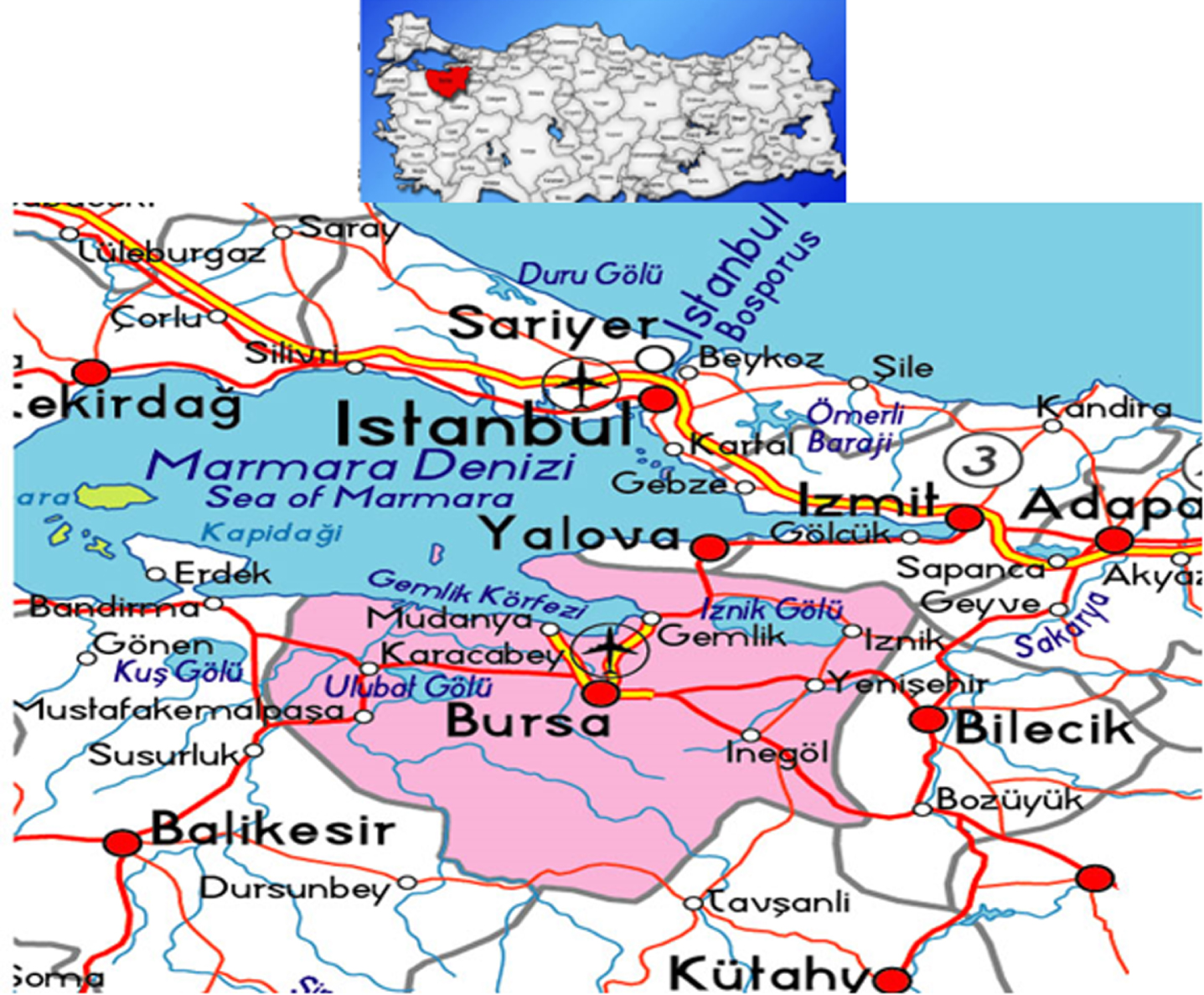
Study area representing Karacabey, in Turkey.
In the present study, which is part of the project named “Determining Farmers’ Knowledge of, and Attitudes and Behaviors towards Pesticide Use” (BAUN BAP No. 2018/169), the findings from the third stage of the project are presented. The study aimed at investigating the farmers’ knowledge of and attitudes towards pesticide use which were registered at the Chamber of Agriculture in Karacabey District, determining the frequency of acute pesticide poisoning, and conducting an educational intervention on the health effects of pesticides and ways to prevent farmers from harmful effects of pesticides.
In the region, mostly fungicides, insecticides and herbicides are used. Spraying is carried out approximately 8–9 times a year, mostly with a spraying machine or a spray pump. In Karacabey, which has fertile land, mainly field products such as wheat, corn and sunflower, fruits such as olives, walnuts and almonds, and vegetables such as tomatoes, peppers and onions are grown. The pesticides investigated in the present study include all pesticides used on the crop, and the participants are farmers who produce vegetables and fruits such as corn, tomatoes, olives, onions, peppers, pears, strawberries, cherries, raspberries, blackberries, medlars, and peas [15].
The number of the farmers who were officially registered with the Chamber of Agriculture in the town was 9750. The sample size was calculated as 54 using the G*power 3.1 statistical analysis program. To achieve a study power of 95%, type I error and the effect size were assumed as 5% and 0.50 respectively [16]. At the end, considering the possibility of losses during the study, it was decided to include seven more people. The sample included 61 people. For the sample selection, the systematic sampling method was used. The interval was determined as 1/160 by dividing the population by the sample size.
Being≥18 years old, (2) Being a farmer registered with the Karacabey Chamber of Agriculture, (3) Being a pesticide applicator, (4) Not having a hearing or speech impairment, or consciousness problems preventing the person from communication, (5) Applying pesticides always in the same period of the year.
The study was carried out with farmers living in Karacabey district of Bursa, a province in the northwest of Turkey between February and August 2020 in 4 stages.

Flowchart of the study.
The farmers were interviewed face-to-face twice: during the training and 6 months after the training. During the interviews, the Pesticide Exposure Prevention Behavior Form was administered to them to collect data. In the post-intervention interview, the farmers were asked about their pesticide use behaviors in the last 4 sprayings they had done at separate times after the training (Fig. 2).
Index=(Mean-1) x (50/3)
While a score between 0 and 25 points indicates inadequate health literacy, a score between > 25 and 33 points indicates problematic / limited health literacy, a score between > 33 and 42 points indicates adequate health literacy and a score between > 42 and 50 points indicates excellent health literacy.
Statistical analysis
Descriptive data obtained in the study were given as numbers, percentages, arithmetic mean, and standard deviation. Whether the continuous variables ensured the normality assumption was evaluated according to kurtosis, skewness coefficients ranging between +1 and –1, and Shapiro-Wilk test. The Repeated Measures of ANOVA (post hoc: Bonferroni) was used to evaluate the differences between the scores obtained from the Pesticide Exposure Prevention Behavior Form.
Pillai’s Trace test was administered to determine whether the value differed without group discrimination and whether the values differed with group interaction. Mauchly’s Test of Sphericity method was used for the sphericity test of the data. The analysis was performed in the SPSS 26.0 program. P-values less than 0.05 were considered statistically significant.
Ethical approval
Before the study was conducted, ethical approval was obtained from the Ethics Committee of Balikesir University (Date: April 04, 2018, No.: 2018/73) and verbal consent indicating that they volunteered to participate in the study was obtained from the farmers.
Results
The mean age of the 61 farmers participating in the study was 48±8.90 years. Of them, 82.0% were≥40 years old, 95.2% were married, and 41.0% were primary school graduates. According to the statements of the farmers participating in the study, of them, 26.2% had income more than their expenses, 50.8% perceived their general health as good, 39.3% had chronic diseases, 80.3% were smokers, and 14.8% (n = 9) suffered from acute pesticide poisoning in the last 1 year. The mean score the participating farmers obtained from the overall Health Literacy Scale-32 was 14.54±6.34, which indicated that health literacy levels were insufficient in 80.3% of them. The mean age of the participants was 48.00±8.90 years, the average time they spent in farming was 26.73±10.92 years, the average time they spent for spraying in the field was 1.46±0.50 hours, and the average number of spraying days per year was 8.83±0.91 (Table 1). The mean scores they obtained from the sub-dimensions of the scale were as follows: 13.86±6.75 from the treatment and service subscale, 15.02±6.83 from the protection from the illness subscale, 13.72±7.52 from the access to health-related information subscale, 14.00±6.79 from the understanding health-related information subscale, 15.26±7.29 from the evaluating health-related information subscale and 14.78±7.42 from using / applying health-related information subscale (Table 2).
Descriptive characteristics of the participants (n = 61)
Descriptive characteristics of the participants (n = 61)
*APP symptom in the past year, SD: Standard deviation.
Descriptive characteristics of the participants (n = 61)
SD: Standard deviation.
The analysis of the differences between the last four sprayings (the last, second-to-last, third-to-last and fourth-to-last) at the pre-interviews and the last four sprayings (the last, second-to-last, third-to-last and fourth-to-last) at the post-interviews performed with the Repeated Measures of ANOVA (post hoc: Bonferroni) is given in Table 3. The mean scores obtained from Pesticide Exposure Prevention Behavior Form at the pre-interview during the last spraying, spraying second-to-last, spraying third-to-last and spraying fourth-to-last did not differ significantly (P > 0.05). The mean scores obtained from Pesticide Exposure Prevention Behavior Form at the post-interview during the last spraying, spraying second-to-last, spraying third-to-last and spraying fourth-to-last were similar (P > 0.05). On the other hand, all of the scores obtained at the post-interview were significantly higher than were those obtained at the pre-interview (F = 346.045, P < 0.001) (Table 3).
The differences between the mean scores obtained from the Pesticide Exposure Prevention Behavior Form (PEPB) by the participants at the pre- and post-interventions
Pilla’s Trace F = 107.030, P < 0.001, Mauchly’s W = 0.000, SD = 27, P < 0.001, Greenhouse-Geisser F = 346.045, P < 0.001.
As can be seen in Fig. 3, the mean scores obtained at the 1st, 2nd, 3rd and 4th measurements were similar to each other, and the mean scores obtained at the 5th, 6th, 7th and 8th measurements were similar to each other. The mean scores obtained at the 5th, 6th, 7th and 8th measurements were significantly higher than were those obtained at the 1st, 2nd, 3rd and 4th measurements (F = 2590.176, P < 0.001). Changes observed in certain behaviors of the participants before, during and after spraying are given in Fig. 4.

Display of the mean scores obtained from the Pesticide Exposure Prevention Behavior Form (PEPB) with an error bar graph.
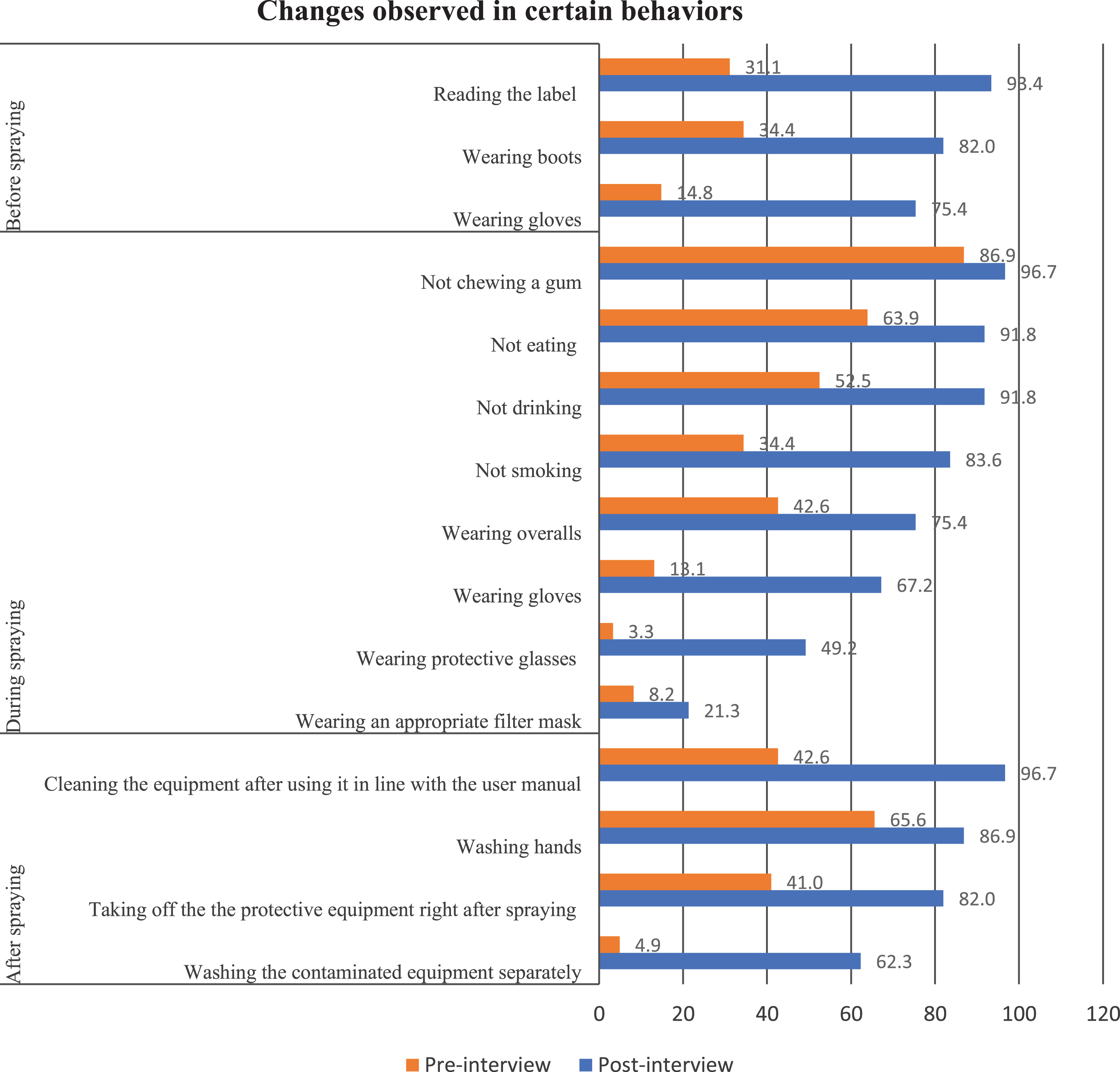
Changes observed in certain behaviors after the training.
The study demonstrated that the training given to the farmers was highly effective in reducing the frequency of behavioral risk factors and confirmed the results of previous research in which the relationship between training and farmers’ safe pesticide practices was investigated [12, 20].
In developing countries, factors such as the widespread use of pesticides, the inadequacy of legal regulations on safe use of pesticides or the lack of implementation of current restrictions, the lack of surveillance systems, not using protective equipment and the failure to use the protective equipment correctly cause agricultural workers to suffer from harms caused by pesticides more [5, 11]. In addition, agricultural workers in developing countries have low educational and socioeconomic levels, and thus they are in a disadvantaged group of the society in this respect [21]. The impact of social determinants on health outcomes is well defined, and agricultural workers who are socially disadvantaged are more likely to suffer from the toxic effects of pesticides. In Andersoon et al.’s study, small farmers with disadvantages were aware of the risks, but their access to technical support and protective measures was largely inadequate [22]. In our study, health literacy levels of 80.3% of the farmers were inadequate, consistent with the results of studies in the literature. For instance, in Srisookkum and Sapbamrer’ study, health literacy levels of 81.8 of the farmers were inadequate [23]. In the present study, the limited and insufficient health literacy levels of all the farmers made them more vulnerable to other health risks besides pesticide exposure. Therefore, this finding revealed the importance of preparing health education programs and performing public health interventions for farmers. In their studies, Srisookkum and Sapbamrer demonstrated the relationship between low education level and low health literacy level, and emphasized the importance of increasing the level of health literacy in improving health outcomes [23]. The participants mostly obtained the pesticides from the traveling sales representatives of the pharmaceutical companies, and authorities of the pharmaceutical companies did not provide adequate information to the farmers about the effects of pesticides on human and environmental health, as result of which the participating farmers’ health literacy levels were low. The farmers stated that it was extremely inconvenient for them to wear PPE because wearing PPE posed an obstacle for their physical flexibility when they sprayed pesticides. Therefore, farmers should be encouraged to use protective equipment, and the convenience of farmers should be taken into account when they use such equipment. Another important point was that the education level of the farmers, the habits they acquired from their families and their environment, and their prejudices about modern agricultural practices were among the factors preventing them from wearing PPE.
The region where the study was carried out has a fertile land in which vegetables and fruits are cultivated, and fungicides, insecticides and herbicides are used mostly as pesticides. Pesticides are applied 8–9 times a year, mostly between March and October. The farming period in the region is 26 years on average. In a study conducted in Brazil, smallholder family farmers used costal pumps 1–3 times a week (85.7%) or 4–7 times a week (11.9%) during the harvest period. The number of sprayings in that study was higher than was that in our study. In spraying, they used insecticide co-formulated mixtures [21]. This difference between the two studies may be due to the differences between the regions where the studies were performed and the quality of the product produced.
If pesticide exposure-related harms are to be reduced, appropriate use of pesticides and application of protective measures gain importance. In the current study, the comparison of the scores obtained from the Pesticide Exposure Prevention Behavior Form by the participating farmers during the last four sprayings before and after the training revealed that the scores obtained after the training were significantly higher. In the training given to the farmers during the intervention, presentations were used, how to use protective equipment (mask, gloves, clothing, etc.) was demonstrated, and the importance of using protective equipment was explained, which contributed to the success of the intervention positively. In our study, the fact that the scores obtained from the Pesticide Exposure Prevention Behavior Form before the intervention were significantly lower than were those obtained after the intervention indicates the effectiveness of the training provided. On the other hand, the fact that the scores obtained before and after the intervention were consistent indicates the behavioral consistency of the farmers, which might also be related to the fact that the spraying times were close to each other. Farmers complied with the protective measures more after the training. For instance, they read, understood and carried out the instructions on the safe and effective use of pesticides included on pesticide labels before they bought the product and used it [14]. In the present study, while only 31.1% of the participating farmers read the pesticide labels before the training, this rate increased to 93.4% after the training. There was also a great increase in the number of the farmers who took other protective measures. Consistent with our study, in their study conducted in Brazil, Buralli et al. found that the education level of most of the farmers was low and that they had difficulty in understanding the instructions on pesticide labels and leaflets, and only 14% of the farmers received technical support or vocational training [21].
In many studies, it has been reported that farmers’ knowledge, attitudes and practices regarding the safe use of pesticides are inadequate and it has been highlighted that they need training [9, 25]. Thanks to such trainings, farmers’ knowledge can be enhanced, their safe use of pesticides can be improved and thus their occupational exposure can be minimized. Afshari et al. reported that there was a positive correlation between the application of protective measures and the level of knowledge, that is, the lower the level of knowledge was, the lower the level of application of the protective measures was [14]. Fathy et al. investigated the effect of a training program which included 13–15-year-old child workers in agriculture in Egypt and found that, thanks to the program, the children’s knowledge of, attitudes towards and practices about pesticides determined at the pre-program test significantly improved at the post-program test [27]. In Greece, it was observed that the farmers who received training on the harmful effects of pesticides and protective measures had higher levels of knowledge and awareness of the dangers of pesticides than did the farmers who did not receive training, and that trained farmers complied with the protective measures more [28]. In the same study, it was also determined that while 53% of the trained farmers always wore gloves when preparing the spray solution, only 4% of the untrained farmers wore gloves, and while 92% of the trained farmers always took a shower after pesticide application, the rate was 70% among the untrained farmers [28]. Studies also demonstrated that training given to farmers increased the frequency of safe storage of pesticides and their awareness of the serious health outcomes due to the irrational use of pesticides [14].
In terms of PPE use among the participants after the intervention, more farmers wore gloves and read labels before spraying, but the number of the farmers who wore boots did not change much. This was probably due to the fact that the farmers did not perceive wearing boots as protective. During spraying, while the number of the farmers who used protective glasses and gloves increased, the number of those who ate something or chewed gum did not increase much. This was probably because behaviors such as chewing and eating were not common among them. After spraying, while the number of the farmers who washed dirty equipment separately increased, the habit of washing hands increased least, which was probably due to the fact that the hand washing habit was already more common than were the other habits before the intervention. In general, the farmers may have been perceived wearing gloves, glasses and masks, and washing the dirty equipment separately as more difficult habits. Given the determinants such as health literacy and income status, it is important to improve the farmers’ health literacy levels and to encourage them to receive extensive, qualified, content-rich and applied training on safe pesticide management.
Another result of our study is that even after the intervention, some farmers, especially those who were single, those who had a poor perception of general health, those who usually presented to private hospitals when they had a health problem, and those who did not receive pesticide training exhibited behaviors of preventing pesticide exposure inadequately. This was probably due to the fact that these farmers’ health literacy levels were low, and that they were influenced by the pesticide applications and health behaviors of other farmers in their environment [23, 26].
Strengths and limitations of the study
The present study has some limitations. First, the farmers’ behaviors in the study were based on their own reporting. The second limitation was that the number of the farmers included in the training was limited. Another limitation was that only the farmers’ compliance with the protective measures was investigated. Finally, the present study did not include an independent control group. Despite these limitations, the results obtained in the present study are expected to contribute to the literature, because the number of studies conducted on this issue is limited. In addition, in our study, behavioral changes of the farmers were discussed within the scope of the training on safe pesticide use, and the findings are expected to provide guidance for researchers and practitioners to identify mechanisms regarding safe pesticide use.
Conclusions
For public health professionals, reducing pesticide exposure in agricultural activities is still a major challenge. Harms caused by pesticide exposure are very common especially in developing countries. The fact that agricultural workers and farmers are poorly trained on issues regarding pesticide safety increases the harms even further. The present study demonstrated that training given to farmers significantly increased their use of protective equipment. To minimize hazardous exposures in agriculture, widespread community-based public health interventions are needed. If pesticide exposure-related harms are to be reduced, it is recommended to plan and implement ongoing education and training programs. Promoting the development and facilitation of lifelong learning related to pesticide use should be a priority if pesticide use-induced risks to human health and the environment are to be minimized. In addition, within the scope of sustainable farming, incentives and support programs can be provided for farmers by governments to prevent their losses, pesticide use can be reduced, and agricultural production can be enhanced with policies based on occupational health, and safety and environmental health in cooperation with agricultural, educational and environmental organizations, and universities.
Education programs on pesticide safety and dangers of pesticide exposure should be developed to fill in the gap in farmers’ knowledge of pesticides. Within this context, national authorities should provide up-to-date, accurate and easy-to-understand information in trainings given to farmers in order to establish trust-based communication with farmers. Farmers’ level of trust in information sources and in those who provide them with information can shape their perceptions of pesticide risk and adoption of preventive measures.
Ethical approval
Before the study was conducted, ethical approval was obtained from the Ethics Committee of Balikesir University (Date: April 04, 2018, No.: 2018/73).
Informed consent
Verbal consent indicating that they volunteered to participate in the study was obtained from the farmers.
Conflict of interest
No potential conflict of interest was declared by the authors.
