



Abstract
BACKGROUND:
Organizational changes in the traditional work models demand studies on the management of the so called “Teleworking”.
OBJECTIVE:
This research aims to analyse the teleworking management practices to subside organizations and leaders to improve their performance and enhance workers quality of life.
METHODS:
A survey was carried out with teleworkers to obtain their perception of the analyzed factors, using the survey monkey tool. The collected data were analyzed using Partial Least Squares – Structural Equation Modeling (PLS-SEM).
RESULTS:
The validated model for the practices analysis is composed of the constructs: business management, physical and people infrastructure, leadership, self-esteem, and job satisfaction. Based on the analysis carried out, it is suggested that organizations establish organizational telework policies, follow government policies and provide communication and competence plans. Moreover, it is crucial providing technologies and support to them and develop people management practices in teleworking. Leaders must provide confidence, a teleworking culture, professional advancement, integration, well-being, negotiation of goals and a training plan. The teleworker’s satisfaction is due to the sustainability related to the work model and its choice defined by personal motivation, balance between personal and professional life and a sense of belonging.
CONCLUSIONS:
All variables observed, linked to the constructs and validated, can be considered by managers to improve human resource management and obtain better productivity results.
Introduction
Organizational changes over the years in large traditional companies and the development of new business opportunities around the world mean that employees and workplaces are increasingly dispersed, geographically distant from headquarters. As organizations move towards globalization and communication technologies, they accelerate the pace of change that often uses teleworking to do the job more effectively and efficiently [1]. Sustainability is a concept related to the objective of preserving the planet’s resources to meet the human needs of this and the next generations, and teleworking is considered, in many studies, as a sustainable travel demand management strategy [2] as an instrument to promote the environmental sustainability of cities.
Another issue related to teleworking is the human capital of organizations, particularly strategic professionals to maintain their competitive advantage. Teleworking could provide workers with greater flexibility and control over time and place of work, helping them to balance work and life [3]. A counterpoint to this argument is observed in the study by Taskin and Devos [4], which brings teleworking issues related to intensification of work, social isolation, control and management, which are issues to be resolved.
New forms of work are defined by their facets in the ways of working [5] that are: time independence from the workplace, performance management rather than management of how employees conduct their work, free access and use of the organization’s knowledge, accommodation between professional and private life and, finally, interaction of physical and mental health by stimulating the relationship and cooperation between co-workers.
According to Macêdo et al. [6], teleworking can be a valuable tool to balance work and family life, which helps to improve workers’ well-being, however, as several factors can influence remote work, companies they must adopt unique strategies that reflect their specific situation.
These researches and observations have been developed before the world society has been surprised by the coronavirus pandemic (COVID-19). This fact has accelerated the need to adapt the vast majority of companies to the home office of their workforce. The trail that the coronavirus has left is one of caution in the job market and changes in the relationships between bosses and employees. Donnely and Proctor-Thomson [7] carried out a study on teleworking in a post-catastrophe situation. The research refers to natural disasters that interfere with the nature of the work and promotes an urgent review of where the work is done. They present teleworking as a way of working for regional post-catastrophe situations, providing a means of ensuring continuity of operations in an emergency situation. Thus, given this scenario, this study contributes to the current demands of society by analyzing the teleworking management practices to be used to guide organizations and leaders to improve their performance and enhance workers quality of life.
Theoretical reference
To support this study, all articles related to teleworking and people management in the SCOPUS and Web of Science databases were analyzed, without a cut-off date.
The most recent teleworking studies are related to flexible work arrangements. The term “flexible work arrangements” is the category with the highest number of occurrences in bibliographic searches. There are studies that classify new forms of work as the same as “flexible work arrangements” [8] being defined as work that is characterized by: flexibility of time, flexibility of location through the technologies of information and communication (ICT). The trend in remote work studies during COVID-19 pandemic suggest the “flexible work” and “job satisfation” are highlighted in research on remote work [9].
Higgins et al. [10] researched how these arrangements involve the individual’s home and analyzed the conflicts between work-family or family-work in 4 different types of flexible work arrangements (the traditional work regime, compressed work weeks, flexible hours and teleworking). Conceptually, the conflict between work and family is bidirectional, and researchers distinguish between the conflict between work-family and family-work. When work responsibilities negatively affect the ability to complete family responsibilities, it is called the work-family conflict.
Another theme to be highlighted are policies, laws and regulations. Teleworking without regulation becomes a marginal practice [11]. Organizations that have policies related to teleworking shape the communication flows of employees and managers. In contrast, organizations that allowed teleworking only by exception, that do not value teleworking and without regulatory policies create different performances for teleworkers [12].
Several themes, in addition to those with greater occurrences in management of teleworkers, stood out in scientific research. Articles on the behavior and attitudes of professionals teleworking analyze the profile necessary for this type of professional and how teleworking influences their attitudes [13]. Eligibility and participation in teleworking influence employees’ attitudes and the different reasons for non-participation have impacts on behaviors and attitudes [14]. The concept of perceived proximity is related to teleworking as a means of measuring the quality of relationships and their results in organizations. The results show that the perceived proximity (a cognitive and affective sense of relational proximity) and not physical proximity (geographical proximity measured in kilometers or miles) affects the quality of the teleworkers’ relationship [15].
Coworking is a new way of thinking about the work environment, sharing space with office resources, which brings together self-employed professionals from different areas and companies in a single location, including teleworkers [16]. Cyberslacking is a concept of counterproductive behaviors with the use of the internet for purposes unrelated to the company’s work and time. The study by O’neill et al. [17] suggests that the teleworker’s personality may be the way to identify those who can be selected for remote work or to assist in the development of processes that reduce cyberslacking opportunities, such as management monitoring closer to the daily production of employees.
The measurement of performance and execution of teleworking is a scientific research topic related to teleworking that only appears in recent years in article databases. They propose performance indicators for teleworking and the result of the study is that there is an increase in performance value [18]. The work performance of the teleworker is a matter of public debate in progress according to Golden and Gajendran [19] and the results of the studies did not support negative associations between teleworking and performance.
The subtopics, below, presented the highest occurrences in the theoretical framework related to the objectives of this research. Thus, they theoretically support the teleworking people management model.
Business management
A fundamental issue for organizations is their human capital, people, specifically strategic professionals, to maintain their competitive advantage. It is necessary to retain them and ensure their well-being. Happy employees are the premise for a successful and sustainable company [20] and teleworking provides workers with greater flexibility and control over time and work place, helping them to balance work and life [3]. But, there are counterpoints, as observed in the study by Taskin and Devos [4], which raises outstanding issues of telework related to intensification of work, social isolation, control and management, which are paradoxes to be solved.
According to Belle et al. [21], teleworkers, especially those of high intensity, are concerned with belonging to the organization and want to feel included. The main thing for the belonging to happen is that the teleworker is always invited, by the leadership and organization, to participate and learn. Confidence building and continuous communication are important, as well as the recognition and reward that stimulate teleworkers’ professional development. When such actions do not occur, a feeling of social isolation is generated, the opposite of belonging.
The insufficient provision of organizational social support reduces job satisfaction and increases psychological tension, due to the social isolation resulting from teleworking [22].
Infrastruture
Bentley et al. [22] found that organizational social support has been positively related to job satisfaction and negatively related to psychological tension. The result was that organizational social support and teleworker support have been associated with increased job satisfaction and reduced psychological stress. These findings suggest that it is important to provide support and organizational support to the teleworker to improve the fit of the teleworker-environment and thus ensure desirable telework results.
The leadership’s commitment to teleworking and a performance-oriented culture are important for the satisfaction of teleworkers. Such performance orientation and defined policies play significant roles in increasing teleworker satisfaction [23].
Leadership
It is observed in the literature that it is essential to pay attention to the role of leadership in the career and development of teleworkers. Charalampous et al. [24] identify practical implications for the teleworker’s welfare dimensions, such as: granting autonomy to individuals and avoiding micro management; convey the feeling of trust; encourage good communications; plan goals for the teleworker so that projects are completed on time; and keeping teleworkers informed about career opportunities to alleviate concerns about career advancement resulting from a physical absence at the headquarters location. Thus, the leadership must be broad, going beyond the establishment of goals and deadlines.
Organizations that adopt teleworking may present resistance to the flexible work arrangement format, in all positions and functions of employees. It is necessary that the attitude of leaders and supervisors towards teleworking in their teams is determined in their organizational guidelines. Companies with teleworking policies have the best results to remedy negative attitudes of supervisors towards teleworking. [25]. According to Martin [26], companies need strategies to adopt teleworking because there is a difficulty in changing and losing the status quo. Many employees can express a willingness to telework, but few companies seek this modality.
Self-esteem
Charalampous et al. [24] suggest that teleworking presents positive results in relation to the well-being of remote workers. However, the research indicates that there are some negative aspects such as social and professional isolation, and perceived threats to professional advancement.
Advancement in teleworking career can be affected by your skills and behaviors. According to Nordbäck et al. [12], organizations that do not value teleworking and without regulatory policies create different performances for teleworkers. The performance of teleworkers was analyzed by Golden and Schoenleber [13] who identified a specific and necessary profile for these professionals, as an example, people with a relational profile who do not develop professional demands with the same intensity and quality when they work with their teams in person.
Job satisfaction
The feelings stress and burnout continue to be high for teachers during the COVID-19 pandemic. Most of them feel very ou extremely stressed. They are struggled to have a satisfactory work-family balance [27].
Vacherand-Revel et al. [28] researched the way in which teleworking redistributes work balance and suggest that the implementation of teleworking in companies requires an awareness of the multiple dimensions that will be affected. Working at a distance reconfigures the balance between professional and private life, induces an evolution in the relationships between colleagues and those with managers, as identified in the research. Higgins et al. [10] suggest that organizations select employees with an adequate profile for teleworking and prepare them to assume this responsibility in the organization as it is a process that involves the individual’s home and conflicts between work-family or family-work.
The feeling of social isolation has consequences for advancing professional life and setting goals. According to Kwon and Jeon [23], for a successful teleworking program, leaders, managers and supervisors must provide consistent and substantial information to support teleworkers. The authors suggest that it is necessary to develop legal and political guidelines that encourage cooperation, collaboration and virtual interactions with and between teleworkers, as they can easily feel isolated, due to the lack of interaction with co-workers. Establishing cultural norms is desirable in the workplace, cultivating a high-performance policy. When teleworkers become aware of such cultural norms in the workplace and there is an effort by the leadership to assess their performance accurately and objectively, it makes the expectation of managing their performance clear.
Methodological procedures
The nature of the research can be classified as applied and exploratory, using mixed methods, where quantitative and qualitative data are collected sequentially or simultaneously in a single study [29].
A bibliographic survey has been carried out with the keyword “teleworking” associated with the issues addressed in this study: feeling of isolation from the teleworker, perception of support from the organization, perception of threat to career growth, perception of balance between personal and professional life with the teleworking and teleworking time. Subsequently, the questionnaire has been applied to the target audience, in which the statements have been measured with a Likert scale of five scores, as shown in Fig. 1. All questions have also been composed by the comment field. This field was optional in order to expand the space for respondents to freely comment on each item.

Questionnaire evaluation scale.
It should be noted that for a better understanding of the respondent, questions of demographic characteristics have been added, before the statements of the variables. The strategy used to send the final questionnaire was to send the survey to the target audience professionals, through the survey monkey system. It has been used the Linkedin relationship network.
The questionnaire has been made available from 18 November 2019 to 9 January 2020 for groups and directly for professional Linkedin users who work in teleworking with a total of more than 700 professionals. These professionals were selected for working in flexible work arrangements, with an emphasis on teleworking and being linked to companies or other types of organizations. Geographically, the research was limited to companies operating in Brazil that include teleworkers. The research was carried out before the WHO declaration of the COVID-19 pandemic.
From the 700 questionnaires sent, 133 questionaires were received, presenting a response rate of 19%. Despite we received 133 questionnaires, just 92 were completely answered and, therefore, were considered in the analysis. According to Hair et al. [30], G*Power software can be used to evaluate the sample size required to run PLS-SEM and this analysis was conducted in this research to validate the number of respondents.
The questionnaire to investigate the people management models in companies that adopt telework and to identify the gaps in these models was designed to be answered online by teleworkers in operation. The 27 statements that made up the questionnaire were based on the themes raised in the systematic literature review. This questionnaire was constructed based on bibliographical research and on the identified result of semi-structured interviews carried out with professionals working in telework.
For data analysis, Partial Least Squares-Structural Equation Modeling (PLS-SEM) was used. As highlighted by Law and Fong [31] and Hair et al. [30], PLS-SEM is a robust modeling method useful for exploratory analysis. The aim of PLS-SEM is “to estimate the path relationships in the model with the objective of minimizing the error terms (i.e., the residual variance) of the endogenous constructs”[30]. The validation through PLS-SEM presented in this study was performed according to the guidelines of Ringle et al. [32], Hair et al. [30], Cohen [33] and Chin [34]. A similar analysis procedures was used in Rampasso et al. [35].
The first step is composed by defining a theoretical model to be tested [32]. Based on the literature and debates among the authors, a first theoretical model was established. After it, it is necessary to define the minimum sample size required to validte the model. As proposed by Hair et al. [30], the G*Power software was used to calculate it. For this, statistical power of 80% and effect size of 0.15 were used.
The software used to run PLS-SEM was the SmartPLS 2.0 (step 3). For this, the following information was used as input: Path Weighting Scheme, value of 1 for variance and zero for mean, 300 as the maximum number of interactions for model convergence; and 0.00001 as the criterion of calculations stopping. Runing PLS-Algorithm enabled the analysis of Average Variance Extracted (AVE), Composite Reliability, R Square, Cronbachs Alpha, and Cross Loadings. AVE analysis (step 4) is used to verify convergent validity. AVE values must be higher than 0.5 [30, 32].
The fifth step is dedicated to the internal consistency analysis. For this, the values of Composite Reliability and Cronbachs Alpha are evaluated. Composite Reliability should present values higher than 0.70 and Cronbachs Alpha should have values higher than 0.60 [30, 32].
Discriminant validity is evaluated in the sixth step, through Cross Loadings analysis. In this analysis, the main goal is to verify if observed variables are correctly allocated. For this, their outer loadings should be higher in their own constructs than in the others [32, 34].
In the seventh step, the coefficients of determination should be analyzed. For this, the values of R square 0.02, 0.13 and 0.26 are considered of small, medium and large effect, respectively [32, 33]. For linear correlations and regressions analyses (step 8), bootstrapping should be runned and t-student values need to be higher than 1.96 (p-value≥0.05) to be validated [30].
Finally, in the step nine, redundancy (Q2) and communality or effect size (f2) values should be considered. For the first, values higher than zero are considered valid, while for the second, 0.02, 0.15 and 0.35 are small, medium and large, respectively [32].
Based on the literature, it was proposed a first theoretical model to be validated through PLS-SEM. The analyzed variables were divided into five constructs, as presented in Fig. 2. The constructs proposed are: Business management, Infrastructure, Job satisfaction, Leadership, and Self-esteem.
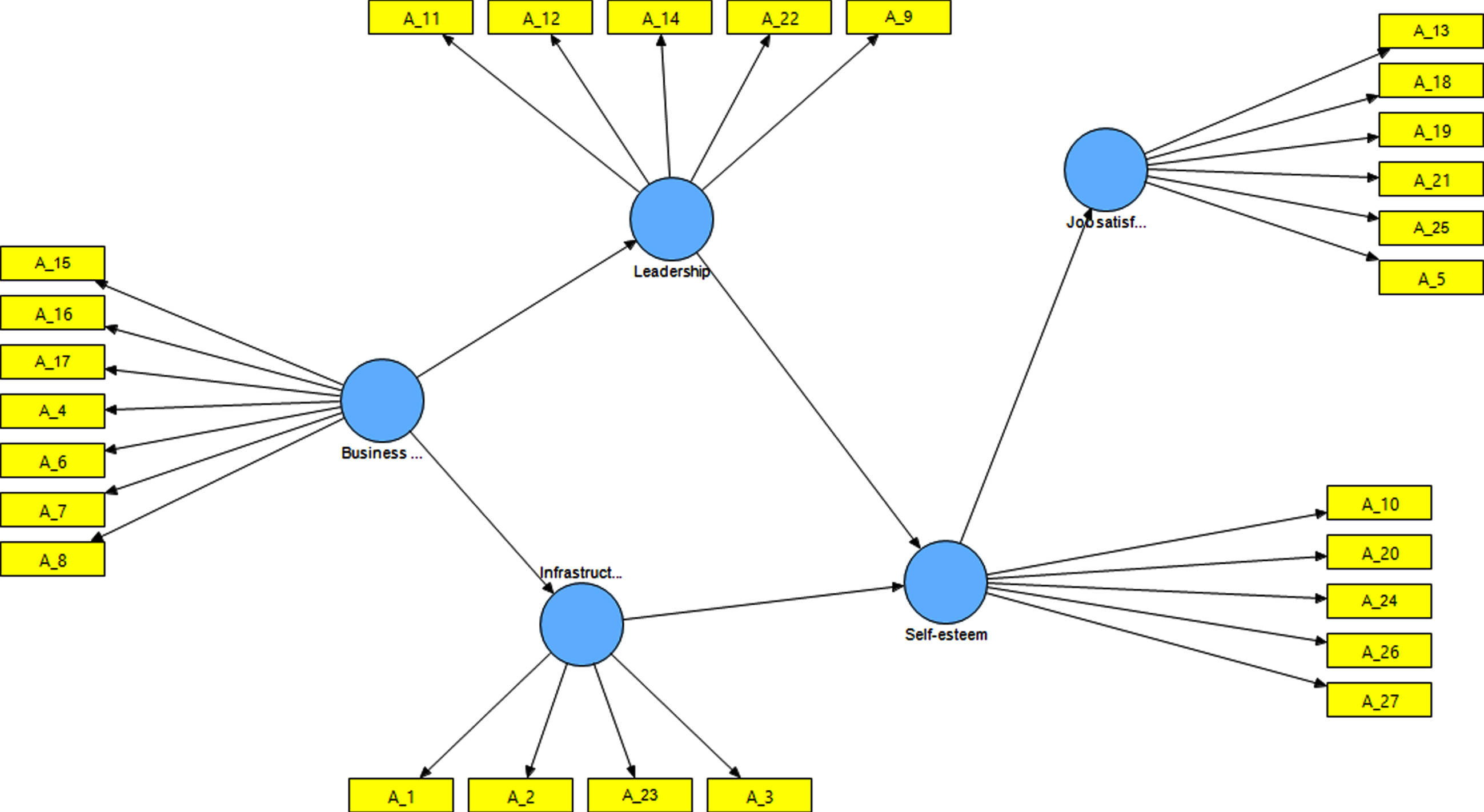
Theoretical model proposed.
Before starting PLS-SEM analysis, the sample size was evaluated. For a statistical power of 80% and the parameters mentioned by Hair et al. [30], the proposed model needs 68 respondents. Considering the sample obtained (92 respondents), the statistical power is 91.53%.
Analyzing this model with PLS-SEM, the first step taken was running PLS-Algorithm. In AVE analysis, four of the five constructs presented AVEs lower than 0.5. Thus, the observed variables with the lowest outer loadings were removed, one by one, until all constructs present AVEs greater than 0.5. The following observed variables were removed: A_17, A_9, A_15, A_25, A_11, A_24, A_4, A_13, and A_23.
After excluding these variables from the model, it was possible to validate the model presented in the Fig. 2. In this Fig. 3, it is also presented the outer loadings and path coefficients of this model. In the sequence, the steps used for this validation are detailed.

Model validated through PLS-SEM.
After running PLS-Algorithm, the first item to be evaluated is constructs’ AVEs (step 4). As it can be verified in Table 1, the validated model presents all AVEs higher than 0.5. This table also presents the values of Composite reliability, Cronbachs alpha and R Square. All values of Composite reliability are higher than 0.70 and all values of Cronbachs alpha are higher than 0.60, validating the internal consistency of the proposed model. Regarding R Square values, as emphasized by Rampasso et al. [35], only endogenous construct analysis is justified. This is the reason for not calculating the R Square of “Business management construct”. The other constructs presented values ranging from medium to large effect.
Quality criteria
Table 2 shows the adequacy of variables allocation, since all outer loadings presented the highest values in their own constructs, as required in Chin [34]. As it can be verified in Fig. 4, the step 8 was also validated, since all t-student values are higher than 1.96 [30].
Cross-loadings analysis

T-student values obtained from Bootstrapping of SmartPLS.
Regarding the values of redundancy and communality (Table 3), it is observed that all constructs were validated for redundancy and communality. Regarding constructs size effects, only Leadership presented a small effect; all the other constructs presented medium effects.
Redundancy and communality values
The model resulting from the PLS-SEM approach, suggests a relationship between five factors related to teleworking management including professional achievement and self-esteem. These last two have been identified as related to labor productivity. The constructs suggested after the qualitative analysis of the appropriate organization of the variables were: business management, as the most comprehensive for management; the physical and people infrastructure, as a basis for the development of the activities required in teleworking; leadership as a motivating construct for achieving relevant results; self-esteem as a result of the balance and execution of the previous constructs and, finally, professional fulfillment, which must be sought and maintained as a way of retaining the human capital of organizations. Each construct described above is composed of variables from bibliographic research. The data were obtained from the questionnaires submitted to the survey respondents. Next, the theoretical support of the results obtained in the modeling is presented.
The business management construct is composed of 4 variables that refer to organizational policies, government policies, communication and competences.
Variable A_6: There are structured teleworking policies in your company
The result of this variable confirmed the scientific literature that points out the need for structured teleworking policies in companies. According to Bentley et al. [22] the benefits of teleworking for organizations are greater insofar as they support teleworkers and contemplate such practices in organizational policies and practices. The data were obtained from teleworkers from companies operating in Brazil, where teleworking was not disseminated before the coronavirus pandemic. This information is relevant because, according to Peters and Den Dulk [36], national culture is the factor that has a global impact on the entire teleworking process because government policies vary between national cultures.
Variable A_7: Government telework laws, regulations and policies are reflected in my company
The behavior of this variable, in this study, has not shown itself aligned with the researched literature. Studies point out that there are problems and flaws regarding government regulations on telework. For Tedeev [37] teleworking is one of the most effective ways to increase the profitability of the business, however, despite the legislative regulations developed for teleworking, many problems remain unsolved. As a result, standards of protection for labor rights are declining for remote workers compared to traditional workers. Hynes [11] reinforces this understanding of teleworking policies and affirms that remote work continues to be unexplored, both as an environmental tool, as a positive economic and social option, and in need of policies. He maintains that teleworking without regulation becomes a marginal practice.
A possible justification for the non-alignment of this variable with the literature could be the fact that the majority of respondents act by teleworking in a hybrid way, without the need to be submitted to the teleworking laws and regulations.
Variable A_8: Communication with my manager takes place on a regular basis
For Bueno [38], teleworkers’ management should be based on regular communication between manager and subordinate as the main factor to ensure good management. Regular communication is a determining factor for the good management of teleworkers.
Variable A_16: My organization has been defining the competences and behaviors necessary for teleworking
Teleworking is a regime that transfers responsibility and risks to the teleworker, and modifies the management function in terms of supervision, expectations and relationships. For this reason, companies must have defined the skills and behaviors necessary for teleworking. Professionals with an individual profile are able to manage their own careers. It is a profile aimed at flexibility, autonomy, self-management, responsibility and effectiveness [4].
Physical and people infrastructure
The physical infrastructure and people construct is composed of 3 variables related to technologies, support of technologies and people management practices.
Variable A_1: I have the necessary technologies to telework
The literature points out that technology is intrinsic to teleworking and it is necessary to have the necessary technologies for teleworking to happen. For Allen et al. [39] information and communication technology tools are needed to interact with other people inside and outside their main office during telework periods. The results are negative in telework management when problems with technology occur [1].
Variable A_2: I receive the necessary IT support from my company
In addition to having technologies, the studies claim that companies should provide IT support to teleworkers. Beno [16] suggests that companies, in their management of teleworkers, offer support, communication tools and guidelines for proper use, with the objective of promoting effective communication on a daily basis. Siha and Monroe [40] consider information technology support one of the leading factors in the implementation of remote work, as they provide positive results such as regulatory compliance, positive environmental impact, higher productivity and less cost for organizations and, also, more satisfaction of the workers.
Variable A_3: My company’s management practices are adjusted to the teleworker
The theoretical foundation on teleworking people management practices indicates the lack of attention on elements such as well-being, communication and culture. Charalampous et al. [24] suggest that teleworkers’ management act on the dimensions of well-being and that studies on the management of more effective teleworking attitudes and policies are needed. For Montreuil and Lippel [41] teleworking at home is generally seen by workers as having a positive effect on their health, although potential problems arising from the design of the workstation, long hours and isolation have been identified. The human factor is an important part in the implementation of flexible work practices [42], variables such as physical space require measurement and evaluation before the decision-making of adoption and work implementation.
Leadership
The leadership construct is composed of 3 variables related to trust, culture of teleworking and professional advancement.
Variable A_12: My manager trusts me
Managers opt for teleworkers who show reliability and credibility, delivering the results that have been negotiated [16]. Reinforcing this understanding, Ipsen et al. [1] identified that, when there is distrust in the relationship between leader and team member, the results of telework are negative and affect the behavior of both.
Variable A_14: Working remotely is considered positive by my managers
Certain groups of teleworkers can be affected by negative aspects, specifically the disadvantage of reduced visibility due to the distance from the leader and insecurity regarding career development [43]. When the company does not have teleworking in its organizational culture, when adopting this regime, there are effects on the leadership that perceives loss of hierarchical power and can privilege employees who remain in the traditional work regime [44]. There are effects of teleworking on those professionals who remain in the office, the non-teleworkers in the organization, who feel unworthy and cause difficulties in the relationship with teleworkers and leaders [45].
Variable A_22: My professional advancement is not threatened by being a teleworker
The teleworker’s professional and career advancement must be guaranteed by the leader. According to Illegems and Verbeke [44], when people management practices are broad, the effects of telework on job satisfaction result in a positive experience and confidence in people management. When they are not broad, the effects are negative, causing a lack of promotion, inadequacy of ICT, negative direct leadership relationships, lack of social and professional interaction, generating distrust and negative perceptions.
Self-esteem
The self-esteem construct has 4 related variables: integration, well-being, negotiation of goals and professional development plan.
Variable A_10: My leadership acts in my professional and social integration
This variable confirms the theoretical basis on the need for leadership to act in the integration of teleworkers. Maruyama and Tietze [43] state that companies’ people management should focus on teleworkers to adopt remote work, to ensure the integration of mechanisms and systems that align teleworkers’ knowledge, productivity and aspirations with goals and organizational targets, ensuring professional integration.
These new ways of working are defined, according to Gerards et al. [5], for facets such as: independence of time and place of work, management of performance instead of management of how employees conduct their work, free access and use of the organization’s knowledge, accommodation between professional and private life and, finally, physical health and mental interaction by stimulating cooperation between co-workers.
Variable A_20: My organization provides social support to support my well-being
It is suggested that organizations should make a selection of employees with an adequate profile for teleworking and prepare them to assume this responsibility in the organization as it is a process that involves the individual’s home and conflicts between work-family or family-work [10]. The role of social support that the organization provides to teleworkers, referring to the well-being, should be in reducing psychological exhaustion and in improving job satisfaction [22]. Researchers suggest that future studies will incorporate a greater variety of teleworkers, including issues such as personality traits, culture and organizational climate of organizations that adopt teleworking. Advanced research methods are necessary to maintain the theoretical advance on how to implement and manage more effective teleworking attitudes and policies for maintaining well-being [24].
Variable A_26: I have goals and / or indicators established and negotiated periodically with the leadership / company
According to Beno [16], studies on the management of teleworkers point out that communication requires feedback and performance monitoring requires challenging goals so that teleworkers have visibility in delivering negotiated results. Arso et al. [18] reinforce that there is an increase in performance value when there are indicators. As a counterpoint, Golden and Gajendran [19] suggest that the teleworker’s performance is a matter of an ongoing public debate and that the results of the studies did not support associations between telework and performance.
Variable A_27: I have a training plan negotiated with my leadership / company
This variable confirms the result of the literature. Illegems and Verbeke [44] identified that people management practices that encompass the development of skills and knowledge cause positive effects in the adoption of telework in companies. Like Pérez et al. [46] who suggest that telework management occurs with the technology management integration, innovation and knowledge, and that the adoption of telework in companies is related to variables that influence the company’s strategy, such as employee training programs.
Professional achievement
The professional achievement construct has 4 variables related to sustainability, personal motivation, balance between personal and professional life, and belonging.
Variable A_5: I consider teleworking to be a green innovation, a positive option for the society and the economy
Part of the literature suggests that the Brazilian teleworkers recognize that they can contribute to the improvement of environmental conditions. According to Riggs [47], teleworking is a sustainable strategy that overcomes the issue of “green” innovation as it is an attraction for human capital. However, this result is a counterpoint to the studies by Hynes [11] and Rietveld [48], who claim that teleworking remains unexplored as an environmental tool, as well as a positive economic and social option for the future. To be successful, changes are needed in the internal organization of companies, in the social responsibility of companies and in the lifestyles and activity patterns of workers [48].
Variable A_18: Work remotely for personal motivation
Bailey and Kurland [49] identified two types of motivation: individual and organizational. The main individual motivational issues raised were that women want to provide assistance to young children and workers in general want to avoid long trips to the office. Illegems and Verbeke [44] indicate teleworking as a preference of employees not to change their private residence in case relocation office. Peisert [20] proposed telework as a retention tool, which can bring satisfaction to employees. Therefore, it would be the best way to provide support to employees, especially those with young children or those who need to organize family life.
Variable A_19: Teleworking gives me a balance between personal and professional life
Studies state that there is a positive impact of teleworking in gaining flexibility and balance in personal and professional life [44]. According to Hislop and Axtell [50], the limits of time and spatial mobility affected the balance between work and personal life, thus, teleworkers who stay entirely at home have more positive results of balance than the types of partial telework. Macêdo et al. [6] showed that telework can be a valuable, but not infallible, tool to balance work and family life, helping to distribute work more equitably among couples and improve their well-being.
Variable A_21: I do not have the feeling that I am isolated socially and professionally
This variable corroborates the literature in its calculation, indicating that the researched group does not suffer negative impacts related to isolation. For Maruyama and Tietze [43] certain groups of teleworkers may be affected by negative results of social and professional isolation, which are, specifically, the reduced visibility of leadership and peers, and the lack or reduction of career development. According to Bentley et al. [22], the negative results of work isolation and work-related stress are a risk to the results and the continuity of telework.
For Taskin and Devos [4], teleworking, being a flexible work arrangement, meets the demands of employees and the employer, however, it brings issues related to intensification of work, social isolation, control and management. Charalampous et al. [24] corroborate the other studies stating that social and professional isolation in remote teleworking are potential threats to the well-being of employees of organizations adopting this regime.
In the case of this research, the workers surveyed mostly worked in a hybrid way, suggesting that this modality contributes to the non-feeling of isolation. In the case of integral teleworking, new research should be carried out.
People practices in a teleworking regime
Based on the results presented in this study, a proposal for strategic people management practices in teleworking was elaborated, presented in Table 4. Based on the analysis of the modeling of constructs and variables, such practices are suggested for organizations and leaders to meet the demands and requirements for the adoption and maintenance of teleworking, as well as the quality of life of professionals working remotely.
Proposal of people management practices in a teleworking regime
Proposal of people management practices in a teleworking regime
This research addressed the teleworking management practices to better understand how organizations and leaders can have better results from this modality of work.
The results show that companies consider governmental laws in their management practices, however the literature indicates that governments lack regulations that support the issues of teleworkers. Probably the labor contracts of the respondents were based on traditional labor laws, since the majority acted in a hybrid way, before the pandemic.
Presenting the technologies, presenting IT support, establishing a relationship of trust, executing an equal treatment between traditional and remote workers, and ensuring that professional growth is not threatened by the teleworking. Indeed, it can provide self-esteem. These actions can be generated by the synergy of business management that supports the technological infrastructure and people acting together with the leadership.
The teleworker’s self-esteem occurs when the organization and leaders establish training goals and plans, support professional and social well-being and integration, ultimately generating the professional fulfillment that occurs when teleworking is a personal choice, provides a balance between personal and professional life, is perceived as sustainable and does not generate the feeling of social isolation.
All of these variables must be considered by managers when adapting new management practices, since new needs arose during the coronavirus pandemic and the return-to-work activities will probably be based on the transformation of traditional models for teleworking. The suggestion is that organizations and leaders adopt teleworking management practices to obtain positive results in their performance with efficiency and effectiveness, as well as to provide quality of life at work.
The use of a non-probabilistic sample should be mentioned as a limitation of this study. However, respondents were selected based on their experience and knowledge to answer about the analyzed issues.
The current scenario of COVID-19 pandemic emphasized the importance of companies to better prepare their employees to work from home and to enhance their efficiency when working in this mode. In this sense, the findings of this research can greatly contribute with companies to improve their human resource management and for future studies, that can use these findings to develop a roadmap to guide companies in the transition for this mode of work or in the improvement of it.
Ethical approval
Not applicable.
Informed consent
Not applicable.
Conflict of interest
Not applicable.
Footnotes
Acknowledgments
This work was financially supported by the research unit on GOVCOPP – Governance, Competitiveness and Public Policy (UIDB/04058/2020)+(UIDP/04058/2020), funded by national funds through FCT – Fundação para a Ciência e a Tecnologia.