



Abstract
BACKGROUND:
Fitness could influence task performance in police officers. Limited research details relationships between different fitness characteristics and police-specific tasks.
OBJECTIVE:
Determine relationships between anaerobic and aerobic capacity with police-specific task performance.
METHODS:
Data for 308 recruits was analysed. Fitness tests included: push-ups, sit-ups, and mountain climbers (muscular endurance); pull-ups (strength); vertical jump (VJ) and 2 kg medicine ball throw (MBT; power); 75-yard pursuit run (75PR; change-of-direction speed); 201 m run (anaerobic capacity); 2.4 km run and multistage fitness test (aerobic capacity). Police tasks included: 99-yard obstacle course (99OC); 74.84 kg body drag (BD); chain link fence (CLF) and solid wall (SW) climbs; and 500-yard run (500R). Partial correlations controlling for sex and linear regression calculated relationships between fitness and job tasks.
RESULTS:
99OC correlated with all assessments; BD only with 75PR. CLF related to the power and aerobic capacity tests, pull-ups, and 201 m run. SW related to VJ, 75PR, pull-ups, sit-ups, 201 m run, and aerobic capacity. 500R related to all except the MBT and 2.4 km run. 75PR and VJ predicted 4/5 tasks.
CONCLUSIONS:
Police research has shown the importance of muscular endurance and aerobic capacity. Specific to this studies’ correlations, the value of power and change-of-direction speed development for task performance was indicated.
Introduction
Law enforcement can be a physically challenging profession. Police or law enforcement officers (LEOs) may be required to push, pull, lift, carry, as well as drag objects or people at any time during their shift [1]. Job-specific policing skills may also need to be performed, which can include: driving vehicles [2, 3]; the use of firearms [4–6]; defensive tactics [5, 7]; civilian or partner rescue, vaulting obstacles, and pursuing and apprehending suspects [8–11]. For recruits, the academy training period is used to develop the fitness and skills needed to perform these tasks successfully. Due to the potential job demands, many law enforcement agencies (LEAs) will conduct final examinations of physical skills. In the state of California in the USA, law enforcement recruits must complete the Work Sample Test Battery (WSTB) to an appropriate standard before they can graduate academy [12–14]. The WSTB consists of five physically demanding tests completed for time: a 99-yard (90.53 m) obstacle course (99OC); a body drag (BD) with a 165-lb (74.84 kg) dummy; a climb over a six-foot chain link fence (CLF); a climb over a six-foot solid wall (SW); and a 500-yard (457.2 m) run (500R). The faster a recruit can complete each of these tasks, the more points they are allocated [12, 14].
Performance in the WSTB could be influenced by different fitness characteristics, such as anaerobic and aerobic capacity [12, 13]. This is important to note, because if an officer can improve a specific fitness characteristic (e.g. improved muscular endurance, strength, or power), this could translate to better performance in a job task. Better job task performance by an officer could then improve the safety of the officer and the public they serve (e.g. a faster body drag could ensure a civilian is safely rescued from a hazardous environment) [15, 16]. To this end, Lockie et al. [12] examined the relationships between the WSTB with an agency-specific fitness test battery called the PT500. The PT500 comprised: push-ups, sit-ups, and mountain climbers completed in 120 s; pull-ups; and a 201 m (220-yard) and 2.4 km (1.5-mile) run. This agency used the PT500 to monitor performance in physical training, and to award fitness pins to high-performing recruits [12]. Lockie et al. [12] found that the 99OC related to performance in sit-ups, pull-ups, and the 201 m and 2.4 km runs (r =±0.127–0.253). The CLF related to sit-ups, pull-ups, and 2.4 km run (r =±0.175–0.315), while the SW related to mountain climbers, pull-ups, and the 2.4 km run (r =±0.127–0.309). The 500R correlated with all PT500 assessments (r =±0.128–0.574), Lockie et al. [12] also found significant predictive relationships for the 99OC (pull-ups, push-ups, and 2.4 km-run; r2 = 0.301), CLF (pull-ups and push-ups; r2 = 0.418), SW (pull-ups; r2 = 0.493), and 500R (2.4 km run and pull-ups; r2 = 0.500). The BD did not relate to any of the PT500 assessments. Nonetheless, Lockie et al. [12] noted the potential benefits of developing upper-body strength and aerobic fitness for enhanced WSTB performance.
However, an issue within the Lockie et al. [12] study was a lack of power (e.g. jump or speed/sprint running) tests in the PT500. This is very typical of law enforcement fitness testing, where there tends to be a focus on muscular endurance and aerobic capacity [1, 17–32]. It could be expected that both upper- and lower-body power should be beneficial for both law enforcement recruits and officers. Indeed, LEOs ranked anaerobic power as being more important for their regular job tasks than characteristics such as muscular endurance or aerobic capacity [33]. As further evidence, Dawes et al. [8] found that faster LEOs in an occupational-specific physical ability test, which included tasks such as maximal running, obstacle clearance, dragging, and lifting and carrying, also tended to display superior countermovement vertical jump (VJ) performance (r = –0.54). Moreno et al. [16] discovered that greater lower-body power as measured by the VJ and standing broad jump both related to faster performance in the BD (r = 0.209–609).
The agency analysed by Lockie et al. [12] has recently started incorporating a fitness assessment internally referred to as the Validated Physical Ability Test + (VPAT+). The VPAT + is a modification of the typical fitness test battery used during the hiring process for this LEA [21, 29], and it includes the 75-yard pursuit run (75PR), 20 m multistage fitness test (MSFT), and two tests of power. These are the 2 kg medicine ball throw (MBT) to indirectly measure upper-body power, and the VJ to indirectly measure lower-body power [34, 35]. The 75PR is a change-of-direction (COD) speed test, and it could also be expected that lower-body power would be indicated by this test [36–39]. Indeed, in civilian males and females, Post et al. [39] found that a greater VJ, standing broad jump, and lateral jumps from each leg related to a faster 75PR (r = –0.53 to –0.68). The 75PR has been a standard test used during the hiring process for this agency [21, 29], but there has yet to be investigations as to whether it also relates to WSTB performance. Previous research has also linked faster 75PR time with the ability to graduate from academy [40], so there is potential utility for this test in job-specific task performance. It would be of value to analyse whether, in addition to measures of muscular endurance and aerobic fitness, other qualities such as upper- and lower-body power and COD speed relate to WSTB performance. As noted, if an officer can perform their job tasks more effectively (e.g. suspect pursuit and obstacle clearance) due to superior fitness characteristics (e.g. faster linear or COD speed, greater lower-body power), this can only be more beneficial for public safety. Furthermore, if significant relationships can be shown between certain general fitness characteristics and police-specific job task performance, this could lead to changes in what is emphasized during physical and skill training for law enforcement recruits. This could then impact the physical development of recruits during the academy period, such that they are better prepared for the job.
Therefore, the objective of this study was to expand upon previous work by Lockie et al. [12] and analyse relationships between the PT500 and VPAT + with the WSTB in law enforcement recruits from one LEA. A novel aspect of this study involves the incorporation of upper- and lower-body power (MBT and VJ, respectively), and COD speed (75PR) tests, supplementary to the traditional muscular endurance and continuous aerobic capacity tests that feature in law enforcement testing [1, 17–32]. Further, if law enforcement officers are reporting the importance of anaerobic power for their job tasks [33], it is important for researchers to ascertain whether this can be statistically shown. This evidence-based practice could greatly aid in shifting the approaches adopted during physical training in law enforcement academies. It was hypothesised that there would be significant correlations between the PT500 and VPAT + test elements and the WSTB, and assessments within the PT500 and VPAT + would predict WSTB performance. However, the strength of the correctional and predictive relationships would be stronger for the tests reliant on power (e.g. the 75PR, MBT, and VJ).
Methods
Participants
Data were collected by the staff of one LEA in the USA and was released to the primary investigators with consent from that organization. A sample of convenience comprised of 308 recruits (age: 26.29 ±4.63 years; height: 1.74±0.09 m; body mass: 79.67±14.54 kg) from five academy classes, including 259 males (26.25±4.76 years; 1.76±0.08 m; 82.01±13.24 kg) and 49 females (26.45±3.87 years; 1.63±0.07 m; 67.28±14.97 kg). All training cohorts started their academy within a calendar year in southern California, and all recruits in this study graduated. Only those recruits with full data sets were considered. Based on the archival nature of this analysis, the institutional ethics committee approved the use of pre-existing data (HSR-17-18-370). Regardless, the study still conformed to the recommendations of the Declaration of Helsinki [41].
Procedures
The data in this study were collected by staff working for one LEA. The staff involved in data collection for the PT500, VPAT +, and WSTB were all trained by a certified Tactical Strength and Conditioning Facilitator who verified the proficiency of all staff. Each recruit’s age, height, and body mass were recorded at the start of the 22-week academy training period, and included to provide a description of the characteristics of the recruits. Height was measured using a portable stadiometer (Seca, Hamburg, Germany), while body mass was recorded by digital scales (Health o Meter, Neosho, Missouri). The PT500, VPAT +, and WSTB were completed on separate days in the final weeks of academy depending on the class schedule, and typically between 0500–1200 (5:00am–12:00pm). Recruits wore their physical training attire (athletic shirt and shorts) for all tests. The weather conditions for testing were typical of the climate of southern California during a calendar year. Although conducting testing outdoors is not ideal, there was no indoor testing facility available for this LEA and these procedures were typical of staff from this LEA [35].
PT500
The PT500 was an established standard of fitness assessment used by this LEA, and the procedures for the tests have been described [12, 32]. However, they will also be detailed here. The push-ups, sit-ups, and mountain climbers were conducted outdoors on a concrete surface, and each test was completed with a partner who counted the number of repetitions before the partners alternated. Pull-ups were completed on an outdoor bar. The 201 m and 2.4 km run was performed on dirt athletics track at the LEA’s facility, and the recruits completed the runs in their platoons, which consisted of 10–15 recruits per group.
Push-ups: The push-up test assessed upper-body muscular endurance. Recruits started in the ‘up’ position, with the body taut and straight, hands positioned approximately shoulder-width apart, and the fingers pointed forwards. This LEA required candidates to use a standard water bottle placed on its side to determine the bottom position of the push-up, which was placed underneath the recruit’s chest [21, 29]. On the start command, recruits lowered themselves until their chests contacted the water bottle and extended their elbows to return to the start position. They performed as many repetitions as possible within the 120 s time period.
Sit-ups: The sit-up test assessed abdominal muscular endurance. Recruits laid on their backs with their knees flexed to 90°, heels flat on the ground, arms crossed across the chest, and hands positioned on the shoulders. The feet were held to the ground by a partner. On the start command, recruits raised their shoulders from the ground while keeping their arms crossed and touched the elbows to the knees. The recruit then descended back down until the shoulder blades contacted the ground, and they completed as many repetitions as possible within the 120 s time period.
Mountain climbers: This exercise also assessed muscular endurance. Recruits started in the standard ‘up’ position as for the push-up, and maintained the position with the arms extended throughout the test. The back was required to remain in neutral alignment, and recruits alternated flexing the hip and knee for each leg in movements that brought the knee close to the chest and the foot underneath the body within each repetition. Recruits completed as many repetitions as possible within the 120 s time period.
Pull-ups: This test provided a measure of upper-body pulling strength. The start position involved the recruit hanging on the bar in a vertical position with their hands shoulder-width apart using a pronated grip. Recruits then pulled themselves up while maintaining the vertical body alignment until the chin was over the bar. This counted as one repetition. The recruit then descended to a position where the arms were fully extended, and continued until they could no longer complete full repetitions.
201 m run: The 201 m run provided a measure of anaerobic capacity. The test distance was marked on the track, and recruits were instructed to run the distance as quickly as possible. Time was recorded to the nearest 0.1 s by a LEA staff member on a stopwatch.
2.4 km run: The 2.4 km run assessed aerobic capacity. Recruits completed six laps around the track as quickly as possible, and time was recorded for each recruit by a staff member on a stopwatch to the nearest 0.1 s.
VPAT+
The procedures for the tests featured in the VPAT + have also been previously detailed in the literature [35, 40], but will be presented here. Recruits were split into groups of 8–10 and completed the VJ, MBT, and 75PR in a circuit. This limited the influence of testing order fatigue, and this was also done so that the testing could fit in the restricted time frame within the schedule for each academy class. All recruits completed the MSFT last, and all tests were completed outdoors on a concrete surface.
VJ: A Vertec apparatus (Perform Better, Rhode Island, USA) was used to measure the VJ, which indirectly measured lower-body power [42, 43]. The recruit initially stood side-on to the Vertec (on the recruit’s dominant side), reached upward as high as possible, and fully elevated the shoulder to displace as many vanes as possible. The last vane moved became the zero reference. The recruit then jumped as high as possible, with no restrictions placed on the range of countermovement during the jump. Jump height was recorded from highest vane moved. The final VJ height was calculated in cm by subtracting the standing reach height from the jump height. Two trials were completed with at least 60 s rest between trials, and the best jump was used for analysis.
MBT: The MBT was used to indirectly measure upper-body power [35]. Recruits sat on the ground with their head, shoulders, and lower back against a concrete wall. They then extended their legs horizontally on the floor in front of the body, and maintained this position. Recruits projected a 2 kg medicine ball (Champion Barbell, Texas, USA) as far as possible using a two-handed chest pass, without the head, shoulders, and hips moving from the wall. The medicine ball was lightly dusted with chalk to allow recruits to grip the ball, and also to mark the ground where the ball landed. The measurement was taken using a standard tape measure as the perpendicular distance from the wall to the chalk-marking closest to the wall made by the ball. Two trials were completed with at least a 60 s rest period between trials, and the best throw was analysed.
75PR: The 75PR was designed to simulate a foot pursuit for a law enforcement officer (Fig. 1) [21, 39]. The recruit completed five linear sprints about a square grid, while completing four, 45° direction changes to zig-zag across the grid. During three of the linear sprints, recruits also stepped over three barriers that were 2.44 m long and 0.15 m high. 75PR time was recorded via stopwatch by a staff member. Timing commenced from the initiation of movement at the start of the sprint, and stopped when the recruit crossed the finish line.
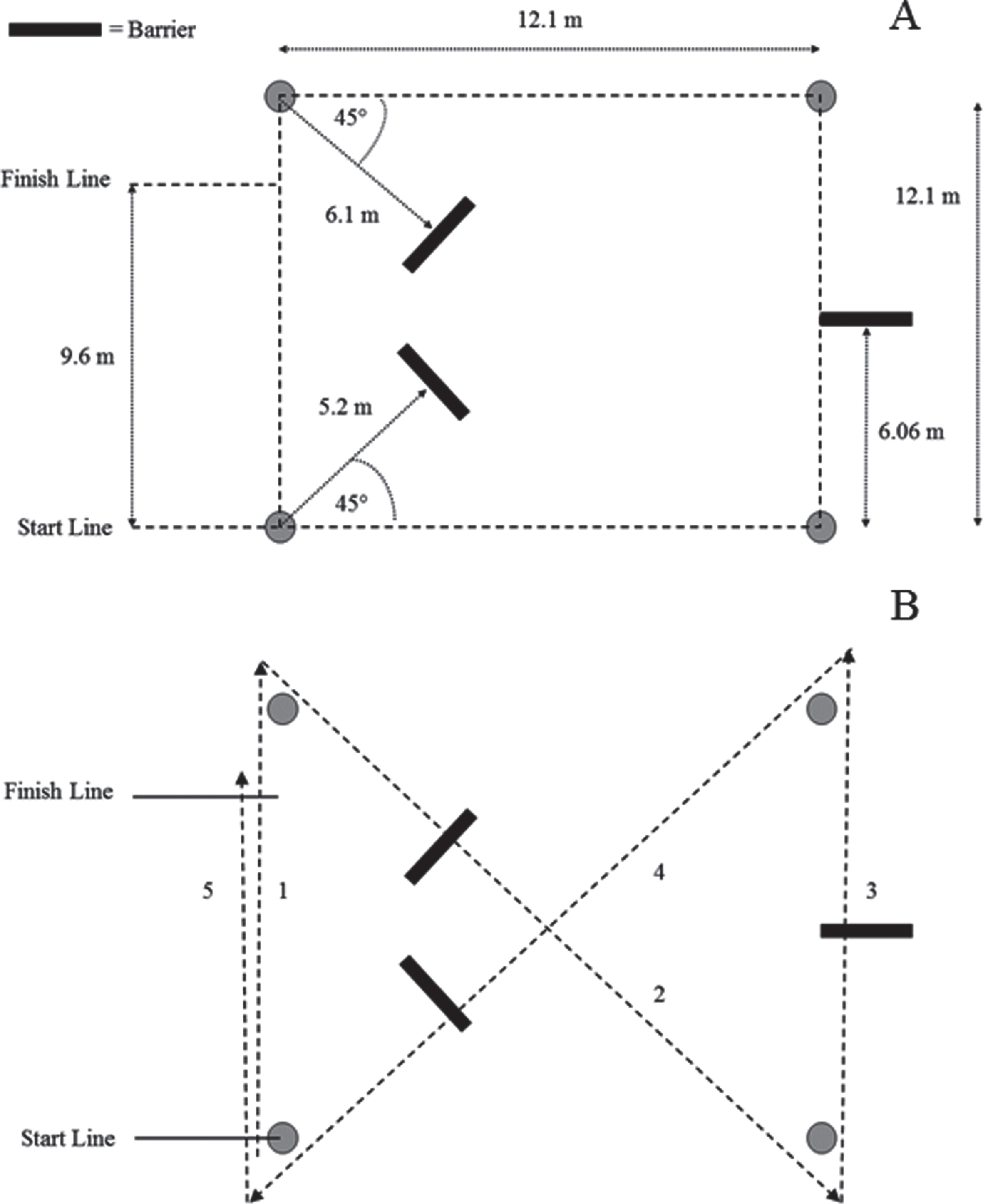
The dimensions for the 75PR in meters (m; A) and the running direction (numbered in order; B).
MSFT: The MSFT also provided a measure of aerobic fitness. Recruits were required to run back and forth between two lines indicated by markers 20 m apart. The running speed was standardized by pre-recorded auditory beeps played from an iPad handheld device (Apple Inc., Cupertino, California) connected via Bluetooth to a portable speaker (ION Block Rocker, Cumberland, Rhode Island). The speaker was located in the centre of the running area. The test was terminated when the recruit was unable to reach the lines twice in a row in accordance with the auditory cues. The MSFT was scored as the total number of completed shuttles.
The WSTB is mandatory for LEAs in California, and recruits must attain a minimum score of 384 to graduate from academy [12, 14]. The procedures for each assessment have been presented by Peace Officer Standards and Training [14], and Lockie et al. [12, 13]. Nonetheless, each test will be described. The WSTB was performed outdoors on specifically designed structures at the LEA training facility. The tests could be completed in any order, except for the 500R which was completed last. Recruits were provided the opportunity for two attempts for each test, with a minimum 120 s rest period between attempts. Time for each test was recorded to the nearest 0.1 s by a staff member with stopwatch for each attempt, and the fastest time was analysed.
99OC: This test was designed to simulate a foot pursuit, and is shown in Fig. 2. Recruits completed the 99-yard (90.53 m) course as quickly as possible, while remaining on the concrete track. During the run, they also needed to step over three 6-inch×6-inch (0.15 m×0.15 m) simulated curbs, and one 34-inch (0.86 m) high obstacle.
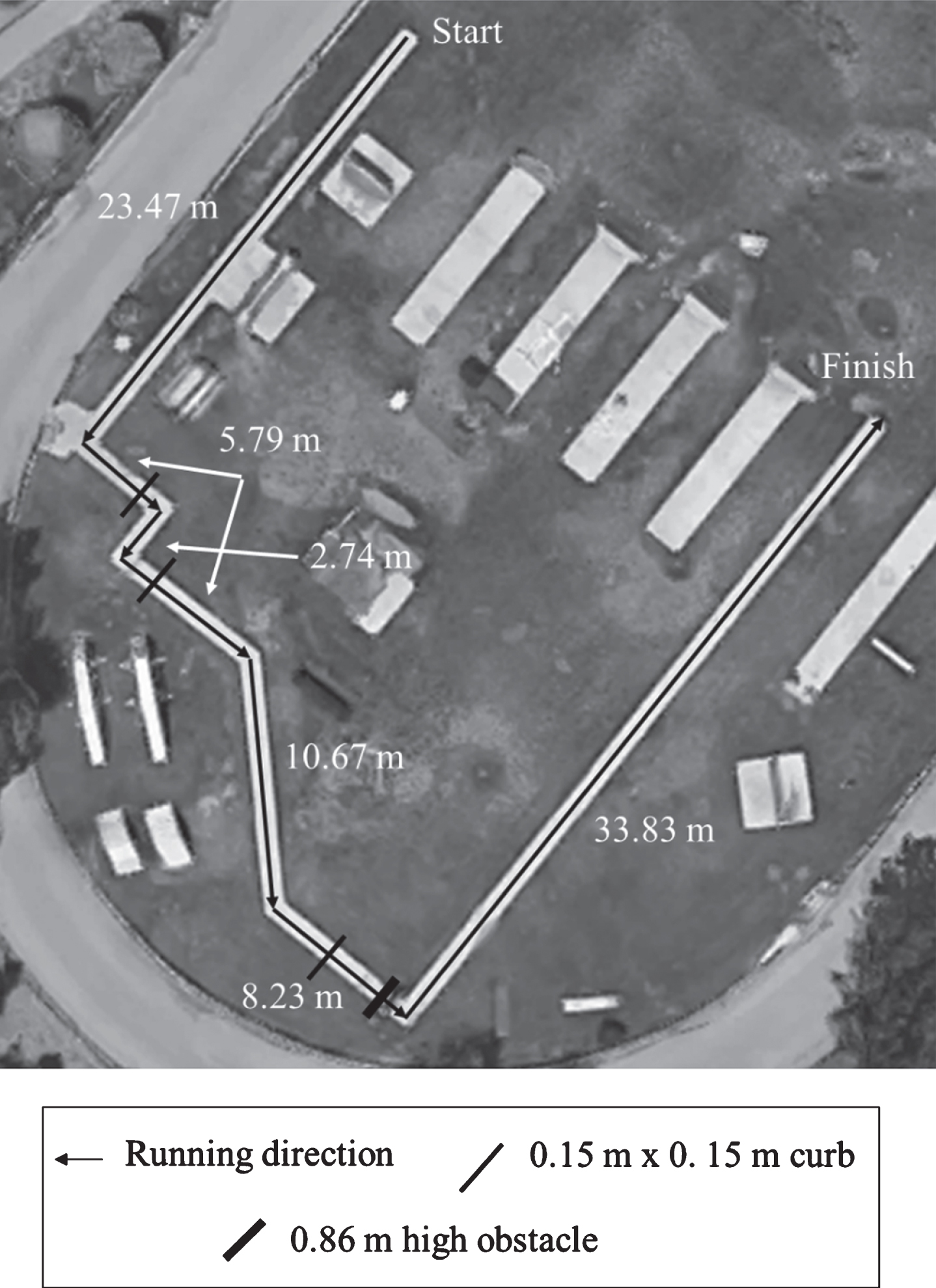
The 99OC.
BD: Recruits were required to drag a 165-pound (74.84 kg) dummy over a 32-feet (9.75 m) distance. Recruits lifted the dummy by wrapping their arms underneath the arms of the dummy to a standing position by extending the hips and knees. Once standing, the recruit informed the tester they were ready and timing was initiated. The recruit dragged the dummy as quickly as possible by walking backwards over the required distance, and timing stopped when the dummy’s feet passed the finish line.
CLF: Recruits ran a 5-yard (4.57 m) distance to the fence, and had to scale the 6-foot (1.83 m) fence with whatever technique they chose (without using the side supports on the fence). If the recruit did not initially climb the fence in their first attempt within a trial, they could continue attempting to climb, but the time continued to run. Once the recruit cleared the fence, they were to land and run a 25-yard (22.86 m) distance as fast as possible to complete the test.
SW: The same instructions and procedures for the CLF were provided for the SW, with the only difference being the type of wall that was climbed (the SW had the same height).
500R: This test was designed to simulate a long-distance foot pursuit. The running distance was marked on the track, and recruits ran the 500-yard (457 m) distance as quickly as possible.
All statistical analyses were computed using the Statistics Package for Social Sciences (Version 26.0; IBM Corporation, New York, USA). Descriptive statistics (mean±standard deviation [SD]) were calculated for each variable, and stem-and-leaf plots confirmed a normal distribution in data [12, 44]. Partial correlations controlling for sex were used to determine relationships between the PT500 (push-ups, sit-ups, mountain climbers, pull-ups, 201 m run, and 2.4 km run) and VPAT + (VJ, MBT, 75PR, and MSFT) with the WSTB (99OC, BD, CLF, SW, and 500R). An alpha level of p < 0.05 was required for significance. The correlation strength was designated as: an r between 0 to ±0.3 was small; ±0.31 to ±0.49, moderate; ±0.5 to ±0.69, large; ±0.7 to ±0.89, very large; and ±0.9 to ±1 near perfect for relationship prediction [45]. Stepwise linear regression analyses (p < 0.05), with sex as a control variable, were conducted for the WSTB (each test within the WSTB acted as a dependent variable) to illustrate whether specific PT500 or VPAT + tests predicted WSTB performance.
Results
Descriptive data for all variables is shown in Table 1, while the correlation data is shown in Table 2. All significant correlations indicated that superior performance in a PT500 or VPAT + related to a faster time for the WSTB task. The 99OC correlated with all tests in the PT500 and VPAT +, with the strength of relationships ranging from small-to-large. The strongest relationship was with the 75PR. The BD only had a significant relationship with the 75PR, with the correlation strength being small. The CLF significantly related to pull-ups and the 201 m run from the PT500 (both small), and all VPAT + tests (small-to-moderate). The SW had significant, small relationships with pull-ups, sit-ups, and the 201 m run from the PT500, and the VJ, 75PR, and MSFT from the VPAT +. The 500R correlated with all tests except for the MBT, with relationship strength ranging from small-to-large (the strongest relationship was with the 2.4 km run).
Descriptive data (mean±SD) for the PT500, VPAT+, and WSTB in law enforcement recruits (N = 308)
Descriptive data (mean±SD) for the PT500, VPAT+, and WSTB in law enforcement recruits (N = 308)
Relationships between the PT500 and VPAT +, with the WSTB in law enforcement recruits (N = 308)
*Significant (p < 0.05) relationship between the two variables.
The stepwise linear regression data is shown in Table 3. The 75PR, 201 m run, push-ups, VJ, and mountain climbers run predicted the 99OC, with an explained variance of 57.0%. The BD was predicted by the 75PR, although the explained variance was small (8.8%). The 75PR, 201 m run, and VJ predicted the CLF (explained variance = 32.9%), while 201 m run and VJ predicted the SW (explained variance = 32.4%). The 2.4 km run, 75PR, VJ, and 201 m run predicted the 500R, with an explained variance of 48.6%.
Stepwise linear regression analysis between the PT500 and VPAT + with the WSTB in law enforcement recruits (N = 308)
This study documented the relationships between an agency-specific fitness testing battery called the PT500, and a novel testing battery called the VPAT + which featured power-focused assessments (MBT, VJ, and 75PR), with a job-specific testing battery called the WSTB in law enforcement recruits. The analysis from this study expands upon the findings from Lockie et al. [12] with the inclusion of muscular power assessments. This study is important, as law enforcement officers have indicated the importance of power to their job tasks [33], so research should be performed to demonstrate whether this is statistically true. Additionally, although the results may be specific to the recruits in the current research, the recruit characteristics and ratio between the sexes was typical of law enforcement populations from the literature [12, 35]. This highlights the general applicability of the results. There were a range of significant relationships between the PT500 and VPAT + with the WSTB. Notably, the 75PR correlated with all WSTB tasks, while pull-ups, the 201 m run, VJ, and MSFT correlated with four out of five WSTB tasks. The 75PR, 201 m run, and VJ were also presented in several predictive relationships for the WSTB. These data provide support for improving anaerobic power and COD speed, supplemental to the recommendations from Lockie et al. [12] to enhance upper-body strength and aerobic fitness, to ultimately benefit WSTB performance.
The 99OC requires a recruit to sprint, change direction, and clear obstacles over a 99-yard (90.53 m) course. The duration of this test (19.08±1.61 s) would indicate it primarily relies on anaerobic energy sources [46]. COD ability would be important for navigating the direction changes required, while upper- and lower-body power could assist with obstacle clearance. Furthermore, even though the 99OC is a shorter distance maximal running test, previous research has shown relationships between short distance sprint tasks (e.g. 300 m run, 75PR) with longer distance aerobic capacity events (e.g. 2.4 km run, MSFT) in law enforcement populations [21, 48]. Lockie et al. [12] found small-to-moderate relationships with the PT500, indicating the range of physical qualities required in the 99OC. This was supported by the data in this study, with the added relationships from all the VPAT + tests. What is worth highlighting is the relationships with the 75PR. As previously stated, the 75PR provides a measure of COD speed [39]. Given the relationships with the 99OC, which was designed to be similar to a foot pursuit, this would suggest that enhancing the characteristics needed for COD speed could influence foot pursuit ability. This could include not just enhancing the strength and power of the recruit, but also how they navigate direction changes (e.g. lowered centre of gravity, correct footwork, deceleration and acceleration capabilities) [39, 49–51]. While it is important to note that in the field, numerous other factors will affect whether a LEO completes a foot pursuit (e.g. the behaviour of the offender, the environment) [52], recruits could still benefit from specific coaching in COD speed. This could at least ensure recruits display effective COD technique if they are required to perform a pursuit when on-duty.
Lockie et al. [12] found that the BD did not relate to any test from the PT500. That was also the case in this study. However, it was thought that the VJ would relate to the BD, as this has been found previously by Moreno et al. [16] in law enforcement recruits. Instead, the BD had only one significant relationship, which was with the 75PR. The duration of both tasks would stress an individual’s anaerobic capacity [46], which provides some evidence as to why the two tests may relate. Nonetheless, the strength of the correlation (r = 0.11) and predictive relationship (r2 = 0.088) were both relatively small, which suggests other factors may be more important for BD performance. A recent study by Lockie et al. [15] investigated the relationships between the BD and strength measured by a one-repetition maximum (1RM) hexagonal bar deadlift (absolute, relative, and peak power measured by a linear position transducer) in college-aged men and women. When controlling for sex, Lockie et al. [15] found that a greater 1RM load (r = –0.666), relative 1RM load (r = –0.619), and peak power (r = –0.477) all related to a faster BD. Clearly, more research is required on the effects of strength on policing tasks, despite the challenges that are associated with measuring this quality in law enforcement populations. Although Lockie et al. [15] used a hexagonal bar deadlift, a leg/back chain dynamometer has been used in previous law enforcement research [8, 53], and this method is quick to complete and requires minimal skill. Additionally, Dawes et al. [8] found that greater force produced on a leg/back chain dynamometer correlated with faster performance time on an occupational-specific physical ability test (r = –0.14) in LEOs. Thus, in lieu of a dynamic exercise such as a deadlift, the leg/back chain dynamometer could be a practical method for measuring strength in law enforcement populations.
The CLF and SW provide a measure of how well a recruit can scale an obstacle, such as that they might encounter in an urban environment [12]. Lockie et al. [12] found that more pull-up and sit-repetitions, and a faster 2.4 km run time, related to better performance in the CLF. Additionally, pull-ups and push-ups predicted performance in this task [12]. In the current study, only pull-ups and the 201 m run from the PT500 correlated with the CLF. However, better performance in all VPAT + tests related to a faster CLF. The 201 m run, 75PR, and VJ also predicted CLF performance. It should be noted that about the actual fence climb in the CLF, there is a 4.57 m run to the fence, and a 22.86 m run away from the fence. This highlights why the 201 m run and 75PR would relate to the CLF. However, although the correlations were small, the relationships with pull-ups, the MBT, and VJ underscore some contribution from upper-body strength, and upper- and lower-body power. Strength and power are considered important qualities for climbing athletes [54], and it could be expected that these qualities would also be important for a LEO if they did need to clear a fence. Although the strength of relationships suggest other factors not analysed in this study may contribute to performance of the CLF (e.g. climbing technique) [55], the new data from this study indicate that in addition to upper-body strength [12], and upper- and lower-body power could be important for CLF performance. The implications for these findings is that academy training staff should incorporate exercises within their physical training programs to specifically develop upper- and lower-body power in recruits.
With regards to the SW, Lockie et al. [12] found significant relationships with mountain climbers, pull-ups, and the 2.4 km run, and a predictive relationship with pull-ups. In this study, there were significant correlations between the SW and sit-ups, pull-ups, the 201 m run, VJ, 75PR, and MSFT. The predictive relationship included the 201 m run and VJ. As for the CLF, the ∼28 m running distance in the SW underlines why the running tests from the PT500 and VPAT + would relate to this task. Additionally, as the abdominal musculature is active during climbing tasks [56, 57], this provides some verification as to why sit-ups correlated with the SW. Notably, the potential value of lower-body power as measured by the VJ for occupational performance was also shown in this study, which supports the findings from Dawes et al. [8]. Nonetheless, and as for the CLF, the strength of the correlations and predictive relationships suggests other qualities not measured in this study, such as climbing technique, will influence SW performance. Although more research is required, it can be surmised that in addition to developing upper-body strength, upper- and lower-body power, and anaerobic capacity, law enforcement recruits should be taught appropriate climbing techniques for navigating tasks like the CLF and SW.
Lockie et al. [12] found that the 500R related to all tests in the PT500, and was predicted by the 2.4 km run and pull-ups. In this study, the 500R correlated with all PT500 and VPAT + tests, and was predicted by the 2.4 km run, 75PR, VJ, and 201 m. The range of relationships shown in this study, supplemental to Lockie et al. [12], provide further evidence as to the value of general overall fitness for law enforcement recruits [21] and officers [8]. It is also not unexpected that the 500R would be predicted by other running tasks such as the 2.4 km run, 75PR, and 201 m run. Relationships between different running tests over a variety of distances has been shown in previous law enforcement research [21, 48]. In addition to this, the VJ has been related to short distance sprint performance in Special Weapons and Tactics officers [36], highlighting why there would be the predictive relationship as shown in this study. These results suggest that those recruits that have generally better aerobic and anaerobic capacity (inclusive of lower-body power), in addition to muscular endurance, should be faster in a task such as the 500R. Academy training should attempt to develop these fitness qualities in their recruits during academy.
There are some study limitations that should be noted. Multiple LEA staff were involved with data collection, which could affect the results even though all staff were required to follow established protocols by the agency [12–14, 35]. Environmental and testing conditions may have varied from when recruits were tested during each class, even though the times for testing in the PT500, VPAT +, and WSTB are relatively consistent (i.e. between 5:00am–12:00pm). As previously acknowledged, no maximal strength tests were included in the PT500 or VPAT +. Future research could investigate strength tests such as the hexagonal bar deadlift [15] or leg/back chain dynamometer [8, 53] to calculate any relationships with job-specific performance in law enforcement recruits. Lastly, the WSTB is only mandatory in the state of California in the USA [12–14]. Other states and countries may use different job-specific testing protocols, and these should be investigated specifically for each agency, state, or country [12]. Nonetheless, any well designed occupational assessment should incorporate tasks that are relevant to the job. This should include running, obstacle clearance, and dragging tasks, which provides great applicability of the results from the current study.
Conclusion
Specific relationships between the PT500 and novel VPAT + with job-specific performance measured by the WSTB were identified. Muscular endurance, and anaerobic and aerobic capacity could influence running tasks such as the 99OC and 500R. Pertinent findings included lower-body power, as measured by the VJ, being related to both the 99OC and 500R, and COD speed, as measured by the 75PR, being an important component of the 99OC. Specific lower-body power and COD training could be incorporated into academy for recruits to enhance the physical qualities important for a task such as a foot pursuit. The BD only related to the 75PR in this research. Although both stress an individual’s anaerobic capacity, it is likely that other qualities not measured in this study, such as lower-body strength, could contribute more to the BD. Future research should investigate relationships between lower-body strength and the BD in law enforcement recruits. Upper-body and abdominal strength, in addition to upper- and lower-body power, may influence climbing tasks such as the CLF and SW. The strength of the relationships, however, suggested that factors such as climbing technique could be an influencing factor in the CLF and SW. Nonetheless, the development of upper- and lower-body power and COD speed, in addition to the more traditional qualities of muscular endurance and aerobic capacity, could aid in improving the job-specific task performance of law enforcement recruits.
Footnotes
Acknowledgments
The authors would like to thank the training instructors for facilitating this research, and the California State University, Fullerton tactical research team for collating the data.
Conflict of interest
This study received no external financial assistance. None of the authors have any conflict of interest.