



Abstract
BACKGROUND:
Many employers are turning to training programs to help them cope or flourish in life. Many programs on the market have not been validated.
OBJECTIVE:
The objective was to evaluate the effect building awareness and skill development can have on sustaining high resilience within a group of employees.
METHODS:
524 participants completed the 44 itemed Q-Life assessment. A CFA model was conducted to determine whether the Q-Life score, adequately describes the data. 116 employees signed up to the Q-Life experience with 64 completing all requirements.
RESULTS:
The RMSEA index was less than 0.08, RMSEA = 0.07, 90%CI = [0.07, 0.07], which is indicative of a good model fit. The mean of score for resilience on the first test (M = 249.91) was significantly lower than the mean of post-test (M = 264.91).
CONCLUSIONS:
The results indicated that the model demonstrated acceptable fit to the data and can be used as an assessment tool for the Q-Life. The Q-Life experience showed significant improvement in resilience.
Introduction
There continues to be a growing number of employees in the workplace at risk for mental and/or physical illness [1]. Some negative impacts of increased health issues are a loss of productivity, increase in employee benefit and health costs, and a premature loss of talent [2]. Chrysalis Performance Inc. research shows that stress in a business contributes to at least 60%of workplace accidents [3]. In the United States, the findings of a 2004 study conducted by the National Institute for Occupational Safety and Health found that the number of lost work days for workers challenged by anxiety, stress and neurotic disorders is four times greater (25 days) than the number of workdays lost for all other non-fatal injuries or illnesses (an average of six days) [4].
Setbacks in workplace is inevitable, and progress is expected despite these setbacks. Employees may not feel comfortable expressing their stress, thus internalizing it, which can have adverse health effects, impacting their well-being and slowing their productivity. Employees who feel that their employer demonstrates care and concern for their personal health and wellbeing are four times more likely to stay [5]. Business leaders who are good role models and understand that employee resilience training is a competitive advantage will reap the rewards.
A lack of resilience is significantly related to hopelessness, loneliness, life-threatening behaviors, and connectedness [6]. Given that stress remains the number one cause of absence from work, and mental health conditions are the most widespread cause of long-term absence in the workplace [6], addressing this thoughtfully is now a critical priority [7].
Building resilience requires an understanding of the core mental and physical factors that enable a person to stay resilient and achieve their life’s purpose [8]. While some people seem to come by resilience naturally, the behaviors that contribute to it can also be learned [9]. The process of developing resilience is dynamic and fluid. As people become more self-aware, they are more likely to take a problem-solving approach towards life rather than dwelling on setbacks [10].
Although everyone must deal with challenges and transitions in life, some individuals are much more competent than others. Individuals who sustain normal development despite long-term stress, are frequently labelled resilient [10]. The quality of resilience is attributed to individuals who, in the face of overwhelming adversity, can adapt and restore balance to their life and avoid the potentially negative effects of stress [11, 12].
Advocates of creating a positive environment suggest that organisations that build or develop resilience in their employees will be more adaptive and successful over the time [13]. Lengnick-Hall et al. concluded that the organisation itself becomes resilient and gains a competitive advantage with resilient employees [11]. A meta-analysis of 14 studies showed that resilience training can indeed improve the levels of resilience and have a positive impact on subjective well-being, self-confidence, and performance of employees [14]. The Q-Life reviewed the authors recommendations when developing the curriculum and assessment tool such as using more contextually relevant measure and other factors as outlined in table 10 of the paper.
The purpose of this study was to examine the effects of creating awareness and increasing personal resilience through a valid targeted assessment along with skill development. Resilience is defined as sustaining ones physical and mental health most times of the day, week and year through knowing one’s purpose, having a vision, living one’s values, and practising daily resilience skills when needed. It is hypothesised that the awareness created with the assessment and the skill development would show an improvement in resilience amongst a cohort of employees.
Methods
This project was determined to be a program evaluation thus exempt from the research ethics board per Tri-Council Policy Statement (TCPS2) governing research ethics in Canada article 2.5.
“Quality assurance and quality improvement studies, program evaluation activities, and performance reviews, or testing within normal educational requirements when used exclusively for assessment, management or improvement purposes, do not constitute research for the purposes of this Policy, and do not fall within the scope of REB review.”
All procedures performed in studies involving human participants were in accordance with the ethical standards of the institutional and/or national research committee and with the 1964 Helsinki declaration and its later amendments or comparable ethical standards.
Participants were recruited through human resource websites and promotional materials that were emailed to participants for the completion of a 67 item self-report assessment. The 5-point Likert type scale ranging from 1 to 5 and loaded onto 12 subscales was scored. 524 participants completed the Q-Life assessment. Participants were all full-time employees.
Initially 116 employees signed up to the Q-Life experience with 64 completing both assessments and course work (59 females and 5 males). Employees were recruited via a description of the experience offering and potential benefits on the university website. On the site, the experience was advertised as a program to assess and develop the skill of resilience, which would help address the feelings of stress and being overwhelmed. Participants were informed that the assessment was on-line and that the sessions would occur live; thus, access to a computer and commitment to all live sessions was necessary. The name of the course leader and email was provided.
Q-Life assessment example
Q-Life assessment example
Employees who desired to participate sent an email to the human resource representative. An invitation was sent to the employees individually to complete the Q-Life assessment on-line via a link and the participant was provided the location for the first session as well as the time and location of subsequent sessions. Included in the message was the number of sessions, length of sessions, attendance commitment, participation level, homework level and learning objectives.
The Q-Life assessment was a 67-item assessment scale with 12 factors that addresses the foundational component and skills related to resilience taught in the experience and are outlined below. The items were chosen based on consultation with subject matter experts, current literature in resilience with the needs of employees accounted for. The Q-Life assessment was reduced to 44 items and 7 subscales based on the model fit through a primary confirmatory analysis.
Factor 1: Self-esteem [15, 16]. Factor 3: Hope [13]. Factor 6: Family Unity [15, 16]. Factor 7: Social Network [17]. Factor 9: Hardiness [18]. Factor 10: Resourcefulness [19]. Factor 11: Well-being [20].
A 5-point Likert scale was used for each item (Strongly disagree, disagree, neutral, agree, strongly agree).
The assessment was completed within a week of starting and within a week of completion of the Q-Life program. A report was developed for the participant based on the overall Q-Life score with specific feedback. Participants were asked to reflect if they felt it represented their current level of resiliency and was addressed in the on the second session. Participants took part in a round table discussion if they felt results matched their perceived level of resilience.
The program consisted of eight 55-minute live sessions taught over 8 weeks (1 day per week). The program consisted of the following learnings:
Day 1 – on-boarding, what is resilience, mindfulness, Day 2 – vision, purpose, values, Day 3 – physical activity, sleep, nutrition, Day 4 – acceptance, logging, journaling, Day 5 – mindfulness, gratitude and self-compassion, Day 6 – problem solving, optimism, social support, Day 7 – blocking time, red flags, self-awareness, Day 8 – family unity, putting it all together, go forward plan. A comprehensive manual called the “companion” was developed with educational material on each topic as well as skill development worksheets. Each week a section of the companion was designated to do outside of the live session. The average length of homework was estimated at one hour. Participants received a weekly email update and reminders to encourage their on-going participation.
Upon completion of the live session work the Q-Life assessment was resent and asked to be completed within one week of receiving it.
Prior to the final assessment, those items that had a negative impact . . . were eliminated from the Q-Life assessment.
A secondary CFA model was conducted to determine whether the latent variables, V1, V3, V6, V7, V9, V10, V11, and RES, adequately described the data. Maximum likelihood estimation was performed to determine the standard errors for the parameter estimates.
The reliability of the analysis was tested based on the sample size used to construct the model. Next, the results were evaluated using the Chi-square goodness of fit test and fit indices.
Along with the Chi-square goodness of fit test, the following fit indices were used to assess the model fit: root mean square error of approximation (RMSEA), comparative fit index (CFI), Tucker-Lewis index (TLI) and standardized root mean square residual (SRMR).
A two-tailed paired samples t-test was conducted to examine whether the difference between PRE and POST Q-Life assessments was significantly different from zero.
Factor analysis requires a large sample size to construct repeatable and reliable factors. A common rule of thumb for determining sufficient sample size is 300 observations [21].
The results of the CFA model are presented in Table 2. The correlations between the latent variables are presented in Table 3. The node diagram is shown in Fig. 1.
Unstandardized loadings (Standard Errors), standardized loadings, and significance levels for each parameter in the CFA model (N = 524)
Unstandardized loadings (Standard Errors), standardized loadings, and significance levels for each parameter in the CFA model (N = 524)
Note. χ2(853) = 2945.57, p < 0.001; –indicates the statistic was not calculated due to parameter constraint.
Correlation table for the latent variables
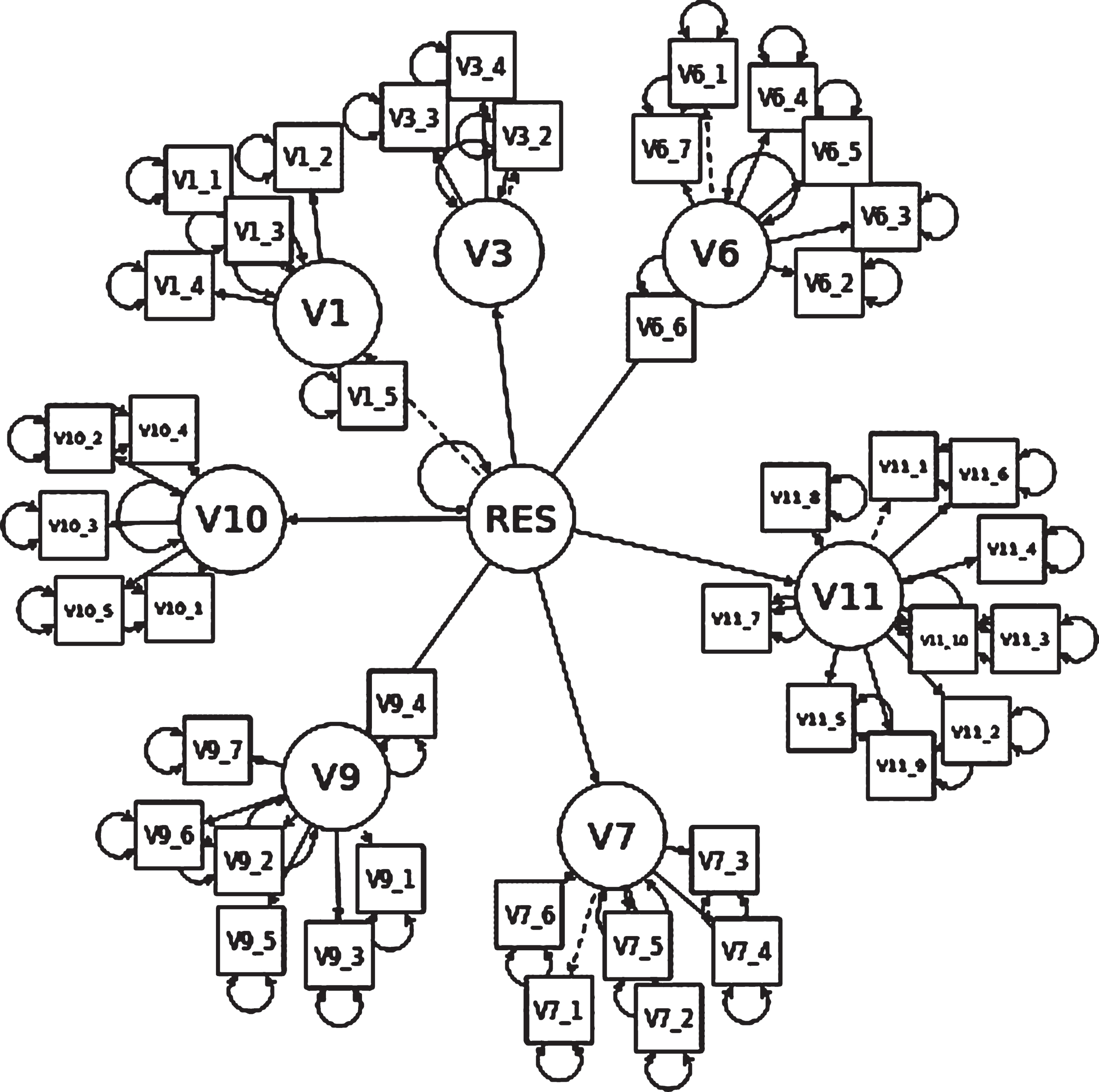
Node diagram for the CFA model.
It is standard practice for CFA to include the Chi-square test. However, this test is sensitive to sample size, which causes the test to almost always reject the null hypothesis and indicate a poor model fit when the sample size is large. The results of the Chi-square goodness of fit test were significant, χ2(853) =2945.57, p < 0.001, suggesting that the model did not adequately fit the data.
The RMSEA index was less than 0.08, RMSEA =0.07, 90%CI = [0.07, 0.07], which is indicative of a good model fit. All fit indices are presented in Table 4.
Fit indices for the CFA model
Note. RMSEA 90%CI = [0.07, 0.07]; –indicates that the statistic could not be calculated.
The result of the two-tailed paired are presented in Table 5.
Two-tailed paired samples t-test for the difference between PRE and POST
Note. Degrees of freedom for the t-statistic = 64. d represents Cohen’s d.
The Q-Life experience showed significant improvement in resilience. This is an important finding as resilience can be associated with lower levels of perceived stress, higher job satisfaction and fewer stress related symptoms [22]. Higher resilience is related to higher levels of worker productivity, fewer absences from work and an employee is less likely to quit [22].
The assessment was used to develop awareness and determine the improvement in overall resilience following participation in the Q-Life program. There is a disconnect between the assessment tools used, the way the researchers defined resilience and the intervention [23]. When choosing an instrument, or developing a new instrument, for a study, a researcher is expected to consider the relevance of the instrument to particular research questions as well as the quality of the instrument.
This finding is consistent with others such as Mealer et al., which had a starting mean resilience score of 71 before the intervention and saw a significant increase to 78 after the intervention [24]. Sood et al. performed a study with a group of physicians and showed that resilience scores after an 8-week program increased from 69.6 to 79.4 after the intervention [25]. Rose et al. studied volunteer graduate students using a 6 week intervention with 40 min self-guided, computer based virtual resilience training and homework with weekly emails and showed improved amounts and control over stress as compared to a control group [26]. The resilience training group reported significantly less stress, more perceived control over stress, and rated resilience training as significantly more useful than the control group. Vanhove et al. did an in-depth meta-analytical review of resilience building programs effectiveness in workplaces [27]. 37 studies were used to summarize the effectiveness of resilience building programs implemented in organizational context. The findings showed that resilience building programs have a statistically significant effect across health and performance criteria.
Focusing on increasing an employee’s well-being appears to be a positive approach to building employee resilience. The well-being component of resilience can play a role in the ever-important health and safety focus in workforce legislation [28]. Physical fitness increases concentrations of norepinephrine, a chemical that can help the brains response to stress. Hydration can play an integral role on mood and cognitive functions such as concertation and, alertness [29]. Lastly those that get 8 hours of sleep per night have a decreased risk of burnout, mood disorders, more likely to be optimistic and high life satisfaction [30].
Only responses of those employees that fully participated in the Q-Life experience were used in this study as studies have shown a relationship between time on task and improvements in resilience [31].
A future consideration for the Q-Life experience is to add in a resilience trajectory component. Resilience is a dynamic process that is fluid and can fluctuate from low to high resilience [18]. The question remains whether the post-intervention improvement is sustainable and also if this new or renewed skills are applied when trauma occurs. Lieb et al. suggested that intervention studies should include not only a post-test but a long-term follow-up assessment. Their recommendation is follow-up assessment 6 months and 12 months post-learning. The authors do point out:
“We are aware that these suggestions impose considerable additional burden on intervention studies. We nevertheless believe that resilience training must improve that it enhances an individuals’ chances to stay mentally healthy in the face of adversity” [23].
A limitation of this project is that participants in this experience were self-selected respondents which limits the generalization of the results. Any investigation that lacks a control group risks inferring causality when the observed change is due to some other influence.
Another limitation is the low male participation. Future work will need to address the recruitment of males as females appear more willing to participate with current recruitment strategies.
The Q-Life experience shows that employees can improve their resilience with a relatively small amount of skill development provided on-site.
Footnotes
Acknowledgments
The author would like to thank the subjects for the dedication to this program.
Conflict of interest
None to report.