



Abstract
BACKGROUND:
Talents are the basis of all development and comprehensive strength of a country. As college students who are about to contact the society, their mental health and social adaptability are the most critical factors for their entry into society.
OBJECTIVE:
Therefore, this study explores the correlation of exercise style to mental health and social adaptability of college students.
METHODS:
Based on the sample processing of college students in 4 universities in a city, 1,000 students are selected for research on the correlation of exercise style to mental health and social adaptability. In addition, the impacts of college students participating in sports activities on their mental health and social adaptability are analyzed.
RESULTS:
When the duration of a single sports activity is 30–60 min, the mental health of students reaches optimal. On the contrary, when the duration of a single sports activity exceeds 90 min, the mental health of students is low. This indicates that the more students participate in sports activities, the stronger the social adaptability is. When the intensity of sports activities for students is moderate, the average scores of interpersonal communication ability of students are the highest. When the duration of a single sports activity is 60–90 min, the average scores of living adaptability of students are the highest. If students keep the appropriate duration and intensity of sports activities, their social adaptability will be improved notably.
CONCLUSION:
The social adaptability of students is related to the number of times they participate in sports activities, the duration of a single sports activity, and the intensity of sports activities. However, while exercising, students should plan the duration of sports activities to avoid excessively prolonged exercise time. In addition, students should beware their exercise intensity of sports activities. The optimal choice of exercise intensity is moderate or slightly tired.
Introduction
With the improvement of living quality of people, China has started to value the cultivation of talents. Talents are the foundations for all developments and the comprehensive strength of a country. Therefore, with China’s rapid development and technology development, the education sector also proposes higher requirements for talent cultivation [1–3]. As college students who are about to connect with society, their mental health and social adaptability are the most critical factors for entering society [4, 5]. How students balance their future work life and personal life, how to deal with a series of pressures in the workplace, society, and family, how to handle the interpersonal relationships in the workplace, and how to improve the competitiveness of students themselves are the problems to be solved for all college students [6]. Only by having a good mental health state and social adaptability can college students overcome various setbacks they face in different environments, such as school, family, and the workplace, continue to advance in these setbacks, and calmly treat the possible difficulties in the future [7, 8]. In 2002, to promote the comprehensive development of students, China pointed out that physical education is the key to improving the mental health and social adaptability of students. The most capable way to conduct large-scale physical education for students is sports classes and extracurricular activities [9]. College students are in a stable and consistent education environment. Universities and colleges are often referred to as minor societies. During their university ages, students are in a stage of strong plasticity. Therefore, at this time, education on mental health and social adaptability for students is critical [10, 11]. Therefore, this study explores the impacts of college physical education and sports styles on the mental health and social adaptability of college students, thereby obtaining more efficient education methods for college students.
Various countries have shown a high degree of attention to the social adaptability of college students. Many scholars have also studied how to improve the social adaptability of college students. Akelaitis et al. researched the relationship between the physical education of high schools and the social ability of students. The study found that physical education would greatly help improve students’ communication ability, which would also have different degrees of improvement in the cooperation ability, self-confidence, and social adaptability of students [12]. Zerengok et al. studied the benefits and impacts of international students’ participation in leisure activities on social adaptation in a medium-sized city university in Manisa, Turkey. The study found that students’ social adaptability would be improved if the students actively participated in leisure activities; meanwhile, the participation in leisure activities would also bring benefits to students, and students would have requirements and expectations for leisure activities [13]. Kalina et al. analyzed why sports activities help students adapt to the high school training environment and train future professionals so that students could work efficiently in a changing social environment and public production [14]. Jian used the literature and logical analysis methods to analyze the relationship between students’ physical education and social adaptability. Then, from the perspective of teaching and students’ social adaptability, the critical role of physical education in colleges and universities to improve students’ social adaptability was expounded, and specific training measures were put forward [15]. Allen et al. conducted an exploratory factor analysis and parallel analysis based on recognized sociological theory. Through analysis, they found that cultural maintenance and adaptation to a multicultural environment through sports activities are effective and reliable measures for American international students [16]. Based on previous studies, this study explores the correlation of exercise styles to mental health and social adaptability of college students.
This study searches and browses the literature on the correlation of sports activities to students’ mental health and social adaptability, thereby obtaining the research objectives and methods of this study. Based on the sample processing of college students in 4 universities in a city, 1,000 students are selected for research on the correlation of exercise style to mental health and social adaptability. In addition, the impacts of college students participating in sports activities on their mental health and social adaptability are analyzed. Consultations are made with experts from the relevant industry, and a series of communications are made with the administrators and management of the schools selected by the study and the persons in charge of the relevant directions, soliciting a lot of opinions and suggestions about the research of this study from relevant industry personnel. The professional personnel in the relevant industry also provide constructive suggestions for the student questionnaire designed in this study.
Method
Social adaptability of students
For the social adaptability of students, different scholars have different definitions of it or its included contents. The social adaptability of students analyzed in this study is based on their learning adaptability, interpersonal communication ability, and living adaptability [17–19]. Mostly, college students are looking forward to sports activities on the campus when they first enter the university campus. Due to the intense study life in high school, their sports activities have changed to cultural courses such as mathematics and English. What they look forward to is physical education. Physical education allows students to relax appropriately after a long period of intense study. After entering the university campus, various sports elective courses at the university make students look forward to them [20].
Students are free to choose the sports they prefer according to their interests from sports activities available in universities and colleges. Students will be proficient and consolidate what they have learned in physical education by mastering appropriate learning methods and continue to glow in the direction they are interested in or the direction they are good at. In this process, students will accumulate many learning methods and learn the behavioral norms in sports activities, which are essential for students to understand the social norms in the future [21, 22]. In addition, students will encounter different sports activity environments and different substitute teachers. In the process, they will invisibly improve their ability to adapt to strange things [23].
Interpersonal communication ability is the ability to communicate with others. In the process of sports activities, students should cooperate and compete. There may be a consultation with teachers and students, and there may also be criticism from teachers. In the process, the interpersonal communication ability of students will be improved implicitly [24]. Also, participating in sports activities enhances the cooperative consciousness of students and cultivates the team spirit of students, and reduces their academic pressure and the loneliness of students away from their families in the school, which can significantly reduce the psychological pressure of students [25–27]. Therefore, participating in sports activities will enhance students’ physical fitness and reduce their psychological pressure and enhance their social adaptability.
Objects of study
In this study, based on the sample processing of college students in 4 universities in a city, 1,000 students are selected for research on the correlation of exercise style to mental health and social adaptability. In addition, the impacts of college students participating in sports activities on their mental health and social adaptability are analyzed.
Research methods
According to the research objectives and contents of this study, more than 50 pieces of literature with high relevance to this study are searched from significant databases. The research methods and contents in these documents are analyzed and explored to provide theoretical support for this study. In addition, through the research and analysis of the previous literature, the research efficiency of this study is improved.
Before this study, consultations are made with experts from the relevant industry, and a series of communications are made with the administrators and management of the schools selected by the study and the persons in charge of the relevant directions, soliciting a lot of opinions and suggestions about the research of this study from relevant industry personnel. Also, the professional personnel in the relevant industry provides constructive suggestions for the student questionnaire designed in this study, which contributes a lot to this study.
According to the research needs of this study, a large number of pieces of literature are reviewed. Finally, a questionnaire based on the literature review is designed. The questionnaire is divided into two parts. The first part is mainly used to obtain students’ necessary information and participate in sports activities in daily life. The second part is mainly used to obtain the psychological state and the social adaptability of the students. The second part of the questionnaire is compiled regarding the contents of the Psychological Diagnosis for College Students and the Social Adaptability Diagnostic Scale. The second part of the questionnaire refers to the opinions of relevant industry practitioners and experts, making the questionnaire designed in this study completer and more effective.
A total of 1357 questionnaires are distributed, and 1,357 questionnaires are recovered during the research process of this study. The recovery rate of the questionnaire is 100%. Among these questionnaires, 1131 invalid copies are excluded, and 1,000 are randomly selected for this study.
The analysis of the validity of the questionnaire is performed by expert evaluation. A total of 10 experts are invited to evaluate the validity of the questionnaire designed in this study, thereby obtaining the feasibility of the questionnaire designed in this study.
Statistical methods
Statistical methods are used to reflect the survey results of this study. The statistical software used in this study includes SPSS22.0 and Excel 2010. The above software is used to analyze the research data in this study.
Mental health assessment
In the questionnaire designed in this study, 20 questions related to mental health are designed, and the designed score for each question is 1–5. The sum of all the scores in the 20 questions will be the total score, which is then divided by 20 to obtain the final score. A final score of fewer than 2 points indicates an excellent mental health state. A final score of 2–2.99 points represents mild psychological problems. A final score of 3–3.99 points represents moderate psychological problems. A final score of 4–4.99 points indicates serious mental health problems. A final score of 5 points represents very serious mental health problems.
Results
Sample condition and questionnaire validity
The source of the sample is shown in Fig. 1. The research samples in this study are from four universities. The proportion of boys is 54.5%, and the proportion of girls is 45.5%. The proportion of students in each grade in the sample is shown in Fig. 2. As shown in Fig. 2, of the research conducted in this study, the freshman students account for 21.5%of the total sample, the sophomore students account for 25.3%of the total sample, the junior students account for 26.1%of the total sample, and the senior students account for 27.1%of the total sample. The samples of all grades account for the average. The errors of grade factors are eliminated in this study.
The results of the expert evaluation of the questionnaire designed in this study are shown in Table 1. As shown in Table 1, the industry personnel who have a high degree of recognition for the questionnaire designed account for 90%, which shows the rationality of the questionnaire designed in this study, indicating that the questionnaire designed in this study applies to the correlation study of exercise style, mental health, and social adaptability of college students.
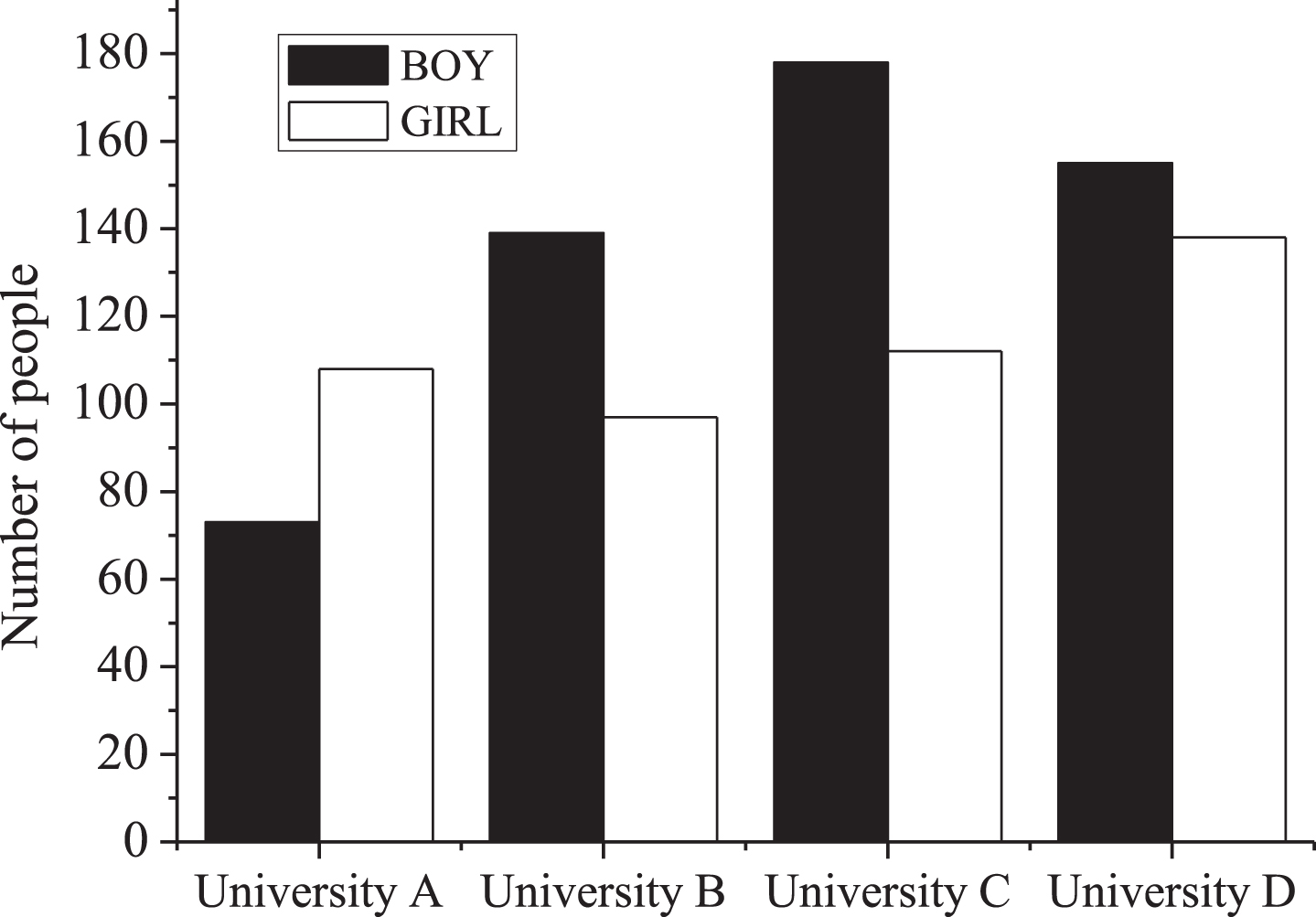
Sample source.
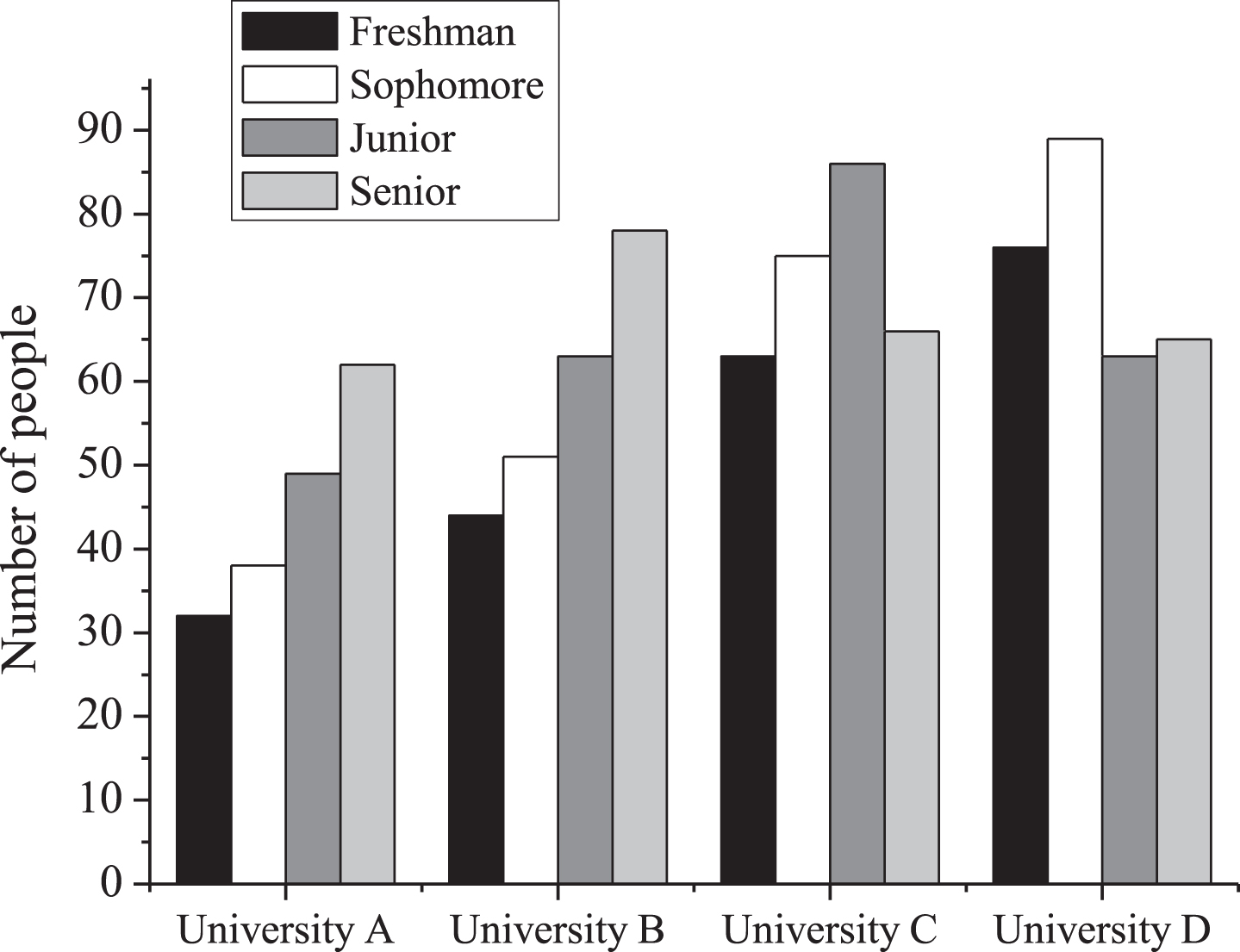
Sample structure.
Expert evaluation
The mental health survey results of the samples analyzed in this study are shown in Fig. 3. As shown in Fig. 3, among the 1,000 students surveyed in this study, most of the students are in good mental health, but those with mental health problems still account for 32.73%of the total sample. Generally, there are no cases of serious psychological problems and very serious psychological problems in the sample. However, there are more boys with mental health problems than girls, and students have more potential mental health problems. Therefore, schools should pay attention to the mental health issues of students.

Survey results of mental health.
According to the social adaptability questionnaire in the designed questionnaire, the total score is 40 points. A score of 35–40 indicates strong social adaptability, a score of 29–34 indicates good social adaptability, a score of 17–28 indicates that students’ social adaptability is average, and a score of 6–16 indicates that the social adaptability of students is insufficient. A score of 5 points or lower indicates that the social adaptability of students is very poor. The survey results of the social adaptability in this study are shown in Fig. 4. As shown in Fig. 4, senior students’ social adaptability is higher than in other grades, and the difference is statistically significant (P < 0.05); meanwhile, boys have slightly higher social adaptability than girls, but the difference is not statistically significant.
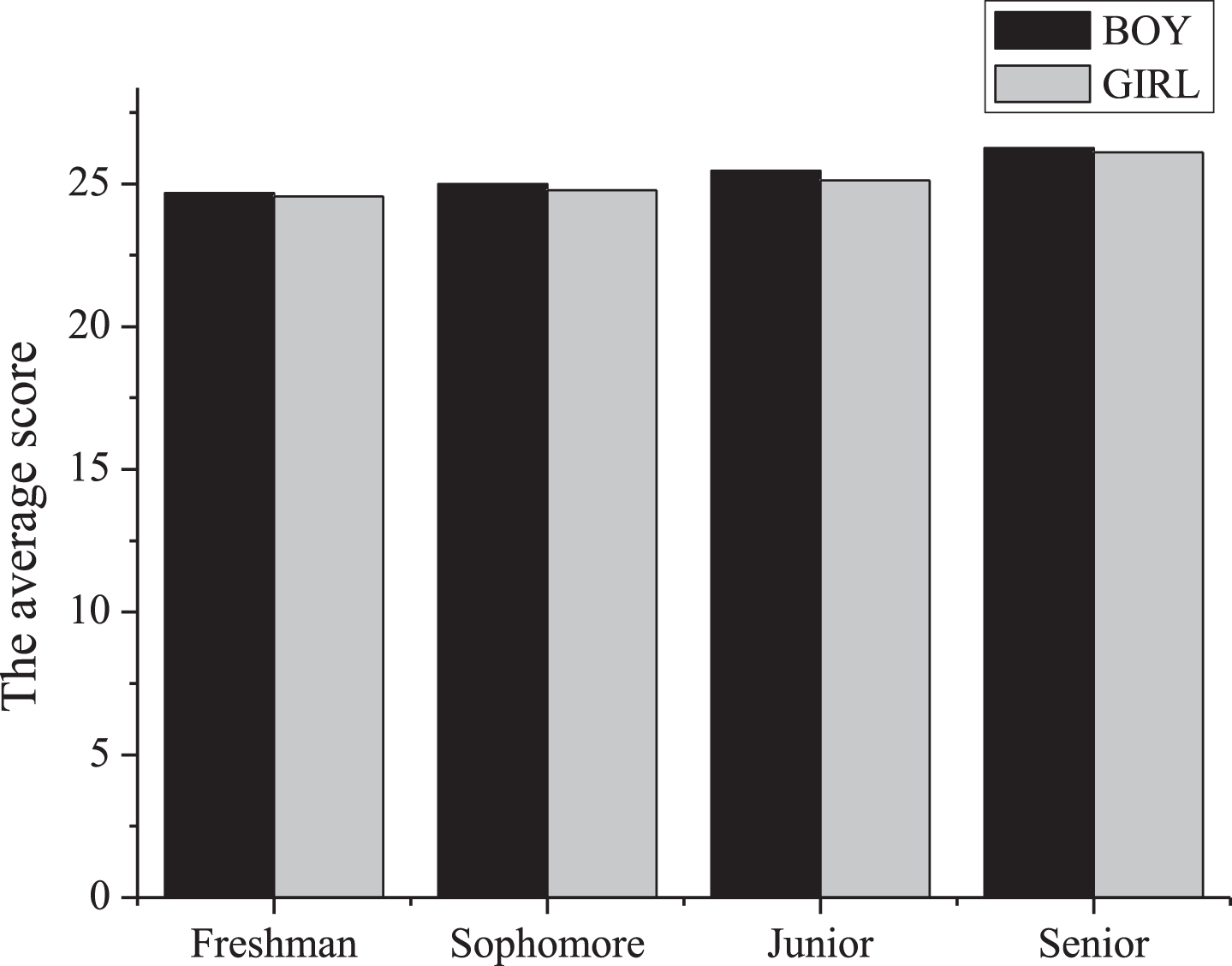
Survey results of social adaptability.
The situation of students participating in sports activities every week is shown in Fig. 5. As shown in Fig. 5, students participating in sports activities once a week account for 14%of the total sample, and students participating in sports activities twice and three times a week account for 35%and 47%. Only 6%of students will participate in sports activities four or more times per week. Students whose duration of a single sports activity exceeds 30 min account for 64%of the total sample. Students whose intensity of sports activities is moderate or above account for 77%. The definition of sports activity in China includes (1) at least three times a week; (2) at least 30 min each activity; (3) the activity intensity is moderate or above. Students in this study shown in Fig. 5 have a better performance in a single activity. Only the duration of a single activity in the exercise duration item is relatively worse.

Participation of students in sports activities (A: Number of sports activities per week; B: Time of each sports activity; C: Intensity of each sports activity).
The relations among the number of students participating in sports activities, the duration of activities, the intensity of exercises, and the mental health score are shown in Table 2. As shown in Table 2, the number of times participating in sports activities, the duration of a single sports activity, and the intensity of a single sports activity are correlated to the mental health of students (P < 0.05), which shows that schools can improve the mental health of students by arranging appropriate duration of sports activities or physical education courses for students. In addition, students should keep the proper duration of a single exercise. When the duration of a single sports activity is 30–60 min, the mental health of students reaches optimal. On the contrary, when the duration of a single sports activity exceeds 90 min, the mental health of students is low. The possible reason is that students with low mental health use exercise to vent, causing students to exercise for a long time, which will make students have psychological or physical discomfort.
Correlation between physical activity and mental health
Correlation between physical activity and mental health
The correlation between students’ participation in sports activities and their social adaptability is shown in Figs. 6–8. Figure 6 shows the correlation between the number of weekly sports activities and social adaptability. Figure 7 shows the correlation between the duration of a single sports activity and social adaptability, and Fig. 8 shows the correlation between the intensity of a single sports activity and social adaptability.

Correlation between the number of weekly sports activities and social adaptability (A: Learning adaptability; B: Interpersonal communication ability; C: Living adaptability).

Correlation between the duration of a single sports activity and social adaptability (A: Learning adaptability; B: Interpersonal communication ability; C: Living adaptability).
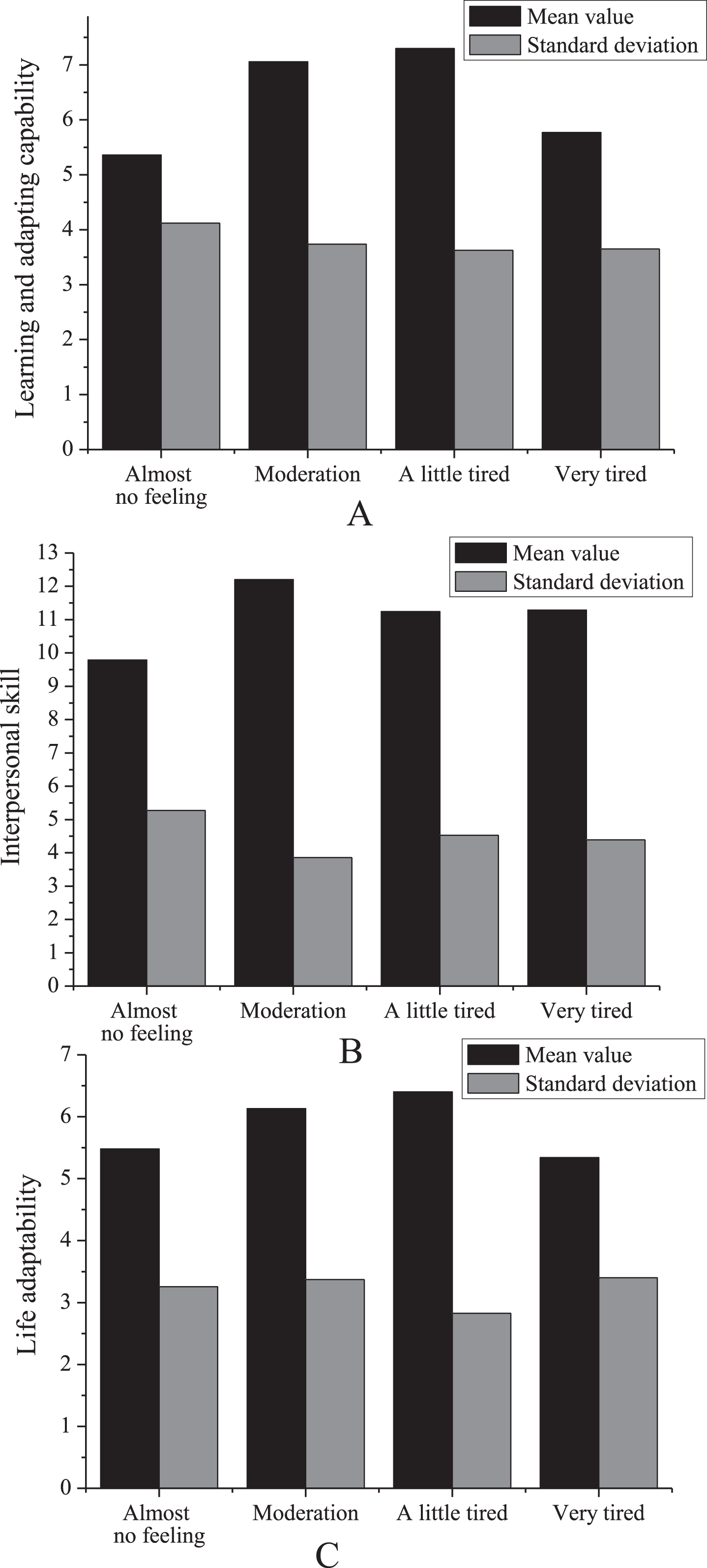
Correlation between the intensity of a single sports activity and social adaptability (A: Learning adaptability; B: Interpersonal communication ability; C: Living adaptability).
As shown in Fig. 6A, the average value of students’ learning adaptability increases with the increase in the number of times students participate in sports activities. When students only participate in sports activities once a week, the average value of their learning adaptability score is 5.01. When participating in four or more sports activities per week, the average learning adaptability score of the students is 7.65, which is significantly increased. A statistical difference test shows that the significance reaches 0.000, which is much less than 0.05. Therefore, there is a significant difference, indicating that the more students participate in sports activities, the stronger their social adaptability is.
As shown in Fig. 6B, the average value of students’ interpersonal communication ability increases with the increase in the number of times students participate in sports activities. When students only participate in sports activities once a week, the average value of their interpersonal communication ability score is 10. When participating in four or more sports activities per week, the students’ average interpersonal communication ability score is 12.4, which is significantly increased. A statistical difference test shows that the significance reaches 0.000, which is much less than 0.05. Therefore, there is a significant difference, indicating that the more students participate in sports activities, the stronger their interpersonal communication ability is.
As shown in Fig. 6C, the average value of students’ living adaptability increases with the increase in the number of times students participate in sports activities. When students only participate in sports activities once a week, the average value of their living adaptability score is 5.44. When participating in four or more sports activities per week, the average living adaptability score of the students is 6.24, which is significantly increased. A statistical difference test shows that the significance reaches 0.135, which is larger than 0.05. Therefore, there is no significant difference. However, data show that the more students participate in sports activities, the stronger their living adaptability is. A possible reason may be the insufficient included research data.
As shown in Fig. 7A, only by maintaining a proper exercise duration can college students improve their learning adaptability. When the duration of a single sports activity is 30–60 min, the average learning adaptability score of students reaches 7.24, which is the highest. On the contrary, when the duration of a single sports activity exceeds 90 min, the average learning adaptability score of students is 5.7, which is the lowest. A statistical difference test shows that the significance reaches 0.05, which indicates a marginal significance. However, it is concluded that students should maintain the proper duration of a single sports activity.
As shown in Fig. 7B, by maintaining a proper exercise duration, college students can improve their interpersonal communication ability. When the duration of a single sports activity is 30–60 min, the average interpersonal communication ability score of students reaches 12.04, which is the highest. On the contrary, when the duration of a single sports activity exceeds 90 min, the average interpersonal communication ability score of students is 10.38, which is the lowest. When a single sports activity is less than 30 min, the average interpersonal communication ability score of students is 10.65. A statistical difference test shows that the significance reaches 0.048, which is much less than 0.05. Therefore, there is a significant difference, indicating that students should maintain a proper exercise duration to improve their interpersonal communication ability.
As shown in Fig. 7C, when the duration of a single sports activity is less than 30 min, the average living adaptability score of students reaches 5.61, which is the lowest. On the contrary, when the duration of a single sports activity is 60–90 min, the average living adaptability score of students is 6.24. A statistical difference test shows that the significance reaches 0.417, which is not significantly different. However, in general, students should keep a proper exercise duration because when the duration of a single sports activity is more than 90 min, the average living adaptability score of students is 5.62, which is only 0.01 more than the lowest value.
As shown in Fig. 8A, when college students participate in sports activities, if the activity intensity is slightly tired, their learning adaptability score is the highest, with an average value of 7.3. If they cannot feel tired after the exercise, their learning adaptability score is the lowest, with an average value of 5.36. This indicates that students should maintain appropriate exercise intensity during sports activities. The intensity must be neither too high nor too low. A statistical difference test shows that the significance reaches 0.001, which has significant differences, indicating that the intensity of sports activity is significantly correlated to college students’ learning adaptability.
As shown in Fig. 8B, when college students participate in sports activities, if the activity intensity is moderate, their average interpersonal communication ability score reaches 12.2, which is the highest. If they cannot feel tired after the exercise, their average interpersonal communication ability score is 9.79, which is the lowest. This indicates that the intensity of sports activity is also vital. However, either the moderate-intensity or the slightly tired intensity is optimal remains unclear. A statistical difference test shows that the significance reaches 0.002, which has significant differences, indicating that the intensity of sports activity is significantly correlated to college students’ interpersonal communication ability.
As shown in Fig. 8C, when college students participate in sports activities, if the activity intensity is slightly tired, their living adaptability score is the highest, with an average value of 6.4. If they feel exhausted after the exercise, their average living adaptability score is 5.34, which is smaller than when students are not tired. A statistical difference test shows that the significance reaches 0.071, which has no significant differences, indicating that the intensity of sports activity is not correlated to the living adaptability of college students.
As elaborated in the above results, students’ social adaptability is related to the number of times they participate in sports activities, the duration of a single sports activity, and the intensity of sports activities. However, while exercising, students should plan the duration of sports activities to avoid excessively prolonged exercise time. In addition, students should beware their exercise intensity of sports activities. The optimal choice of exercise intensity is moderate or feeling slightly tired.
College students are in a stable and consistent education environment. Universities and colleges are often referred to as minor societies. During their university ages, students are in a stage of strong plasticity. Therefore, at this time, education on mental health and social adaptability for students is critical [28, 29].
Sports activities increase blood oxygen content in a short period, make students feel relaxed, and improve students’ psychological stress, thereby helping students quickly pass through the unfamiliar period of college life. Simultaneously, sports activities will accelerate the blood circulation of the human body and stimulate the brain, thereby stimulating people’s responsiveness, memory, and the brain to receive more information [30–32]. Participating in sports activities enhances the cooperative consciousness of students and cultivates the team spirit of students, and reduces their academic pressure and the loneliness of students away from their families in the school, which can significantly reduce the psychological pressure of students [33]. Students are free to choose the sports they prefer according to their interests from sports activities available in universities and colleges. Students will be proficient and consolidate what they have learned in physical education by mastering appropriate learning methods and continue to glow in the direction they are interested in or the direction they are good at. In this process, students will accumulate many learning methods and learn the behavioral norms in sports activities, which are essential for students to understand the social norms in the future [34–36]. The competitive nature of sports activities will also have an exercising effect on the psychological endurance of students. There will be wins and losses; therefore, in this process, students must adjust their mentality and treat each competition seriously, which will improve their pressure resistance ability to some degree [37, 38].
Therefore, this study explores the impacts of college physical education and sports styles on the mental health and social adaptability of college students, thereby obtaining more efficient education methods for college students.
The research results show that most of the 1,000 students surveyed in this study are in good mental health, but those with mental health problems still account for 32.73%of the total sample. Generally, there are no cases of serious psychological problems and very serious psychological problems in the sample. However, there are more boys with mental health problems than girls, and students have more potential mental health problems. Therefore, schools should pay attention to the mental health issues of students. When the duration of a single sports activity is 30–60 min, the mental health of students reaches optimal. On the contrary, when the duration of a single sports activity exceeds 90 min, the mental health of students is low. This is consistent with the results mentioned in Chunju’s research on the impact of height and weight on college students’ functional and quality indicators [39]. This indicates that the more students participate in sports activities, the stronger their social adaptability is. This is consistent with the results mentioned in the research by Milton et al. on the relationship between the health and intelligence of students [40]. When the intensity of sports activities for students is moderate, the average scores of interpersonal communication ability of students are the highest. When the duration of a single sports activity is 60–90 min, the average scores of living adaptability of students are the highest. If students keep the appropriate duration and intensity of sports activities, their social adaptability will be improved notably.
The social adaptability of students is related to the number of times they participate in sports activities, the duration of a single sports activity, and the intensity of sports activities. However, while exercising, students should plan the duration of sports activities to avoid excessively prolonged exercise time. In addition, students should beware their exercise intensity of sports activities. The optimal choice of exercise intensity is moderate or feeling slightly tired.
Conclusion
The research in this study shows that schools should actively cultivate students’ awareness of sports activities to participate in sports activities independently of physical education courses. In addition, schools should provide students with some sports theory courses to prevent students from performing sports incorrectly and causing physical injuries. Although the research in this study has achieved some results, there are still some shortcomings in the research process. Due to some limitations, this study only includes 1,000 students from 4 schools. The sample size of this study is small, resulting in relatively one-sided research results. At present, schools have guided students in sports activities; therefore, the next step will be to guide sports activities in ordinary school students with different physical and psychological states. Also, this study does not conduct a detailed study of gender differences; therefore, gender differences are also one of the subsequent research plans.
Conflict of interest
None to report.