




Abstract
BACKGROUND:
The long-term separation of parents and children as well as the incomplete family structure affect the mental health development of left-behind children and the formation of healthy personality, good interpersonal relationships and positive coping styles in adulthood. At present, there is insufficient empirical investigations on the mental resilience of left-behind children.
OBJECTIVE:
It is aimed to understand the mental health of left-behind children and explore the characteristics of mental resilience, self-esteem and emotional processing bias, as well as social coping styles.
METHODS:
The random sampling method is used to select the left-behind children as the research subject. The general demographic information questionnaire, RSCA (Resilience Scale for Chinese Adolescent), emotional self-rating scale, SES (Self-Esteem Scale), and coping style questionnaire are used for the survey. Also, the experiments on cognitive processing bias effects of self-esteem and emotion are further carried out.
RESULTS:
There are differences in demographic variables in mental resilience, self-esteem level, emotional level, and social coping styles. The low mental resilience group shows a processing bias towards low praise words, while the high mental resilience group shows a processing bias towards high praise words. At a low level of self-esteem, there is an interaction between mental resilience and self-esteem on low praise words. Mental resilience has a significant effect on the cognitive processing bias of emotion. Under the induction of positive emotions, the high mental resilience group responds significantly more slowly to the negative words than the low mental resilience group. Under the induction of negative emotions, the high mental resilience group responds significantly faster to the negative words than the low mental resilience group.
CONCLUSIONS:
Promoting the mental health education of left-behind children can start from enhancing positive emotions, reducing negative emotions, developing high self-esteem, and improving mature coping styles.
Introduction
Since the 1980s, China’s urban and rural population flow restrictions have been broken, and lots of rural surplus labor has flowed into cities. Restricted by the dual structure of urban and rural areas, migrant farmers have many difficulties in terms of socio-economic conditions, children’s education, and welfare. They can only leave their children in the countryside and entrust others to take care of them, resulting in a lot of left-behind children in the countryside [1]. Prolonged parent-child separation and incomplete family structure not only affect the mental health development of left-behind children, but also affect the formation of the sound personality, good interpersonal relationships and positive coping styles in adulthood [2–4]. With the increasing number of left-behind children, the mental health and education of left-behind children have gradually received widespread attention from all walks of life [5]. At present, academia and education carry out many studies on left-behind children from the perspective of problem psychology. Studies suggest that left-behind children have problems in self-cognition, emotions, and learning [6–8]. Their understanding of their parents’ work-out behavior is the mental basis for adopting a positive approach to adapt to the left-behind life [9]. Wang and Zhou believed that the cognitive re-evaluation level of left-behind children is significantly negatively related to negative academic emotions and mental health; it can reduce negative academic emotions and increase psychological well-being by improving the cognitive re-evaluation level of left-behind children [10].
The development level of left-behind children’s mental health, emotional performance, psychological cognition, and adaptation status after their parents leave home will diverge [11–13]. In order to better study the mental health development of left-behind children, their mental resilience is explored. Mental resilience is the potential that everyone has, which refers to the psychological process of individuals in overcoming difficulties and completing active adaptation under adversity [14]. In positive psychology, mental resilience is an important indicator of mental health. Also, its apparent level does not determine the implicit true level of self-esteem and emotions [15–18]. Hence, it is necessary to explore the mental health problems of left-behind children in combination with their mental resilience, self-esteem, emotions and social coping styles.
Most current studies focus on the negative issues of left-behind children, while studies on individual adaptation differences and active responses are few. Therefore, left-behind children are taken as the research subject to explore the effects of mental resilience on self-esteem and emotional processing bias as well as social coping styles. This exploration provides empirical research support for promoting the cultivation of left-behind children’s mental resilience and the development of self-esteem and emotion, which is of great practical significance for formulating mental health care measures for left-behind children and guiding them to face life’s adversities cheerfully.
Method
Research subject
With the cooperation of a county education authority in Weinan city (March 2019-September 2019), the left-behind children who meet the conditions are selected from 3 primary and middle schools through random sampling method. All subjects are 12–17 years old. Their parents are alive and biological. Within one year, both parents or one party work outside the home for more than 6 months.
General demographic information questionnaire
Based on the research purpose and literature review, the researcher designs the general demographic information questionnaire for left-behind children, including basic information such as gender, class, migrant workers, time spent working outside, and education of guardians. The questionnaire is anonymous and self-filling to fully protect the subject’s privacy.
Resilience scale for Chinese adolescent (RSCA)
RSCA is suitable for the measurement of the mental resilience of adolescents in the oriental context [19]. The scale is divided into two factors, personal power and support. Personal power includes three factors: target concentration, emotional control, and positive cognition. Support includes two factors: family support and interpersonal assistance. RSCA has a total of 27 entries, each of which has 5 options, using a 5-point scoring method. The scale ranges from 27 to 135 points. The higher the score is, the better the individual’s mental resilience is.
Emotional self-rating scale
The emotional self-rating scale consists of two sub-scales of positive emotion and negative emotion. Each sub-scale contains 10 emotional descriptors [20]. Subjects are asked to evaluate the intensity of each emotion experienced during a certain period of time. A 5-point scoring method is used in the scale. 1 means no or very slight, and 2 means a little, and 3 means moderate, and 4 means strong, and 5 means very strong.
Self-esteem scale (SES)
SES is used to measure the overall self-esteem of individuals, which is the most widely used self-esteem measurement tool worldwide [21]. There are 10 entries on this scale, with half of the forward and reverse questions. Each entry is a simple statement with 1–4 numbers to choose from. Subjects are asked to evaluate themselves between four levels, with a total score of 10–40 points. The lower the score is, the higher the individual’s self-esteem is.
Social coping style questionnaire
The social coping style questionnaire is a self-assessment questionnaire, which is divided into six sub-scales: solving problems, self-blame, asking for help, fantasy, retreat, and rationalization. Among them, solving problems and asking for help are mature coping styles. Rationalization is a hybrid coping style. Self-blame, fantasy, and retreat are immature coping styles [22]. The scale has a total of 62 entries, each of which has two answers, “yes” and “no”. Subjects who select “yes” get 1 point and “no” get 0 point. The sub-scale factor score is the sum of the sub-scale entry scores divided by the number of sub-scale entries.
Data collection method
The understanding, consent, and support of education authorities are obtained before a formal survey is conducted. According to the standard of the questionnaire issue, a unified guideline is set up to conduct on-site collective testing by class. The questionnaire is distributed by the trained investigators in a unified manner. It is necessary to read out the informed consent, fill out the notes and explain the instructions to ensure that the subjects clearly understand how to answer. Subjects are required to complete the questionnaire independently within the required time. After the investigation and testing, the investigators collect the questionnaires on the spot and check them one by one. If there are any mistakes or omissions, they will return to the subject for verification on the spot.
Quality control
When studying the design of the questionnaire, to ensure the reliability and authenticity of the research results, the researcher needs to select a measurement tool with higher reliability and validity based on much literature, thereby ensuring the comprehensiveness of the questionnaire. A uniform questionnaire is used for all subjects. Both the reliability and validity of the scale reach a high level. Uniform and strict training are conducted for investigators. Before starting the investigation, investigators use a unified guideline to explain the purpose, significance, and precautions of the investigation. They need to inform students that they will fill in anonymously to eliminate their concerns and motivate them to fill in the questionnaire truthfully. All questionnaires are issued in a unified order, which is guaranteed to be completed in one class, and the questionnaires are recovered on the spot. The preliminary check is made on the filling of the questionnaire, and the missing items are filled on the spot. Before the data analysis, the coding and entry of the data are checked for errors, omissions and logical checks. The suspicious questionnaires are eliminated. Data are entered by one person and checked by another person to ensure the quality of data entry. After final verification and quantification, data analysis is performed to ensure the correctness of the results.
Experiment on the effect of mental resilience on self-esteem processing bias
Three types of vocabulary are identified through semi-structured surveys and expert assessments. A total of 60 words are used as color-stimulating words, including 20 high social praise words such as excellence, success, and beauty, 20 neutral words such as the world, electrical appliances, and earth, as well as 20 low social praise words such as dirty, clumsy, and ugly. Programs are written using the E-prime 2.0 experimental software tool. Each word is set to green and red. The background is set to white. The font size is set to 2×2 cm regular script, and each word appears once. The time interval between the two words is 500 ms, and 60 stimuli are randomly arranged. The entire experiment is presented on a laptop. Through semi-structured surveys and expert assessment methods, 36 words are obtained for word meaning testing, including 12 words with high social praise, 12 neutral words, and 12 words with low social praise. Words for the meaning testing do not overlap with words for color testing.
The subjects are selected based on the RSCA and SES scores. They are divided into four groups: low mental resilience and low self-esteem, low mental resilience and high self-esteem, high mental resilience and low self-esteem, as well as high mental resilience and high self-esteem. All subjects have normal or corrected vision, without color weakness or color blindness, and they are tested by the E-prime 2.0 system. First, 12 words are randomly selected for practice stimulation. The subjects sit in front of the computer with their eyes about 60 cm from the screen. The index finger of the right (left) hand is placed on the F(H) key, and the ring finger is placed on the H(F) key. The subjects are informed to ignore word meanings and try to identify the color of stimulus words quickly and accurately. If it is green, the F key needs to be pressed quickly. Practice stimulus is first performed to familiarize the subjects with the experimental rules. Then, the formal test is performed, and the computer automatically records its reaction time. Then, the word meaning testing is performed. The subjects are informed to carefully read the word appearing on the computer and imagine it as the evaluation by others. Next, they need to decide whether to press the space key to see the next word, without setting a time limit. The next word appears after the key is pressed. After all the words are presented, the subjects are asked to freely recall the words presented on the computer and write them on the prepared paper for a time limit of 5 minutes.
Experiment on the effect of mental resilience on emotional processing bias
The cyberba11 game program is used to conduct experiments on the effect of the mental resilience of left-behind children on emotional processing bias. The cyberba11 game program is divided into two parts, social exclusion and social support. It can effectively induce positive and negative emotions in subjects [23]. Three types of words are selected and identified, including a total of 60 words (20 positive emotion words such as happy, travel, and leisure; 20 neutral words such as cars, stairs, and trees; 20 negative emotion words such as punishment, failure, and error). Programs are written using the E-prime 2.0 experimental software tool. The entire experiment is presented on a laptop. The subjects are screened according to the scoring results of RSCA and emotional self-rating scale. They are divided into four groups: low mental resilience and negative emotion group, low mental resilience and positive emotion group, high mental resilience and negative emotion group, and high mental resilience and positive emotion group. Subjects complete the social exclusion and social support of the cyberba11 game program in groups of three. After the game is over, subjects are subjected to color word discrimination experiments using the E-prime 2.0 system. The computer automatically records its reaction time and accuracy as the dependent variables.
Statistical analysis
Excel and SPSS 26.0 statistical software are used for data analysis. Measurement data are expressed as mean±standard deviation (x±s). The t-test is used for the comparison of the means of the two samples. Counting data is expressed in incidence n (%). The x2 test is used for comparison. The test statistic for the analysis of variance uses the F-value test. The differences are statistically significant at P < 0.05.
Results
General demographic information questionnaire for left-behind children
A total of 629 questionnaires are distributed and 562 are recovered, with a recovery rate of 89.35%. 46 invalid questionnaires are excluded. There are 516 valid questionnaires, with an effective rate of 91.81%. The subjects are 12–17 years old, with an average age of 14.45±1.39 years old. There are 337 males and 179 females. The general demographic information questionnaire results of left-behind children are shown in Table 1.
General demographic information questionnaire for left-behind children
General demographic information questionnaire for left-behind children
The differences in mental resilience, self-esteem, emotions, and social coping styles of left-behind children in gender, grade, and other variables are shown in Tables 26. It can be seen that the main effects of gender on support and positive emotions are significant (Fig. 1). The main effects of grade on personal power, self-esteem, and mature coping styles are significant (Fig. 2). There is no interaction between gender and grade. The main effects of migrant workers on personal power and negative emotions are significant (Fig. 3). The main effects of migrant time on support and self-esteem are significant (Fig. 4). The main effect of the guardian education level is not significant.
Differences of mental resilience, self-esteem, emotions, and social coping styles of left-behind children in gender
Differences of mental resilience, self-esteem, emotions, and social coping styles of left-behind children in gender
Note: *:P < 0.05, **:P < 0.01.
Differences of mental resilience, self-esteem, emotions, and social coping styles of left-behind children in grade
Note: *:P < 0.05, **:P < 0.01.
Differences of mental resilience, self-esteem, emotions and social coping styles of left-behind children in migrant workers
Note: **:P < 0.01, ***:P < 0.001.
Differences of mental resilience, self-esteem, emotions, and social coping styles of left-behind children in working time
Note: *:P < 0.05, **:P < 0.01.
Differences of mental resilience, self-esteem, emotions and social coping styles of left-behind children in guardian education
Note: **:P < 0.01.
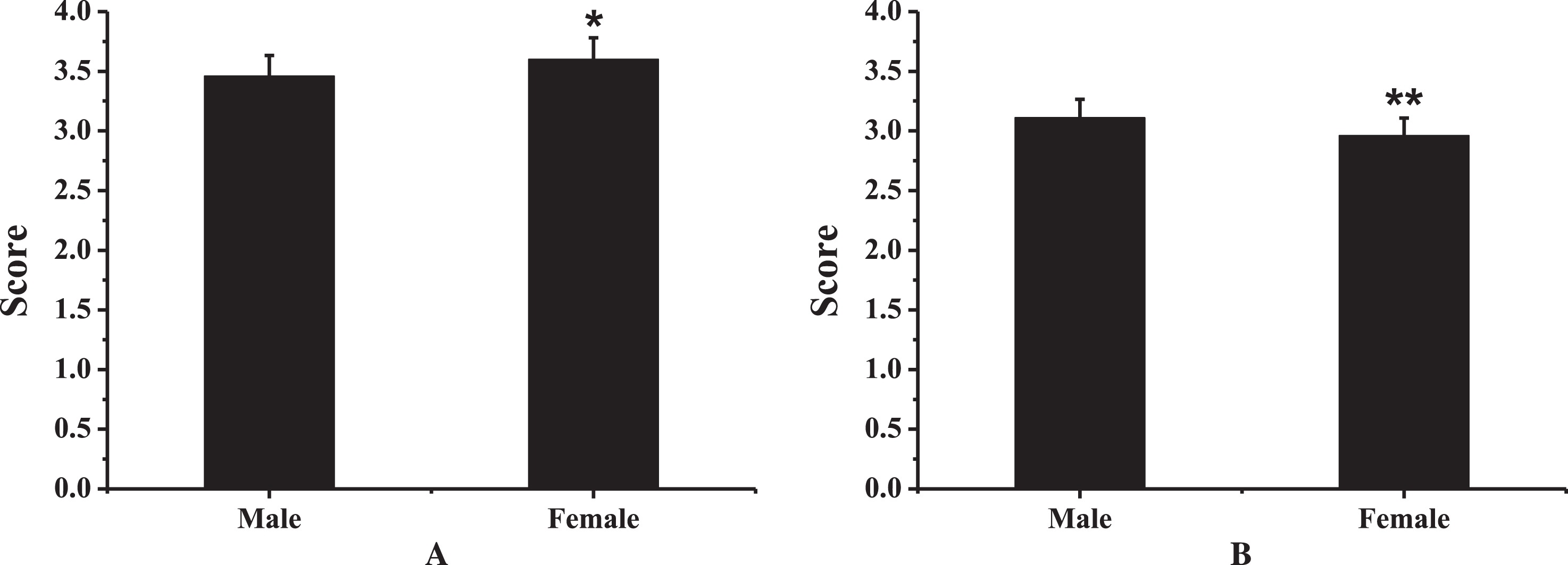
Differences of support and positive emotions of left-behind children in gender (A: support; B: positive emotions; *:P < 0.05, **P < 0.01).

Differences of personal power, self-esteem, and mature coping styles of left-behind children in grade (A: personal power; B: self-esteem; C: mature coping styles; *P < 0.05, **P < 0.01).
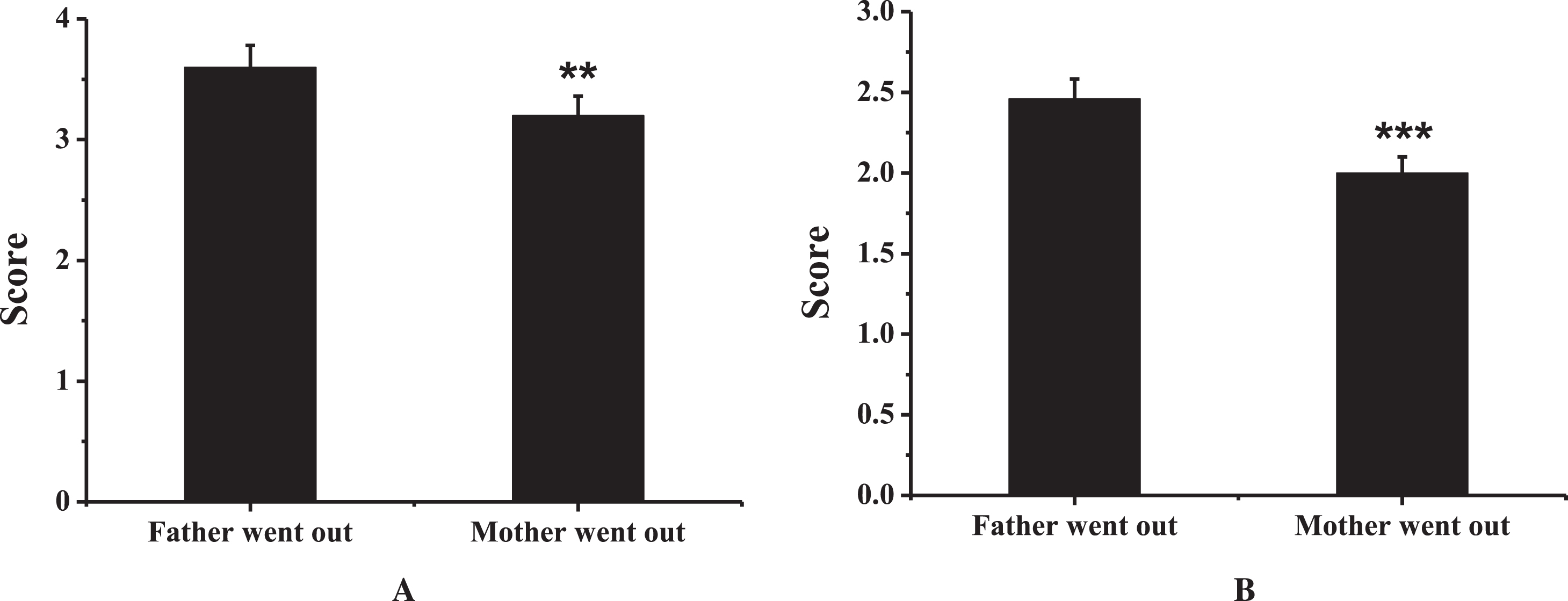
Differences of personal power and negative emotions of left-behind children in migrant workers (A: personal power; B: negative emotions; **P < 0.01, ***P < 0.001).
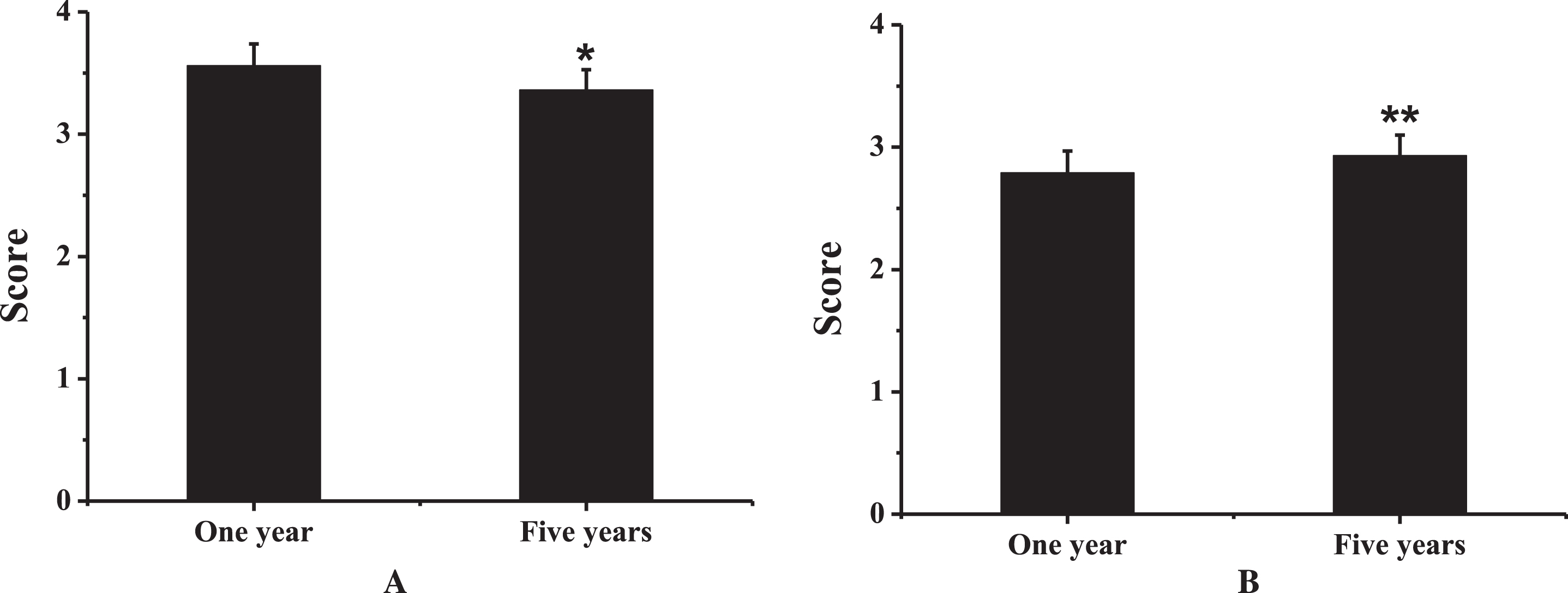
Differences of support and self-esteem of left-behind children in working time (A: support; B: self-esteem; *P < 0.05, **P < 0.01).
The overall average score of left-behind children’s mental resilience is 3.49±0.53. With a standard deviation of plus or minus as a limit, a score of less than 2.96 is set as low level, 82 people in total (15.89%); a score of more than 4.02 is set as high level, 72 people in total (13.95%) (Fig. 5). The mental resilience of left-behind children is at a low level. The overall average score of left-behind children’s self-esteem is 2.85±0.39. With a standard deviation of plus or minus as a limit, a score of less than 2.46 is set as low self-esteem, 84 people in total (16.28%); a score of more than 3.24 is set as high self-esteem, 75 people in total (14.53%) (Fig. 6). The self-esteem of left-behind children is at a low level. The overall average score of left-behind children’s positive emotions is 3.05±0.52. With a standard deviation of plus or minus as a limit, an average score of less than 2.53 is set as a low positive emotion, 83 people in total (16.09%); a score of more than 3.57 is set as a high positive emotion, 73 people in total (14.15%) (Fig.7A). The positive emotions of left-behind children are at a low level. The overall average score of left-behind children’s negative emotions is 2.33±0.54. With a standard deviation of plus or minus as a limit, an average score of less than 1.79 is set as a low negative emotion, 97 people in total (18.80%); a score of more than 2.87 is set as a high negative emotion, 95 people in total (18.41%) (Fig. 7B). The emotional level of left-behind children is generally low negative. The scores of the six factors in the social coping styles of left-behind children (Fig. 8) suggest that the scores of the left-behind children from high to low are solving problems, fantasy, retreat, self-blame, rationalization, and asking for help. The social coping styles of left-behind children are mainly mature coping styles.

Characteristics of mental resilience of left-behind children.

Self-esteem characteristics of left-behind children.

Emotional characteristics of left-behind children (A: positive emotions; B: negative emotions).

Characteristics of social coping styles of left-behind children.
The experimental grouping is shown in Table 7. After the preliminary grouping and data screening, a total of 160 subjects are selected, including 95 males and 65 females. Figure 9 reveals the reaction time of different groups to various types of words. The main effects of various words are significant. Subjects have the longest reaction time to high praise words, the shortest reaction time to low praise words, and the middle reaction time to neutral words. There are significant differences in the reaction time of subjects with different mental resilience to high and low praise words, while there is no significant difference in the reaction time to neutral words. Compared with the group with high mental resilience and low self-esteem, the group with low mental resilience and low self-esteem has significantly higher reaction time to low praise words (P < 0.001). Compared with the group with high mental resilience and high self-esteem, the group with low mental resilience and high self-esteem has significantly lower reaction time to low praise words (P < 0.001). The other groups do not show processing bias. The reaction time of the high mental resilience group on negative words is significantly lower than that of the low mental resilience group. It shows that low self-esteem has a bias in cognitive processing, but its direction changes with the level of mental resilience. That is, the low resilience group shows a processing bias toward low praise words, while the high resilience group shows a processing bias toward high praise words.
Experimental grouping distribution of the effects of mental resilience on self-esteem processing bias
Experimental grouping distribution of the effects of mental resilience on self-esteem processing bias

Reaction time of different groups of subjects to various words in the experiments of effects of mental resilience on self-esteem processing bias (*: Compared to the group with high mental resilience and low self-esteem, P < 0.001; **: Compared to the group with high mental resilience and high self-esteem, P < 0.001).
Table 8 shows the F-test of the effect of mental resilience on the reaction time of various types of words at different levels of self-esteem. The ternary interaction of self-esteem level, degree of resilience and words is significant. Mental resilience has a significant effect on the processing bias of self-esteem on low praise words. When words are highly praised, the main effects of mental resilience and self-esteem are significant. When words are neutral, there is no significant difference in the reaction time of the different groups of subjects. When words are lowly praised, the ternary interaction of mental resilience, self-esteem, and words is significant.
F-test of the effect of mental resilience on the reaction time of various types of words at different levels of self-esteem
Note: *:P < 0.05, **:P < 0.01, ***:P < 0.001.
Table 9 shows the F-test of the effect of mental resilience on the various word recall at different levels of self-esteem. The recall of neutral words can affect the recall of high social praise and low social praise words. Therefore, the recall of neutral words is treated as a covariate. The main effect of neutral word recall is significant, which has a significant effect on the recall of high and low praise words. Thus, it is reasonable and effective to control neutral words. The main effect of self-esteem is significant on high praise words. The main effect is significant in high and low praise words. The interaction between high-low self-esteem group and mental resilience on low praise words is significant. It can be seen that the subjects with different mental resilience have a significant effect on the change of the recall of different praise words.
F-test of the effect of mental resilience on the various word recall at different levels of self-esteem
Note: *:P < 0.05, **:P < 0.01.
Table 10 presents the experimental grouping. After the preliminary grouping and data screening, a total of 160 subjects are selected, including 96 males and 64 females. Figure 10 shows the reaction time of different groups to various words. The main effects of various words are significant. Subjects have the longest reaction time to negative words, the shortest reaction time to positive words, and the middle reaction time to neutral words. When words are positive, the main effects of mental resilience and emotion induction are significant. When words are negative, the main effect of emotion induction is significant. Compared with subjects with negative emotions, subjects with positive emotions have significantly shorter reaction time to both positive and negative words (P < 0.001). Compared with subjects with low mental resilience, subjects with high mental resilience have significantly shorter reaction time to positive words (P < 0.001).
Experimental grouping distribution of the effects of mental resilience on emotional processing bias
Experimental grouping distribution of the effects of mental resilience on emotional processing bias
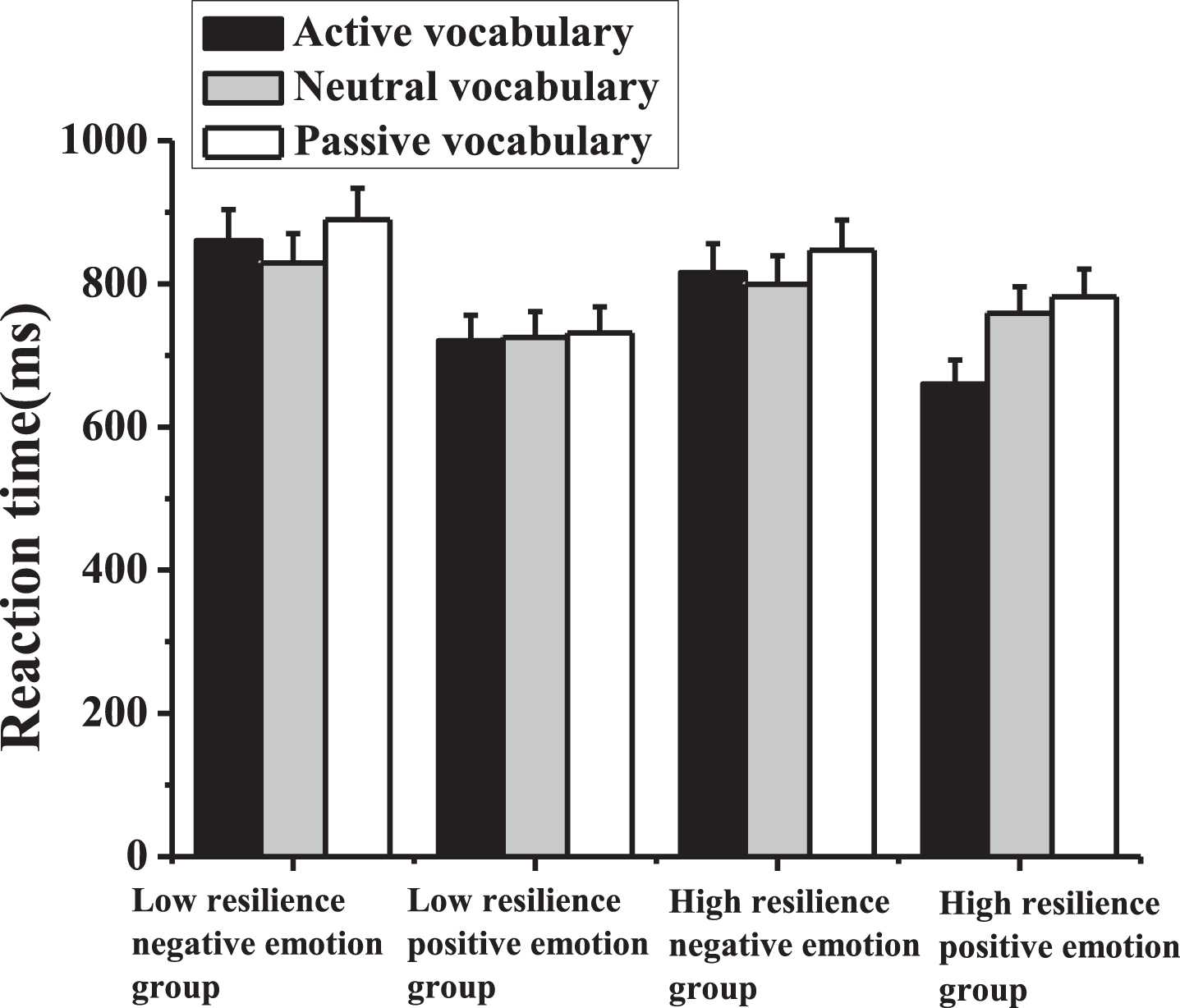
Reaction time of different groups of subjects to various words in the experiments of effects of mental resilience on emotional processing bias.
Table 11 shows the F-test of the effect of mental resilience on the reaction time of various words at different emotional levels. The main effect of emotional induction on various words is significant. There is a difference between positive and negative emotions. Differences between positive words, neutral words, and negative words are affected by emotional induction. Regardless of the high resilience group or the low resilience group, compared with the negative induction, the reaction time under the positive induction conditions is significantly shortened. Subjects show a tendency to avoid under the induction of negative emotions. The main effect of mental resilience on positive words is significant. Compared with the low mental resilience group, the reaction time of the high resilience group is significantly shortened on positive words. The ternary interaction of emotion level, degree of resilience and negative words is significant. Mental resilience has a significant effect on the cognitive processing bias of emotion.
F-test of the effect of mental resilience on the reaction time of various types of words at different levels of emotions
Note: *:P < 0.05, **:P < 0.01, ***P < 0.001.
Left-behind children are a special group in China, accounting for 8.05%of all children. Among them, rural left-behind children account for 86.5%of all left-behind children [24]. Long-term parent-child separation and incomplete family structure have important effects on the mental health development of left-behind children. Xing et al. argued that compared with non-left-behind children, left-behind children have significant mental health damage. With less social support and poor parenting behavior, their mental health may be affected by subjective support and general health status [25]. The analysis about the differences of mental resilience, self-esteem, emotions, and social coping styles of left-behind children in gender, grade, and other variables shows that there are differences in demographic variables in mental resilience, self-esteem, emotions, and coping styles. Left-behind children have low levels of mental resilience and self-esteem and they have one-sidedness, superficiality, and cognitive instability. They may value their deficiencies more. The lack of timely and reasonable guidance and education from the family and the outside world causes low self-confidence, low self-evaluation, and further lower self-esteem. The emotional level of left-behind children is generally low negative, indicating that their left-behind experience is not good for emotional development. Studies suggest that when individuals encounter adverse situations, people who are self-indicating in a negative emotional state are generally more likely to develop behavioral biases and mental health problems. Negative emotional states can reduce immune system activity accordingly, while positive emotions do the opposite [26]. The social coping styles of left-behind children are mainly mature coping styles. Mature coping styles have a positive effect on mental health. Psychological fluctuations during adolescence are large, and it is also the most critical period for the formation of self-evaluation. Only by knowing and accepting themselves rationally can people better control themselves. Studies reveal that when some individuals are challenged by adversity, their potentials are stimulated, and they have a stronger ability to adapt, thereby reducing or avoiding the negative effects of adverse environments [27]. Therefore, in mental health education for left-behind children, attention should be paid to improving coping styles.
The experiments of the effects of mental resilience on self-esteem processing bias show that the main effect of mental resilience on self-esteem processing bias is significant. On low social praise words, the interaction between self-esteem and mental resilience is significant, showing a significant processing bias. On high social praise words, the interaction between self-esteem and mental resilience is not significant. Lei et al. believed that individuals with high self-competence and high self-acceptance do not show significant memory bias towards the corresponding high social praise words [28], which is similar to the results of this study. The experiments of the effects of mental resilience on emotional processing bias show that mental resilience has a significant effect on the cognitive processing bias of emotion. For left-behind children, the most direct impact of the lack of parent-child relationships is emotional changes. Regardless of whether children are transiently separated from their parents indirectly or completely, they will cause emotional problems such as anxiety, loneliness, and sensitive inferiority [29, 30]. Ren et al. found that the level of social anxiety and loneliness of rural left-behind children is significantly higher than that of non-left-behind children, and both social anxiety and loneliness increase their possibility of Internet addiction [31].
In summary, schools should encourage students to participate more in all activities such as group psychological counseling. It can improve the mental resilience of left-behind children by enhancing positive emotions, reducing negative emotions, cultivating high self-esteem, and improving mature coping styles, thereby comprehensively guiding their mental health development.
Conclusion
The characteristics of mental resilience, self-esteem and emotional processing bias, as well as social coping styles of left-behind children are investigated. The results suggest that there are differences in demographic variables in mental resilience, self-esteem, emotions, and coping styles. The high mental resilience group shows a processing bias towards high praise words, while the low mental resilience group shows a processing bias towards low praise words. Mental resilience has a significant effect on the cognitive processing bias of emotion. This exploration has important application value and theoretical significance to promote the sound development of left-behind children’s mental health. However, there are still shortcomings in the research process. For example, the subjects selected are relatively scattered, and there may be cases of subject loss. Therefore, in subsequent studies, more representative and stable subjects will be selected to make the results more referenced.
Footnotes
Acknowledgments
This work is supported by the Shaanxi Province Social Science Fund Project: Research on Strategies of Promoting Mental Health of Rural Residents in Shaanxi Province under the background of targeted poverty alleviation, project number 2019Q011.
Conflict of interest
None to report.