



Abstract
BACKGROUND:
This research work establishes the relationship between job strain and being overweight among Mexican managers. Recently in Mexico, there has been a sharp increase in work-related diseases and mental health disorders. Furthermore, evidence shows that Mexicans rank top among employees who suffer from stress, yet research on the impact of job strain on the phenomena of obesity and being overweight among such vulnerable job positions in the industrial field is scarce.
METHODS:
The sample included 170 overweight middle and senior managers from six companies in the Mexican Manufacturing Industry. Cedillo’s Spanish version of the Job Content Questionnaire by Karasek was used, and the Body Mass Index (BMI) was used to characterize an overweight condition. Structural Equations Modelling studied the relationships among variables.
RESULTS:
Even though, the model shows a power of explanation of 6%(R2 = 0.06), the variable showing the greatest direct effect on the overweight variable is social support, with 21%(p < 0.01, β= –0.21). Regarding the total effects, only two of the four variables studied contributed directly to the overweight variation: the social support variable and the job demand variable.
CONCLUSIONS:
The results of the model hold a relatively low explanatory power; however, they do show a relationship between the studied variables. Also, the importance of the supervisor and co-workers’ support should be considered when developing organizational strategies for the prevention of work stress and an overweight condition.
Introduction
The main topic of this investigation is the relationship between job strain and being overweight. Job strain was studied taking into consideration Karasek’s [1] widely known Job Demand-Control-Social Support Model (DCSSM) as a theoretical framework. The overweight condition was established using the World Health Organization (WHO) criteria. Karasek’s model consists of six dimensions: job skill discretion, job decision latitude, psychological job demands, social support, job insecurity, and physical job demands. Furthermore, this model establishes that job strain can result when high job demands which affect employees psychologically combine with a lack of control over such demands. This, in turn, leads to a loss of productivity at work [2].
Job strain has been associated with serious adverse effects on human health such as obesity, overweight, and the increase in cardiovascular, respiratory, gastrointestinal, and other types of disorders, which affect a person’s physical and mental wellbeing [3]. Moreover, mortality among industrial workers is higher every year, and the risk of suffering from diabetes and certain types of cancer [3–5] as well as of cardiovascular diseases have been increasing and becoming the main cause of death worldwide in recent years [6]. Thus, it is important to study the impact of this health problem at work and to prevent the negative effects on vulnerable and neglected job positions such as middle and senior managers in the manufacturing industry.
The WHO defines obesity and being overweight as the abnormal or excessive accumulation of fat. Mexico ranks second in the world in adult obesity, with a percentage (30%) 10 times larger than that of countries such as Japan and Korea [5]. Moreover, obesity may be one of the main causes of death in the world, as every year nearly 3.4 million adults die from an obesity-caused disease.
Concerning the Mexican context, which is the focus of this study, the WHO [7] reports that Mexico features the highest rate of job strain in the world, with 75%of Mexican employees suffering from work stress. Additionally, these numbers could be increasing as between 30 and 60%of Mexican workers approximately admit having to comply with high job demands [8]. Such facts lead to the key question in this problem: Why is Mexico in the first place of work stress? A possible answer may be related to the fact that companies often disregard human capital as their most important asset and place exceeding task demands on their workers. Employees’ feelings of not being capable of meeting such demands could be the origin of job strain [9]. Furthermore, Mexican employees are often subjected to extended working hours [10]. Under such work conditions, managers experience high mental and physical demands, with which they must comply -usually in exchange for uncompetitive salaries [11].
Some authors claim that, as a result, there is an obvious rise in work-related illnesses, especially in stress-related symptoms, which only increase when employees’ task requirements exceed the skills and mental resources to complete them. It is under those circumstances that workers begin to show symptoms of work stress [12, 13].
Additionally, Gamez [14] mentions that work stress has an economic impact on companies. Stress-related decreases in productivity take a toll of up to 16 billion Mexican pesos/USD $826 million per year. To reduce this effect, the Mexican Government has taken measures such as passing a new law addressing the psychosocial risk factors at work. The law is known as the Official Mexican Norm (Norma Oficial Mexicana, NOM-035), and companies that infringe it by neglecting their employees’ psychological wellbeing will be penalized with up to half a million Mexican pesos/USD $26,000.00 [15].
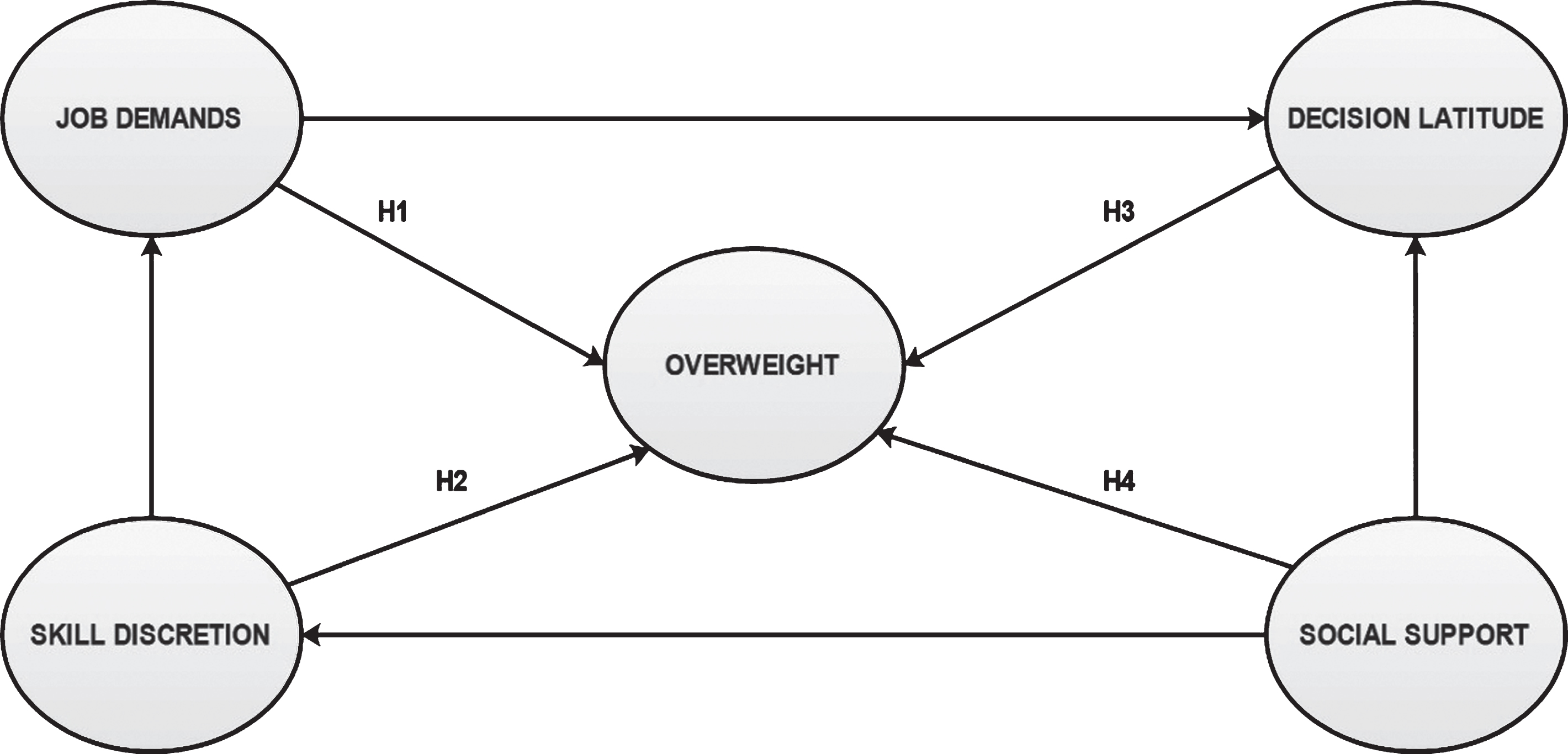
Hypothetical Model of the relationship between the JCQ’s dimensions and Overweight.
Despite all this, there is a gap in the research conducted up to now within the field of the manufacturing industry. Among the few studies found, one addressed the relationship between obesity and being overweight with the dimensions of the Job Content Questionnaire (JCQ), where variables such as psychological demands, lack of skill discretion, high decision-making latitude, social support, and physical demands were related to the overweight and obesity conditions. This study either showed no evidence of having an impact on conditions or on the dimensions studied [16]. Other studies such as Armenta et al. [17] point to the lack of studies carried out among middle management from the industrial sector. On the other hand, Valadez et al.’s work [18] discusses musculoskeletal problems and their relationship with stress, showing results where the social support variable has a direct and negative effect on work demands. Another study by Armenta et al. [19] offers results alluding to a relationship between work stress and Body Mass Index (BMI). These authors mention the need to incorporate additional factors so that the BMI variable can be better explained and, consequently, the explanatory power may be higher and better grounded. In addition, in some other related studies, prestigious authors present job strain and its subsequent diseases as a result of individuals’ own need to cope with stress-related situations or of their level of adaptability [20, 21]. Finally, Rodríguez associates work stress with high demands and emotional exhaustion and observes that further studies on these topics are needed to validate the findings [22].
The following section presents the main concepts studied in this work in order to provide a better understanding of the topics addressed as well as of the methodology and/or the instruments used.
Job strain
Because this is a relevant topic to this paper, this section presents several conceptions of job strain to expose its main characteristics. The term strain refers to nervous or emotional tension. However, the definitions of strain are diverse, and they may also have psychological, social, or other connotations. Along these lines, Rivera [23] defines job strain as a set of emotional, cognitive, physiological and behavioral reactions in the face of harmful situations within the job’s content, organization or environment, characterized by high levels of agitation and anxiety, the feeling of inability to cope with a situation, and, additionally, a lack of job satisfaction. Such reactions have a significant impact on health, so much so that job strain takes a gradual yet permanent toll on the different biological systems, which, in turn, leads to physical illnesses as well as to significant psycho-emotional deterioration, behavior disorders, and emotional disturbances [12].
Job strain in industry
Stress is a general process, a physiological response to the perception of dangerous or threatening situations or stimuli known as stressors. Many factors can cause the loss of balance in an individual due to the demands perceived as stress. Because job stressors are negative stimuli, they can damage health by generating harmful responses [24]. Accordingly, there is evidence of these reactions in Marrero's study [25], which includes job demands and the long working hours as stress-generating factors. Moreover, in many organizations, there is currently a lack of labor. The excessive demands with limited resources to meet them force employees to become multitasking and to add to the activities they already perform regularly. In other words, they must carry out tasks or projects in a shorter time. All of these scenarios may be the causes for stress.
Job strain models
In this section, some relevant models can be found; among them is the French and Kahn’s Person-Environment Fit model. This model tried to determine the degree of individuals’ adjustment to the environment where they performed their work. Such degree was assessed in two aspects: 1) an individual’s level of skill and abilities to meet demands, and 2) the extent to which his/her needs were met. A lack of adjustment in any of such aspects would represent a source of stress. To determine this adjustment degree, a causal sequence was established beginning with the characteristics of the working environment and how individuals responded and moving on to factors that had a long-term effect on the employees’ physical and mental health.
McGrath’s Cyclical Model of Work Stress: The purpose of this model was to establish crucial distinctions within the work stress phenomenon and to propose selected hypotheses among its levels, the activation, and the execution of the task. Its main components were the “objective” situation, as employees perceive it, the selection of the response to the work situation, and the behavior itself. The components would be affected sequentially so that the situation the selected individual perceived as threatening would produce a response that would, in turn, become a behavior affecting the situation.
Effort-Reward Imbalance Model (ERI): the theory behind this model is that an imbalance between effort and reward leads to negative psychobiological changes and to over-activity in the autonomic nervous system (ANS). The model posed that the consequences of this imbalance were accentuated by a high need for control.
The Person-Environment Fit model has been replaced by Karasek’s [1] Job Strain Model (JSM). According to Serrano, Salvador, et al. [26], this model has become the most customary and comprehensive to date, both in terms of the number of publications and in popularity. It has also been suggested that the Karasek model holds a greater “predictive power,” and is cited as support in a larger number of publications.
Thus, the Karasek’s Job Strain Model was proposed at the end of the 7 0s and it is also known as the demand-control model or Job Strain Model (JSM), which highlighted different aspects, associated with work and health. This model poses the hypothesis that stress-related occupational diseases occur when employees perceive themselves to be under high psychological / work demands but with low control over them. This occurs when individuals face the responsibilities, work pressures, and uncertainty of having to use their skills and make decisions [27] while lacking enough resources to have control over demands in order to meet them. Thus, R.A Karasek, and Theorell [28] infer four different types of jobs resulting from the combination of high and low levels of demand and control at work. Accordingly, these are classified as follows:
High strain jobs: It is the quadrant of greatest concern for specialists as it represents a high risk of accumulated stress, which leads to chronic diseases since workers experience high levels of exhaustion. As has been observed, whenever the difficulty of the task increases, there is also an increase in blood pressure response, heart rate, and other autonomic nervous system indicators.
Active jobs: (high demand and high control). These jobs are challenging and rewarding because employees have the resources to meet the proposed challenges.
Relaxed jobs (3): (low demand and high control). There is little risk of suffering from work-related diseases or psychological imbalances since control over work allows demands to be met.
Passive jobs: (low demand and low control). People show similar, high levels of fatigue or risk of disease to those present in active workers since they experience a loss of motivation and the lack of skill discretion.
Obesity and overweight
Obesity and overweight are public health problems in both developed and developing countries. Being overweight has been defined as having a weight of 10 to 20%greater than an individual’s height in centimeters. Weight is considered ideal when it is lower than 10%in men and 15%in women in relation to their height. Thus, according to Jensen and Ryan from the World Health Organization [29], individuals are considered to be overweight when their body mass index (BMI) is between 25 kg/m2 and 29, 9 kg/m2, and to show obesity when their BMI exceeds 29.9 kg/m2.
Currently, obesity and being overweight are considered chronic diseases and are among the main causes of mortality in Mexico. According to a study by the Organization for Economic Co-operation and Development (OECD), Mexico ranks among the first places in obesity, with 73%of adults and 35%of children and adolescents in the country suffering from this disorder. This amounts to a total of 60.6 million or 52%of Mexicans featuring obesity. According to the WHO, BMI values higher than 25 equal being overweight, which is a risk factor for developing serious diseases. Finally, obesity is characterized by a high accumulation of body fat, which over time, hinders the proper functioning of the internal organs in a human being, thus causing the development of diseases. Obesity, then, makes an organism considerably vulnerable [30].
Middle and senior managers in industry
In the industrial sector, managers hold an important responsibility. Their position is crucial for organizational strategy-development and highly important and influential in the decision-making processes. Additionally, managers are responsible for leading people, which makes them accountable not only for their specific work but also for that of their subordinates. They perform their responsibilities in three dimensions, which relate specifically to their tasks: What they should do concerning the people with whom they work. What they should do concerning the tasks that they perform and for which they are responsible. What they should do regarding the tasks their subordinates must carry out.
Additionally, they need to have a clear knowledge of the company’s goals, the objective behind their own tasks, their commitments, and their capacities. Also, they need to be aware of the organizational vision that the (actual) director of their department holds and develop a genuine interest in getting to know the people under their supervision: their needs, skills, capacities, and limitations. Furthermore, they need to be able to effectively communicate the performance expectations that the senior managers and their team members have from them.
Individuals in such management positions are highly capable of working under pressure, especially since they are responsible for others’ work and achievements. However, that same endurance in the face of demanding situations, with their implied stressors, may be the cause of job strain and may bear job strain effects. Moreover, managers are responsible for leading the activities that will help an organization achieve its goals. One foundational trait of a good manager is the degree of efficiency and effectiveness with which he/she achieves the organization’s goals. Another key feature is the ability to establish appropriate objectives and to minimize the resources used to reach them. In essence, the main tasks of a manager are planning, organizing, directing, and controlling activities to achieve the objectives set by the company.
Additionally, middle managers are known as supervisors, and they are key elements within any organization. The quality of the work, job performance, morale, and the development of good attitudes among employees all depend on these individuals. Furthermore, supervisors are responsible for directing and evaluating the work of their subordinates all of whom they must know personally.
Along these lines, group leaders are another type of middle management position in the industry and other contexts, whose role is not easy either. These individuals usually report to a supervisor and are responsible for the results of the team. Some of the qualities that an effective group leader should have are self-motivation, positive attitude, discipline, commitment, competence, good communication skills, good organization skills, leadership, and responsibility, among many others.
Middle and senior managers’ contributions to a company are a pro-active attitude and the approaches that they create. Thus, management positions may be among the most stressful in a company as they require entrepreneurship, everyday self-improvement, and the motivation to maintain such continuous improvement [31]. This is supported by Barrera's study [32], which mentions that the four main strengths that middle managers add to companies are entrepreneurship, communication, analysis, and balance.
Likewise, the study by Lopez [33] addresses the type of behavior and the acts of leadership that middle managers ought to display as they undertake opportunities for improvement. Their role is, therefore, a significant and a critical one in helping to develop company strategies.
Job Content Model (JCM)
The JCM created by Karasek [34] is based on the questionnaire designed to measure work-related psychosocial factors, which is the Job Content Questionnaire (JCQ). This instrument collects data on the type of work performed by workers in a certain position, including the duties and responsibilities such work entails and the necessary qualifications to carry it out satisfactorily. Ideally, the questionnaire should be answered by each employee and should be updated at least once a year.
The JCQ was designed to evaluate psychological demands. Because it predicts stress-related risks and active-passive behaviors that the job might entail, it is also known as the Demand/Control model. This model consists of several dimensions, which were considered in this research. Among the most important ones are:
Psychological Job Demand: It occurs when the employee is subjected to high psychological demands, but especially when their decision-making authority is low.
Job Skill Discretion: It contains questions about the employees’ skills and creativity.
Decision-making authority: It addresses the employees’ decision-making and organization.
Job Decision Latitude: It involves job skill discretion and decision-making authority.
Job Demands: It relates to the employees’ feeling of having control over their performance in their job position.
Job Insecurity: It analyzes the way employees feel about the steadiness of their job and their relative permanency over a certain period.
Job Physical Demand: It relates to all physical efforts of the musculoskeletal type.
Total Social Support: It analyzes both the instrumental and socio-emotional impact of support on co-workers, including supervisor support and co-worker support.
Relationship among JCQ dimensions and overweight
According to Bean [35], skill discretion contributes to the reduction of overweight, while decision latitude bears a relationship with both sides, since making decisions without having enough knowledge can generate stress. On the other hand, when an individual has enough knowledge or capacity, decision-making is more satisfying. Additionally, high psychological job demands also contribute to the increase in body weight as does low social (partner and supervisor) support.
Based on the above findings and the reviewed literature, the main objective of this study is to contribute to the body of knowledge concerning vulnerable job positions in the Mexican manufacturing industry by identifying the relationship between job strain and overweight among individuals in middle and upper management positions in companies located in Ciudad Juarez, Chihuahua, Mexico. Consequently, the hypothetical model hereby proposed is based on the relationship between the job content dimensions and being overweight. The following hypotheses were proposed:
Hypothesis 1: There is a negative relationship between Job Demands and being Overweight among middle and senior managers in the Mexican manufacturing industry.
Hypothesis 2: There is a positive relationship between Skill Discretion and being Overweight among middle and senior managers in the Mexican manufacturing industry.
Hypothesis 3: There is a positive relationship between the Decision-Making Latitude and being Overweight among middle and senior managers in the Mexican manufacturing industry.
Hypothesis 4: There is a positive relationship between Social Support and being Overweight among middle and senior managers in the Mexican manufacturing industry.
Methodology
Materials
The Spanish version of Karasek’s Job Content Questionnaire, validated by Cedillo [36], was used along with a questionnaire of sociodemographic factors which will be further explained later in this work. Regarding analyses, version 23 of the SPSS software was utilized in the sample’s creation, validation, screening, and descriptive analysis, while the WarpPLS 4.0 software was used for the creation and analysis of structural equation models.
The survey
In order to analyze the relationships between the job content variables and being overweight, a questionnaire was administered which was divided into 2 sections: (1) the Job Content Questionnaire (JCQ) [28, 36]; and (2) a general information sheet with demographic data, which included information such as age, gender, educational level, and marital status.
Job content questionnaire
The Job Content Questionnaire (JCQ) developed by Karasek was used to measure the psychosocial characteristics of the job positions. This questionnaire identifies the causes of occupational stress. In general, the instrument has shown high reliability and internal consistency throughout its various adaptations and validation processes in different countries. This study utilizes the Spanish version translated by Cedillo [36], which had been previously used in studies conducted among the population in the Mexican industry. In the translation of the 42 items, only 27 were used, with a Likert-type response scale of four alternatives: (1) completely disagree, (2) disagree, (3) agree, and (4) completely agree. The different item groupings resulted in six dimensions: job skill discretion, job decision latitude, psychological job demands, social support, job insecurity, and physical job demands. The skill discretion dimension was covered by 6 items (1, 2, 3, 5, 7, 9); decision latitude by 3 items (4, 6, 8); job demands by 5 items (10, 11, 13, 14,15); and total social support was comprised of the dimensions of co-worker support, with 4 items (17, 18, 19,20), and supervisor support, with 4 items (21, 22, 23,24). Additionally, job insecurity was addressed through 4 items (25, 26, 27,16); and physical job demands of work, through only one item (12). It should be noted that these last two variables were not considered in the analysis due to their lack of theoretical support regarding the overweight condition. Examples of some of the items are: “My opinions are taken into consideration in my job” (item 8), “My supervisor cares about his/her subordinates’ wellbeing” (item 21). The dimensions evaluated are comprised as follows: job skill discretion (6 items), job decision latitude (3 items), decision-making authority (9 items), job demands (5 items), supervisor support (4 items), co-worker support (4 items), job insecurity (4 items), and physical demands of the job (1 item).
The results obtained by the JCQ regarding the reliability of the studied dimensions obtained through the Cronbach’s alpha values are shown in Table 2 and were as follows: job skill discretion (0.766), job decision latitude (0.664), job demands (0.683), social support entailing supervisor support and co-worker support (0.890). Thus, such studies corroborate the acceptable reliability of all dimensions to be used in the structural modeling.
Validation of variables and efficiency of the job strain and overweight model
Validation of variables and efficiency of the job strain and overweight model
To describe the characteristics of the sample, the study included a group of questions in order to obtain information such as gender, marital status, educational level, and age, among other personal data, from participants.
Previously, to obtain obesity-related data from each of the individuals surveyed, their weight, height, and abdominal circumference measurements were collected through the help of the companies’ medical staff, who corroborated the accuracy of the measurements.
Finally, the WHO criteria were used to classify the BMI. Thus, only 170 (47.09%) of the 361 participants were included in this study; that is, those who had a BMI greater than 25 kg/m2 and lower than 30 kg/m2. The sample was described based on this category alone.
Research consent and ethics
Respondents participated voluntarily in this research project after being informed of the anonymous use of their data. Furthermore, the questionnaire included an authorized consent form explaining the strictly confidential and research purposes use of the data. The institutional ethics committee officially issued a favorable opinion.
Structural equation models
Structural equation models are also known as structural analyses of covariance, or simply, causal models. Structural modeling is considered a suitable methodology for the study and analysis of multiple variables, as well as for determining the magnitude of their effects. Models are advantageous, first, to comprehend whether a set of observed variables actually provides meaning to a theory-based construct (confirmation of a factor structure) and then, to understand whether a set of constructs fits a theoretical model (confirmation of a series of regression models executed synchronously).
The benefit of using structural equations is that they develop confirming models that allow researchers to reiterate, through the sample’s mathematical analysis, the existing relationship between the theoretical foundation and the proposed relationships. According to Hair et al., the use of SEM has several strengths, the most important one being that it allows for the graphic representation of the causal process under study, thus yielding a clear conceptualization of what is being studied. An additional advantage is the opportunity to create hypotheses about the causal effects among the variables in addition to allowing for the linking of effects between variables. These qualities are the reason for the widespread use of SEM in academic publications [37]. This study considered that the results of structural modeling would confirm more soundly the impact of the relationships on the proposed hypotheses.
Some other structural equation models use Partial Least Squares (PLS) methods to establish relationships among variables. In this case, the software used for the modeling in this research was WarpPLS, which uses the partial least squares (PLS) methodology to generate the structural equation models (SEM). This software provides the user with a wide range of features, some of which are not available in other SEM software [37]. Additionally, this software is the first and only one that provides classic PLS algorithms along with PLS algorithms based on SEM factors.
Method
Sample identification
The sample was non-probabilistic. During this stage, the initial contact with the companies was established both to introduce the project and to obtain the companies’ agreement to the administration of the survey. The survey was administered among those employees who complied with the criteria of the investigation; that is, only among middle or senior managers, and not among pregnant women or production employees.
Context of research and questionnaire administration
The questionnaires were administered in different manufacturing companies in Ciudad Juarez, Mexico, which houses one of the top 10 manufacturing industries in Mexico. The scheduled sessions for gathering data were developed and organized by the companies’ own human resources departments, which administered the questionnaire on certain agreed-upon days and hours only to staff in middle and upper management positions in the industry.
Creation and screening of the database
The database was created with a sample size of 361 participants, this study includes 170 overweight participants. Next, this sample was classified by BMI. During this data-review stage, descriptive analyses were conducted to detect missing data and outliers. In the case of questionnaires, because ordinal values were used (Likert scale), any respondents’ missing data were replaced by the median. In the case of the BMI, those missing values were replaced by the mean since scalar data were used.
Statistical validation of the sample’s characteristics
The characteristics of the sample were analyzed through a descriptive analysis considering the sociodemographic variables (gender, schooling, marital status, type of contract, seniority, hours worked per week, current position, and department).
Structural equation model generation
At this stage in the methodology, the Structural Equations Models were generated and validated. Likewise, the following variables were stated for such models: in terms of job strain by JCQ, the latent variables involved were job demands, skill use, social support, and decision latitude, considering only overweighed individuals. We analyzed the relationships among the dimensions proposed in the research hypotheses, which were analyzed by the WarpPLS software, version 4.0, establishing the criteria for acceptance or rejection of the hypothesis on the p- values.
Establishment of direct, indirect and total effects
Next, direct effects were obtained for the participating latent variables. The direct effects are those given per segment, from one (latent) variable to another, and in which the proposed hypotheses are validated. For the direct effects, the regression R2 value of each dependent latent variable was analyzed to determine the percentage of the explained variance. As for the indirect effects, they were produced through the mediation of the variables using two or more model paths. The total effects of each relationship were obtained by adding the direct and indirect effects.
Model adjustment indices
The adjustment indices taken into consideration were those proposed by Knock: average trajectory coefficient (APC), average R-squared (ARS), adjusted average R-squared (AARS), average blocks (AVIF), average variance inflation factor (AFVIF), Tenenhaus’ goodness of fit (GoF), Simpson’s paradox (SPR), the contribution of the R-square relation (RSCR), and statistical suppression relation (SSR).
Latent variables coefficients
The R- square (R2), Q-square, adjusted R-squared, composite reliability coefficient, and Cronbach’s alpha values were used to validate the questionnaires, and the Average block AVIF and AFVIF values were employed in the validation of the latent variables.
Results and discussion
This section shows the results of the sample’s descriptive study as well as the resulting structural equation models.
Sample characteristics
The complete sample of this research consisted of 361 middle and senior managers from six different companies in Ciudad Juarez, Chihuahua, Mexico, belonging to the automotive, manufacturing, textile, and other sectors. The job positions considered were managers, supervisors, group leaders, engineers, and administrative staff. The data were classified as normal weight, overweight, and the three degrees of obesity according to BMI. As a result, this case study only addresses the results of the 170 overweight individuals in the sample. Table 1 shows the results for the most important characteristics of the overweight managers’ sample including mean, minimum (Min) and maximum (Max) values for age, weight, and height. Additionally, gender and only the most frequent categories under marital status and level of education are shown.
Characteristics of the sample
Characteristics of the sample
The quality indicators for each latent variable are shown in Table 2. As can be seen, the Cronbach’s alpha values and the reliability of some variables stand above the recommended value of 0.7, while others stand above the questionable value of 0.6. Only those variables showing a good reliability index were included in the model.
Regarding the validation of all the latent variables included in the model, the AVE values were above 0.5 units, which demonstrates the discriminant validity of the questionnaire. Furthermore, the VIF values were lower than 3.3; therefore, based on Kock’s [38] established criteria, there are no collinearity problems among the latent variables. Finally, the Q2 coefficient values are greater than zero and are very similar to the R2 values desirable for parametric testing. The table shows the cross loads of each latent variable.
Model adjustment indices
The indices in Table 3 demonstrate that the model is efficient since all p-values are lower than 0.05. They also show that the model has average prediction capacity in all parameters; likewise, the GoF indicator shows that the model does have an average explanatory capacity. All these indicators confirm that the model is efficient.
Indices of the job strain and overweight model adjustment
Indices of the job strain and overweight model adjustment
The model shows the effects of the latent variables on each other. They are observed in Fig. 2, using the p-values and ß values to explain the direct effects among variables. The beta (ß) values show dependency and are obtained from standardized values, while the p-values represent the significant values for the hypothesis test; statistically significant relationships show a p-value lower than 0.05, which means that the effect is significant at a 95%confidence level. From this model shown, it can also be observed that only the job demands and social support dimensions were directly significant.

Job strain and overweight final model.
The conclusions regarding the regression coefficients or R2 are shown in Table 4. It can be observed that the job demands variable is explained by 12.4%by the variable of skill discretion (p < 0.01, β= 0.35, R2 = 0.124); the decision latitude variable is explained by 21.3%by the job demands (p = 0.04, β= 0.13 R2 = 0.014) and by the social support variable (p = 0.01, β= 0.45 R2 = 0.199). Finally, the social support variable explains skill discretion by 15.9%(p < 0.01, β= 0.40 R2 = 0.159).
Extent of the effects of the job strain and overweight model
In terms of direct effects, the being overweight variable is explained by 5.8%by social support (p < 0.01, β= –0.21 R2 = 0.043) and job demands (p = 0.05, β= –0.12 R2 = 0.015).
From this table, it can be observed that the direct effects of the social support variable and the job demands variable reduce considerably the being overweight variable.
Relationships in structural models are not always direct. Accordingly, Table 5 contains the sum of the indirect effects of the final model. As can be seen, there are p-values greater than those acceptable with a p = 0.05, which means that such indirect relationships are not significant.
Sum of indirect effects in the job strain and overweight model
Sum of indirect effects in the job strain and overweight model
To conclude this point, it can also be observed in Table 5 that the unique significant relationship found is the one between the social support variable and the job demands variable. This means that when the social support variable increases by a unit, the job demands variable increases by 0.003 units (p = 0.004, β= 0.003, ES = 0.053).
Table 6 shows the totals for both the direct and indirect effects. As can be seen, there are some effects whose p-value is greater than acceptable; this means that such total effects are not significant; on the other hand; however, those that are significant have a confidence level of 95 %.
Total effects of the job strain and overweight model
Total effects of the job strain and overweight model
To further explain the table, the greatest effect observed was that of the social support variable over the decision latitude variable. This means that when the social support variable increased by one unit, the decision latitude one increased by 0.207 units, with a 7%variability (p < 0.001, β= 0.207, ES = 0.07). Another important effect was that of the social support variable on the being overweight variable since when the social support variable increased by one unit, the overweight variable increased by 0.047 of a unit, also with a 7%variability.
The goal of this research was to contribute to the existing knowledge about the relationship between job strain and being overweight. The study used the dimensions of the Job Content Questionnaire (JCQ) to survey a sample of employees from middle and high management positions in the Mexican manufacturing industry sector. Given the lack of literature explaining such a relationship, especially among these vulnerable management positions, this paper could be laying the initial ground for assessing job strain by offering a more complete perspective of its impact on BMI variation.
The final model hereby presented has specific results and conclusions. The model showed an R2 value of 6%, which means that the being overweight variable is explained by 6%by the job strain model dimensions, with social support as the dimension contributing the most to its variation.
It is important to mention that while the results of the model hold a relatively low explanatory power, they do show a relationship between the studied variables. Accordingly, the model has predictive validity, since the R2 value of 0.06 (6%) is higher than the 0.02 (2%), the minimum acceptable cutoff value. The model helps to recognize the significance of social support, that is supervisor and co-workers’ support, which could be emphasized on when developing effective organizational strategies for the management and prevention of an overweight condition in the manufacturing industry. Thus, the importance of supervisor and co-workers’ support could be considered crucial aspects to avoid work stress and being overweight.
However, the study of the relationships found between job strain and being overweight can be considered indeed a complex problem. Consequently, it can also be concluded that it would be necessary to include either other factors or additional variables that might better explain overweight and BMI variation since weight and height measurements do not suffice. Table 7 shows the conclusions based on the proposed hypotheses.
Conclusions of the model based on the initial hypotheses
Conclusions of the model based on the initial hypotheses
The findings of this study may inform those companies searching for effective, diversified strategies to manage job-strain and to prevent the increase in BMI. The consequences of an increase in BMI, such as heart disease, diabetes, and fatal respiratory problems, are serious. Therefore, Mexican companies are eager to increase their knowledge about the spread of obesity, work stress, and other psychosocial factors among their employees in order to implement pertinent preventive actions. Reporting on the consequences of the combination between work stress and an increasing BMI can help raise awareness among stakeholders so that they can develop effective work stress and obesity-overweight prevention strategies. Accordingly, these strategies will help to avoid reaching levels of these problems that could adversely affect the companies’ expected results and performance goals.
The conclusions reached by this study can lead to further research to increase the explanation power of the model. Some suggested factors that might render the findings as more conclusive are the engagement in physical activity, eating habits, and sociodemographic factors that may affect healthy living conditions. Additionally, other anthropometric dimensions such as abdominal circumference or hip-waist measurements should be included as it would be interesting to explore them in the model. Further research suggestions would be to include other factors that might better describe BMI variation, i.e. food intake, eating behaviors, physical activity, and other work stress variables. Additionally, the structural equation modeling could help to explore the vast relationships among other variables of interest as they relate to job strain, for example, job position, gender, marital status, education, working hours, and the sociodemographic factors included in this study.
Study limitations
The limitations of the research were evident since the onset of the study. First, data collection throughout the companies was difficult as some companies allowed limited access for the administration of the data-collecting questionnaire. Another limitation is the size of the sample since the working hours and the time provided by both the company and the participants were insufficient to obtain a larger sample of individuals for survey.
Footnotes
Acknowledgments
The authors would like to thank the Asociación de Maquiladoras de Ciudad Juárez (Ciudad Juarez Manufacturing Centers Association), especially the INDEX Health Committee, for their participation in this project. They provided the initial contact with the manufacturing companies through their health care staff and supported the project through the administration of the data-collection instrument. Additionally, the authors are grateful to the Mexican Ergonomists Society for providing medical advisors from the manufacturing companies. Our gratitude also to the Universidad Autónoma de Ciudad Juárez (Autonomous University of Ciudad Juarez) and to the CONACYT (National Council of Science and Technology) for providing the financial support for this research through the CONACYT-INS (FRONTERAS CIENCIA) 2016-01-2433 project. Finally, special thanks to Leslie Cedeño for her assistance in the translation of this paper.
Conflict of interest
None to report.