



Abstract
BACKGROUND:
The demanding working conditions of teachers make them susceptible to stress. Monitoring temporal changes in recovery and stress may provide a valuable approach for maintaining well-being.
OBJECTIVE:
This exploratory study followed a two-stage approach aimed at: a) collecting data about the potential effects of holidays on stress in teachers, and b) utilizing these findings to provide tangible feedback to teachers.
METHODS:
Thirty-seven German teachers completed online questionnaires over six months (eight measurements) which included two holiday periods (Easter break, Summer break). Sociodemographic data regarding recovery and stress were gathered using the Recovery-Stress Questionnaire Work. Interested teachers received individual feedback sessions.
RESULTS:
The results, inter alia, indicated significant time effects for the dimensions Overall Stress (F(7,119) = 5.31, p < 0.001) and Overall Recovery (F(3.7,67.7) = 4.33, p = 0.004). Significant positive changes were identified over the Summer, but not the Easter break. In the feedback sessions, group-based findings were connected with the individual recovery-stress values. Notable scores were highlighted in a matrix.
CONCLUSIONS:
This study demonstrates an approach to monitoring and providing group and personalised feedback to raise teachers’ awareness and sensitivity of psychological health status in relation to their working environment.
Introduction
Teachers have an essential role in the personal and academic development and future of the children and adolescents for whom they are responsible, since they provide content knowledge in a variety of subjects and also influence the formation of values and attitudes of adolescents [1, 2]. Time and resources are needed for the preparation of classes, administrative duties, marking assessment and exams, and organisational appointments [3, 4]. Novice teachers in particular can struggle with these challenges [5, 6]. More recently, Australian research has also demonstrated the extensive role that teachers play in promoting the health and well-being of children and young people, which can extend to the management of complex family welfare issues and crises [7, 8].
As a result, teachers are confronted with substantial psychological demands which can collectively cause teacher stress. Kyriacou [9] describes this job specific condition of teacher stress as the perception of negative emotions as a consequence of work-related demands considered as a personal threat. This may stem from reduced self-efficacy as a consequence of having to deal with the demands per se, being unable to cope with the demands appropriately, and a lack of (personal or occupational) resources to manage life stressors [10, 11]. The working hours in schools are often insufficient to fulfil all tasks, which results in teachers working extended hours at home. This significantly diminishes the possibility for teachers to detach (i.e., unwind physically and mentally from work) and recover at home [12, 13].
Due to these manifold influences, the population of teachers is susceptible to reduced well-being and increased stress [14]. Studies examining the relationship between teacher health, well-being and stress are numerous and corroborate that an accumulation and chronic presence of stressors may ultimately result in severe psychological issues [15, 16]. These issues may include burnout, anxiety disorders, or somatoform disorders which precipitate teacher turnover and attrition [17–20]. High rates of teacher attrition and low rates of retention have significant implications both economically and educationally. Watlington, Shockley [21] as well as Synar and Maiden [22] report costs in the United States extending to several billion dollars for items such as sick leave pay, recruitment costs, pre-employment administrative costs, and professional development costs for new personnel. From an educational standpoint, intangible factors play an important role when it comes to providing uninterrupted education for students and creating an enjoyable learning environment with teachers knowing the internal processes of the school [23, 24].
To counteract this negative spiral of teacher stress, reduced well-being, and increased attrition, attempts to promote teacher well-being by targeting work-related stress represent a meaningful approach. Naghieh, Montgomery [25] summarised studies which conducted interventions to improve well-being in teachers via changes at an organisational level. Three organisational facets were recognised, namely changes in the work tasks, changing organisational features (e.g., teacher support), and multicomponent programmes (e.g., combining performance bonus pay and mentoring). Only four studies meeting the selection criteria were identified, encompassing a total of 2199 teachers and providing merely low-level quality of evidence. Naghieh, Montgomery [25] concluded that more methodologically sound and convincing studies are warranted regarding the effectiveness of organisational programmes for teacher well-being. The authors recommended that future research should include both organisational (i.e., structural changes to change the environment to individual needs) and individual-level (i.e., individual changes in attitudes, behaviours, coping) interventions.
Structural changes targeting the inherent processes of a school or the schooling system itself appear to be difficult to achieve, particularly within a global schooling landscape characterised by high surveillance, performativity and incessant testing of student performance [26]. Approaches at an individual level predominantly involve stress management interventions [27, 28], but there is a lack of synthesised research in terms of systematic reviews and documented conclusive effects. This may be due to the variety of potential sources of stress which limits the possibility to successfully reduce stress. Another approach to deal with constant and a range of stressors involves efficient recovery through individually and deliberately chosen recovery-related activities (e.g., exercise, relaxation techniques, social interactions). Kallus characterises recovery as “an inter- and intra-individual multilevel (e.g., psychological, physiological, social) process in time for the re-establishment of personal resources and their full functional capacity” (p. 42). The idea of the interplay between recovery and stress is that stress is not problematic if sufficient recovery activities and strategies are implemented to balance the stress. Kellmann, Bertollo [30] state that with accumulating stress, more recovery is essential to constrain further increase in stress, establish an equilibrium between stress and recovery, and thereby maintain individual well-being and optimal performance. This may result in an imbalance of recovery and stress characterised by ‘underrecovery’ which may cause physical and psychological issues [19, 31]. Approaches to preserve the well-being of individuals, while considering the relationship between recovery and stress, aim to monitor the changes in these psychosocial constructs over time in order to detect negative alterations, provide suitable feedback, and derive potential interventions [32]. Previous studies have successfully conducted recovery-stress monitoring in a variety of contexts, for example injuries in athletes and individuals with back pain [31, 33].
One issue for monitoring the well-being of teachers is the existence of scheduled holiday periods as potential phases of augmented recovery and reduced stress. However, only Kühnel and Sonnentag [34] investigated the effects of holidays in 131 teachers while assessing health-related variables at one measurement point before and three measurement points after a holiday period. The results suggested that although teachers’ work engagement significantly improved and burnout significantly decreased after the holiday period, a fade-out effect (i.e., return of beneficial post-vacation effects to pre-vacation levels) established within one-month post assessment. Leisure time relaxation after the holidays served as a buffer and prolonged the beneficial holiday effects. These sparse findings provide valuable insights into the effectiveness and longevity of holiday effects but should be extended by examining the potential impact of multiple holiday periods with a different duration over a longer period of time. This could be complemented by subsequent individualised feedback on the recovery-stress monitoring in order to provide information regarding stress sources and recovery activities [35, 36]. Additionally, this combined procedure could represent a meaningful and practically relevant approach in improving and sustaining teacher well-being [25].
Therefore, this pilot study had two related objectives combining data collection and its transfer into a practical application. First, developments of the recovery-stress balance in teachers were monitored over six months, including two holiday periods (Easter break, Summer break). Second, the monitoring data were used to provide the participants with group-based as well as individual feedback based on their recovery-stress scores. This approach could provide a basis for a brief intervention to raise teacher awareness of the recovery-stress process.
Materials and methods
Participants
A group of 37 teachers (MAge= 43.2 years, SDAge= 11.1; 21 females) participated in the study. After completing the data collection, 18 teachers provided complete data for all measurement points. An a priori calculation of the sample size was not conducted since the main goal of the study was exploratory to assess individual feedback sessions. All participants were recruited from one integrative school in the vicinity of the university which served as a pilot school to test the combined approach of recovery-stress monitoring and subsequent individualised feedback for the participants. A more detailed summary of the characteristics of the sample is provided in Table 1.
Participant demographics
Participant demographics
Note. M = Mean; SD = Standard Deviation; n = Number of participants; aHSIE = Human society and its environment. Includes history, geography, economics, society and culture, etc.; bOther = Subjects entailing domains such as philosophy, psychology, physical education.
Survey
The partnership for this study was organised between the university research unit and an alumnus of the university who was working in a leadership position as a teacher at the participating school. The first author was invited to present the framework of the study at a school staff meeting of the entire teaching staff with approximately 120 teachers. Participants were provided with information about the nature of the online survey and regarding organisational procedures (e.g., delivery of questionnaire link) using a short PowerPoint presentation. As an incentive, individualised feedback, to be provided after the finalisation of the survey, was offered for each participant who completed at least five measurement points. The online survey was created with the software SoSci Survey which was chosen due to its user-friendliness and free availability for scientific purposes [37]. Each participant’s email address was associated with a computer-generated participant code to provide anonymity. The code was used to deliver the individual questionnaire link for each participant and to organise the individual feedback sessions after the study. Each participant received a questionnaire link via email at each measurement point at 1 pm and up to two reminder emails, one at the same day at 4 pm and the second on the next day at 10 am. To optimise the opportunity for response from this specific sample of teachers, the times of the day the questionnaire emails were sent were based on the school schedules.
The questionnaire survey was conducted eight times between March and September 2018. Specific emphasis (i.e., pre- and post-vacation measurements) was put on the evaluation of holiday effects (2-weeks Easter break vs. 6-weeks Summer break) as periods of prolonged recovery. The completion of each survey took about 10–15 minutes. Figure 1 illustrates the assessment timing protocol.

Chronological sequence and participant distribution over the course of the study.
After the data collection was completed in September, individual face to face feedback sessions with a duration of 30–40 minutes were arranged in October to coordinate with the schedules of the participating teachers. These feedback sessions were provided by the first and last author. Based on their unique participant code, a time slot was reserved for a feedback meeting using the respective individual evaluation sheet. The feedback sessions consisted of group-based and individual information evaluating the recovery-stress development of the whole sample and the respective teacher. The individual feedback on the personal recovery and stress values was provided on a differentiated scale level for all measurement points. A decrease in recovery or an increase in stress respectively represented an unfavourable process. These deviations from the group mean were coloured either yellow (<1–2 SD for recovery, >1–2 SD for stress) or red (<2 SD for recovery, >2 SD for stress) in an overview matrix [38] to provide a starting point for discussion and individual clarifications. A more detailed description of the feedback procedure is given in the results section. This study was awarded ethical approval and was conducted in accordance with the ethical principles of the Faculty of Sport Science of the Ruhr University Bochum and the Declaration of Helsinki.
Measures
The data were collected using self-administered questionnaires. The first measurement (T0) differed from the remaining seven measurement points in that it included assessment of basic sociodemographic characteristics in combination with recovery-stress data. Participants provided sociodemographic information regarding their age, gender, marital status, employment status, working experience, and the school subjects they were teaching the remaining assessments assessed working hours at school and at home.
The recovery-stress measurement was conducted using the Recovery-Stress Questionnaire (RESTQ) [39] which is a validated psychometric questionnaire to monitor the development of the psychosocial factors of recovery and stress. In the context of this study, a detailed assessment of the recovery and stress experiences was conducted focusing on the working environment of the sample. Therefore, the RESTQ-Work with 92 items was implemented at all measurement points [40]. The instrument provides a means of systematic assessment of individual recovery and stress experiences within the previous seven days and requires approximately 10–15 minutes for completion. These experiences and states can be synthesised into the recovery-stress balance. For stress, the RESTQ evaluates the degree to which individuals experience physically and/or mentally demanding events (e.g., “I had difficulties in concentrating”) and perceptions of well-being and recovery (e.g., “I was in a good mood”). Each item is rated on a seven-point Likert-like rating scale ranging from 0 (never) - 6 (always). The 92 items of the RESTQ-Work are reduced to 26 scales which in turn are categorised into six sub-dimensions, namely Overall Stress (Scales: General Stress, Emotional Stress, Social Stress, Conflicts/Pressure, Fatigue, Lack of Energy, Physical Complaints) and Overall Recovery (Scales: Success, Social Recovery, Physical Recovery, General Well-being, Sleep Quality) as well as four work specific dimensions, namely Burnout (Scales: Emotional Exhaustion, Loss of Control, Loss of Meaning, Conflicts with Colleagues, Spillover), Leisure/Breaks (Scales: Undisturbed Leisure Time, Leisure, Efficient Breaks, Undisturbed Breaks), Psychosocial Recovery (Scales: Social Support Friends, Social Support Colleagues), and Work-related Recovery (Scales: Participation, Personal Growth, Action Latitude). Both the scales and dimensions of the RESTQ-Work show good internal reliability in both German and English populations [39]. The RESTQ-Work has been validated with other similar psychometric instruments and used as a monitoring instrument with a variety of populations including athletes or administrative employees [33, 41].
Data analyses
The datasets saved in the online survey system SoSci Survey were directly transferable into a SPSS data sheet. After reorganising the data sheet to prepare it for the data analysis, the data were thoroughly checked by two student assistants experienced in data control and management to identify any errors having occurred during the reorganisation of the data. The data analysis at the group level regarding the changes over time were conducted in SPSS Version 24.0 (SPSS, Inc., Chicago, IL, USA) using repeated measures analysis of variance (ANOVA) after the statistical assumptions were checked. The Greenhouse-Geisser adjustment was applied to account for violations of sphericity. A Bonferroni correction for multiple testing was applied to control for the inflation of the alpha error. The individual-level results including the figures and matrices for the feedback sessions were derived using Microsoft Excel 2010. A general overview of results for all participants and each measurement point with all the means of the recovery and stress scales as well as the working hours at home and at school was listed in the first Excel tabs. Using these data, the group-based figures for the development of recovery and stress were created. Additionally, an individual matrix for each participant including the individual values for all parameters was integrated into the Excel sheet. Using the conditional formatting command in excel, formulas for each cell were generated and the cells were coloured yellow or red automatically (see Procedure) depending on the reference value (Fig. 3).
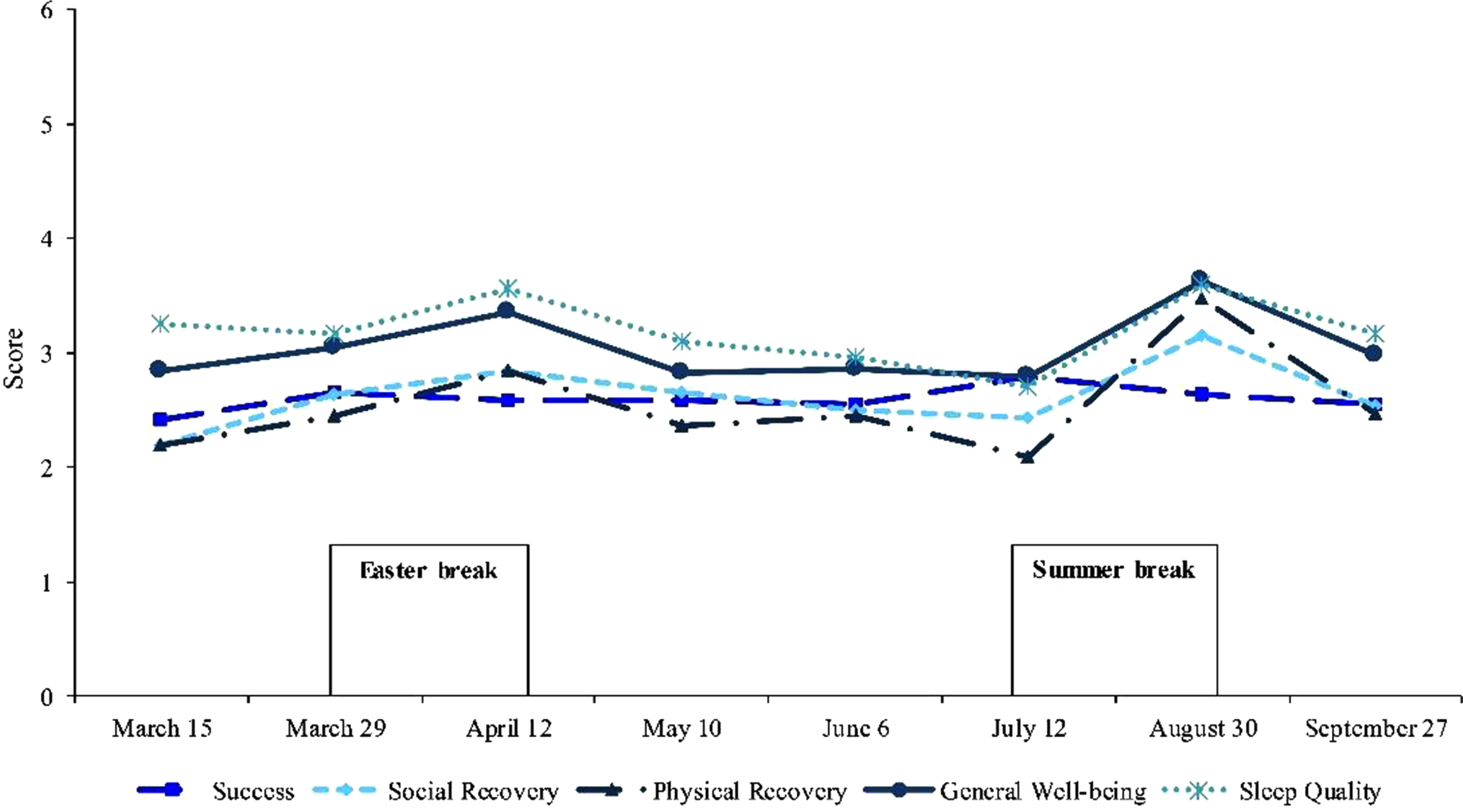
Development the five general recovery dimensions of the RESTQ-Work-92 across all measurement points (N = 18).
General results on holiday effects
Six repeated measures ANOVAs were conducted for the RESTQ dimensions to identify potential differences over time. Bonferroni corrected post-hoc tests were applied to detect specific differences between the measurement points. For Overall Stress, a significant time effect was found, F(7,119) = 5.31, p < 0.001, ηp2 = 0.24. For the Easter break data, the post-hoc comparisons did not indicate significant differences for the pre-and post-measurements (T2–T1). The post-hoc tests revealed that T6 (after the Summer break) was characterised by significantly lower stress values than all of the other measurement points, thereby indicating a significant decrease in Overall Stress over the Summer break. The largest difference in stress scores was -0.93 (T6–T5), p < 0.001 and was identified between the measurement points before and after the Summer break. Significant variations across the measurement points were also obtained for Overall Recovery, F(3.7,67.7) = 4.33, p = 0.004, ηp2 = 0.20. Again, no significant discrepancies appeared for the pre- and post- assessments of the Easter break. Post-hoc examinations showed that the Overall Recovery values were significantly higher for T6 than for T0, T1, T4, T5, T7, with the largest difference of +0.69 identified between T6–T7, p = 0.013. For the work-related dimensions of the RESTQ, both Burnout F(4.4,74.9) = 5.54, p < 0.001, ηp2 = 0.25 and Leisure/Breaks F(3.6,61.2) = 5.57, p = 0.001, ηp2 = 0.25 had significant differences over the course of the survey. For Burnout, no statistically significant effects for the Easter break were detected. However, the Burnout scores after the Summer break were significantly lower than those of almost all other assessment points (with the exception of T2 which was after the Easter break). The greatest discrepancy of –0.95 was between T6 - T5, p < 0.001 which suggested a significant effect of the Summer break. A statistically significant Easter break increase of +0.55 was found for the dimension Leisure/Breaks, T2–T1, p = 0.019. Similar to the Burnout dimension, the Leisure/Breaks scores were significantly higher after the Summer break than almost all other measurements (exception: T2 after the Easter break). The significant holiday effect of the Summer break was reflected by the largest difference of +1.0 regarding T6–T5, p = 0.001. The dimensions of Psychosocial Recovery and Work-related Recovery did not display significant differences over time.
Feedback sessions
The feedback sessions followed a defined structure to ensure that all participants were informed identically. The first component consisted of a description of the group-based results which were derived from those individuals who completed the questionnaires at all eight measurement points (n = 18). To describe these processes, the researchers used five different group-based figures. These were shown to the participants to provide them with an overview of the sample across the time. The first figure displayed the course of all six sub-dimensions of the RESTQ (Fig. 2). Following this, two illustrations were provided showing the general and work specific dimensions separately. Subsequently, the general dimensions Overall Stress and Overall Recovery were displayed in greater detail on a scale level. An example for Overall Recovery is presented in Fig. 3. The researchers emphasised the holiday effects, elaborated on the greater effect of the Summer break, and concluded that these holiday effects appeared to vanish relatively quickly after the teachers returned to their working routine.

Development of all dimensions of the RESTQ-Work-92 across all measurement points (N = 18). The recovery dimensions are displayed in blue shades, while red shades were chosen for the stress dimensions.
For the second component, a matrix visualising the individual scores over time was shown to the individual teachers. The individual data on recovery and stress was presented in greater detail on a scale level to highlight inter- and intrapersonal characteristics. Figure 4 depicts all the individual scores for all recovery and stress scales including their overarching dimensions for all completed measurement points.
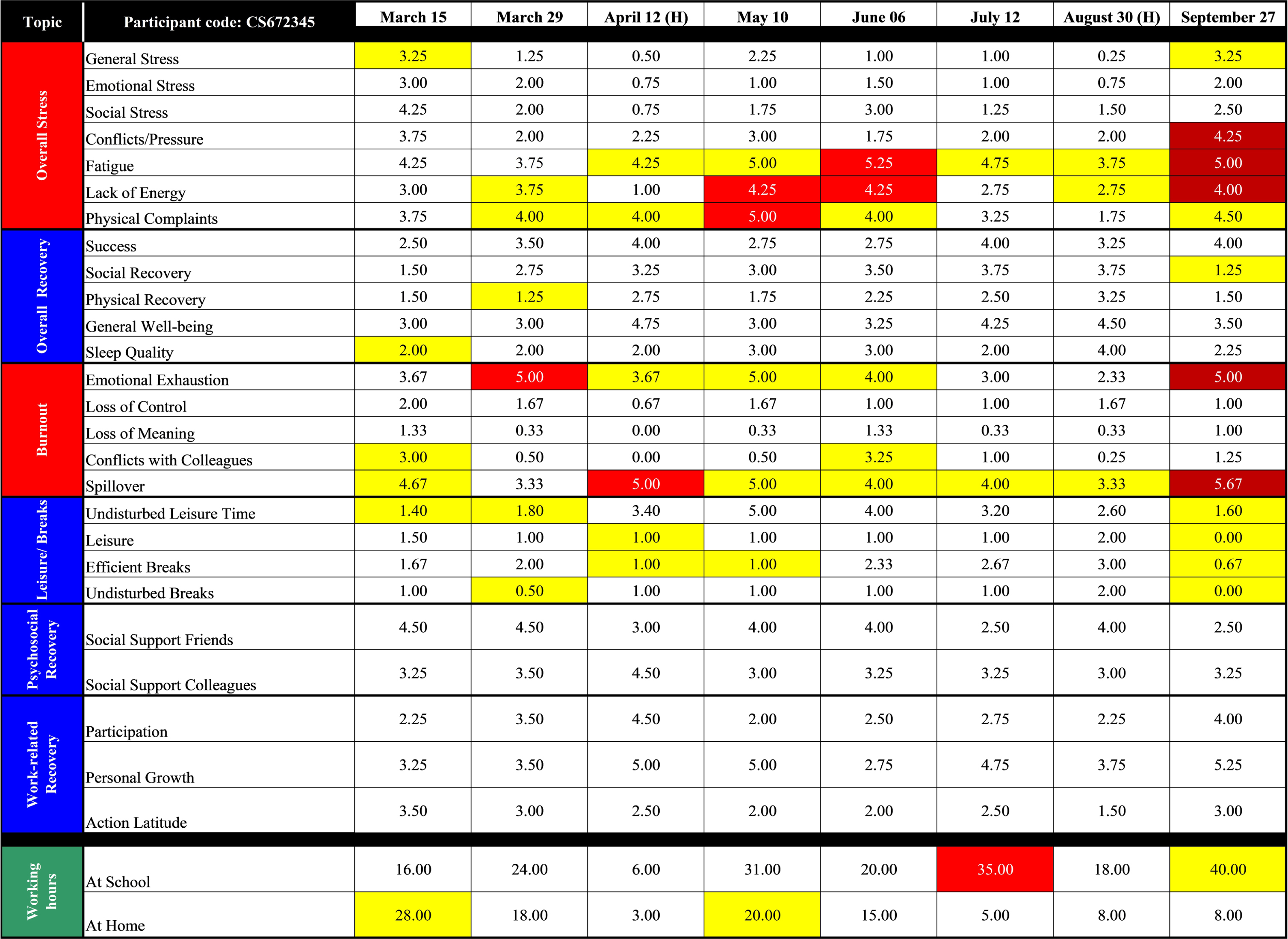
Example matrix for the individual teacher feedback illustrating a teacher’s recovery-stress balance over the course of the study. The recovery dimensions are highlighted in blue, the stress dimensions are highlighted in red, and the working hours are highlighted in green. The individual values displayed in the matrix were compared with the average scores of the entire sample of teachers for each measurement point. Individual values with a difference between 1-2 standard deviations from the mean of the reference sample are marked in yellow. Individual values with a difference of >2 standard deviations from the mean of the reference sample are highlighted in red. Notably, only the critical deviations are marked in colour, i.e., noticeable low scores for the recovery dimensions (‘too little’) and noticeable high scores for stress dimensions and weekly working hours (‘too much’). The range for all dimensions was 0 (never) –6 (always). Working hours were specified in hours per week. The ‘H’ in the header indicates the post-holiday measurement points.
The approach for analysing the individual matrices was equivalent for all teachers. The matrix was screened for noticeable patterns and potential systematic effects both vertically (i.e., boldness for one or more measurement points) and horizontally (i.e., abnormalities for one or more scales). The identified patterns were addressed by the researcher and the teachers were asked whether the data reflected their subjective evaluation of their recovery-stress balance. The third feedback component consisted of a discussion of the potential personal relevance of the data. Depending of the frequency and severity of exceptional patterns, this part of the feedback process varied in duration. Finally, the fourth feedback component varied based on the existing recovery-stress balance and individual preferences of each teacher. For the more unfavourable recovery-stress cases, recommendations on how to improve recovery in the daily routine were provided. Individuals with an already favourable recovery-stress balance were commended and advised on how to maintain the healthy balance.
For the example case illustrated in Fig. 4, starting points for discussion were found in regards to the last measurement point (September 27) where a couple of red scales were identified. More specifically, a high stress load seems to be present for the teacher especially on a physical level (e.g., Fatigue, Lack of Energy) together with reduced effectiveness to experience and benefit from breaks after work (e.g., Spillover, Leisure, Efficient Breaks). During the interaction with the teacher, potential work- and non work-related reasons for these observations were discussed and suggestions for changes were considered (e.g., promoting detachment after work, designing specific plans for recovery activities). Similarly, a horizontal analysis could be conducted which in this case confirmed the vertical data. Deficits on the scales Fatigue, Lack of Energy, Emotional Exhaustion, and Spillover manifested at almost all measurement points. Such tendencies warrant cognitive and behavioral changes and were addressed in these individual feedback sessions.
The present study had two related aims. First, to extend the evidence regarding holiday effects on well-being in teachers by monitoring the recovery-stress balance over six months including two holiday periods. Second, to introduce and describe an approach to combine well-being monitoring in teachers with related group-based and individual feedback. This strategy of obtaining and reporting back data serves as a starting point to further refine the approach in terms of the data acquisition process, participant recruitment, adherence, and the feedback process.
Holiday effects
The outcomes at the group level reflect previous findings indicating that holiday periods contribute to a reduction in stress and increase in recovery [42, 43]. The results of the current study extend previous research by providing new information regarding the length of the overall monitoring period and the observation of two holiday periods of different durations (i.e., 2-weeks Easter break vs. 6-weeks Summer break). Significant improvements in stress and recovery were identified for the Easter break for Leisure/Breaks, and after the Summer break for Overall Stress, Overall Recovery, Burnout, and Leisure/Breaks. This could be explained by both the duration and timing of the breaks. In the feedback sessions, many teachers reported that the two weeks of the Easter break were not actually used for resource restoration and unwinding, but rather for marking exam papers and preparing for conferences scheduled immediately after the break. This reflects previous research indicating that a spillover of work and leisure time may impair recovery processes and maintain stress levels [44]. Dealing with work at home increases the presence of work-related problems and interferes with detachment and functional stress management. In comparison, the Summer break signified the end of the school term and could therefore be effectively utilised for recovery activities. Additionally, some teachers indicated that they normally require a few days to ‘power down my system’ to reduce their allostatic load which had accumulated during teaching. In our sample, this process occurred over the six weeks’ time span, but two weeks was too short to realise a profound restoration. Other than the duration of the holiday period, fade-out effects in recovery and stress manifested after both the Easter break and Summer break in the study participants. Such processes have also been reported in a meta-analysis by de Bloom, Kompier [45] for various health variables in other demographic groups, although the potential underlying mechanisms of these processes could not be identified. With the feedback sessions in this study, we aimed to explore potential individual-level mechanisms contributing to the development of the participants’ individual recovery-stress balance.
Feedback sessions
In addition to understanding the recovery-stress process over the six months period including holiday effects, these data were the basis for feedback sessions with the teachers. The structured feedback procedure demonstrated a combined approach of providing group-based and individual results. The visual presentation of the outcomes provided a method of illustration which was then unpacked by explanations from the authors.
For the most part, teachers were surprised by the comparatively low levels of recovery across all measurement points, indicating a lack of proactive recovery. This suggests that a focus on stress reduction is present despite that the circumstances often make it impossible to decrease stress-related situations. Rather, a proactive promotion of recovery should be realised in order to buffer stressful periods [46]. These reflections were discussed with the teachers in the feedback sessions, with the aim of sensitising them to the importance of active recovery through self-initiated behaviour. These discussions were combined with the feedback using the individual matrix of each teacher (Fig. 4). Specific areas of need, signs of unfavourable developments, as well as reasons for the findings were addressed and ideas for improvement were discussed. Depending on individual preferences, potential recovery strategies (e.g., playing an instrument, 15-minute run, reading a book) were generated collaboratively, and teachers were encouraged to create space for these activities.
A caveat of this study is that no outcome data on the potential impact of the feedback sessions regarding the direct interactions using protocols and qualitative analyses are available. However, the material in terms of the data preparation and analysis is shown in Figs. 1–4 and can provide an impression of the nature of the feedback sessions and the potential benefits to participants. This exploratory study can serve as a starting point for subsequent research aiming to incorporate facets of the proposed feedback process and synthesise the feedback output to identify topics for interventions. Consistent with the claims of Naghieh, Montgomery [25], the feedback procedure demonstrated in this study has the potential of identifying potential organisational and individual changes. Organisational changes can be common overarching problem areas identified during the feedback sessions that require modifications to the working conditions in schools. Individual changes can focus on individual strategies for stress management and recovery improvement. The individual feedback information could also be used to identify topics of common interest for the development of related workshops for teacher groups.
Limitations and future directions
Some limitations need to be taken into account with regards to the study. The number of individuals completing all eight measurement points (n = 18) was small and does not allow us to draw any general conclusions. However, this study aimed to demonstrate and exploratively examine the approach of monitoring and providing teacher feedback. For future studies, multiple schools should be contacted and the feedback approach could be used as an incentive for participation. Ideally, the prospect of receiving data-based individual feedback for participation could increase the likelihood of full data sets. Another issue relevant to all volunteer -based studies is the composition of the sample. It can be assumed that selection biases including volunteer bias and a self-report bias may have influenced the data [47, 48]. These biases are difficult to exclude completely given the reliance on self-report data and should be considered when interpreting the data. These biases may be minimised through transparent information about the underpinnings of the study together with pre-study information emphasising that the individualised feedback is only helpful if genuine and authentic information is provided. The monitoring process could be refined by adding questionnaires which gather additional data relevant to the well-being of the participants (e.g., coping strategies) and reducing the number of items for the assessment of recovery and stress. The extended version of the RESTQ-Work with 92 items could be implemented at a limited number of pivotal measurement points (e.g., first and last assessment) and a shortened version could be used at other assessment points to reduce participant burden. The balance between the number of measurement points and participant adherence needs to be considered and a qualitative evaluation of the impact of the feedback sessions (e.g., on self-awareness and resolution to change) could also be considered in future research.
Conclusion
The present study proposed a framework and approach to study recovery-stress processes over time and link data collection with feedback for the participants. Teachers appear to experience extended stress periods with low levels of recovery. Using individual feedback, the specific associations between recovery and stress were explored which in turn enabled personalised recommendations on how to initiate individual-level changes to promote well-being. The individual feedback sessions could also provide a means to identify common issues that could then be addressed in either individual or organisational level approaches to reduce teacher stress. As teachers play a vital role for the future of children, more resources should be invested into processes to promote psychologically healthy and regenerated teachers able to provide high quality education for children and adolescents.
Conflict of interest
No conflict of interest is declared. No funding agency supported this project.
Ethical approval
All procedures performed in studies involving human participants were in accordance with the ethical standards of the institutional ethics committee of the Faculty of Sport Science of the Ruhr University Bochum and with the 1964 Declaration of Helsinki and its later amendments or comparable ethical standards.
Informed consent
Informed consent was obtained from all participants included in the study.