



Abstract
BACKGROUND:
Creativity is essential to the work of occupational therapy practitioners. Nonetheless, little is known about the way it influences their work satisfaction.
OBJECTIVE:
This study explores several internal and external factors related to organizational, personal, and socio-relational sources of creativity. Our main hypothesis was that occupational therapy practitioners are more satisfied when creative.
METHODS:
A mixed-methods study included a qualitative (n = 22) and a quantitative (n = 250) phase. Data were gathered using focus group interviews and an online survey, where a novel assessment instrument –the Creativity in Occupational Therapy Questionnaire –was administered.
RESULTS:
The synthesis of the results revealed that factors connected with the client, the practitioner’s personal characteristics, the work environment, relationships with colleagues and relationships with superiors all influenced the creativity of occupational therapy practitioners, in negative or positive ways. Professional autonomy and a supportive work environment were found to be important for the creativity of occupational therapy practitioners. Creativity at work had a statistically significant influence on work satisfaction of occupational therapy practitioners (B = 0.575, t = 6.267, p < 0.01).
CONCLUSIONS:
The results demonstrate the importance of creativity for job satisfaction of occupational therapy practitioners and suggest a dynamic reciprocal relationship between different factors and circumstances that should be considered when fostering creativity at work.
Introduction
Job satisfaction is an aspect of work that has been widely studied due to its potential effect on job performance and productivity, as well as employees’ health and well-being [1–3]. Since the benefits of employing satisfied staff are often tangible and relate to both employees and employers, effort has been made recently to define specific factors that can have a positive effect on workers and enhance their job satisfaction [1, 3]. In occupational therapy, and other health disciplines, the concept has been studied from different perspectives, for example, in relation to burnout and professional identity [2, 4], the availability of supervision [5], turnover intentions [6, 7], and managerial style [8]. The type of setting (e.g. mental health) and geographical location (e.g. urban vs rural areas) have also been considered when examining the job satisfaction of occupational therapy practitioners [9]. It has also been acknowledged that many factors can affect the feelings of satisfaction among medical professionals, calling for a multifaceted approach [10].
Organizational climate has been recognized as an important factor for job satisfaction [11–13]. For instance, when organizations support their workers, this can influence various aspects of work, including innovation, creativity, productivity, and turnover [14, 15]. The theory of work values describes creativity, alongside levels of autonomy and opportunities for new knowledge, as a potential intrinsic reward or a non-physical outcome of work that should be stimulated [16]. However, the role of creativity and its contributions to job satisfaction are not well understood and neither are the factors that can support it in the workplace [11]. Since occupational therapy is a profession with strong links to creativity, the topic is considered especially pertinent in relation to the practice and study of this profession [17, 18]. Yet, although creativity is often at the center of occupational therapy treatment process and occupational therapy practitioners distinguish themselves as inherently creative, the concept does not extensively feature in occupational therapy literature [19]. In fact, creativity has not been researched in relation to job satisfaction of occupational therapy practitioners to date. Moreover, to the best of our knowledge, the link between creativity and job satisfaction has rarely been examined in other professional sectors either.
Job satisfaction of occupational therapy practitioners
Job satisfaction is most commonly defined as “the extent to which people like (satisfaction) or dislike (dissatisfaction) their jobs” [20]. A meta-analysis conducted by Faragher, Cass, and Cooper [21] showed that there is a significant association between job satisfaction and workers’ physical and mental health; therefore, work practices that promote satisfaction could be particularly valuable from the perspective of health management.
There have been a number of studies that explored job satisfaction of occupational therapy practitioners, mostly originating in America, Australia, and Scandinavia. A review of the literature suggests that occupational therapy practitioners are generally satisfied with their work, which has mostly been attributed to the intrinsic rewards the job offers as well as to workplace relations (e.g., teamwork, relationship with colleagues) and social support [12, 22–24]. The only study that examined job satisfaction of occupational therapy practitioners in Slovenia to date investigated it together with the concept of self-efficacy. The results of that study showed that the lowest levels of self-efficacy and job satisfaction were reported by therapists working in mental health, who also experienced the highest emotional exhaustion [25].
A study conducted by Bendixen and Ellegård [5] found that job satisfaction of occupational therapy practitioners was facilitated by experiencing autonomy in everyday working life. Furthermore, rewards and recognition, feedback, and participation have also been associated with job satisfaction [7]. A recent study by Scanlan and Hazelton [4] showed that we should also consider the meaningfulness of different work activities as they can be a source of job satisfaction. However, several factors constraining job satisfaction have also been identified, including demanding work and stress [2, 7], economic concerns and decreasing possibilities for supervision [5], as well as lack of promotional opportunities, poor working conditions, and role ambiguity [26]. Considering the contradictory results, it is important to better understand what could increase occupational therapy practitioners’ job satisfaction and well-being, especially with regard to intrinsic rewards which appear to be the profession’s strength, yet have not been widely studied.
Creativity and job satisfaction
Despite the great many definitions of creativity, which present a challenge to the rigorous study of this concept [27], there has been a general consensus on the definition of creativity. Runco and Jaeger [28] established that we need to consider characteristics such as novelty, originality, infrequency, or unusualness, as well as characteristics relating to usefulness, value, utility, effectiveness, adaptability, or appropriateness. Creativity often enables people to reach their highest potential, their goals and a positive life or organizational change [11, 29]. The foundation for creativity is the interaction between people and their environment [29]. We all have creative potential, which can get more or less developed. It is therefore important to encourage creativity-connected skills and abilities, in personal as well as professional life [11, 30].
Creativity can be a strong motivator that gives a person a sense of usefulness at work [31]. In contrast, although routine tasks are a part of almost any job role, they diminish creativity and job satisfaction [32]. In the context of an organization, creativity aids the production of novel and useful ideas with direct or indirect value [33]. Providing the opportunity for creativeness can foster loyalty among employees [14]. Moniarou-Papaconstantinou and Triantafyllou [16] also found that in times of economic constraints, when resources and monetary rewards are often scarce, some professionals tend to find satisfaction in the intrinsic rewards of their work, for instance, they look for opportunities to be creative.
This study aims to explore some of the internal and external aspects of work that can contribute to job satisfaction of occupational therapy practitioners working in Slovenia. A special focus is put on the role creativity plays in this process and the factors that can support or inhibit it in the work environment. Based on the reviewed literature, we predict that creativity and autonomy could support the job satisfaction of occupational therapy practitioners:
Hypothesis 1 (H1): Occupational therapy practitioners who can work more creatively are more satisfied with their work compared to occupational therapy practitioners who work predominately routinely.
Hypothesis 2 (H2): Freedom and professional autonomy are more important than a supportive work environment for the creativity of occupational therapy practitioners.
Material and methods
Study design
This was a mixed-methods study of creativity in occupational therapy that followed exploratory sequential design [34]. As such, we aimed to use quantitative and qualitative data together to gain a more complete and in-depth understanding of the studied phenomenon. Qualitative and quantitative data were collected and analyzed separately, and the findings of both datasets were later merged in the interpretation phase of the research [34]. The initial qualitative phase, which included focus group interviews, aimed to increase the body of knowledge on the theory of creativity in occupational therapy and provided information that could enrich the everyday practice of occupational therapy practitioners. It also guided the development of a novel assessment instrument, the Creativity in Occupational Therapy Questionnaire, or COTQ [17, 18]. This assessment tool was used to gather quantitative data in the second phase of the study, which was an online survey. To fulfill the aim of this article, we will mainly focus on the findings that apply to the topic of work satisfaction and creativity in the work environment.
Data collection and sample
The qualitative study was the preliminary explorative phase that created the basis for the subsequent quantitative study. Twenty-two occupational therapy practitioners participated in four focus group interviews. They were approached based on their extensive work experience and were considered a rich source of information. Examples of questions discussed during focus groups included: How does creativity manifest in the work of an occupational therapy practitioners? Which factors and circumstances facilitate/inhibit it? What are your experiences with creativity?
The focus group interviews lasted between 59 minutes and 84 minutes and were facilitated by the first author. They were recorded by a research assistant. The conversations were transcribed verbatim and the accuracy of the transcriptions was checked by the first author before they were analyzed.
In the second phase of the study, data were gathered using an online survey that was sent to all electronic addresses obtained from the Association of Occupational Therapists of Slovenia and the Faculty of Health Sciences Ljubljana where occupational therapy practitioners are educated. Our aim was to approach all occupational therapy practitioners working in Slovenia at the time of the study, which was estimated at 500 therapists [35]. Two hundred and sixty-seven therapists returned the questionnaire. Out of these, 250 (90.6%) completed it at least partially and 203 (80.2%) completed it in full. The survey sample included over 40%of the whole population of Slovenian occupational therapy practitioners.
Sample characteristics for both research phases are presented in Table 1.
Participants’ characteristics
Participants’ characteristics
*In the quantitative phase, gender was reported by 208 participants.
Prior to the data collection, ethics permission was obtained from the National Medical Ethics Committee (number 0120-135/2015-2 KME 100/06/15). Participation in an online survey was voluntary and anonymous. Occupational therapy practitioners participating in focus group interviews signed a consent form. No incentives were provided to the participants.
Although a full description of the development and content of the COTQ has been presented elsewhere [18], we summarize the instrument here. The COTQ contains 83 closed-ended statements relating to creativity of occupational therapy practitioners and their creativity at work. The statements are divided into five subcategories: attitude toward creativity, including questions about how participants define creativity (15 items), attitude toward work and feelings related to the work environment (13 items), creativity in the occupational therapy process, including how creativity is used during the assessment, planning, treatment and evaluation phase (14 items), attitude toward clients and their influence on the therapist’s creativity (12 items), factors that influence creativity, either as facilitators or as inhibitors of the process (29 items).
The questionnaire uses a five-level, Likert-type scale ranging from 1 (strongly disagree) to 5 (strongly agree).
Reliability of the COTQ was checked in a separate pilot study for all five clusters of questions and Cronbach’s alpha for the 83 items was .90, which shows that the instrument can be considered highly reliable [36].
We focus on the fifth subcategory of questions pertaining to the participants’ opinions on the factors that can initiate, facilitate and inhibit the creativity of occupational therapy practitioners in the process of their work.
Data analysis
The main goal of the qualitative analysis was to inductively develop concepts and explanations relating to creativity in occupational therapy. Focus group interviews were analyzed following these six steps [37]: (1) organizing the material, (2) selection of themes and coding units, (3) open coding, (4) choosing and defining relevant concepts and categories, (5) axial coding, (6) developing the final theoretical formulation. To increase the study’s validity, we employed different measures and techniques, including audit trial, peer debriefing, and member checking [38].
In the quantitative portion of the study, data were analyzed using descriptive statistics, factor analysis, and regression analysis. By inspecting skewness and kurtosis we established that data were normally distributed. Since the questionnaire was divided into five different clusters, we used factor analysis to reduce the number of variables, employing the Principal Axis Factoring method. The factor analysis followed a three-step process: (1) calculating initial factor loadings, (2) factor rotation, (3) calculating the factor scores described [39]. Finally, the research hypotheses were tested using regression analysis (stepwise regression) to check for correlation between the dependent variable (H1 = job satisfaction; H2 = OTs’ creativity) and the two independent variables (H1 = creativity and routine work; H2 = freedom and professional autonomy, and supportive work environment). Pearson’s correlation coefficient was used to measure the strength of a linear relationship between paired data [40]. All analysis was conducted using SPSS Statistics v.23 for Windows.
Results
Qualitative results
Six main factors that can influence creativity in occupation therapy emerged from the qualitative analysis: (1) the uniqueness of each case (client), (2) the occupational therapy practitioner’s personal characteristics, (3) work experience (years in practice), (4) work environment, (5) relationships with work colleagues, (6) relationships with superiors.
Our data revealed an inherent duality in all these factors, manifesting as either a positive or a negative influence on creativity in the occupational therapy process. For instance, for factor “relationship with work colleagues”, many participants experienced close and friendly relationships in the occupational therapy team as a source of strength that enabled them to overcome different hurdles and sustain pressure from managers. Good atmosphere created a sense of safety. When one felt supported and backed by colleagues, this contributed to their expression of creativity. Participants revealed that their creativity could fully develop only in a supportive environment. One said:
“Relationships at work are very important . . . you need to have some harmony with the people you work with. They cheer for you and then it’s not hard to work” (OTP9).
In contrast, when relationships were strained, or the practitioner’s ideas were not well received, this could hinder creativity:
“Sometimes, it’s your colleagues; they just don’t accept what you want to do, and this really puts a stop to my creativity” (OTP11).
In conjunction with the six main factors that can influence the creativity of occupational therapy practitioners, our participants recognized another important circumstance. It emerged that a lack of an established or standardized work protocol also positively contributed to their creativity. This was framed as “freedom at work”. Occupational therapy practitioners included in our focus groups saw this job characteristic as an enabler of professional autonomy, especially when searching for (innovative) ways to improve their clients’ health. In fact, many felt that the process of seeking unique solutions for each client was inherently creative and required work freedom and freedom of professional expression. One participant described this creative process in the following way:
“We get someone with a certain injury or a trauma, but it’s up to the individual therapist how to reach the therapy goal. And this is where I see the core of your creativity. Which path do you take? What do you consider? What do you add? How do you get enough depth in the process? So, we need to be creative. But we also don’t have our services defined as rigidly as some other professions” (OTP16).
Another participant echoed this:
“Our hands are not tied, we have a lot more freedom than, let’s say, physiotherapists. So, our creativity can get much more pronounced. And this is also connected with greater satisfaction, at least for me. I feel a lot more satisfied if I can decide about something” (OTP19).
Work autonomy was perceived as the amount of freedom their superiors gave them in running the therapy process. When our participants felt autonomous, they self-initiated more and had the desire to be creative and look for innovative solutions. On the other hand, the superiors’ constant control and a directive leadership style could inhibit the occurrence and development of creativity. However, if occupational therapy practitioners demonstrated a rich knowledge-base and had enough professional experience, they could sometimes resist the constant supervision and maintain a level of professional autonomy. One participant explained:
“. . . You need to have the autonomy. But, most of all, you need to have the confidence. If you do, then the external control and lack of time don’t get to you so much; you are more able to prevail over it and find a way out and react in a suitable way . . . but you really need to be 100%sure of yourself” (OTP12).
In addition, the participants identified three factors influencing their creativity that were exclusively negative. These included: (1) bureaucracy and demanding administrative routine (e.g. excessive paperwork), (2) lack of existing legislation (e.g. lack of professional recognition, difficult access to occupational therapy services), and (3) lack of feedback. The latter referred to receiving little or no information from the client about their satisfaction or dissatisfaction with treatment. One participant elaborated:
“There is not much feedback. If we have a feeling that we’ve been very creative, but we don’t get this confirmed by the client, we don’t experience so much satisfaction. Also, next time you look for solutions, you maybe don’t try as hard, you don’t invest so much energy . . . the feedback about our creativity and effort is very appreciated and propels us to continue; it also matters in our interactions with colleagues, not just with patients. If we receive some encouragement and praise, a confirmation that we’re good at what we do, then we get more élan for creativity” (OTP20).
Analysis of the COTQ answers
Most of the occupational therapy practitioners included in our study (83.1%) agreed or strongly agreed with the statement that they were satisfied with their work (M = 4.0, SD = 0.7). They experienced their work as interesting and dynamic (M = 4.2, SD = 0.7) and felt that creativity contributed to their overall work satisfaction (M = 4.4, SD = 0.7). Almost three quarters (71.3%) also felt that in their work, creativity was more important than routine work (M = 4.0, SD = 0.9). Just over one half (52.0%) agreed or strongly agreed that relationships at work were mostly good and relaxed (M = 3.5, SD = 0.9). However, two thirds (66.3%) also felt that their superiors often did not recognize their creativity (M = 3.4, SD = 1.0). Overall, the COTQ confirmed that different factors –including the client, the practitioner’s personal characteristics, work environment, relationship with colleagues, relationship with superiors and work experience –influenced the creativity of occupational therapy practitioners, in a negative or positive way.
Cluster five of the COTQ, which focused on different factors that can influence the creativity of an occupational therapy practitioners, showed that the majority of our participants felt that when their work was more routine, the work satisfaction was reduced (M = 3.9, SD = 0.8). Also, too much routine inhibited their creativity (M = 3.9, SD = 0.8). Praise by co-workers received a high score as a facilitating factor for creativity (M = 4.3, SD = 0.7). A strong majority of the participants (94.3%) also agreed or strongly agreed that freedom and professional autonomy boosted their creativity (M = 4.6, SD = 0.6). In contrast, external motivators, such as financial incentives, received a lower score when their contribution to creativity was assessed (M = 3.6, SD = 0.9). Table 2 presents the results of cluster five of the COTQ.
Results of statistical analysis for cluster five of the COTQ
Results of statistical analysis for cluster five of the COTQ
Our first hypothesis was that occupational therapy practitioners who can be more creative are more satisfied with their work compared to occupational therapy practitioners who work more routinely. Table 3 shows that the stepwise regression method produced two regression models. The first model included “creativity in the process” as the independent variable and explained 14.9%of the variability in the dependent variable “job satisfaction”. In addition, the second model also included “routine work” as the independent variable and explained another 2.1%of the variability in the dependent variable. Both independent variables combined, therefore, explained 17.0%of the variability in the dependent variable (job satisfaction).
Summary of the regression model for H1
Summary of the regression model for H1
aIndependent: (variable), creativity in the process. bIndependent: (variable), creativity in the process, routine work.
For the rest of the analysis, the second regression model was used to test H1 . The regression model was statistically significant (F = 20.329, p = 0.000). Table 4 shows that the opportunity to work creatively had a statistically significant influence on work satisfaction. In contrast, routine work had a statistically negative correlation with job satisfaction. Therefore, we can confirm H1. The findings indicate that occupational therapy practitioners who can work more creatively express higher job satisfaction. Routine work, on the other hand, has a negative effect on their job satisfaction and occupational therapy practitioners who work predominantly routinely are less satisfied with their work.
Regression model’s coefficients for H1 testing
aDependent variable: Job satisfaction.
Our second hypothesis was that freedom and professional autonomy are more important for the creativity of occupational therapy practitioners than a supportive work environment. Table 5 shows that the stepwise regression method produced two regression models. The first model included “freedom and professional autonomy” as the independent variable and explained 21.8%of the variability in the dependent variable “creativity in all phases of the occupational therapy process”. In addition, the second model also included “work environment” as the independent variable and explained another 4.3%of the variability in the dependent variable. Both independent variables combined explained 26.1%of the variability in the dependent variable (creativity in all phases of the occupational therapy process).
Summary of the regression model for H2
aIndependent: (variable), freedom and professional autonomy. bIndependent: (variable), freedom and professional autonomy, work environment.
To test H2, we used the second regression model. The regression model was statistically significant (F = 34.717, p = 0.000), so it fitted the data well. Both freedom and professional autonomy (Beta = 0.435, p < 0.001) and the work environment (Beta = 0.209, p < 0.001) statistically significantly influenced the creativity of occupational therapy practitioners. Based on the results, we can present a regression model (Fig. 1). Freedom and professional autonomy impacted the creativity of occupational therapy practitioners more significantly than a supportive work environment; therefore, we can confirm H2.
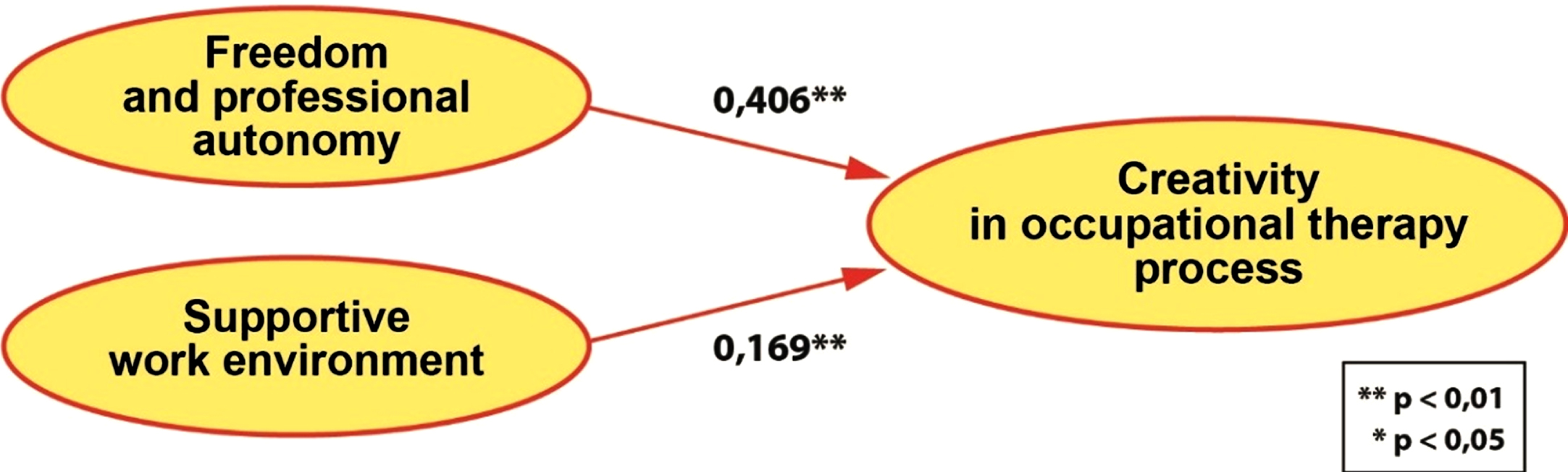
Regression model for hypothesis 2.
Synthesis of qualitative and quantitative results
To our knowledge, this was the first study of creativity and job satisfaction of occupational therapy practitioners in Slovenia. In order to fulfill the purpose of the study, the results of different research phases need to be combined. Therefore, strict separation of results is not feasible. Only by considering all the findings can we gain a complete understanding of the phenomenon under study [34]. The following section will aim to synthesize the results of different phases of the study and juxtapose them against the existing body of knowledge.
Our data suggest that most occupational therapy practitioners included in our study liked their work and were satisfied with it. They often described a positive engagement with their work role, indicating that they had an opportunity to use a degree of their physical, cognitive and emotional selves, hence feeling an emotional connection with the work [41]. One of the participants said:
“My understanding of creativity is not that it is about moving mountains. It can be in the way you greet a patient, how you approach him, how you write your final report where you don’t just tweak a formula, but you add something of your own” (OTP18).
The majority of occupational therapy practitioners also agreed that creativity brought them satisfaction at work (M = 4.4, SD = 0.7), which was also confirmed when we tested our first hypothesis. During focus group interviews, a distinction was made between job satisfaction and life satisfaction. However, the two concepts were considered interrelated:
“I think overall life satisfaction is an important influence . . . it shows in the way we function in the work environment and it influences our creativity” (OTP17).
Another practitioner said:
“If you’re not feeling your best self, for example you’re a bit depressed or have a lot of personal problems, you usually don’t bring these with you to work, but sometimes, if you get a bit overwhelmed, you bring the problems with you and then you can’t be overly creative” (OTP4).
Life satisfaction and job satisfaction have previously been linked, life satisfaction purportedly having a stronger effect in this reciprocal relationship [42, 43]. A study of entrepreneurs recognized that individuals with a high level of creativity were happier in life, which was considered more important than their financial success [44]. Jalali and Heidari [45] also explored the relationship between happiness, subjective well-being, creativity and job performance of primary teachers. They found that there was a significant relationship between the four concepts with happiness and well-being being the strongest predictors of job performance.
Our study provided new insight about the role creativity can play for life satisfaction. Data from the quantitative study showed that creativity can bring happiness and satisfaction (M = 4.4, SD = 0.7), and, at the same time, that satisfaction at work encourages further creativity (M = 4.4, SD = 0.7). This suggests a potential reciprocal relationship; creativity both adds to the satisfaction and is fueled by it.
Participants also expressed that creativity can contribute to the meaning-making process of the individual:
“Creativity can give meaning to your life. You are doing something you are satisfied with. Because if you do nothing, you are deteriorating, I mean, a person can deteriorate, either physically or mentally. So, creativity somehow directs our lives too” (OTP10).
In support of this finding, the COTQ results showed that three quarters (75.1%) of the respondents agreed or strongly agreed that creativity gives meaning to life (M = 4.0, SD = 0.8). This is an important finding considering the recent focus on meaningful work-related activities that can foster job satisfaction in occupational therapy practitioners [4].
Another aspect that was emphasized by our participants was the work-life balance. One said:
“If you’re too busy and under stress, and you don’t really look after yourself /. . . / the leisure time, you often don’t have it, but I think it’s very important . . . that you have a balance, and time for yourself and leisure time, because then it will be easier to be creative, no matter what you do. On the other hand, if you’re close to burning out, then you’re not creative easily” (OTP6).
Non-work factors can, therefore, be important when trying to understand creativity and job satisfaction. It has previously been suggested that life balance, particularly the way work interferes with family life, has important implications for job satisfaction and turnover intentions [46]. A study of work creativity among millennials also showed that when millennials were satisfied with their work-life balance and could participate in job crafting, their creativity became more noticeable. For that group of employees, creativity was hampered when long work hours and frequent overtime were coupled with a rigid work schedule [11].
Our participants also agreed that an internal balance and time for your own personal development were essential:
“Therapists need to work on themselves, I think. You need to have some hobbies or activities that fulfill you and give you pleasure, because then you can also be more creative in your profession” (OTP20).
This was also confirmed in the quantitative part of the study where the majority of the participants reported that the opportunity for personal development boosted their creativity (M = 4.2, SD = 0.7). In contrast, stress and work overload impeded the occupational therapy practitioners’ creativity (M = 4.1, SD = 0.8).
According to the quantitative and qualitative data, participants felt that characteristics of the work itself (e.g. dynamic, interesting, supplying opportunity for personal development, autonomous) and the practitioner’s personal characteristics, experience and knowledge were more important for creativity than the factors connected with external motivation (e.g. financial incentives, praise from superiors). One participant said:
“It’s more that internal need, and if you fulfill it, you’re more satisfied. /. . . / because the external need can never give you such satisfaction” (OTP2).
Professional autonomy was often mentioned during the interviews. Nonetheless, the COTQ results showed that relationships at work (M = 4.3, SD = 0.7), good working conditions (M = 4.3, SD = 0.8) and praise from co-workers (M = 4.3, SD = 0.7) did have a beneficial effect on creativity too, suggesting that some external circumstances might be more important than others to the creativity of occupational therapy practitioners. The analysis of the second hypothesis also confirmed that both professional autonomy and the work environment significantly influenced the creativity of occupational therapy practitioners included in this study, professional autonomy having a stronger effect. It has previously been argued that a lack of professional autonomy can limit the worker’s creativity and negatively influence the motivation for work and work-related problem-solving [47]. Regel, Forneck and Quendler [48] also emphasize that work environment and freedom at work have an important impact on job satisfaction. Based on our findings, we could argue that professional autonomy, creativity, and job satisfaction are likely in a reciprocal relationship. Therefore, it might be alarming that some recent studies show that work autonomy has been declining while work pressure has been increasing in most countries of the European Union, which has had a negative effect on the overall job satisfaction of employees [49]. However, it is important that human resource managers address the needs of employees [48] and create an optimal work environment that can maximize employees’ job satisfaction [2].
Limitations and future directions
The study design included a qualitative and a quantitative phase, which both have their limitations. For instance, with focus groups, there is always the danger of moderator bias. It has been recognized before that moderators can sometimes unintentionally influence the outcome of a discussion, especially if the topic is their area of expertise, as was the case with our study [50]. It is possible that during the interviews, not all participants got equivalent time to express their views and ideas, or, they did not feel comfortable enough to express them [50]. Some of these limitations were addressed in the quantitative phase, which employed a bigger sample and offered anonymity. However, online questionnaires have their own limitations, too. Ours was designed as a self-assessment tool that recorded subjective opinions and evaluations; the answers might, therefore, not represent the objective situation. Furthermore, it is not clear whether the respondents shared their understanding of the word creativity and its meaning. Also, some participants did not complete the questionnaire in full, which could be attributed to the length of the COTQ and time constraints.
This study focused only on some aspects of creativity, so certain factors and circumstances that can inhibit or facilitate it might have been left unaddressed. We have, however, established that the relationship between different internal and external factors and work satisfaction is complex and will require further in-depth research to better understand the relationship between various dimensions of personal and work life that contribute to it. Future studies could also include the experience of clients and their perceptions of the occupational therapy practitioners’ creativity.
We are aware that the generalizability of our findings outside the sample of occupational therapy practitioners working in Slovenia is limited. The authors are planning to translate the questionnaire and implement it in other geographical locations, which would increase the generalizability of the findings.
Conclusions
This study was the first to explore some of the internal and external aspects of work that contribute to job satisfaction and creativity of occupational therapy practitioners in Slovenia. The findings highlight the importance of creativity in achieving work and life satisfaction of occupational therapy practitioners. To nourish it, certain requirements need to be met, which relate to both the workplace and personal lives of occupational therapy practitioners and include the need for professional autonomy, good relationships with colleagues, work-life balance, and opportunity for personal development. The findings also suggest that some of the factors that can impede creativity include stress, shortage of time, and routine work. Modern and conscientious organizations should strive to support their employees’ creativity by facilitating the factors that foster it and curbing the factors that could impede it.
Creativity is of key importance to occupational therapy practitioners irrespective of where or how they work. This has become especially evident during COVID-19 pandemic, which confronted them with the need to quickly adapt to the changing circumstances, to learn new skills, to change their routine and to fundamentally change the manner and implementation of their practice, all of which demanded of them to be very creative. It seems therefore that today in these changing circumstances creativity gained even greater importance for the efficiency of practice and a sense of personal satisfaction of occupational therapy practitioners.
Conflict of interest
The authors declare that there is no conflict of interest.
Funding
No funding has been received for this study and manuscript preparation.