



Abstract
BACKGROUND:
Organizational factors including a proper safety culture are among the important contributors of major accidents in process industries
OBJECTIVE:
This study evaluates and compares the dimensions of safety culture maturity (SCM) and resilience engineering (RE) among 423 employees of government-owned drilling companies (GODC) and private drilling companies (PDC) located in Azar oilfield, Ilam province, southwest of Iran.
METHODS:
The maturity of safety culture was measured using the modified version of Hudson safety culture maturity questionnaire and RE performance was studied using the resilience analysis gird (RAG). The relationship between RE and the SCM was discussed according to Hollnagel conceptual model.
RESULTS:
The results showed that lowest and highest levels of SCM in all dimensions were observed in the pathological (11.75%) and reactive (28%) levels, respectively. However, high levels of SCM have not been established in any of the studied drilling companies. The status of SCM dimensions and levels as well as RE performance was better in PDC compared to GODC which is consistent with their safety performance lagging indicators.
CONCLUSION:
This study showed that RE abilities could be improved by establishment of high levels of safety culture maturity.
Introduction
Organizational factors including a proper safety culture are among the important contributors of major accidents in process industries, e.g. Piper Alpha, BP Texas City explosion, BP Oil spill in Gulf of Mexico, and Langford gas plant explosion [1–3]. Investigation of major disasters in process industries, shows that these accidents were not primarily caused by failures in engineering systems and not having technical safeguards, but also by defects in the safety culture of the people who run the system [4, 5].
Establishing an appropriate safety culture as an important organizational and social factors can modify individual behaviors and reduce human error and accidents [6]. Safety culture was first introduced in 1986 by the International Atomic Energy Agency (IAEA) in the Chernobyl accident report, and was used to justify the organizational error and individual performance impairment that triggered the disaster [7].
The safety culture includes all actions, values and attitudes regarding occupational health and safety, effective and useful attitudes, application of laws, systems and methods of management, and participation in creating a healthy and safe working environment [8]. The safety culture is a complex structure in an organization incorporating attitudes, values and safety behaviors of members. These factors are potentially alterable and related to the actual behavior of the accident [9]. To date, many studies have been conducted on the maturity of safety culture. But these studies have rarely reported weaknesses in the application of safety culture in practice [10–14], focusing only on one dimension of safety culture [11], not considering the resilience aspects [12] and the failure to make full use of systemic theories [13].
Experience has shown that creating a strong safety culture for all levels of work environment, such as workers, employers, and governments is equally useful and necessary [14]. Creating a safety culture by changing motivations of individuals regardless of occupational and organizational aspects, or changing individuals’ behavior regardless of their motives and organizational systems is not achievable. Similarly, changing systems without considering interaction of behavioral and organizational psychological factors is condemned to failure [15].
In process industries, the importance of safety culture is growing increasingly, so that developing, sustaining, and enhancing the organization’s safety culture is one of five elements of risk based process safety (RBPS) pillar developed by center for chemical process safety (CCPS) [5].
Although the role of safety culture is well-known in accident prevention, due to the lack of a clear implementation guidelines, enforcement models, and mapping features, there are a limited number of organizations successful in creating a safety culture. Today, safety culture maturity (SCM) models are widely being used to describe stages of the establishment of such practice [16].
SCM models
Maturity models have been used in development of safety culture in high-risk industries such as drilling at sea [17, 18] aviation [19], railways [20, 21], and petrochemical industries [22, 23]. These models are derived from organizational development patterns and maturity models in the software industry [21]. The purpose of these models is to empower organizations to understand the level of safety culture and evaluate adaptation of different key elements to its maturity [24].
According to the International Atomic Energy Agency (IAEA), growth of the safety culture in organizations occurs in three stages. In the first stage, organizations consider safety as an external entities and not as an aspect of their actions that lead to success. Such entities include government, law framework, and law enforcement agencies. At this stage, safety is considered as a technical aspect achieved by complying with the rules and regulations. In the second phase, organizations consider safety as an important goal. Although there is a growing improvement in behavioral issues, this aspect is often ignored by management, with the focus on technical solutions. In stage 3, organizations choose the idea of continuous improvement and use the concept for improving safety. There is a great deal of emphasis on participation, education, management style and improved efficiency and effectiveness. Individuals within the organization understand the impact of cultural concepts on safety [25].
In the Fleming & Lander SCM model, the safety culture develops in three phases: dependent, independent, and interdependent. At the first stage (dependent culture), emphasis is placed on management, monitoring and control, focusing on rules and guidelines. Fleming et al. advise that if an organization with such a culture wants to improve its maturity, it should develop the second stage (an independent culture) focusing on personal commitment and safety responsibility. The third phase focuses on group commitment to safety and a sense of responsibility for safety beyond the work place [26].
In 1993, Westrum presented a model for identifying a variety of organizational cultures based on how an organization processes information. There are 3 types of culture in this model: pathological, office, and manufacturing. This data flow model (DF) is considered to be the most important issue for organizational safety [27, 28].
In 2001, Fleming presented a model for development of a safety culture aimed at helping orga-nizations to determine the level of maturity of their safety culture. This model is based on maturity models in software engineering organizations consist of 5 levels as: integration, management, partnership, collaboration, and stability [29].
The Hudson Cultural Maturity Model was introduced in 2001. This model is based on the model proposed by Westrum [30] and has been used in many industries, including oil, air transport, and healthcare [31 and 32]. In the Hudson model, advancement of SCM occurs in five steps [30]:
Pathological level:
People are ignorant of safety and only comply with the framework of rules, beyond which, safety precautions are not taken. Accidents are ignored and not tracked and safety concerns arise from workers.
Reactive level:
Organizations regard safety only when an accident occurs.
Calculative level:
Safety is derived from the management system by gathering a large amount of information.
Proactive level:
Serious events for the organiza-tion are a challenge to optimize performance. Participation and involvement of labor forces is the beginning of a move towards a pioneering stage, starting from a pure approach and a top-to-bottom organization perspective.
Generative level:
There is an active partnership at all levels and safety is perceived as an essential part of business. Organizations are characterized by long-term concerns that look like a counter to achieve satisfaction and self-esteem. Generative level has been named as “Resilient” meaning that the organization was able to function properly under the expected or unexpected conditions. [33].
Resilience engineering (RE)
The concept of RE, has been introduced by extensive studies arguing that besides individual cases and human decisions, organizational issues also contribute to formation of accidents [34]. Organizational components are important because they act as early informants in the absence of critical systems [35]. On the other hand, technological advancement over the past 20 years has created unstoppable systems and processes that require appropriate responses to events, continuous monitoring, prediction of risks and opportunities, and lessons from past failures and successes. Therefore, a more comprehensive look at the safety issue is felt with regard to the importance of organizational components, safety markers, the need for hazard prediction, complexity and inelasticity of systems and proper safety monitoring [5].
In other words, in RE, instead of emphasizing human errors as the main cause of accidents, the role of individuals is analyzed at all levels of the organization. RE is a new approach to control and limit accidents and retrieving system after unwanted and inconvenient accidents as part of organization safety management system [35, 36]. Today, RE is widely used in solving complex system problems, because a new approach to solving security problems is used in various industrial environments [37]. In other words, in RE, flexibility and inherent ability of a system to control disruptions during performance, before, or after change is considered so that operations can be performed in both predicted and unpredictable conditions [38].
There are various ways to measure the level of organizational resilience. In the Resilience Analysis Grid (RAG) developed by Hollnagel, four main attributes of the resilience, including the ability to respond, the ability to monitor, the ability to anticipate, and the ability of the organization to learn are considered [38, 39]: Ability to respond: This ability is related to the ability of organizations to respond to common disorders and opportunities. The principle is that the organization knows how and when it is accountable, and ultimately has the right tools to apply the correct answer. In order to know what action is appropriate for abnormalities and opportunities, it is necessary to determine the necessary measures before they are needed. Ability to monitor: In this component, ability of organizations to monitor what may happen in the near future is considered. To this end, organizations should use credible indicators to monitor critical and essential processes. Ability to anticipate: This ability is related to anticipating future events and how the organization is affected by progress and development. The main idea behind this ability is to discover potential events in the future, including internal and external events, that may harm the organization or have negative effects, and measures are needed to prevent these events. Ability to learn: In this regard, the organization ability to learn from past events, including failures and achievements, is examined. The path toward successful learning depends on what has been learned from the past and whether this information has been used to change the behavior and working practices.
If an organization does not have any of the above abilities, would not be considered as resilient. The importance of an organization being able to perform any of these abilities to the best of its capacity and establishing an appropriate balance between these four capabilities depends on the organization activities. The important thing is that the organization can predict the future, monitor the present and learn from the past, including failures and successes, because the work system is constantly changing [38, 40]. The organizations with resilient safety culture, highest level of safety cultural maturity will be achieved. Accordingly, the more organizations reach higher levels of SCM, the fewer the errors and the higher the ability of organizations [41].
Several studies have been carried out on the study of the safety culture and RE individually. However, the interaction between these issues and their relation to safety performance indicators have been less studied. The aim of this study was to study the dimensions of safety culture maturity (SCM) and the RE among the employees of Azar oilfield drilling companies (AODCs).
Methodology
This cross-sectional descriptive study was carried out among the staff and managers of AODCs. The drilling rigs are located in Azar oilfield near Mehran city in the Anaran exploration block in Ilam province, southwest of Iran, near the border between Iran and Iraq. Two drilling companies were operating in this area; private drilling company (PDC) including 3 drilling rigs (rigs 2, 3 and 4) and a government-owned drilling company (GODC) including 2 drilling rigs (rigs 5 and 6). The GODC has the largest number of rigs in Iran.
The SCM was studied among 423 employees of the AODCs who were randomly selected and had at least one year of work experience. RE principles were studied among all managers with a work experience of at least 10 years and one year of management experience (70 people). The data needed to conduct the research were collected using the following questionnaires: Demographic questionnaire: The questionna-ire contained background information, including age, work experience, and company name. SCM questionnaire: The maturity of safety culture was measured using Hudson SCM questionnaire, modified by Filho et al. [23]. The questionnaire consisted of 22 questions covering 5 levels of SCM (pathological, passive, calculative, proactive and resilient) in 4 dimensions of commitment and leadership (6 questions), participation (5 questions), communication (2 questions) and organizational learning (4 questions). The framework describes how each one of the 4 dimensions is treated in each one of the 5 SCM levels. For each question, the respondents were asked to select one of the SCM levels (pathological, passive, calculative, proactive and resilient) that best represented the position for their company. The number of participants’ choices in each dimension is aggregated in SCM levels and the mean response of the participants is obtained at each level. RE Questionnaire: In this research, RE performance was studied using RAG. For this purpose, a questionnaire was designed according to the studies conducted by Ljungberg et al. [39], Peciłło et al. [42] and Hollnagel [43]. The questionnaire consisted of 50 questions in four abilities including responding (14 questions), monitoring (11 questions), anticipation (8 questions), and organizational learning (17 questions). Each item of the questionnaire was rated using a 5-point Likert scale (very weak, Poor, moderate, good and very good).
Demographic characteristics of the studied participants
Demographic characteristics of the studied participants
GODC; Government-owned drilling company, PDC; private drilling company.
Before completing questionnaire, a full description of the objectives and method of implementation was presented to the participants and they were assured that the received information will be only used for research purposes and will remain completely confidential.
In order to check internal consistency of the questionnaires, Cronbach’s alpha coefficient was calculated for different dimensions. The values of this coefficient for the SCM questionnaire were 0.82, 0.76, 0.80, and 0.91 for the dimensions of commitment and leadership, participation, communication, organizational learning, respectively. The Cronbach’s alpha for RAG questionnaire were 0.87, 0.88, 0.75 and 0.79, respectively, for responding, monitoring, anticipation and organizational learning. In terms of internal consistency, all questions had the Corrected Item (Total Correlation) (CITC) values higher than 0.4. Statistical analysis was performed using SPSS software version 20 using appropriate statistical tests at a significant level of 0.05.
To study the relation of safety performance indicators (SPIs) with SCM levels and RE principles, SPIs of the companies were obtained from HSE department over a 4 years period (2014–2017). These were including number of issued Stop cards (as a leading indicator) and lagging indicators of Lost Time Incidents (LTI), Lost Work Days (LWD), Accident Frequency Rate (AFR) and Accident Severity Rate (ASR). STOP Card is a system designed for reporting unsafe act and conditions to safety department to take corrective and proactive measures to prevent incidents. STOP card is a proactive SPI and its greater number reflects the greater involvement of employees in safety programs
Results
In this study, 400 personnel of AODCs (160 GODC and 240 PDC) fully completed the SCM questionnaire. The average of age and work experience of the subjects were 34.2±6.15 and 7.4±4.2 years, respectively. PDC workers were more educated and had more work experience than GODC employees (7.4±4.9 versus 6.9±4.9). (Table 1).
Table 2 shows data on SPIs of studied drilling companies over a four-year period (2014–2017). As can be seen, the GODC has a higher values of lagging indicators and lower number of STOP cards, compared to PDC.
Safety performance indicators of studied government-owned drilling company (GODC) and private drilling company (PDC) over a four year period (2014–2017)
Safety performance indicators of studied government-owned drilling company (GODC) and private drilling company (PDC) over a four year period (2014–2017)
(1)Cards designed for reporting unsafe act and conditions to safety office to take corrective and proactive measures to prevent accidents. (2)No. of accidents reported x 1,000, 000 / no. of man-hours worked (3)No. of man days lost to workplace accidents x 1,000, 000 / no. of man-hours worked.
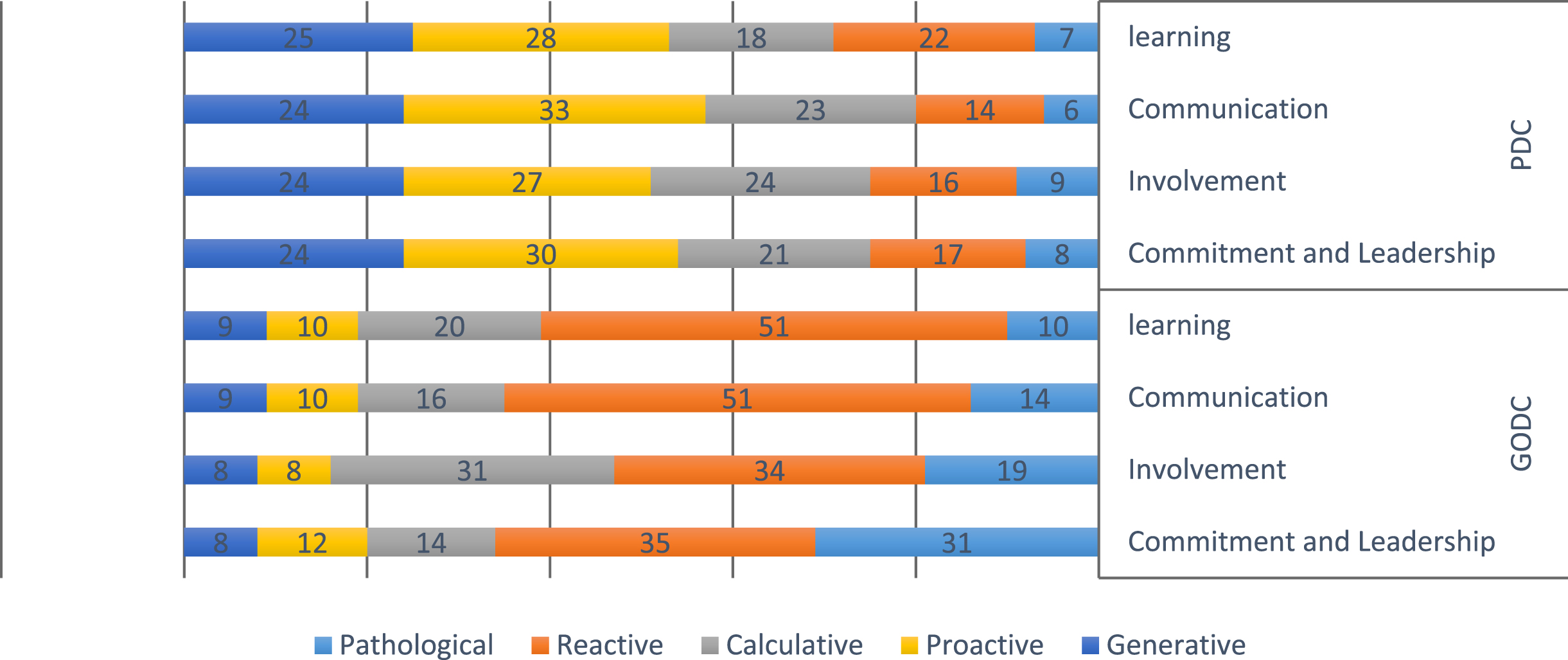
The percentage of process safety culture maturity levels in different dimensions in the studied drilling companies (GODC; government-owned drilling company, PDC; private drilling company).
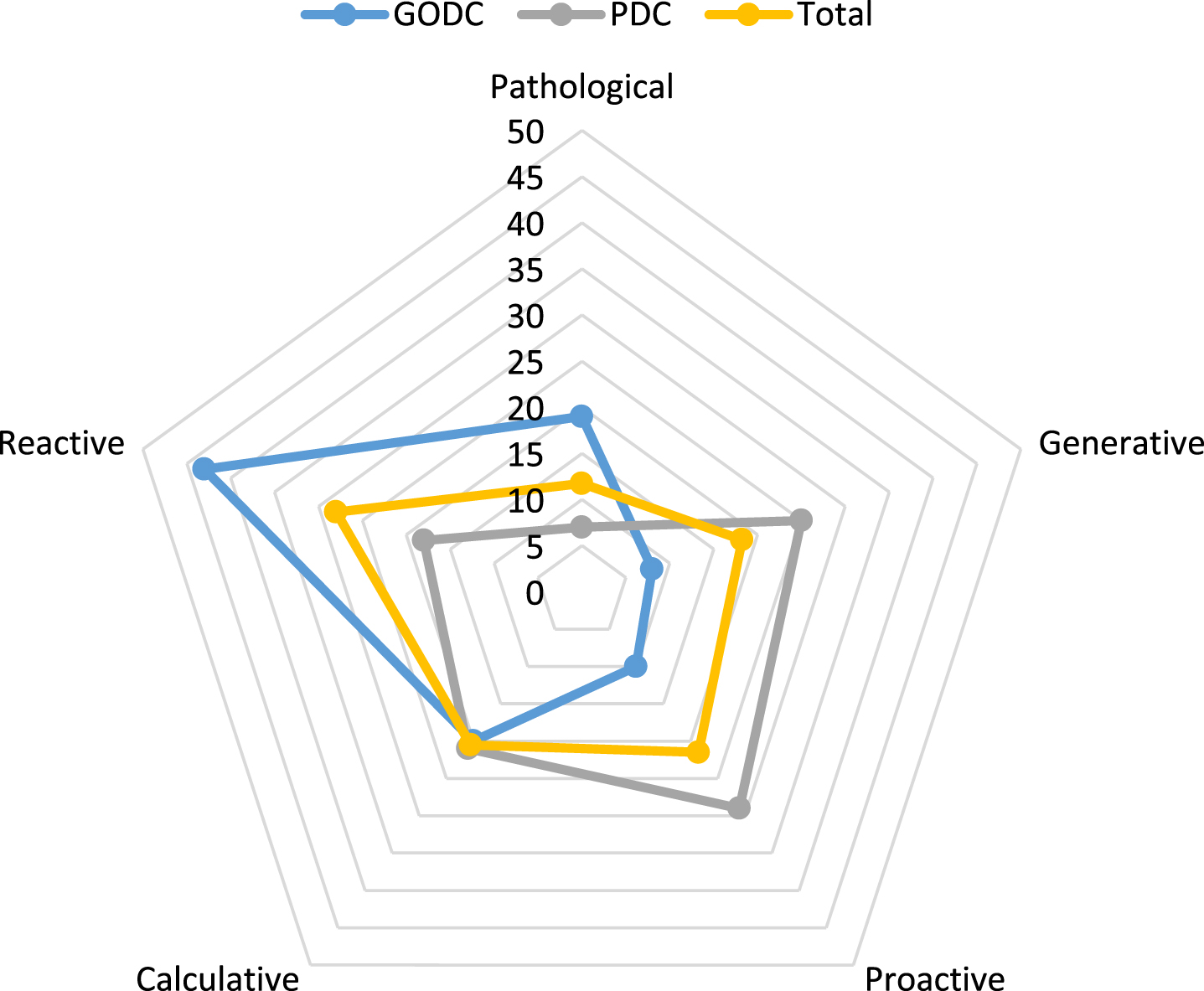
Comparison of process safety culture maturity levels in the studied drilling companies (GODC; government-owned drilling company, PDC; private drilling company).
Figures 1 2 shows the dimensions of the SCM in GODC compared to PDC. As shown, in GODC, the highest percentages of SCM in all dimensions is at reactive level. In PDC, the highest and lowest percent of SCM were related to proactive and pathological levels, respectively. These graphs also show that the SCM of the studied drilling companies is not favorable at the resilient level. For these reason, we decided to study the RE principles in more detail using RAG, which the results are shown in Fig. 3. As can be seen, the PDC had better RE performance in all abilities compared to GODC. Moreover, in the GODC, most respondents rated the status of learning, monitoring, and anticipating abilities as moderate and ability to respond as good level. In PDC, the status of response, monitoring, and anticipation abilities were reported as good and ability of learning as moderate level.

Results of resilience engineering evaluation in government-owned drilling company (GODC) and private drilling companies (PDC).
The purpose of this study was to investigate the SCM levels and RE principles in AODCs. The results showed that in none of the studied companies, high levels of SCM have not been established. Only 8 and 25 percent of participants reported the SCM at resilient level in GODC and PDC respectively.
SCM in drilling companies
All levels of SCM (pathological, reactive, calculative, proactive and resilience) were observed in the studied drilling rigs and companies. This is because reaching to high levels of maturity requires passing of early stages of SCM. The lowest and highest levels of SCM in all dimensions were observed in the pathological (11.75%) and reactive (28%) levels, respectively. Given that in all the studied drilling companies, safety management system had been established, it was expected that the level of maturity would be observed at the calculative instead of the reactive level. It seems that implementation of the above mentioned safety management system has failed to achieve its goals.
The results of this study are consistent with other studies in view of the fact that all levels of SCM (pathological, reactive, calculative, proactive and resilient) were observed in the studied drilling companies [23, 44–46]. However, regarding the highest frequency among SCM levels, the results of this study was different from other studies; while in this study, the highest level of SCM was reported at the “reactive”, in the study of Filho in Brazilian petrochemical industry [23], “proactive and resilient” had the highest levels of SCM. Moreover, in the oil and gas industry of Thailand [47], the highest level of SCM was at “calculative”. Stemna et al. also showed that SCM levels in the studied mining sites were mainly in the lower safety levels (pathological and reactive) [48]. The dissimilarity between above mentioned studies can be attributed to the difference in the nature and organizational characteristics of companies in different countries.
According to Shein [49], development of SCM occurs seriously at the resilient level. However, in the present study, only 16%of the respondents reported the level of SCM at the resilient, which is lower than values reported by other studies conducted in process industries [23, 47].
According to the findings of this study, while GODC had the highest percentage of SCM levels at the reactive (43%) and the lowest at the resilient (8%), in the PDC, the highest and lowest percentage of the SCM level was related to the proactive (29%) and pathological (7%), respectively. In PDC, rig No. 4, showed different characteristics of SCM, so that, in this rig, the level of SCM was reported mainly at “resilient” in all dimensions. Overall, the status of SCM in the PDC was better in all dimensions compared to GODC. This could be explained by the following factors: The level of education and work experience of the PDC employees were significantly higher than the GODC. Some studies have shown that education and work experience can enhance the safety culture [49]. Corrigan et al. also showed that employees with more work experience have a more positive perception of safety culture [50]. The size of the GODC is much larger than the PDC, and in addition to the two rigs in the Azar oilfield, it has a large number of rigs in other parts of the country. In large organizations with a large number of sub-sectors, a distinct culture can be created by managers in each of the sub-sections. Bascompta et al.’s study on the mining activities in South America showed that large scale mining improves their level of safety culture as the size of the company increases because of implementing control systems compared to small companies [51]. However, depending on the size and complexity of the organization, there are areas in which SCM is less developed than other regions. In addition, the safety culture needs time to be institutionalized, and its progress occurs more quickly in some areas because of organizational and managerial reasons. In this study, the number of STOP Cards, as a leading indicator of safety performance, issued in PDC was significantly higher than the GODC (2463 vs. 788). This indicates the active involvement of employees to report the unsafe act and conditions, as well as the management commitment to remedy deficiencies and corrective measures which is one of the prerequisites for reaching the high levels of maturity of the safety culture. In addition, according to the safety performance lagging indicators including AFR, ASR, LTI and LWD, PDC have better safety performance which is consistent with higher levels SCM in this company compared to GODC.
RE Status in drilling companies
Resilience is the intrinsic ability of a system to adjust its functioning prior to, during, or following changes and disturbances, so that it can sustain required operations under both expected and unexpected conditions. A resilient or proactive safety management requires that all levels of the organiz-ation are able to Respond to actual or regular and irregular conditions in an effective, flexible manner, anticipate potential long-term threats and opportuni-ties, learn from past events (factual), and monitor short-term developments and threats [38]. In this study, RE principles were studied using the RAG which measure four essential capabilities of resi-lience, namely: the ability to respond, monitor, and anticipate and learning.
The performance of studied companies was significantly better in ability to respond than other abilities, so that, 72.8%of the respondents assessed the status of this ability as desirable (good and very good). This figure has been reported at PDC to be 86.2%and in GODC to be 63%. These results indicated that work instructions and their training are better in PDC compared to GODC. In order to improve response capability of the companies under review, it is imperative that the managers provide necessary resources for the safety of staff, inform the personnel after any changes in the organization and assess the risks.
After respond ability, the highest level of RE was related to the ability to anticipate, so that, 44.3%of the respondents reported this capability at the desired level (respectively 30%and 53.3%for GODC and PDC). This component is the main idea of discovery and identification of possible future accidents (internal plus external events of the organization) that may result in harm to the organization or negatively affect it. The goal is to search for changes in the environment, such as the demands, resources and tools that can make this possible [34]. In order to increase this ability in surveyed drilling companies, organizations should raise awareness of personnel in the field of safety through training, make the necessary changes in the organization to the personnel and increase motivation of the personnel in their agenda. Organization management should analyze the accidents that occurred and take proactive and preventive measures to prevent their recurrence.
Regarding the ability to monitor, 41.4%of the res-ponses were at the favorable level. Among the RE abilities, the greatest difference between the GODC and PDC was in monitoring ability, so that respectively in the GODC and PDC, 25%and 63.3%of the responses were at the favorable level. The main weaknesses of the GODC in this regard was low level of personnel awareness about organization problems, lack of recruitment of qualified individuals and lack of adequate supervision over employers.
The ability to learn had the lowest status among the RAG capabilities of GODC and PDC. To improve the resilience in this dimension, a culture of reporting and managing accidents, incidents and unsafe acts should be developed.
The relationship between RE and the SCM
To illustrate the relationship between RE and maturity of the safety culture, the Hollnagel’s conceptual model, shown in Fig. 4, was used. Based on this figure, organizations are resilient when they are at the highest level of SCM. At this levels, there are fewer errors and organizations are more capable of responding, anticipating and monitoring events. Accordingly, at pathological level of SCM, the organization is unable to respond to any ability. At the reactive level, the ability to respond to RE is acceptable, but the ability to monitor is inadequate. For this reason, in cases where the organization faces a problem, it cannot go beyond learning and anticipating abilities due to the failure in identification and monitoring. At the calculative level, the ability to respond is adequate, the ability to monitor is stereotyped and the ability to learn is limited and based on defeats and failures. However, the ability to predict is not achieved in this level. At the proactive level, the ability to respond is at an effective level, and the ability to monitor and learn is sufficient. However, the ability to anticipate is inadequate. Only at the resilience level, the ability to respond is complete without any defect, and the ability to monitor is reached to the extent that individuals of an organization are mentally capable of monitoring. In this level, learning is done effectively for both positive and negative aspects, and in this view, the organization is fully capable of anticipating [41].
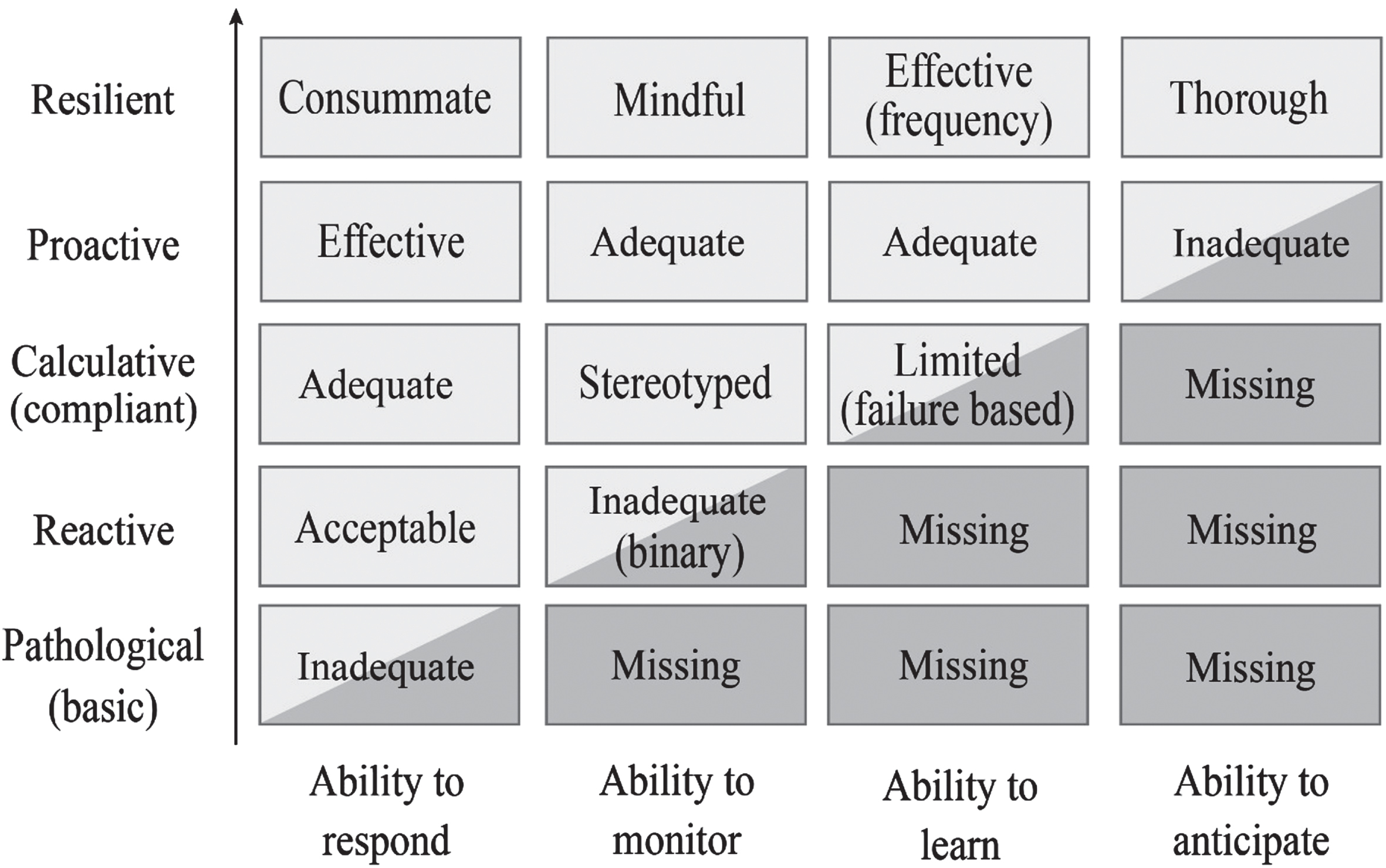
Hollnagel conceptual model of relationship between resilience engineering abilities and levels of process safety culture maturity [41].
In this study, the highest level of SCM determined at the reactive level (28%). At this level organization is expected to have adequate reactive capability, ability to binary monitor and lack the ability to learn and anticipate (Fig. 4). The most weakness of studied drilling companies were related to the “learning” and “monitoring” abilities and the best performance was related to the ability to “respond”, which is in line with the expectations in Fig. 4. On the other hand, 44.3%of people reported the ability to anticipate at a desirable (good and very good) level, which is higher than the expected level of response to the maturity of the safety culture. The reason for this can be attributed to the fact that the maturity of companies was not at the reactive level, and 18.25%of them reported it at a resilience level, and at this level, the ability to anticipate seems logical.
At the GODC, the highest level of SCM was at the reactive level. At such a level, the organization is expected to have adequate response ability, the ability to binary monitor, and inability to learn and anticipate. The greatest weakness of REG in GODC was related to the ability to monitor, anticipate and learn, and the best performance was related to the ability to respond, which is in line with the expectations of Fig. 4. On the other hand, 30%of people reported their ability to anticipate to be at a favorable (well and very good) level, which is higher than the expected level for the maturity of the safety culture. The reason can be attributed to the fact that SCM of the GODC was not completely reactive, and 18%have reported it on a proactive and resilient level. Conversely, given the fact that RE indicators were evaluated by managers and levels of SCM by employees, it is normal for the managers to report higher safety status. This has already been reported in the Hudson and Willekes studies in the Omani oil and gas industry [47]. In the PDC, all RE abilities were reported at desirable level which is in line with the highest SCM levels of proactive and resilient (Fig. 4).
This study investigates the interaction between SCM and RE and their relation to safety performance indicators among the employees of an oilfield drilling companies. Therefore, the results might not be generalizable to all industries and organization.
Conclusion
According to the results of this study all levels of SCM (pathological, reactive, calculative, proactive and resilient) were observed in the studied drilling companies. However, high levels of SCM have not been established in any of the studied drilling companies. The status of SCM dimensions and levels as well as RE performance was better in PDC compared to GODC which is consistent with their safety performance lagging indicators. To enhance the level of SCM and RE principles in the studied drilling companies, the following measures are required: The safety management systems that are cur-rently established in some companies as stereotypes should be implemented more accurately and precisely and elements of this system should be strengthened using the RE indicators. Risk assessment of working activities with active participation of all employees should be reviewed. Moreover, after publishing results of an accident and pseudo-accident analysis, all personnel should be informed about proactive strategies. An accurate program to receive employees’ feedback on safety plans should be developed and a two-way communication channel between management and personnel on safety issues should be established.
Footnotes
Acknowledgment
This article was extracted from a thesis written by Kiarash Zinat Motlagh, MSc. student of Occupational Health Engineering and was financially supported by Shiraz University of Medical Sciences under grant no. 95-01-04-11492. The authors wish to thank all industrial hygienists employed in the participating petrochemical plants for their kind assistance.
Conflict of interest
The authors declare no potential conflicts of interest with respect to the research, authorship, and/or publication of this article.
Funding
This study was financially supported by Shiraz University of Medical Science grant no. 93-01-42-795.