



Abstract
BACKGROUND:
Occupational self-efficacy (OSE) is an appropriate adaption capability to react to continuous changes in work life today. While self-efficacy is an important component in work context, there is less knowledge regarding older workers’ OSE.
OBJECTIVE:
This study examined the relationship between work ability, OSE and work engagement among a middle-aged workforce, and whether there were any differences between age groups and between professionals in different work context.
METHODS:
Data were collected by questionnaire, which included Work Ability Index (WAI), Occupational Self-Efficacy Scale, and Utrecht Work Engagement Scale.
RESULTS:
A total of 359 home care workers and engineers (response rate 43%) participated. The average age was 54 (SD±5.3) years, 69%were women. The results of logistic regression analyses revealed an association between WAI, OSE (OR 0.66; 95%CI 0.52 to 0.86) and work engagement (OR 0.61; 95%CI 0.47 to 0.78). Higher OSE and work engagement were related to higher work ability. No difference in OSE (5.9; ±0.8) between professional groups was seen, but the home care workers scored considerably higher work engagement (5.1; ±0.9) than the engineers (4.5; ±1.3).
CONCLUSIONS:
Improving OSE could be worthwhile to support work ability among middle-aged workers, despite dissimilarities in work context and educational level.
Introduction
Western societies are undergoing continuous change, including citizens’ work life [1]. Workers with an appropriate adaption capability are more likely to develop their skills and perceive the changes taking place as challenges to be overcome. Essential to such adaption is people’s belief in own capabilities [1]. Self-efficacy relates to people believing in their capability to successfully realize behaviors necessary to generate specific outcomes and is a core aspect of Bandura’s Social Cognitive Theory [2]. Self-efficacy is developed in four ways: mastery of experiences (overcoming obstacles through perseverance), social modelling (peers’ successful performances), social persuasion (encouragement of belief in one’s self), and good physical and mental health. Since people’s belief in own capabilities varies from situation to situation and across activity domains, Bandura recommended the measurement of domain-specific self-efficacy versus general self-efficacy [2]. The domain-specific occupational self-efficacy (OSE) pertains to workers’ belief in their capability to successfully perform in an occupational domain in respect to occupational adjustment and the management of obstacles [3]. Previous research has shown positive relationships between OSE and general health [4], and work-related factors, for example work efficiency [5], job performance [5, 6], work motivation and job satisfaction [4, 5].
Because of the decreasing number of workers in Europe, retaining ageing workers in work life is important [7]. Personal resources refer to intrinsic factors generally linked to individuals’ beliefs about whether they can successfully influence their environment [8, 9], and are found essential for work related wellbeing throughout the work life [10]. Universally, self-efficacy has been considered an important personal resource [9], and the domain-specific OSE an important personal resource for workers [3]. Research on workers’ general self-efficacy has shown age-related decline [11]. However, regarding work domain-specific self-efficacy among older workers there is less knowledge [5, 12]. Some evidence is found on higher OSE among older workers compared to younger ones [12, 13]. Negative attitudes, organizational [12] and workers’ own [5], towards ageing have been seen to decrease the older workers’ OSE. Among older workers, higher OSE has been related to better work motivation, job satisfaction and life satisfaction, but not to predicted future job performance and retirement age [5].
Research shows a positive relationship between OSE and work engagement [4, 14], especially when workers are facing work demands [15]. Workers with high self-efficacy tend to feel good at work and are motivated and engaged [16]. Similarly, people with high work engagement are both able and motivated to do a good job [17] and are primarily driven by intrinsic motivation [18]. Work engagement relates to a more persistent and pervasive affective-cognitive state of how workers experience their work as, “ . . . a positive, fulfilling, work-related state of mind that is characterized by vigor, dedication, and absorption” [19]. Vigor is characterized by high levels of energy and mental resilience and the willingness to devote time and effort at work. Dedication relates to having work as a significant and meaningful interest, while absorption is being fully concentrated and deeply absorbed in one’s work [19]. Work engagement is an important indicator of occupational well-being and is positively associated with, for example, health [14, 20], life satisfaction [17], low sickness absence, job resources [14], and job performance [21]. Yet even high-engaged workers may experience failure at work when self-efficacy is low [22].
In one multidimensional model, work ability is described as a balance between individual resources and work demands [23]. Individual resources include health and functional capacities, competence, values, attitudes and motivation. Work demands are related to working life, work community and leadership. Workers’ everyday work ability is influenced by individual resources, work demands, family and close community, which interact. Workers’ values, attitudes and motivation are strongly influenced by previous work life experiences and have the greatest influence on work. In previous studies, researchers have found that work ability tends to decrease with age, even though high individual variability exists [10, 24]. Chronic disease is typically seen to increase alongside age, and as the European workforce ages the proportion of workers with health-related limitations will increase [23, 26]. Having a chronic disease is often related to an imbalance between individual resources and one’s ability to meet work demands [25]. Still, because ageing is an individual process, a deterioration in one’s health does not necessary impact one’s job performance [27]. Nevertheless, the need to achieve a best-possible balance between individual resources and work demands throughout one’s working life exists [23]. The more positive values, attitudes and motivation to work a worker has, the more likely he/she will have a good work life, longer career, better work ability and better quality of life after retirement. In the shadow of a focus on decreasing work demands and increasing job resources [28], personal resources can help managing adverse work demands [8, 9]. Additionally, personal resources may, together with job resources, reduce the negative effects of age on work ability [10]. Thus improving workers’ self-efficacy may help workers meet emotional demands at work [15] and facilitate work engagement [15, 22] and motivation [5, 22].
The female-dominated health care sector and the male-dominated engineering sector are different both in terms of the nature of work and educational levels; however, each faces increasing job demands [29]. Finnish home care workers already perceive their workload to be too high, including a burdensome physical workload and an increased psychological one [30]. Many changes in home care work have taken place during the last few years. The greatest change has been an increased number of administrative tasks. Additionally, there are more clients overall, and with more complex care needs. These home care workers have expressed concern that the lack of home care staff constitutes a risk for the clients’ safety as well as for their own health. About 40%of them have considered quitting their work. Although the Finnish home care staff has been rejuvenated, approximately 60%are 45 years and older [30]. Previous research on self-efficacy among home care workers in different ages has revealed that self-efficacy promotes work ability [31]. For middle-aged nursing staff in Germany, researchers have found positive correlations between OSE and task performance and feeling recovered during leisure time, but no correlation between work reflection and contextual performance [32].
Engineers’ work content has also shifted due to changes in the world in the last 20 years [33]. The world has become more complex, interconnected and interdependent. The engineers’ work is characterized by offering solutions, and todays’ demands require different skills and broader competence compared to before. Engineers’ central role in high-tech companies still requires strong and unique technical skills. Additionally, it necessitates global understanding and competence, as well as entrepreneurship, creativity, teamwork and social skills [33]. In a report from the Finnish association for engineering academics, 25 %of their workers 50 years and above have experienced discrimination because of their age [34]. Higher self-efficacy belief has been found to buffer the negative effects of job demands on psychological strain among engineers [35].
To conclude, despite the importance of OSE on work engagement [4, 14–16] and work related well-being [3, 36], only few studies have investigated the relationship between OSE and work ability [10] among the ageing workforce [5, 12]. Moreover, regarding gender differences in OSE, contrary findings have been reported. Some studies have found higher OSE for men than for women [12], while others revealed no gender differences [3, 4]. Regarding educational status, higher OSE has been found among workers with college level education compared to primary education [3]. A Finnish sample showed higher work engagement for women than for men, and for white collar compared to blue collar workers [37]. Additionally, both home care and engineering sectors are considered upcoming bottleneck vacancies in Europe [38]. It is therefore important to retain workers of both professions in their respective work sector. In the future, ageing will affect access to labor in the European countries, resulting in recruitment difficulties [38]. We presume OSE to be an important personal resource also among ageing workers. In addition to the workers themselves, work organizations could therefore benefit from strengthening ageing workers’ OSE [36, 39].
The aim of this study was to explore the relationship between perceived work ability, occupational self-efficacy and work engagement among a middle-aged workforce. An additional aim was to examine whether there were any differences, regarding these variables, between ageing and older workers and between professionals in home care and engineering settings, despite dissimilarities such as work context, educational level and gender distribution.
Methods
Design and study population
The study had an observational and cross-sectional design. Forty-five years old and older home care workers and engineers were recruited from a region in Western Finland to answer an anonymous questionnaire (Fig. 1). In this study, workers aged 45 to 54 years were considered “ageing workers”. The term encompasses a period where major changes in function that can affect work ability and personal resources usually occur but where there are still nonetheless possibilities to improve functional abilities [40]. However, loss in work ability may accelerate if no preventive actions are taken. Workers aged 55 years or older were considered “older workers”. This threshold often used for older workers corresponds to their decline in the participation rate in the labor market [41], even though the rate for 55 years and older workers has slightly increased in the OECD area [42].
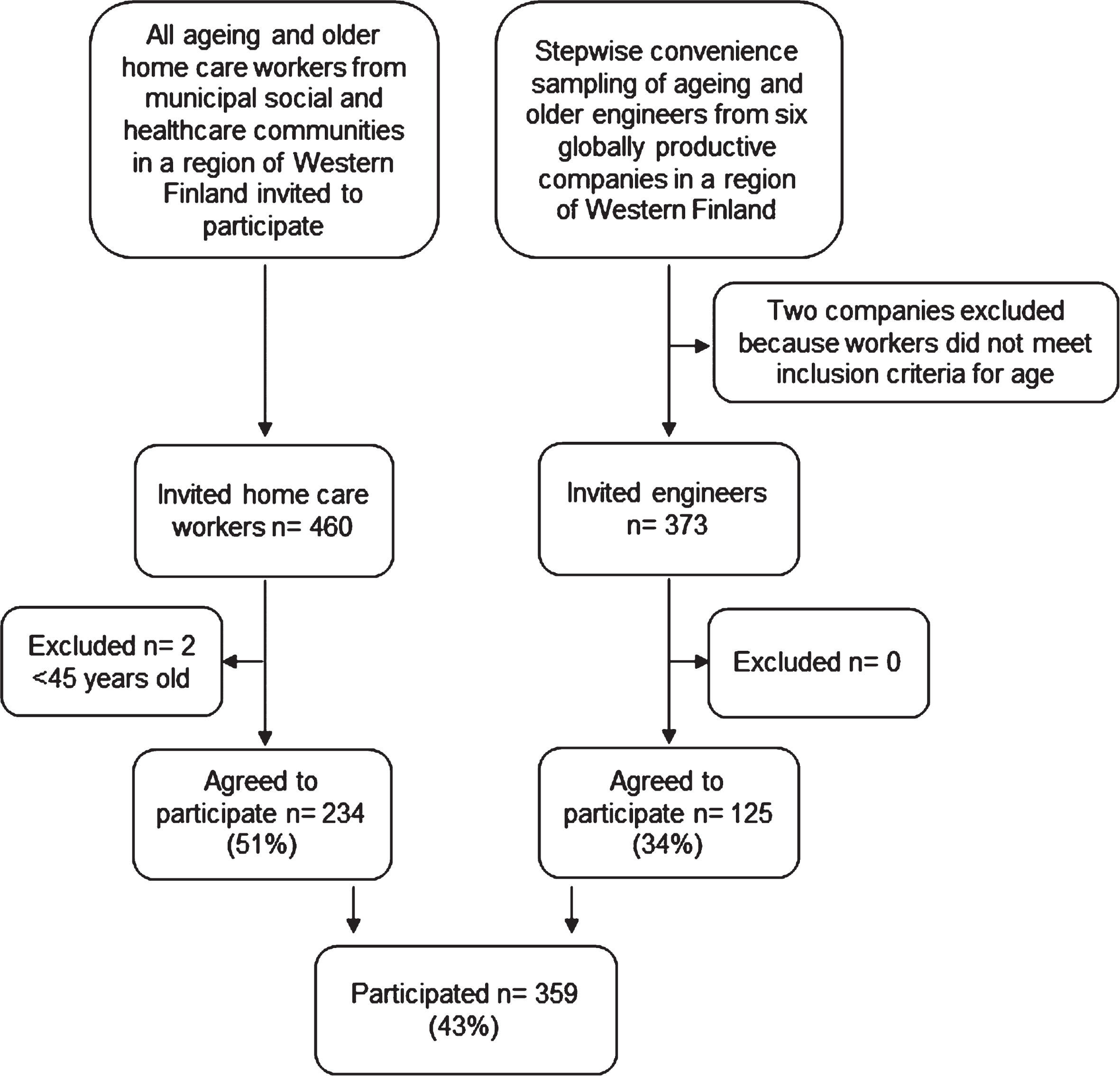
Flowchart of the sample selection and study population.
The main inclusion criteria were being 45 years old or above and having a valid employment contract. All home care workers meeting these criteria and working in municipal social and healthcare communities, regardless of educational level, were invited to participate. Their closest supervisors shared information about the study and access to the study questionnaire, in either paper-based or web-based form. Seventy-one percent of the participating home care workers completed a paper-based questionnaire. Data material from two home care workers was excluded because they were younger than 45 years old. Engineers meeting the inclusion criteria were invited by convenience sampling. One company at a time was selected following a discussion about the inclusion criteria with each company’s head of human resource management. While six companies were invited to participate, workers from two of these companies did not meet the inclusion criteria, because no 45 year-olds or older engineers were working there. These companies were excluded before the survey was sent out to their engineers. Thus, four globally productive companies were ultimately included. Each company’s local human resource department provided those participating with information about the study and access to web-based questionnaires. The period to collect data material was set for May to June 2018, and was extended to September 2018 to enable a larger participation. The collection ended at the end of September, despite some difficulties in recruiting engineers to the survey. The study questionnaire was made available in both the Swedish and Finnish languages.
Work ability
Perceived work ability was assessed using the Work Ability Index (WAI) [43]. The WAI measures seven aspects: current work ability compared with lifetime best, work ability in relation to physical and mental job demands, number of current diseases diagnosed by a physician, estimated work impairment due to diseases, sick leave during the past year, own prognosis of work ability two years from now, and mental resources. The WAI summative index ranges from 7 to 49 points and is classified into poor (7–27), moderate (28–36), good (37–43) and excellent (44–49) work ability. The WAI has been shown to have satisfactory internal reliability and construct validity, and is a highly predictive instrument for mental and physical wellbeing [44].
Occupational self-efficacy
Confidence in mastering various occupational tasks was measured using the Occupational Self-Efficacy Scale –Short Form [3] (OSS-SF). Statements in the OSS-SF (e.g., “I feel prepared for most of the demands in my job”) are scored using a seven-point Likert scale ranging from 1 (strongly disagree) to 7 (strongly agree). Higher mean scores indicate more positive OSE. The OSS-SF has been found to have satisfactory internal consistence and evidence of construct validity. The OSS-SF provides a domain-specific measurement. Defined by Rigotti et al. [3], OSS-SF refers to “the competence that a person feels concerning the ability to successfully fulfill the tasks involved in his or her job”. An advantage of this domain-specific measurement is that it enables a comparison of workers from different organizations, professions and/or jobs [3].
Work engagement
Work engagement was assessed with the short version of the Utrecht Work Engagement Scale (UWES-9) [45]. The UWES-9 consists of nine items (e.g., “At my work, I feel that I am bursting with energy”) and assesses the level of vigor, dedication and absorption at work, scored on a seven-point Likert scale ranging from 0 (never) to 6 (always). Higher mean scores indicate better work engagement. The UWES-9 has been found to have good internal consistency and test-retest reliability [40] and construct validity [46].
Covariates
Variables thought to affect the association between the WAI, OSS-SF and UWES-9 were selected based on a review of the literature and in relation to the feasibility of collecting data in the field. Included covariates were gender, age, marital status, educational level (low: no vocational training/professional school/traineeship contracts, high: vocational institute/higher vocational education/lower university degree/university degree), employment status (full-time/part-time employment, permanent/temporary employment), profession (home care worker/engineer) and work experience in years (continuous).
Statistical analyses
Descriptive analyses of baseline characteristics are presented as mean, standard deviation and percentage rates (Tables 1–2). Differences between groups were evaluated using the independent sample t-test and Mann-Whitney U test. Pearson’s chi-square test and Fisher’s exact test were used for categorical variables. Effect size was calculated using Rosenthal's formula [47]. Missing value analysis was performed to address concerns caused by incomplete data. The missing data varied between 0 and 4.7%in the variables studied. Little’s Missing Completely at Random (MCAR) test confirmed that missing data were completely at random (p = 0.084), which allowed data transformation through maximum likelihood estimation.
Characteristics of the study population, stratified by profession
Characteristics of the study population, stratified by profession
a = Independent Samples T-Test b = Mann-Whitney U Test c = Fisher’s Exact Test d = Pearson Chi-Square Test p-value = Differences between home care workers and engineers.
Characteristics of the study population, stratified by work ability (poor-moderate and good-excellent)
a = Independent Samples T-Test b = Pearson Chi-Square Test. p-value = Differences between poor-moderate work ability group and good-excellent work ability group. * = Widow n = 1 in good-moderate group, not included in p-test.
To examine the relationship between the WAI, OSS-SF and UWES-9, binary logistic regression analyses were performed to generate odds ratios and 95%confidence intervals (95%CI). Work ability was considered the dependent variable. Workers with poor or moderate WAI are at risk of losing their work ability, unless preventive or corrective actions are initiated [48]. Binary logistic regression enabled the examination of differences between poor-moderate and good-excellent levels of WAI. Therefore, we dichotomized WAI into poor-moderate work ability (= 1) and good-excellent work ability (= 0). The threshold of 55 years of age for older workers is often used because of the correspondence to decline in participation rate in the labor market [41]. Therefore, the variable age was dichotomized into 45–54 years old (ageing) and 55 and above (older workers), to analyze possible differences between the age groups. The variables OSS-SF, UWES-9, profession (home care staff = 1) and age (55 years and older = 1) were considered covariates. Nagelkerke R Square values are presented with regression analysis models (Table 4). The OSS-SF and UWES-9 have different scales, making them difficult to interpret and compare. Therefore, standardized slopes were used in the statistical analyses to facilitate the interpretation. All statistical tests were conducted at the two-sided p < 0.05 level of significance. The data were analyzed using SPSS Statistics 24.0 (IBM Corporation, Armonk, NY, USA).
Relationship between WAI, occupational self-efficacy, and work engagement by binary logistic regression
*** = p < 0.001 ** = p < 0.01 * = p < 0.05. Odds ratio with 95%confidence interval (95%CI). Reference group: poor-moderate WAI. Standardized slopes for occupational self-efficacy and for work engagement were used in regression analysis. WAI = Work Ability Index.
Of 833 questionnaires, 359 were completed after three reminders, yielding a response rate of 43%(home care workers n = 234, 51%; engineers n = 125, 34%). Participants were on average 54±5.3 years old and 69%were women (Table 1). The majority were home care workers. As there were only a few men (n = 2) among the home care workers and a few women among the engineers (n = 15), the results are presented in relation to professional groups.
The average WAI was good in both professional groups (Table 3). More than two-thirds of the participants had good-excellent work ability. Among the home care staff, there was a higher proportion of workers with poor-moderate work ability compared to the engineers (Table 2). In addition to more often being home care workers, those with poor-moderate work ability were generally older, women, part-time employed, and had both physically and psychologically demanding work; all factors related to a greater degree to home care workers in this study. Three-quarters of home care workers perceived their work to be both physically and psychologically demanding, while nearly all of the engineers perceived their work to primarily be psychologically demanding. Both professional groups perceived their work ability to be rather or very good, due to work-related psychological demands. However, in the poor-moderate work ability group, significantly more engineers (68%) than home care workers (43%) (p = 0.030) perceived their work ability in relation to psychological demands as poor-moderate. The poor-moderate work ability group had more currently diagnosed diseases (p < 0.0005). The most common were musculoskeletal (73%) and cardiovascular diseases (40%), also most common among the good-excellent work ability group (25%and 16%each).
Comparison of WAI, OSS-SF and UWES-9 measurements between groups
Comparison of WAI, OSS-SF and UWES-9 measurements between groups
p-value for differences between home care workers and engineers, and between poor-moderate WAI and good-excellent WAI. p-values were analyzed using Mann-Whitney U Test. Effect size were analyzed using Rosenthal’s formula. SD = Standard deviation. OSS-SF = Occupational Self-efficacy – Short Form. UWES-9 = Short version of the Utrecht Work Engagement Scale. WAI = Work Ability Index.
The poor-moderate work ability group showed lower OSS-SF and UWES-9, meaning that their belief in being able to successfully accomplish work-related tasks and work engagement were significantly lower compared to the good-excellent work ability group (Table 3). In the whole study sample, the reported mean values of OSS-SF were seen to be at the same level for both professional groups. However, the engineers showed significantly lower UWES-9 compared to the home care workers, meaning they had a significantly lower work engagement regardless of their level of WAI. Stratified into age groups, older workers had significantly higher OSS-SF and lower WAI compared to ageing workers. No differences were found between age groups in UWES-9. Despite frequently significant values, effect sizes were mostly at a low level, except for the moderate level difference between WAI groups in UWES-9.
Before testing the regression model, a correlation analysis between the study variables was conducted. Spearman’s rho showed significant correlations in the whole sample between the dichotomous set WAI (poor-moderate = 1, good-excellent = 0) and OSS-SF (r = –0.236, p = 0.000), UWES-9 (r = –0.334, p = 0.000), profession (r = –0.145, p = 0.006), gender (r = –0.138, p = 0.010), educational level (r = –0.128, p = 0.016), and dichotomous set age (r = –0.119, p = 0.025). For the home care workers, Spearman’s rho showed significant correlations between WAI and OSS-SF (r = –0.210, p = 0.001) and between WAI and UWES-9 (r = –0.360, p = 0.000). Similar correlations were seen for the engineers: OSS-SF (r = –0.332, p = 0.000) and UWES-9 (r = –0.502, p = 0.000). Nevertheless, based on Fisher’s r-to-z transformation, the correlation between WAI and OSS-SF was not significantly different between the professional groups (z = –1.17, p = 0.242), nor the correlation between the WAI and UWES-9 (z = –1.53, p = 0.126). Subgroup binary logistic regression analyses were computed, and no differences in explanatory variables between the home care workers and engineers were found. For this reason, the results from the regression analyses were presented for the whole study sample.
The results of the binary logistic regression analyses showed a significant relationship between the WAI, OSS-SF and UWES-9, even after adjustment for additional covariates (p < 0.05). The unadjusted model included the OSS-SF and UWES-9 as explanatory variables. In the adjusted model, socio-demographic factors with p-value < 0.05 in Spearman’s rho test were also included. A model including solely socio-demographic factors such as profession, work experience, level of education and age showed non-significant results and are therefore not presented in Table 4 (Nagelkerke R Square 0.048). Interactions between work ability and possible confounders for OSE were also tested, with non-significant results. The results revealed that higher OSS-SF and UWES-9 more often related to good-excellent WAI as well. Being a home care worker entails four times greater odds and being 55 years or older entails twice greater odds of having poor-moderate work ability, when compared to the reference group in each dichotomous variable.
In this study we examined the relationship between 45-year-olds’ and older workers’ perceived work ability, OSE and work engagement. Additionally, we investigated possible differences between ageing and older workers in the home care and engineering professions. The main finding was that higher OSE was related to higher work ability among both ageing and older home care workers and engineers, despite the differences in their work content and work context.
Regarding the home care workers, these results are consistent with findings by Larsson et al. [31]. Given that previous research on ageing engineers’ OSE and WAI was not found, the findings here contribute new knowledge on male-dominated technical professions. Similar to earlier findings [12], older workers in our study perceived higher OSE in comparison to ageing workers. Such results support the assertion that OSE is an important personal resource also for the ageing and older work force, which corresponds to previous research [5].
As seen in previous research, during the past few years both home care workers [30] and engineers [29] have reported experiencing an increasing level of work-related psychological demands. In the holistic Work Ability House-model, work ability is defined as the balance between individual resources and work demands [23]. In the Job Demands-Resource (JD-R) model, the workers’ performance and well-being are similarly explained in terms of work demands and job resources (for an overview: [9, 49]). In the development of the JD-R model, personal resources were included [49]. Workers with high personal resources can successfully control and influence their environment [8, 9]. Personal resources can help workers resist adverse work demands. Additionally, personal resources may, together with job resources, decrease the negative effects of age on work ability [10]. Self-efficacy is stated as an important personal resource enabling work-related well-being [5, 16], and previous research has revealed that enhancing workers’ self-efficacy can help them meet emotional demands at work [15]. Therefore, based on our results, we claim that OSE might be helpful also for ageing and older workers to cope with work-related demands.
However, activities supporting work ability among the ageing workforce mainly focus on harmonizing work demands against job resources [26]. Supporting activities less frequently focus on improving personal resources. According to the results in our study, enhancing OSE might strengthen work ability among ageing and older workers. Previous research has also indicated that it is worthwhile to enhance OSE in occupational interventions [13]. Self-efficacy can be stimulated through mastery experiences of overcoming challenging obstacles [2]. In the changing home care and engineering sectors, including the high number of work demands [30, 33], strengthening OSE by mastery experiences could be valuable. Mastery experience is the most significant indicator for workers’ abilities [50]. While exceeding demands will undermine self-efficacy beliefs, meeting challenges that are possible to overcome will instead increase them. Nevertheless, leaders and organizations have a great mandate since they have the power to improve the work environment [51, 52], consequently influencing work demands.
Even though OSE was related to work ability among both home care workers and engineers, their work context highly differs. In general, all workplaces and work situations as well as all workers are different [51]. Therefore, the actions improving workers’ opportunities to remain longer in working life need individual, organizational and company adaptations. As regards the role of social modeling of similar others in corresponding situations [2], interventions planned to enhance OSE should consider individuality also in group-based interventions.
In our study both ageing and older workers had higher work engagement when compared to a previous Finnish sample [37]. Also the home care workers had considerably higher work engagement when compared to the engineers. For the engineers, work engagement was at about the same level as in a sample including Finnish supervisor engineers [37]. The home care workers had higher scores when compared to other studies for healthcare workers [37] and home care aids [31]. When emotional demands are high, high self-efficacy facilitates work engagement [15]. Both professional groups in our study perceived their work ability as good in relation to work-related psychological demands and both professional groups demonstrated high OSE, which nonetheless still does not illuminate the difference seen between the groups in relation to work engagement. One can suppose that the difference may be related to home care workers’ and engineers’ dissimilar work content and work contexts. Home care workers perceive their work to be meaningful and have a high sense of responsibility for their clients, even when it negatively affects their own health [30]. The meaningfulness of the home care work itself acts as an inner motivation [53]. Even though work engagement differs from motivation, high work pleasure and involvement refer to dedication and reflect the motivational aspect of the concept [54]. Work engagement refers to the content of work rather than to the workplace itself. Job resources are physical, psychological, social and organizational, functional in achieving work goals and stimulating personal growth, learning and development. Job resources act as motivational factors and are most predictive for work engagement. Consequently, to support the engineers’ work engagement, coaching supervisors giving feedback, a positive team atmosphere and learning opportunities throughout their working career might be helpful, and will contribute to higher self-efficacy as well [54].
Methodological considerations
A strength was that the study sample encompassed both the nursing and technical sectors and national and international work contexts. Despite the different natures of the professions included, no differences in explanatory factors regarding work ability were seen. One limitation was the response rate of 43%. This could imply a possible selection bias, whereby the results should be interpreted with some caution. A disadvantage of using a questionnaire is the risk of a high number of dropouts. Here the engineers demonstrated a lower response rate (34%) in comparison to the home care workers (51%). This difference can possibly be attributed to the different methods whereby the questionnaire was administered. For the engineers, their company’s human resource department distributed the questionnaire while for the home care workers their closest supervisor distributed the questionnaire. A questionnaire distributed by a close supervisor may have motivated workers to a greater degree to complete the questionnaire. The home care workers were also able to choose between a paper-based or web-based questionnaire, as opposed to the engineers who were only provided with a web-based questionnaire. Still, because the average WAI here did not differ from a previous Finnish sample [55], the sample here can be considered representative. Another limitation was the cross-sectional design of the study, which did not allow for testing causal inferences. Also, because the measures were self-reporting, some self-report bias might have influenced the results. Furthermore, some researchers question the use of chronological age as a determinant of work ability, because of the high individual variability in age related declines [27]. Nevertheless, the use of a start age of 45 years [40], chosen in relation to age-related functional decline that affects work ability, still allowed for the use of the terms ageing and older workers.
Conclusions
Higher OSE was positively associated with higher work ability among middle-aged workers in home care and engineering settings. OSE was on the same level in both professions, despite dissimilarities such as work context, educational level and gender distribution. Based on these results, improving occupational self-efficacy could be worthwhile in supporting work ability among ageing workforce.
Conflict of interest
None to report.
Ethical approval and consent to participate
The study was performed in compliance with the ethical principles delineated by the Finnish National Board on Research Integrity and was approved by the Board for Research Ethics at Åbo Akademi University, Turku, Finland (dated April 12, 2018). All individual participants in the study received written information that completing the survey meant consent to participation in the study.
Funding
Funding for this study was provided by Åbo Akademi University, Finland.