



Abstract
BACKGROUND:
Noise is a common harmful physical factor in the work environment.
OBJECTIVE:
This study sought to prioritize noise control methods using the analytical hierarchy process (AHP) in a tire factory.
METHODS:
The study, which adopted a cross-sectional, descriptive, analytical design, was conducted in the baking hall of an Iranian tire manufacturing factory in 2018. 4 criteria (namely implementation and maintenance cost, method applicability, method effectiveness and efficiency, and intervention in the process) and 8 alternatives (including reducing individuals’ noise exposure time, designing and installing sound isolation chamber for operators, using of earmuffs and earplug simultaneously, changing processes or operational procedures in machinery with excessive noise generation, forming noise control engineering teams, requiring people in charge to quickly fix the leaks and change baking press washers on time, using acoustic panels in the ceiling and walls, and designing and manufacturing silencer and nuzzle for the steam and compressed air outlet of baking press machinery) were selected. Then, to prioritize noise control methods based on objectives, criteria, and alternatives, an AHP questionnaire was developed and completed by domain experts and noise control specialists. Data analysis was performed using Expert Choice V. 11 and Excel.
RESULTS:
The results showed that the inconsistency rate in all cases was less than 10%, hence the consistency of responses was approved. Based on experts’ opinion about the selected criteria, “implementation and maintenance cost” had the highest weight (0.481), while “method effectiveness and efficiency” recorded the lowest one (0.046). With regard to the alternatives, “change in the process” registered the greatest weight (0.193), whereas “individuals’ noise exposure time” had the lowest weight (0.046).
CONCLUSIONS:
Based on the final weights, the most appropriate noise control methods in this industry are changing processes in machinery with excessive noise generation, forming noise control engineering team, and manufacturing silencer and nuzzle for the steam and compressed air outlet of baking press machinery. Furthermore, AHP is a suitable approach for prioritizing decisions related to noise control.
Introduction
Noise is an indispensable component of every human- related activity. Depending on its effect on human health, noise is divided into two categories: occupational noise (i.e. noise produced in the work environment) and environmental noise (i.e. noise generated in the society, residential areas, traffic, etc.). Over 30 million workers in the US are exposed to dangerous noises [1]. In 1990, 200 million dollars were paid as compensation for hearing loss in the US [2]. In Germany, around 4–5 million people (accounting for 12%to 14%of the work force) are exposed to excessive sound pressure levels, as defined by the World Health Organization (WHO) [3]. Based on the available information, it seems that 2 million Iranian workers are exposed to excessive occupational noise. In most of the work environments across the world, excessive noise is regarded as a serious challenge [4, 5]. Noise exposure may have non-auditory effects as well, such as disruption to the autonomic nervous system, which may contribute to increased skin temperature and pulse rate, high blood pressure, constriction of blood vessels, excessive hormone secretion, and muscle tenseness. Furthermore, studies have shown that noise exposure in the workplace has a negative impact on efficiency, as well as an increase in human error and fatigue [6, 7].
Intervention of secondary sources in work environments creates complicated noise fields. Some of these sources include airborne noise, structure-borne noise, reflection on the edges of machinery, and reflection from the floor, wall, ceiling, and machined surface. Therefore, prior to taking any control measures, noise generating sources must be identified and prioritized. Work equipment and environments can be improved to reduce noise production or isolated to prevent noise transfer to surrounding environments. Steps that are taken in this regard are known as engineering control measures, which are usually expensive and certainly more effective than individual controls and personal protective equipment [8].
Noise can be controlled via three methods: 1- control methods in the noise generating source; 2- control methods through propagation ways (the area between the source and the recipient of noise); 3- noise recipient (worker). Usually, to implement effective control measures, all three engineering control methods should simultaneously be adopted. However, the best procedure for noise control is implementing measures at the noise generating source [8]. In addition to engineering control methods, there are some other techniques that can be applied to reduce noise exposure. These techniques include management controls (e.g. changing processes, replacing staff members, job scheduling, etc.) and use of personal protective equipment [9, 10].
Controlling noise in the work environment seems to be a given. Nonetheless, since financial resources in every industry are limited, all noise control methods cannot be implemented simultaneously. Thus, it is essential to prioritize such measures and implement the most influential ones. A constructive procedure in this regard is using decision making methods to give priority to the most effective noise control methods in the industry. Decision making entails the process of selecting the best alternative out of the available choices. That is, while trying to accomplish a duty, one may encounter various alternatives and they are required to make the best choice. Issues in which several factors must be simultaneously evaluated for making a decision are known as multiple criteria decision making (MCDM) problems. MCDM is a major decision making operation in which several assessment criteria (rather than one criterion) are taken into account. MCDM comprises developing a decision tree through selecting, weighing, and ranking all relevant criteria [11].
MCDM models are divided into two general categories: multiple objective decision making (MODM) and multiple attribute decision making (MADM) [12]. One of the most popular techniques in MADM is the analytical hierarchy process (AHP) [11, 13]. AHP is a very famous MCDM technique originally proposed by Thomas L. Saaty (who had an Iraqi origin) in the 1980s [12, 14]. This technique is mainly used for making decisions based on qualitative criteria. AHP utilizes the mathematical foundation of matrices to prioritize various alternatives. In addition to mathematical procedures, experts’ opinions may be sought [12]. Since AHP is in alignment with human thought processes and its algorithm is based on a mathematical logic, it is highly efficient, with its application solving many decision making problems [12, 15].
Sekhavati et al. (2014) exploited AHP to prioritize noise control and reduction measures in a cement factory in Larestan, Iran [16]. A similar study was carried out by Eshaghi et al. (2012) in a glass factory in Hamedan [12]. However, there is a small body of studies investigating noise control methods in tire manufacturing factories across the world.
Few studies have been conducted in Iran and around the world to investigate noise control measures in tire manufacturing industries that use AHP. As a result, the current study used AHP in one of Iran’s tire manufacturing complexes to accomplish the following goals: Assessment of the inconsistency rate’ Pairwise comparison of the criteria Pairwise comparison of alternatives within each of the criteria Assessment of the relative weight of alternatives in the light of each criterion Assessment of the final weight of research alternatives
Materials and methods
Research design
The study adopted a cross-sectional, descriptive, analytic design to prioritize various noise control methods using AHP. The study was conducted in 2018 in a tire manufacturing factory in Iran. Ethical approval was obtained from the Ethics Committee of Kerman University of Medical Sciences (IR.KMU.REC.1397.392).
The following steps for weighting and prioritizing the sound control method are performed using the method of AHP: 1- Identifying the purpose, criteria and sub-criteria; 2- Creating a problem tree; 3- Creating a questionnaire and preferential judgment; 4- Prioritizing and weighing Criteria and options for the AHP method.
Industry selection
The research was carried out in an Iranian tire manufacturing complex. In this factory, there were 15 curing press machines in each row, for a total of four rows (hence the total number of machines was 60). Every two machines were 2 m apart, and the hall measured 100 m in length, 50 m in width, and 9 m in height. The number of machines, the distance between them, and the hall volume can all have an impact on the amount of noise generated. In addition, 30 twin PLC tire curing press machines facing each other were placed in the center of the hall. To cure tires, these machines used direct heat under compressed air. Furthermore, 30 singleton OTR tire curing press machines were installed on both sides of the hall. These machines used compressed air and vapor to create 70 different types and sizes of tires for automobiles, trucks, lightweight, semi-heavy, and heavy machinery, as well as agricultural machines. This factory employed between 2000 and 2300 people. Sixty-six of them worked three shifts in the curing hall (22 workers in each 8-hour shift, with the morning shift beginning at 8 a.m.). The curing hall had a total area of 5000 m2, while the sandblast and trimming units took up 200 m2.
Determining the purpose, criteria and sub-criteria
The aim of this case study was prioritizing elements with the aim of helping factory directors identify the best noise control methods. To this end, a simple three-level hierarchical structure was developed. An initial challenge in this regard was determining the appropriate number of levels and variables. Previous literature on prioritized noise control methods in Barez Tire Factory was used to overcome this problem and construct a hierarchy (Fig. 1). In this model, the highest level entails the overall goal, namely to construct an evaluation structure for convention site selection with weights corresponding to the criteria. The second level following the overall goal has to do with the criteria (or factors) influencing prioritized noise control methods in Barez Tire Factory. These factors are A* (implementation and maintenance cost), B* (method applicability), C* (method effectiveness and efficiency), and D* (intervention in the process) [17, 18].
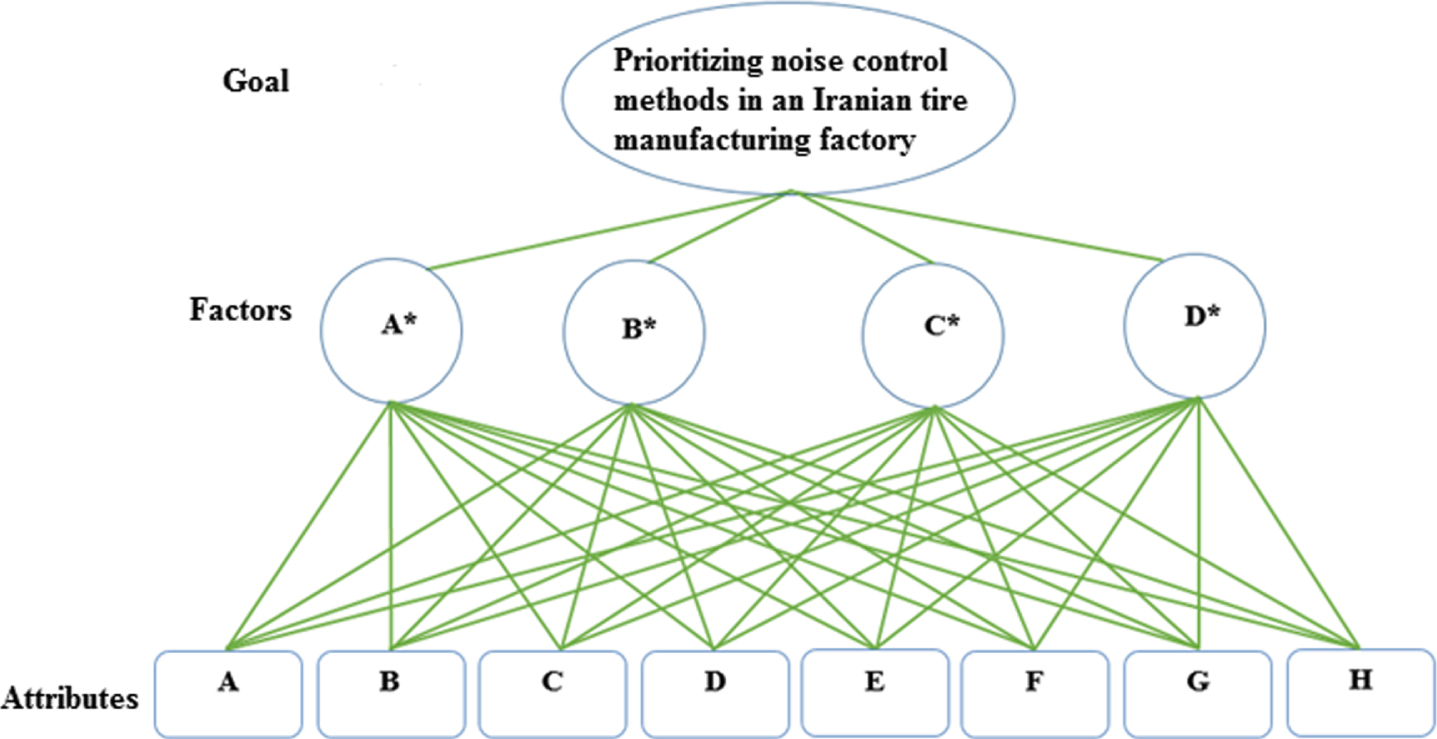
The hierarchy of convention site selection.
In the third level, different sets of sub-criteria (i.e. Attributes) were identified and connected with each factor in the second level. In total, 8 attributes were proposed in the third level, including A (reducing individuals’ noise exposure time), B (designing and installing sound isolation chamber for operators), C (using earmuffs and earplug simultaneously), D (changing processes or operational procedures in machinery with excessive noise generation), E (forming noise control engineering teams), F (requiring people in charge to quickly fix the leaks and change baking press washers on time), G (using acoustic panels in the ceiling and walls), and H (designing and manufacturing silencer and nuzzle for the steam and compressed air outlet of baking press machinery) [17, 18].
At first, a list of all criteria (10 criteria) and noise control methods (16 alternatives) was prepared. Then, a questionnaire was developed based on this list and submitted to 15 industrial and occupational health experts, who were specialized in noise control. Receiving their feedback, 4 criteria and 8 alternatives were selected to be prioritized in terms of their effectiveness and efficiency in noise control. The criteria and alternatives were scored on a Likert scale (as illustrated in Table 1). The selected criteria and alternatives subsequently underwent AHP to prioritize them in the light of their effectiveness in noise control.
9-point intensity of relative importance scale
9-point intensity of relative importance scale
As a popular MCDM method, AHP has been extensively utilized by researchers in a wide array of decision making processes and human-related judgments [19]. Using this approach, an evaluation model is constructed through weighing various criteria. As a result, various measures are integrated into a single total score for ranking different alternatives. AHP simplifies a multiple criterion problem through breaking it down into a multilevel hierarchical structure. The solutions obtained through AHP should not be regarded as mere statistics. Rather, they help decision makers to come up with plausible solutions for an MCDM problem [20].
AHP is applied through three basic steps: 1- decomposition, or the hierarchical construction; 2- comparative judgments, in which data collection procedures are executed to compare data pairwise in the light of the elements of the hierarchical structure; and 3- synthesis of priorities, which leads to the construction of an overall priority rating [21].
Decomposition is accomplished using available studies and empirical experiences. According to AHP principles, the problem should be decomposed and hierarchically structured by all those involved in the decision-making process. Nonetheless, it is not necessary for all the participants to agree on every single problem component during the planning process [22]. On the other hand, including all relevant elements in the hierarchical structure is of utmost importance. A hierarchy is typically formed beginning with the top (objectives from the management viewpoint), moves down to the intermediate level (entailing criteria and sub-criteria on which the next levels depend), and concludes with the lowest level (including the list of alternatives).
Once the hierarchy is designed, data should be collected to conduct pairwise comparisons which aim at assessing the relative importance of the elements in each level, a process known as the prioritization procedure. The criteria and sub-criteria at each level of the hierarchy do not carry equal weight in terms of importance. Furthermore, each alternative may be rated differently on various criteria. In total, AHP makes it feasible for decision makers to gauge the value of different alternatives through an analytical process [23].
In fact, an advantage of AHP over other methods is that it compares two elements simultaneously, hence considerably declining the conceptual complexity of an analysis. This simplification of pairwise comparisons is achieved by following some steps proposed by Saaty (1980) [24] or others [25, 26]. (1) Beginning at the second level and working down, a comparison matrix is developed at each level of the hierarchy; (2) the relative weight for each element of the hierarchy is assessed; and (3) the consistency ratio is estimated to check the judgment reliability.
At each level, elements are compared pairwise in the light of their significance to an element in the upper level. Moving in a top-down manner in the hierarchy, the pairwise comparisons at each level can be reduced to some square matrices A = [aij] nxn, as in the following (Equation 1):
The matrix has reciprocal properties, which are shown in Equation 2;
Saaty (1980) proposed a scale of relative importance ranging from 1 to 9 to make subjective pairwise comparisons (see Table 1) [24]. Upon developing pairwise comparison matrices, the vector of weights, w = [w1, w2,..., wn], is computed based on Saaty’s eigenvector procedure. Two steps are taken in the weight computations; initially, the pairwise comparison matrix, A = [aij] nxn, is normalized Equation 3, followed by computing the weights through Equation 4.
For all j = 1, 2,..., n.
For all I = 1, 2,..., n.
Saaty (1980) demonstrated an association between the vector weights, w, and the pairwise comparison matrix, A, as illustrated in Equation 5 [24].
At AHP, the λmax value is a crucial validating parameter, which is utilized as a reference index to screen information through computing the consistency ratio (CR) of the estimated vector. In order to calculate the CR, the consistency index (CI) for each matrix of order n is obtained from Equation 6.
Subsequently, CR can be calculated using Equation 7:
Random inconsistency indices (RI) for N = 10
Where aqij is an element of the matrix A of an individual q (q = 1, 2,..., Q), and ahpij is the geometric mean of all individuals aqij. The group CR is calculated using Equations 6 and 7.
After gathering the questionnaires completed by noise control experts and technical specialists in the tire manufacturing factory, the data were analyzed using Expert Choice. V.11 and Excel [28].
Results
Examining the questionnaires completed by experts and formulating the group decision matrix by the use of a geometric mean showed that the inconsistency rate was 0.024. Upon determining the consistency rate, the following results were yielded for prioritization of noise control methods:
Table 3 shows the pairwise comparisons of criteria based on the geometric mean method. As observed, implementation and maintenance cost has the greatest importance, while the method effectiveness and efficiency has the lowest significance (Table 4). Tables 5 8 display the results of pairwise comparison of alternatives within each of the criteria.
Pairwise comparison of criteria
Pairwise comparison of criteria
The weight of the major criteria based on decision makers’ view
Pairwise comparison of alternatives based on criterion A*
Pairwise comparison of alternatives based on criterion B*
Pairwise comparison of alternatives based on criterion C*
Pairwise comparison of alternatives based on criterion D*
Thus, the inconsistency rate of the matrices obtained as a result of pairwise comparison of alternatives are 0.091 (for criterion A* which entails implementation and maintenance cost), 0.087 (for B* which includes method applicability), 0.093 (for C* which has to do with method effectiveness and efficiency), and 0.075 (for D* which refers to intervention in the process). Given that the inconsistency rate is below 10%, the viewpoints’ matrices are consistent and the results enjoy the highest possible accuracy.
Table 9 displays the relative weight of the alternatives within each of the criteria. Based on the obtained weights of alternatives within each criterion calculated through collecting data from decision makers, the highest relative weight recorded for the first criterion (A*: implementation and maintenance cost) belongs to alternative D (changing processes or operational procedures in machinery with excessive noise generation) (0.317), for the second one (B*: method applicability) was observed in alternative E (forming noise control engineering teams) (0.415), for the third criterion (C*: method effectiveness and efficiency) belongs to alternative D (changing processes or operational procedures in machinery with excessive noise generation) (0.358), and for the fourth criterion (D*: intervention in the process) was detected in alternative A (reducing individuals’ noise exposure time) (0.279).
The relative weight of each alternative within each criterion
After calculating the relative weight of the research criteria in the light of the research objective and the relative weight of the alternatives within each criterion, the final weight of the research alternatives can be calculated. To do so, the relative weight of the major criteria should be multiplied by the relative weight of the alternatives within these criteria. Then, the total score should be obtained for each alternative, a move that yields the final weight of that particular alternative (Table 10).
The final weight of criteria and alternatives based on the criteria
As indicated in Fig. 2, “changing the process”, with a weight of 0.193, has the highest priority, while “reducing individuals’ noise exposure time”, which has a weight of 0.046, comes last with respect to its priority.
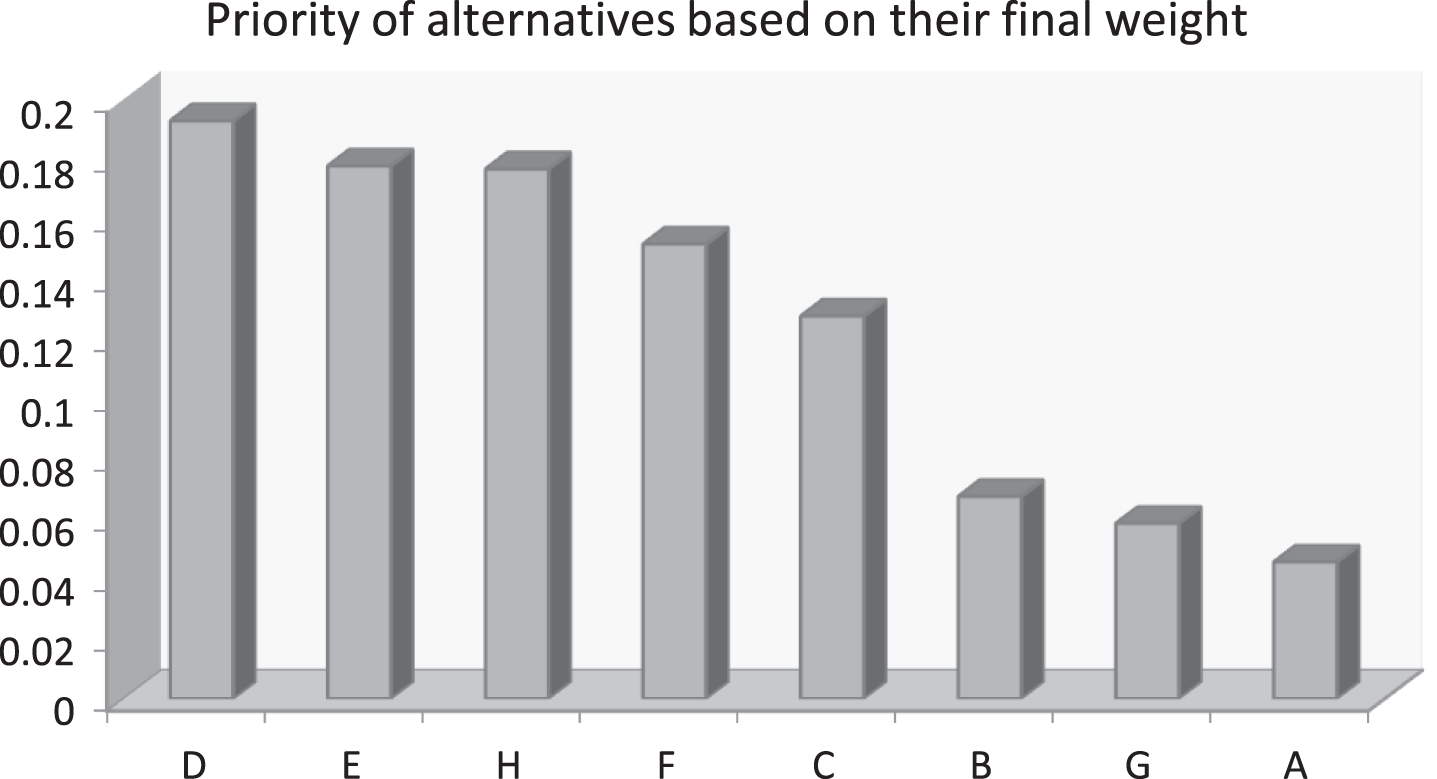
Final weight and priority of research alternatives.
This study was carried out in an Iranian tire manufacturing factor in 2018 and aimed to select and prioritize noise control methods through utilizing AHP. To do so, the features of this industry, the noise generating sources, and the nature of producing noises were taken into account.
One of the important advantages of AHP is that it uses qualitative indices in the decision-making process and yields results in the form of mathematical concepts (i.e. Quantitative indices). Using quantitative results makes them understandable and facilitates the decision making process [12].
The results of calculating the consistency rate of criteria and alternatives show that the inconsistency rate was below 10%in all cases, hence the prioritization of pairwise comparison of matrices was acceptable and the consistency of responses was confirmed. This means that the obtained coefficients were reliable and pairwise comparisons were made. The results of weighing the criteria showed that implementation and maintenance cost had the highest weight (0.481), while method effectiveness and efficiency recorded the lowest one (0.046) (Table 4). Furthermore, considering the alternatives in noise control methods, “changing the process” had the highest weight (0.193) followed by “forming engineering teams” (0.178). “Designing and manufacturing silencer and nuzzle for the steam and compressed air outlet of baking press machinery” came third with a weight of 0.177. The last two alternatives were “reducing individuals’ noise exposure time” and “designing and installing sound isolation chamber for operators” were the last ones with weights of 0.046 and 0.068, respectively (Fig. 2).
Sekhavati et al. [16] used AHP to prioritize noise control and reduction measures in a cement factory in Larestan, examined 8 criteria and 9 alternatives. The results showed that “initial investment cost”, which had a weight of 0.247, had the highest importance, while “satisfaction with method implementation”, which recorded a weight of 0.035, was the least important criterion. Additionally, pairwise comparison of alternatives in the light of the objectives of using noise control methods showed that “individuals’ noise exposure time” was the alternative with the highest priority (with a final weight of 0.224), while “isolation of buildings” came last with a final weight of 0.064. The results of Sekhavati et al. study is therefore in conflict with the findings of this research. This can be attributed to the large number of proposed alternatives and criteria, which disrupts the weighing and prioritizing the alternatives and criteria.
In another study, Ahmadi et al. [29] used AHP to prioritize noise control methods in Alam San’at Factory of Lamerd, Fars, Iran. The results of pairwise comparison showed that “method effectiveness and efficiency” had the highest importance (with a relative weight of 0.576), while “implementation cost” had the lowest priority (with a relative weight of 0.073). Further, considering noise control methods, installing noise absorbing layers in the floor, ceiling, and walls had the highest priority (with a final weight of 0.243) and was the most appropriate method for noise control. On the other hand, “putting a noise wall between the worker and the machinery” was the most inappropriate method of noise control and reduction in (with a final weight of 0.135). The results of their study are in contrast with our findings, which may be due to the wide variety of proposed alternatives and criteria.
Madbouly et al. [30] proposed an assessment of the classroom model acoustics criteria based on AHP for enhancing speech intelligibility. The model consists of five main criteria that include classroom specifications, noise sources inside and outside the classroom, teaching style, and vocal effort.
These five criteria covered twenty-eight alternatives that were considered the main factors influencing classroom acoustics. The AHP method can evaluate the priorities of alternatives by conducting a number of pairwise comparisons. The results of the study showed that achieving good acoustics design must be considered at the early stages of new classroom design. Renovating existing classrooms through acoustic treatment will help improving learning quality and enhance the overall education process by enhancing speech intelligibility. The work in this paper proposed an acoustics classroom model for enhancing learning quality. It can help acoustics design engineers, architectures, and infrastructure decision makers to do a better first step estimates and do a well-focused study about acoustical problems in KAU classrooms. This will help to take accurate decisions and to manage the treatment phase in a proper way. The priority and weights of the model criteria along with their alternatives were identified using the views of students, staff, education consultants, and expertise using a developed questionnaire, and the AHP methodology. This model can also be generally used for other universities and schools as well. The proposed model adds important dimensions and recommendations to be taken into considerations in advance before starting the classroom renovation and acoustical treatment process.
Mak et al. [31] presented an approach to sustainable noise control system design using the AHP method to evaluate various noise control systems. However, the AHP cannot take into account uncertainty when assessing and tackling a problem effectively. Therefore, the combination of fuzzy set of AHP method can effectively tackle fuzziness or vague decision-making problem.
An assessment model based on multi-layer fuzzy comprehensive evaluation method (FCE) of classroom acoustical environment is proposed by Yang and Mak [32]. The model classifies five major factors affecting overall assessment model into several subsets alternatives. The weightings of these main criteria and alternatives were collected through questionnaires among students based on AHP methodology. An evaluation score was calculated from the proposed model with the weightings generated by AHP method. The PolyU classrooms were used to develop the assessment model. The result shows that the evaluation score of PolyU classrooms is about 87.2, which refers to “Good” evaluation set. It indicates that classrooms in PolyU need to be improved. The weightings generated from AHP method can be considered for the importance of each alternative. The assessment model can provide proper recommendations to universities for acoustic treatment so as to increase the acoustic quality of the educational environment.
One of the advantages of this study was that, for the first time in Iran and across the world, it utilized AHP to prioritize noise control methods for baking press machines. Therefore, it is suggested that further studies be conducted in this regard. However, this study is not without limitations. 1- Sound measuring device preparation, calibration, and availability; 2- Prolonged steps of coordination with the factory to measure sound; 3- Some devices’ bodies are silent. Factories within a factory; 4- Issues with traveling to various parts of the factory.
Conclusion
With regard to noise control methods in the tire manufacturing industry, implementation and maintenance cost had the highest weight, while method effectiveness and efficiency occupied the lowest position. In addition, considering the final weight of the alternatives, replacing baking press machines with hydraulic ones, forming noise control engineering team, and designing and manufacturing silencer and nuzzle for the steam and compressed air outlet of baking press machinery had the highest weight. It was also discovered that AHP is a suitable approach for prioritizing alternatives while making decisions.
Footnotes
Acknowledgments
This article was extracted from a research proposal (code = 96000891) which was sponsored by the Committee on Environmental Medical Research of Kerman University of Medical Sciences and Health Services. We should express our sincere gratitude to the CEO and HSE manager of the tire manufacturing complex. We are also indebted to all the personnel who kindly participated in this study.
Conflict of interest
The authors do not declare any potential conflicts of interest with respect to the research, authorship, and/or publication of this article.
Funding
The authors received no financial support for the research, authorship, and/or publication of this article.