



Abstract
BACKGROUND:
Professionally, private security guards are expected to manage their anger and stress successfully.
OBJECTIVE:
The primary purpose of this study is to determine stress and anger levels of private security guards working in the Ankara Electricity, Gas and Bus Operations Organization. The secondary aim of this research is to determine the effectiveness of the training program given to private security guards within the scope of anger and stress control. The effects of training on 690 private security guards who participated in the training program were investigated.
METHODS:
In the first part of the study, the validity and reliability of the Trait Anger, Anger Expression Scale and Coping with Stress Scale were investigated, and in the second part, the effectiveness of training given to 690 private security guards was examined. Also, as a comparison group, 201 private security guards who did not participate in the training were reached and the scales were applied.
RESULTS:
The results showed that private security guards had an inability to cope with stress and anger was triggered easily. The average treatment effect was E[Y(1) – Y(0)| X] = –0.111 and statistically significant. It shows that training had a significant effect on anger. Anger decreased when stress-coping behaviours increased and the training was effective.
CONCLUSIONS:
It is important that training about anger and stress control should be given to security forces at regular intervals.
Keywords
Introduction
Emotions affect our daily life in various ways. The individual and organizational consequences of emotions are important to address at work. Human beings face many positive and negative emotions such as worry, sadness, excitement and being loved in their family and professional lives [1]. In this context, anger and stress are among the emotions that can be encountered in daily life.
Anger may be useful when experienced in a short time or moderate intensity; however, it is a feeling that can cause psychological and social problems when it is continuous and severe [2]. Anger is very wide ranging in that it can vary from low level anger to high level anger [3]. As well as being human-specific, natural, and normal at a certain level, anger is an emotion and not a behaviour such as violence or aggression. Therefore, many people want to cope with anger and control anger in order to avoid instances of aggression or violence. Anger emerges as ‘anger-in’ and ‘anger-out’ expressions [4]. Anger-in is the accumulation of anger within an individual and involves hiding it/suppressing it. Anger-out is the expression of anger in verbal or behavioural ways. People who constantly suppress their anger tend to experience depression and psychological problems after a while. Individuals with anger-out problems tend to have a narcissistic personality and are over-controlling. Anger-out can sometimes turn into physical and verbal aggression and lead to a number of negative effects on social life [5, 6].
A sense of anger may show continuity (trait) and contingency (state) characteristics. Trait anger is a condition of constant anger and state anger is the condition of irritability, tension and anger experienced by an individual in the case of an obstacle [7]. Anger control is another concept related to anger. Anger control is an individual’s ability to control anger without disturbing communication with other people [8]. It is indeed normal for every individual to experience anger occasionally. However, lack of anger control negatively affects individuals’ relationships with others and makes it difficult for an individual to regulate their behaviour [9]. Nonetheless, there are numerous methods to provide anger control and these methods may vary from individual to individual. What is most important for anger control is to choose a method that is appropriate for the individual’s own personality structure and lifestyle. In other words, for anger control, individuals need to manage their internal and external reactions in a constructive manner during an antipathetic event or situation [10]. In light of these explanations, it is thought that stress is one of the factors that may cause anger and negatively affect anger control. It is inevitable that an individual who cannot cope with stress can become angry or unable to control his/her anger.
Stress can be defined as the sum of the psychological and physiological reactions of individuals to incidents that they perceive as threatening or degrading [11]. Although stress is perceived as a negative condition, it is claimed to be useful in some situations since a certain level of stress can result in benefits such as the acquisition of some abilities and new methods in daily life [12]. In other words, stress can be considered as a positive or negative change that requires adaptation. The efficiency of stress depends on the individual’s ability to cope with stress and to control stress. In managing the consequences of stressful events, individuals’ behaviours or thoughts can be decisive in coping with stress [13]. The main purpose of coping with stress is to lower stress levels that could disrupt an individual’s life to an acceptable level. Success in coping with stress is possible by controlling negative emotions [14]. The intensity and the timing of stress sources are important variables in the emergence of stress. Stress stages are alarming due to the increase in these variables, resistance during efforts to resist and exhaustion as a result of inconclusiveness.
Strategies for coping with stress include problem solving, positive evaluation, logical analysis, professional support and environmental support. Problem-solving methods refer to actions taken to resolve a situation that causes stress, the positive evaluation method means recognizing the problem and making cognitive interventions in positive ways, and the logical analysis method refers to dealing with stress factors through cognitive processes [15]. The professional support method means receiving help from experts to deal with stress; the environmental support method involves accepting support from spouses, friends and relatives to overcome stress [16]. The methods of coping with stress can be discussed in three groups: physical methods, mental methods and behavioural methods. Physical techniques include physical exercise, dietary habits, respiratory control, deep breathing and movement habits. Mental techniques include changing bad, intrusive, negative and irrational thoughts, mental regulation, prayer and worship. Behavioural techniques include meditation, yoga, time management and social habits [17]. The methods of coping with stress cannot be considered as approaches which completely eliminate stress. The important idea in coping with stress is not to eliminate it, but to keep the stress levels at a reasonable degree that will not negatively affect our daily lives [18].
Along with the personality traits of the individual, organizational characteristics play an active role in the prevention and reduction of stress that may arise from feelings such as anger, tension and anxiety which can occur at any moment in human life, but are often observed in work life. While psychologically healthy individuals prefer active ways of coping with stress such as social support and problem-solving approaches, individuals with personality disorders adopt passive coping strategies such as denial and avoidance [19]. From the organizational perspective, working conditions, job description, role conflicts and areas of responsibility can be a source of stress for employees. Therefore, the positive and negative effects of stress and anger on performance can be seen in professional life. In this respect, both individuals and organizations make significant efforts to identify these emotions and behaviours in order to minimize the possible negative effects of stress and anger and to maintain them at an appropriate level for the employees of the organization [20]. Some occupational groups are more likely to experience feelings such as anger and stress due to the nature of the business [21]. One of these occupational groups is thought to be private security guards (PSG).
With “The Private Security Services Law” No. 5188 dated June 2004 published in the Official Gazette No. 25504, PSGs are defined as people who provide private security services to individuals, institutions and organizations with the permission of the government [22] and constantly interact with people due to their jobs. This law provides PSGs with at least 120 hours of basic training and at least 60 hours of renewal training every 5 years. In addition, general law-enforcement officers who have served and been qualified for at least 5 years are not subject to this training requirement [21]. Considering their place in society, the rate of employment, their contribution to the regulation of social life, and problems arising from the nature of their work, working conditions, areas of responsibility and interpersonal relations may result in different negative consequences. In this context, it should be possible to overcome problems encountered and prevent possible undesired conditions for the PSGs who play a supplementary and integrative role in public security by displaying conscious behaviours linked to anger and stress.
According to the literature, security guards have higher levels of stress compared to other professions due to the nature of the job [23–25]. Professionally, private security guards are expected to successfully manage their anger and stress. In this respect, it is very important to examine anger and stress in the context of private security tasks. The primary purpose of this study is to determine the stress and anger levels of PSGs working in the Ankara Metropolitan Municipality and to examine this level according to a number of variables. In addition, the secondary aim of this research is to determine the effectiveness of a training program given to private security workers within the scope of anger and stress control. Moreover, the study is expected to contribute significantly to the professionalization and personal development of PSGs.
Materials and methods
The population of this study includes all private security officers who worked so far in the Metro, ANKARAY and Cable Car Works of Ankara Metropolitan Municipality Rail Systems Department. However, the sample for this study comprises 891 PSGs who are currently employed in Ankara Electricity, Gas and Bus Operations Organization (EGO). Furthermore, the effect of training on 690 PSGs who participated in the Effective Communication and Stress Management Training program conducted by the Academy of the Union of Municipalities of Turkey was investigated. The study is split into three different sections and the data was collected at three different times. In June 2019, the initial data were collected for validity and reliability (Study 1). Secondly, in August 2019 data were obtained from participants before and after the Effective Communication and Stress Management Training programs were carried out by the Academy of Union of Municipalities of Turkey (Study 2). The third set of data was collected from those who could not attend the training within the same month (Study 3).
The study is designed in three sections. In the first section involving measurement tools, the validity and reliability of the Trait Anger, Anger Expression Scale and Coping with Stress Scale were investigated. In the second part, statistical analysis and normality measurements were performed and the success, or not, of the training given to 690 PSGs was investigated. In the third part, 201 PSGs who did not participate in the training were analysed and the Trait Anger, Anger Expression Scale and the Coping with Stress Scale were applied. The training effects on the 690 trained PSGs and the 201 PSGs who were not trained were analysed.
Measurement tools
For validity and reliability of the Trait Anger, Anger Expression Scale, and Coping with Stress Scale, 384 private security guards participated in the study. The Trait Anger and Anger Expression Scale was developed by Spielberger et al. [26] and adapted to Turkish culture by Özer [27]. The Coping with Stress Scale was developed by Moos [15] and adapted to Turkish by Koca Ballı and Kılıç [28]. The scales were used with permission. However, the validity and the reliability of the Turkish version of the scales were reinvestigated in study 1. The analysis was performed with LISREL 8.80 software.
Confirmatory factor analysis (CFA) was used to determine whether the Trait Anger and the Anger Expression Scale factor structure was validated for this study. To improve the model, modifications were made between items O2–O3, O6–O7, and O8–O10 items. As a result of the modification, the one-dimensional factorial structure had goodness-of-fit indices calculated (AGFI = 0.91, GFI = 0.95, NFI =0.94, NNFI = 0.94, RFI = 0.92, CFI = 0.96, IFI = 0.96, RMR = 0.053, SRMR = 0.058, RMSEA = 0.077, χ2 / sd = 103.81 / 32 = 3.24) and the path diagram in Fig. 1 shows that the model fits well with the research data.
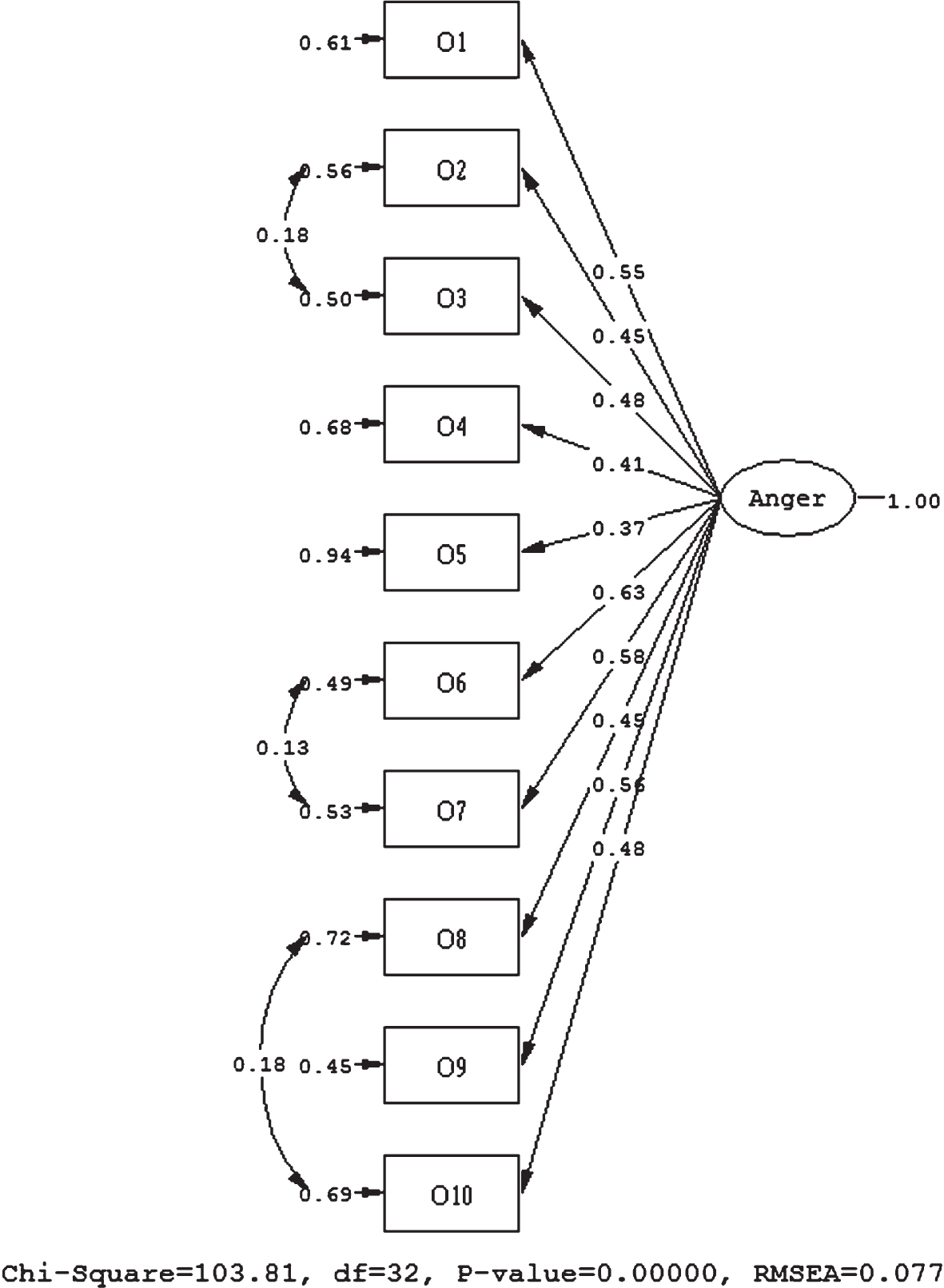
Path diagram of Trait Anger and Anger Expression Scale (n = 384).
As shown in Fig. 1, the correlation coefficients for the items range from 0.37 to 0.63.
To determine the factor structure of the Coping with Stress Scale, it was also validated with CFA in this study. As a result of CFA, the goodness-of-fit indices were calculated for the 5-dimensional factorial structure (AGFI = 0.92, GFI = 0.94, NFI = 0.97, NNFI = 0.98, RFI = 0.96, CFI = 0.98, IFI = 0.98, RMR = 0.026, SRMR = 0.039, RMSEA = 0.032, χ2 / sd = 276.52 / 199 = 1.39).
As shown in Fig. 2, the correlation coefficients of the items ranged from 0.42 to 0.71.

Path diagram of Coping with Stress Scale (n = 384).
The reliability results for the Coping with Stress Scale and Trait Anger and Anger Expression Scale were determined with Cronbach’s alpha internal consistency coefficient. The internal consistency reliability coefficients were 0.77 for the problem-solving dimension; 0.76 for the positive evaluation dimension; 0.83 for the logical analysis dimension; 0.79 for professional support; and 0.60 for environmental support. Cronbach’s alpha for the Coping with Stress Scale was calculated as 0.90. The reliability results for the Trait Anger and Anger Expression Scale were 0.78. Thus, when all validity and reliability analyses are evaluated together, it can be concluded that the Coping with Stress Scale and Trait Anger and Anger Expression Scale were appropriate psychometric measurement tools.
The statistical analyses were conducted with R 3.5.3 and SPSS 23.0. Since the data were collected before and after training, a two paired sample t-test was used for the dependent samples. The results showed that the assumptions of normal distribution were not met. Therefore, non-parametric tests (Wilcoxon Signed Ranks Test) were used for comparison. The Shapiro-Wilk test and the distributional plots were used to test for normality.
Pearson’s coefficient of correlation is assumed to be normally distributed for correlation analysis. Since the overall scale scores and the coping with stress dimension scores did not show normal distribution, Spearman’s correlation coefficient was used for correlation analysis. Nonparametric estimation of average treatment effects (ATE) was used to estimate the effect of training on anger scores. Statistical analyses were conducted with R 3.5.3 and STATA 14.0. The studies were evaluated with the probability of error level 0.05.
Results
The study group consisted of 690 PSGs working in Metro, ANKARAY, and Cable Car Works of Ankara Metropolitan Municipality Rail Systems Department in 2019. The study group was trained in the Effective Communication and Stress Management Training program, developed specifically for the PSGs and conducted by the Academy of the Union of Municipalities of Turkey. In August 2019, the Effective Communication and Stress Management Training program continued for 3 hours in each group for three days lasting a week (Monday, Wednesday, and Thursday) with morning (M) and afternoon (A) sessions. The participants took the survey before and after the training. Table 1 shows the descriptive statistics of the group.
Descriptive statistics of the variables
Descriptive statistics of the variables
According to Table 1, 15.9%PSGs (n = 110) attended the Monday morning session, 14.5%PSGs (n = 100) attended the Monday afternoon session, and 14.3%PSGs (n = 99) attended for both Wednesday morning and afternoon sessions, 22.9%PSGs (n = 158) attended the Friday morning session, and 18%(n = 124) attended the Friday afternoon session. Of the participants, 627 (90.9%) were male. The mean age of PSGs was 38.05 years (±4.899), and 75.5%(n = 521) were married. Most of the PSGs are secondary education graduates (75.2%). The PSGs’ average working hours were about 11.41 (±6.769), and 38.1%of security guards had 4 household members (n = 263). Of PSGs, 6.4%(n = 44) had attended training about anger and stress before, and 646 had not received any training (93.6%).
Table 2 demonstrates the descriptive statistics for the Trait Anger and Anger Expression Scale items and the Coping with Stress Scale items.
Descriptive statistics of Trait Anger and Anger Expression Scale items and Coping with Stress Scale items
1. Strongly disagree, 2. Disagree, 3. Agree, 4. Strongly agree; (a) Pre-test, (b) Post-test
When Table 2 is examined, most participants had a higher level of Trait Anger and Anger Expression according to the pre-test score of the Trait Anger and the Anger Expression Scale. When the post-test score is examined, the Trait Anger and Anger Expression levels were lower for most participants. While other views were more balanced, PSGs stated they strongly disagree (57%) and strongly agree (4.6%) with the statement I have a chip on my shoulder.
When the pre-test and post-test scores for the Trait Anger and Anger Expression scale were compared, the number of participants increased for strongly agree and agree with the statement I go crazy when a good job is judged bad. This statement had the most dramatic change in the strongly disagree level between the pre-test (15.1%) and post-test (22.3%) scores. For the statement After I’ve done a good job, I’m annoyed not to be appreciated, the number of participants who strongly agreed decreased according to the pre-test (20.3%) and post-test (15.8%) scores. The statement had the highest decrease, followed by the statement Being criticized in front of others makes me angry at the strongly agree level (pre-test 19.3%, post-test 15.8%).
For the coping with stress questionnaire, the coping stress levels were higher after the training for most of the participants when the pre-test and post-test scores were compared. The statement I get help from a professional about my problems generated most strongly disagree responses in the pre-test results (15.8%) and the lowest number of strongly agree on responses in the pre-test result (20.4%). I try to predict how incidents will end had the lowest share of responses at the strongly disagree level on the pre-test results (2.2%). The statement I always think there might have been something worse in life generated the highest number of (57.8%) strongly agree responses in pre-test results. The statement I think of different ways to deal with problems had the highest number of strongly agree responses (95.8%) in the post-test results.
To examine the difference between the pre-test and post-test scores, the assumption of normality was examined with both the Shapiro-Wilk test and the distributional plots. Accordingly, the normality assumption is not met, as shown in Fig. 3.
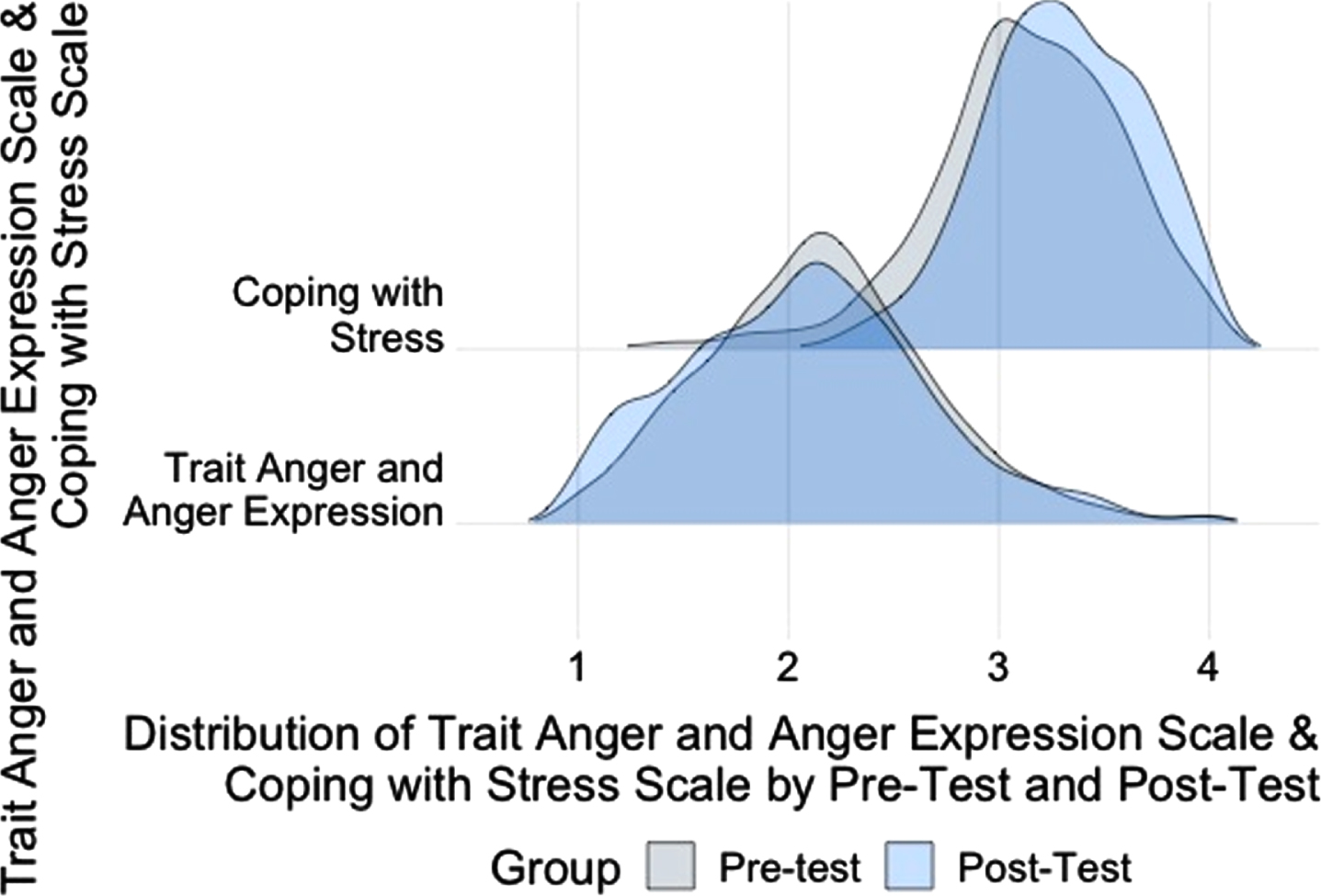
Distribution of Trait Anger, Anger Expression Scale and Coping with Stress Scale according to pre-test and post-test.
The pre-test and post-test scores for Trait Anger and Anger Expression of the private security officers in the EGO General Directorate are shown in Table 2. Pre-test and post-test scores for problem-solving, positive evaluation, logical analysis, professional support, environmental support dimensions, and the overall total stress management methods of private security officers are presented in Table 3.
Statistical comparison of pre-test and post-test scores
p < 0.01**, p < 0.05*, R = Range.
As shown in Table 3, according to the results of the Wilcoxon Signed Ranks test, statistically significant differences were observed between the pre-training and post-training scores of the PSGs who participated in the training. The statistically significant scores are as follows: problem-solving dimension (z =–10.427, p < 0.05); positive evaluation dimension (z =–7.878, p < 0.05); logical analysis dimension (z = –15.282, p < 0.05); professional support dimension (z = –2.896, p < 0.05); anger (z = –2.208, p < 0.05) and stress coping scores (z = –9.147, p < 0.05). The environmental support dimension had no statistically significant difference between the pre-training and post-training scores (z = –1.916, p > 0.05).
Accordingly, it can be said that the training was effective in reducing the state of continuous anger. Additionally, 8%(Cohen’s d = 0.08) of the difference between the measurements can be explained as the effect of training on the state of trait anger. The effect size for stress-coping was calculated as 35%, close to moderate effect. The training is effective concerning problem-solving. According to the effect size of training for the problem-solving dimension, 39%of the difference between measurements was explained. The effect size for the positive evaluation dimension was calculated as 0.30 and indicated a low level of effect. The differences between measurements were explained as 11%(Cohen’s d = 0.11) for the effect of training on the professional support dimension.
With the high level for the effect size on logical analysis dimension (Cohen’s d = 0.58), the training boosted logical thinking and evaluation of PSGs.
According to Cohen’s d calculation, the effect sizes were found to be very low. However, the overall scale scores and coping with stress dimension scores had effect sizes that create instability. It was not possible to decide whether the training is effective or not only by examining the Cohen’s d effect size. For this reason, the effects of training, together with the effect of other variables, were estimated by using the average treatment effect regression model.
The correlations between variables (Coping with Stress Scale Dimensions and Trait Anger, Anger Expression Scale) were investigated according to pre-test and post-test and shown in Fig. 4. In (A) Pre-Test, Positive (Pos.)-Problem (Prob.), Problem (Prob.)-Logical (Log.), STRESS-Environment (Env.) and Logical (Log.)-Positive (Pos.) had strong and significant correlations. Also, Positive (Pos.)-Professional (Prof.), Problem (Prob.)-Professional (Prof.), and Logical (Log.)-Professional (Prof.) had moderate and significant correlations. However, the other correlations were not significant. In (B) Post-Test, Positive (Pos.)-Problem (Prob.), Problem (Prob.)-Professional (Prof.), and Professional (Prof.)-Positive (Pos.) had moderate and significant correlations.
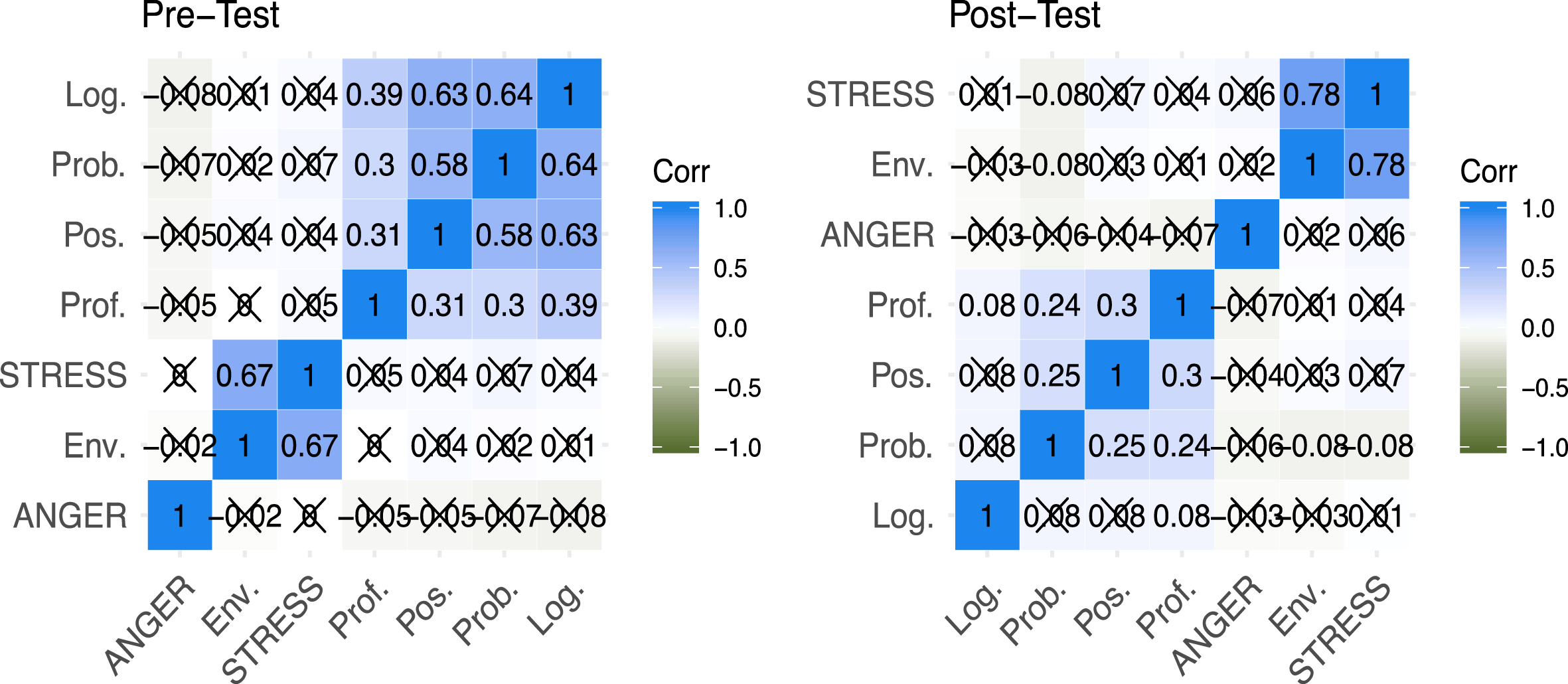
The correlation maps of Coping with Stress Scale dimensions and Trait Anger, Anger Expression Scale. A) Spearman’s correlation coefficients of pre-test. B) Spearman’s correlation coefficients of post-test.
For the anger scores, the effect of training was estimated with the average treatment effects analysis with other independent variables. In Table 4, Y(0) shows the outcome without training, Y(1) shows that outcome with training and E[Y(1) –Y(0) | X] is the ATE. In the model, anger scores are explained by gender, age, marital status, and stress score in both trained and untrained cases. According to this, the anger scores of those who did not receive the training were 2.154 (95%CI 2.111–2.197), whereas anger scores for those receiving training were 2.043 (%95 CI 1.997–2.088), which was also statistically significant. The average treatment effect was –0.111 and this was statistically significant. This shows that training had a significant effect on anger. The inability to cope with stress was also shown to trigger anger. As seen in Table 4, whether with training or not, it was observed that the anger variable tends to decrease when the cope with stress variable increases. This is thought to be due to the negative coefficients of the cope with stress variable. It was also found that age, gender, and marital status affect anger as well.
Average treatment-effect regression model on anger
p < 0.01**, p < 0.05*; ATE: Average treatment effect.
As the private security sector is experiencing quantitative growth, the increase in its impact area and its importance becomes critical making it necessary to increase the quality of private security workers. This emphasizes the importance of in-service training. With this in mind, when analysing the levels of anger and stress of PSGs in the Ankara Metropolitan Municipality, who are in constant communication with the public and responsible for regulating the social domain, one of the important aims of the study was to determine the effect of the Anger and Stress Control training given to them. In order to achieve this aim, an important objective of the research was to ensure the validity and reliability of the measurement tools.
For this study, the results of CFA show that the Trait Anger, Anger Expression Scale was validated with one-dimensional factorial structure and the Coping with Stress Scale was validated with the 5-dimensional factorial structure. The results also showed that the goodness-of-fit index and the model fit well with the research data. Thus, when all validity and reliability results are evaluated together, the Trait Anger, Anger Expression Scale and the Coping with Stress Scale are appropriate psychometric measurement tools that can be used for this research.
The scores received by participants for the Trait Anger, Anger Expression Scale and the Coping with Stress Scale before and after training were examined according to the purposes of the research. There was a statistically difference between the pre-test and post-test results for the Trait Anger and the Anger Expression Scale. The pre-test scores were higher for trait anger scores (
When the pre-test and post-test scores of the Trait Anger and Anger Expression scale are compared, the highest change was for the statement I go crazy when a good job I do is judged bad. After the training, more security guards reported that they could remain calm if their good work was not appreciated. The highest decreases in the strongly agree level were seen for the items After I’ve done a good job, I’m annoyed not to be appreciated and Being criticized in front of others makes me angry, respectively. This shows that the views of PSGs about using strategies to help them control their anger levels after training differed. This finding is concurrent with the results of Bilge, Balta, Şenuzun, Aykar and Yilmaz [31] who researched anger control training with the employees of hotel businesses in the service sector. As a result of their study, the researchers determined the effectiveness of anger control training applied to personnel working in hotels and determined that individuals were more angry before the training. After anger control training, they experienced less anger and were able to control it. For staff satisfaction, they recommended that professionals receive training that includes anger control and control strategies.
For the coping with stress questionnaire, there was a statistical difference between the pre-test and post-test results of the Coping with Stress Scale. The post-test scores were higher for the coping with stress scores (
According to the results of the pre-test and post-test, there was a statistical difference for the professional support dimension and the post-test scores were higher (
According to the results of the pre-test and post-test scores, there was a statistical difference for the logical analysis dimension and the post-test scores were higher (
When the meaningful difference observed between the pre-training and post-training trait anger states of the security personnel is interpreted, the training was effective in reducing trait anger. In addition, the difference between the measurements can be explained as the effect of the training on the state of trait anger.
Conclusion
To conclude, nowadays, it is very important to increase the qualifications of the employees by organizing training during service in any field. The rapid development of information and technology in the world is accelerating the development of education systems. The training of private security personnel who are in communication with all individuals in the public sphere within the municipality is important. Improving the ability of PSGs to handle anger and stress enhances their awareness of their interactions with the people around them and enables them to develop the skills and behaviours requested in this regard.
Private institutions provide certain security services to people and institutions in need according to law. The purpose of the training of personnel in private security organizations is to equip them with professional and general information in order to perform the duties assigned to them properly and to use their power adequately. In this study, it was concluded that the training of security personnel reduced levels of anger and stress. Therefore, it is expected that development of skills to control anger and stress control by PSGs will positively affect their communication with the public.
Advances in social life have led to changes in the role of PSGs who are in close contact with the community and are responsible for ensuring security. During the completion of these roles, the knowledge, skills and behaviours of PSGs will determine the level of interaction with society. The ability to perform the duties and responsibilities expected depends on the development of these qualifications. This is possible only if in-service training programs are prepared according to the real needs of working life. The aim of private security training is to prepare and train PSGs for development of these qualifications. PSGs are expected to perform their duties properly within their area of responsibility and to know how to act under specific conditions. PSGs are the public face of the institutions they work for due to the nature of their jobs. For this reason, it is important for PSGs to be conscious and responsible in relation to their job descriptions.
Since there was no change in the age, sex and marital status variables, it was observed that anger decreased when the stress coping behaviours increased and that the training developed for the PSGs in this study was effective in this situation. It is possible that there are other variables, such as inability to cope with sudden anger, that can trigger and increase the state of trait anger, and social and economic phenomena. However, in our study, we found that in case of an inability to cope with stress, it triggered anger for this occupational group. It is considered important that training about anger and stress control should be given to the security forces at regular intervals and it is concluded that the level of continuous anger decreases because of the increased ability to cope with stress. In this professional group, we recommend that periodic training is necessary, and perhaps more detailed examination is required for those who are more severely affected.
Limitations may be considered as the time, duration and participants of the training conducted within the scope of this research and also the measurement of the effectiveness of this training through a questionnaire. The research can be repeated with a different and diverse sample group of security workers in different municipalities, and more detailed results will be obtained.
Conflict of interest
None to report.