



Abstract
BACKGROUND:
Evidence continues to build on the value of Individual Placement and Support (IPS), enabling those with long-term mental health conditions to find mainstream employment. Many of these individuals would like to work; however, unemployment for this population remains high. IPS research thus far has targeted the effectiveness of the model, with less emphasis on how individuals perceive and experience IPS and the return to work.
OBJECTIVE:
This study explores the barriers, enablers, meaning and personal experience of being supported to find work through IPS, for individuals with long-term mental health conditions. Findings based on lived experiences of nine participants from two Scottish centres running IPS, should be useful to enhance and develop services.
METHODS:
This study involves qualitative data collection, using semi-structured interviews and Interpretative Phenomenological Analysis (IPA).
RESULTS:
Transcript analysis revealed three master themes: 1) “Working is good for me”: positive aspects to working; 2) “Rome wasn’t built in a day”: time-unlimited supported journey and 3) “My inner critic”: negative aspects to working. Participants praised IPS for the on-going practical and emotional support in overcoming self-identified occupational barriers.
CONCLUSION:
Paid employment was greatly associated with financial freedom, social inclusion, increased self-esteem and alleviation of depressive symptoms. Participants described the person-centred, time-unlimited approach taken by the employment specialists (ESs) or occupational therapists (OTs), as the main enabler to maintaining paid employment. Barriers, such as anxiety and work-related stress were identified, however, participants felt supported to overcome some of these negative symptoms.
Keywords
Introduction
Poor mental health is one of the major health challenges in Scotland, accounting for 1 in 3 general practitioner appointments, with the prevalence of individuals seeking help steadily increasing [1]. Conversely, good mental health is globally recognised as integral to health and wellbeing [2]. The Equality Act, 2010, suggests a mental health condition becomes a disability if it has a long-term impact on normal day-to-day activity [3]. The current ‘See Me in Work’ campaign by See Me Scotland, aims to protect those with a mental illness from stigma and discrimination by offering a guide for employers and employees [4]. Despite recent campaigns focussing on these issues, stigma remains around mental health conditions. Research shows that many individuals with a long-term mental condition want to work [5] and with the right support can do so [6].
Employment has been found to aid recovery and improve mental health and wellbeing [7]; yet, only 1 in 4 (26.2%) of people with long-term mental health conditions within the UK are currently employed [8]. The UK Thriving at Work report found that 300,000 individuals with long-term mental health conditions do not receive the support they need and are forced to resign each year, costing the economy £99 billion annually [9]. Importantly, this highlights the challenge of maintaining paid employment for those with long-term mental health conditions such as bi-polar disorder, psychosis, severe depression and schizophrenia. Work has a powerful role to play in improving quality of life and providing financial security, whilst reducing social exclusion [10, 11].
Historically, paid employment was not viewed by health professionals as a viable option for people experiencing moderate to severe, long-term mental illness [12]. The Individual Placement and Support (IPS) employment model challenges this view and focuses on effective vocational rehabilitation (VR) for those with severe and enduring mental health conditions [13]. To give context, VR enables individuals with a disability to overcome barriers to accessing, maintaining or returning to work by providing them with the support they need to engage in employment [14]. IPS was developed in the United States by the Dartmouth IPS Supported Employment Centre and is recognised internationally as the most effective method of enabling those with severe and enduring mental health conditions to find and maintain employment [15]. IPS is an effective, evidenced based intervention to support individuals with a moderate to severe long-term mental condition into paid employment [16]. The model is based on eight principles (Fig. 1). Instead of providing ‘generic’ training as seen in traditional VR models, IPS uses a ‘place and train’ approach, placing the individual into the workplace, whilst providing on-going emotional support by recognising personal strengths and overcoming barriers to employment [17]. IPS helps more people with mental health conditions into work than other VR programmes, at no greater cost [18]. Recipients of IPS are more than twice as likely to gain competitive employment, work for longer and are less likely to be re-hospitalised, when compared to recipients of traditional VR models [19].
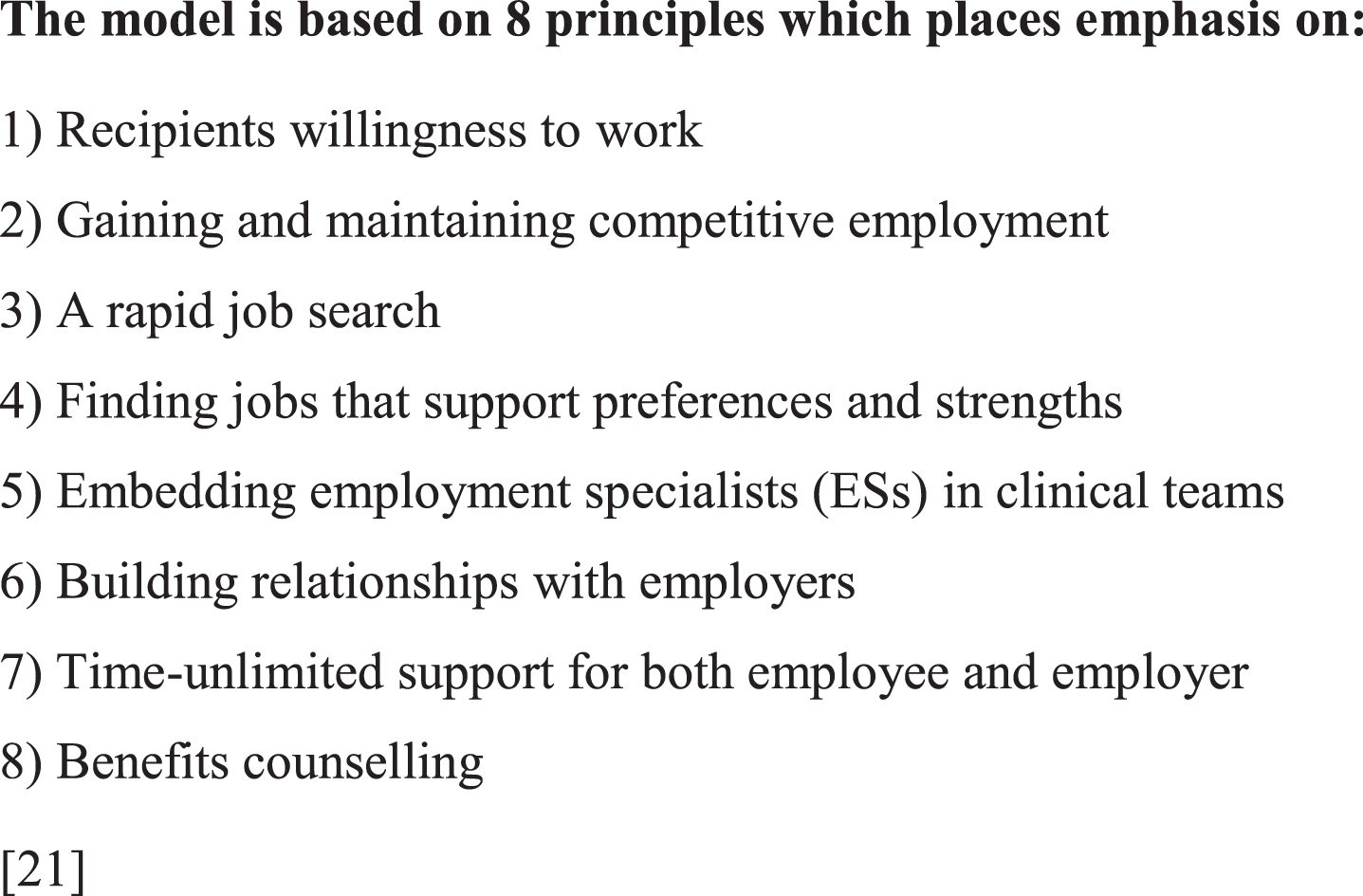
IPS 8 principles
Use of the IPS model in the UK began in London around 2003 [20]. Since then, provision of the IPS model in the UK has continued to grow. Research has been focused on the effectiveness of the model, including the numbers of recipients supported into mainstream competitive employment and the numbers maintaining employment longer term. This research shows once in employment these individuals require less input from mental health services. In response to the Five Year Forward View in Mental Health plan, NHS England (2018) [22] committed to doubling access to IPS services by 2021. In Scotland, the third sector (non-government organisations), National Health Service (NHS) and employment partnerships are the main providers of IPS [23]. The Scottish Association for Mental Health (SAMH) is the largest provider in Scotland. Across the UK services continue to seek sustainable funding to develop IPS provision, and this can be challenging with finances tightening across health and social care. A recent review of an NHS provided IPS service, led by occupational therapists in Glasgow, suggests that IPS may save health resources in the longer term as 68%of their service users who found work required less mental health services in the year following paid employment [24]. Engaging in a productive occupation, can be essential to an individual’s health and wellbeing, with IPS offering the potential for re-engagement for those with long term mental health conditions [25]. This study provides an insight into the consumer perspectives of the IPS model exploring the barriers, enablers, meaning and personal experience of being supported to find work through IPS, for individuals with long-term mental health conditions.
Recruitment
Ten participants from two IPS centres in Scotland were recruited representing a convenience sample. The convenience sample was identified by the employment specialist or occupational therapist involved in their rehabilitation. To be included participants had to be enrolled on the IPS program; currently employed in competitive employment; working 7.5 hours per week or more and diagnosed with a moderate to severe long-term mental health condition.
Referrals to IPS services were made by health professionals working in Community Mental Health Teams (CMHTs).
Participants
Of the 10 participants one participant withdrew due to deteriorating mental health at interview stage. Nine participants were interviewed from two mental health centres running IPS services throughout Scotland. The participants consisted of four males and five females aged between 24 and 64 years of age. All participants were in paid employment and working between 7.5 and 58 hours per week. Participants had been in current employment between 1 and 18 months, having been on the IPS program between 6 months and 3 years. Employment was found in a variety of different areas: social work, cashier work, project coordination, land management, cleaning services, event services and school tutoring.
Ethical approval/consent
This study gained ethical approval from the Glasgow Caledonian Universities Health and Life Science Ethics Committee, 23rd of May, 2018. All participants received an information leaflet about the study and gave verbal and written consent prior to interview. Participants have been given pseudonyms and all data collected held in a password protected file on the researcher’s computer. Time was allocated before each interview to allow the participants to raise any questions or concerns.
Data gathering
The study was conducted from June to November 2018. All interviews were performed by an independent researcher via telephone, audio recorded and transcribed verbatim by the author. Interviews were typically 30 minutes in duration and consisted often semi-structured, open ended questions, designed to meet study objectives and developed using a guide on how to formulate IPA research questions [26]. The interview style allowed for unexpected topics to emerge, which could then be investigated with further questions. Areas of interest could therefore be explored in depth, permitting rich data gathering. Questions covered the journey back into work, positive and negative aspects to working.
Data analysis
Data was analysed using IPA; a research methodology which enables the researcher to capture individual’s lived experiences [28]. IPA was chosen as it recognises the researcher within the research and analytical process [28]. Alternative methods, such as content analysis could have been used, however, letting data ‘speak for itself’ allows for more original results [29]. The listening and re-listening of interview recordings, transcribing of data and reading and re-reading of transcripts, allowed for full data immersion, providing foundations for rich analysis. Notes on transcripts where transformed into subthemes. Master themes were identified by seeking relationships of subthemes, represented in Table 1.
Table of themes
Table of themes
Analysis of the transcripts exposed three master themes. 1) “Working is good for me”: positive aspects to working; 2) “Rome wasn’t built in a day”: time-unlimited supported journey and 3) “My inner critic”: negative aspects to working, presented in Table 1.
“Working is good for me”: Positive aspects to working
This theme addresses the many positive aspects to working, expressed by participants. The realisation that maintaining paid employment was indeed possible with the right support, appeared to grant participants a greater level of self-respect. Work provided a sense of purpose, structure and routine and reduced isolation. It offered the comfort of getting back to ‘normality’, regaining independence and financial freedom. Participants commonly reported the welcome distraction from depressive thoughts engaging in work offered:
It (working) helps with mental health problems and depression. . . it helps alleviate them. . . the very fact that you are doing a job takes your mind off things. . . meeting people and contributing something to society (Paul).
As highlighted by Paul, employment brought opportunity to engage in appointed tasks within a social environment, providing distraction from depressive thoughts. He suggests employment provides greater relief from depressive symptoms compared to other day-to-day occupations. Meeting new people and contributing to society were identified motivational factors, echoed by Alice and Olivia below. Living on benefits made some participants feel uncomfortable and they wanted to give back to society, both financially and socially:
I was very good about feeling very guilty about the fact I wasn’t at work and I had to be supported by people. . . being in paid employment. . . having your own money has been a major thing (Alice).
Working actually helps with your mental health; it improves your mental health. You’re out there working, socialising, contributing, making a difference ‘cause all these things come with working [pause] and I wouldn’t be here just now if it wasn’t for IPS (Olivia).
This suggests that Olivia viewed the IPS service as providing a sense of purpose and a way to contribute to society as reflected by Adam below. This resonated with many participants in providing motivation to get out of bed in the morning and seize the day:
I didn’t do anything for about 5 years. . . just being at home, doing nothing. Having a job meant a sense of purpose. Not in a grand sort of philosophical sense, in a, OK, I need to get up today, I’ve got stuff to do (Adam).
Here participants appear to suggest that finding work helped to relieve the boredom of ‘being at home and doing nothing’. Finding work added a reason to get up and leave the house with meaningful, paid employment, based on personal preference, leading to increased job satisfaction. Self-respect as perceived by Jack came from his realisation of his ability to do the job and do it well:
Firstly, it gets me out of the house because unless it’s something that I need to do [pause] I find it difficult to leave the house. Secondly, it’s a bit of self-respect. I can actually to do some work, it’s difficult, it’s hard. . . but. . . I’m able to do it (Jack).
This demonstrates what Jack valued most from employment; reducing isolation and gaining self-respect. Fixed appointments that benefit either himself or others pull Jack out of isolation. Equally, work responsibilities led to commitment; and a routine which prompts him to leave the house. The determination and sense of achievement Jack alludes to when acknowledging the type of work, finding it difficult at times, contributes to his sense of achievement and the satisfaction that he is able to do it. The desire to reduce isolation featured strongly amongst participants:
I want to build up relationships with colleagues. Aye, to widen my opportunities because I’m still very, very isolated, very painfully isolated I am unless I’m out working (Olivia).
Here, Olivia valued the opportunity to build relationships with colleagues. She, along with the many of the participants, emphasised that isolation plays a big part in worsening of depressive symptoms. Participants spoke of two main contributing factors to isolation: internal battles with their mental health, and importantly, financial concerns:
People are always amazed that. . . you don’t go (out). . . if you have absolutely no money you very quickly learn that if you stay in the house you don’t spend money that you don’t have (Alice).
You worry about when you’re not working. . . I’m worried about going running cause that would mean more clothes I would have to buy, that’s more washing I would have to do. . . and these are all the things that go round in your head (Carol).
As highlighted by Carol, participants spoke of avoiding or cancelling social hobbies due to financial constraints when unemployed, and this financial hardship has an impact on their wellbeing. Most saw gaining a higher income as a route back to normality:
It means getting back out into the working environment, getting back to normality. . . being able to support myself financially once again (Olivia).
The goal of returning to normality was a common theme throughout interviews. Being able to support themselves financially, links with feelings of independence, reflecting on life before mental illness or spells of good mental health. All participants expressed concerns around getting by on benefits alone. Steady employment and higher incomes appeared to enrich the quality of time spent with loved ones:
It gives me a bit more freedom. . . I can get nicer things for my little girl and that’s a very, very important thing for me. It’s not just about buying her things; it’s about being able to do things with her and spend time with her (Jack).
Here, Jack is not overly concerned with the ability to buy possessions but values how a higher income buys lived experiences, enhancing engagement and time spent with his daughter. Participants voiced family was a motivational factor for achieving employment to enhance lifestyle changes for themselves and family members.
Continuing with positive aspects to work, Simon identifies that of routine, structure and how this helps him manage his mental health condition:
Its routine and structure for myself and. . . having that in place for me. I think it’s also a pride thing. You know, to tell people you are working hard. When you buy yourself something, you know you’ve earned it (Simon).
As for Simon and others the importance of achieving structure and routine featured highly in terms of the stability it grants them. Increased financial freedom and satisfaction of buying something with the money earned. Employment also provided structure and routine to days off, planning household tasks and social activities, around work which further enhanced overall sense of achievement.
“Rome wasn’t built in a day”: Time-unlimited support
This theme reflects on the journey of each participant in finding and maintaining employment through IPS, addressing the meaningful therapeutic relationships built with ESs though time-unlimited, person-centred support. Here participants spoke of the value of ongoing support with an employment specialist that believed in them:
Having someone neutral actually having faith in myself. . . it’s not something that I’d felt I’d had for a very long time and that was what sort of really, really helped (Jack).
Jack describes having someone ‘neutral’, who chose to see beyond the mental illness, empowering through recognition of his strengths. This was applied not only to the recruitment process but also holistically: taking into account mental health and wellbeing. With IPS, it is recognised that individuals do not necessarily have to be symptom free to start working:
I know I’m not fully recovered but it doesn’t mean to say I’m not ready for a job because IPS is supporting me along the whole road. If I’m having a meltdown, I just need to phone my ES and she’ll make arrangements for me to see her. . . I’m not fully well, she’s that added bonus for me. . . she’s. . . my crutch (Olivia).
Here, Olivia acknowledges that she is not fully recovered but looks at her mental health as a journey, in which taking on employment at this stage was a positive step. Both Olivia and Liz (participants from different IPS centres) referred to their ES as their crutch, not ready to walk the employment path alone, recognising they still require on-going, emotional support.
Three participants spoke about wanting to work, however, acknowledged periods where they felt incapable of starting the process. The below statement from Jack, highlights how the opportunity to access work came quicker than anticipated. This rapid job search appeared to both surprise and please Jack:
I never thought I would be. . . for a few months yet. . . even thinking about work and the fact I’ve been able to do it and do it well, it’s very impressive (Jack).
Through working with his ES and the IPS model, Jack returned to work quicker than planned and benefited from the realisation of his capabilities. This appears to bring him hope and encouragement, learning that competitive work can benefit recovery, highlighting that one does not have to be recovered to succeed in maintaining paid employment.
Most service users spoke of long periods of unemployment or going from job to job, with decreasing confidence. This extract from Alice demonstrates the model’s success in maintaining work:
I graduated from uni (university) seven years ago this summer and since then. . . this currently, over 18 months. . . is my longest stretch in employment. Most of them have been not even 6 months (Alice).
Like Alice, 80%of interviewees were receiving the time unlimited aspect of IPS often called ‘long-arm’ support, having been in their current posts for a prolonged period. Liz and Carol highlight the challenge of maintaining employment and how essential it is to have the right support in place. Importantly, Liz stresses the perceived stigma around disclosing mental illness to employers when in paid employment, despite this being a principle of IPS. Suggesting supportive management reduces stigma:
People quite often, they will get over that hurdle, they will get into a job and then when they hit glitches, they have no one to support them through it unless they have a very supportive employer. With mental health issues you quite often don’t want to let an employer know that this problem exists (Liz).
I’m actually on ‘long-arm’ support...it’s at the stage when I’ve been with them . . . you’re getting along fine . . . but then something happens and I need them. . . they are always there for you. . . someone who understands you (Carol).
Here Carol suggests that the time-unlimited support offered with the IPS model has been of value. Three participants spoke of volunteer work or workshops attended in previous VR programs they had engaged in. Although this is not part of IPS participants reflected fondly on these, for example:
Because of little workshops I went to. . . you know that you are not the only person but somehow it’s affirming when you think, oh, people in this room, they’ve had problems as well, you realise that they are normal (Liz).
Here, Liz highlights comfort found in normalising mental health. Entering a room with no stigma attached, having the opportunity to engage with others who have been through similar journeys. She suggests this provides a confidence boost and opportunities for reducing isolation.
“My inner critic”: Negative aspects to working
In conjunction with the many positives of competitive work, there are undoubtedly hurdles acknowledged, such as work-related stress, previous employment trauma and associated anxiety and self-doubt. For the majority of participants, their mental illness was in their opinion the seminal factor in not taking on more hours, but for one participant the financial support was a barrier to acquiring additional hours:
I was on ESA and I was doing permitted work, my ESA was £110, and my work was £90 so that’s £200 a week. I was doing 12 hours; I would have actually had to work 27 hours to break even (Carol).
Here Carol speaks of her frustration of how in relation to benefits work does not always equate to more money. Some participant’s highlighted negative aspects such as work-related anxiety with Jack, however, reflecting on these as being temporary., For example:
The anxiety comes to the full and you get the physical symptoms as well...I struggle to sleep the night before. . . you’ve got four hours acting on a stage; you’re going to be exhausted. . . it’s hard work but it’s been going well. . . I’d say on the whole, those things I mentioned are short term (Jack).
Jack describes putting on an act when at work, wanting to display a cheerful face to the public, despite feeling anxious. Anxieties could be around self-confidence and self-doubt in ability to provide a good service. Possibly, he feels pressure to put on an act for his work in customer services or it could be a coping mechanism, distracting him from depressive thoughts. Many participants revealed having an ‘inner voice’, which contributed to feelings of depression and reduced confidence. Jack may also associate his current work, with stress from former employment. He described how his mental health deteriorated due to unsupportive management, echoed by three other participants:
I’d worked in a place previously. . . they [management] were very quick to criticise but never actually praised or thanked you for anything...this sort of experience made me very anxious. . . the management (in his new workplace) was (is) absolutely brilliant. . . very people orientated (Jack).
I wasn’t being paranoid; they (management) treated me appallingly. I was only 17 and they were horrible to me. . . I went from being a very happy girl to. . . extremely depressed (Liz, reflecting on her first employment experience).
In addition, Olivia reflects on her perceptions of work place bullying and how this still has an impact on her several years later.
I always wanted to go back to work but then I never seemed to have the confidence and obviously that was right out the window after my bullying (Olivia).
These extracts demonstrate the potential impact managers behaviours and attitude can have on an employee’s perceived mental health and wellbeing. Previous negative work experiences potentially contributed to poor mental health. For Carol, despite support from her IPS employment specialist and the management at her work, poor reactions were encountered during sickness absence:
My boss said; “Oh it’s hard seeing you in here, shopping and speaking to people and you’re out and about” (Carol, speaking about current employment).
The employee, even with support available to managers through IPS, can still feel stigma, as the program cannot account for individual’s reactions. Additionally, Olivia highlights her desire to work with the reported barrier being self-confidence, triggered by previous work trauma associated with workplace bullying. To return to work, Olivia voiced a combination of psychiatry and medication, alongside the IPS program being vital in her recovery journey. This integration of employment support with health service provision is a core aspect of the IPS model and a component valued by participants.
Conversely, as mentioned by Jack above, good, person-centred management with an understanding of mental health, working in collaboration with IPS, can empower individuals, as reflected by Alice:
I was on sick leave for 5 weeks and my employer was saying well you can come back, and you can just do what you can and what you want. . . So, I started back two days a week (Alice).
Whilst this phased return works well for Alice, she goes on to say:
There is a colleague of mine who. . . doesn’t think that I actually do work when I’m not in the office. . . today was. . . particularly difficult. . . there were words said (Alice).
When a worker needs to take time off work or complete work from home, Alice perceived there can be resentment amongst colleagues in their absence. Working hours provided further discussion, with some participant’s voicing uncertainty regarding capability of part-time or full-time employment suggesting a preference at least initially towards part time hours:
I don’t know if I’m ready to have a full-time job just now because I still get [pause] my black days a couple of days a week (Paul).
Paul highlights the individual nature of mental illness and how he reflected on his decision to go for part-time rather than full-time employment which he perceived may be harder to achieve. The use of “black days” suggests, for Paul the fear of relapse and, fluctuating mental health appears to have contributed to his view that full time employment was not right for him at this time.
Discussion
Three qualitative research papers on IPS suggest participants felt motivation levels increased when employed. They felt supported and learnt to adapt to barriers of sustaining employment; overall reporting a positive impact on mental health and everyday life [30, 34]. Individuals with a long-term mental health condition want to work; however, barriers including perceived stigma, and lack of self-belief among those with mental health issues remain [5]. It is therefore important to explore the barriers around this identified problem, whilst identifying enablers, to better inform future practice within mental health vocational rehabilitation. Recent literature called for further qualitative evidence of IPS within the UK [24, 32] providing the incentive for this study.
This research revealed that a person-centred, holistic, time-unlimited approach to employment was currently the best available method to promote good mental health and wellbeing. As identified in “Working is good for me”: positive aspects to working, participants found that gaining employment provided a sense of purpose, daily structure, providing alleviation of depressive symptoms. These findings are consistent with qualitative studies on IPS from Sweden and Denmark together with a Scottish study on mental health service user views on employment [30, 35]. Participants in this study reported that working helped to relieve feelings of boredom and isolation a finding supported by previous research in to the IPS model [34]. In addition, this study suggests that employment also gave structure and routine to non-workdays, enhancing quality of life, which suggests that IPS has systematic impact on non-vocational outcomes, in contrast to the findings of Bond [21].
All participants in this study recognised the importance of not living in isolation, welcoming the chance of getting back to ‘normality’ as reflected in the research of [30, 35]. Prior et al., found the financial reward to be the biggest incentive to continue working [35]. The findings of this current study highlight that achieving higher incomes not only provided financial freedom and independence, it increased opportunities to engage with friends and family and promotes social inclusion. In addition, this current study discovered that contributing to society motivated participants to continue working, expressing enthusiasm to contribute to a society that helped support them through unemployment.
All participants described the importance of the therapeutic relationship with their ES, built on trust and emotional as well as vocational support. This supportive relationship helped motivate and empower participants, boosting their confidence and self-worth. The theme “Rome wasn’t built in a day”: time-unlimited, highlighted the importance of this relationship in maintaining competitive employment, aligning with former research [36, 37]. This current study discovered that time-unlimited support can be a crucial factor in maintaining employment, increasingly important due to the cyclical and fluctuating nature of participant’s mental health conditions. This time-unlimited support is not a feature of traditional VR programs. Traditional rehabilitation models provide pre-vocational training, before placing the individual into employment, with support ending at this stage [38].
A five-person, qualitative study by Coombes et al., found that the role of the ES is critical in the initial stages but appears to diminish as time goes on [7]. Conversely, the findings from this nine-participant study indicate that ESs are still frequently utilised by some participants 2–3 years on, highlighting the unique path of long-term mental health conditions and the person-centred practice of IPS.
The theme “My inner critic”: negative aspects to working, identified various barriers such as anxiety, self-doubt and previous work trauma, which challenged participant’s resilience at times. Besse et al., and Koletsi et al., found that competitive work changes the nature of stress and is associated with a decrease in stress levels, as stress was no longer associated with mental illness but employment [5, 34]. However, results from this current study, when Jack mentions increased stress and anxiety levels which appear associated with his employment, suggests the participants in this study also experienced, like many of us, work related stress. This might be important to monitor in relation to mental health. The additional counterbalancing feeling of self-respect is what Jack appreciates, overall enhancing his sense of wellbeing.
While most participants were grateful for financial support before gaining paid employment, one participant identified potential loss of benefits as a reason to limit herself to the 16 hours of ‘permitted work’. One other study looking at supported employment, not specifically IPS, identified this barrier [39]. Research suggests fear of losing monthly benefit can discourage individuals from seeking employment [39]. Employment and Support Allowance (ESA) was utilised by participants during this study. This type of benefit is means-tested, allowing recipients to work a maximum of 16 hours per week under ‘permitted work’. Exceeding restrictions in any week would mean no ESA allowance for that week [40].
Line managers play a crucial role in supporting employee well-being and engagement [42]. As highlighted in the introduction, IPS engages with service users and employers; however, this current study revealed the model appears to be more successful when workplace management is equally as empowering. Therefore, the successes may not be from IPS working in isolation, further endorsed by two other studies [7, 42]. What appears clear is that support from an ES who is able to build relationships with employers, not only improves employment outcomes but helps those with mental health conditions to cope better with workplace challenges [43].
When speaking with ESs and OTs providing the IPS program in Scotland, volunteering was used from time to time to ease the service user back into employment. This may come from opportunity constraints on what is available within the local competitive job market, or difficulty in finding work for individuals with limited experience. Almost all participants had been through various VR programs prior to IPS. Although IPS was thought to be superior, many spoke fondly of elements from previous programs which included volunteering and group working opportunities. A Cochrane review studying 18 global randomised control trials, found that supported employment was more effective than prevocational training in gaining paid employment [19]. However, it cannot be assumed that initially engaging in time-limited voluntary work will not result in meaningful long-term paid employment. Voluntary work, which is unpaid and potentially with fewer performance requirements, may be better suited to some individuals to assist the journey of recovery [44], prompting critiques of the IPS model having a limited scope. There is nothing within IPS guidelines to suggest long term voluntary work is part of the model, but occasional time-limited work experience may be used alongside active job searching.
Strengths
This is, to the researcher’s knowledge, the first study to explore the meaning and purpose around finding work for those with long-term mental health conditions on IPS programmes in Scotland. The study design was appropriate for addressing the purpose of the research. Participants were interviewed from two IPS centres covering areas throughout Scotland. All interviews were undertaken by an independent researcher (not employed in the IPS centres) and transcribed verbatim by the author, which allowed for full data submersion. A rich description of the recruitment, data collection and data analysis processes were provided to facilitate transferability.
Limitations
Research suggests, the absence of visual cues by conducting interviews via telephone, can result in loss of contextual and non-verbal data [45]. Equally, telephone interviews may allow respondents to feel relaxed and able to disclose sensitive information, suited to the nature of this study. Using a convenience sample can result in a group of highly motivated individuals, with the study capturing the views of those who felt able to speak about their experience and possibly those with a positive experience of IPS. Nevertheless, one could argue that in the very nature of IPS, willingness to work is the first principle; therefore, enthusiasm for the program could be present in most recipients. In addition, the focus on the individualised job search based on personal preferences is likely to have an impact on the participant’s enthusiasm. The program inherently aims to find jobs and hours of work that individuals have expressed an interest and desire to do. Our participants represented a convenience sample and were from more than one service across Scotland. So, whilst it is possible that there may be some differences in the delivery of the IPS model this could add depth and richness to the data.
Furthermore, this was the principle researcher’s first experience of data collection and IPA. IPA can bring its own limitations as the author selects relevant quotes to highlight different themes; therefore, the researcher’s role in the analysis added a unique viewpoint [28].
Conclusion
This study has uncovered client’s perceptions on the barriers and enablers, meaning and purpose around finding work through IPS for individuals with long-term mental health conditions. For the participants, paid employment was greatly associated with financial freedom, social inclusion, increased confidence and self-esteem. Participants were motivated to contribute to society and noticed a positive impact to their mental health and wellbeing through the alleviation of depressive symptoms when working. The participants in this study described the person-centred, holistic, time-unlimited approach taken by the ESs and OTs, as the main enabler to finding and maintaining paid employment. Barriers, such as anxiety and work-related stress were identified, however, participants felt supported to overcome negative aspects to working.
Additionally, this study suggests that IPS appears to be more successful for the recipient when workplace management is equally as empowering. Importantly, this study’s findings provide incentive for the expansion of IPS services within Scotland.
Footnotes
Acknowledgments
The authors are grateful for the help of dissertation supervisor Dr Jean McQueen for her guidance, support and encouragement throughout this study. They are also grateful to the occupational therapists and employment specialists for their assistance in recruiting participants and, of course, to all participants that took part.
Conflict of interest
None to report.