



Abstract
BACKGROUND:
In 2013 the U.S. Army began developing physical tests to predict a recruit’s ability to perform the critical physically demanding tasks (CPDTs) of combat arms jobs not previously open to women.
OBJECTIVE:
To revalidate 15 CPDTs chosen by subject matter experts (SMEs) and researchers through questionnaires pertaining to task performance frequency, perceived importance, and performance expectations.
METHOD:
Web-administered job analysis questionnaires were completed by 2,090 soldiers. Seventy-three percent ranged between 25–38 years of age, 66%were staff sergeants or above, and 73%were in service for 7 + years.
RESULTS:
Overall, the nine SME-endorsed CPDTs were conducted more frequently and rated as more important than the six tasks identified by researchers. Foot march, dragging a casualty to safety, and connecting a tow bar (vehicle transport) were identified as the combined most important, most frequently performed and highly expected CPDTs to be performed. The canonical correlation between task performance frequencies and ratings of task importance across all 15 CPDTs was 0.82 (p < 0.001). Expectations of task completion were strongly associated with more frequent task performance (Cramer’s Vs ranged 0.22 to 0.71; all p’s < 0.001), but not task importance (only four CPDTs at p < 0.05).
CONCLUSION:
This study revalidates the value of CPDTs chosen by SMEs and researchers. Soldier readiness should reflect tasks identified by incumbents as important to success (e.g., evacuating a casualty) be trained more often, whereas others classified as frequently performed, but less important (e.g., filling sandbags), be deemphasized while ensuring that standards are met.
Introduction
U.S. Army soldiers perform many physically demanding movements as part of their jobs according to their assigned military occupational specialties (MOSs) [1]. These movements include combinations of lifting, carrying, lowering, pushing, pulling, climbing, digging, walking, marching, and running. Lifting and carrying has been identified as the most common physically demanding task type, followed by lifting and lowering, digging, walking/marching/running and pushing and pulling [2].
These movements are reflective of 15 critical phy-sically demanding tasks (CPDTs) that have been previously identified by military subject matter experts (SMEs) and researchers as common to many U.S. Army combat arms MOSs [3]. Nine of these tasks were identified by a group of SMEs from the U.S. Army Training and Doctrine Command (TRADOC). A few examples of these tasks include lifting and dragging a casualty, lifting and carrying ammunition, filling sandbags, and lifting and carrying sandbags. The other six tasks were specified by researchers, from the U.S. Army Research Institute of Environmental Medicine (USARIEM), through job observation, job analysis, and focus groups with soldiers in these MOS [3]. These 15 CPDTs are presented in Table 1 and grouped on the basis of whether they were identified by TRADOC or USARIEM.
Critical physically demanding tasks on the job analysis questionnairea
Critical physically demanding tasks on the job analysis questionnairea
aThese 15 tasks are referred to throughout this article by their labels in this table. bMOSs: 12B: combat engineer; 13B: cannon crewmember; 13F: fire support specialist; 19D: cavalry scout; 19K: armor crewman.
Australia [4], the United Kingdom [5–7] and Canada [8–10] have conducted similar processes to identify their respective countries’ Army common tasks. Australia identified the four following tasks as common among their soldiers: load carriage/marches, combat rushes/brief sprints, jerry/military fuel can carries, and lifting heavy equipment [4]. The United Kingdom identified and labelled three tasks as common among their military members: jerry/military fuel can carries, load carriage/marches, and the single ammunition box lift [5–7]. Finally, the Canadians recently followed an exhaustive three-phase process evaluating all 102 occupations of the Canadian Army, Navy and Air Force. They identified the following six tasks as essential and common to all Canadian Forces personnel: escape to cover, sandbag fortification, picket and wire carries, picking and digging, casualty extrication, and stretcher carries [8–10].
The purpose of this paper is to revalidate the selection of the 15 Combat Arms jobs’ CPDTS by SMEs and researchers. This was accomplished via surveying the frequency and importance of nine CPDTs endorsed by military SMEs and six others derived from job observation, job analysis and focus groups conducted by researchers. It is hypothesized that task frequency will correspond with the importance of these tasks and that task importance is consistent with expectations that individual soldiers will perform these tasks if the appropriate situation arises. Additionally, these data are consolidated to present a smaller set of tasks that can be thought of as more frequently performed, more important and highly expected to perform among soldiers in the five Army jobs considered here.
Fifteen CPDTs (Table 1) for combat arms jobs were identified by SMEs for investigation in a previous study [3]. A more complete description of this task identification process can be found in Sharp et al. [3] and Boye et al. [11]. The task list was then used to design a set of web-administered job analysis questionnaires. Each questionnaire included a demographics section and a set of 45 items that asked respondents how often they performed each of the 15 CPDTs over the past two years (i.e., frequency) while deployed or in training, how important each task was to successful performance in their MOS (i.e., importance), and whether they were expected to complete each task if the situation arose (i.e., expectations). The frequency items were responded to using the following format: “I have not performed this task,” “I have only performed this task during Initial Entry Training,” “Three times or less in the past two years,” “Four to nine times in the past two years,” “10 to 19 times in the past two years,” and “20 or more times in the past two years.” The importance items were responded to as follows: “Very little importance to the performance of my MOS,” “Some importance to the performance of my MOS,” “Important to the performance of my MOS,” “Very important to the performance of my MOS,” or “Extremely important to the performance of my MOS.” Finally, the expectations items included only two response options: “No, I am not expected to perform the task,” and “Yes, I am expected to perform the task.”
The two-year time frame used for the frequency items was based on the need for: 1) a common time frame for reference that would minimize the confounding factors of soldier tenure and experience in reports of task frequencies, 2) a time frame that was long enough to include a reliable sample of behavior, and 3) a time frame that was short enough to minimize demand on memory and, thereby, reduce response distortion [12]. The majority of deployments span one year, which would allow for time in both environments had the soldiers deployed within the past two years. The two-year time frame was selected as a reasonable balance to the trade-off posed by these requirements.
For survey responses to be included in the analyses, two inclusion criteria were used in this study. These were: 1) fifty percent or more of the survey items were required to be completed by each participant (excluding demographic data); and 2) more than fifty percent (i.e., 23 or more) of the 45 survey items pertaining to the frequency, importance, or completion expectation of one of the tasks were required to be completed by each participant.
The questionnaires were completed anonymously by soldiers in each of five Army combat arms military occupation specialties (MOSs) from April to August of 2014. These MOSs were combat engineers (CE, MOS 12B), cannon crewmembers (CC, MOS 13B), fire support specialists (FSS, MOS 13F), cavalry scouts (CS, MOS 19D), and armor crewmen (AC, MOS 19K). All soldiers in the five MOSs were asked to participate in this research.
Statistical analyses
When interpreting analyses of the frequencies of task completion in this study, it was important to be mindful of the response format for frequency items. This response format is unorthodox and is by classical definition ordinal rather than interval in nature. This is because quantities of differences between the response options were not equidistant across the entire scale. Because of this psychometric characteristic, non-parametric tests (i.e., Mann-Whitney U and Kruskal-Wallis rank analysis tests and chi-square tests) were often used for group comparisons of the frequency items. However, because more information could be determined by responses to these items than simply “more or less” (i.e., an amount within a specified range), we occasionally used parametric analyses (e.g., one way ANOVAs and Duncan post-hoc tests) with these data for predetermined purposes (e.g., statistically ranking and differentiating group means).
Simple frequency counts were used to obtain both demographic and prevalence information over the total sample. One-way ANOVAs and Duncan post-hoc tests were used to examine differences across the five MOSs in the mean number of CPDTs performed in the prior two years, and compare the relative performance frequencies and rated importance of the 15 CPDTs. For the first of these three analyses, the mean number of CPDTs performed in each MOS were compared across the MOSs. For the second and third, each of the CPDTs were compared to each other concerning their rated frequencies and rated importance.
A Mann-Whitney U test compared the performance frequencies of tasks identified as important by SMEs to those of tasks identified as important by the process of job observation, job analysis and focus groups. A t-test compared the same two sets of tasks by their rated importance to job success. Correlational and canonical correlational analyses were performed to examine relationships between task performance frequency and rated importance. For each of the tasks, Cramer’s V analyses were used to determine relationships between others’ task expectations (a dichotomous variable) and task performance frequency, as well as between others’ task expectations and task importance.
To select the most critical of the 15 tasks, three criteria were used: [1] The mean performance frequency rating of the task in question must be among the top eight (i.e., the “top half”) of the 15 mean ratings, and statistically different at the 0.05 probability level from each of the seven mean frequency ratings in the lower half of this distribution; [2] The mean importance rating of the task must be among the top eight (again, the top half) of the 15 mean ratings, and statistically different at the 0.05 probability level from each of the seven mean importance ratings in the lower half of this distribution; [3] A minimum of 80%of the respondents must have reported that they were expected to perform the task as part of their MOS.
Results
Demographics
The questionnaires were sent to 35,372 soldiers and 2,090 were returned, for a response rate of 5.9%. Applying the two inclusion criteria, the number of respondents in the final dataset was reduced to 1,454 soldiers in the five MOSs. There were 258 participants in the 12B MOS (18%of the sample), 301 13Bs (21%), 281 13Fs (19%), 560 19Ds (38%), and 54 19Ks (4%). All of the soldiers in this sample were male. Seventy-three percent ranged between 25 and 38 years of age and the modal response (10%) was age 33 to 34 years. Sixty-six percent were senior enlisted soldiers (i.e., staff sergeants and above), and 73%had been in the Army for at least seven years. Fifty-three percent had been deployed at least three times since September 11, 2001.
Prevalence of task performance
Table 2 displays the number of CPDTs reported to be performed by all respondents in the sample. Nearly 75%of the soldiers in this study completed at least half (i.e., eight or more) of the CPDTs represented by the questionnaire, while 15%completed five or less of these tasks. Figure 1 displays the percentages of soldiers (i.e., nearly 88%by 19Ds) in each MOS who reported performing eight or more of the 15 CPDTs in the prior two years.
Number of critical physically demanding tasks reported to be performed by soldiers in five military occupational specialties over the last two years
Number of critical physically demanding tasks reported to be performed by soldiers in five military occupational specialties over the last two years
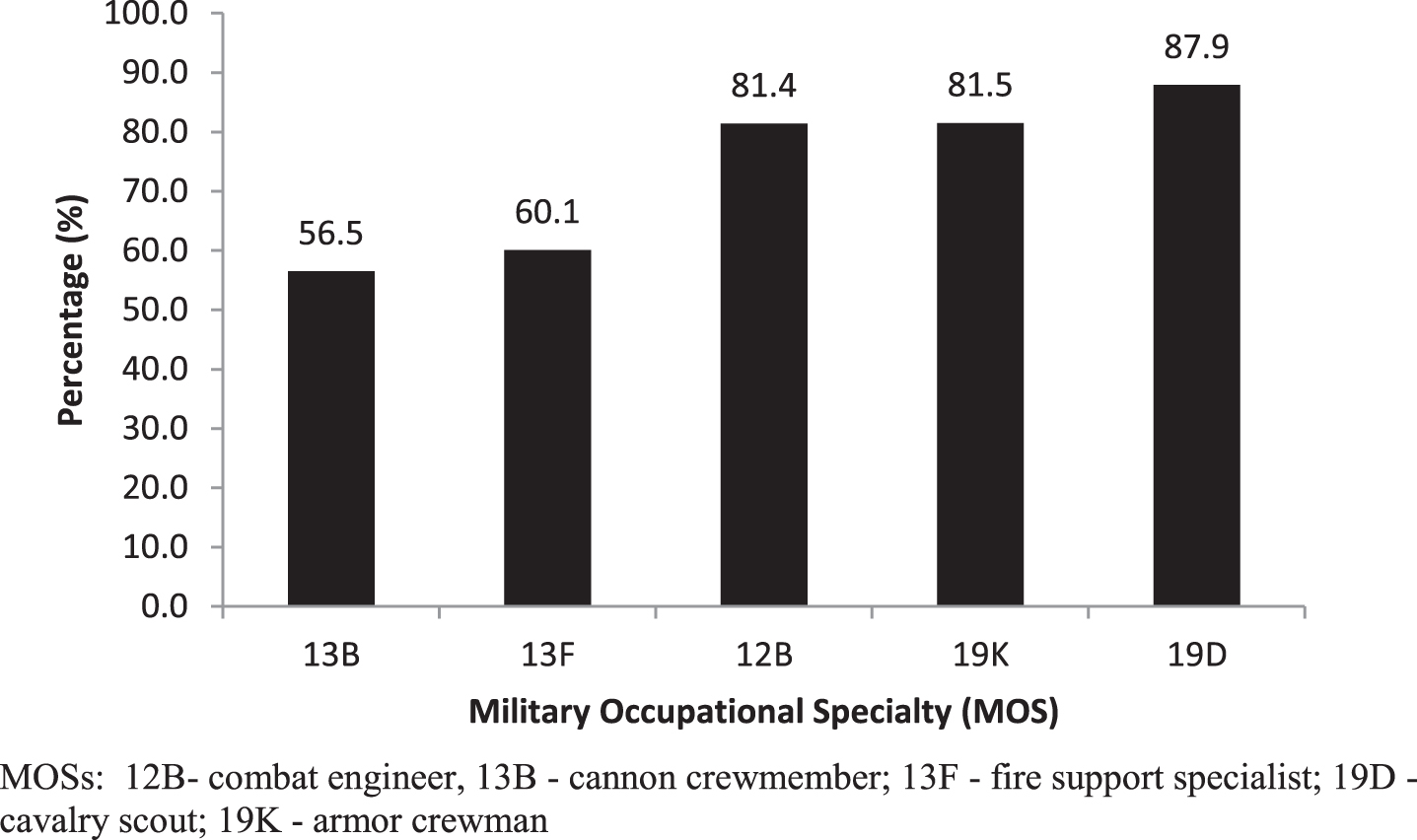
Percentages of soldiers in five military occupational specialties who reported performing eight or more of the 15 critical physically demanding tasks in the last two years.
Table 3 contains 11 CPDTs (foot march to remove a flat) with 60%or more of all Soldier respondents reporting having completed each critical physically demanding task on the job analysis questionnaires in the prior two years. Only 4 CPDTs (load ammunition cans, evacuate a casualty, install a 25mm barrel, and remove a feeder) were completed by 54%or less of the Soldiers.
Percentages of soldiers who reported completing each critical physically demanding task on the job analysis questionnaires, by military occupational specialty
MOSs: 12B: combat engineer; 13B: cannon crewmember; 13F: fire support specialist; 19D: cavalry scout;19K: armor crewman.
Significant frequency differences were found ac-ross the five MOSs in the percentage and means of the 15 CPDTs performed in the prior two years (F [4,1449] = 71.9; p < 0.001). Each MOS statistically differed from the others (p < 0.05) with the exception of the MOSs with the lowest frequency of performance, the 13Bs (i.e., nearly 53%of the 15 CPDTs) and 13Fs (55%tasks). The 19D (i.e., nearly 77%) soldiers performed the largest amount of the 15 CPDTs compared to soldiers in the other four MOSs. Figure 2 provides the rank ordering of the 5 MOSs.
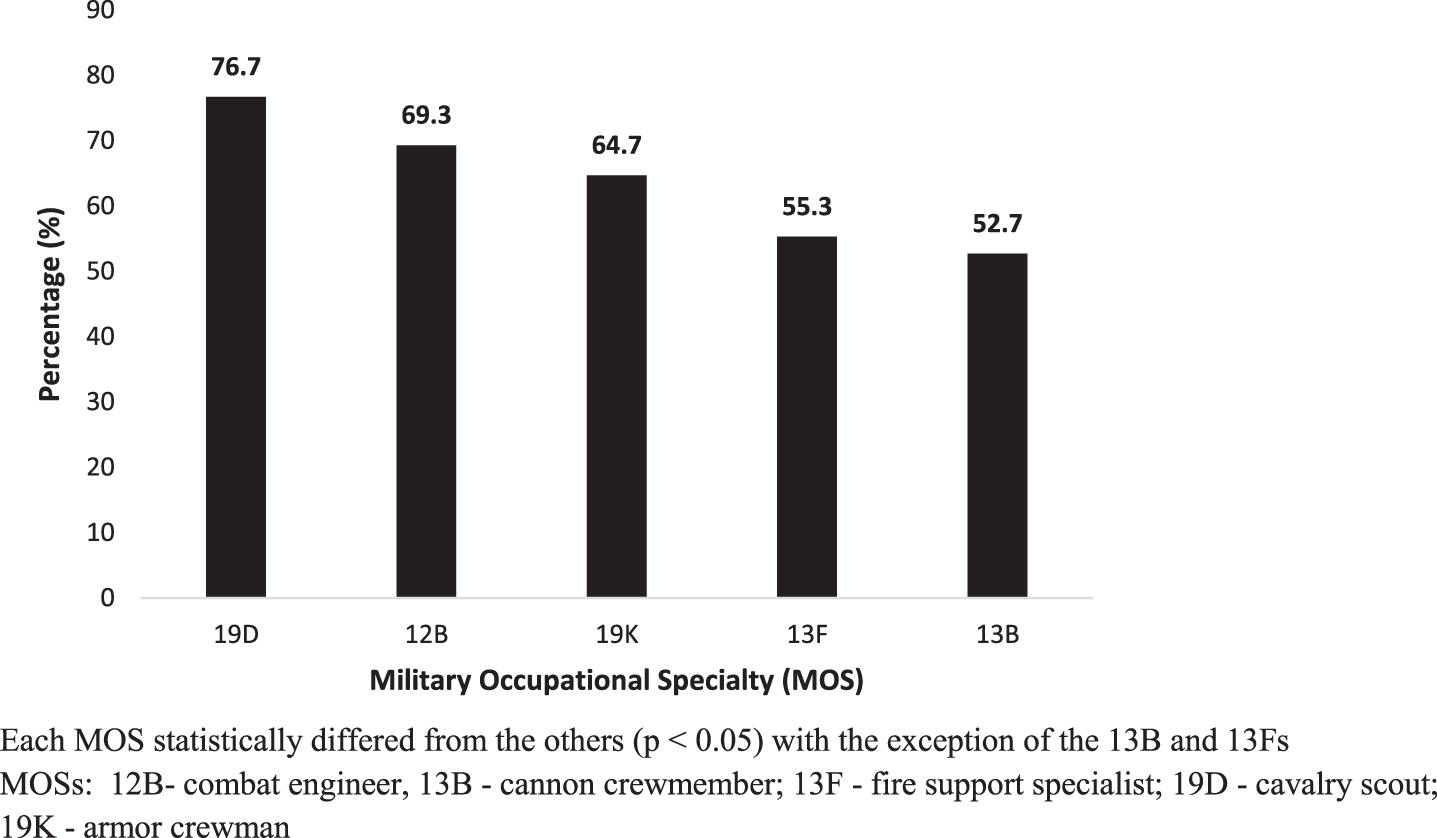
Percentages of the 15 Critical Physically Demanding Tasks (CPDTs) performed in the last two years by military occupational specialty.
Small to substantial (1.9%to 95.3%) percentages of soldiers performed tasks deemed as non-essential (not a primary function or responsibility to their specific MOS/job, but a task belonging to another MOS) to their by the SMEs, at least once in the previous two years while either deployed or in training: 4.7%of 13Bs and 1.9%of 19Ks installed a gun barrel; 44.4%of 13Bs and 13.2%of 19Ks loaded ammunition cans; 31.5%of 13Bs and 64.7%of 19Ks evacuated a casualty; 7.1%of 13Bs and 1.9%of 19Ks removed a feeder; and 95.3%of 13Bs conducted a foot march.
Comparisons of TRADOC- vs. USARIEM-determined sets of critical physically demanding tasks
Results indicated that the nine TRADOC SME-endorsed CPDTs as a whole, compared to the six USARIEM job-analysis identified tasks, were conducted more frequently (means of 2.58 for the SME-endorsed CPDTs and 2.13 for the six USARIEM-identified tasks; mean ranks of 1,685.58 and 1,213.18, respectively; z = 15.21, p < 0.001) and rated as more important (means of 3.72 and 3.40, respectively; t = 9.18; p < 0.001) as conducted during the last 2 years.
Relationships between task importance and performance frequency
Correlations of the reported frequency with which an individual task was performed compared to ratings of the importance of the same task to job success ranged from 0.23 (throwing hand grenades) to 0.42 (removing a feeder) across the 15 tasks (all p’s < 0.001). Thus, these relationships were positive, but were low to low-moderate in strength. These analyses are reported in Table 4. The canonical correlation between task performance frequencies and ratings of task importance across all 15 CPDTs was 0.82 (p < 0.001).
Correlations of task performance frequency reports with ratings of task importance
Correlations of task performance frequency reports with ratings of task importance
aAll p’s < 0.001.
The two-way ANOVA analyses conducted to examine which CPDTs were rated as most frequently performed and most important were both statistically significant (Frequency items: F [14,19513] =345.99; importance items: F [14,16604] = 90.02; both p’s < 0.001; groups specified by Duncan post-hoc tests at the p < 0.05 significance level; Tables 5 6, respectively). The three tasks rated as most frequently performed were conducting a foot march, dragging a casualty, and filling sandbags. The three tasks rated as most important to job success were conducting a foot march, evacuating a casualty, and removing a feeder.
How often each of the 15 Critical Physically Demanding Tasks were reported to be performed by soldiers in the last two yearsa
How often each of the 15 Critical Physically Demanding Tasks were reported to be performed by soldiers in the last two yearsa
aOverall F (14,19513) = 345.99, p < 0.001. bTasks with the same ranking numbers (i.e., the same preceding numbers on the far left) do not statistically differ from each other. cUnits of task performance frequency in this table correspond to the following response format: (1) I have not performed this task; (2) three times or less in the past two years; (3) four to nine times in the past two years; (4) 10 to 19 times in the past two years; (5) 20 or more times in the past two years.
Soldiers’ rated importance of each of the 15 Critical Physically Demanding Tasksa
aOverall F (14,16604) = 90.02, p < 0.001. bTasks with the same ranking numbers (i.e., the same preceding numbers on the far left) do not statistically differ from each other. cUnits of task importance in this table correspond to the following response format: (1) Very little importance to the performance of my MOS; (2) some importance to the performance of my MOS; (3) important to the performance of my MOS; (4) very important to the performance of my MOS; (5) extremely important to the performance of my MOS.
The tasks rated as most important to job success are to some extent also reported as the most frequently performed Tables 5 6. However, installing a 25 mm barrel, evacuating a casualty, and removing a feeder were reported to be more important but less frequently completed. The data also highlighted filling sandbags being reported as less important but more frequently performed.
For each of the 15 CPDTs, differing number of subjects believed they were not expected to perform certain tasks when the situation required. Not expected to perform the task percentages are reported in Table 7. Conversely, at the high end of performance expectations, 96%of subjects believed they were expected to conduct a foot march while at the low end of performance expectations only 55%believed they were expected to remove a feeder.
Percentages of the total sample who believed they were not expected to perform the task when the situation required
Percentages of the total sample who believed they were not expected to perform the task when the situation required
Expectations of task completion were strongly associated with more frequent task performance. Subjects were likely to report performing each of the 15 tasks more often when expected to complete the task if the situation arose (Cramer’s Vs ranged from lower association 0.22 to 0.71; all p’s < 0.001; Table 8). The tasks most likely to be performed more often by soldiers when expected were loading ammo cans (0.71 = large effect), removing a feeder, and installing a 25 mm barrel. The task least likely (0.22 = medium effect) to be expected to be performed was dragging a casualty.
Associations of task completion expectations with task performance frequency reports1,2
Associations of task completion expectations with task performance frequency reports1,2
1All p’s < 0.001. 2For each task, expectations of task completion were associated with reports of more frequent performance.
Expectations of others were not strongly related to ratings of task importance. Only 27%(four of 15) of the CPDTs were rated as more important to job success at the p < 0.05 level of significance when soldiers were also expected to perform the task as appropriate. These four CPDTs were installing a 25 mm barrel, installing a spare tire, throwing a hand grenade, and filling sandbags (Table 9).
Associations of task completion expectations with ratings of task importance1
*p < 0.05. **p < 0.01. 1For each task for which the Cramer’s V coefficient is statistically significant, expectations of task completion were associated with higher ratings of task importance. 2For this task and three others in this table, no coefficient is reported because no subjects reported both a “no” response on the task completion expectations item and a response on the item asking for a rating of task importance.
Of the eight tasks that were rated as more frequently performed, four were also rated as more important than others (Tables 5 6, respectively). These tasks were conducting a foot march, dragging a casualty, loading ammo cans, and connecting a tow bar. Of these four tasks, all tasks except loading ammunition cans were reported as being expected to be performed by more than 80%of respondents. Thus, only conducting a foot march, dragging a casualty, and connecting a tow bar were rated as being more frequently done, more important to job success, and highly likely to be expected to be done when the situation demands.
Discussion
The findings of this job analysis questionnaire have successfully served to validate that the 15 CPDTs represented in this study were selected as highly important to success in the MOSs for most of these incumbent soldiers based on original job performance analysis, focus group input, and judgments of SMEs and researchers (3). More specifically, the nine SME-endorsed CPDTs as a whole were conducted more frequently and rated as more important than the six tasks identified by USARIEM researchers. This study highlights the value of SMEs in the preliminary phases of a project to identify tasks that may aid in the prioritization of future training as well as the use of different methodologies in the establishment of critical tasks.
Approximately 25%of the soldiers reported not having performed eight or more of the 15 CPDTs in the questionnaire within the last two years, and nearly 15%reported not performing 10 or more of the tasks. There may be several reasons for these findings. First, several of the tasks were not considered part of the jobs of soldiers in two of the MOSs included in this study. Second, a majority of the survey participants were staff sergeants or higher and, thus, may have delegated many of these tasks to lower ranking soldiers. Third, the military installations to which these soldiers were assigned in the last two years may not have had some or all of the equipment required to perform the tasks. Fourth, the soldiers’ companies and battalions may have emphasized training on some of these tasks over others. The finding that some soldiers reported not performing several of these tasks over the previous two years should be followed up in further study.
Nearly 75%of the soldiers in this study reported completing at least half of the 15 CPDTs in the questionnaire. 19D soldiers reported performing the highest number of CPDTs, on average, over the two-year time period. This would be expected because of the five MOSs represented here, these CPDTs represent the greatest percentage of the tasks required by the 19D MOS [3, 13]. Soldiers in the four other MOSs perform other MOS-specific physically demanding tasks on a regular basis [13–15]. The 19D and 12B soldiers performed the most CPDTs on average, followed by 19K and then 13F and 13B soldiers.
According to SMEs, 13B and 19K soldiers were not required to perform several of the 15 CPDTs as part of their jobs. However, for each CPDT not considered as required for these soldiers, a small to substantial percentage of 13B and 19K soldiers performed the task. One reason why a soldier may perform a task not generally considered as part of his or her job is that leadership may consider the task essential in a deployed or other high demanding setting and, thus, press the soldier into service. Another reason may be that soldiers in other MOSs may require the soldier’s help when they need to complete a task. It is quite possible that 13B and 19K soldiers often find it necessary to perform tasks in deployed settings that are not normally part of their jobs. A recent research article reported that 13B and 19K soldiers spend 18%and 30%more of their time, respectively, performing CPDTs in deployed settings than they spend performing these types of tasks in training settings [11]. The finding that 13B and 19K soldiers are performing tasks that are not considered as part of their jobs by SMEs is likely to be important and may serve as an incentive to examine and perhaps modify the frequency with which the tasks of these MOSs are trained and performed. It is conceivable that when soldiers perform unfamiliar tasks that they have not recently, or ever been trained to execute, there may be an increased likelihood that errors will be made and injuries can occur. Further, the consequences of these errors and injuries may likely to be greater in deployed settings where soldiers are put in harm’s way during actual battle conditions, with lives in the balance, rather than stateside under simulated training conditions. Future research into the relationship between military task-specific training and performance frequency along with associated (non) combat related injuries seems warranted.
Reported frequencies of task performance were found to be moderately related to ratings of task importance. Although a moderate degree of relationship between these two constructs might be expected, it is apparent that some tasks (e.g., filling sandbags) may frequently be performed but not considered to be important by job incumbents. Conversely, other tasks (e.g., evacuating a casualty) would likely be considered highly important by most incumbents yet not often performed. These two types of tasks would serve to mitigate against higher relationships between performance frequencies and rated importance. Further, whereas some tasks might be considered very important and worthy of high performance frequency to improve proficiency, several factors such as lack of equipment and leadership training priorities may serve to minimize the frequency of task performance. Taken together, the correlation between reported task performance frequencies and ratings of task importance was strong (i.e., a canonical r of 0.82). Davis et al. [16] also found a strong canonical correlation between performance frequencies and importance using ratings of 20 physically demanding tasks (r = 0.69, p < 0.001) from Special Weapons and Tactics team officers.
A number of tasks were indicated as being more important but less frequently performed or more frequently performed and less important. It could be beneficial to develop training programs that place additional emphasis on tasks that are more important than others to success in an MOS, while still training to meet performance standards for all required tasks. This is critical if more important tasks have a high probability for immediately saving lives when they are performed (e.g., dragging a casualty to safety, evacuating a casualty). Thus, perhaps tasks identified as highly important to success can be trained more often, whereas others borne out as less important could be deemphasized while ensuring that standards are met. The apparent incongruities noted in this research may be helpful in restructuring MOS training to ensure all tasks receive adequate but not undue training emphasis.
For each CPDT, there was a small to substantial percentage of soldiers who did not believe they were expected to perform the task when needed. Perhaps for some of these soldiers, it is reasonable to believe that one or more of the CPDTs are not part of their jobs. For example, it was quite reasonable in this study for 13B and 19K soldiers to consider several CPDTs as not part of their jobs since SMEs did not consider them as such. However, the belief held by many soldiers that they were not expected to complete certain specific tasks when the situation arose may well reflect on the training they received.
Expectations of task completion were found to be strongly associated (Cramer’s Vs ranged 0.22 to 0.71; all p’s < 0.001) with the likelihood that soldiers performed the tasks represented in this study. All the CPDTs on the questionnaires were more likely to be performed by soldiers when they knew they were expected to perform the task when the situation arises. Expectations of task completion were not, however, found to be strongly associated with ratings of task importance. Only 27%(four of 15 at p < 0.05) of the CPDTs were rated as more important to job success by incumbents when soldiers were also expected to perform the task as appropriate. It would appear that frequency of execution weighed more heavily than importance rating as to whether soldiers were expected to perform these CPDTs. If this is not the desired intention then perhaps the program of instruction and training should conduct the highly rated important tasks more frequently and spend less time on the less importantly rated tasks.
In an attempt to develop a recommendation concerning the most critical of the 15 CPDTs represented in this study, we examined which of these tasks were rated as more frequently performed, more important to job success, and most likely to be expected to be done when demanded by the situation. Three tasks were identified: conducting a foot march, dragging a casualty to safety, and connecting a tow bar. Thus, based on the results of this study, these three tasks are the most critical of the 15 CPDTs identified by USARIEM scientists and TRADOC SMEs. The specification of three CPDTs is consistent with the processes undertaken by Australia, the United Kingdom, and Canada to identify a small number of tasks that are essential and commonly performed [4–10]. Of these three CPDTs, two were identified as highly important to job success both by SMEs at TRADOC and the scientific process conducted by USARIEM researchers; the third was identified as such only by the USARIEM research process.
The questionnaires and methodology used for this study were designed with several strengths. First, the questionnaires were designed using best practices for survey development [17], including the writing and scaling of items based on the combined experience of 20 SMEs and observations of job performance conducted by several research scientists. Many item response sets were quantified as appropriate by SMEs, and supplemental items in the form of open-ended text box questions were used to gather qualitative information concerning many of the tasks. Second, the entire population of Army soldiers in each of the five targeted MOSs was provided the opportunity to respond to the surveys, rather than only a sample of these soldiers. Third, questionnaires were administered by computer to maximize sample size, ease of use, and ease of data compilation and transfer.
Limitations of this study must also be addressed. First, the response rate was low (i.e., 5.9%). Thus, there is a possibility that some results are not reflective of the five MOS populations as a whole. Further, those conducting this research had no way to compare respondents to non-respondents. Second, a large percentage of items on the questionnaires were of necessity written generically to ensure comparability of responses from soldiers in many Army MOSs. This may have affected the quality of some item responses. This survey was limited to male Soldiers as these jobs were only open to males at the time of this survey. Finally, this survey was web-administered, and thus participants had limited opportunity to seek feedback about question intent. This may have affected the appropriateness of some item responses. The expectations items used in the questionnaires did not specify to the respondent whose expectations were being addressed. These expectations could be held by supervisors, peers, subordinates, members of high command, or some combination of these parties.
Conclusion
The findings of this questionnaire have successfully served to validate that a job analysis based on judgments of SMEs and researchers is vital in identifying important, frequently performed, and expected to perform tasks of jobs that may aid in the prioritization of future soldier critical task training. These findings have significant implications for both military and civilian jobs (e.g., law enforcement, firefighting) where physical labor (i.e., lifting, climbing, running, bending, digging, and operating tools) is conducted in dangerous settings (e.g., battles, fire scenes), and in which a single error, or failure to meet a task objective, can result in an injury or fatality to oneself or others. It must be ensured that training provided in these occupations is sufficient for employees to acquire the physical conditioning and requisite skill needed to perform these jobs well. Perhaps tasks identified as highly important to success should be trained more often, whereas others classified as less important could be deemphasized while ensuring that standards are met. The apparent incongruities noted in this research may be helpful in restructuring MOS training to ensure all tasks receive adequate but not undue training emphasis. The information provided here can be used to help physically prepare combat arms soldiers to perform optimally.
Footnotes
Acknowledgments
The authors would like to thank Dr. Deborah Gephardt, Dr. Todd Baker and HumRRO, Inc. for their help in survey preparation, and Dr. Jennifer Jebo for her assistance in distributing the job analysis questionnaires and compiling the data base. The authors would also like to thank the many Army and civilian leaders who assisted in administering this survey and completing all other aspects of the performance standards study being conducted with the U.S. Army Training and Doctrine Command.
Conflict of interest
None to report.
Declarations
The opinions or assertions contained herein are the private views of the authors and are not to be construed as official or as reflecting the views of the Army or the Department of Defense.
The investigators have adhered to the policies for protection of human subjects as prescribed in Army Regulation 70–25, and the research was conducted in adherence with the provisions of 32 CFR Part 219.
Funding
This research was supported in part by appointments to the Postgraduate Research Participation Program at the U.S. Army Research Institute of Environmental Medicine administered by the Oak Ridge Institute for Science and Education.