



Abstract
BACKGROUND:
Radiologists need to learn more about the management of their emotions and their impact on individual well-being as well as proper communication within the radiology realm.
OBJECTIVE:
This cross-sectional study was conducted to assess the relationship between joining social events organized by the radiology department of Al-Ahrar Teaching Hospital and the emotional intelligence of radiologists.
METHODS:
A questionnaire-based survey was conducted on 82 radiologists at the Radiology Department of Al-Ahrar Teaching Hospital, Sharkia Governorate, Egypt. This was preceded by a pilot study among radiologists, and modification of the questionnaire items to be more precise. The questionnaire consisted of three sections: it assessed sociodemographic, personnel, and workplace characteristics of the participants; social events’ related factors, and emotional intelligence of radiologists.
RESULTS:
52.4% of radiologists had moderate emotional intelligence scores, and 24.4% had high emotional intelligence scores. High emotional intelligence scores were significantly associated and positively correlated with the increased participants’ years of work experience and frequency of attending social events, and the overall impression of the events. The radiologists’ overall impression of the social events was the only significant independent predictor of a high emotional intelligence score.
CONCLUSION:
The majority of the participants in this study had moderate to high emotional intelligence scores. The social events that were organized by the radiology department succeeded in crossing-over the gaps in communication and workflow knowledge that take place due to significant personnel turnover and should be considered for improving team preparedness and communication in similar workplaces.
Introduction
Emotional intelligence (EI) is defined as the ability to apprehend one’s own and others’ feelings, to influence oneself, and to efficiently handle one’s emotions to get the greatest results for relationships [1]. The concept of EI was first introduced 30 years ago. There has been a growing recognition of its importance to individual performance in academic and corporate settings [2].
EI impacts how individuals perceive situations both professionally and personally [3]. It is also an influential factor in shaping individuals’ attitudes and behaviours. Ghasemi et al., concluded that emotional intelligence influences safe behaviors in the workplace [4]. The importance of emotional intelligence in the workplace environment in clinical departments has been explored by several researchers [3, 5], and although the radiology profession demands interpersonal social skills, creation of integrated networks and interaction with referrers, not to mention patients and families, the development of such skills is relatively hindered in the radiology profession, as radiologists spend years building a broad knowledge foundation to competently interpret complicated imaging results. On the other hand, they are requested to devote a significant portion of their time to sharing their broad clinical knowledge with others [2].
The importance of communication and teamwork in improving patient safety was explored by Lane Donnelly et al. [6], who designed a project to address the role of positive effects of group dynamics by incorporating activities (such as radiology leadership rounds, error reduction training, and communication lessons-learned programs) in building trust in teamwork, and after 2 years of follow up, they concluded that safety performance assessed in mean days between significant safety occurrences improved from a baseline of one significant safety event every 200 days to one significant safety event every 839 days, which is considered statistically significant, leading to successful improvement of the safety culture and overall radiology department performance.
The same applies to team huddles and positive team communication. Team huddles are progressively recognized as a way to promote communication and cooperation between and within teams, in addition to improving quality and workflow. Sharing lunch or delivering tiny symbols of reassurance at work (e.g., recognizing holidays and staff birthdays and awarding certificates, prizes, and gift cards to employees who meet certain criteria) are examples of specific techniques. Radiologists can interact directly with referring physicians during inter-departmental rounds or conferences. Providing occasions for radiologists to interact outside of the workplace should also be encouraged [7]. Positive team communication enhances team preparedness, according to Woodard et al. [8], with statistically significant improvements in technician scheduling, identification of residents and medical students on rotation, and section equipment difficulties. This has resulted in a gradual improvement in daily workflow planning. Costa et al., recommended a pre-employment assessment for emotional intelligence to prevent future human-related accidents [5].
The need and importance of implementing emotional education practices have been published earlier [9]. The majority of research on EI and its implementation in graduate medical training focuses on surgical specialties. This evidence forces us to consider that EI training should be incorporated into post-graduate radiology education programs is equally important [10]. Emerging research demonstrates a beneficial association between one’s ability to control one’s emotions and the effect on one’s social contacts in the field of radiography, where communication and sociability are at the forefront of interpersonal relationships between practitioners and patients [11]. As a result, EI characteristics are likely to influence human relationships in the health workplace, such as the relationship between patients and radiographers and among radiography employees. Mackay et al. supply international radiography students with benchmarking data. They found significant variations in EI ratings between qualified practicing radiographers and students. Their findings pave the way for further research on the impact of academic and clinical practicum as a determinant in the development of EI skills [12]. To the best of our knowledge, there is a lack of studies that evaluate the incorporation of EI training into such programs.
To fill such a knowledge gap, this study was conducted to assess the relationship between joining social events organized by the radiology department of Al-Ahrar Teaching Hospital and the emotional intelligence of radiologists at the workplace.
Materials and methods
Study design and setting
A questionnaire-based survey was executed at the Radiology Department of Al-Ahrar Teaching Hospital, Sharkia Governorate, Egypt for three months (September-November 2021). The study was conducted according to the international guidelines of Strengthening the Reporting for Observational Studies in Epidemiology (STROBE).
Study population and sampling
A sample of 82 radiologists was drawn based on the total population of 101 radiologists who were working at Al-Ahrar Teaching Hospital from 2009 to 2019, population proportion is 50%, at a confidence level of 95%. The sample was calculated using the online calculator [13].
A purposive sampling technique was used to recruit participants who fulfilled inclusion criteria. The participants were Egyptian radiologists who worked at Al-Ahrar Teaching Hospital and had attended at least three of the social events that were organized by the radiology department per year between 2009 and 2019.
Evaluated social events
The evaluated social events were those organized on a regular basis since 2009 by the radiology department at Al-Ahrar Teaching Hospital, but unfortunately, they were discontinued due to the COVID-19 pandemic in 2020. They included mainly “Iftar Ramadan” that was held on an annual basis during the holy month of Ramadan, besides other social events held on the sidelines of the scientific events (e.g. biannual conferences, quarterly educational courses), other social team huddles (e.g. birthdays, weddings, condolences), and finally, charity activities held by the members of the radiology department.
The attendance list included all radiologists (current and former) who worked in the department. Their families and close friends were welcome to participate whenever possible. Most of the events were open-air and self-served gatherings, where radiologists were allowed and encouraged to volunteer in organizing the event and preparing the venue. There was no compulsion to attend, and no charges to pay, apart from the fees allotted by other authorities.
Data collection tool
After a review of the literature [14], a structured questionnaire was designed by the researchers. The research tool content validity was assessed by 6 experts in the field, and the scale validity index/average S-CVI/Ave was 1 and the content validity ratio (CVR) was 0.99. Reliability of the questionnaire was tested using Cronbach’s alpha, which was 0.95, which is considered to be good. The questionnaire was then updated based on their feedback and suggestions. A pilot study was performed before data collection. Twelve radiologists were asked to answer the questionnaire for checking the applicability and clarity of the questionnaires, and these radiologists were not included in the study group.
The questionnaire was designed to take less than ten minutes to fill out. It was divided into three sections: The first section is for data about sociodemographic, personnel, and workplace characteristics of the participants. The second section included questions about social events’ related factors, including frequency of attendance, volunteering to organize the event, memory about personal sharing in the event, and a general impression of the social events. The third section included questions assessing the emotional intelligence of attending radiologists that were based on Daniel Goldman’s four-factor taxonomy [14,15, 14,15]. According to Goldman, this section assesses four components, which are self-awareness, self-management, social awareness (empathy), and relationship management. It consisted of 25 questions distributed among the 4 components as follow: Seven questions for self-awareness including [Do you think social events’ gatherings encouraged you to: identify your emotions in a better way (being happy or upset), identify your strengths and limits, self-control when you get upset, feel trustworthy after social gatherings with colleagues, improve your ability to be responsible for your performance, and enrich my ability to adapt to others’ needs?] six questions for self-management including [Do you think social events’ gatherings motivate you to: be more creative and innovative, achieve a standard of excellence in your work, be more aligned with the group goals, be more initiative, look at the brighter side of life despite obstacles and setbacks, and be aware of others’ feelings?] seven questions for social awareness (empathy) including [Do you think social events’ gatherings triggered you to: gain experience in developing others by sensing their needs and highlighting their abilities, predict, recognize and meet your patients’ and trainee needs, enhance dealing with different characters in the workplace, improve your understanding of the work team and benefit from relations’ network, improve your tactics for effective influence, improve your ability to communicate effectively with others, and improve my negotiation skills to resolve conflicts?] and 5 questions for relationship management including [Do you think social events’ gatherings influenced you to: improve your leadership skills (e.g. communication, motivation, positivity, creativity), be more capable in handling and managing changes in the workplace and your life, increase your relationships within the workplace, be more cooperative with your colleagues, and work in a team?]. Answers of the third section were presented on a 5-point Likert scale, with participants responses specified in five points: strongly agree, disagree, neither agree nor disagree, agree, or strongly disagree with an overall score of 125. The assessment gives a score for each of the components and an overall emotional intelligence score. The score was interpreted as low, moderate, or high by cut-off points that were taken at Quartile 1 (Q1) and Quartile 3 (Q3) of the data for each component as well as the overall score.
Data collection process
Participants who fulfilled the inclusion criteria were enlisted and invited to participate in a self-administered online questionnaire using Google forms. Invitations to participate in the study were distributed to respondents via social media platforms, including Facebook and WhatsApp. The questionnaire was designed to be completed in less than ten minutes, and if the participants did not meet the inclusion criteria, they were automatically excluded.
Data management
The statistical package for social sciences (SPSS) version 24 [16] was used to analyse and present the collected data. Descriptive statistics were used, such as numbers and percentages for qualitative variables and medians and quartile ranges for quantitative variables. Cut-off points were taken at the median to divide the data of some independent variables (age, years of work experience, relationship with colleagues, frequency of attendance, and impression of the social events) into two groups. Analysis of data was done using several statistical tests as the association between socio-demographic, personal, workplace, and social events-related factors and the radiologists’ emotional intelligence was assessed using Pearson chi-square. The Spearman’s correlation coefficient (r) was used to test the correlation between different factors and the overall score of emotional intelligence. Multinomial logistic regression analysis was calculated to determine the independent predictors of high emotional intelligence. A significant relation was considered at a P-value≤0.05, and at a P-value≤ 0.01 was a highly significant relation.
Results
The total number of radiologists who participated in the current study was 82. The majority were in the age group 20–40 years (86.6%), and females constituted 62.2 % of the sample. Only 6.1% had a MD. More than half of the sample (56.1%) worked at Al-Ahrar Teaching Hospital for less than 5 years, and the same percentage were not current employees. 75.6% of participants showed a good relationship with their colleagues (Table 1).
Sociodemographic, personal, and workplace characteristics of the study sample
Sociodemographic, personal, and workplace characteristics of the study sample
37.8% of all participants were frequent attendees of the social events. Among those who left Al-Ahrar Teaching Hospital, more than half (56.5%) continued to attend the events. Only 24.4% of the study group volunteered to help plan and organize social events. Among all participants, 39% accompanied their relatives or friends to the events, and about half of them (47.6%) recalled their colleagues as the first people to remember at the event. 64.6% of radiologists showed a good overall impression of the social events (Table 2).
Social events related factors of the study sample
Figure 1 showed that 48.8%, 43.9%, 42.7%, and 42.7% of participants had moderate scores of self-awareness, self-management, social awareness, and relationship management components, respectively, while 25.6%, 26.8%, 28.0%, and 31.7% had high scores of them, respectively. Regarding the overall emotional intelligence score, more than half of the participants (52.4%) had moderate emotional intelligence scores, and 24.4% had high emotional intelligence scores.
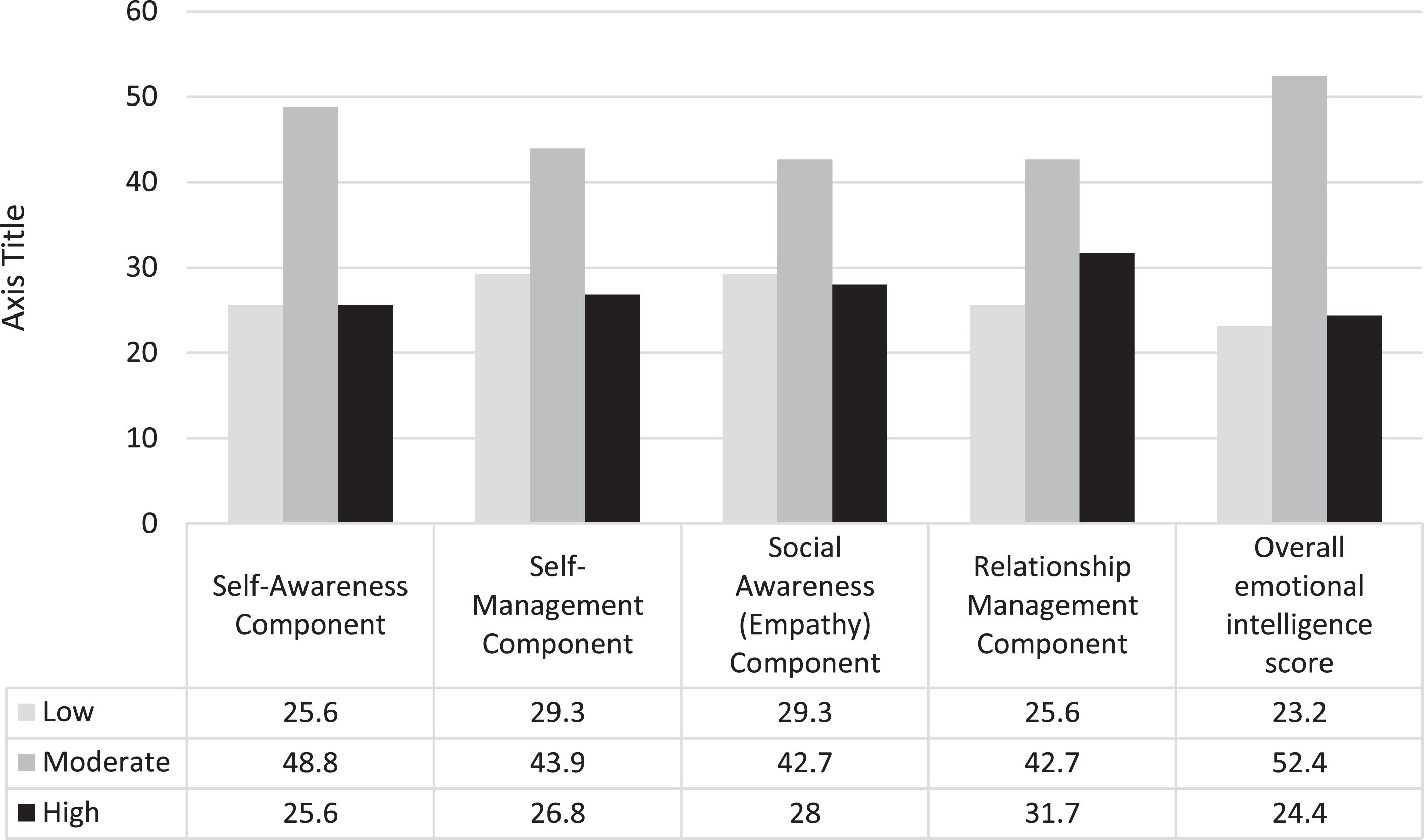
Emotional intelligence components among the study sample.
Table 3 showed that there was a significant association between high emotional intelligence scores and increased participants’ ages, years of work experience, and frequency of attending social events. There was a highly significant association between the high emotional intelligence scores and the participants’ overall impression of the events.
Association between the studied factors and emotional intelligence score
The correlation coefficient revealed a positive and significant correlation between the high emotional intelligence score and the participants’ overall impression of the social events and a positive and significant correlation with both years of work experience, and frequency of attending the social events (Table 4).
Correlation between the studied factors and emotional intelligence score
r* = Spearman’s correlation coefficient.
Multinomial logistic regression analysis revealed that the participants’ overall impression of the social events was the only significant independent predictor of a high emotional intelligence score, while other factors were not considered significant independent variables affecting the emotional intelligence score (Table 5).
Multinomial logistic regression analysis of predictor factors on emotional intelligence of the study sample
In the imaging work environment, achieving a state of wellbeing is a multistep process that requires the participation of radiology team members at all levels. Leadership and individual radiologists must be equally engaged and committed to the process in order to achieve the intended goals. With the blurring of the lines between our professional and personal lives [17], there has been a trend away from the concept of work-life balance and toward work-life integration and harmony, with the awareness that a full separation is unlikely in our digitally connected world [18]. This concept was adopted by our radiology department leaders. We planned to overcome the observed gaps in communication, workflow knowledge, and emotional intelligence between team members by holding periodic social gatherings. Similarly, Fishman et al. suggested that social activities can strengthen the radiology workplace community, foster a peaceful and integrated work life, and ease the transition of new radiologists into the practice [19]. We hereby described the characteristics of the periodic social events organized by our radiology department and investigated its relation with the EI of radiologists.
When we planned for such events, one of our main goals was to encourage all team members to participate, taking into consideration the conservative environment and cultural background of many members. Our results reflected adequate encouragement of both recently graduated and older professional radiologists to attend different events. More than 50% of attendees were females, and newcomers to the department constituted about 56%, which enabled better integration of both parties into the team. With a similar target, Gerard et al. [3] designed radiology team huddles; where the whole team was invited to attend, and there was an opportunity for introducing new faces (e.g. residents, rotating or visiting learners, and new hires) and identifying issues that may impact workflow. Another important finding is that the social events organized by our radiology department succeeded in bridging cross-over gaps in communication and workflow knowledge that take place due to significant personnel turnover and should be considered for improving team preparedness and communication in similar workplaces. This was evident in the many colleagues who attended such events even after leaving work at our department.
Social relationships with peers were a highly valued working quality for our radiology team. We believe that solid social bonds can have a major impact at work. They boost employee morale and work engagement and decrease turnover. Friends are more willing to share knowledge, offer assistance, and serve as mentors to one another. They provide encouragement and praise, which can help to reduce stress and dissatisfaction with work [20, 21]. The current research revealed that 75.6% of participants declared good relationships with their colleagues. Moreover, less than half of the sample invited their family members to share the events. This reflects a sense of relief with co-workers.
Given that EI is the handling of emotional information for better communication [22] interpersonal skills, and profound influence on the professional success of individuals, including physicians [12], we reported factors affecting the EI of the study participants. The results of this study indicated that older radiologists had higher EI. According to earlier studies, those who are older are more likely to have a positive attitude, less neuroticism, and better emotional regulation. They also become more conscious of life’s fragility and complexities, allowing them to better manage their emotion [23]. Years of job experience are treated similarly. Given mounting evidence that EI has a significant impact on people’s professional achievement, particularly physicians [24], our findings could be used as a starting point for providing more support to younger radiologists in order to improve their leadership and work performance.
When adequate emotional awareness and emotional management are present, conflicts can be mitigated by maintaining acceptable team relationships [14]. Reflecting this concept on our team, high emotional intelligence scores were significantly associated with frequency of attendance as well as an overall good impression of the social events. This could be explained by the fact of empowering one’s emotional intelligence through the regular meeting of team members at social events where they are confronted by multiple situations that teach them how to handle their and others’ emotions, besides improving their social communication with co-workers. This match interpretation of Gasemi et al. [4] for EI and its impact on how employees interpret events professionally as well as personally, and also has a significant influence on people’s performance and behavioral patterns.
It’s worth noting that, while older radiologists had higher EI, years of experience were not proven to be a predictor of EI in this study. Stami et al. appeared to have reported similar results [25]. This finding contradicts previous research that demonstrated a favorable relationship between years of experience and EI [26]. Stami et al. offered a possible reason for this dissonance for radiation departments that is also applicable to radiology departments, as both are constantly evolving due to the introduction of new techniques and technologies [25]. As a result of this evolution, practitioners must stay current with the learning and development that comes with all of these changes. This development contributes to the workplace’s constant pressures, high patient loads, and increased work expectations. These demands and conditions make the gains and advantages of years of experience, such as improved EI, negated.
The major strength of this study was that it included a heterogeneous group of radiologists who worked in different healthcare settings across Egypt. In addition, the study was conducted in a rigorous manner using validated instruments. All the population sample responded to the questionnaire, which is also a strength of the study and makes the findings both meaningful and generalizable.
Conclusion
Radiology is an emotionally demanding profession and focuses mainly on practical skills. This study has provided new and valuable insights about the role of social activities in improving EI among radiologists. EI was significantly associated with older age, increased years of work experience, the frequency of attending the social events, and the overall impression of the events. The latter is the only predictor of a high EI score. It would be interesting to replicate this study in other medical specialties that are emotionally demanding. Further studies are needed to investigate the impact of attending social events held by the workplace on the emotional intelligence of radiologists.
Despite the evidence, some limitations inherent in undertaking such a study need to be acknowledged. First, this study used a self-selected sample, which may have been highly motivated. The use of an online survey might have impacted the study’s generalizability. Recall bias is another limiting factor. Although the results are only applicable to this context and may differ among other populations, they highlight an important factor that could affect the emotional intelligence at the workplace, which is a good quality periodically held social event. We believe that our experience of integrating periodic social events into the working environment turned out to be a cornerstone for creating a community of practice for radiologists in Egypt by ensuring continuous social and academic communication. Another notable limitation was the retrospective filling of the questionnaire after years from the time of the events, not on an annual basis. Thus, it did not highlight the immediate impact on the participants. However, the frequency of attendance that we used in this study may reflect the cumulative effect of attendance.
Ethical approval
Approval from the Institutional Review Board of the School of Medicine, Zagazig University was obtained before data collection (No. 8000-17-8-2021).
Informed consent
Informed written consent was collected from the study participants. The purpose of the study was clearly stated at the beginning and both anonymity and confidentiality of data were preserved.
Conflict of interest
The authors declare that they have no conflict of interest.
Footnotes
Acknowledgments
The authors appreciate the assistance of all radiologists who spent their time filling out the questionnaire.
Funding
The authors declare that no funding was received for this study.